UPDATE: After an extraordinary series of machinations among the Tory Party's leadership, Theresa May, who was Home Secretary in David Cameron's second cabinet, has emerged as the new Prime Minister of the United Kingdom. She is the second woman PM in British history, and faces the difficult task of unwinding the country from the European Union, even though she publicly, if quietly, supported the Remain camp.
She won the post after Tory Secretary of State for Justice Michael Gove appeared to turn against his Leave ally, Boris Johnson, challenging him for the vote. That knocked Johnson out, leaving May, Gove, and Andrea Leadsom, another Eurosceptic Tory who was further to the right than either of her two opponents. She made heteronormative comments about motherhood that were considered insensitive to May, and also is alleged to have inflated her record, so she removed herself from the race, leaving May as the sole candidate.
May has begun to clear out Cameron's cabinet, in the process making bizarre moves that include appointing the known racist and xenophobe Boris Johnson as Foreign Secretary. Also out has been one of the UK's major champions of austerity, George Osborne, who has stepped down after a six-year run as the Chancellor of the Exchequer.
Both the Labour and Liberal Democratic Parties have called for a general election soon, to certify May's position as head of Parliament. Neither opposition party looks ready to offer an alternative to the Brexit vote, nor does either one have an answer for Scotland's push to become independent, so in addition to leaving the EU, the likelihood of a shrunken UK seems increasingly likely.
ALSO: I corrected the typos in the post below!
.
***
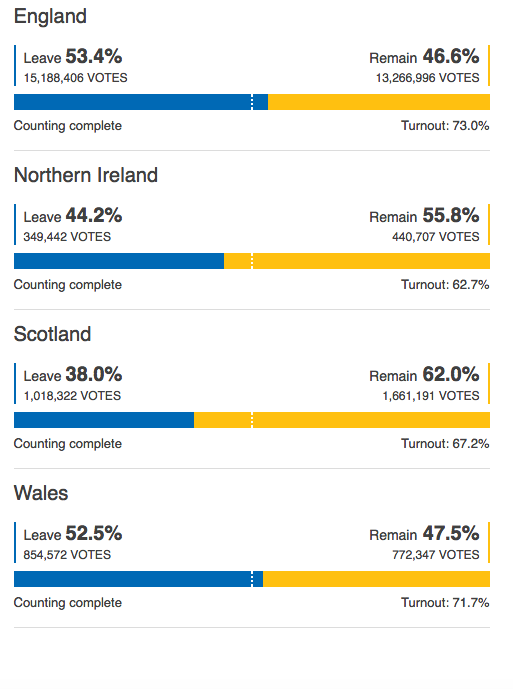
Heckuva job! Yesterday the British people faced a major vote on their future, and chose by a 52% to 48% margin to have the United Kingdom leave the European Union. The "Leave" vote dominated in most of England outside the major cities, particularly the capital, London, and in Wales, achieving a goal that UK Eurosceptics had pressed for since Britain joined the EU in 1973. On the other hand, Scotland, which nearly two years ago voted to remain part of Great Britain, voted overwhelmingly to remain part of the EU, as did the heavily Roman Catholic western counties of Northern Ireland. Only months ago, polls showed the "Remain" position in the lead, but last night's vote was decisive, with a 72% turnout and 17,410,742 votes in favor of withdrawing vs. 16,141,241 against. (Strangely enough, the UK's leave vote total was almost identical to its 1975 vote, at 17.3 million, to stay in the EU.)
The vote spells the end of David Cameron's six-year tenure as Prime Minister and head of the Conservative Party, since he had called the national referendum partially to decisively quell an intraparty struggle between the Conservatives' dominant, elite neoliberal faction and its vocally Eurosceptic, far-right flank, and to consolidate his power as PM after having been reelected just 13 months ago with an increased Parliamentary majority. Now he's out of a job, and his party is in disarray. The successful leave vote also may endanger the position of main opposition Labour Party leader Jeremy Corbyn, who unenthusiastically supported staying in the EU, which was also the stance of the Liberal Democratic Party, led by Tim Faron.
The main political beneficiaries of the vote appear to be former London mayor Boris Johnson, a controversial MP, known racist and xenophobe, and longtime rival of Cameron's, as well as the United Kingdom Independence Party (UKIP), led by Nigel Farage, who lost his UK parliamentary seat but ironically currently holds one in the European Parliament in Brussels. Tussles over the UK's EU membership had created problems for Cameron's two Tory predecessors, Margaret Thatcher and John Major, and have now brought Cameron down as well. He has announced he will resign once the Conservatives have chosen a new leader, by this coming October. Corbyn's battle to retain his post will like ensue as well; he already has faced stiff challenges from the neoliberal wing of the Labour Party over his strongly Leftist positions and statements.
The "Little England" voters, particularly hit hard by globalization, the global financial crisis, and just as importantly, Conservative austerity under Cameron and his Treasurer and Chancellor of the Exchequer, George Osborne, chose the path emphasized by UKIP, which was to blame immigrants and decry directives from and treaty obligations to Brussels. Many issues, such as the EU's mishandling of the economic downturns in members states like Greece, Spain and Portugal; its central policy ensuring the free flow of EU member state citizens to wealthier countries like Germany and Britain; and its inability to provide a viable program to address the continent's influx of refugees and immigrants from outside the EU all combined to produce a potent brew that "Leave" voters swallowed wholesale. Despite the EU's stumbles, younger voters on the whole supported staying in, while voters above 50 supported the "Vote Leave" position, and ethnic, racial and religious minority voters unsurprisingly supported continued EU membership, while a sizable Britain's still overwhelmingly white electorate did not. This "populist" nationalism, which has clear parallels with Donald Trump's success in the GOP primaries, bodes ill for the stability of the UK as we know it. Queen Anne and her Stuart predecessors might not be the last British monarchs to hold a personal, rather than governmental, reign over the UK's constituent parts.
As predicted, the markets reacted with shock, with non-US exchanges suffering huge losses and the Dow plummeting 600 points. The leaders of the "Vote Leave" have already begun to backtrack somewhat on their claims about the financial benefits of Britain's independence, but they also face a more shocking scenario in that the UK itself could splinter, with Scotland once again holding a referendum to become an independent country, and, contrary to decades of tension, Northern Ireland, or at least parts of it, merging with the Republic of Ireland, an EU member state, to the South. While full Scottish devolution would probably mostly entail major administrative and bureaucratic challenges, any sharp changes in the sovereign status of Northern Ireland could reignite sectarian violence of the kind that marked the country for decades. Britain's vote could also spur a push by Eurosceptic and ultraconservative parties in other member states, like France and the Netherlands, to quit the Union. Whether Scotland can block the referendum's results is unclear. Also, calls for a new referendum have gained 2 million votes so far, and it's also unclear whether a popular referendum can override the will of Britain's elected Parliament. Unlike the the US, the UK has no written constitution (time for one!), and lawyers, legislators and historians will have to hit the books to figure out whether the referendum is binding or not. (Imagine if it turns out that it isn't!)
The risks to Britain's economy and society are real. It has benefited from maintaining its own currency, which fell by 11% the day after the BREXIT vote, but its links to and avoidance of trade barriers non-EU states and across the globe face have helped its economy tremendously over the last 40 years. EU membership has also helped London become one of the world's global financial capitals; as an EU state with less regulation and a strong national currency, it has become a major spot to park money and speculate, all of which could change if the EU assumes a harsh stance on trade policy.
Withdrawal from the EU may also exacerbate xenophobic and racist elements in the UK, particularly given the putative leaders of the Conservatives and UKIP; neither Johnson nor Farage has hesitated to use overtly racist rhetoric and discourse to further their aims. Once Cameron's successor takes over, she, he or they will have a set timetable to follow, with roughly two full years expiring as the UK unwinds itself from Brussels' embrace, and renegotiates all manner of relationships with the EU's constituent states.
At the same time, the European Union must figure out a way to resolve its internal economic and social problems lest it too begin to splinter. The euro--and Eurozone--remains a major issue. Britain had avoided the euro debacle of the last few years, but it now enters very dangerous territory. How it and the EU's leaders respond in the near and long term will determine its fate.
She won the post after Tory Secretary of State for Justice Michael Gove appeared to turn against his Leave ally, Boris Johnson, challenging him for the vote. That knocked Johnson out, leaving May, Gove, and Andrea Leadsom, another Eurosceptic Tory who was further to the right than either of her two opponents. She made heteronormative comments about motherhood that were considered insensitive to May, and also is alleged to have inflated her record, so she removed herself from the race, leaving May as the sole candidate.
May has begun to clear out Cameron's cabinet, in the process making bizarre moves that include appointing the known racist and xenophobe Boris Johnson as Foreign Secretary. Also out has been one of the UK's major champions of austerity, George Osborne, who has stepped down after a six-year run as the Chancellor of the Exchequer.
Both the Labour and Liberal Democratic Parties have called for a general election soon, to certify May's position as head of Parliament. Neither opposition party looks ready to offer an alternative to the Brexit vote, nor does either one have an answer for Scotland's push to become independent, so in addition to leaving the EU, the likelihood of a shrunken UK seems increasingly likely.
ALSO: I corrected the typos in the post below!
.
***
 |
| (Image © BBC.com) |
Heckuva job! Yesterday the British people faced a major vote on their future, and chose by a 52% to 48% margin to have the United Kingdom leave the European Union. The "Leave" vote dominated in most of England outside the major cities, particularly the capital, London, and in Wales, achieving a goal that UK Eurosceptics had pressed for since Britain joined the EU in 1973. On the other hand, Scotland, which nearly two years ago voted to remain part of Great Britain, voted overwhelmingly to remain part of the EU, as did the heavily Roman Catholic western counties of Northern Ireland. Only months ago, polls showed the "Remain" position in the lead, but last night's vote was decisive, with a 72% turnout and 17,410,742 votes in favor of withdrawing vs. 16,141,241 against. (Strangely enough, the UK's leave vote total was almost identical to its 1975 vote, at 17.3 million, to stay in the EU.)
The vote spells the end of David Cameron's six-year tenure as Prime Minister and head of the Conservative Party, since he had called the national referendum partially to decisively quell an intraparty struggle between the Conservatives' dominant, elite neoliberal faction and its vocally Eurosceptic, far-right flank, and to consolidate his power as PM after having been reelected just 13 months ago with an increased Parliamentary majority. Now he's out of a job, and his party is in disarray. The successful leave vote also may endanger the position of main opposition Labour Party leader Jeremy Corbyn, who unenthusiastically supported staying in the EU, which was also the stance of the Liberal Democratic Party, led by Tim Faron.
 |
| (Image © BBC.com) |
The "Little England" voters, particularly hit hard by globalization, the global financial crisis, and just as importantly, Conservative austerity under Cameron and his Treasurer and Chancellor of the Exchequer, George Osborne, chose the path emphasized by UKIP, which was to blame immigrants and decry directives from and treaty obligations to Brussels. Many issues, such as the EU's mishandling of the economic downturns in members states like Greece, Spain and Portugal; its central policy ensuring the free flow of EU member state citizens to wealthier countries like Germany and Britain; and its inability to provide a viable program to address the continent's influx of refugees and immigrants from outside the EU all combined to produce a potent brew that "Leave" voters swallowed wholesale. Despite the EU's stumbles, younger voters on the whole supported staying in, while voters above 50 supported the "Vote Leave" position, and ethnic, racial and religious minority voters unsurprisingly supported continued EU membership, while a sizable Britain's still overwhelmingly white electorate did not. This "populist" nationalism, which has clear parallels with Donald Trump's success in the GOP primaries, bodes ill for the stability of the UK as we know it. Queen Anne and her Stuart predecessors might not be the last British monarchs to hold a personal, rather than governmental, reign over the UK's constituent parts.
As predicted, the markets reacted with shock, with non-US exchanges suffering huge losses and the Dow plummeting 600 points. The leaders of the "Vote Leave" have already begun to backtrack somewhat on their claims about the financial benefits of Britain's independence, but they also face a more shocking scenario in that the UK itself could splinter, with Scotland once again holding a referendum to become an independent country, and, contrary to decades of tension, Northern Ireland, or at least parts of it, merging with the Republic of Ireland, an EU member state, to the South. While full Scottish devolution would probably mostly entail major administrative and bureaucratic challenges, any sharp changes in the sovereign status of Northern Ireland could reignite sectarian violence of the kind that marked the country for decades. Britain's vote could also spur a push by Eurosceptic and ultraconservative parties in other member states, like France and the Netherlands, to quit the Union. Whether Scotland can block the referendum's results is unclear. Also, calls for a new referendum have gained 2 million votes so far, and it's also unclear whether a popular referendum can override the will of Britain's elected Parliament. Unlike the the US, the UK has no written constitution (time for one!), and lawyers, legislators and historians will have to hit the books to figure out whether the referendum is binding or not. (Imagine if it turns out that it isn't!)
 |
| (Image © BBC.com) |
Withdrawal from the EU may also exacerbate xenophobic and racist elements in the UK, particularly given the putative leaders of the Conservatives and UKIP; neither Johnson nor Farage has hesitated to use overtly racist rhetoric and discourse to further their aims. Once Cameron's successor takes over, she, he or they will have a set timetable to follow, with roughly two full years expiring as the UK unwinds itself from Brussels' embrace, and renegotiates all manner of relationships with the EU's constituent states.
At the same time, the European Union must figure out a way to resolve its internal economic and social problems lest it too begin to splinter. The euro--and Eurozone--remains a major issue. Britain had avoided the euro debacle of the last few years, but it now enters very dangerous territory. How it and the EU's leaders respond in the near and long term will determine its fate.