Showing posts with label African American music. Show all posts

Saturday, February 10, 2018

The Music of Florence Price

Florence Price
The treasures of the past may seem lost, but often enough, they are merely forgotten, or hidden. Such is the case with the music of Florence Price (1887-1953), an African-American composer whose work has never entered the mainstream canon, but which was very much in the current of the classical music of her time. In 1933, the Chicago Symphony Orchestra performer her "Symphony in E," making her black woman to have her work performed by a US symphony orchestra. Yet, as Micaela Baranello reminds readers in today's New York Times, Price probably never receive a reply to her repeated requests for consideration from Serge Koussevitzky, the famous conductor of the Boston Symphony Orchestra and champion of new music, who commissioned or premiered works by the likes of Alexander Scriabin, Maurice Ravel, Paul Hindemith, Igor Stravinsky, Albert Roussel, Bela Bártok, and Leonard Bernstein, just to name a few.

All were white men; Price did not register on Koussevitzky's radar, nor on that of many other major conductors. Baranello states, however, that she was well known among the major African American intellectuals of her era, corresponding with W. E. B. DuBois, among others. She also set poems by Langston Hughes and Paul Lawrence Dunbar to music. Price's background, in fact, primed her for success as a member of DuBois's "Talented 10th." Born the daughter of a prominent dentist in Little Rock, Arkansas, she showed musical talent early on, and enrolled in the New England Conservatory at the age of 14. Because of the widespread racism of that era, she passed as non-black person, claiming that she was from Pueblo, Mexico, and studied with the head of the NEC, the famed composer George W. Chadwick.

Yet numerous struggles marked her life from this point forward. Eventually she settled in Chicago, where she continued her studies in music and other disciplines at a number of institutions, including the University of Chicago and the Chicago College of Music (now a division of Roosevelt University), and, after a divorce, raised her two daughters as a single mother and worked as an organist for silent movies and under a pseudonym, wrote advertising jingles for radio. In addition to pieces she composed on her own, she also collaborated frequently with her former student, fellow composer and pianist, and frequent collaborator Margaret Bonds. It was a first prize win and public recognition for her Symphony in E in the 1932 Wanamaker Foundation Awards that led to conductor Frederick Stock's premiere the subsequent year of her orchestral piece.

Though Price's music did receive performances during her lifetime, including Marion Anderson's delivery, at her landmark 1939 concert at the Lincoln Memorial, of Price's arrangement of spiritual "My Soul's Been Anchored in De Lord," in the years after her death from a stroke, a good deal of her work was thought to have been lost. In 2009, as critic Alex Ross relates in his recent New Yorker discussion of Price's life and work, homeowners Vicki and Darrell Gatwood found a cache of her manuscripts in what was her former summer house, in St. Anne, Illinois, outside Chicago. This has led to a mini-resurgence in interest in Price's work, including new recordings and performances, among them Janacek Philharmonic's  premiere recording of her First Violin Concerto, with University of Arkansas professor and violinist Er-Gene Kahng as soloist.

Price's oeuvre draws from a number of aesthetic springs, chief among black spiritual and vernacular music traditions, as well as American and European early 20th century Modernism. Her Second Violin Concerto "reflects the richly chromatic language of [American] composers like William Schuman and Roy Harris," and, as musicologist Douglas Shadle recently learned, she even studied with Harris briefly in 1940. To quote Baranello:
Marquese Carter, a doctoral student at Indiana University who specializes in Price’s work, said in an interview that she “uses the organizing material of spirituals. You may not hear direct quotation, but you will hear playing around with pentatonicism, playing around with call and response, some of these organizing principles that African-American scholars like Amiri Baraka have pointed out as indicative of black musical discourse.”

“Florence Price is a representation in music of what it means to be a black artist living within a white canon and trying to work within the classical realm,” Mr. Carter added. “How do we, through that, create a sound that sounds our culture, sounds our experience, sounds our embodied lives?” 
***
“Everything she was doing was musically mainstream but at the same time idiosyncratic,” he said. “Her music has kind of a luminous quality that strikes me as her own. Our understanding of American modernism of the 1930s and 1940s is not complete without Price’s contribution.”

Price's compositions are numerous, and despite recent interest, the question remains: who will perform, let alone premiere, many of these works? Baranello argues, and I agree, that if US symphony orchestras are serious about diversifying not just their audiences but their repertoires, composers like Price and Bonds--and María Teresa Carreño García, William Grant Still, R. N. Dett, Adolphus Hailstork, Anthony Davis, Tania León, and many others--offer a direct and corrective option. According to Baranello, the Fort Smith Symphony plans to record all four of her symphonies for Naxos, but far more orchestras need to step up, now and in the future. Yesterday, NPR featured Price's Violin Concerto No. 2 on its "Songs We Love" page.

Here are YouTube links to Florence Price's music:


Excerpts from Florence Price, Violin Concerto No. 2 (1952), dedicated to Minnie Cedargreen Jernberg, excerpts with the Janacek Philharmonic Orchestra, Er-Gene Kahng, violin, Ryan Cockerham, conductor


Karen Walwyn, piano, New Black Music Repertory Ensemble, Leslie B. Dunner, conductor, from Albany TROY1295


New Black Repertory Ensemble, Leslie B. Dunner, conductor


Night by Florence Price, Amy Petrongelli, soprano, Blair Salter, piano, Kerrytown Concert House, Ann Arbor, MI

Sunday, January 03, 2016

RIP Natalie Cole

The new year brought with it the saddening news that the golden-voiced Natalie Cole (1950-2015) had died of congestive heart failure, at Cedars-Sinai Medical Center in Los Angeles, at the age of 65. One of the most talented singers of her generation, Cole debuted in 1975 with Inseparable, which was an instant success, with both the title song and "This Will Be" charting and confirming that she was not just the daughter of one of the greatest singers of all time, Nat King Cole (1919-1965), and former Ellington Orchestra Maria Hawkins Cole, but a major talent in her own right.

Nominated 21 times for a Grammy Award and recipient of 9, Cole posted platinum-level sales several times and scored many hits, including "Sophisticated Lady," "Mr. Melody"(one of my favorites of all her songs), "I've Got Love On My Mind," "Our Love," "Miss You Like Crazy," "Pink Cadillac," "I Live for Your Love," and the remarkable "Unforgettable," her duo with her late father, which would go down as one of her most popular recordings (and LPs) of her career.

In addition to her 4-decade musical career, Cole also acted on TV and in films, and published a memoir in which she discussed her struggles with drugs and challenges from a range of illnesses throughout her career. I grew up listening to Natalie Cole as a child and have been a lifelong fan, but her record Unforgettable touched me deeply, in part because by the early 1990s I had started to re-immerse myself in jazz, and her decision, after refusing for much of her career to cover her father's songs, struck me as a gesture of tremendous grace and tribute. The result was a treasure for the entire world, like so much of Natalie Cole's music.

Here are a few videos featuring Natalie Cole. Enjoy!

Natalie Cole singing "Inseparable" and "This Will Be," November 5, 2014, Hard Rock Café.
Natalie Cole singing "Stardust," LIVE at the Singapore International Jazz Festival 2014.
Natalie Cole singing one of her father's first hits, the folk tune "Straighten Up and Fly Right," in 1991.
Natalie Cole singing "Mr. Melody" live, from Natalie Cole: Love Songs
A heartbreaking duo, featuring Natalie Cole and Whitney Houston (RIP), singing "Say A Little Prayer"
Natalie Cole, at the "Unforgettable" concert in Los Angeles, 1992 Natalie Cole's complete concert from Bergen PAC, Englewood, NJ April 25, 2014 (in 1080p/24fr).

Friday, June 12, 2015

Remembering Ornette Coleman

(Randolph Denard) Ornette Coleman (March 9, 1930 - June 11, 2015) succeeded, through his extraordinary musical gifts and linguistic inventiveness, in introducing a new term and form into American music: free jazz. It was the genre for which Ornette--whose first name alone sufficed as his calling card--was best and will always be known, and it exploded upon the landscape with such force that some major figures have still not fully reckoned with it. He did not, however, introduce free jazz alone; his collaborators, beginning in the late 1950s, were the heralds of, as Coleman's albums announced, "Something Else!!!!," "The Shape of Jazz to Come," "Tomorrow is the Question!," and of course, "Free Jazz."

Ornette Coleman was born and grew up in segregated Fort Worth, Texas, and never formally studied music, though he began playing the saxophone while still in high school. He allegedly was dismissed for improvising during a performance of John Philip Sousa's famous march, "The Washington Post"--the shape of things to come!--and later performed R&B and bebop, then the dazzling, dominant trend in jazz, first with his own band and then with a traveling R&B show. After a brutal physical attack in Baton Rouge, Louisiana, Coleman switched to the alto saxophone, which would become his primary instrument for the rest of his life.

Beginning with Something Else!!!: The Music of Ornette Coleman and continuing through the landmark albums of the early 60s, which paralleled Ornette's gigs at major venues across the US, he developed what would become quickly viewed as a revolutionary approach to jazz. I am obviously not a musicologist, but I can say that when I listen to these records I hear the variations of the blues and bebop expressed as a series of wails, plaints, chants, extended runs; dissonance liberated, melodies stretched like rubber bands, and harmony pressed beyond its limits in improvisatory and daring ways in solos and instrumental combinations; and a sense of ever-new discovery of what a (plastic, initially) saxophone individually and in combination with small ensemble, can do. Coleman labeled his approach harmolodics, which he defined as "the use of the physical and the mental of one's own logic made into an expression of sound to bring about the musical sensation of unison executed by a single person or with a group."

Coleman drew supporters, among this collaborators such as Don Cherry, Paul Bley, Billy Higgins, Charlie Haden, and even Lionel Hampton and Leonard Bernstein, but also harsh critics; Miles Davis, another of the greatest musicians of his era and a bebop veteran who was pioneering his own new style in the late 50s, "cool jazz," in some ways perhaps the musical antithesis of Coleman's development, mocked the saxophonist, saying he "was all screwed up inside," though he allegedly subsequently retracted this statement.  The effects of Coleman's and his collaborators' performances and pressings, however, would ripple out with free jazz becoming a genre in its own right. From the mid-1950s through the mid-1960s, he was married to the great poet Jayne Cortez, and their son, Denardo Coleman, eventually became an important musician in his own right.

Later Coleman shifted to working with bigger ensembles, particularly string orchestras, as well as electronic instrumentation, and tended to record his own compositions. One of my favorite albums by him is his 2005 LP Sound Grammar, which features tunes that quote standards by Richard Rodgers, among others. The album received a 2006 Grammy nomination for Best Jazz instrumental Performance, and went on to receive the 2007 Pulitzer Prize in Music, making Coleman the first and only person to receive a Pulitzer Prize in music for a jazz recording, and only the second African American winner in this category. Among his other honors were the 2001 Praemium Imperiale from the Japanese Imperial family, the 2004 Gish Prize, the 2009 Miles Davis Award, and a 2007 Grammy for Lifetime Achievement.

Though he is gone, his music--and free jazz, in its many permutations today--will live on. Here are a few recordings. Enjoy!


The Shape of Jazz to Come (full album), 1959

Free Jazz, 1960

Tomorrow Is the Question (Full Album), 1959

 Dancing In Your Head (Full Album), 1976
Sleep Talking, from Sound Grammar, 2005

Sunday, May 17, 2015

Remembering B. B. King

It felt momentarily like a light went out in the world when Riley B.--"B. B."--King (b. September 16, 1925, near Itta Bena, Mississippi) passed away last Thursday. One of the consummate and best known musicians of his generation, he excelled as a songwriter, singer, and guitarist in a range of musical genres, though he was without a doubt most renowned for his skills as a bluesman and as a pioneering instrumentalist who influenced several generations of blues, R&B and rock & roll guitarists, including Eric Clapton and Jimmy Page. His skillful use of vibrato in his solos, and his style of singing, which matched restraint and deep emotion, are unforgettable once you have heard them. It is no surprise that he gained the nickname "The King of the Blues" and that he was considered one of the "Three Kings of the Blues," along with the late Albert King and the late Freddie King.

King grew up in Indianola and Kilmichael, Mississippi, the home of many of the greatest artists working in the blues, and sang in the church choir as a child, his immersion in church music evident to the very end. Self-taught on the guitar, he began performing as a traveling guitarist with the King John's Quartet while still a teenager, and eventually began to make a name for himself on the radio while playing in Memphis, Tennessee, another major home for the blues and black music. While DJing at WDIA radio station in Memphis, King gained the nickname "Beale Street Blues Boy," which became "Blues Boy" and then the lasting "B. B." by which he would be revered by music lovers across the globe. Although he began playing on an acoustic guitar, he would eventually shift to an electric guitar and develop the style that grew into his trademark.

By the 1950s King had formed his own bands, started composing, recording and touring the US, and garnering fame with the then burgeoning genre of rhythm and blues. Among his major hits from this era were "Woke Up This Morning," "Whole Lotta Love," "Every Day I Have the Blues," "Sweet Little Angel," and "Please Love Me," a number of which were later covered to great acclaim by other musicians. King founded his own record label in Memphis, Blues Boys Kingdom in 1956, allowing him to record and promote other important R&B and blues musicians. As his fame grew, he reached new audiences, appearing as the opening act for the Rolling Stones 1969 tour, recording with U2, Clapton and others, and charting on the R&B and pop charts, but he never lost his deep connection to blues or his distinctive performing style, as recordings and video clips up to the end of his life attest.

B. B. King received a Grammy Award in 1970, the National Medal of the Arts from President George H. W. Bush in 1990, and the Presidential Medal of Freedom from President George W. Bush in 2006. He was inducted into the Rock and Roll Hall of Fame in 1987. In its 2011 list of the 100 greatest guitarists of all time, Rolling Stone ranked him #6. On May 1 of this year, he announced that he was in hospice care, having battled complications caused by diabetes for several decades.

We have his music, though, so that light still burns. Below are a few clips of King performing, from the late 1960s through 2011. They take me back to my childhood and adolescence, when my father would put his records on, sharing his love of the King's music and pointing out one of the sources of the r&b and rock & roll I was listening to. RIP, B. B. King, and do watch and enjoy the YouTube lips.


B. B. King giving what he felt was one of his best recorded performances

Sounding Out (1972)

B. B. King, live in Africa

B. B. King on Ralph Gleason's Jazz Casual, in 1968

B. B. King performing "The Thrill Is Gone," in 1971

B. B. King and Buddy Guy, performing "I Can't Quit You Baby"

B. B. King, with Stevie Wonder and John Legend, performing "The Thrill Is Gone," in 2009

B. B. King, Eric Clapton, Buddy Guy, and Jimmy Vaughan, performing "Rock Me Baby"

Thursday, May 17, 2012

Cecil Taylor on NPR + Poem

Cecil Taylor (from All About Jazz)
Via his Twitter feed and New Black Man's blog, a very appropriate tribute for today, International Day Against Homophobia, one of jazz's and contemporary improvisatory music's greatest living and rare out queer figures, one of my heroes, Cecil Taylor (1929-). Over the last two weeks he's been honored with a series of concerts in New York City, and was the focus today of a segment NPR's All Things Considered. As someone posted today on Twitter, honor folks while they're still with us. So I am. For those in New York City, he'll be giving a rare solo concert at Harlem Stage tonight. I've seen him play and there's nothing like it.


Here's a poem I wrote about him (and of course, more broadly, all innovative artists), that appeared in Jazz Poems, edited by Kevin Young (Everyman's Library, 2006), and which cultural worker Fred Joiner featured on his blog. Thanks so much, Fred!

  Cecil Taylor Poem
Cecil
Jazz Poems

Saturday, February 11, 2012

RIP Whitney Houston

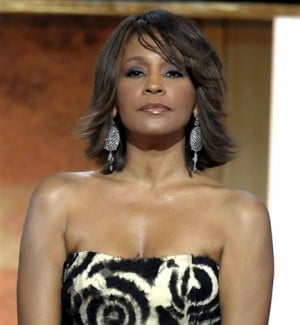
Whitney Houston in 2009 (AP/Evan Evangelisti)

Whitney Houston (1963-2012)

Whitney Houston, "The Greatest Love of All"

I almost cannot believe this news, but this afternoon, but singer and actress Whitney Houston was found dead in her room at the Beverly Hilton hotel in Beverly Hills, California.  One of the finest and most talented singers of her or any generation, with an extraordinarily powerful voice grounded in the gospel tradition, Whitney Houston could have sung almost any kind of music, but primarily made her mark in rhythm & blues and pop. (Yet as she showed on the many times she sang the "Star-Spangled Banner," she could make it sound like you'd never heard it before, and later sang with a 35-piece gospel choir on The Preacher's Wife: Original Soundtrack Album.) The Newark-born daughter of gospel singer Cissy Houston, the cousin of icon Dionne Warwick, and the goddaughter of the musical goddess Aretha Franklin, this beautiful and poised singer, blessed with a once-in-a-lifetime vocal instrument, debuted her first album, the eponymous Whitney Houston in February 1985, and the hits came right away.  They continued well into the 1990s, with perhaps her apogee being her rendition of Dolly Parton's "I Will Always Love Young," from the popular movie The Bodyguard, whose soundtrack won a Grammy award, one of numerous awards Whitney collected over the years.

Whitney Houston, turning out Chaka Khan's hit "I'm Every Woman" (one of my favorite songs of hers)


I have listened to her music since her debut in 1985, and I rushed out to buy her first and subsequents not long after they appeared. Without question her many LPs and CDs have formed part of the soundtrack of my adult life. I'm even old enough to recall staying up to catch her on Byron Allen's old late night show, so enthralled was I by her music and her.  It's hard to put into words how sorrowful her decline over the last 15 years has been to witness, and how saddened I am by today's new. It was clear by 2001 how bad off she was, but I remember how when C and watched her reality show with her then-husband, Bobby Brown, there was no doubt that she had hit rock-bottom, and perhaps was even on the rock and rocks as the cameras rolled. Yet in 2009 it appeared that Whitney Houston had turned things around, but the struggles that she faced are never easy to win and, whatever happened today, it was clear that her many trials had taken their toll.  It is so very tragic, and so inadequate are these words, but as she sang, I will always love her music and her. RIP, Whitney Houston.

Whitney Houston, "I Will Always Love You"

Here, apparently and tragically, is her last performance, last night, at Kelly Price's pre-Grammy party.