Showing posts with label sculpture. Show all posts

Friday, April 27, 2018

Poems: Shin Yu Pai

Shin Yu Pai
(Seattle Review of Books)

Back in 2008, the multi-talented Shin Yu Pai published a book of collected poems entitled Sightings: Poems 2000-2005 with 1913 Press. Comprising a range of formal, material and textual experiments, it also showed her to be both an artist at heart and in her practice. The poems were mostly brief, political, playful, and never repetitive, marking her out as as someone not following the main experimental crowds. After reading Sightings, I added her to my list of poets to follow, and I have, including blogging her poetry several times, once for her baseball poems in 2011 (scroll past the break), and once for a very witty still life poem in 2012. She has since published several more full collections of poems, including AUX ARCS (La Alameda, 2013) and Adamantine (White Pine, 2010), two of whose poems I quote below, as well as limited edition artist books, works on paper, photography, and collaborative projects of various kinds.

In 2015, the poet and scholar Michael Leong curated a collection of poems about visual art, "Lines of Sight," by nine Asian American writers for the Asian American Writers Workshop's The Margins journal. One of the poets he included was Shin Yu Pai, and when I remembered that she was one of the poets--the others were Christine Wong Yap, Debora Kuan, Eileen Tabios, Jennifer Hayashida, Mei-Mei Berssenbrugge (whom I highlighted earlier this month), Walter K. Lew, O Woomi Chang, and John Yau (whose work will close out the month--I said that I would have to include her here. (Please do check out the entire portfolio.)

Michael featured four of Pai's poems, but to whet readers' interests and encourage that you head over to AAWW's website I'm only going to feature two, both from Adamantine. The first is entitled "Lunch Poem," which immediately made me think of Frank O'Hara (1926-1966) and his eponymous, beloved collection, but when you the photograph her poem is in conversation with, her poem's title becomes clearer, shaking off (a bit) the New York School avatar's influence. Instead, we are exploring Indian artist Subodh Gupta's hanging sculpture, a shiny excrescence whose surface appears to be both bumpy--all those fissures between the pails--and, from a short distance, a silvery, pulsating button.

In this poem, Pai plays with the lunch pails and boxes the image invokes, the vast world those pail carriers index, opening with a statistic about how rare it is that they "[go] missing." It is brief enough to be a poem she might have thought up and mulled over during a lunch-time exploration of it, whether it hung in an art museum or a wall near wherever she was spending any time. The poem itself bells like a vessel--a bit plumper here than on The Margins site because of my lack of kerning tools--that has been filled, or, by its end, by author and reader, like the lunchtime diner, emptied.


LUNCH POEM


by Shin Yu Pai


(after Subodh Gupta)
                     6,000,000

             to one: the delivery that

        goes missing – a lunch pail that fails

        to arrive @ its destination; domestic

       articles bear homemade offerings produced

    by housewives & dadi jis for their men-folk –

        fleet-footed dabbawallas dispatch, carry,

    & collect steel boxes by the thousands packed

         lunch boys sport starched cotton nehru

         caps pilot familiar passages – the son

       of a railway guard solders stainless-steel

              tiffin carriers a new class

                     of metalwork


Subodh Gupta. Untitled, 2008,
Stainless steel, Houston Museum of Art.
(Photo: Deena DeNaro-Bickerstaffe.)

The second poem is entitled "Bell(e)," and speaks to an actual ornamental bell, by the late Japanese-American artist Toshiko Takaezu, produced in 1997, and one of many she produced during her career. Pai's title injects a bit of polysemy through that final "e," making the word French as well as English, and highlighting the beauty inherent in Takaezu's sculpture, with its patinated surface color and graceful, parabolic form. That silent "e" also embodies the silence and latent sound to be released, once the bell sounds...its beautiful sounds.

"Bell(e)" tells in swift strokes about how such a bell might have been handled "in centuries / past," but now it hangs in what looks like a greenhouse, "a museum / of curative plants." Where the poem goes is beyond description to an evocation of the bell(e)'s potentiality, as I note above, showing the reader its anticipation--and ours--of its "stillness & / gathering before / the shudder / of first sound," that is, when it finally is rung or struck, how it dreams of the sounds within sounds that will come, or that reappear, as part of and after that reverberation, like the poem itself.

Here is a short paragraph about Takaezu from Wikipedia (linked above):
Takaezu treated life with a sense of wholesomeness and oneness with nature; everything she did was to improve and discover herself. She believed that ceramics involved self-revelation, once commenting, "In my life I see no difference between making pots, cooking and growing vegetables... there is need for me to work in clay... it gives me answers for my life."[5] When she developed her signature “closed form” after sealing her pots, she found her identity as an artist. The ceramic forms resembled human hearts and torsos, closed cylindrical forms, and huge spheres she called “moons.”
The bell pictured below is an "open" ceramic forms, but its capacity for "self-revelation," and its connection to nature are both aspects that Pai discerns in her poem.

BELL(E)


After Toshiko Takaezu


in centuries
past, sunk
beneath soil

to draw earth’s
vital force, inert
vessel of

sound + light,
conserved

in a museum
of curative plants
the moment of

stillness &
gathering before
the shudder

of first sound

dreaming
the shake of chime
hum &

g o n g


Toshiko Takaezu. Bell (1997). Seattle’s Volunteer Park
Conservatory. (Photo courtesy Myra/Flickr.)

Both poems, Copyright © Shin Yu Pai, from Adamantine, White Pine Press. Buffalo, NY 2010. All rights reserved.

Saturday, April 14, 2018

Poems: Doug Kearney

Douglas Kearney
Posting poems about art works and ones using ekphrasis has been illuminating, because one thing I've always known and even practiced myself but never really articulated publicly is how many different ways one can explore conversations between poetry, literature and visual and plastic art. (Seismosis, my collaborative book with artist and poet Chris Stackhouse does walk through various ways of initiating and sustaining the conversation.)

In his poems in response to the late genius artist and musician Terry Adkins (1953-2014), poet and performer Doug Kearney (1970-) shows yet another way to think and write about and with a fellow artist and the work of art. Doug is not just a brilliant, highly inventive poet, but an excellent performer as well. I don't mean simply that he performs his own poetry well, nor do I mean that he is a performance poet; rather, he understands in a profound way what performance can be, and elevates it to an art in conjunction with his poetry, which sizzles as poetry on the page but also serves as a graphic score, with latent possibilities that Doug activates when he is presenting his work live.

But back to this idea of graphic texts, concretion, and poems' visual components: Doug sees and often explores all of these, which is to say the materiality of the text alongside its semantic possibilities and the connections between the two. His "granted collaboration" with Adkins produced a score for a project entitled Freedom of Shadow, as well as poems that look almost all the ones I've shared on here so far. They started working together in 2013, yet Adkins sadly died but a year later, at age 60, of a heart attack. Doug decided to continue, and the result was a series of works that are as much visual art and poetry.

Doug discusses with moving insight the process of working with Adkins, and how he thought through a variety of approaches, only to lose his collaborator, at least in body, just a few months into the new (2014) year. The folio he presented in Poetry--and Adkins, who had created a persona named "Blanche Bruce," after the first black US Senator, from Mississippi, to serve a full term, during Reconstruction, did not want a "book" as the final product for their work together--is both a powerful tribute to Adkins and their thinking and working together, and yet another example of Doug's manifold gifts as a poet. You can read Doug's thoughts at Poetry's website. Below are the two of the drafts and final pieces (poems) that comprised Freedom of Shadow.


And, lastly, here is an image of Terry Adkins' "Muffled Drums," which spurred Doug's imagination, in conjunction with a different Adkins piece, as Lone Wolf, performing his "Muffled Drum Lynch," a sculpture recital about W. E. B. Dubois and his anti-lynching campaign while creating intelligent propaganda with the NAACP. (Via Atum53 on YouTube.)

Tuesday, April 03, 2018

Poem: Tyehimba Jess

Tyehimba Jess
Several years ago, Tyehimba Jess (1965-), winner of last year's Pulitzer Prize in Poetry for his innovative, rich and complex collection Olio (Wave Books), published the following poem on "Poem-a-Day." In it, he calls forth a sculpture by the famous 19th century African American sculptor Edmonia Lewis (see below), a pioneering figure in the world of Western art. Lewis was the first Black woman  artist and first woman artist of Native American ancestry to gain international recognition and acclaim, in no small part for artworks that depicted Black subjects, though often with the features tempered for her white patrons and audience.

Jess, a friend and fellow former Cave Canem grad and NYU alum, excavates American and African American history, often in relation to major and lesser known Black figures who are artists and performers, whether working in the fine arts or vernacular and popular forms. The poem below, while differing in form from the page-crossing sonnets in Olio, offers a sense of his poetics, particularly his skillful use of voice and imagery, which also are on vivid display in his award-winning first book, Leadbelly. What I also like about the poem below is how he merges ekphrasis and dramatic monologue; it is the sculpture, as well as Hagar, the Biblical figure serving as a metonymic stand-in for Black women, and Lewis, who speak through the lines, figuratively and literally bringing the art work to life.

HAGAR IN THE WILDERNESS


by Tyehimba Jess


Carved Marble. Edmonia Lewis, 1875


My God is the living God,
God of the impertinent exile.
An outcast who carved me
into an outcast carved
by sheer and stony will
to wander the desert
in search of deliverance
the way a mother hunts
for her wayward child.
God of each eye fixed to heaven,
God of the fallen water jug,
of all the hope a vessel holds
before spilling to barren sand.
God of flesh hewn from earth
and hammered beneath a will
immaculate with the power
to bear life from the lifeless
like a well in a wasteland.
I’m made in the image of a God
that knows flight but stays me
rock still to tell a story ancient as
slavery, old as the first time
hands clasped together for mercy
and parted to find only their own
salty blessing of sweat.
I have been touched by my God
in my creation, I’ve known her caress
of anointing callus across my face. 
I know the lyric of her pulse
across these lips...  and yes,
I’ve kissed the fingertips
of my dark and mortal God.
She has shown me the truth
behind each chiseled blow
that’s carved me into this life,
the weight any woman might bear 
to stretch her mouth toward her
one true God, her own
beaten, marble song.

Edmonia Lewis (1845-1907) was an African/Native American expatriate sculptor who was phenomenally successful in Rome.

Copyright © 2013 by Tyehimba Jess. All rights reserved. This poem appeared in the Academy of American Poetry's Poem-A-Day on December 26, 2013.
And Lewis's "Hagar," also known as "Hagar in the Wilderness," 1875, carved marble, Smithsonian American Art Museum, Gift of Delta Sigma Theta Sorority, Inc., 1983.95.178


Wednesday, January 10, 2018

Visionaries: Keorapetse Kgositsile (+ Poem) + Kynaston McShine

Keorapetse Kgositsile
With the new year comes saddening news, and so it was with the emails, Tweets and posts announcing the passing in Johannesburg of Keorapetse "Willie" Kgositsile (September 19, 1938 - January 3, 2018). Kgositsile, whom I had the immense pleasure of meeting when he toured the US back in 2012, came to Evanston under the auspices of Northwestern University's Poetry and Poetics Colloquium, performing his work with his longtime friend, musician Douglas Ewart. At the time he was the Poet Laureate of South Africa. His visit was a special event, and I felt extraordinarily fortunate to have the opportunity finally to hear him read his work in person.

As I noted in my 2012 post,

Not only is Kgositsile one of the major poets of his country and of contemporary African literature, but during the 1960s and part of the 1970s was actively involved in the creation of the Black Art literary, cultural and political movement, and as such represents and embodies a link between the political and cultural liberation movements of Africa and the US and the Americas. The famous proto-rap group, The Last Poets, took their name from one of his poems; others who acclaimed his work included established figures like Gwendolyn Brooks, and peers like Amiri Baraka.

He had lived in exile in the US from 1962 until 1975, and is acclaimed in part as one of the first African authors to connect in his work 20th century African and African American poetries. He also was actively involved in Harlem's Black Arts Theater, formulating a revolutionary theory of theater that sought to transform Black artists' underlying assumptions about their work and its effects on Black people. To put it another way, he was a linchpin in terms of thinking through Diasporic artistic practices during the Civil Rights, Black Arts and anti-apartheid eras.

Kgositsile returned to South Africa, after a number of years living in other African countries, in 1990, and was active from that point forward in artistic and cultural activities. The South Africa he returned to had changed dramatically and improved considerably in some ways from the country he left, but the ongoing social, political and economic inequities remained, and he did not hesitate to criticize them in his work.  In 2009, he published Beyond Words: South African Poetics (Flipped Eye Publishing), with fellow South African poets Don Mattera, Lebo Mashile and Phillippa Yaa de Villiers.

Above and below are two poems by Kgositsile, from his 2002 collection If I Could Sing (Kwela Publishers), via Poetry International Web, that convey his later style, questioning approach and committed spirit. Also below are a few more links with much more information about him. Read his work, and remember him, and may he rest in poetry.


Huffington Post Black Voices: "Poet and activist Keorapetse Kgositsile, Who Celebrated Black Arts, Dead at 79"

News24: "National Poet Laureate and political activist dead at 79"

XXL: "Earl Sweatshirt's Father, Famed Poet Keorapetse Kgositsile, Dies at 79"

Pitchfork: "Earl Sweatshirt's Father, Poet Keorapetse Kgositsile, Dead at 79"

***

Kynaston McShine (center) at the opening
of "Primary Structures: Younger American
and British Sculptors," April 27-
June 12, 1966. The Jewish Museum, NY.

Outside the art world, the name Kynaston McShine (February 20, 1935 - January 8, 2018) is probably little known, but within it, and especially in New York City, it held considerable importance, for, as I blogged back in 2011, McShine played a key role as a curator at several of New York's major art institutions: the Museum of Modern Art, and The Jewish Museum. When I wrote my blog post, McShine did not have a Wikipedia entry--he now does, though it remains fairly threadbare--and some of my information, culled from various online sources, was incorrect. (I had seen his birth year listed online as 1939.)

Billy Sullivan's Kynaston (2001).
The Museum of Modern Art,
New York © 2018 Billy Sullivan
What led me initially to write about McShine? I had previously come across a mention of his striking name online, and assumed that he was one of many well-placed, powerful, clearly brilliant and far-thinking, possibly British white curators of his generation, but an image search brought back the face of a Black man, and so I had to dig a bit more and write something up here, though I am hardly an art historian or scholar in the field. As it turns out, there are numerous mentions of McShine, as the scholar and critic Dorothy Wang shared with me, in MoMA's online interviews with its former curators, and Sarah Kleinman, who was writing her dissertation back in 2011 and wrote me via my comments section, may have unearthed other nuggets about him. As she pointed out, though, at that time biographical details about him online, at least seven years ago, were scarce.

At ArtNet, Julia Halpern, in a moving memorial writeup, asserts that McShine might have been "the first curator of color to work at a major American museum," and quotes Sarah Kleinman making a key point about McShine: "In the context of 1950s and 1960s New York City, where curators and artists of color faced blatant discrimination, McShine’s work is even more significant and groundbreaking, opening conversations about the intersections of race, identity, and power." A second ArtNet piece by Halperin collects lovely tributes to him, from MoMA president emerita Agnes Gund and artist Billy Sullivan to curator Anne Umland.

Mr. McShine in a 1988 photograph by
Robert Mapplethorpe. Among the many
exhibitions he organized,  two have
become part of art history.  (© Credit
Robert Mapplethorpe Foundation,
via New York Times)
His New York Times obituary does give considerably more information, including the fact that he did stage solo shows of at least one Black, Sam Gilliam, and one Latino artist, Rafael Ferrer, the first through the pioneer experimental exhibition program he founded at MoMA in 1971, and included other artists of color, including Fred Wilson, in his large-scale exhibitions. The Times review also points out, though, that his 1984 show, "An International Survey of Recent Painting and Sculpture" included only 13 women artists out of 165 total (ArtNet lists 169!), which spurred a group of women to found the now legendary Guerrilla Girls. In its tribute to McShine, the Jewish Museum also notes that in his landmark 1966 "Primary Structures: Younger American and British Sculptors," he included several women, including Judy Chicago (then Judy Gerowitz) and Ann Truitt. He received the CSS Bard Award for Curatorial Excellence in 2003, and served on the boards of several arts organizations. He retired from MoMA in 2008, and passed away just days ago. He was 82.

To quote The New York Times's obit, whose author Roberta Smith spoke with Ann Temkin, formerly McShine’s curatorial assistant at the end of the 1980s, and later chief curator of painting and sculpture at MoMA starting in 2008:
Kynaston’s sensitivity was deep and his opinions were strong. At the museum, he championed the poetic, the unexpected and the individual as opposed to the academic, the predictable and the institutional. His lasting contribution to the life of the museum, and to the lives of countless artists and colleagues, is immense.
What a fitting epitaph.

PS: In my original post I included Alex Katz's painting of McShine, and as part of this post I have included Robert Mapplethorpe's beautiful portrait of him, which accompanied the Times obituary, and Billy Sullivan's portrait, which was part of the ArtNet tributes. I now wonder whether there might be other images created or taken of him over the years. Something for someone else to suss out, I think.

Wednesday, June 07, 2017

Photos I: 2017 G37 Summit, Sicily

More photos from the trip. Enjoy!

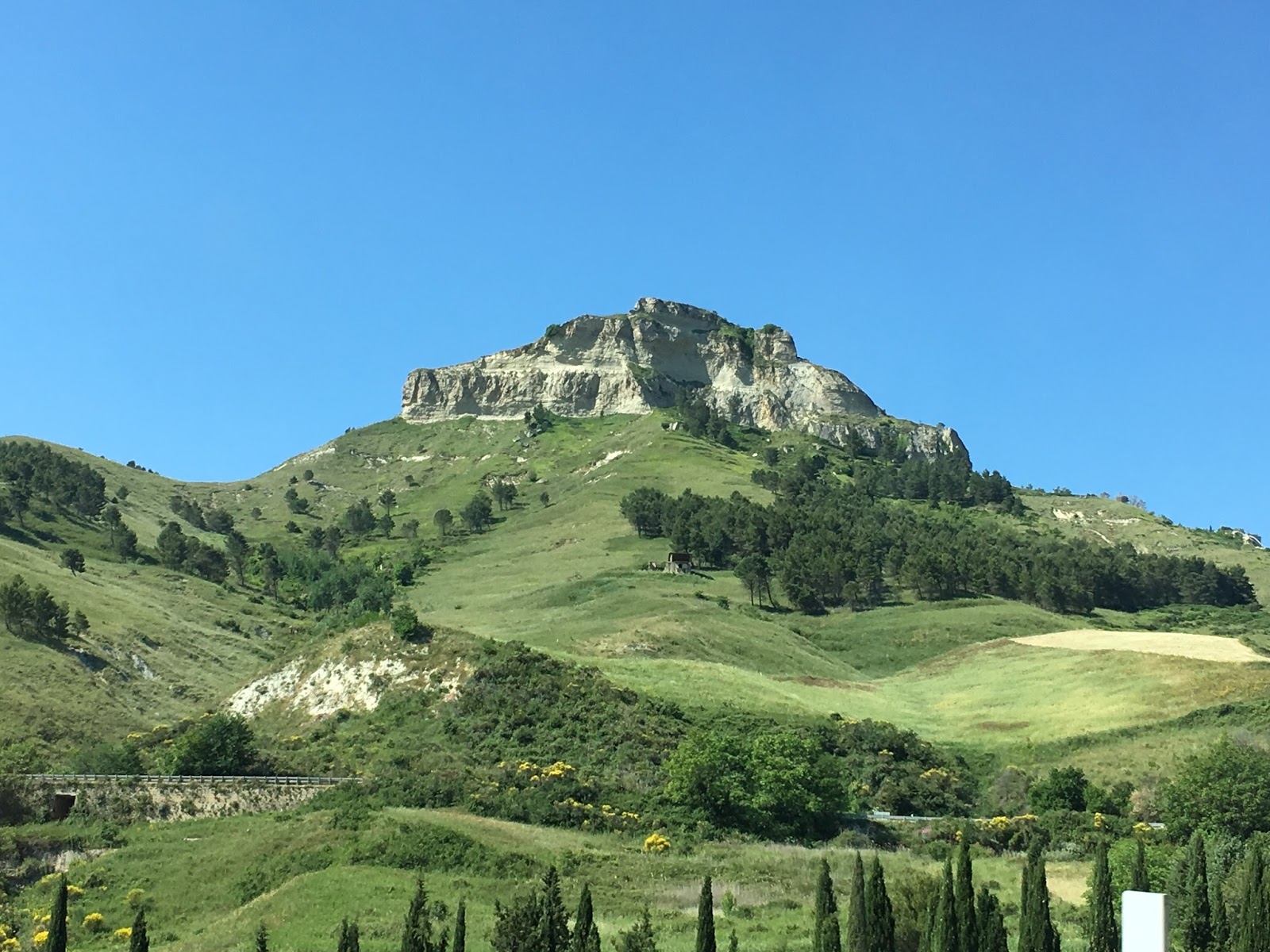
Landscape in the interior of Sicily, heading
towards Caltagirone
Landscape in the interior of Sicily, heading
towards Caltagirone
Ceramic heads, Caltagirone
C, on the famous Caltagirone steps
A piazza, evening in Caltagirone
A Caltagirone street, at night
The Straits of Messina, with Calabria,
the Italian "boot" (mainland) in the distance
Near Savoca
In Savoca
Mother Church Santa Maria of the
Assumption into Heaven, Savoca
Engraving the concrete
blocks, in Savoca
The students, poets and audience,
lining up outside the event, Birch Forest
Carmine Elisa Moschella, making
her entrance, with song
Students reading, Birch Forest,
Piedimonte Etneo
Presentation by more of the students at the Rifugio
With Josephine (at left) & the college students
from Palermo, at the Rifugio Soggiorno
Castiglione di Sicilia
A proclamation by the Fondazione
Antonio Presti, in Castiglione
More after the jump!

Wednesday, March 09, 2016

PATH's New World Trade Center Station

WTC PATH station, with 1
World Trade Center in the background 
Fifteen years in (re-)construction (and it's still not finished), at a cost of $4 billion dollars (and it's still not finished), the main hall of the PATH's new World Trade Center station main's building, designed by starchitect Santiago Calatrava, is on the cusp of opening. But the entire hub is, unaccountably, still not finished. Incomplete or not, it is worth an ogle, and I did so on Tuesday on my way back from an appointment in the city.

The external form of the main hall, or Oculus, retains some aspects of Calatrava's original design, though his plan for a retractable roof, much like bird's wings, gave way to a rigid white steel exoskeleton, with additional security features. Its interior consists of a vast, marble-floored hall surrounded by ribbed arches, as if it were the evacuated belly of some immense white alien. I immediately thought of the movie Prometheus, which seems like a belated influence. 

The Oculus mirrors the futuristic ossuary-like maze of corridors, which I have featured in the past in some random photos, that connect the station to other buildings like Brookfield Place and West Street. As I walked around the atrium space and snapped photos, I did not see many people (as the photos make clear), but I suppose they will start arriving once the shops open and the exits at Vesey Street and Church Street open up.

The headline of critic Michael Kimmelman's New York Times critique of the building, linked above, refers to it as a boondoggle. Yet he does initially praise the Oculus's eye-catching space.  But he concludes that, given its cost, lack of functionality, and insignificance in the New York-New Jersey public transportation system, this glorified vanity sculpture project represents a failure of multiple kinds, as well as a waste of public funds. (Where did all that money go?) 

I know I may sound churlish, but I actually liked the PATH's rough hewn temporary station, which opened not long after the 9/11 attacks. It eventually closed and instead, the site turned into a cardboard-lined warren whose navigability seemed geared to train rats. Given the number of New Yorkers who may find themselves displaced in coming years and undertaking a move to New Jersey, the transit officials probably should do everything they can to ensure that the hub will be able to accommodate as many travelers as possible.

When it will be completed remains a question; the original 5-year-estimate has been exceeded by an order of 3, so perhaps by 2020 or 2025, barring Manhattan being inundated by rising sea water, it will be done. Also, when the connections with the MTA's lines will be open also isn't clear. As confusing as the old WTC station (pre-9/11) was, you could exit the PATH and head directly to the 2, 3, 4, 5, etc., with an array of shops dotting the way. Not today, though. All of that is apparently coming soon. 

The station is worth seeing, though, especially before all that white turns gray and then black (which might have been more appropriate given the graveyard and memorial next door), especially if you don't have to travel through the station during rush hour, and it isn't raining or snowing outside. I can say from experience that all that marble flooring is extremely slippery, like a mid-winter lake rink, making it a major hazard, which I imagine someone must have considered before laying down so much of it, but perhaps they didn't. It looks pretty, though, and that appears to be all that matters, whatever the costs.

Part of the soaring white spine 
The path past the PATH station to the
9/11 Memorial 
Approaching the Oculus, from inside the station
The Oculus, with the skylight visible
The skylight
Another view 
Towards the WTC PATH trains

Monday, October 07, 2013

23rd Annual Jersey City Artists Studio Tour

Somewhere in my long lists of posts on this blog there lies one about my participation years ago in one of Jersey City's annual Artists Studio Tours. I am not sure what I named the post or what labels I tagged it with, since repeated searches of this blog have turned up nothing. I'm pretty sure, however, that I did blog about one (was it 2009, the one fall between 2000 and 2012 that I was here? before? after?), and that I posted pictures. Where they are among this blog's many posts, though, I can't say.

So I will just note that recently, I went to my first Artists Studio Tour in a long while. For whatever reason (the Hurricane? being out of the loop?) I missed last year's version, but I did receive advanced notice about this, and moseyed over to the Powerhouse Arts District (i.e., gentrifying-again downtown), where a number of artist buildings and studios are located. There was a kickoff celebration on October 5 at the Tenmarc Building on Communipaw, not far from where we used to live, but I missed that, just as I missed the closing party the next day down at 150 Bay, another major arts spot. Between the two, however, I did explore into some of the studios, starting at the Warehouse Café and proceeding on foot to as many spaces as I could.

JC Artists' Studio Tour
A party and performance in one of the studio spaces
Along the way I received a free T-shirt, saw quite a bit of affordable art (some of it so economical I almost didn't believe the prices), met a few friendly artists and art lovers, and reconnected a bit more with the local arts scene. With 75 spots (some with up to 10 or more artists) spread out of the city, the tour will require a bit more time--two days, very comfortable shoes, a little bag to hold art if it's affordable and appealing--next year. Below are a few photos from the tour.

A DJ, at my favorite JC café, Warehouse Cafe
Warehouse Café, with DJ
An amazing studio, JC Artists' Studio Tour
In one of the sizable studios
An amazing studio space, JC Artists' Studio Tour
The rest of the studio/loft space, with handmade
furniture and art objects
Photographs, JC Artists' Studio Tour
A photography exhibition around the corner
Art!
One of the signs alerting people on the tour
to an exhibit inside
Outside one of the artists' buildings, JC Artists' Studio Tour
140 Bay Street
Inside a studio, JC Artists' Studio Tour
In one of the studios 
Inside a studio, JC Artists' Studio Tour
People speaking with one of the artists
One of the walkways, with Ribbons of Hope Exhibit
Ribbons of Hope exhibit
Ribbons of Hope exhibit at JC Artists' Studio Tour
Ribbons of Hope exhibit
(mine is one of the illegible blue ones)
A band at JC Artists' Studio Tour
A band performing in one of the studios
JC Artists' Studio Tour
Another studio
JC Artists' Studio Tour
Artist Jonathan Wolf (at right)
JC Artists' Studio Tour
A piece by artist Chantal Lamour
(those are painted eggs)
Looking out over part of downtown JC
The view from one of the windows
(the towers in the rear are the old Jersey City
Medical Center, now a condo cluster)