Showing posts with label African American history. Show all posts

Monday, February 13, 2017

Visiting the National Museum of African American History and Culture

The National Museum of African American
History and Culture, from the north view
Last week I ventured to Washington, DC to attend the annual Associated Writing Programs Conference, which I'll say a little more about in a subsequent post, but one of the highlights of the trip to DC was the opportunity to visit the Smithsonian National Museum of African American History and Culture (NMAAHC). Designed by British architect David Adjaye in conjunction with the Freelon Group and Davis Brody Bond, the museum sits on the National Mall, across the road from the Washington Monument. Long in planning, the NMAAHC was authorized for construction by the Congress and George W. Bush in 2003, and opened in ceremony led by the United States' first African American president, Barack Obama, last fall, September 14, 2016, to considerable acclaim for its architectural beauty and substantial collection.

The flag of the Bucks of America,
an American Revolutionary War
Black regiment
I'd been warned that acquiring tickets to the NMAAHC would be a challenge, but a colleague, Tayari Jones, was able to score me a ticket for 3:15 pm, and I made sure not to be late. The NMAAHC's building immediately commands the eye, rising in bronze from its site like a series of stacked wicker baskets or bowls that both convey solidity while also shimmering with the shifts in light. (The bronze carapace aims to and convincingly symbolizes a Yoruban crown, invoking one of the ethnic groups from which a sizable portion of African peoples in the New world share descent.) As it turns out, the museum is too large to see in one day, so I chose to head to the historical section, which presents a rich panorama, full of visual and material artifacts, from the 1400s through the present day. To view this section, museumgoers have to descend in an elevator to the bottom-most floor, and then slowly ascend, via a ramp, stairs and escalator, to reach return to the ground floor. In essence, everyone viewing this portion of the museum is physically and symbolically in the ship and in the hold, to borrow two key phrases from Christina Sharpe's remarkable study In the Wake: On Blackness and Being (Duke, 2016).

More manacles and shackles
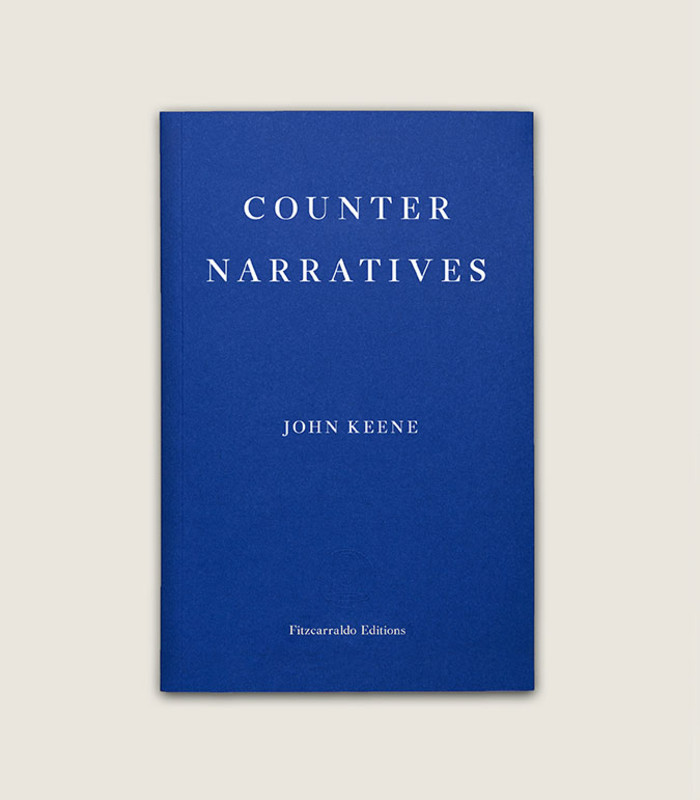
On the day I went, the afternoon crowd wasn't especially heavy at first, though my cabdriver assured me that the museum was, in his experience of the last few months, the most and best-attendance attraction in the city. By the time I'd begun the tour, however, the waves of museumgoers, of all races, ethnicities and backgrounds, began increasing, and I found it a challenge at times, especially at the beginning of the exhibit, to linger over the displays and artifacts. It was also at times uncanny to read the plaques and descriptions, since I was familiar with much of the material from prior study in college and personal research, including in preparation for Counternarratives and other works, but I nevertheless found myself learning a lot that was new, and was impressed at how well the exhibits accessibly contextualized the various eras and moments from the dawn of the Atlantic Slave trade through its decline and the Civil War. At times I found the artifacts so moving I was moved nearly to tears--and at least once did tear up. Among the exhibit's revelations for me was a flag by the Bucks of America, an organization of Revolutionary War veterans whose members included a historical figure who serves as the model for the protagonist of the novel I'm currently working on; another was a whip, formerly wielded by a plantation overseer, whose metal end and thick cording exceeded most models you would find today and emblematized the brutal conditions of African American labor not only in the past but today.

As I walked through the exhibit, taking notes and snapping photos (which are, thankfully, allowed), stopping to discuss the experience with friends, and frequently moved by what I was seeing and reading, I felt incredibly grateful that this institution now existed, that millions of people would have the opportunity to see and experience it, that millions of black people, from the US and across the globe, as well as million of non-black people, would be able to walk through its rooms and learn and see and feel. What I also felt and feel, however, as a black person, as an African American, is that one museum or even several dozen, if one adds in all the smaller and single-person related museums, the various Civil Rights memorials and museums, and various key archives, collections and monuments, will only scratch the surface of my and the collective black experience, especially compared to the many thousands of museums, as well as the vast and expanding network of interlinked and dominant media, dedicated to white people, European culture, and so forth, that exist all over the United States and the globe. That said, the NMAAHC is a gift to the country and the world, and I highly recommend visiting it. I plan to return as soon as I can, to explore more of it. To all who made it possible, I say thank you!

My timed pass 
The ground floor
The beginning of the historical exhibit
A visual display featuring scenes
from African American history
Closeup: James Baldwin and Zora Neale Hurston
In the elevator: Booker T. Washington
From the 1400s on
"The Atlantic Creoles"
Actual slave manacles and shackles 
Timber and iron ballast from
a slave ship, the São José 
Nat Turner's Bible 
A close-up of Nat Turner's Bible
An important historical list
And another
The country, divided after the entry
of my native state, Missouri
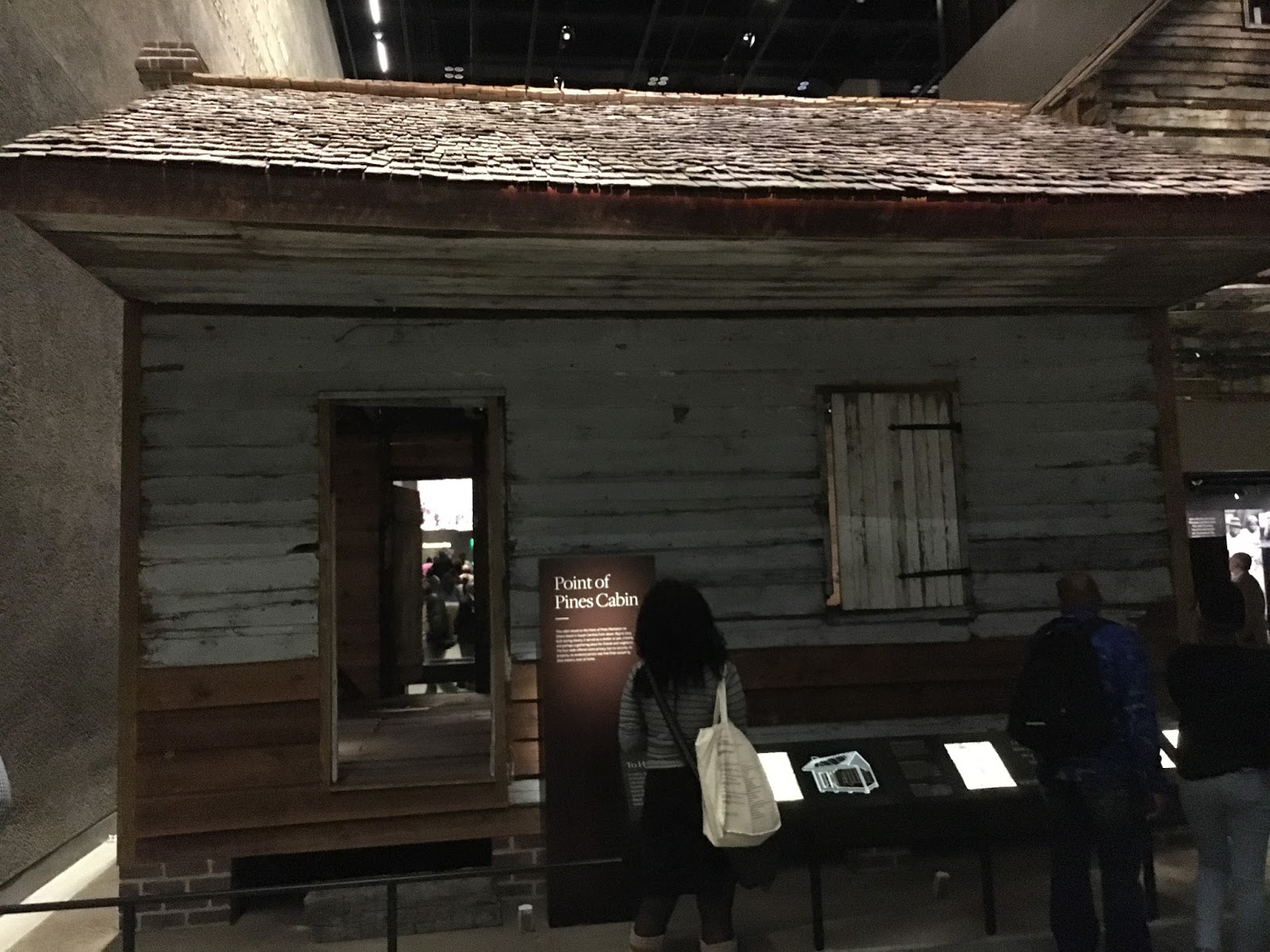
Point of Pines Cabin, an actual stlave
cabin from Edisto, South Carolina
Artifacts, including a note in Arabic 
Harriet Tumbman's artifacts,
including a shawl and a Bible
Historical marker for Nicodemus,
one of the original free Black town
established in Kansas 
Inside one of the formerly segregated
train cars, from the 1940s 
A multimedia tableau from the
Civil Rights era, with Medgar
Evers at bottom right 
Bayard Rustin display
(Rev. Dr. Martin Luther King Jr.
with Rustin at right)
Malcolm X
("by any means necessary")
A Black Unity jacket
(belonging to a Vietnam veteran) 
Amiri Baraka and Stokely Carmichael (Kwame Toure)
Black Power display 
Muhammad Ali and
Black Panther badges
A young Nikki Giovanni
Toni Morrison receiving
the Nobel Prize in Literature, 1993 
The 1990s
Public Enemy

A Langston Hughes quote that graces
the final wall leading out of the
history exhibit
Oprah Winfrey Theater
(Oprah donated $22 million+ to the museum)
Yours truly (photo by Tayari Jones)

Thursday, February 19, 2015

The Book of Negroes on BET


If it takes Black History Month to spark excellence on BET (Black Entertainment Network), so be it. I am talking about that station's airing this week of The Book of Negroes, the three-part miniseries based on the award-winning 2007 novel of the same name by Canadian author Lawrence Hill (which was originally published as Someone Knows My Name in the US, and rereleased under its original name this past January). Co-written by Hill and Jamaican-Canadian director Clement Virgo, and produced by Guyanese-Canadian Damon D'Oliveira and Virgo, the miniseries, original in six parts, initially premiered on Canadian Broadcast Channel TV in January, and was, to my mind, not just compelling TV, but utterly perfect in its historical and diasporic dimensions for Black History Month.

Aminata Diallo (Aunjanue Ellis),
speaking to abolitionists in London
The series, and Hill's novel, draw from the historical Book of Negroes, which the British Army, after its defeat in the US Revolutionary War, compiled as a means of documenting which people of African descent, many of them enslaved, had escaped to the British lines and aided its war effort. Those who could vouch for their contributions and who had no standing claims as chattel nor debtors were guaranteed their freedom and passage to Nova Scotia. Some 3,000 people qualified. In Hill's novel, which fictionalizes and reshapes the story, an enslaved woman, named Aminata (later Meena) Diallo and raised in the Muslim faith, from Segou in what is now Guinea, plays the central role in recording the names, later going on to testify before a select committee of British legislators in order to help end the British Slave Trade.

Aunjanue Ellis
In fact, the novel and miniseries center on Aminata's experiences. When we first see her, she is a child (Shailyn Pierre-Dixon) with her parents in Africa. Shortly thereafter, after hearing a djeli, or traditional storyteller, she is captured by slavers, assisted by a young native, Chekura Tiano (Siya Xaba), and on the slave ship, we see the early sparks of her lifelong as she provides the means for a near slave rebellion, which is violently quelled. Aminata and Chekura survive the Middle Passage, and she ends up on a South Carolina plantation owned by the lecherous Robertson Appleby (Greg Bryk). Here, as elsewhere, Aminata/Meena never forgets her family, Africa or her past; now into early womanhood (and played with aplomb and fearlessness throughout by Aunjanue Ellis), she befriends one of the older enslaved women, Bertilda (Cara Ricketts), who serves as a surrogate mother, and reconnects with Chekura (now the strapping, handsome Lyriq Bent), who manages to make infrequent nocturnal trips to see her, and uses the fishnet (or "slave grapevine," an effective proto-telecommunications system) to keep abreast of what she is up to.
Aminata in revolutionary New York
Much of this early portion of the story unsurprisingly parallels the usual depictions of plantation slavery, though Virgo's direction is assured throughout; a vile master, the hardships of the enslaved people, punishment for defiance. In Aminata's case, her relationship with and pregnancy by Chekura, whom she marries without the permission of and in defiance of her master Appleby, leads him to sell off her daughter May to unknown owners and eventually her to Solomon Lindo (Allan Hawco), a Jewish trader who becomes the witting and unwitting catalyst for Aminata's liberation. Witting, because his wife Rosa (Amy Louise Wilson), fosters the multilingual, perspicuous Aminata's skill at reading and writing. Unwitting because after Rosa's and the Lindo's child death from smallpox (and here, we get a strange moment of present-day irony because Bertilda had innoculated Aminata so as to protect her from the pox's ravages), Solomon takes her to New York, where she will serve and assist him in his business affairs.

The trip coincides with the stirrings of the Revolution, though Aminata's taste of freedom begins when she encounters free black people, including free black tavern keeper Sam Fraunces (Cuba Gooding, Jr.), who is smitten with her. (The depiction of Black Sam, both in Hill's book and the miniseries, takes some liberties, but some contemporaneous accounts apparently did describe Black Sam as a "mulatto" or mixed race person.) Aminata flees to precarious freedom among the city's black encampment while Solomon heads back to South Carolina, and Chekura, having learned of her whereabouts, finds her in the City. He also volunteers for the British side, as does she as an aide to Captain John Clarkson (Ben Chaplin). This creates the conditions for their unqualified freedom and her role as the author of the official Book of Negroes.
Aminata and Chekura Tiano (Lyriq
Bent), in Nova Scotia
To give just a bit more of the plot, Aminata and Chekura find themselves separated when authorities prevent her from boarding the ship bound for Nova Scotia because of a standing claim on her--but not by Solomon. It is Robertson Appleby, instead, who tries to game the law and gain control of Aminata before she can get away. Miraculously, Sam Fraunces produces (!) Solomon, her former owner, and countermands the claim, in the process and in court manumitting Aminata, though she tempers his heroic gesture by reminding him that she cannot forgive his role in selling off her infant daughter May. In Birchtown, the black settlement in Nova Scotia, Aminata emerges one of its leaders alongside preacher Daddy Moses (Louis Gossett, Jr.), but the economic and social conditions for the newly arrived black population remain shaky before they find themselves at the hands of rioting whites who blame for the loss of jobs and other privations.
Cuba Gooding Jr., who
plays tavernkeeper Sam Fraunces
The British have set up a colony in Africa, Sierra Leone, which Aminata and Chekura and nearly 1,000 other blacks from Canada will head to, together, and while there, in addition to helping to establish Freetown, the capital city, she hopes to see her native village again. As it turns out, Chekura is able to redeem his participation in their enslavement, though with tragic consequences; Aminata does find another village mirroring her native one, which may no longer exist; and she ends up, in her final chapter, moving to London to assist Captain Clarkson. It is there that she pens her own autobiography, despite the disbelief of her white abolitionist supporters and opponents (reminiscent of Phillis Wheatley's attestation), which with her testimony will play a key role in ending Britain's participation in the slave trade. There is a final, moving and lovely twist, which exists in both the novel and miniseries, and which the story certainly earns.
One of the actors during
a Revolutionary War scene
There are moments of anachronism throughout the series; at one point I felt, based on the dialogue in revolutionary New York and in Nova Scotia, as if I were watching a mashup of MTV and 1776; at another, at the very end, when Aminata participates in an outdoor public book-signing, which might have been possible though it seemed unlikely from a historical standpoint, it took me momentarily out of the story. All of the enslaved and free men are a bit too buff (a fact I am not really complaining about). In addition, though the screenplay mostly avoids sentimentality, but it does crop up at points, such as when Aminata and Chekura reunite in New York, but I chalked this up to the demands of portraying a story of such complexity that a little shorthand was necessary and not worthy of a quibble.

What works throughout is Aunjanue Ellis's characterization of Aminata. She fully inhabits this visionary figure of resistance, showing vulnerability when required but also conveying an inner fortitude that would have made possible the vast journey she traveled. Lyriq Bent also is strong as Chekura, and though he has less to do and say throughout, he succeeds in embodying the sort of man who could steal through the night, despite all obstacles, to be with her, and who is willing to make the ultimate sacrifice to atone for actions he could not have fully understood in his youth. Veteran actor Jane Alexander exudes the right combination of liberalism and racism in her depiction of Nova Scotian printer Mary Witherspoon, while Louis Gossett, Jr., as Daddy Moses, radiates joy in his role. I could not, however, stop thinking that I was watching Cuba Gooding, Jr., as opposed to Fraunces, but accepting this I was able to enjoy his scenes. This was true too for some of the secondary actors, who were uneven, but a few, like Matt Ward as Jason Wood, and Stephan James as Cummings Shakspear, endowed their characters with vivacity and gravity. All in all, I was impressed with the rich cast of mostly black Canadian and South African actors, and now want to see them--along with their African American, British, and Afro-Latin peers--much more frequently on screens, large and small.
Lyriq Bent
Other aspects of the miniseries are even stronger. The adapted screenplay transforms the novelistic material in appropriate ways, while also never faltering in its ability to properly and effectively depict expressions of black solidarity, love, and, between Aminata and Chekura, eros and tenderness. Another pinnacle is the cinematography. From start to finish, though it occurred primarily in Cape Town, South Africa and Nova Scotia, it sensorially and visually anchors each scene, whether the grim edged pastoral of Appleby's plantation; the frenetic (though perhaps far too clean) streets of revolutionary New York; and the chilly, snow-doilied hills of Birchtown and Nova Scotia. Even the period interiors, if sometimes too sumptuous when depicting the enslaved people's quarters, place viewers firmly in a past time and space. In terms of pacing, the series never lags. Each two hour installation races by--and around BET's sally of ads. I could easily have stood several more nights of this fascinating tale, though that would have gone beyond the novel's and story's scopes.

As entertainment, The Book of Negroes is a triumph, but it also succeeds in its efforts to highlight a still too-little known aspect of American, African American and African Diasporic history. In essence, it presents the history of black Loyalists, who had everything at stake by agreeing to support the British. It also shines a light on the contributions of a black woman who was unwilling every to cede her agency if she could help it, and in so doing, helped to change one of the most abominable systems that has gripped the globe. The novel and miniseries succeed in their efforts to present a fuller social and political economy of the slave trade, of black resistance and freedom, and of a feminist perspective on our histories--and herstories. I recommend, and will say don't forget the popcorn and the tissues for the tears that may come along the way, before you get to cheer at how this particular story does end on a high note.

For more about The Book of Negroes' historical facts and context, BET even has an iPhone/Android app!

Monday, January 19, 2015

Rev. Dr. MLK Jr. Day: His 1965 Interview with Alex Haley

Selma-Montgomery March: Rev. Dr. Martin Luther King leading march
from Selma to Montgomery to protest lack of voting rights for
African Americans. Beside King is (l-r), Ralph Abernathy, James Forman,
Reverend Jesse Douglas and John Lewis, March 1965.
(Photo Credit: Steve Schapiro/Corbis)
Today on Rev. Dr. Martin Luther King, Jr. Day, I thought I'd post a link to one of the best interviews Rev. Dr. King (1929-1968) ever gave, with journalist and author Alex Haley, of Roots fame. The interview took exactly 50 years ago today, in January 1965, the year of the Selma-to-Montgomery March--and of the story underpinning Ava Duvernay's highly acclaimed new film Selma--and appeared in Playboy magazine, preceding the famous Alabama march and the assassination of Malcolm X, but following many other landmark moments in Rev. Dr. King's and the Civil Rights Movement's long march towards social, political and economic equality and freedom.

It's worth reading the entire interview (linked from AlexHaley.com), which gives a far fuller portrait of Rev. Dr. King's mindset in the mid-1960s. In it he talks about mistakes he felt he made, his disappointment of the lack of support and righteousness from white Christian ministers and churches in the cause of Black equality, the moving resistance of young people, the concept of "militant nonviolence," strategizing for the future for Civil Rights, a critique of the Nation of Islam and Malcolm X, the challenges of nonviolence and the dangers of violence as a solution, racist science and white supremacy, the relationship between African Americans and Black people around the globe, and so much more. Here is one quote:
King: I mean to say that a strong man must be militant as well as moderate. He must be a realist as well as an idealist. If I am to merit the trust invested in me by some of my race, I must be both of these things. This is why nonviolence is a powerful as well as a just weapon. If you confront a man who has long been cruelly misusing you, and say, “Punish me, if you will; I do not deserve it, but I will accept it, so that the world will know I am right and you are wrong,” then you wield a powerful and a just weapon. This man, your oppressor, is automatically morally defeated, and if he has any conscience, he is ashamed. Wherever this weapon is used in a manner that stirs a community’s, or a nation’s, anguished conscience, then the pressure of public opinion becomes an ally in your just cause.

and here is another, concerning the Civil Rights Act, which Rev. Dr. King didn't think went far enough:

King: One of these decisive developments was our last major campaign before the enactment of the Civil Rights Act—in St. Augustine, Florida. We received a plea for help from Dr. Robert Hayling, the leader of the St. Augustine movement. St. Augustine, America’s oldest city, and one of the most segregated cities in America, was a stronghold of the Ku Klux Klan and the John Birch Society. Such things had happened as Klansmen abducting four Negroes and beating them unconscious with clubs, brass knuckles, ax handles and pistol butts. Dr. Hayling’s home had been shot up with buckshot, three Negro homes had been bombed and several Negro night clubs shotgunned. A Negro’s car had been destroyed by fire because his child was one of the six Negro children permitted to attend white schools. And the homes of two of the Negro children in the white schools had been burned down. Many Negroes had been fired from jobs that some had worked on for 28 years because they were somehow connected with the demonstrations. Police had beaten and arrested Negroes for picketing, marching and singing freedom songs. Many Negroes had served up to 90 days in jail for demonstrating against segregation, and four teenagers had spent six months in jail for picketing. Then, on February seventh of last year, Dr. Hayling’s home was shotgunned a second time, with his pregnant wife and two children barely escaping death; the family dog was killed while standing behind the living-room door. So S.C.L.C. decided to join in last year’s celebration of St. Augustine’s gala 400th birthday as America’s oldest city—by converting it into a nonviolent battleground. This is just what we did.

and a third, concerning the relationship between Black Americans and Black Diasporic peoples:
King: Yes, I do, in many ways. There is a distinct, significant and inevitable correlation. The Negro across America, looking at his television set, sees black statesmen voting in the United Nations on vital world issues, knowing that in many of America’s cities, he himself is not yet permitted to place his ballot. The Negro hears of black kings and potentates ruling in palaces, while he remains ghettoized in urban slums. It is only natural that Negroes would react to this extreme irony. Consciously or unconsciously, the American Negro has been caught up by the black Zeitgeist. He feels a deepening sense of identification with his black African brothers, and with his brown and yellow brothers of Asia, South America and the Caribbean. With them he is moving with a sense of increasing urgency toward the promised land of racial justice.
Do read the entire interview; so much of what he says still pertains today, a sign of his extraordinary vision and of the challenges we still face.

Thursday, January 24, 2013

Spring Semester Classes Begin


This post is of zero interest to anyone beyond my students and me, I know, but Spring 2013 semester classes began today, first thing this morning to be exact, and I'm excited about both of them, but especially about my undergraduate literature class, which incorporates some material I've taught before but many new texts as well. That class is officially an English and African American Studies class on The Black Arts Movement, satisfying two distinct registrations (and I thus have two Blackboard sites, which is a little disorienting), and covers not only aspects of the movement itself, but several antecedent moments (The Harlem Renaissance, Négritude, Black American poetry of the 1950s) and successors (a Spike Lee film, Public Enemy's music, and Kia Corthron's play Force Continuum). At the core of the course we'll be delving into a great deal of Amiri BarakI've included a good deal of  scholarly, critical and theoretical material (by figures from Alain Locke and W. E. B. DuBois to more recent scholars and authors like Cheryl Clarke, Howard Rambsy II, Cherise Pollard, and Lorrie Smith, as well as primary), including some primary documents by Larry Neal, Amiri Baraka and others. It's a decent-sized class (anywhere from 18-26 students, depending upon how many stay enrolled, and smaller is always better for the students and their professor) and thus manageable. The second course is one all members of the African American and African Studies teach in rotation, Introduction to African American Studies (Part II), which spans the period from Reconstruction through today, and which draws a pretty sizable enrollment. Right now I have about 45-50 students, but one asked about the amount of reading (up to 200 pages a week, from an array of texts, including historical and critical studies in a range of fields, primary documents by the likes of Marcus Garvey, Malcolm X, and Rev. Dr. Martin Luther King Jr., and creative works), so perhaps the numbers will slim down by next week. As with my fall classes my students come from a range of backgrounds, though the majority are black (African American, African, Caribbean, mixed race, etc.), latino (many Afro-Latino), and Asian-American (South Asian and East Asian), which I learned quickly lent a very different cast to the conversations we had about the course material. I expect no less this semester. We begin with Booker T. Washington's Up From Slavery, a book I haven't read in many years, and rereading it in preparation for the class has reminded me why I enjoyed it so years ago, and how rich and complex our history--black history, American history--truly is.

Thursday, March 15, 2012

Remarkable Trove Found in Chicago: Richard T. Greener

Richard Theodore Greener, A.B. 1870, Harvard College,
LL.B. 1876, University of South Carolina
(courtesy of Harvard University Library)
It was, at least from the outside, just another abandoned house on the South Side of Chicago, at 75th and Sangamon.  According to Kim Janssen's article in the Chicago Sun-Times, squatters, drug addicts, and stray animals had reduced it mostly to a shell, its front door flapping open like a tribute to desolation. Rufus McDonald, one of the workers hired to raze the house, made a remarkable discovery in its attic. There he found a steamer trunk full of papers, including what appeared to be--and was--a Harvard College diploma from 1870. While this would not be unheard of--Chicago has long had among its residents graduates of Harvard, and the neighborhood, Englewood, was once part of the very vibrant southern part of the post-fire 19th and early 20th century metropolis. McDonald went through the papers and noticed other documents that caught his eye: a law licence from South Carolina; a photograph of a man who appeared to be mixed-race or black; and an 1853 or 1854 book entitled Autographs for Freedom, a publication of the Rochester Ladies' Anti-Slavery Society.

Richard Theodore Greener (1844-1922)
University of South Carolina
McDonald had the presence of mind to collect all the papers and put them in a brown paper bag, despite being told by his crew to trash them, and took them to book expert on the northside of Chicago. The expert reviewed the documents and let McDonald know about his find: they had originally belonged to Richard Theodore Greener (1844-1922), the first African-American graduate of Harvard College (and the second black person to have been admitted to the college).  Not only that, but Greener was a major intellectual and public figure of his day, despite the constraints racism imposed upon him. He became the first, and the for decades the only, black professor (of philosophy) at the University of South Carolina, during the brief window Reconstruction provided (1873-1877), and was admitted to the bar in that state in 1876; he became a dean of Howard University's School of Law in 1879; he helped to elect several Republican presidents and successfully pushed that party to condemn lynching; he was served in the foreign service in Russia in 1898, and later in China.
Richard T. Greener
(courtesy Harvard University Library)
Who was this extraordinary person, Theodore Greener, almost completely unknown by anyone today, though he is, I must note, not infrequently invoked by Harvard? Historian Michael Mounter wrote his doctoral thesis on Greener and has uncovered a good deal about his life. He was born the grandson of a slave in Philadelphia, and his father was a mariner; his uncle, in whose orbit he spent a great deal of time, was a prosperous barber and politically active in the civic affairs of that city.  When he was 10 the family moved to Boston, where he was barred from attending the public schools because of his race, so his mother enrolled him in a private school, from which he later had to withdraw when his father never returned from the Gold Rush in California. He began working as a porter at the age of 14, and it was two Boston businessmen, George Herbert Palmer and Augustus Batchelder, who funded Greener's education at Oberlin College's preparatory school from 1862-1864 (during the US Civil War, no less), and then at Phillips Academy from 1864-65, before Batchelder arranged for his admission, as an experimental, to the college, where he was an academic standout.

Richard T. Greener
Several of Harvard's other schools had already admitted and graduated black students: Harvard Medical School in 1850 had admitted three students, including author and anti-slavery activist Martin Delany, before rescinding the offers after pressure from white students; in 1869 Harvard Law School graduated its first African American, George Lewis Ruffin, who in 1883 became Massachusetts' first black judge; and that same year, Harvard Dental School graduated a black student, Robert Tanner Freeman. (The following year, George Franklin Grant would graduated with a dental degree, before going on to invent the golf tee.)

McDonald holding a copy of Greener's
diploma from the University of South Carolina
(Cheryl Corley/NPR)

Indeed, a tiny number of African Americans had previously received undergraduate and graduate from institutions ranging from Oberlin College to Brown University to Middlebury College, during a period when the majority of black people were forbidden, sometimes at penalty of death, from learning to read or write, and the majority were enslaved. After Greener's graduation, Harvard would admit a few more African Americans to its various schools through the end of the 19th century and into the 20th, though they remained a tiny but often publicly noteworthy minority until the 1970s. Among the most famous 19th century graduates after Greener include W. E. B. DuBois (AB 1890, AM 1891, PhD 1895, becoming the first African American earn a doctorate in the United States); his classmate Clement G. Morgan (AB 1890, LLB 1893, the first person to hold both degrees from Harvard, and the first black Senior Class Orator); and the anti-racist and peace activist William Monroe Trotter (AB 1895, AM 1896).

McDonald holding one of the photographs
he found, of Richard T. Greener
(Cheryl Corley/NPR)
But back to McDonald: He not only refused any money from the appraiser for the documents, but went back to the Englewood residence to fetch the trunk. It, like the house, was already gone. He retains the rights to the documents, and is considering where they might go. Interested parties include Harvard itself; the Sun-Times report quotes Harvard professor and scholar Henry Louis Gates, Jr., for many years head of its African and African American Studies Department, as having expressed interest, though he has told McDonald not to expect a mint in return. Other possible places the papers might go would include the New York Public Library's Schomburg Center for Research in Black Culture; the Moorland-Spingarn Research Collection at Howard University; the Library of Congress; or other notable research collections around the country. Perhaps someone will donate the papers to the forthcoming Museum of African American History in Washington. Whatever the case, it is likely a private collector will snap them up and donate them to one of these institutions. They will be invaluable for historians, scholars, writers, and others interested in Greener and the era.

Belle da Costa Greene
(Library Portraits)
One final note: Greener's family life, as the Sun-Times mentions, was a sad one. He had two families, in fact, one with his wife Genevieve Ida Fleet, the scion of a notable black Washington family, producing six children, and, after he headed to Russia, he established a common-law family with a Japanese woman, Mishi Kawashima, with whom he had three children. One of his daughters from his first marriage, Belle da Costa Greene, would go on to considerable fame on her own, as the biographer Heidi Ardizzone recounts in her enthralling book, An Illuminated Presence: Belle da Costa Greene's Journey from Prejudice to Privilege (W. W. Norton, 2007). Greene, having dropped the "r" from her last name and changed her middle name from "Marian" to the Mediterranean-sounding "da Costa," not only "passed" as a white person in turn of the century New York, becoming a society cynosure and a love interest, for a long period, of the connoisseur Bernard Berenson, but also, astonishingly, the person whom financier J. P. Morgan chose to organize his library and subsequently the first Director of the Pierpont Morgan Library. The article notes that Greene ordered all her papers burned before her death in 1950, but the discovery of her father's papers could shed light not only on his life and times, but on her, her mother, and her siblings. Ardizzone points out that she might have visited her father in Chicago in 1913, though it is unlikely that she let many people in on her familial link, even though or especially because her boss and her father both served together on the committee to build Grant's Tomb in New York!

Bella da Costa Greene
(Morgan Library, Photo: Clarence White)

Although Greener did live with cousins in the Hyde Park neighborhood of Chicago from 1909 until his death in 1922, there is no known connection to the house in Englewood. The districts sit not that far apart, however, one might imagine that someone in the Greener family could have moved to Englewood at some point, as that has been a predominantly black neighborhood of Chicago since the 1920s. In fact, it would be fascinating, I think, for some enterprising journalists, scholars and creative writers to trace out some of the connections among black Chicagoans radiating outwards from Greener and his relatives. I have noted to friends that you never know whom you might come across here or in other major cities. Once, a few years back when I went with my cousin to meet an elderly woman who had a little gallery in her beautiful South Side house and was selling some of my cousin's paintings, I noted what appeared to be some very fine art. It turned out that she and her husband were longtime major collectors of all kinds of art, most of it by African Americans, some of whom, like Charles Sebree, had been close friends of hers. (I will always also recall a beautiful sculpture by the Russian artist Archipenko.) But most remarkable to me was my discovery, when wandering in her living room, of a photo of a man whose face I immediately recognized, having grown up hearing about him and having even written a poem, many years before, that called his name forth. The man, it turned out, was her grandfather. And, it also turned out, he was the first black US Senator, seated during Reconstruction, from none other than Mississippi: Hiram Rhodes Revels. She seemed stunned that I knew who he was; I was stunned that I was standing there talking to one of his direct descendants. I imagine there are people who might know the story of Greener's trunk, and his family, if they talk to the right people and look in the right places, here in Chicago. And there are more such troves, and histories, and stories, our histories and stories, out there, waiting to be discovered, and told.