Showing posts with label freedom. Show all posts

Monday, January 15, 2018

Happy Rev. Dr. Martin Luther King Jr. Day

The July 10, 1966, march to City Hall
from Soldier Field.
 (Chicago Tribune
 historical photo)
Today, on Rev. Dr. Martin Luther King Jr. Day, I thought I would post a short passage from one of Rev. King's most controversial speeches, which was the centerpiece of one of his most difficult campaigns, the Chicago Freedom Movement, in 1966. Not only did Dr. King remark on the virulence of the racism and white resistance he encountered, but at the time of his death three years later, it probably appeared to many people that the campaign had failed.

Dr. and Mrs. Coretta Scott King had visited Chicago and some of its suburban towns several times over the years, and in 1966 they even moved to Chicago to demonstrate the disparate conditions Black people were enduring under the tenure of Mayor Richard J. Daley. As part of the Chicago Freedom Movement, Dr. King urged Black voters to come out in droves and challenge the Democratic machine, controlled by Richard J. Daley. He decried white supremacy and Northern racism. He urged challenges to the Chicago power structure, better schools, housing, representation in government, everything. He also espoused Black pride and support for Black businesses, though he also criticized the nascent Black Power movement. Much like his namesake, Dr. King even presented his demands in person at City Hall, first by taping them to one of the outer doors, and then the following day in person to Mayor Daley, who was enraged by the campaign.


In the long run, despite the problems Black Chicagoans still face, things did change for the better from the status quo just over 50 years, and for lifelong and longtime Black Chicagoans now in their 70s and 80s, the changes were visible and measurable. Here are a few articles about the struggles Dr. King faced, his actions during that tough summer and year, and some of the changes that did happen. Also, I've posted an image from the speech he gave (readers can find the entire speech at the King Center's site), in which he uses the phrase "the fierce urgency of now." It is one of his memorable lines, and as applicable today as then or ever. (I'd also note that, in light of the ongoing crises Puerto Rico faces, it is notable that he mentions Puerto Ricans and the discrimination they face in Chicago in the speech's final paragraph.)

Chicago Tribune: "50 Years Ago Today: MLK Jr.'s speech at Soldier's Field, march to City Hall with demands for Daley"

Chicago Tribune: "Martin Luther King in Chicago"

WGNTV: "Web Extras: Martin Luther King and the 1966 Chicago Freedom Movement"

Chicago Magazine: "The Longest March"

From Dr. King's Chicago Freedom
Movement Speech (courtesy of the King Center)

Saturday, March 07, 2015

President Obama at Selma's 50th Anniversary

Yesterday President Barack Obama traveled down to Selma, Alabama to participate in the commemoration of the 50th anniversary of "Bloody Sunday," March 7, 1965, which was the day on which roughly 300 Civil Rights marchers, who had been planning and organizing for several years to launch their attempt to march, on behalf of voting rights, from the smaller city to the state capital, encountered a horrifying brutal response from white Alabama State troopers and local posse members. As they proceeded over the Edmund Pettus Bridge, marchers, who included organizers Southern Christian Leadership Council (SCLC) Director of Action James Bevel and Amelia Boynton, as well as future US Representative John Lewis (D-GA), encountered beatings with nightsticks, horses trampling them, and near-suffocation by tear gas. TV cameras captured the attacks, including Boynton clubbed and lying unconscious, broadcasting them across the nation and globe, which helped to make possible two subsequent marches, the third successful and both led by the Reverend Martin Luther King, Jr., and also spurred President Lyndon Johnson and Congress to pass the Voting Rights Act of 1965, as Ava Duvernay's Oscar-nominated film Selma, depicts with great skill.

In his remarks, which I watched today and found to be among the best speeches he has given since becoming president, the President outlined how far we as a society have come since the events of 50 years ago while noting the journey left before us. His emphasis on voting rights is especially important given the challenges black voters--and voters in general, especially the poor, and the young and elderly--still face as a result of changes enacted by state legislatures, and court rulings, including the US Supreme Court's 2013 decision in Shelby County v. Holder, which held that the coverage formula delineated in Section 4(b) was unconstitutional, since it no longer responded to current conditions in the US, thereby rendering Section 5 of the Act, which apply to specific jurisdictions singled out in Section 4(b), legally unenforceable. The stakes of voting rights are huge, and as the President and other speakers at the event asserted, the future not only of the blood-stained, tear-drenched gains of the past hang in the balance, but of our democracy in general. We have come so far, as a nation, but we still have a way to go.


Later, the President, Mrs. Obama, their daughters, and Mrs. Robinson, the First Lady's mother, marched with participants, including many veterans, across the Edmund Pettus Bridge as a symbolic gesture to those who had bravely done so 50 years before, and who have done so many times since. Commemorative marches also took place all over the country, including over the Brooklyn Bridge.

U.S. President Barack Obama (3rd L) participates in a march
across the Edmund Pettus Bridge in Selma, Alabama, March 7, 2015.
Also pictured are first lady Michelle Obama (L), U.S. Representative
John Lewis (D-GA) (2nd L), former first lady Laura Bush (2nd R)
and former president George W. Bush (R). The event comes
on the 50th anniversary of the 'Bloody Sunday' march
at the bridge, where police and state troopers beat
and used tear gas against peaceful marchers
who were advocating against racial discrimination
at the voting booth. REUTERS/Jonathan Ernst
To build upon the events of 50 years and today, and of the hundreds of years of struggle over the right to vote, over social, political and economic equality and freedom, I hope everyone commits to contacting her Congressperson to urge them to vote for new legislation to address the Supreme Court's ruling; to pushing all our state legislators to expand, rather than restricting voting rights, including greater access, extending voting periods, and the franchise to former felons; and to championing the repeal of the SCOTUS's monstrous 2010 decision in Citizens United vs. FEC, which has gutted regulation of campaign spending laws and unleashed an ocean of money, masquerading as "speech," into our election system at all levels.

Monday, January 19, 2015

Rev. Dr. MLK Jr. Day: His 1965 Interview with Alex Haley

Selma-Montgomery March: Rev. Dr. Martin Luther King leading march
from Selma to Montgomery to protest lack of voting rights for
African Americans. Beside King is (l-r), Ralph Abernathy, James Forman,
Reverend Jesse Douglas and John Lewis, March 1965.
(Photo Credit: Steve Schapiro/Corbis)
Today on Rev. Dr. Martin Luther King, Jr. Day, I thought I'd post a link to one of the best interviews Rev. Dr. King (1929-1968) ever gave, with journalist and author Alex Haley, of Roots fame. The interview took exactly 50 years ago today, in January 1965, the year of the Selma-to-Montgomery March--and of the story underpinning Ava Duvernay's highly acclaimed new film Selma--and appeared in Playboy magazine, preceding the famous Alabama march and the assassination of Malcolm X, but following many other landmark moments in Rev. Dr. King's and the Civil Rights Movement's long march towards social, political and economic equality and freedom.

It's worth reading the entire interview (linked from AlexHaley.com), which gives a far fuller portrait of Rev. Dr. King's mindset in the mid-1960s. In it he talks about mistakes he felt he made, his disappointment of the lack of support and righteousness from white Christian ministers and churches in the cause of Black equality, the moving resistance of young people, the concept of "militant nonviolence," strategizing for the future for Civil Rights, a critique of the Nation of Islam and Malcolm X, the challenges of nonviolence and the dangers of violence as a solution, racist science and white supremacy, the relationship between African Americans and Black people around the globe, and so much more. Here is one quote:
King: I mean to say that a strong man must be militant as well as moderate. He must be a realist as well as an idealist. If I am to merit the trust invested in me by some of my race, I must be both of these things. This is why nonviolence is a powerful as well as a just weapon. If you confront a man who has long been cruelly misusing you, and say, “Punish me, if you will; I do not deserve it, but I will accept it, so that the world will know I am right and you are wrong,” then you wield a powerful and a just weapon. This man, your oppressor, is automatically morally defeated, and if he has any conscience, he is ashamed. Wherever this weapon is used in a manner that stirs a community’s, or a nation’s, anguished conscience, then the pressure of public opinion becomes an ally in your just cause.

and here is another, concerning the Civil Rights Act, which Rev. Dr. King didn't think went far enough:

King: One of these decisive developments was our last major campaign before the enactment of the Civil Rights Act—in St. Augustine, Florida. We received a plea for help from Dr. Robert Hayling, the leader of the St. Augustine movement. St. Augustine, America’s oldest city, and one of the most segregated cities in America, was a stronghold of the Ku Klux Klan and the John Birch Society. Such things had happened as Klansmen abducting four Negroes and beating them unconscious with clubs, brass knuckles, ax handles and pistol butts. Dr. Hayling’s home had been shot up with buckshot, three Negro homes had been bombed and several Negro night clubs shotgunned. A Negro’s car had been destroyed by fire because his child was one of the six Negro children permitted to attend white schools. And the homes of two of the Negro children in the white schools had been burned down. Many Negroes had been fired from jobs that some had worked on for 28 years because they were somehow connected with the demonstrations. Police had beaten and arrested Negroes for picketing, marching and singing freedom songs. Many Negroes had served up to 90 days in jail for demonstrating against segregation, and four teenagers had spent six months in jail for picketing. Then, on February seventh of last year, Dr. Hayling’s home was shotgunned a second time, with his pregnant wife and two children barely escaping death; the family dog was killed while standing behind the living-room door. So S.C.L.C. decided to join in last year’s celebration of St. Augustine’s gala 400th birthday as America’s oldest city—by converting it into a nonviolent battleground. This is just what we did.

and a third, concerning the relationship between Black Americans and Black Diasporic peoples:
King: Yes, I do, in many ways. There is a distinct, significant and inevitable correlation. The Negro across America, looking at his television set, sees black statesmen voting in the United Nations on vital world issues, knowing that in many of America’s cities, he himself is not yet permitted to place his ballot. The Negro hears of black kings and potentates ruling in palaces, while he remains ghettoized in urban slums. It is only natural that Negroes would react to this extreme irony. Consciously or unconsciously, the American Negro has been caught up by the black Zeitgeist. He feels a deepening sense of identification with his black African brothers, and with his brown and yellow brothers of Asia, South America and the Caribbean. With them he is moving with a sense of increasing urgency toward the promised land of racial justice.
Do read the entire interview; so much of what he says still pertains today, a sign of his extraordinary vision and of the challenges we still face.

Monday, January 20, 2014

Rev. Dr. Martin Luther King Jr. Day


Rev. Dr. Martin Luther King Jr., from "The Impasse in Racial Relations," from The Trumpet of Conscience, San Francisco: Harper & Row, Co., 1968.

Update: You can listen a newly released audio version of an address Rev. Dr. King Jr. gave in 1962 to the New York State Civil War Centennial Commission at the Park Sheraton Hotel in New York City. He spoke to commemorate the 100th anniversary of Abraham Lincoln's Emancipation Proclamation (issued on January 1, 1863), enumerating the history of human rights in the US, and criticizing the nation for not living up the ideals of the Declaration of Independence or Lincoln's proclamation. The New York State Museum has now made the address available.

Thursday, December 05, 2013

Nelson R. Mandela, 1918-2013


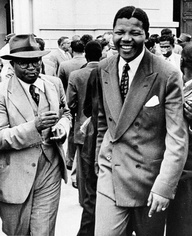
We have lost one of the true heroes and greatest statesmen of our era or any other. A brilliant person, a freedom fighter, a beacon of resistance, a visionary leader, an icon of peace. A person who, alongside others, bore arms when he needed to. A person who, alongside others, consulted the law when he needed to. A person who, alongside others, endured decades years in prison because he had to. A person who, alongside so many other women and men, brought a new dawn and a new day to one of the most benighted countries, wracked by the cancer of institutionalized and systemic racism and white supremacy known as apartheid. A man who chose democracy, who chose inclusion, who chose justice informed and enrichd by forgiveness rather than vengeance. A man who promoted economic, political and justice in the new South Africa. A man who assumed the role of President of a renewed country that was forever changed, giving hope to his people, all the people of his country, and to many more across the globe.

Nelson Rolihlahla MANDELA (July 18, 1918 - December 5, 2013)

The forthcoming New Yorker cover
by Kadir Nelson


Mandela in traditional clothing
A young Mandela
President Nelson R. Mandela
Mandela the young lawyer
Celebrating with Miriam Makeba
Mandela at an ANC rally
Winnie and Nelson Mandela
as newlyweds
"I am prepared to die" (1964)
Mandela at Robben Island

Nelson Mandela with Walter Sisulu

Mandela receiving the Nobel Peace Prize
with South Africa's last apartheid
leader, F. W. de Klerk
MADIBA
Mandela with actor and musician Will Smith

The landmark 1994 South African
presidential ballot
Rest in peace, Madiba, rest in peace.

Videos after the jump:

Thursday, May 10, 2012

Obama Again Supports Marriage Equality + NC Again Denies Equal Rights + Garry Wills on the Myth of Marriage

A busy week, with a big deadline, so these posts will be brief.


I was very glad to see President Barack Obama cease his seesawing and finally (once again) back marriage equality, i.e., same-sex marriage yesterday morning in his conversation with Good Morning America's Robin Roberts. Ever the politician, he qualified it by noting his avowal was only his personal belief and not a policy statement for his administration. He also made no larger or broader statements about the gross inequality that now exists between states that permit same-sex marriage and those, like North Carolina, that have now doubled down on banning it. (It was already outlawed in the Tarheel State; the new law also cancels out civil unions and domestic partnerships.) Popular opinion, however, trends on towards greater acceptance of same-sex marriage, and it eventually will exceed 75% or more, in my lifetime, I believe, which is an amazing thing to consider. And as I said, Barack Obama in a sense is coming home. In 1996, when he ran for the Illinois State Senate he supported same-sex marriage. To become US Senate from Illinois, however, he began his backwards shimmy, and has been dancing around ever since. Until yesterday.

---

As I noted above, Amendment One, banning same-sex marriage and stripping away even more equal rights, passed in North Carolina, 61% to 39%, on Tuesday. I'm not surprised this occurred; civil rights should never be put up to a vote, and while North Carolina is not and has never been the most conservative Southern state by any measure--and even during the US Civil War nearly sided with the Union--it is still not so progressive that Amendment One would have been defeated. I particularly feel for all the North Carolinians who now face having their government-sanctioned relationships voided, because of a bigoted majority.  One question I have for the Democratic Party, which has chosen to hold its presidential convention in Charlotte later this year: why?  North Carolina's recent history with unionized labor was bad enough, but it adds insult to injury--to use that cliché--to hold the event there now.  I'm sure there are other cities that could swing into gear; the Democrats should consider Buffalo, or Cleveland, or return to Denver. Anything but Charlotte, which admittedly provided many votes against the heinous Amendment.  But still...Democrats: Pittsburgh, maybe?

---

A footnote: the eminent historian and my colleague, Garry Wills, with a brief, historically informed commentary, "The Myth of Marriage," on the New York Review of Books' blog.

A quote:

Those who do not want to let gay partners have the sacredness of sacramental marriage are relying on a Scholastic fiction of the thirteenth century to play with people’s lives, as the church has done ever since the time of Aquinas. The myth of the sacrament should not let people deprive gays of the right to natural marriage, whether blessed by Yahweh or not. They surely do not need—since no one does—the blessing of Saint Thomas.

Friday, December 23, 2011

Photo: The Kiss

V-J Day in Times Square © Alfred Eisenstaedt (Life, 1945)


Marissa Gaeta (left) kisses fellow US naval officer Citlalic Snell Photograph: MC2 Joshua Mann/AFP/Getty Images


Thursday, December 15, 2011

Oscar Niemeyer Turns 104

Grades are in, and now it's letters of recommendation time, a few more graduate projects to read, and final preparations for the new quarter, which begins January 3. Yes, you read that correctly. A swift little break this will be...half of it spent at the library!

+++

There are octogenarians among us who continue to create, nonagenarians still at their art, and, believe it or not, centenarians too who are practicing their craft. One is the Brazilian architect and political activist Oscar Niemeyer, who turns 104 years old today. Perhaps most famous for his now iconic buildings for the new, mid-century Brazilian capital of Brasília, Niemeyer has continued to draw upon his inner visions to create buildings of note, transforming metaphors and images into unforgettable structures. One of the 20th century's pioneers in reinforced concrete structures, Niemeyer designed his first building, the Education Ministry in Brazil's then-capital, Rio de Janeiro, in 1936, creating what was reportedly the first state-sponsored modernist skyscraper in the world. The building debuted in 1943.

Memorial JK, Brasília
As this building was underway, Niemeyer met Juscelino Kubitschek, then mayor of Brazil's fourth largest city, Belo Horizonte, the capital of Minas Gerais state. This personal connection would would prove fruitful several times over. At the behest of Kubitschek and Minas Gerais's governor, Benito Valadares, Niemeyer designed Pampulha, a suburb of Belo Horizonte, whose striking complex, completed in 1943, included a church, São Francisco de Assis, which the church authorities would not consecrate until 1959 because of its form and the imagery in it.  Later, when Kubitschek became president of Brazil in 1956, he immediately called upon Niemeyer to help him design a new capital in the country's interior. Niemeyer's former employer, Lúcio Costa, created the plan, and Niemeyer the buildings, and thus was the core of what is now one of the most famous world capitals launched. Even today, over half a century later, Niemeyer's buildings in Brasília, the Presidential residence (Palácio da Alvorada), the House of the Deputies, the National Congress of Brazil, and the Cathedral of Brasília, among others, have not lost an iota of their unique beauty or capacity to arrest the eye and mind.

Government buildings, Brasília

Among Niemeyer's many other buildings notable creations are the Headquarters of the United Nations, designed collaborative with one of his epigones, Le Corbusier (1947); São Paulo's Ibirapuera Park, which commemorated that city's 400th anniversary (1951); the French Communist Party seat in Paris; the headquarters of Mondadori, the Italian publisher, in Milan; and, in Brazil, two of the most eye-catching of buildings of the last 40 years: the space-ship like Museum of Contemporary Art in Niterói, the former state capital that sits across Guanabara Bay from Rio de Janeiro, and the hovering eye that is the Oscar Niemeyer Complex in Curitiba, Paraná State. Niemeyer designed the Niterói museum at the age of 89, in 1996, and the Niemeyer Complex in Curitiba in 95. In Brasília, he also designed a tribute to the city's founder, the Memorial Juscelino Kubitschek, in 1980. In 1988, he received the highest international prize for architecture, the Pritzker Architecture Prize, becoming the second Latin American (after Luís Barragán, of Mexico, in 1980) and first Brazilian (Paulo Mendes da Rocha followed in 2006) to be so honored.

Centro Niemeyer, in Avilés, Spain
One of Niemeyer's most recent designs, the Óscar Niemeyer International Cultural Center (or Centro Niemeyer) in Avilés, Asturias, Spain, opened 9 months ago to national and international acclaim, but is shutting down, temporarily one hopes, and will remove Niemeyer's name after an ongoing brouhaha between the new conservative government and the art center's administrators, who are accused of having misspent public funds. Whatever happens with the arts complex, it's clear that as long as he's breathing Niemeyer will keep designing, and I look forward to marking his 105th birthday next year.

Sunday, October 02, 2011

Freedom Budget + Occupy Wall Street's Declaration

Much ado about various responsibilities, so no time for intensive blogging, but the ever brilliant Geoffrey J. pointed me toward the following remarkable document, the Freedom Budget For All Americans: Budgeting Our Resources, 1966-1975, To Achieve 'Freedom From Want,'" which the A. Philip Randolph Institute of New York published in 1966. In edition to the eponymous Randolph, the longtime president of the Brotherhood of Sleeping Car Porters, one of the most important 20th century labor organizations for African-Americans, and a beacon in and of the Civil Rights Movement, other signatories to the document include many of the leading lights of the mid-century labor, progressive, civil, human and equal rights movements, crossing all racial, ethnic, ethnic, and class backgrounds. (There are almost no women on the list, but this document appears almost at the early point of what we now think of as the full-flowering of women's movement and second wave feminism; there are also almost no openly queer signatories, save Bayard Rustin, but the document precedes the Stonewall Riots by 3 years.)

A page from the Freedom Budget, 1966
It's a remarkable document, and I urge you to read it at your leisure, but sooner rather than later; it's hosted on invaluable the Internet Archive site, which allows you to read documents online, download them in a range of formats, and forward them to others quite easily, free of charge.

The Freedom Budget makes an engaging companion template to the Declaration of the Occupation of New York City, which was accepted by the General Assembly of the Occupy Wall Street protests, which I first wrote about almost three weeks ago, on September 29, 2011. I am linking to it, but also posting it in full. Whatever one may feel about the protests, which I personally believe are among the most important to have occurred in the US in some time, the principles below articulate a good deal of what a great many people--a great many of the 99% of us who have not been the beneficiaries of the disaster-capitalism, supply-side, neoliberalism-meets-libertarianism economic debacle that has marked not just the decade preceding the Global Financial Crisis 2.0 of 2007-2009 (+), but of the 3 decades before--feel about what has gone wrong, while highlighting a number of other issues that are important to progressives in the US. The document below, like the protests, is both an important start, and a vital link in a long tradition of dissent and protest from the left that has preceded it. Do read it, amend it, talk about it, challenge and debate about it, but above all, pass it on.
Declaration of the Occupation of New York City
Posted on September 30, 2011 by NYCGA
THIS DOCUMENT WAS ACCEPTED BY THE NYC GENERAL ASSEMBLY ON SEPTEMBER 29, 2011
As we gather together in solidarity to express a feeling of mass injustice, we must not lose sight of what brought us together. We write so that all people who feel wronged by the corporate forces of the world can know that we are your allies.

As one people, united, we acknowledge the reality: that the future of the human race requires the cooperation of its members; that our system must protect our rights, and upon corruption of that system, it is up to the individuals to protect their own rights, and those of their neighbors; that a democratic government derives its just power from the people, but corporations do not seek consent to extract wealth from the people and the Earth; and that no true democracy is attainable when the process is determined by economic power. We come to you at a time when corporations, which place profit over people, self-interest over justice, and oppression over equality, run our governments. We have peaceably assembled here, as is our right, to let these facts be known.

They have taken our houses through an illegal foreclosure process, despite not having the original mortgage.
They have taken bailouts from taxpayers with impunity, and continue to give Executives exorbitant bonuses.
They have perpetuated inequality and discrimination in the workplace based on age, the color of one’s skin, sex, gender identity and sexual orientation.
They have poisoned the food supply through negligence, and undermined the farming system through monopolization.
They have profited off of the torture, confinement, and cruel treatment of countless animals, and actively hide these practices.
They have continuously sought to strip employees of the right to negotiate for better pay and safer working conditions.
They have held students hostage with tens of thousands of dollars of debt on education, which is itself a human right.
They have consistently outsourced labor and used that outsourcing as leverage to cut workers’ healthcare and pay.
They have influenced the courts to achieve the same rights as people, with none of the culpability or responsibility.
They have spent millions of dollars on legal teams that look for ways to get them out of contracts in regards to health insurance.
They have sold our privacy as a commodity.
They have used the military and police force to prevent freedom of the press. They have deliberately declined to recall faulty products endangering lives in pursuit of profit.
They determine economic policy, despite the catastrophic failures their policies have produced and continue to produce.
They have donated large sums of money to politicians, who are responsible for regulating them.
They continue to block alternate forms of energy to keep us dependent on oil.
They continue to block generic forms of medicine that could save people’s lives or provide relief in order to protect investments that have already turned a substantial profit.
They have purposely covered up oil spills, accidents, faulty bookkeeping, and inactive ingredients in pursuit of profit.
They purposefully keep people misinformed and fearful through their control of the media.
They have accepted private contracts to murder prisoners even when presented with serious doubts about their guilt.
They have perpetuated colonialism at home and abroad. They have participated in the torture and murder of innocent civilians overseas.
They continue to create weapons of mass destruction in order to receive government contracts. *

To the people of the world,

We, the New York City General Assembly occupying Wall Street in Liberty Square, urge you to assert your power.

Exercise your right to peaceably assemble; occupy public space; create a process to address the problems we face, and generate solutions accessible to everyone.

To all communities that take action and form groups in the spirit of direct democracy, we offer support, documentation, and all of the resources at our disposal.

Join us and make your voices heard!

*These grievances are not all-inclusive.
 These grievances are not all-inclusive, indeed. Now read the Freedom Budget, and note how many of these issues are addressed or touched upon both in its in general principles, and in its specific plans for how the government might spend its--our--monies.

We have a ways to go, but to the people of Occupy Wall Street and all the sibling protests, all over the country and the world, you are on the best track, a new one building upon many older ones, and I like many people say: thank you!