Showing posts with label free jazz. Show all posts

Tuesday, April 10, 2018

Cecil Taylor (1929-2018)


Another one of the greats, Cecil Taylor, is gone. He passed away on April 5. As longtime J's Theater readers know, I've posted about Taylor many times, including on his 86th birthday, back in 2015; when he appeared on NPR back in 2012 (along with my poem about him and his music, "Dark to Themselves," which appeared in Jazz Poems, edited by Kevin Young); my afternoon in 2007 watching the marvelous documentary Imagine the Sound with Northwestern colleagues Kevin Bell and Ed Robersonback in 2005, on his 75th birthday; and again in 2005, when I saw him perform live at the Blue Note, in Manhattan ("Apraxia, apraxia, apraxia!"). (I wanted to meet him then but only got a glimpse of him peering out through the crack in his green room door.)

I described how he opened the performance like this (the Keith I mention is Keith Obadike, who was there with his wife and fellow artist Mendi, as were Christopher Stackhouse, his partner Kelly Kivland, and a friend of theirs named Lute):

Taylor, as Reggie H. and others have described, entered dramatically, this time in his striped socks after his bassist and drummer had opened the set as a duo, Balgochian doing some interesting moanful bow-work with the lowest portion and register of his bass strings. Then he extracted a handwritten score/graph/chart, which I assume, in my gross musical ignorance, contained the melodic kernel he was going to develop and improvise off of, as well as some harmonic guides and cues, some text and the gods know what else (scribbles? quotes?), CT proceeded to recite an opening poem that riffed off "Chinampas 1," which I listened to again today. Then he and the trio launched into this long and furious set. Afterwards I told Mendi and Keith that it reminded me of a player piano that had caught the Spirit (and spirits) and was revved up by multiple motors. Keith put it more succinctly: "A player piano speaking tongues." Krall, who appears on CT sessions from around 1996 forward, seemed to flow well with CT, sometimes pacing, other times mirroring, other times chasing CT's polymetric races along the keyboard, but Balgochian sometimes seemed out of sync as if he couldn't catch up or missed some of his cues (sometimes his expression betrayed this) or just wasn't up for it, though he gave it a valiant effort. He did know enough to stop on a dime, like Krall, when CT (maybe giving a visual cue) ended the pieces.


Reading some of the obituaries of Taylor, I appreciated how they captured differing facets of who he was and what he accomplished. He was, as the 2005 performance demonstrated, at his very core a poet--experimental, searching, daring, profound, uncompromising, his medium and grammar extending from words into space, and onto the keyboard, via notes themselves. Sound and time were his true media. Pushing the evolving jazz conventions from the very beginning, Taylor kept developing and trying out new possibilities, individually and with ensembles. A native of Queens, he deftly combined a wide array of influences, drawing from the blues, other African-American, Euro-American and European sources--he studied at the New York College of Music and the New England Conservatory--to an often sublime invention, and though one could draw throughlines from his early career to the works of the last few year, Taylor almost never repeated himself.

Among the musicians Taylor recorded with are innumerable greats: Earl Griffith, Steve Lacy, Buell Neidlinger (who passed earlier this year), Sunny Murray (who passed late last year), John Coltrane, Gil Evans, Jimmy Lyons, Andrew Cyrille, Mary Lou Williams (!), Max Roach, Dewey Redman, Elvin Jones, and Peter Brötzmann. He also performed with dancers, including Min Tanaka and Mikhail Baryshnikov. Taylor's detractors, including Miles Davis (another great innovator) and Branford Marsalis, were legion, but so were his admirers, including former President Jimmy Carter, who invited him to perform at the White House. (Just imagine the current resident even vaguely considering such a thing.) One of my favorite albums of his is Great Paris Concert of 1966, which includes the masterpieces "Student Studies (Part 1)," "Student Studies (Part 2)," and "Niggle Feuigle." I also love his late-career trio recording with Dewey Redman and Elvin Jones, Momentum Space, particularly the songs "Is," "It," and "Spooning." One commemoration I especially appreciated was Jason Moran's discussion of Taylor's artistry, and how it took him years to grasp what Taylor was up to.

Cecil Taylor was outed by the critic Stanley Crouch, and became one of the most high-profile gay figures in jazz, though he sidestepped that term while remaining unapologetically himself. His oeuvre, I would argue, queered jazz as we know it, and its influence continues to ripple out in instrumentalists who may or may not appear to have any direct ties to him. Taylor's relationship to his blackness was solid and complex, and was a topic about which he could be combative, as when, back in 1964 while participating in a "Jazz Weekend" at Bennington College, he defined  what jazz was and could be, avowing its roots in African-American life, culture and experience, to the displeasure of some on a panel discussion and in the crowd. In 2013, he received the prestigious Kyoto Prize; the Inamori Foundation, the award's grantor, praised his life's work, though "free jazz" only scratches the surface:
One of the most original pianists in the history of free jazz, Mr. Cecil Taylor has developed his innovative improvisation departing from conventional idioms through distinctive musical constructions and percussive renditions, thereby opening new possibilities in jazz. His unsurpassed virtuosity and strong will inject an intense, vital force into his music, which has exerted a profound influence on a broad range of musical genres.
A contractor he had befriended stole nearly the entire amount, before being caught, tried and convicted.

A few videos about Taylor, including one of my favorites, "Les grandes répétitions":

"Les grandes répétitions"

A fragment from Ron Mann's Imagine the Sound

Interview, from the Snapshots Foundation (full interviews here)

Cecil Taylor performing at Ornette Coleman's memorial, in 2015

Dark to Themselves

As I concluded in my poem tribute, "Their ears are still learning." 

Friday, June 12, 2015

Remembering Ornette Coleman

(Randolph Denard) Ornette Coleman (March 9, 1930 - June 11, 2015) succeeded, through his extraordinary musical gifts and linguistic inventiveness, in introducing a new term and form into American music: free jazz. It was the genre for which Ornette--whose first name alone sufficed as his calling card--was best and will always be known, and it exploded upon the landscape with such force that some major figures have still not fully reckoned with it. He did not, however, introduce free jazz alone; his collaborators, beginning in the late 1950s, were the heralds of, as Coleman's albums announced, "Something Else!!!!," "The Shape of Jazz to Come," "Tomorrow is the Question!," and of course, "Free Jazz."

Ornette Coleman was born and grew up in segregated Fort Worth, Texas, and never formally studied music, though he began playing the saxophone while still in high school. He allegedly was dismissed for improvising during a performance of John Philip Sousa's famous march, "The Washington Post"--the shape of things to come!--and later performed R&B and bebop, then the dazzling, dominant trend in jazz, first with his own band and then with a traveling R&B show. After a brutal physical attack in Baton Rouge, Louisiana, Coleman switched to the alto saxophone, which would become his primary instrument for the rest of his life.

Beginning with Something Else!!!: The Music of Ornette Coleman and continuing through the landmark albums of the early 60s, which paralleled Ornette's gigs at major venues across the US, he developed what would become quickly viewed as a revolutionary approach to jazz. I am obviously not a musicologist, but I can say that when I listen to these records I hear the variations of the blues and bebop expressed as a series of wails, plaints, chants, extended runs; dissonance liberated, melodies stretched like rubber bands, and harmony pressed beyond its limits in improvisatory and daring ways in solos and instrumental combinations; and a sense of ever-new discovery of what a (plastic, initially) saxophone individually and in combination with small ensemble, can do. Coleman labeled his approach harmolodics, which he defined as "the use of the physical and the mental of one's own logic made into an expression of sound to bring about the musical sensation of unison executed by a single person or with a group."

Coleman drew supporters, among this collaborators such as Don Cherry, Paul Bley, Billy Higgins, Charlie Haden, and even Lionel Hampton and Leonard Bernstein, but also harsh critics; Miles Davis, another of the greatest musicians of his era and a bebop veteran who was pioneering his own new style in the late 50s, "cool jazz," in some ways perhaps the musical antithesis of Coleman's development, mocked the saxophonist, saying he "was all screwed up inside," though he allegedly subsequently retracted this statement.  The effects of Coleman's and his collaborators' performances and pressings, however, would ripple out with free jazz becoming a genre in its own right. From the mid-1950s through the mid-1960s, he was married to the great poet Jayne Cortez, and their son, Denardo Coleman, eventually became an important musician in his own right.

Later Coleman shifted to working with bigger ensembles, particularly string orchestras, as well as electronic instrumentation, and tended to record his own compositions. One of my favorite albums by him is his 2005 LP Sound Grammar, which features tunes that quote standards by Richard Rodgers, among others. The album received a 2006 Grammy nomination for Best Jazz instrumental Performance, and went on to receive the 2007 Pulitzer Prize in Music, making Coleman the first and only person to receive a Pulitzer Prize in music for a jazz recording, and only the second African American winner in this category. Among his other honors were the 2001 Praemium Imperiale from the Japanese Imperial family, the 2004 Gish Prize, the 2009 Miles Davis Award, and a 2007 Grammy for Lifetime Achievement.

Though he is gone, his music--and free jazz, in its many permutations today--will live on. Here are a few recordings. Enjoy!


The Shape of Jazz to Come (full album), 1959

Free Jazz, 1960

Tomorrow Is the Question (Full Album), 1959

 Dancing In Your Head (Full Album), 1976
Sleep Talking, from Sound Grammar, 2005

Wednesday, March 25, 2015

Happy 86th Birthday & Cecil Taylor à Paris

Cecil Taylor
Today is pianist and composer Cecil Taylor's 86th birthday. One of the true originals of late 20th century American music, a pioneer in free jazz and a master in exploring the intersections between improvisation and notated European classical traditions, Taylor has been sparking admiration and dissent since founding his own band in the mid-1950s. Some years ago on this blog I wrote a short review of hearing him live at the Blue Note. On YouTube there are numerous videos of Taylor playing away, and several documentaries or trailers about, as well as interviews with him.

One of my favorites is Cecil Taylor à Paris: De l'autre côté du chemin de fer (mislabeled Les grandes répetitions 1968 on Youtube). This was one of five documentaries on contemporary music, under the title of Les grande répétitions, that were filmed for French TV in 1965 and 1966, and as the video shows, it was directed by Luc Ferrari and S. G. Patris, and produced by the great electronic musician Pierre Schaeffer. The short film features Taylor in several poetic, revelatory exchanges about his music and life, including some clever, controversial mythmaking by Taylor, bizarre clips by the filmmakers, and vibrant performances by Taylor's quartet, with Jimmy Lyons on saxophone, Alan Silva (misnamed Ron Silva in the credits) on bass, and Andrew Cyrille on drums.

Ferrari and Patris filmed the documentary shortly after Taylor had completed recording one of his greatest albums (and one of my favorites), Student Studies (The Great Paris Concert), and he and his combo are in exceptional form. Taylor's assured, percussive playing is especially thrilling, and it's clear that the excitement of the groove extends to all members of the combo, who rock the walls of their set in a room in the Place des Vosges, in Paris's Marais district.  I would have embedded the video but the original poster has removed that option, so please click on the title above to see the video, and here are some screen caps of Cecil Taylor and the film. Enjoy! 


Wednesday, December 28, 2011

Quartet: Chamberlain / Frankenthaler / Rivers / Havel

Last Wednesday, the sculptor and plastic artist John Chamberlain passed away. He was 84. I always think of him as Mr. Crushed Cars, though he worked in media other than, well, crushed scrap metal from cars. But what he could do with car parts! I often perceive a physical lightness (akin to the wittiness of their names) in his sculptures that is quite at odds with the weightiness of their materials and materiality.  Interstellar flowers, often brightly, crazily colored, gracing our world. Here are a few images of his sculptures.
BIG E (© 2001 John Chamberlain / Artists Rights Society (ARS))
Taffeta Coupé (© PaceWildenstein, 1999)
Imagescrimmage, 2007 (image courtesy of: www.anthonymeierfinearts.com)
Untitled, c. 1961 (image courtesy of: www.artnet.com)
Also leaving the world was Helen Frankenthaler, one of the New York School's major figures, an adept of Clement Greenbergian formalism, whose career spanned the entire second half of the 20th century. She was 83, and a pioneer in "stain painting" untreated canvas. I had no  idea that she was conservative in her leanings and even participated, as a friend's email relayed, in helping to shut down the National Endowment of the Arts's grants for visual arts when she went on record criticizing several of the grantees, including Andrés Serrano. Bad politics, to my mind, yet there is, however, the art.  I have seen some of the paintings in person, and find them quite beautiful, lyrical, enchanting.  To reframe a point made by another artist in a forwarded email, does Frankenthaler's formalism provoke thoughts about the politics of form, and if so, what politics (and ideology) does her formalism suggest?  Some images:

The Bay, 1963 (© Detroit Institute of Arts via Detroit Free Press)
Nature Abhors a Vacuum, 1973 (© National Gallery of Art, Washington)
Bacchus, 2002 (© Knoedler and Company, New York)
Driving East, 2002 (© Knoedler and Company, New York)
 Mauve Bag, 1979 (© Helen Frankenthaler, Morgan Library, NY)

Geoffrey J. noted that another figure who passed recently was the saxophonist Sam Rivers, one of the brightest lights in New York's loft jazz scene of the 1970s. His Studio Rivbea, on Bond Street in the East Village, open from 1970 till 1979, was one of the major sites places to catch him and others during this period.  A native of Oklahoma who grew up in Chicago, Rivers was 88, and began playing free improvisations in the late 1950s, eventually working in combos with Miles Davis, Cecil Taylor, Dave Holland, Dizzy Gillespie, and many other greats.  He could turn his tenor saxophone inside out, offering dazzling improvisations that the videos below give hints of, but he also could make music on a range of instruments, and could set the pace in a variety of styles. he In recent years he was living in Florida, and revived his Rivbea Orchestra.  Now, those videos:

Sam Rivers and Dave Holland, Pisa, 1980

Sam Rivers Quartet 1989 - Beatrice

Sam Rivers Trio, 1979 - Germany

Sam Rivers and the Rivbea All-Star Orchestra, rehearsing, 1998

Sam Rivers and the Orlando Rivbea Orchestra, 2010

Jazz at Lincoln Center, JazzStories podcast, 2011

***

Lastly, an artist who put his career on hold in the service of freedom, others' and his own, Václav Havel (1936-2011), the playwright and former president of what was then the new post-Soviet Czechoslovakia, and what is now the Czech Republic, has passed away. He was 75. The scion of a wealthy family that was targeted by the post-World War II Czech Communist regime, Havel was denied the opportunity initially to study the humanities, yet later took a correspondence course and trained in the theater, developing his skills as a playwright in the early 1960s before becoming, after the Prague Spring period in 1968 one of his country's leading dissidents, ending up in jail and continually persecuted until the winter of 1989 and the fall of the old order. With his country's transition to democracy, he became its leader.  His tenure was rocky, through no fault of his ideas or ideals; politics, he knew and relearned, are difficult and often complicated, and with an opponent as dogmatic and deadset as Václav Klaus, he had a battle on his hands.  As a playwright he had often captured this difficulty, this complexity, ad absurdum: now he was living it. His tenure ended finally in 2003; he wrote an autobiography, and returned to dramaturgy as well.

One of Havel's greatest and most enduring works is his 1978 essay, "The power of the powerless," in which he says, in words prefiguring the transformations his own nation witnessed nearly two and a half decades ago, and that we are again seeing across the globe over the last few years:

 For the real question is whether the brighter future is really always so distant. What if, on the contrary, it has been here for a long time already, and only our own blindness and weakness has prevented us from seeing it around us and within us, and kept us from developing it?

Wednesday, July 13, 2011

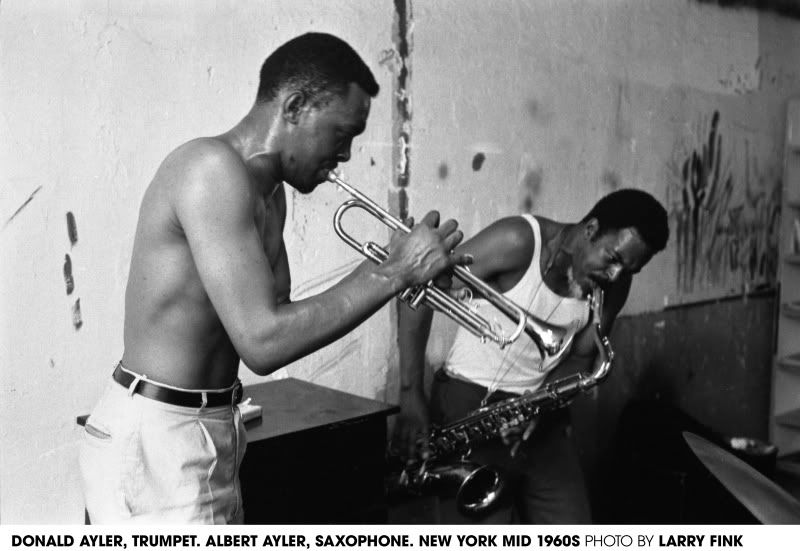
Albert Ayleriana

b. Cleveland Heights, Ohio, July 13, 1936 - d. New York, NY, November 25, 1970

"Love means nothing in tennis, but it's everything in life."
Albert Ayler, "My Name Is Albert Ayler"

"John [Coltrane] was like a visitor to this planet. He came in peace and he left in peace; but during his time here, he kept trying to reach new levels of awareness, of peace, of spirituality. That's why I regard the music he played as spiritual music -- John's way of getting closer and closer to the Creator." - Albert Ayler, in Valerie Wilmer, As Serious As Your Life, p.31

from lyssa.humana.blogspot.com
+ saxophonist, major figure in free, avant-garde jazz, "energy music"
+ music characterized by almost elemental force, piercing, versatile tone and range, startling improvisatory skills, bone-chilling, other-wordly feeling
+ drew from blues, R&B, marches and classical music, Tin Pan Alley standards, rock & roll, and other established and vernacular forms
+ studied at the Academy of Music in Cleveland with Benny Miller
+ US Army veteran
+ played with Little Walker, Stanley Turrentine, Cecil Taylor, Gary Peacock, Sunny Murray, Don Cherry, brother Donald Ayler, Charles Tyler, Lewis Worrell, Bobby Few, Niels-Henning Ørsted-Pedersen

Notable recordings: My Name Is Albert Ayler (Delmark, 1963); Spirits (a/k/a Witches and Devils) (Delmark/Freedom, 1964); Goin' Home (a/k/a Swing low sweet chariot) (Black Lion/Osmosis, 1964); Prophecy (ESP, 1964); Spiritual Unity (ESP, 1964); New York Eye and Ear Control (ESP, 1964); Ghosts (a/k/a Vibrations) (Debut/Freedom, 1964); The Hilversum Session (DIW, 1964); Bells (ESP, 1965); Spirits Rejoice (ESP, 1965); At Slug's Saloon, Vol. 1 & 2 (ESP, 1966); In Greenwich Village (Impulse!, 1966); Music Is The Healing Force of the Universe (Impulse!, 1969); The Last Album (Impulse!, 1969); The Complete ESP-Disk Recordings (ESP, 2006).

Documentary: My Name Is Albert Ayler (2007), Kasper Collin, director and writer.

I once spent an afternoon listening to Bells and felt afterwards like my ears had been reset.

"I feel really free over here. One thing every day will be as it should be." - Albert Ayler, on "My Name Is Albert Ayler"


Albert Ayler, "Billie's Bounce"


Albert Ayler, "Summertime"


Albert Ayler Quartet, at John Coltrane's Funeral, July 21, 1967, "Love Cry, Truth Is Marching In, Our Prayer"


Albert Ayler, "Nobody Knows the Trouble I've Seen"


Albert Ayler, "Ghosts"


Albert Ayler, "Spirits"


Albert Ayler, "Angels"


Albert Ayler, "All Love"


Albert Ayler, "Spiritual Reunion," Nuits de la Fondation Maeght, 1970

Albert Ayler, "On Green Dolphin Street