After one of my always too-brief trips home, I headed back west to teach and host this year's Visiting Fiction Writer-in-Residence,
Junot Díaz, who flew in for a whirlwind visit from Rome, where he's spending the year on a
Rome Prize, awarded by the
American Academy of Arts and Letters. As part of his visit, he met with our senior-year writers over two days, spoke to my fiction major advanced sequence class, where he discussed the issue of how to shift from short fiction, which the students are working on now (3 longish stories by the end of the first half of the course) to longer forms (like the novella they'll have to complete by June); delivered a talk about craft, which the students who attended were still talking about a day later; and read a brief section from his new novel,
The Brief Wondrous Life of Oscar Wao (one of my October and November book selections), as well as a very brief story, "Alma," before opening the floor to questions. I was incredibly pleased that Díaz was able to join us, and especially appreciated his graciousness, openness, and thoughtfulness when he was with the students, some of whom told me immediately after that class that they found his comments "excellent." (Personally, I also love his
REALNESS.) They were taking notes assiduously, and even, like several other colleagues who primarily teach different genres (poetry, creative nonfiction), scribbled down some of what he had to say at the talk. In essence, he broke it down in terms of the issue of character and how important it was (is) to fiction writing, and how characters in relation to each other and the other elements of fiction, which is to say, character as transactional, was what writers ought to keep in mind. He stressed that his comments weren't meant to be prescriptive or proscriptive, but he also then noted that as fiction editor of the
Boston Review, he saw a great deal of stories that were really stories of "condition," static, lacking conflict and what emerges from it, without any real movement in terms of narrative arc or dramatic arc, let alone plot(tedness); his emphasis on character(s), the source of conflict, was an effort to counter this. At the reading, both the excerpt from the novel and "Alma" illustrated his points, while also demonstrating how you could artfully negotiate the dangerous ground of second-person narration (you), an issue my graduate class and I have been exploring to some extent (
Jhumpa Lahiri's May 6, 2006
New Yorker story "All in a Lifetime," is exemplary in this regard). It was also pleasing to see that both the talk and the reading were packed, and that students as well as people not directly affiliated with the university (hey LaToya!) not only showed up, but actively posed questions and engaged Díaz in conversation. Below are a few photos I snapped with my camera phone, which is 1,000x better than the previous one.

Díaz chatting with one of my introductory fiction students, Andrés, after his talk

The crowd slowly filling up before the reading

Díaz reading his short story, "Alma"

Díaz answering questions after his reading
###

On a different note, for those in New York City and environs, please consider catching the current, brief run of one of my favorite plays,
The Ohio State Murders, by one of my favorite authors and cultural hero(in)es,
Adrienne Kennedy.
Charles Isherwood's mostly laudatory New York Times review today provides some useful background on 76-year-old Kennedy, a treasure of American and African-American literature, and on the work itself, which is relatively formally conventional by Kennedy's standards, but quite challenging in its themes and content, as it delves into her usual trove of racially and sexually inflected uncanniness, with parallel selves, twins, intertextual critique, insanity, and a mysterious murder all mixed together for a haunting measure.
Isherwood criticizes the production, which he suggests could have used a larger, deeper set to enhance the play's eerieness, its underlying terror, but I guess I'd have to see it to judge this. (Point of fact, I've never seen the play, but have read it many times and taught it as well.) This run stars
The Practice's
LisaGay Hamilton (at right, standing, with Cherise Boothe, from
New York Times, Gerry Goodstein) whose performance Isherwood calls "spellbinding." That's quite a compliment, so catch it and be bound by her--and Kennedy's spell--if you can.
###

There are people for whom the words and phrases "Bells," "Witches and Devils," "Ghosts," "Spiritual Unity," and "New York Eye and Ear Control" conjure a name instantly:
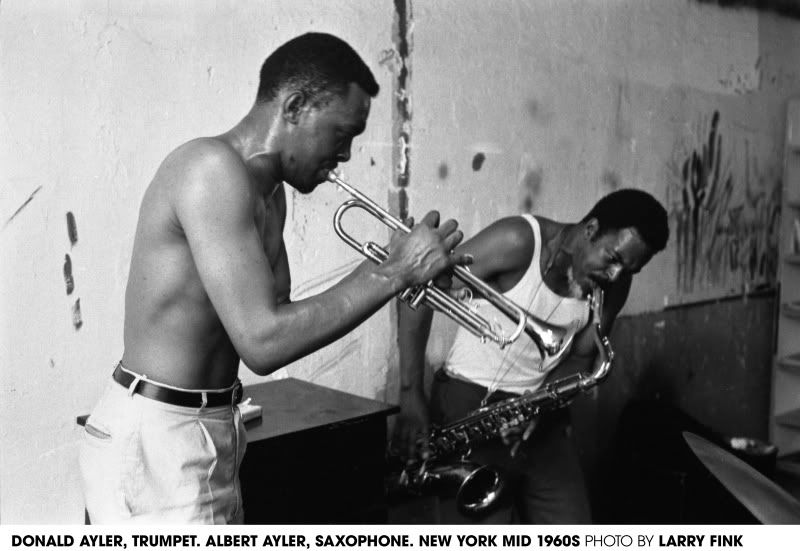
Albert Ayler. The saxophone visionary, adept of
Cecil Taylor and protegé of
John Coltrane, who blazed on the public scene in the early 1960 and made around a dozen landmark records, only to be found floating in the East River in 1970, is one musician whose work, once heard, usually isn't forgotten or mistaken for anyone else's. And not only not forgotten; as a friend once said to me after listening to
Spirits Rejoice, she had nightmares and was afraid to be alone in her apartment for a while afterwards. My experience was different, but I recognize that Ayler's music, particularly the late-career inner ear-shearing honks, bleats, shrieks, cries, hollers, and wails, couched within more than a little soulful swinging, to my mind the sonic embodiments of an almost indescribable freedom, and its antecedent and parallel, suffering, that were so palpable for millions of Americans, especially Black Americans, during the period of his career, are not for everyone. Or really for anyone but those who're able and willing to listen. If you've never listened to Ayler's music--and I went through my 20s phase of trying to ferret out every obscure Black musician I could get my hands on, which is how I came across him, and am glad I did, since he was not part of the expansive r&b, soul, rock&roll, and jazz soundscape in which I grew up--
there's a new film out, playing for a week at Film Forum in, where else, New York City: Kasper Collin's My Name is Albert Ayler. The
New York Sun's reviewer likes it quite a bit. According to another review I saw, it's antithetical to the Burns model; consisting of audio snippets of performances and interviews with Ayler and those close to him, still imagery, and video clips of family members and associates, it sounds like it jars the viewer out of spectatorial passivity. Which seems appropriate in Ayler's case. Ayler's no easy study. But you just might dig him a lot. A whole lot. In small doses.