Showing posts with label Oscar Niemeyer. Show all posts

Friday, December 07, 2012

Oscar Niemeyer, Poet of Geometry & Reinforced Concrete

Almost to the week last year I blogged about the 104th birthday of Oscar Niemeyer, the Brazilian modernist architect who cemented his reputation through his designs in the 1940s first of the Pampulha entertainment complex in a suburb of Belo Horizonte, then collaboratively of the United Nations complex (with Wallace K. Harrison and LeCorbusier, among others). He saw the realization of his most important and visionary buildings and plans from 1956 to 1960, with the building and inauguration of the then-new Brazilian capital city, Brasília. And so it remains; as beautiful and iconic as many national capitals are, there are none as striking and unforgettable--from the sky or on land--as Brazil's third and current one. Two days ago, on December 5, 2012, Oscar Niemeyer passed away, after respiratory problems. Born Oscar Ribeiro de Almeida Niemeyer Soares Filho on December 15, 1907, in Rio de Janeiro, he lived in exile in France as a result of the Brazilian dictatorship for nearly 20 years, returned to his native country to increasing domestic and international acclaim, and continued to draw and create designs right up to his death. He had even débuted a new building in Rio, based on a design from 1997, just two years ago. Here in tribute are a few images of his work.

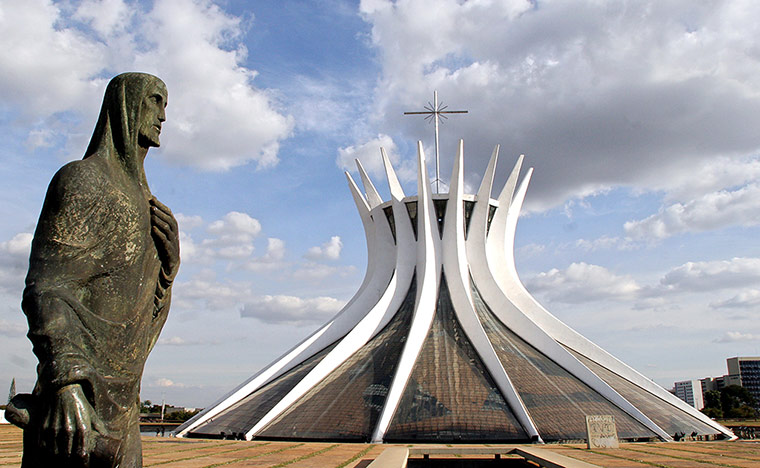
Brasília's Metropolitan Cathedral, in 2005
(Evaristo Sá/AFA/Getty Images)
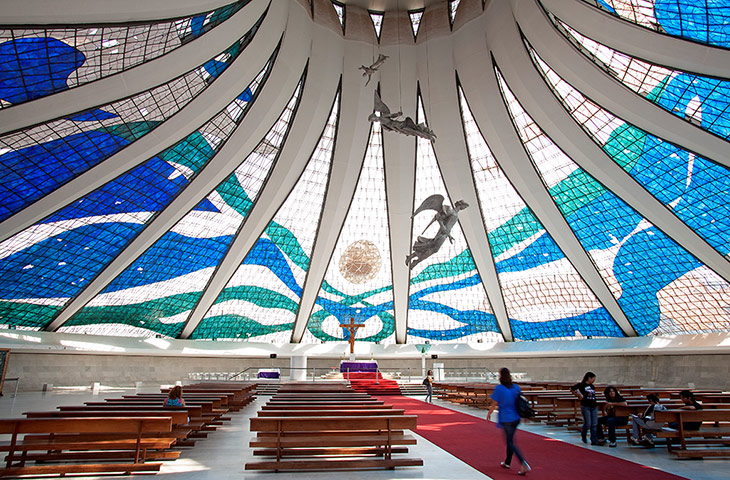
The remarkable interior of the Cathedral
of Our Lady of Aparecida (Catedral Metropolitana
Nossa Senhora Aparecida), Brasília
(Ludovic Maisent/Hemis/Corbis)
Pampulha Complex
Niemeyer's Pampulha complex, from the 1940s (Wikipedia)
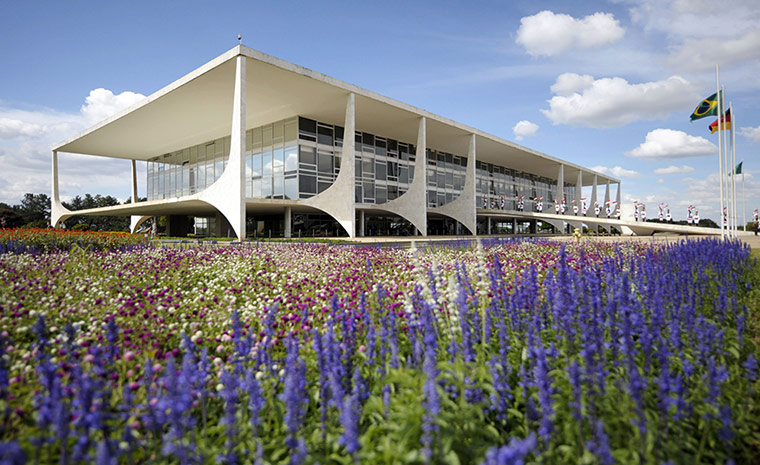
The Palácio do Planalto, the Brazilian presidential palace, Brasília
(Michael Kappeler/AFP/Getty Images)
UN Buildings
The UN Headquarters in NYC (Wired.com)
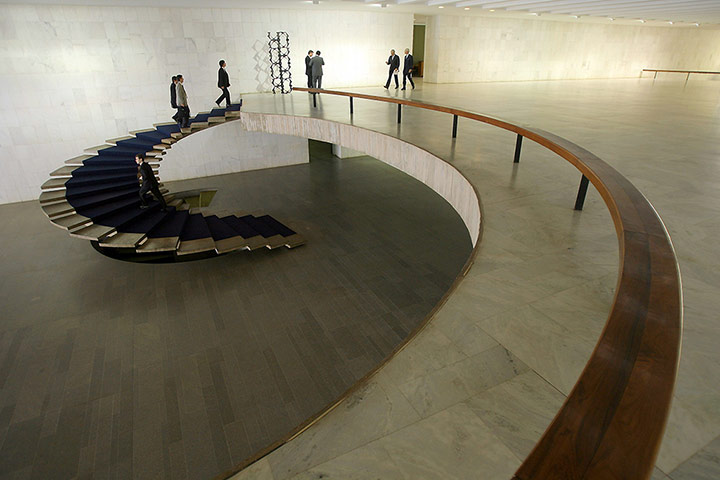
The foyer of the Palácio do Itamaraty, Foreign Ministry
(Tim Brakemeier/Corbis)
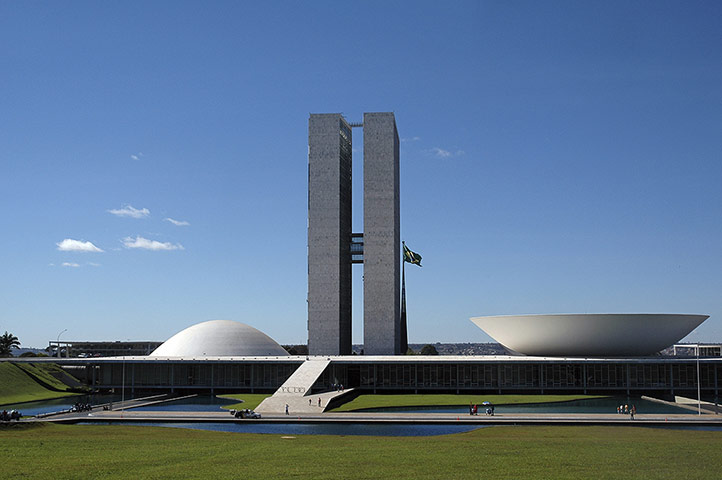
Brazilian National Congress buildings, Brasília
(Image Broker/Rex Features)
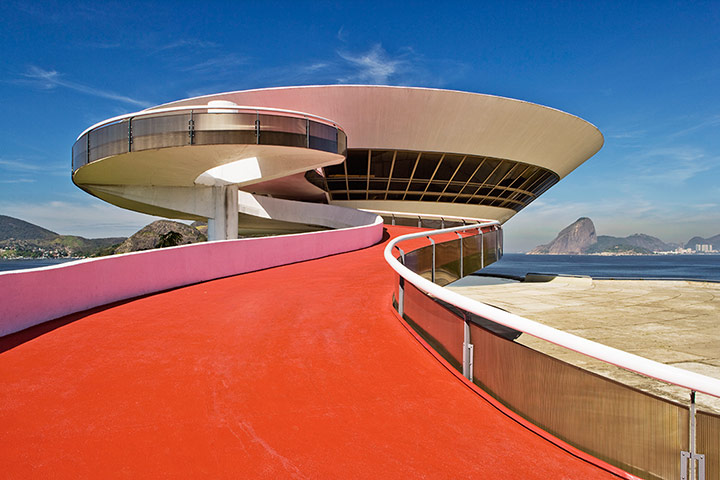
Ramp leading up to the Museum of Contemporary Art, Niterói
(Alan Weintraub/Arcaid/Corbis)
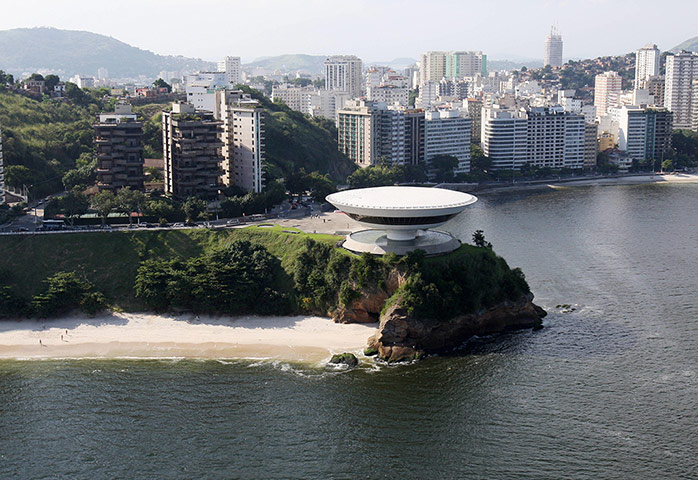
Museum of Contemporary Art, Niterói,
across Guanabara Bay from Rio de Janeiro
(Vanderlei Almeida/AFP/Getty Images)
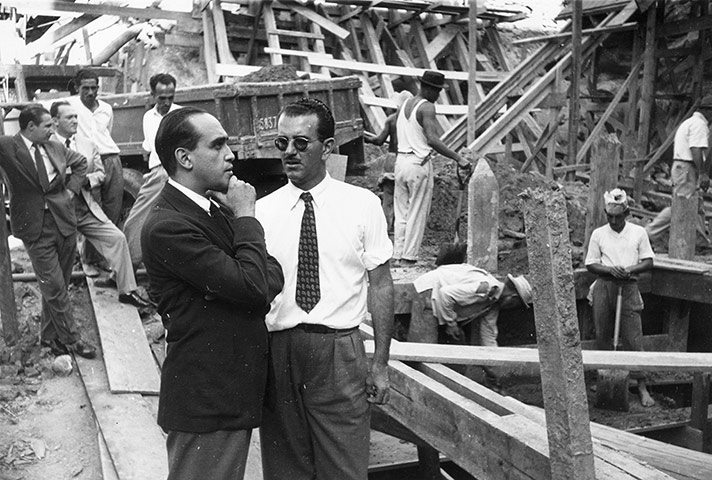
Niemeyer, hand on chin, inspecting an office block
in downtown Rio de Janeiro, 1950
(Kurt Hutton/Getty Images)
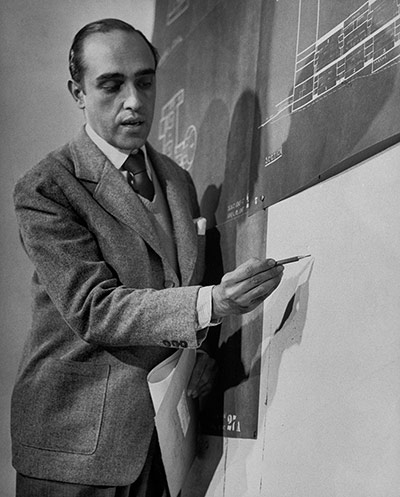
Niemeyer discussing the United Nations complex design
(Frank Scherschel/Time & Life Pictures/Getty Image)
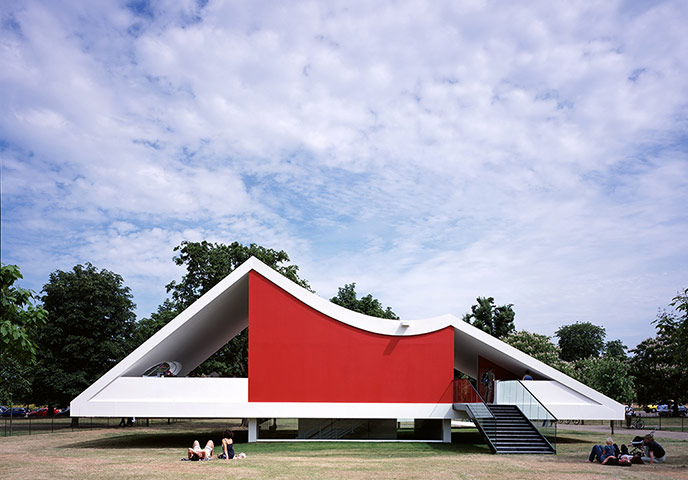
Serpentine Gallery pavilion, Kensington Gardens, London
(John Maclean/View Pictures/Rex Features) 
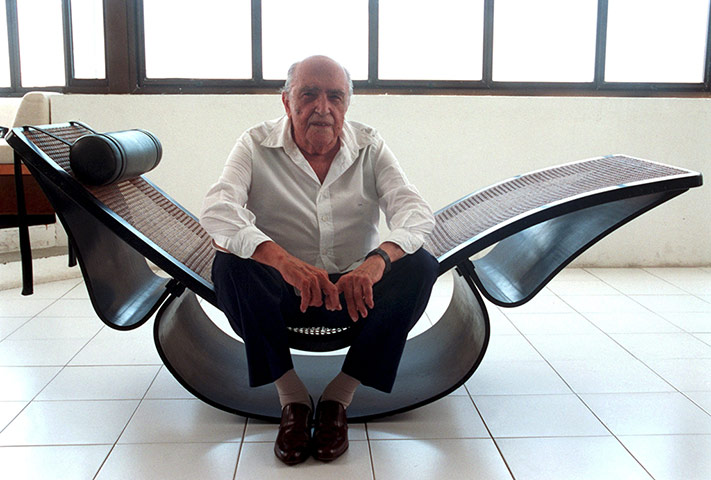
Oscar Niemeyer in 2002, sitting on a chair he designed,
in his Copacabana studio (Frederic Reglain/Gamma-Rapho via Getty)
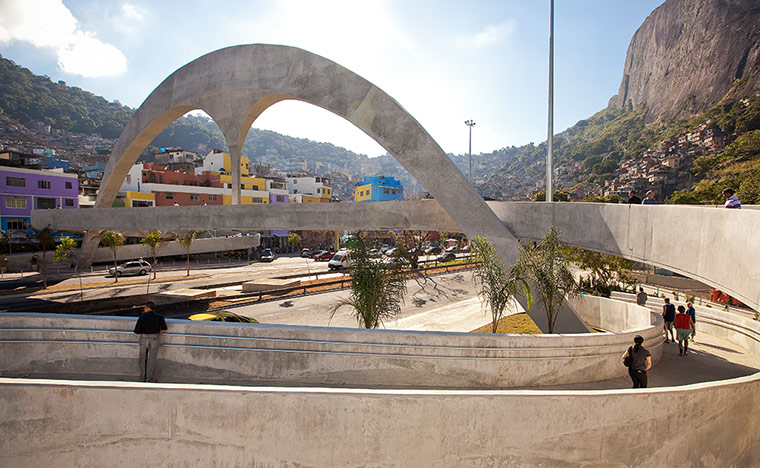
The arch and footbridge of the Rocinha Sports Complex,
built in the Rocinha favela, which will also
serve as a site for the 2016 Olympic Games (Buda Mendes/
Latin Content/Getty Images)

Thursday, December 15, 2011

Oscar Niemeyer Turns 104

Grades are in, and now it's letters of recommendation time, a few more graduate projects to read, and final preparations for the new quarter, which begins January 3. Yes, you read that correctly. A swift little break this will be...half of it spent at the library!

+++

There are octogenarians among us who continue to create, nonagenarians still at their art, and, believe it or not, centenarians too who are practicing their craft. One is the Brazilian architect and political activist Oscar Niemeyer, who turns 104 years old today. Perhaps most famous for his now iconic buildings for the new, mid-century Brazilian capital of Brasília, Niemeyer has continued to draw upon his inner visions to create buildings of note, transforming metaphors and images into unforgettable structures. One of the 20th century's pioneers in reinforced concrete structures, Niemeyer designed his first building, the Education Ministry in Brazil's then-capital, Rio de Janeiro, in 1936, creating what was reportedly the first state-sponsored modernist skyscraper in the world. The building debuted in 1943.

Memorial JK, Brasília
As this building was underway, Niemeyer met Juscelino Kubitschek, then mayor of Brazil's fourth largest city, Belo Horizonte, the capital of Minas Gerais state. This personal connection would would prove fruitful several times over. At the behest of Kubitschek and Minas Gerais's governor, Benito Valadares, Niemeyer designed Pampulha, a suburb of Belo Horizonte, whose striking complex, completed in 1943, included a church, São Francisco de Assis, which the church authorities would not consecrate until 1959 because of its form and the imagery in it.  Later, when Kubitschek became president of Brazil in 1956, he immediately called upon Niemeyer to help him design a new capital in the country's interior. Niemeyer's former employer, Lúcio Costa, created the plan, and Niemeyer the buildings, and thus was the core of what is now one of the most famous world capitals launched. Even today, over half a century later, Niemeyer's buildings in Brasília, the Presidential residence (Palácio da Alvorada), the House of the Deputies, the National Congress of Brazil, and the Cathedral of Brasília, among others, have not lost an iota of their unique beauty or capacity to arrest the eye and mind.

Government buildings, Brasília

Among Niemeyer's many other buildings notable creations are the Headquarters of the United Nations, designed collaborative with one of his epigones, Le Corbusier (1947); São Paulo's Ibirapuera Park, which commemorated that city's 400th anniversary (1951); the French Communist Party seat in Paris; the headquarters of Mondadori, the Italian publisher, in Milan; and, in Brazil, two of the most eye-catching of buildings of the last 40 years: the space-ship like Museum of Contemporary Art in Niterói, the former state capital that sits across Guanabara Bay from Rio de Janeiro, and the hovering eye that is the Oscar Niemeyer Complex in Curitiba, Paraná State. Niemeyer designed the Niterói museum at the age of 89, in 1996, and the Niemeyer Complex in Curitiba in 95. In Brasília, he also designed a tribute to the city's founder, the Memorial Juscelino Kubitschek, in 1980. In 1988, he received the highest international prize for architecture, the Pritzker Architecture Prize, becoming the second Latin American (after Luís Barragán, of Mexico, in 1980) and first Brazilian (Paulo Mendes da Rocha followed in 2006) to be so honored.

Centro Niemeyer, in Avilés, Spain
One of Niemeyer's most recent designs, the Óscar Niemeyer International Cultural Center (or Centro Niemeyer) in Avilés, Asturias, Spain, opened 9 months ago to national and international acclaim, but is shutting down, temporarily one hopes, and will remove Niemeyer's name after an ongoing brouhaha between the new conservative government and the art center's administrators, who are accused of having misspent public funds. Whatever happens with the arts complex, it's clear that as long as he's breathing Niemeyer will keep designing, and I look forward to marking his 105th birthday next year.

Saturday, December 18, 2010

Bye Bye, DADT! + Niemeyer's 103rd

There's been so little to celebrate of late with the current administration or the now lame-duck Congress, and the capitulation on the tax cuts for millionaires-to-get-an-extension-of-unemployment insurance for the most vulnerable Americans, during the winter holidays no less, was a particularly bitter pill.  But today proved that the government will not end the year only on low notes.

Today brought one of the highest of the year thus far. Although Senate Republicans last week killed a bill to provide funding for 9/11 first-responders and the Defense Appropriation Bill, which had included a DADT repeal component, and this morning, with the support of five Democrats, quashed passage of the Dream Act for the children of undocumented immigrants, the Democrats with some GOP help today broke this sorry string by first voting 63-33 (a third of the US Senate was still voting no, but six Republicans, Collins, Brown, Murkowski, Olympia Snowe, Mark Kirk and George Voinovich, voted with nearly all the Democrats) to invoke cloture on a bill introduced by Joe Lieberman, then voted 65-31 this afternoon to repeal the 1993 Don't Ask Don't Tell (DADT) policy, which barred openly lesbian and gay servicepeople from serving in the US military. The House had already passed a DADT repeal earlier this week. President Obama, who had promised in campaign to repeal this odious policy, has fulfilled this promise, and is expected to sign the bill in the next few days.

For years before the 1993 policy, enacted under President Bill Clinton as a response to extreme reactions to his attempts to end the prior, harsher policy against LGBT servicepeople (Secretary of State Colin Powell, the Chairperson of the Joint Chiefs of Staff, was strongly against allowing openly gay LGBT to serve), brave active duty soldiers, veterans and gay activists had fought to allow LGBT people to serve openly in the military, and after the 1993 policy took effect, activists increased their efforts to repeal DADT, since like previous policies it consigned valuable members of the US military to dismissal, destroying their careers and livelihoods prematurely, based solely on their sexual orientations or others' perceptions thereof.

After this week's votes I, like all other LGBTQ people, and like all Americans, can say I have lived to see the day that this heinous, unequal policy and the one preceding it were repealed by my federal representatives, and signed into law by the President. Most impressive to me was that Congress's courage finally matched that of the American people, who in increasing numbers in recent years have come to believe this policy should be ended, and that of the military's leaders, officers and soldiers, who also agreed that it should be repealed.

Thank you to all those who fought tirelessly to end this policy, through protests, lawsuits, putting their careers and lives on the line. Thank you to all the LGBT people who protested, wrote their officials, wrote articles and blogs to push for the repeal, and to all the non-LGBT allies. Thank you to all those in the military leadership, from the Secretary of Defense to the Chairperson of the Joint Chiefs and present and past officers, who changed their views and did the right thing. Thank you to the rank-and-file, whose responses helped to shape the broader public discourse and the specific arguments used by those who still were unsure. Thank you to Congress, especially Speaker of the House Pelosi, and Senators and Majority Leader Harry Reid, Joe Lieberman, and Kristen Gillibrand, along with the handful of Republicans, for passing this bill. And, once President Obama signs it into law, we will be able to thank him for doing what he promised he would do, and what should have been done years ago.

***

On Wednesday, one of the great living architects, Oscar Niemeyer, an artist whose medium is sinuous concrete and steel, turned 103, and celebrated his birthday by inaugurating the newly opened site he had designed in 1997, the headquarters of the Fundação Oscar Niemeyer (Oscar Niemeyer Foundation), in Niterói, a city across Guanabara Bay from Rio de Janeiro.  The Foundation was created in 1988, but is only now debuting this spectacular, futuristic site, which is several kilometers to the north of another of Niemeyer's masterpieces, the space ship-atop-a-hill that houses Rio's/Niterói's Museum of Contemporary Art. Both the foundation's new headquarters and the Museum are part of a series of buildings and sites, known as the Caminho Oscar Niemeyer, in Niterói (formerly the provincial capital when Rio de Janeiro was the federal capital of Brazil), which also includes People's Theater of Niterói, Charitas Boat Station, and Plaza JK (Juscelino Kubitschek, Brazil's president from 1956-1960, and the visionary behind Brasília).  All are accessible after a short and picturesque ferry-ride from the city of Rio.

Though Niemeyer has designed notable sites and buildings all over the world, 600 in total, including some of the buildings at the United Nations (with Le Corbusier), he is perhaps most famous for his site plan and structures for Brazil's third and permanent capital, at Brasília, which he created at the behest of then-president Juscelino Kubitschek beginning in 1956.