Showing posts with label Asian American poetry. Show all posts

Monday, April 30, 2018

Poem: John Yau


I end this month's run of ekphrastic poems with yet another approach to the genre, by John Yau (1950-), a poet whose work has garnered an array of awards over the years but who, I believe, remains still too little known or discussed. A native of Lynn, Massachusetts and a longtime professor of art history and criticism at Rutgers University-New Brunswick, Yau began publishing his work in the early 1970s, and from the beginning, he showed a singular voice with his inventive, playful, humorous poems, drawn from his experience as an Asian American child and young adult growing up in mid-century America, viewing the work of Asian American and white artists, taking in the mass culture of those years, and engaging in dialogue with his avant-garde contemporaries as well as senior figures whom he studied with at Boston University, Bard College and Brooklyn College, including John Ashbery and Robert Kelly. Yau also has published fiction; established and runs a press, Black Square Editions; and serves as a freelance curator, and regularly writes for an online magazine he co-founded, Hyperallergic Weekend. He was the Art Critic for the Brooklyn Rail from 2006-11.

Yau's poetry can range from riffs on popular culture to readings of rarefied art, but his personal, incisive vision and sensibility always come through. By far the best and most subtle reading of Yau's poetry (and of Mei-Mei Berssenbrugge's work, Asian American poetry and contemporary experimental poetics, particularly in relation to the politics of race and form in general) can be found in Dorothy Wang's award-winning scholarly monograph Thinking Its Presence: Form, Race, and Subjectivity in Asian American Poetry (Stanford, 2014). As Dorothy notes in the opening of her first chapter on Yau, in his work one can find "Film noir, Jasper Johns, Peter Lorre, Anna May Wong, Eugene Delacroix, Boris Karloff, Dashiell Hammett, X-rated movies, German Expressionist writers...." (Wang, Thinking Its Presence, p. 162). Yau has developed a unique means for bringing all of these strands together, even though, as he has said, he aims not to have a particular "style," but to leave open all avenues of experimentation.

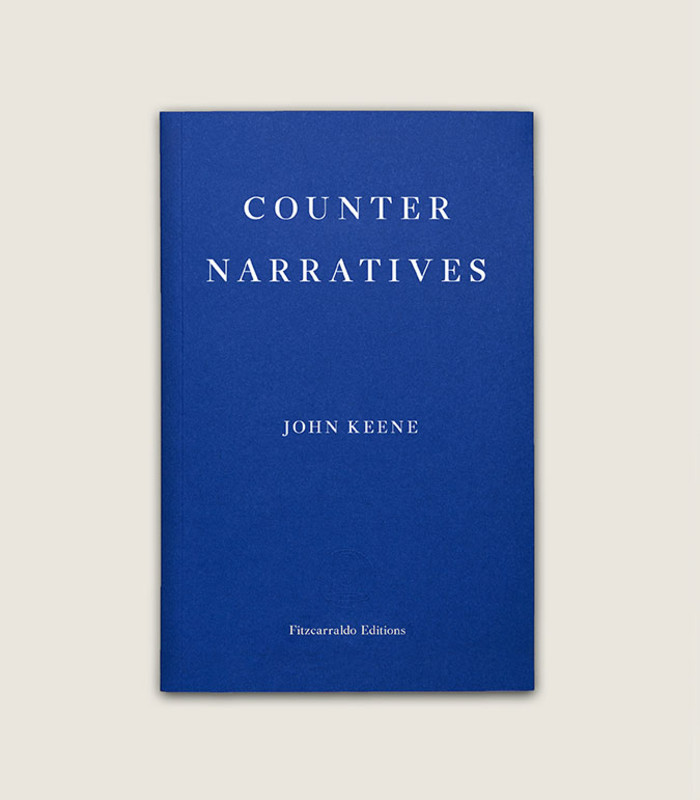
Like Ashbery, Yau has written extensive art criticism, and published a hybrid book of poetic criticism, entitled Further Adventures in Monochrome in 2012. The title immediate tips off an astute reader to the book's subject and focus: the experimental genius and proto-conceptualist Yves Klein (1928-1962), whose untimely death cut short a path-charting career across a range of formal experiments. Klein was a painter, composer, sculptor, installation and performance artist, judoka (!), and exemplar of the Nouveau réalisme movement, while also prefiguring Pop and minimal art. And, as I wrote of Frank O'Hara but a few days ago, he accomplished all of this in a very tiny window of time. Perhaps best known for his International Klein Blue 191, the sublime, seemingly infinite blue monochrome that he made the subject of various works--and which is the color of the British edition of Counternarratives, published by Fitzcarraldo Editions!--he also created a number of other works that both critiqued the post-war moment of their appearance and looked forward to whole swaths of art to come.

In Further Adventures in Monochrome, Yau attempts to do more than write about Klein and his art. In 2013, Rachel May interviewed Yau for the Los Angeles Review of Books, and introduces the collection in this way:

The title poem of Further Adventures, written in 15 sections that alternate between poetry and prose, addresses issues central to Yau’s work: his insistence that “painting is not dead,” the materiality of paint and language, language’s plasticity. He takes on the voice of Yves Klein throughout the poem’s 15 sections, and also speaks to Klein’s own writing about painting in 1954, and engages with Baudelaire, Mallarme, Dickinson, Rilke, Trakl, Whitman, Pollock, Warhol, and Johns, among others. The work is sometimes playful, as in the section titled “(Robert Desnos and Yves Klein meet in the sky),” but he’s pushed past what might be categorized as ekphrastic poetry or criticism, to create a form that combines the two. He speaks from or with the art, rather than “about” it. The penultimate section opens in the voice of Klein:

What I wanted from art was impossible. This is what every artist wants. If you settle for the possible, then your failure is ordinary, although, in a few cases, spectacular. I didn’t want what was there for the taking, the images of things that could be named. I didn’t want to add names to the vocabulary.


 Yau goes on to say in the interview that

That’s part of it. In a way, what I learned from painters is that words could be treated as things, that you could put any one color next to any other color. And I thought, in poetry, you should technically be able to put any one word next to any other word. So, looking at painting made me look at language differently.

I’m interested in what language is capable of, and I am interested in collage without collaging. In other words, I do try to put one thing next to another — words, phrases — but I haven’t actually collaged. I haven’t taken it from one place and collaged it next to something from another place.

Here then, is the excerpt, borrowed (as I did with Shin Yu Pai's poems the other day) from Michael Leong's excellent curated selection, "Lines of Sight: Visual Art in Asian American Poetry," at the Asian American Writers Workshop's online site The Margins. I have blathered on enough, so let's read and hear what Yau's poetic speaker--and Klein and his work(s)--have to say.


FROM “FURTHER ADVENTURES IN MONOCHROME”

by John Yau

4)

I dwell in possibility, Emily Dickinson

I dwell in impossibility, Yves Klein

You should understand that I did not want you to read a painting. I wanted you to bathe in it before words domesticated the experience, and you turned to such stand-bys as “illumination” and “transcendent” to describe what happened to you. Painting should not be sentenced to sentences.
Painting is COLOR, I yelled at my first champion and biggest supporter. COLOR banishes words from its domain. When you read a painting, you turn it into language, but there is so much that cannot be turned into language that each of us experiences every day.

Red shadows leak out of rusting cars and collapsed bridges. Green smoke rises from behind horizons and rooftops. The spectrum of your mother’s voice the last time she spoke to you.
Every day there are thresholds that you must cross to reach the domain where words mar every transmission, rendering them intangible. We put our memory of these reverberations aside in favor of what is known and, we believe, knowable. We say we are going to the beach and we will look at the ocean and leave indentations in the sand, but that is not what happens. We go there to ponder a blue parcel cut from infinity.

True poets and artists know where language ends, which is why they go there. Some settle for going beyond the possible into possibility, but others want to dwell in the impossible. I am not talking fantasy here, because that version of the impossible is just a story about a girl named Thumbelina or a boy named Jack. The ones who go to where two roads diverge in a yellow wood are not poets, because they believe that experience can be reduced to a lesson about choices. True poets know that language is neither window nor mirror. The mistake is to believe that the opposite is true, that words (or signs) are arbitrary.

This is my example of why words are not arbitrary. Charles Baudelaire believed that there are perfumes for which all matter is porous. These perfumes can permeate the air of one’s dreams. Our thoughts quiver in the shadows that fall over us; they begin to free their wings and rise in flight, tinged with azure, glazed with rose, spangled with gold.

Azure, Rose, Gold.

I was not thinking of Baudelaire when I made my paintings, but the poet was clearly dreaming of me when he sat at his desk and wrote “The Perfume Flask.”

Can’t you see that this is how I, radiating outward, happened to appear on this planet, this speck of dust? Yves Klein was born because Baudelaire predicted this propitious event by naming colors, which, like all colors, escape the confines of their names, becoming more than an emanation of infinity. Even black can get away from its name, which is why Malevich had to surround it with white. But what is color that isn’t surrounded by another color? What is that boundless world we catch a glimpse of whenever we look up at the sky? Is it so vast that we must turn away from it, afraid that it will swallow us up, which it will? Astronomy, the Greeks believed, was a royal science, which means I am a royal painter. Do not confuse me, however, with a painter of royalty, with Ingres, who used lines to hold and improve the faces of his sitters, who believed in the despotic power of beauty.

I am not interested in beauty. I am not Andy Warhol. He longed for possibility, but was afraid of what it might tell him. I dwell in impossibility, and I want to be embraced by what it will tell me. My name is Yves Klein. There is a photograph of me that you might know. I have put on my best suit and jumped out a window. My arms are outspread, but they are not wings. I don’t need them to fly. Nor am I the prince of clouds, Baudelaire’s albatross, fallen from the sky. Screw that fascist Marinetti. My arms are not the wings of a drunkard beating against the wall. Mine are the outstretched arms of a diver. I fall effortlessly through the air, but I never am completely fallen. The cobblestones and I will never meet. I hover in a miracle, which is why you believe in the photograph, even after you have learned how I tricked you. It wasn’t that hard to do. The true magician shows everyone how the trick was done, and after seeing how you were deceived, you believe in the trick all the more. I jumped out the window and I stayed in the air, which is where you wanted me to stay. I dwell in impossibility—that zone that lies beyond here and there, while embracing both.

Copyright © John Yau, from Further Adventures in Monochrome, Port Washington: Copper Canyon Press, 2012. All rights reserved.

And here are two of Klein's works, also borrowed from Michael's curated selection:

Yves Klein. Silence is Golden (1960). ADAGP, Paris.

Yves Klein, photographed by Harry Shunk
and Janos Kender. 
Leap into the Void (1960).
Gelatin silver print. 25.9 x 20 cm.
The Metropolitan Museum of Art.

Friday, April 27, 2018

Poems: Shin Yu Pai

Shin Yu Pai
(Seattle Review of Books)

Back in 2008, the multi-talented Shin Yu Pai published a book of collected poems entitled Sightings: Poems 2000-2005 with 1913 Press. Comprising a range of formal, material and textual experiments, it also showed her to be both an artist at heart and in her practice. The poems were mostly brief, political, playful, and never repetitive, marking her out as as someone not following the main experimental crowds. After reading Sightings, I added her to my list of poets to follow, and I have, including blogging her poetry several times, once for her baseball poems in 2011 (scroll past the break), and once for a very witty still life poem in 2012. She has since published several more full collections of poems, including AUX ARCS (La Alameda, 2013) and Adamantine (White Pine, 2010), two of whose poems I quote below, as well as limited edition artist books, works on paper, photography, and collaborative projects of various kinds.

In 2015, the poet and scholar Michael Leong curated a collection of poems about visual art, "Lines of Sight," by nine Asian American writers for the Asian American Writers Workshop's The Margins journal. One of the poets he included was Shin Yu Pai, and when I remembered that she was one of the poets--the others were Christine Wong Yap, Debora Kuan, Eileen Tabios, Jennifer Hayashida, Mei-Mei Berssenbrugge (whom I highlighted earlier this month), Walter K. Lew, O Woomi Chang, and John Yau (whose work will close out the month--I said that I would have to include her here. (Please do check out the entire portfolio.)

Michael featured four of Pai's poems, but to whet readers' interests and encourage that you head over to AAWW's website I'm only going to feature two, both from Adamantine. The first is entitled "Lunch Poem," which immediately made me think of Frank O'Hara (1926-1966) and his eponymous, beloved collection, but when you the photograph her poem is in conversation with, her poem's title becomes clearer, shaking off (a bit) the New York School avatar's influence. Instead, we are exploring Indian artist Subodh Gupta's hanging sculpture, a shiny excrescence whose surface appears to be both bumpy--all those fissures between the pails--and, from a short distance, a silvery, pulsating button.

In this poem, Pai plays with the lunch pails and boxes the image invokes, the vast world those pail carriers index, opening with a statistic about how rare it is that they "[go] missing." It is brief enough to be a poem she might have thought up and mulled over during a lunch-time exploration of it, whether it hung in an art museum or a wall near wherever she was spending any time. The poem itself bells like a vessel--a bit plumper here than on The Margins site because of my lack of kerning tools--that has been filled, or, by its end, by author and reader, like the lunchtime diner, emptied.


LUNCH POEM


by Shin Yu Pai


(after Subodh Gupta)
                     6,000,000

             to one: the delivery that

        goes missing – a lunch pail that fails

        to arrive @ its destination; domestic

       articles bear homemade offerings produced

    by housewives & dadi jis for their men-folk –

        fleet-footed dabbawallas dispatch, carry,

    & collect steel boxes by the thousands packed

         lunch boys sport starched cotton nehru

         caps pilot familiar passages – the son

       of a railway guard solders stainless-steel

              tiffin carriers a new class

                     of metalwork


Subodh Gupta. Untitled, 2008,
Stainless steel, Houston Museum of Art.
(Photo: Deena DeNaro-Bickerstaffe.)

The second poem is entitled "Bell(e)," and speaks to an actual ornamental bell, by the late Japanese-American artist Toshiko Takaezu, produced in 1997, and one of many she produced during her career. Pai's title injects a bit of polysemy through that final "e," making the word French as well as English, and highlighting the beauty inherent in Takaezu's sculpture, with its patinated surface color and graceful, parabolic form. That silent "e" also embodies the silence and latent sound to be released, once the bell sounds...its beautiful sounds.

"Bell(e)" tells in swift strokes about how such a bell might have been handled "in centuries / past," but now it hangs in what looks like a greenhouse, "a museum / of curative plants." Where the poem goes is beyond description to an evocation of the bell(e)'s potentiality, as I note above, showing the reader its anticipation--and ours--of its "stillness & / gathering before / the shudder / of first sound," that is, when it finally is rung or struck, how it dreams of the sounds within sounds that will come, or that reappear, as part of and after that reverberation, like the poem itself.

Here is a short paragraph about Takaezu from Wikipedia (linked above):
Takaezu treated life with a sense of wholesomeness and oneness with nature; everything she did was to improve and discover herself. She believed that ceramics involved self-revelation, once commenting, "In my life I see no difference between making pots, cooking and growing vegetables... there is need for me to work in clay... it gives me answers for my life."[5] When she developed her signature “closed form” after sealing her pots, she found her identity as an artist. The ceramic forms resembled human hearts and torsos, closed cylindrical forms, and huge spheres she called “moons.”
The bell pictured below is an "open" ceramic forms, but its capacity for "self-revelation," and its connection to nature are both aspects that Pai discerns in her poem.

BELL(E)


After Toshiko Takaezu


in centuries
past, sunk
beneath soil

to draw earth’s
vital force, inert
vessel of

sound + light,
conserved

in a museum
of curative plants
the moment of

stillness &
gathering before
the shudder

of first sound

dreaming
the shake of chime
hum &

g o n g


Toshiko Takaezu. Bell (1997). Seattle’s Volunteer Park
Conservatory. (Photo courtesy Myra/Flickr.)

Both poems, Copyright © Shin Yu Pai, from Adamantine, White Pine Press. Buffalo, NY 2010. All rights reserved.

Thursday, April 19, 2018

Poem: Mei-Mei Berssenbrugge

Mei-Mei Berssenbrugge
(Kelsey Street Press)
It was only a matter of time before I posted a poem by Mei-Mei Berssenbrugge (1947-) during this month's ekphrastic/art poem cavalcade; she published a marvelous new and selected volume entitled I Love Artists: New and Selected Poems (University of California Press) in 2006, and has collaborated extensively with her husband, the highly lauded painter and sculpture Richard Tuttle (1941-) over the years. In fact I am a huge fan of her work, and this post marks the third time I have featured a poem by Berssenbrugge, and the other two also could be said to deal with aspects of art and poetry.

This poem, however, explicitly explores the work of two poets Berssenbrugge knows, Kiki Smith (1954-), perhaps best known for her sculptures, figurines and prints, which have explored human bodies and our excreta, feminism, and the AIDS pandemic, among other themes, and Bruce Nauman (1941-), the conceptual artist whose work crosses a range of media, including the televisual.

"I Love Artists" is one of many favorites in the 2006 collection, and I was reminded of it again when I happened upon it on the Painters and Poets blog, which for a number of years focused on the very topic I am posting about this month, poetry and visual art. The organizers of that blog created a real treasure, and stopped blogging last year, but the archives are still up at the link above, so be sure to check it out. They also offer their distinctive takes on Jorie Graham's "San Sepolchro" and other poems I've posted about here.

In the poem below, Berssenbrugge references Smith's drawing "Blues Stars on Blue Trees," a 2006 work, using ink and silver leaf, on Nepal paper, and Bruce Nauman's video piece, "Mapping the Studio 1 (Fat Chance John Cage)," from 1981, which appeared at Dia Center for the Arts back in 2001-2. It was, I can say as someone who went to see it, extremely dull, but, in the way that Andy Warhol's extended cinema could also be, quite fascinating as an idea and in practice. (It lacked the minute-to-minute excitements and spark of other extended works like Christian Marclay's The Clock.)

One thing to consider when reading Berssenbrugge is how she plays with the poetic persona in her poems, and how she shifts from observation and description to more abstract thought, sometimes within a single sentence, thereby shifting the reader's perception of what you are reading in the process. (I should note here that I have had to wrap her long lines, since they go a bit haywire on Blogger, especially when I use the formatting command <pre> which allows me to present poems very close to how they originally appeared.)

In the third stanza, she mentions "Bruce," the mice that were at the center of his video project, and very soon thereafter, we get the line, "I realize my seeing is influenced by him, for example, when we change form and become light reaching into corners of the room." We have left the human plane altogether, in a sense, and are now something more spectral, presence and immanence themselves, reaching into the spaces that we cannot but which is exactly where our minds, like the video, can take us. That is, the spaces poems and films open up for us.

As the poem concludes: "Creation is endless." But poetry it is rarely so simple or simplistic. Good poetry, that is. The poem charts a journey that I urge readers to take. And then please do take a look at Smith's and Nauman's images, for good measure.


I LOVE ARTISTS


by Mei-Mei Bersenbrugge


1.


I go to her house and talk with her as she draws me or
    knits, so it’s not one-on-one exactly, blue tattooed stars
    on her feet.

I pull the knitted garment over my head to my ankles.

Even if a detail resists all significance or function,
    it’s not useless, precisely.

I describe what could happen, what a person probably or
    possibly does in a situation.

Nothing prevents what happens from according with
    what’s probably, necessary.


2.


Telling was engendered in my body and fell upon me,
    like a battle skimming across combatants, a bird hovering.

Beautiful friends stopped dressing; there was war.

I’d weep, then suddenly feel joy and sing loud words
    from another language, not knowing my song’s end.

I saw through an event and its light shone through me.

Before, indifference was: black nothingness, that
    indeterminate animal in which everything is dissolved;
    and white nothingness, calm surface of floating,
    unconnected determinations.

Imagine something, which distinguishes itself, yet
    that from which it distinguishes does not distinguish
    itself from it.

Lightning distinguishes itself from black sky, but trails
    behind, as if distinguishing itself from what espouses it.

When ground rises to the surface, her form decomposes in
    this mirror in which determination and the indeterminate
    combine.

Did you know, finally, there was not communication between
    her and myself?

Communication was in time and space that were coming anyway.

I may suffer if I can’t tell the agony of a poisoned rat,
    as if I were biting.


3.


Bruce leaving for the night makes space for his cat to enter.

Mouse (left) exits door and returns

Moth and mouse on sculpture exit (left), noise.

It’s an exterior relation, like a conducting wire,
    light fragment by fragment.

I realize my seeing is influenced by him, for example,
    when we change form and become light reaching into corners
    of the room.

Even now, we’re slipping into shadows of possessions that
    day by day absorb our energy.

I left my camera on to map unfinished work with shimmering
    paths of my cat (now disappeared), mice and moths (now dead).

There’s space in a cat walking across the room, like pages
   in a flip-book.

The gaps create a reservoir in which I diffuse my embarrassment
    at emotion for animals.

I posted frames each week, then packed them into suitcases,
    the white cat and her shadow, a black cat.

I named her Watteau, who imbues with the transitory friendship
    we saw as enduring space in a forest.


4.


A level of meaning can be the same as a place.

Then you move to your destination or person along that plane.

Arriving doesn’t occur from one point to the next.

It’s the difference in potential, a throw of dice, which
   necessarily wins, since charm as of her handcrafted gift
   affirms chance.

I laugh when things coming together by chance seem planned.

You move to abandon time brackets, water you slip into, what
    could bring a sliding sound of the perimeter of a stone?

You retain “early” and “walking” as him in space.

When a man becomes an animal, with no resemblance between
    them, it feels tender.

When a story is disrupted by analyzing too much, elements
    can be used by a witch’s need for disharmony.

Creation is endless.

Your need would be as if you were a white animal pulling
    yourself into a tree in winter, and your tears draw a
    line on the snow.


Mei-Mei Berssenbrugge, from I Love Artists: New and Selected
Poems, Berkeley: University of California Press, 2006.

Here are the two art works:


Kiki Smith, "Blue Stars on Blue Tree," 2006, work on paper, ink and silver leaf on Nepalese paper, Pace Gallery


Bruce Nauman, "Mapping the Studio I (Fat Chance John Cage)," 2001, video, Dia Foundation, New York.

Wednesday, April 11, 2018

Poem: Monica Youn

Monica Youn
I should start today's post by saying I'd initially imagined, as I often do, that these entries would be brief and that the poems would speak for themselves. In a few cases, that's how things have unfolded. In others, like yesterday's...well, one paragraph leads to another, followed by another, and then I've written far more than I intended to. I hope none of it is boring, and that, for readers who might not be familiar with the poem and poet, the commentary is at least somewhat interesting and perhaps even a little insightful. But I am going to strive for brevity or I'll struggle to finish these posts.

Today's poem takes the idea of writing about art and ekphrasis in yet another direction. Instead of focusing on a particular art work or artist, Monica Youn's "Drawing for Absolute Beginners" starts from a more basic principle: drawing--that is, learning to draw--for absolute beginners. Whether in art school or browsing bookstore shelves, you can come across courses and books geared toward "absolute beginners" that presuppose no familiarity with picking up a pen or pencil and sketchbook t all, a state utterly foreign to someone like me who began drawing at 18 months old.

But there are absolute beginners in almost everything out there, and with drawing, a quick Net search showed one such course at The Cooper Union, as well as Andrew Loomis's various instructional series, which include the line quoted as an epitaph in Youn's poem. Yet Youn's poem is about more than drawing per se than, I would venture, exploring how we assemble meaning out of various strands of experience, information, knowledge we encounter, the lines and hatchmarks and shadings of art and life, and how, almost like beginners, we have to interpret what we hope to understand. That also is one definition of how we "read" a poem. We can approach it, as I once suggested in a micro-essay entitled "The X-Ray of the Poem," in a variety of ways, and perhaps we should.

The basic template, however, is that initial instruction beginning "Take any desired height...." And then we proceed from the top of the head to the feet or, as Youn's numbering suggests, from the bottom up. Each eighth is a clue, a glimpse, an answer, with some, like section (or stanza) #7 replete with subsets. What answers to we draw up by the time we're done? Desire is here, tenderness and brutality, relationships of various kinds, loss, and yet, by #1, we hear, overhear, someone saying they want to leave the friend, the beloved, the person with whom they have connected, exactly as they found them. So much has been drawn, indirectly and with a great deal of mystery, but the addressee has not been erased. The relationship between the speaker and the addressee has deepened considerably, though.

Monica Youn is a poet and lawyer who grew up in Houston, the daughter of Korean immigrants, and was a Rhodes Scholar.  She has published three award-winning books of poetry, Barter (2003), in which the poem below appears; Ignatz (2010); and most recently, BLACKACRE (2016), which won the Poetry Society of America's William Carlos Williams Award and was a finalist for the National Book Award. She also book on one of the most controversial Supreme Court decisions of the last 30 years, entitled Money, Politics, and the Constitution: Beyond Citizens United (2011). She currently teaches creative writing at Princeton University, and is a member of the curatorial group The Racial Imaginary Institute and chairs the Lewis Center Committee on Race and Arts.


DRAWING FOR ABSOLUTE BEGINNERS
by Monica Youn
Take any desired height, or place points for
top of head and heels. Divide into eights. . . .


8.  Head tilted back between the headboard slats. Eyes glass boxes
     filling up with light. Later, drained to a blue-gray, the color of
     good government.
 
7.  Thus, we see that commodification is a function of local necessity.
     a.  As Angelenos collect percolating shade in shallow pans, to
          leach the arsenic out of the light.
     b.  “And then I buried it.”
          “Where, exactly? And when?”
          “In the chest. Insertion point at the base of the throat. You
          were still asleep.”
          “But what is it, exactly? I mean, I can’t figure out its precise
          extent. I mean, I can feel it there sometimes, like stitches, or
          sometimes like a flanged or branching bone.”
 
6.  Cross-hatchings of street noise and the Minotaur with his boy’s
     body. Narrowing. Rib cage the verge of a canoe. Armpit a whiff of
     pencil lead.
 
5.  “If you want to fuck me with that bottle, Mr. Arbuckle, best take
     the foil off first.”
 
4.  osculation:
     a.  The act of kissing. A kiss.
     b.  Math. A point where two branches of a curve have a common
          tangent and extend in both directions of the tangent.
     c.  To the ankles. Or to the knees. Or just unzipped enough.
 
3.  Charmeuse chemise. A shuddering fall. Miss Adelaide Hall on
     the chaise longue singing I ain’t much caring / Just where I will
     end. Then jerked upright, skirt hiked to the knee, that bridge
     stretching out under every skip-step. Slaphappy scat-puppet of
     the fixed smile, the meanwhile, Ain’t got nobody to love now.
 
2.  The bone begging bowl. The foot that pushed it away.
 
1.  “I want to leave you exactly as I found you.”


Monica Youn, “Drawing for Absolute Beginners” from Barter. Copyright © 2003 by Monica Youn. Reprinted by permission of Graywolf Press, www.graywolfpress.org

Monday, April 02, 2018

Poem: Cathy Song

Cathy Song, at the Island School,
April 17, 2015, from a post by
Peggy Ellenburg
(courtesy of The Voyager Voice)

Continuing the ekphrastic theme and poems about art, here is a diamond of a lyric by Cathy Song (1955-), a native of Hawai'i, whose first collection of poems, Picture Bride, received the Yale Series of Younger Poets Prize in 1982, making her the first Asian American poet to be so honored (a number of amazing poets have followed in her footsteps). She has gone on to publish four more collections, including Cloud Moving Hands, which appeared in 2007. She teaches in Hawai'i's "Poets in the Schools" program and says of her process and poetry as an art, "You've got to be willing to dismantle...to realize that poetry is something made outside of yourself." This poem, "Girl Powdering Her Neck," is based on Kitagawa Utamaro's ukiyo-e print "Girl Powdering Her Neck," which is in the Musée Guimet in Paris.

GIRL POWDERING HER NECK 

by Cathy Song
from an ukiyo-e print by Utamaro
The light is the inside 
sheen of an oyster shell, 
sponged with talc and vapor, 
moisture from a bath. 


A pair of slippers 
are placed outside 
the rice-paper doors. 
She kneels at a low table 
in the room, 
her legs folded beneath her 
as she sits on a buckwheat pillow. 


Her hair is black 
with hints of red, 
the color of seaweed 
spread over rocks. 


Morning begins the ritual 
wheel of the body, 
the application of translucent skins. 
She practices pleasure: 
the pressure of three fingertips 
applying powder. 
Fingerprints of pollen 
some other hand will trace. 


The peach-dyed kimono 
patterned with maple leaves 
drifting across the silk, 
falls from right to left 
in a diagonal, revealing 
the nape of her neck 
and the curve of a shoulder 
like the slope of a hill 
set deep in snow in a country 
of huge white solemn birds. 
Her face appears in the mirror, 
a reflection in a winter pond, 
rising to meet itself. 


She dips a corner of her sleeve 
like a brush into water 
to wipe the mirror; 
she is about to paint herself. 
The eyes narrow 
in a moment of self-scrutiny. 
The mouth parts 
as if desiring to disturb 
the placid plum face; 
break the symmetry of silence. 
But the berry-stained lips, 
stenciled into the mask of beauty, 
do not speak. 
Two chrysanthemums 
touch in the middle of the lake 
and drift apart.


Copyright © Cathy Song, from Picture Bride (New Haven: Yale University Press, 1983). All rights reserved.

Kitagawa Utamaro, "Girl Powdering Her Neck," ukiyo-e print, c. 1790, Musée Guimet in Paris

Saturday, April 20, 2013

Poem: Prageeta Sharma

Prageeta Sharma,
Lantern Review's Flickr
photo stream
These are troubled times, but then one could easily say all times are so, depending upon one's perspective. There is an unsettled air that Prageeta Sharma (1972-) captures in her poem below, which also feels very appropriate to this moment, particularly in terms of its thematization of violence, particularly in the presence, in this sonnet, of firearms, and in the interpersonal violence it depicts, beginning in a dream (not, curiously, a nightmare), that bleeds out of that oneiric space into the lyric itself, into the speaker's interiority.

Read more broadly, it touches upon the underlying fear of the unknown--events, persons, the Other--that undergird our contemporary moment, this society, with its "dark-skinned male" or "Muslims" or "immigrants" a stand-in for any and every evil, every problem, every crisis, and state and corporate violence and surveillance, the violence of elites and capitalism itself, elude sustained mass, public critique. Only unlike the poem, whose 14-line sonnet form can contain the excess that threatens to spill over, there is no similar container for everyday reality. We would do well to listen to Prageeta here: "things are unexpected, people are terrible / sometimes," and "Events that are pleasantly unnoticed / are not about adventures."

This is the kind of knowledge that poetry often can best convey: like a lens that zooms in and simultaneously can pan all the way up and out. But you have to look through it. Look.

ACTION-PACKED SONNET

This rather tall Indian man shot me in a dream;
I thought I could just mosey up on him
and say in a protective but assertive voice,
I am a Hindu and he would put down his gun.
But he said you are my enemy and my unmarried hands
stung only for an instant, realizing this immensity
was fake immensity. And it goes to show you
that things are unexpected, people are terrible
sometimes. Events that are pleasantly unnoticed
are not about adventures, not about paranoia or silk turbans.
If you are my gun, put it between the mattresses, it will rest
underneath us like a holiday inside eternity. A firefly
    admits to light,
a ray gun, obfuscated, we both tumble before I look
the rather tall man in his angry Indian face.

Copyright © Prageeta Sharma, from The Opening Question, New York: Fence Books, 2004. All rights reserved.

Tuesday, April 03, 2012

Poem: Shin Yu Pai

Here's a delightful little poem by Shin Yu Pai, a poet with whom I share a publisher (1913 Press, which has all kinds of great new books out). She works not only in a range of forms but across media. She is an artist in every sense, and knows how to draw profundity out of simplicity. Here's her little poem about conversation between artists that is a poem about visual art, poetry, and thus art itself. Enjoy.

A CONVERSATION BETWEEN HUIDOBRO AND BRAQUE

Is a poem a poem? 
And isn’t an orange just an orange,
and not an apple?

Yet next to each other, the orange 
ceases to be orange
the apple ceases to be apple,
and together the two 
become fruit.

Copyright © Shin Yu Pai. First published in Gastronomica and later published Equivalence (La Alameda, 2003).

Saturday, April 23, 2011

Poem: Li-Young Lee

Li-Young Lee (1957-) is one of those poets who entered my consciousness like a meteor when I was younger; in fact, it was his book The City in Which I Love You (Boa Editions Ltd., 1990), that rocked me so profoundly. I read those poems like a sacred text over and over, and I cannot say that they had any direct influence, though I do quote him in my first book. The lyrical exploration of his family and past, the way he wrote about his Chinese-American ancestry and his experiences, his capacity for abstracting his life and yet emotionally grounding it were all key in ways I have not yet fully acknowledged. I went to hear him read several times during that period, and responded like a fanboy, but I must admit I haven't read his work much in recent years, and I'm told he lives in Chicago, though I have never heard him read t/here in the 8 years I've lived in the city.

Today I came across the poem below by Lee in the New York Times, which seldom prints poetry nowadays, except on special occasions, like holidays or the beginning and ending of seasons. (They very well may feature poems commemorating the upcoming British royal nuptials, given their class fixations....) The special occasion for today's Times poetry feature was Spring, the current season now darting about coquettishly, and so, in the "Opinion" pages--not the "Arts" pages, tellingly--they published four poems on the theme of Spring, by Lee, Ellen Bryant Voight, Kiki Petrosino, and Billy Collins. Not much aesthetic diversity there, and just one poet of color, but the bigger issue is why the Times doesn't regularly publish poetry; it should, for multiple reasons, not least because, as one of my favorite poets, William Carlos Williams (1883-1963) once wrote, in his late, long and revelatory poem, "Asphodel, That Greeny Flower":

My heart rouses
  thinking to bring you news
    of something
that concerns you
  and concerns many men.  Look at
    what passes for the new.
You will not find it there but in
  despised poems.
    It is difficult
to get the news from poems
  yet men die miserably every day
    for lack
of what is found there.

Well, yes indeed, and soon I will post an entry on the (mis-)use of metaphor and metonymy, so central to poetry and fiction, and its effects on our ways of thinking. As for the Times, one might say, what should I expect. Yes, I know, but.... I nevertheless recommend reading all the poems, and snipping the section, which is a .jpg file, for your files.  Here is Li-Young Lee's poetic contribution, "The Word From His Song," which, rather than retyping, I digitally snipped from the paper. "The voice is a sighted brink"--okay, maybe his poetry has sunk more deeply into my imaginary than I thought.... Enjoy!


From The New York Times © Li-Young Lee and The New York Times, 2011. All rights reserved.

Friday, April 15, 2011

Poem: Tan Lin

Lest we forget that in the digital age new kinds of poems are possible, and that writers are creating them, here is one by Tan Lin (19_?-), my former colleague and one of the most original creative people I know. I'll just say that this piece, from 2002, mirrors several that he discussed, displayed and performed during a brief visit to the university around that period.  One of his aims, he argued, was to create poetry that mirrored early 20th century Modernist French composer Erik Satie's (1866-1925) concept of "musique d'ameublement," or "furniture music." The pieces he showed did not have musical accompaniment, but this piece does, matching an ambient soundworld to (semi-)ambient language. If you're so inclined and have the technological means, you might hook the piece up to your speakers and let it play as you go about your business.

I'll just add that one of Tan's most recent works, Seven Controlled Vocabularies and Obituary. The Joy of Cooking [AIRPORT NOVEL MUSICAL POEM PAINTING FILM PHOTO HALLUCINATION LANDSCAPE], from Wesleyan University Press (2010), is actually a multiplatform, multi-concept(ual) creation, that keeps proliferating, like a (capitalistic) rhizome (which is, in part perhaps, what he's after).  It manages to send up numerous forms by embodying what amount to zombie forms of them all.  I posted photos of the book launch a while back, and I recommend the main book, from Wesleyan too. You can, like the ambient audiovisual piece below, dip and out, and even prepare a meal--it has recipes, of a sort--while you're at it. He also has a novel, wildly heralded by the writers and scholars I know who've read it, on the way. I never know what he's going to come up with, but it's never boring (even when that's his ostensible aim).

Click on the image, or the link below, to see the poem play as it should, and about this one, I can say, enjoy!


OR: click on the link below:
Pennsound: Dub Version

© 2009 Tan Lin. Used with permission of Tan Lin. Distributed by PennSound.

Monday, April 11, 2011

Poem: Ronaldo V. Wilson

"This is a song for the genius child." - Langston Hughes

Hughes was incontestably a genius, as is Ronaldo V. Wilson. (But his soul already runs wild, as did Hughes's.) Ronaldo's first book, The Narrative of the Life of the Brown Boy and the White Man (University of Pittsburgh Press, 2008) is a novel-as-poem, or poem-as-novel. And also uncategorizable. It erects chapters-as-mirrors onto a life that is akin to but isn't Ronaldo's. Unless you look closely. But you won't see what you think you're seeing. Or not seeing. And you cannot put it down. The book won the 2007 Cave Canem Prize, which proves that its judges are visionary and a lot more progressive than many people stomping around the literary world claiming to be on the newest tip, but who probably wouldn't have given a book this fresh the time of day, even if they thought they had the moves. Ronaldo's second book, Poems of the Black Object (Futurepoems, 2009), is equally remarkable, worthy of the highest praise, demanding repeated readings. You think you grasp it but you really don't. He's like that.

I carried around one of his manuscripts, dipping into and out of it in amazement, for several years. Whenever I would read it it was as if I were reading something revelatory and unexpected. I always say that there are some poets it's better to see in person before you read their work than after, and some it's better to see after you've read their work, but Ronaldo is an artist and thinker who's worth seeing at any time. He is the only poet and critic I've ever known who can incorporate push-ups, phone conversations, Tagalog, and a host of other things as part of his reading/performance, and pull it off. Flawlessly. His emails are even poems, whether he's reading them aloud or you're reading them on your screen--and some appear in Poems. When I first met him, at NYU, he was doing pull-ups without breaking a sweat. The arms are important. But then what should anyone expect of a Grand Slam champion?  Paris, watch out! Below is a poem from his second book, treading as it does between beauty and menace, splendor and almost unspeakable horror, all of it packed tightly into every fiber of the Black Object's body, breaths, words, silences. Would you remember "red"?

THE BLACK OBJECT's CATALYST

Your face gets to a lake, wind chimes, and pear, sliced near a window. This fruit, laid in a spiral and locked to Jarlsberg cheese, staircased in a row with crackers, is yours. In celebration of your face, you think -- if you were born to vitiligo lips, and naps, instead of clear skin and curl, what $65,000 per square acre land would you ever get to see? On the drive to this spot, there were llamas in a field, African long-horned steer, goats that look like they've been amputated in half. Pine trees wave in the wind and reflect on the glass table on a deck that extends over the water. On the railing is an abalone's husk. Its meat is gutted, mother of pearl left to catch ash. What if your face were stripped away from this house? Would you remember red: the hummingbird's throat?

Ronaldo V. Wilson, from Poems of the Black Object, Futurepoems, 2009. Copyright © Ronaldo V. Wilson. All rights reserved.

Wednesday, April 06, 2011

Poem: Sadakichi Hartmann

Since I've between splitting my tweeting @harriet_poetry, I thought it might be a good option to introduce a different form every day (evening, really) to provide a prompt for folks. Among the forms or genres I've suggested so far are senryus, sestinas, ekphrastic poems (I provided a very simple painting I came across on Morse St. in Chicago) and today's, the mesostic. People have written and blogged or sent me original poems, which is both amazing and heartening--and they've been strong pieces to have been written so fast. The first night, though, I suggested a "nocturne," since the prompting came fairly late in the evening, and people replied with opening lines. That got me thinking about poets who write nocturnes, and about a US poet who's little remembered today but was an early pioneer in a number of ways, no least among them as one of the first major Asian American poets: Sadakichi Hartmann (1867-1944, photo Modern American Poetry Site). A native of Japan with mixed Japanese-German descent, Hartmann grew up in Germany, and moved to the US in the 1890s.  A critic, actor, friend and participant in the Modernist movement, heavily influenced by symbolism, he was also one of the first pioneers of the English-language haiku.  Below is his "Nocturne," from his original 160-issue typed 1904 manuscript, which I copied from Google Books using their "Clip" function. It's not amazing that the text is online (Google!), but it is amazing that with their tool I could save it, send, embed it, or, as you see, repost it here.

From Drifting Flowers on the Sea, by Sadakichi Hartmann, manuscript edition, 1904. Copyright © Sadakichi Hartmann.