Showing posts with label queer art. Show all posts

Monday, August 26, 2013

Quote: Sarah Schulman

Sarah Schulman
(photo by
Monica Simoes)
"At first we [she and Jim Hubbard, at the New York Lesbian and Gay Experimental Film Festival, which they co-founded in 1987, the same year as ACT UP started] showed artists who were experimental. That is to say, they experimented. "Experimental" meant that each artist singularly tried out their own eccentric idea, their own imaginative way, and then they looked at each others' discoveries. They learned how to be artists by making art, talking about art, looking at art, being with artists. Whether or not one went to graduate school was irrelevant (and still is) to whether or ont one was really an artist. But at some point around the height of AIDS/gentrification this shifted. Those true experimenters who needed to earn a living in the rapidly shifting gentrification economy were channeled by inflation into teaching jobs. The increasing number of MFA programs became the only way that artists could earn a living beyond waitressing or copyediting at night at law firms. MFA programs became workfare for writers, as rents skyrocketed, as arts funding--already so elite as to be culturally damaging--was practically eliminated. It was like the role of the artist in society had devolved from WPA to NEA to MFA. Their students started producing inside a now established genre called "experimental". It wasn't actually any longer experimental, but it was a fixed set of derivative paradigms, invented by their teachers--many of whom did not have MFAs." (p. 102)

***

"Of course now that the noose has tightened even further, civilian artists are systematically excluded from teaching, as having an MFA [or Ph.D., for poets] has become mandatory for hiring. Being a product of MFA acculturation is now more important in determining who will influence students than what that person has achieved artistically. So, the frame of information and impulse becomes even more narrow and irrelevant and its product even more banal." (p. 103)

***

"Despite the fact that these programs are homogenizing and corrupting and bad for the culture, I feel that when I am advising working-class or poor students with talent, I have to insist that they go to them. There is simply no other way of getting into the system. As damaging as these programs are when they codify or elevate ruling-class perspectives and middlebrow practitioners, they become the only hope for outsiders to have a chance to be let in. It's a conundrum. Hopefully a talented person can emerge from these programs without a highly distorted sense of their own importance, and if they come originally from the margins this is more likely. But as far as I can see, MFA programs have done nothing to break down the barrier that full-character plays with authorial universes (not performance art, vaudeville, or stand-up) and authentic lesbian protagonists face in the theatrical marketplace. So although they do help certain minority voices who have had the support and sophistication to access and survive the system, overall they reinforce the dominant cultural voice, the clubbiness and repetition and most importantly, the group mentality that is, itself, counterindicated for art making." (p. 108)

-- Copyright © Sarah Schulman, from The Gentrification of the Mind: Witness to a Lost Imagination, Berkeley: University of California Press, 2012, pp. 102-3. All rights reserved.

Sunday, January 13, 2013

"The Black Female Body in Art" Panel at the Brooklyn Museum

"How has the black female body been idealized and misread in visual culture?" And: "How might these tendencies affect black women today?"

Tisa Bryant, Isolde Brielmaier, Deborah Willis, and Carla Williams
Tisa Bryant, Isolde Brielmeier, Deborah Willis, Carla Williams
These were just two of the many provocative questions posed yesterday at a Brooklyn Museum of Art panel discussion entitled "The Black Female Body in Art," which took place in conjunction with the museum's superb current exhibit, Mickalene Thomas: Origin of the Universe. The exhibit, featuring a range of Thomas's (1971-) current work, includes a mural, large scale paintings, smaller mixed-media works, photographs, a room-sized multi-part installation, and a video, and is located in the Morris A. and Meyer Schapiro Wing, on the museum's 4th floor. It runs through January 20, 2012. The panel comprised four distinguished participants, each of whom brought distinctive perspectives to their viewings of and discussions on Thomas's work, and on the broader topic: visual artist, photographer, curator, historian, and NYU professor Deborah WillisIsolde Brielmaier, Chief Curator at Savannah College of Art and Design (SCAD) and Visiting Assistant Professor of Art at Vassar; Carla Williams, coauthor of The Black Female Body: A Photographic History; and my very good friend, writer, art and cultural critic and CalArts professor Tisa Bryant.

The conversation, which ran for about 2 hours, somewhat skirted the very open-ended questions I noted above, yet did provide insightful context for and readings of Mickalene Thomas's show, and of topics and themes related to and deriving out of it. One of the issues the panel spoke about involved Thomas's revisioning and reappropriation of imagery from the European art historical tradition. The very title of her show, "The Origin of the Universe," derives from Gustave Courbet's controversial 1866 painting of a nude, head-and-limb-obscured white woman's genitalia, "L'origine du monde," though as Tisa and other panelists queried, what happens when the artwork and the gaze implicit in it is a woman's, a lesbian's, a black woman's, a black lesbian's (and Thomas is a black lesbian) how does that resituate the image, as well as its relation to Courbet's image? (No one noted that Courbet was a committed ideological and political leader of the French avant-garde, and how that underpinned the vision, gaze and gestures implicit in his work, including this one.) Moreover, Tisa pointed out the metonymic resonances in Thomas work, among them black physicality, sensuality, reproductive agency and power, and an invocation of Lucy/Dinknesh, the first human mother/female ancestor. (Other figures Thomas riffs on, directly in terms of images and styles, include Edouard Manet, Pablo Picasso, and David Hockney, though I also saw a bit of Richard Diebenkorn, the Cubists, and Romare Bearden in her collagistic compositions.)

"Déjeuner sur l'herbe" @ Mickalene Thomas show, Brooklyn Museum
Mickalene Thomas's "“Le Dejeuner sur l’herbe: Les Trois Femmes Noires, Fractured” (2011),
a direct riff on Edouard Manet's "Le Dejeuner sur l'herbe"
Some other topics I'm still thinking about include Carla Williams's point about the specifics of Thomas's technique and images, and how, despite the artist's direct engagement with the Euro-American (male) artistic past, one could come to and connect with them without "the history of [Euro-American] art," in part because of their rich, bedazzled surfaces, their inviting and provocative imagery, and the personal histories a viewer, especially a black female viewer, might bring. (I thought as well of Kehinde Wiley, Thomas's contemporary, and his use and appropriation of Renaissance iconography, as well as of predecessors like Robert Colescott and Bob Thompson, just to name a few.) For Tisa, the "bling" of the rhinestones--one of the most arresting aspects of Thomas's work, from a distance and up close--brought to mind associations such as the celestial, cosmology, stars and the star system (of mass culture, the art world, etc.), high and low culture, the earthly and the heavenly. "What shines?" she asked aloud, much as the paintings ask us as we look at them. Mouths, eyes and eyelids, sometimes jewelry, areola, fleshly contours, pubic hair and genitalia: what happens when Thomas focuses our gaze on these aspects of her paintings? Where is the feminine, the queer gaze, and how is she activating it? (My question.)

The topic of black woman's gazes, and black women looking at, seeing, and painting/creating artwork about and for each other, arose several times, including when Deborah Willis asked Tisa specifically about the "diaristic" aspect of the work. Isolde Brielmeier had just noted the "multiple directionality of the gaze," echoing Thomas's own comments, the many "points of entry," the queerness of looking. For Tisa, in the installations was where "subjectivity was most palpable." Carla Williams added that Thomas was one of only a few very well-known and high profile contemporary out black queer female artists, which made even more significant the ways in which she was changing "iconography." I thought about this and about what it means for a black queer woman, especially in an art world that continues to be dominated by white male artists, and which primarily has elevated black male (straight and queer) artists while overlooking many black women, to portray one's mother, one's female friends, one's female lovers, as subjects and objects of love, desire, fantasy, beauty--and manage to shift viewer's expectations, while also not losing your own focus.  This issue of looking led Tisa to note the presence of mirrors in Thomas's work--calling to mind Oshun, among others--and the concept of women, regular women, as sources of inspiration, as "muses," to use Willis term and an idea long known to male artists. As Tisa asked, "Who do we look at?" In Thomas's work, "reverb(erations)"--reappropriations, repurposings, revisionings--she answered, are taking place.

The panel @ Mickalene Thomas show, Brooklyn Museum
The panelists before one of the many evocative images
that accompanied their conversation

Friday, April 06, 2012

Poem: Jack Spicer

Photo from the collection of Lewis Ellingham and Kevin Killian
I am, as I noted, trying to feature poets I have not blogged before, and poems on poetry in its many aspects. Here today is a poet I started to read years ago, but only recently have delved more deeply into, Jack Spicer (1925-1965). He was a magus, a poet whose influence as a craftsman, lyricist, demiurge, and teacher touched many poets, from peers like Robert Duncan (who got him to come out) and Robin Blaser to students like John Wieners and Jack Gilbert. He also was often involved in significant poetry movements, like the Berkeley Renaissance, and then the subsequent revival of poetry across the bay in San Francisco.

He also was a co-founder of the 6 Gallery, where Allen Ginsberg gave his legendary reading of Howl. (Note to readers: there's a free copy of that book if you can answer the question I posted in the blogpost "Neuroaesthetics, Part II").  Spicer also had a hard time dealing with university bureaucracies and, to put it mildly, fellow poets, which meant that he could not keep jobs, brilliant though he was, and he drank too much for his own good, leading to his early death. We still have his poetry, which casts a subtle but increasingly strong spell the longer you--I--read it. Here is a poem about a topic that can easily become quite trite. He shows how to make it not so. Enjoy!

PSYCHOANALYSIS: AN ELEGY   
by Jack Spicer

What are you thinking about?

I am thinking of an early summer.
I am thinking of wet hills in the rain
Pouring water.  Shedding it
Down empty acres of oak and manzanita
Down to the old green brush tangled in the sun,
Greasewood, sage, and spring mustard.
Or the hot wind coming down from Santa Ana
Driving the hills crazy,
A fast wind with a bit of dust in it
Bruising everything and making the seed sweet.
Or down in the city where the peach trees
Are awkward as young horses,
And there are kites caught on the wires
Up above the street lamps,
And the storm drains are all choked with dead branches.

What are you thinking?

I think that I would like to write a poem that is slow as a summer
As slow getting started
As 4th of July somewhere around the middle of the second stanza
After a lot of unusual rain
California seems long in the summer.
I would like to write a poem as long as California
And as slow as a summer.
Do you get me, Doctor?  It would have to be as slow
As the very tip of summer.
As slow as the summer seems
On a hot day drinking beer outside Riverside
Or standing in the middle of a white-hot road
Between Bakersfield and Hell
Waiting for Santa Claus.

What are you thinking now?

I’m thinking that she is very much like California.
When she is still her dress is like a roadmap.  Highways
Traveling up and down her skin
Long empty highways
With the moon chasing jackrabbits across them
On hot summer nights.
I am thinking that her body could be California
And I a rich Eastern tourist
Lost somewhere between Hell and Texas
Looking at a map of a long, wet, dancing California
That I have never seen.
Send me some penny picture-postcards, lady,
Send them.
One of each breast photographed looking
Like curious national monuments,
One of your body sweeping like a three-lane highway
Twenty-seven miles from a night’s lodging
In the world’s oldest hotel.

What are you thinking?

I am thinking of how many times this poem
Will be repeated.  How many summers
Will torture California
Until the damned maps burn
Until the mad cartographer
Falls to the ground and possesses
The sweet thick earth from which he has been hiding.

What are you thinking now?

I am thinking that a poem could go on forever.

Copyright © Jack Spicer, "Psychoanalysis: An Elegy," from My Vocabulary Did This To Me: The Collected Poetry of Jack Spicer, Peter Gizzi and Kevin Killian, editors. Middletown: Wesleyan University Press, 2008. Used by permission.

Wednesday, April 04, 2012

Poems: Robert Duncan + Sonia Sanchez

Robert Duncan, 1955, in SF (Photo by Jonathan Williams)
First, today's poem about poetry, by a poet I've posted before (I realized today that all the poets I've blogged this month are ones have previously appeared on here over the last 7 years, so it's greatest hits time to start), but a great poet is just that, someone whose work you want to return to. And so today it's Robert Duncan (1919-1988), the pioneering queer avant-gardist who played a central role in what became known as the Beat, Black Mountain and San Francisco Renaissance movements of the 1950s and 1960s, and whose poetry drew from multiple sources (Biblical imagery, Classical Greek, the high lyricism of the troubadors, Renaissance poetry, and Romantic poetry, the fertile delta of Modernism, etc.) to carve out an original path as one of the most significant avant-garde American poets of the 20th century. For most of his adult life Duncan was politically active on the left, and also lived openly as a gay man, with his partner, the artist Jess Collins (1923-2004), at a time when very few of his peers dared to.

I first read Duncan's poetry in junior high; "My Mother Would Be a Falconress," which appears in a subsequent book, Bending the Bow (New Directions, 1968) and which was in the anthology I read in English class, is a strange, terrifying, exhilarating poem that I still remember encountering. In its mythologized yet direct, incantatory staging of the child's struggle with the parent (the child metaphorized as a falcon, the parent-mother as the falconress), it not only seemed to speak immediately to my sense of self and my peers, but also upended the very order of poetry as I was learning it. It led me, a few years later, to more of his work, which I am still reading with fascination and pleasure. Below is his poem, "Poetry, A Natural Thing," from his important 1960 collection The Opening of the Field. In this poem he takes up T.S. Eliot's idea of the poet's impersonality, while making a case for the power of language, poetic language, which is both the result of human culture and of the natural world, and for the poem itself (like the work of visual art referenced, the painting "by Stubbs," of the moose) as thusa  "natural thing," a source and force of cognition, of truth. Enjoy.


POETRY, A NATURAL THING

    Neither our vices nor our virtues
further the poem. "They came up
    and died
just like they do every year
    on the rocks."

    The poem
feeds upon thought, feeling, impulse,
    to breed    itself,
a spiritual urgency at the dark ladders leaping.

This beauty is an inner persistence
    toward the source
striving against (within) down-rushet of the river,
    a call we heard and answer
in the lateness of the world
    primordial bellowings
from which the youngest world might spring,

salmon not in the well where the
    hazelnut falls
but at the falls battling, inarticulate,
    blindly making it.

This is one picture apt for the mind.

A second: a moose painted by Stubbs,
where last year's extravagant antlers
    lie on the ground.
The forlorn moosey-faced poem wears
    new antler-buds,
    the same,

"a little heavy, a little contrived",

his only beauty, to be
    all moose.

Copyright © 1960 by Robert Duncan, “Poetry, a Natural Thing” from The Opening of the Field, New York: New Directions Publishing Corporation, 1960. All rights reserved.

***

Sonia Sanchez, 2011 (Photo, Phillyburbs.com)
Today's second poem is a series of haiku by the poet Sonia Sanchez (1934-), a key figure in the Black Arts Movement and in subsequent developments in African-American and American poetry.  Like Duncan, she has been a politically and socially engaged poet, speaking out about and against racism, sexism, imperialism, and homophobia, among many other issues, while also serving as a (beloved) teacher and mentor, and a bridge across multiple poetry movements. She is currently the Poet Laureate of Philadelphia.

Elizabeth Catlett
Legend's Ball, 2005
 (AP Photo
Michael A. Mariant, File)
A few years ago, she wrote a series of haiku, a form she has increasingly worked in over the years, for the artist Elizabeth Catlett (1915-2012), an African-American sculptor and printmaker, and longtime resident and citizen of Mexico, whose work also spans generations, from the 1940s through the politically and culturally revolutionary period of the 1960s and 1970s.  Some of her images, such as her print "Sharecropper" (1968/1970), are iconic in African-American and American visual art. Catlett passed just a few days ago, in Cuernavaca, Mexico, where she was active in the arts community and had lived for decades, having previously taught, as the first female professor of sculpture and head of the sculpture department, at the Autonomous University of Mexico in Mexico City from 1958 to 1975. In 2006, Oprah Winfrey selected her as one of 18 women she honored as part of her Legends Ball, (which I blogged about here), bringing her name and work back to American public consciousness.

I hope Sister Sonia and Beacon Press, which published the book, Morning Haiku (2010) in which these first appeared, do not get upset at me for reposting these haiku; I direct you to her website, but I also wanted to post them here as a tribute to her and Elizabeth Catlett, two artists whose works, in art, politics, culture, and life, like Duncan's, have blazed the way for those who follow. Here are her haiku, preceded by her note to Elizabeth Catlett. One thing Sister Sonia does in these poems is give a sense of the swift movement, the vibrancy, of Catlett's sculpting, as the materiality of the words themselves take sculptural shape on the page (or here, screen).  Together the 6 haiku create a sculptural form as firm as the flesh, as fluid as the wind, before our eyes.

“In loving memory of a great woman. You will be missed.
It was an honor to walk on this earth with
you.” —Sonia Sanchez

6 haiku
(for Elizabeth Catlett
in Cuernavaca)

1.
La Señora
making us remember
flesh and wind

2.
O how you
help us catch
each other’s breath

3.
a woman’s
arms climbing with
colored dreams

4.
Elizabeth
slides into the pool
hands kissing the water

5.
i pick
up your breath and
remember me

6.
your hands
humming hurricanes
of beauty.

Copyright © Sonia Sanchez, "6 haiku (for Elizabeth Catlett in Cuernavaca)", from Morning Haiku, Boston: Beacon Press, 2010. All rights reserved.

Wednesday, February 08, 2012

Nathanaël & Ronaldo V. Wilson at "Queer(ing) Poetics"

Nathanaël and Ronaldo Wilson
Nathanaël and Ronaldo V. Wilson

On Monday and Tuesday, under the auspices of the university's Poetry and Poetics Colloquium, writers Nathanaël and Ronaldo V. Wilson came to campus to participate in a two-day event, entitled "Queer(ing) Poetics." On Monday evening they gave dynamic readings before a full audience, and on Tuesday afternoon, they offered statements on their poetics and participated in a conversation with faculty members and students on a range of topics, including translation, phenomenology, autobiography, filiation, and their relation to the term queer itself. I have heard both of them read many times, but never together, and was delighted finally to be able to see them together in conversation, and to hear and consider the points of intersections between their distinct and amazing bodies of work.

Here is the brief introduction I offered for their reading, which I have altered slightly.

***
I would like to welcome everyone to tonight's reading by Nathanaël and Ronaldo V. Wilson, which is sponsored by the Northwestern University Poetry and Poetics Colloquium, the Gender Studies Program, and the Weinberg College of Arts and Sciences Course Enhancement Program. To all of our sponsors, thank you very much.

I begin with a brief introduction of both writers together, and then will ask each of them take the floor in succession.


"Queer," the scholar, critic and poet Eve Kosofsky Sedgwick wrote in her landmark essay "Queer and Now," can refer to: "the open mesh of possibilities, gaps, overlaps, dissonances and resonances, lapses and excesses of meaning when the constituent elements of anyone's gender, of anyone's sexuality are made (or can't be made) to signify monolithically." She continued by noting "the experimental linguistic, epistemological, representation, political adventures attaching to the very many of us who may at times be moved to describe ourselves" in many different ways, including as well "people able to learn from, or identify with such." In this essay Sedgwick goes on to decouple "queer" from gender and sexuality per se, to suggest that other concepts and categories of identifications, such as race and class, might be "queer" or "queered," suggesting that "'queer' seems to hinge much more radically and explicitly on a person's undertaking particular, performative acts of experimental self-perception and filitation."


The work of both of today's visitors exemplifies these and many other aspects of what we might term "queer" poetics. In the work of Nathanaël and Ronaldo V. Wilson, we can see an open mesh of possibilities being continuously woven; at the levels of words and syntax, and at the levels of form and genres themselves.  Both writers create texts that function constitutively entre-genre, to use a term of Nathanaël's, which is to say, between genre—and as the French suggests, between gender, queering the concept of genre and forms themselves to engender new forms, new excesses and surpluses of meaning.

Indeed Nathanaël often works in the interstices of language(s) themselves, French and English, translating—and carrying over the living and dead body of—prior discourse, lyric, narrative, her own and others, poetry into essay into philosophy into history into song, pressing forth and producing texts that elude any single language or easy understanding of signification, even as their meanings take shape before our eyes and crystallize. Indeed, in Nathanaël's work one must work to re-orient oneself—for queering the phenomenological is part of Nathanaël's practice and praxis—within and to the text, recalibrating one's eye and ear, to read and listen, carefully: only then can one engage with their insistent spirit of inquiry, and find where their answers lie.


In Ronaldo V. Wilson's work, the desiring and desired brown body, objectified, speaks back. In his first book, which hovers between lyric and narrative, fiction and poem, the reader enters the brown boy's house of thought, of wonders, and wanders around there uneasily, the form, the content, the language itself enstranging one as the boy's own perceptions become enstranged and simultaneously ever more familiar. In his second book, the black object under examination engages in the very kinds of experimental self-perception and self-fashioning, filiation and affiliation, that Sedgwick suggests, improvising what Michel Foucault called an "art of life." In both books Wilson pushes language to its limits—for woven within and beneath his texts are other texts, other languages, black tongues and Tagalog, the discourse of middle-class life and the academy, the discourse of theory and of various poetic traditions, creating a brilliant net from which emerges work like little other, poetic or otherwise: reorient yourself, and enter.


Nathanaël writes l'entre-genre in English and French, with nearly a score of books, including We Press Ourselves Plainly (Nightboat Books, 2010); Absence Where As (Claude Cahun And The Unopened Book) (Nighboat Books, 2009), which received the Prix Alain-Grandbois; At Alberta (BookThug, 2008); The Sorrow And The Fast Of It (Nightboat Books, 2007); Touch To Affliction (Coach House, 2006); Je Nathanaël (l'Hexagone, 2003), which exists in English self-translation (BookThug, 2006); and L'Injure (l'Hexagone, 2004). Other work exists in Basque and Slovene with book-length translations in Bulgarian (Paradox Publishing, 2007) and Portuguese. In addition to self-translation, Nathanaël has translated works by Catherine Mavrikakis, Gail Scott, Bhanu Kapil, and Sina Queyras.
Nathanaël
Nathanaël
Ronaldo V. Wilson is the author of Narrative of the Life of the Brown Boy and the White Man (University of Pittsburgh Press, 2008), winner of the 2007 Cave Canem Poetry Prize, and Poems of the Black Object (Futurepoem Books, 2009), winner of Publishing Triangle's 2010 Thom Gunn Award. He has held fellowships at the Provincetown Fine Arts Work Center, the Vermont Studio Center, The Anderson Center for the Arts, Squaw Valley Community of Writers, Cave Canem, Kundiman, Djerassi Resident Artists Program, the Yaddo Corporation, and has had four poems nominated for a Pushcart Prize. He currently teaches at the University of California, Santa Cruz.
A Medill student interviewing Ronaldo V. Wilson
Ronaldo V. Wilson (r), being interviewed by a Medill student


Friday, October 14, 2011

Claudia Roquette-Pinto & Goldie Goldbloom Readings @ NU

Claudia Roquette-Pinto (center) reading her lecture
Claudia Roquette-Pinto, at the P&PCW workshop
Back in July I posted an entry on the contemporary Brazilian poet Claudia Roquette-Pinto (1963-), a Rio native, author of five books and one of the most acclaimed writers of her generation in Brazil.  I also translated one of her poems, "Space-Writing," which I'd found in a different translation by Charles Perrone in the collection Outras Praias*/13 Poetas Brasileiras Emergentes - Other Shores/13 Emerging Brazilian Poets, and wrote a few thoughts about that poem.  Originally she was slated to visit the university last spring, but the visit had to be postponed till this fall, but that turned out to be fortuitous as it gave me an opportunity, working with her via email, to translate a few more of her poems.  I can say without hesitation that she was a pleasure to work with, gracious and gentle in her corrections and suggestions, and highly informative in how she helped me to dive--as I still am--beneath the surface and upper layers of her poems.  As part of her visit, which the university's Department of Spanish and Portuguese and the cross-departmental Poetric and Poetics Colloquium and Workshop organized, she read for and spoke to a class taught by one of my colleagues, César Braga-Pinto; gave a public reading last night, during which she guided the audience through her career, with accompanying poems; and participated in a conversation and workshop this afternoon.  At her reading, I joined her and read the English translations, most by Guy Bennett and Michael Palmer, but with a few of my own, of her poems, and it was almost otherworldly to hear the poems aloud in Portuguese, read by their author, since I'd been living for several months with them almost on mute, or in their (my) imperfect English versions.  (This was the second time I've ever done this; the other time was in Italy, when I read Elizabeth Bishop's poems in their original English to accompany the beautiful translations by poet Ottavio Fattica; but I had never done this before a room full of university colleagues, so I was unspeakably terrified, but I think it went well.)

The workshop today helped me solve one piece of the puzzle of "Space-Writing": what I'd translated as "sealer" in the penultimate line could also be "shutter," which is probably more apt and, interestingly, has more assonance with "rapture," which could also, I realized, be rendered as "capture," though the former word in English carries, though they're usually lost on most of us, the sense of being captured, kidnapped, taken; in fact, "rapture"'s metaphorical sense is now its dominant one.  But the other deeper meanings nevertheless remain.  Claudia resolved another riddle when, in describing her intent, she clarified for me that the English wordI'd chosen in another translation was perhaps too mild; in American English (as opposed to British English, say), "quarrel" connotes an argument that doesn't reach the level of a battle, or all out war, though that might be the result of an ongoing quarrel.  So a strong word, like "struggle," or even "battle," with a similar metrical length (a trochee) and end-word consonance (that final "uhl") is probably a better option. I have now made changes in both cases.

Roquette-Pinto in both her public reading and the workshop talked about her poetics, how she fit or didn't within various Brazilian literary schools and approaches, and her formal evolution. One thing a reader of her books notices is how the poems formally change--from the more formally conservative poetry in her first book, to poems with considerable linguistic and aural leaps and gaps, poems informed by the tradition of Concretion, poems in which she overtly foregrounds the polysemous possibilities of words, to poems that become more discursive and, as is the case with several of the poems of hers I translated, more prosy in their rhythms and concerns. She also spoke about how her personal challenges--including the horror of her sister being kidnapped--surfaced in oblique ways in her poems. In one of my favorites of her poems, "Alma corsária" ("Pirate Soul"), she engages in an intertextual dialogue with a number of writers who have inspired and informed her work, including Manuel Bandeira, Carlos Drummond de Andrade, Isaac Babel, Walt Whitman, and Clarice Lispector, even directly quoting the last, while also referencing her sister's plight.  Another challenge she discussed was having completed a novel she was compelled to write; she had felt herself at a distance from poetry, but saw that her later poems were, in their own way, a journey to and preparation for the prose work she needed to write. (I hope she does publish the novel some day soon.)

She now heads to several other campuses (Smith College, I believe, and Yale University), as well as other parts of the country (out west, New York), before heading back to Brazil, but I am incredibly delighted that she was able to spend several days on campus, and look forward to continuing a dialogue, in and through poetry, with her.  Now, if only I can afford to get to Brazil!

***

Goldie Goldbloom reading @ Blattner Visiting Prof talk
Goldie Goldbloom delivering her talk
Every year the university's undergraduate Creative Writing program hosts a fiction writer who holds the rank of visiting assistant professor and teaches two classes, one an advanced fiction workshop, the other a literature course, as a result of a gift by a distinguished alumnus, businessman, bibliophile and book artist, Simon Blattner.  Prior Simon Blattner Visiting Assistant Professors have included Tara Ison, Sasha Hemon, Patrick Somerville, Suki Kim, and Cristina Henriquez; this year's visitor is Goldie Goldbloom. I was unaware of Goldbloom's work until I learned last spring that she would spending a quarter at the university, and I've enjoyed familiarizing myself with it. A native of Western Australia, Goldbloom, a Hassidic Jew, has taught both elementary and high school, and served as a librarian. She now lives in Chicago with her 8 children, and has published two books, a collection of stories entitled You Lose These (Fremantle Press) and a novel, entitled The Paperbark Shoe (Picador, 2008), which won the AWP Novel Award in 2008 and the Great Lakes College Association’s New Writer’s Award in 2011.  Her work explores a range of topics, but certain ones, including childhood, difference, queerness, community and its absence, and self-creation come repeatedly come to the fore.

Goldie Goldbloom (iPhone drawing)
Goldbloom
Goldbloom's Blattner lecture, "Literary Spelunking: A map to explore what lies beneath the surface," examined the place and function of subtext in a story, "We Didn't," by our colleague Stuart Dybek. Goldbloom, however, didn't just map out how the story worked or how  to discern the subtext(s) in it, but also drew an actual map--along with a literary diagram--of the subterranean caves beneath the desert of her native western Australia. (I love when writers display any sort of talent for visual art and drafting.) As she was delivering her talk, I decided to draw her, and my quick iPhone sketch is at left. Concluding her talk, she then read from her novel, and her performance of its account of a child burn victim was as evocative as the her, often poetic prose.  I'm looking forward to reading more of Goldbloom's work in the future, and trust her students feel as lucky as we do having her on campus for the quarter.


Saturday, June 11, 2011

Quotes: Nayland Blake


"In terms of my work I see myself as a very radical formalist. I feel taht if something would be better expressed in the form of a newsletter, then you should go out and make a newsletter and distribute it in the ways that newsletters are distributed, don't make a piece about newsletter and put it in a gallery. I see my curatorial activity now as being able to engage ideas that interest me but that I may not be able to workout though my own production, that might be better served by bringing together the work of other artists. I see them very much in terms of a continuum. It's the same thing with activism—I believe that if you want to get a new drug approved by the FDA, you go to the FDA and you scream at them until they do something. You don't go make a painting of a tortured person in an interior yelling, and then exhibit that in a gallery and expect to see any real change in your material situation, because there are many societal conditions that galleries cannot address."

            - Nayland Blake, in "Interview with Nayland Blake," by Anne Barclay Morgan, in Interventions and Provocations, Albany: SUNY Press, 1998, p. 208.

"My pleasures tend to be tied to the intellect. I had a very books upbringing; I read a great deal and I'm into the physical reality of books. There's a moment in reading where you're almost in a suspension within the text and then things come together, connections happen. That type of pleasure, that moment of seeing ideas take form is the sort of thing that I want to have happen for the viewer, in the person who encounters my work."

            - ibid., p. 209

"I think that in general people are very tired of identity politis. The artists are tired of it, both those who are self-identified and those who are not. We need to come to some point beyond the acknowledgment and tolerance of diversity, which has been the aim of most civil rights movements. We need to move to understanding diversity and delighting in it. I think that is something that we as a people are very far from, because we seem to very quickly forget the possibilities for a connection when we have our back sagianst the wall. We have had our backs against the wall for nearly fourteen years in a very specific way. The Reagan administration set about dismantling the social and emotional social fabric of the United States. As a result they have bred embattled enclaves of suburbanites who live in desperate fear that their containment strategies (e.g., of people of color, or the por) will fail and that they will be overrun and their children won't have anything to look forward to but chaos.That entire mindset was fostered by this Republican administration for twelve years.That blatant attack on the social fabric of this country has really been devastating and I do not see any leader attempting to address that. I see leaders attempting to argue for their own dignity within their difference, but not in any sense being able to argue for the reweaving of our social fabric."

            - p. 215

Thursday, March 31, 2011

Glenn Ligon @ the Whitney Museum

Mirror, (2002), Coal
dust, print ink,
glue, gesso,
and graphite
on canvas
82 5/8x55 1/8 in.
Collection of Mellody
© Glenn Ligon
Last Friday, I traipsed over to the Whitney Museum to view Glenn Ligon: America, the first mid-career retrospective of Ligon (1960-), an artist who is perhaps best known for his wall-sized, oil and coal dust text paintings from the 1990s through today. (I must note immediately that his beautiful painting "Black Like Me #3 (Study)," from 1992, graces my first book, Annotations.)  The Whitney rightly devotes a floor to Ligon's oeuvre, which consists not only of the paintings but of drawings, prints, photography, and multimedia installations, including sculptures, which together suggest a coherent approach, across forms, that define the possibilities, and perhaps strike the limits, of what identitarian art might do. I use the term "identitarian" with advisement, since I think that Ligon's work exceeds being so easily categorized, but seeing this art, all of it of considerable technical mastery and distinction, a good deal of it even more beautiful when viewed up close (especially the oil text paintings!), brought me back to the core of what the earliest of these works suggest: Ligon's investigations into questions of identity, racial, sexual, social, political, cultural--his own and those of people around him, in America and outside our shores.

What the works also evoked for me, almost in the sense of setting forth a world, of calling into existence the moment of their creation and first appearance, the fraught period of the 1980s and 1990s, when identity-based art surged to the forefront of public consciousness and discussion, just as other genres, such neo-Expressionism and the second waves of minimalism, conceptual and performance art were waning, and I could feel myself reliving some of the debates I witnessed, that I participated in; I could feel the polemics in favor of (which I passionately was and still am) and against this work, which was and, I would argue continues to be important, especially given how crucial it is in reminding of the broader political, economic and social turmoils of that period. The era of the Reagan, Bush I and early Clinton presidencies has been reduced to a caricature these days (Saint Reagan! The greatest president ever! blah blah blah; George H. W. Bush has virtually disappeared; the relentless attacks against Clinton and his centrist policies, even before he was elected, now almost completely forgotten in the public discourse even as they mirror what Michael Dukakis, and later Al Gore, John Kerry, and Barack Obama have endured), but the brutality and ugliness of that period, the period of the AIDS pandemic's emergence, of the anti-affirmative action and anti-abortion fanaticism, of white racial retrenchment and the rise of the militia movement, of the anti-Japanese and anti-immigrant testeria, of supply-side economic's intellectual triumph and practical failure, of the lust for warmongering and the buildup of the military-industrial and security states, of the ramped-up deindustrialization of the country, of the rise of the crack epidemic, of the cultural wars in and outside the academy, etc., all of these forming the foundations for our current moment and yet phantasmal in our mass media, also all form the backdrops to Ligon's art.

Untitled (I Am a
Man (1960)
Oil and enamel
on canvas,
40x25 in.
Collection of
the artist.
© Glenn Ligon
Walking through each room, I felt something akin to the beating wings of Benjamin's angelus novus, but a black, queer, cosmopolitan, left-leaning, and indefatigable one, against my cheek: the now-time (Jetztzeit) of that earlier era, the era of my 20s, the period of Slackers, of Public Enemy, of Eleanor Bumpers and Tawana Brawley, of Do the Right Thing, of ACT-UP and Queer Nation, of the last glimmers of Gay Liberation, of Essex Hemphill and Marlon Riggs, of Audre Lorde still alive speaking out against Jesse Helms, etc., was there with me even as I was firmly in our present moment, with its host of grave concerns.  What I also began to feel, as I reached Ligon's pieces invoking the runaway slave posters, was that a great deal of this art was perhaps, in some ways, too much of its time; universal yes, and yet perhaps too anchored in that earlier moment whose issues are still with us, but in different ways. The retrospective, to put it another way, felt insistently historical, indexing not only Ligon's history, but the country's, the society's, my own. It felt--dated perhaps is too strong a word, but while the formal power of the work struck me as transcendant, especially the oil text pieces, a good deal of the other aspects of the work felt as if it reflected a moment that had passed, but also, as if it were in some ways trapped, as if in amber, in that moment.  In a sense, this underpins some of the past criticism of this work, and of similar art of this or earlier periods, which I must admit upsets me, in part because I worry that in viewing the art in this life I may be undercutting Ligon's achievement, that I am falling into the trap of arguing that art probing identity, particularly the identifications and intersectionalities so central to Ligon's work, cannot transcend its moment, cannot resonate beyond the particular contexts in which it was created; but another way of looking at it might be to say that some of Ligon's work does and will continue to do this, but some of it does and will not. Perhaps, as an artist I greatly respect suggested to me a few weeks later when we discussed the exhibit, what might benefit some of these pieces down the road would be for them to be exhibited with other works of this era, thus providing an even richer immersion in a conversation whose urgency we forget at our peril.

Notes on the Margins
of the Black Book
(1991-93), (detail)
91 offset prints
11 1/2x11 1/2 in.
(framed) 78 text
pages, 5 1/4x7 1/4
each (framed)
Solomon R. Guggenheim
Museum;
gift of the
Bohen Foundation
© Glenn Ligon
I do want to call attention to one part of the exhibit that particularly took me back to the late 1980s and early 1990s, and somewhat shook me up.  That was Ligon's Notes on the Margins of the Black Book (1991-1993), his response to Robert Mapplethorpe's highly controversial 1988 volume The Black Book, which preceded Mapplethorpe's even more charged 1989 exhibit Robert Mapplethorpe: The Perfect Moment. Ligon's exhibit essayed and assayed the responses, from a range of viewers, some famous scholars and critics like Stuart Hall to figures depicted in the portraits themselves to Mapplethorpe himself, figuratively and physically breaking down the book, image by image, page by page, to critique and open up ways of seeing, reading, understanding, and interpreting--which is to say, experiencing--Mapplethorpe's, and by extension, this society's, views of black men, the black male body, the black body, blackness itself. Ligon's interpretive practice here was and remains quite remarkable; it suggested in its richness some of the subsequent revisionings of Mapplethorpe's work by Kobena Mercer and others, while also demonstrating another powerful, effective and moving method of critique. (It would do us all a bit of good never to forget that art, and not just academic criticism, has this capacity, and when it does so effectively it can reach a great deal more people.) I recalled my own reading of The Black Book, my own youthful critiques and conflicts, at the power being accorded Mapplethorpe, at what I read as objectification, at my own insistent attraction to the images, at my desire for someone black, someone of color, to attempt something of this sort and the frustration I knew I would feel as it went ignored by the wider culture in ways that Mapplethorpe's art never would, and so on. Ligon in fact captures all these feelings and many more--some were his own, reflected in the range of commentary, the juxtapositions of image and text, the sheer panorama of visuality that both magnetized--and magnetizes still--as it overwhelms.  This was one aspect of the exhibit that reminded me of why Ligon is such an important artist, and why I hope he continues to make art, especially work that engages the themes and tropes of our times.

One thing I found surprising was that the exhibit did not include--or perhaps I missed them!--Ligon's playful photographic and digital projects from the mid-to-late 1990s, such as Feast of Scraps (1994-98), in which he juxtaposed family photographs with vintage gay pornography, many of the images featuring black men. One outgrowth or extension of this work appeared in his online Dia Center for the Arts project "Annotations" (no reference whatsoever to my book), which is available here (click on "Annotations"). This work struck me as opening out into really interesting possibilities in terms of the emerging queer studies and discourses on and around family, geneologies, filiations and affiliations, and so on, and its use of digital media also marked what I took to be new directions on Ligon's work. But as I said, I did not see this in the Whitney show, and perhaps missed it. If not, I hope that in a future show and in his work to come Ligon resumes it, especially because it was in conversation with some of the exciting work that Thomas Allen Harris has been undertaking around black families and geneologies but also prefigured the mainstream gay shift towards discussions of marriage, family, homonormativities (which Ligon was queering in very interesting ways), and LGBT relationships in the late 20th and early 21st centuries.  All in all, I highly recommend seeing the exhibit, and look forward to seeing another retrospective of his work several decades down the road.
Outside the Whitney Museum (Glenn Ligon neon sign in window)
Outside the Whitney Museum, Glenn Ligon's exhibit, signaled by the neon Negro Sunshine in the window.

Monday, December 20, 2010

Carmen Herrera Paints On + Wojnarowicz Film to Travel

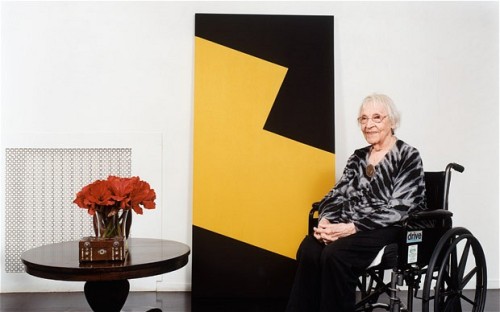
It sometimes is the case that great artists, especially highly original ones or who do not fit the artworld's templates and expectations, may work an entire lifetime and get little or no recognition or notice, and less remuneration.  Okay, that sounds a bit depressing, but here's a positive story, about Cuban-born, New York-based artist Carmen Herrera (1915-), discovered at age 89, that has been reported several times over the last year, though I like these two pieces, one in The Telegraph and the other in The Guardian UK, most of the ones I've read about this artist.  Both show Herrera to be a hoot, as sharp as a knifeblade and as candid as an open window, with a wit and way with words. (Her poor assistant.) But she also sounds like she could be fun to spend some time with, before you became a bother and prevented her from doing her work, which she is evidently (and thankfully) going to do, with aplomb, until she can't any more. So, take it away, Carmen Herrera! (from the The Telegraph interview, conducted by Helena de Bertodano, "Carmen Herrera: 'Is It a Dream?" reposted at Repeating Islands (by Lisa Paravisini):

‘It’s a very selfish way of doing things – I [Herrera] have to work on it for a while before I come to a decision. Sometimes it takes weeks and sometimes I get stuck.

I get very mad and sometimes I win and sometimes the picture wins. I hate being interrupted when I am working but now I am interrupted all the time.’ She looks at me accusingly and laughs.

‘Really, fame is ridiculous. I didn’t used to bother anyone and no one bothered me. Now I am paying because they are paying me.

‘The money is useful because at the end of life, to my amazement, you need a lot of help. Otherwise I would end up in a nursing home. And I dread that.’

Herrera has four helpers who rotate around the clock, enabling her to stay in the home she has occupied for decades.

I ask her when she moved in. ‘About 18 years ago,’ she says. Bechara, who sits in on part of the interview, intervenes. ‘Come on, darling, 18 years ago! You came here in 1968.’

‘You are very nasty, Tony,’ says Herrera. ‘When you are 95 you will forget your own name.’

If you happen to be in London, her work is currently on exhibit alongside work by Peter Joseph at Lisson Gallery, London NW1, until 29 January 2011.

Red with White Triangle (1961)
***

As has been widely reported, the National Portrait Gallery at the Smithsonian Institution bowed to crass political pressure when it removed the 4-minute excerpt of late artist David Wojnarowicz's (1954-1992) film "A Fire In My Belly" from its landmark queer portraiture exhibit, "Hide/Seek: Difference and Desire in American Portraiture." As the Chicago Tribune's Lauren Vieira reported on Saturday, it was only a month into the show's run when the Catholic League for Religious and Civil Rights, the outfit run by Bill Donohue, denounced the film as "hate speech," based on an 11-second clip in which ants crawl across a crucifix.  Shades of L'Age D'Or, etc. The lachrymose incoming Speaker of the House, John Boehner (R-OH), also slammed the work as a waste of taxpayers' money. Said the museum in a December 6th statement, the "Hide/Seek" exhibit would "continue as planned," until February 13, 2010, without Wojnarowicz's film, which allegedly "distracted from the overall exhibition." Ah, thuggery.