Showing posts with label Evie Shockley. Show all posts

Tuesday, April 17, 2018

The 2018 Pulitzer Prizes

Kendrick Lamar (pitchfork.com)
Yesterday, the Pulitzer Prize Foundation announced its 2018 honorees, and this year list brought a particularly unexpected surprise: in the traditionally most aesthetically narrow arts category, Music, the prize committee threw prize watches for a complete loop and selected Kendrick Lamar, the platinum record-selling, Grammy-nominated hip hop artist, for his 2017 album DAMN. The Pulitzer jury noted that Lamar's work was a:
Recording released on April 14, 2017, a virtuosic song collection unified by its vernacular authenticity and rhythmic dynamism that offers affecting vignettes capturing the complexity of modern African-American life.
With his win, Lamar became the first musician not working in a classical/Euro-American or jazz idiom to receive the award, and only the fifth African American since the Music prize was initially awarded in 1943. In fact, there was no Black winner at all until classical composer George Walker won in 1996 for Lilacs, for voice and orchestra. Since then, the other recipients have been Wynton Marsalis in 1997 for Blood on the Fields, the first strictly jazz composition to win; Ornette Coleman's jazz LP Sound Grammar, which won in 2007; and Henry Threadgill's In for a Penny, In for a Pound, in 2016.

Indeed, the Music category award roll was, until Walker's award, notorious for excluding not just Black musicians, but all music not falling under the general rubric of "classical music," and in particular, academic classical compositions. Some of the greatest American musicians, including Duke Ellington (posthumously, in 1999), George Gershwin (posthumously, in 1998), John Coltrane (posthumously, in 2007), Thelonious Monk (posthumously in 2006), and Scott Joplin (posthumously, in 1976!), received "Special Citations," but were otherwise ignored, as were all forms of popular music, however symphonic or orchestral, in the Music category.

Interestingly enough, musical theater, beginning with Of Thee I Sing, by George S. Kaufman, Morrie Ryskind, and Ira Gershwin, was honored in the Drama category as far back as 1932, and over the years, other musicals, like Richard Rodgers' and Oscar Hammerstein II's South Pacific in 1950, were recognized, as "Drama," but not as "Music." This was about as close as the Pulitzer Music juries got to the popular music of the moment.


The honoring of hip hop marked an immense shift and might be a harbinger of things to come, as judges in this category, joining their peers in others, may now decide to take a broader view of the contemporary artistic landscape. Lamar is the real thing; about as far as you can get from hip hop-lite and user-friendly lyrics, he's insistently innovative and political, and very much grounded in the language and culture of his native South Central Los Angeles. (None of this year's music judges were hip hop musicians, but adding some now may also help to shake things up in the future.) But we will, I guess, see what happens going forward. The two finalists in the Music category fell into the more traditional classical/art music vein: Michael Gilbertson, for his string composition Quartet, and Ted Hearne, for his cantata for chamber orchestra, electric guitar, and percussion Sound from the Bench. In past years, either might have won.

I can imagine, however, that some classical musicians, who may already feel beleaguered by the shifts in the music industry as a whole and the reported declines in attendance at classical concerts, may now feel concern that what was their protected sphere, as far as widely known US national awards go, no longer exists. That may be true, but then perhaps the award should not have been called "Music," but more strictly named to reflect how much music and how many musicians had been excluded from consideration. Some prior classical music winners--Aaron Copland (1945), Charles Ives (1947), Virgil Thomson (1949), Gian-Carlo Menotti (1950), Samuel Barber (1958), Steve Reich (2009), and of course Marsalis and Coleman, have been in the ears of the wider public, or some of their music has (I recently heard one of Reich's most famous pieces, "Come Out," sampled in a hip hop song, and Barber's Adagio for Strings has been performed more than once on TV, etc.), but in general, far too many of the Music winners remained mostly unheard and unknown to a degree unlike anyother category, including Poetry or Drama.

Other winners in the "Letters, Drama & Music" section included poet Frank Bidart, for Half-Light: Collected Poems 1965-2016 (Farrar Straus & Giroux), a nod towards his status as one of the senior, major figures in American poetry, and someone who had never received a Pulitzer before. I was very happy to see that the two finalists were two poets I know and admire, and collections I thought were stellar: Patricia Smith, for her collection Incendiary Art (TriQuarterly/Northwestern University Press), and Evie Shockley, for her collection semiautomatic (Wesleyan University Press). Given the threats university presses are facing these days, this was also a good vote of confidence in publishing in a genre that has remained the least commercial.

The poetry citation

The Fiction winner was novelist Andrew Sean Greer, for his comic novel Fiction Less (Lee Boudreaux Books/Little, Brown and Company), and the finalists were In the Distance, by Hernan Diaz (Coffee House Press), and The Idiot, by Elif Batuman (Penguin Press).  In the Drama category, Maryna Majok's Cost of Living received the award; the two finalists were Everybody, by the very brilliant and talented young playwright Branden Jacobs-Jenkins, and The Minutes, by actor and playwright Tracy Letts. Bidart's and Greer's awards may have marked one of the rare times that the poetry and fiction winners were both out, gay male writers; had Jacobs-Jenkins also been honored, it would have marked a very rare trifecta.

In the History category, Jack E. Davis's The Gulf: The Making of an American Sea, by Jack E. Davis (Liveright/W.W. Norton), an exploration of the history of the Gulf of Mexico, received the committee's nod. The two finalists were Fear City: New York’s Fiscal Crisis and the Rise of Austerity Politics, by Kim Phillips-Fein (Metropolitan Books), and Hitler in Los Angeles: How Jews Foiled Nazi Plots Against Hollywood and America, by Steven J. Ross (Bloomsbury). The Biography recipient was Prairie Fires: The American Dreams of Laura Ingalls Wilder, by Caroline Fraser (Metropolitan Books); the two finalists in that category were Richard Nixon: The Life, by John A. Farrell (Doubleday), and Kay Redfield Jamison's Robert Lowell, Setting the River on Fire: A Study of Genius, Mania, and Character (Alfred A. Knopf).

Lastly, under the arts and letters aegis, in the category of General Nonfiction, the winner was the highly praised study Locking Up Our Own: Crime and Punishment in Black America, by James Forman Jr. (Farrar, Straus and Giroux). The two finalists were Notes on a Foreign Country: An American Abroad in a Post-America World, by Suzy Hansen (Farrar, Straus and Giroux), and The Evolution of Beauty: How Darwin’s Forgotten Theory of Mate Choice Shapes the Animal World—and Us, by Richard O. Prum (Doubleday)

I must admit that I have tended to pay less attention to the News winners, but some did catch my eye this year. First, art critic and provocateur--and former reality show judge!--Jerry Saltz received the Pulitzer in Criticism for his commentary in New York Magazine. I sometimes strongly disagree with Saltz's readings of exhibits and the general culture, but I do think he knows how to get readers to think about art and society.

In the Public Service category, the recipients were The New York Times, for coverage led by Jodi Kantor, and The New Yorker's Ronan Farrow, for their exploration of the sexual predation, harassment and abuse in Hollywood and other realms of US life, in response to the #MeToo moment and movement. The Washington Post won in the category of Investigative Reporting for its coverage of the Alabama Senate race, and its revelations of the Republican candidate Roy Moore's sexual abuse of an underage teenager; in part because of this necessary reporting, he may have been defeated by Democrat Doug Jones.

I must admit to some skepticism about the dual award in the National Reporting category, however; while the Washington Post rightly deserved a Pulitzer for its thoroughgoing attempts to enlighten the American public about Russian interference in the 2016 campaign, the Pulitzer board moved the New York Times into contention for this award as well, and then jointly named that paper as a winner. Yet the Times has never explained its bizarre October 31, 2016 report that the FBI had determined there was no Russian interference in the election, which we now know was completely wrong based on multiple accounts, and not long after former public editor Liz Spayd attempted to answer the strange report--who gave the Times this information?--she was let go. Will we ever know what or who was behind that Times report, which provided official establishment and news ballast and support for the Trump campaign? Should the Times have been awarded a Pulitzer Prize for this work given this massive blunder?

Sunday, March 11, 2018

AWP Reading: Letters to the Future: Black WOMEN/Radical WRITING + Poem: Evie Shockley


I'm back from a few days at this year's annual Associated Writing Programs (AWP) conference, which was held over the last week in an unseasonably cool Tampa, Florida. AWP has grown considerably since I first attended it years ago, with several generations of new writers and students now attending, and though I find the sheer number of people and events overwhelming at times, I once again found it an enjoyable and invigorating event to attend since it provides an opportunity to see so many friends that I otherwise would not run into, and meet, hear and learn about the work of so many writers I was not already familiar with, or only knew in print and not in person. C joined me, and we had a great time over all.

R. Erica Doyle
I participated on two panels, one that I moderated, titled "Translating Blackness," sparked in part by my 2016 Poetry Foundation essay. It included translators and authors Aaron Coleman, Kristin Dykstra, Tiffany Higgins, and Lawrence Schimel; the second focused on style, and included Christian Kiefer (organizer and moderator), Caroline Casey, Kim O'Neill, and Christine Schutt. Both were full houses, I was happy to see, and I plan to post my notes for the second within the next few days. In lieu of the kinds of reports I've posted on this blog in the past, I thought I'd feature a few photos, and poem, from one of the events I attended, a reading and pre-launch of the forthcoming must-read anthology Letters to the Future: Black WOMEN/Radical WRITING, edited by Erica Hunt and Dawn Lundy Martin, and on bookshelves in June from Kore Press.

L-r: Ruth Ellen Kocher, Dawn Lundy
Martin, and Erica Hunt

According to its description on Kore Press's site, the collection

celebrates temporal, spatial, formal, and linguistically innovative literature. The anthology will collect late-modern and contemporary work by Black women from the United States, England, Canada, and the Caribbean—work that challenges readers to participate in meaning making. Because one contextual framework for the collection is “art as a form of epistemology,” we envision the writing in the anthology will be the kind of work driven by the writer’s desire to radically present, uncovering what she knows and does not know, as well as critically addressing the future.
It continues:

This anthology will help re-write the misnomer that innovative writing is white writing and do it with a particularly interest in gender. Is it a coincidence that #blacklivesmatter was coined and put into action by black queer women in the same moment that there is a proliferation of black women writing experimental work? We don’t think so. This anthology is part of our means of investigation, or of simply looking at, what we are doing together to re-write the future world as unfamiliar. Indeed, it is the familiar, the well-worn racial and racist past that is killing us.
The audience
The reading, on International Women's Day, took place at the Floridan Palace hotel, in downtown Tampa, and featured a handful of writers whose work appears in the collection, including LaTasha N. Nevada Diggs, R. Erica Doyle, Duriel Harris, Ruth Ellen Kocher, Tracie Morris, Evie Shockley, and giovanni singleton. Given this lineup, every poet's performance sparkled, and made a very strong case for getting a copy of the anthology, which will be perfect not just for reading from cover to cover, but in a wide array of courses.

Dawn Lundy Martin and Evie Shockley reading
Below is one of my Rutgers colleague Evie Shockley's poems, "What's Not to Liken," from the anthology, which I found especially moving, and a few photos from the event. The poem also appears in Evie's most recent collection, semiautomatic, Wesleyan University Press, 2017. This is one poetry collection you definitely want to add to your bookshelf; it is fantastic! You can pre-order the anthology at Kore Press's site, or via Small Press Distributors.

Copyright © Evie Shockley, from semiautomatic,
Middletown: Wesleyan University Press, 2017


Monday, November 14, 2016

Random Photos

A few recent random photos. Enjoy!

Chinelo Okparanta & Robin Coste Lewis
answering questions after their
superb reading at Rutgers-Newark
A subway rat (do you see it?) 
Evie Shockley introducing Mendi+Keith
Obadike at Penn State Conference
on African American Literature and Language

Mendi+Keith Obadike presenting
their work at CAALL
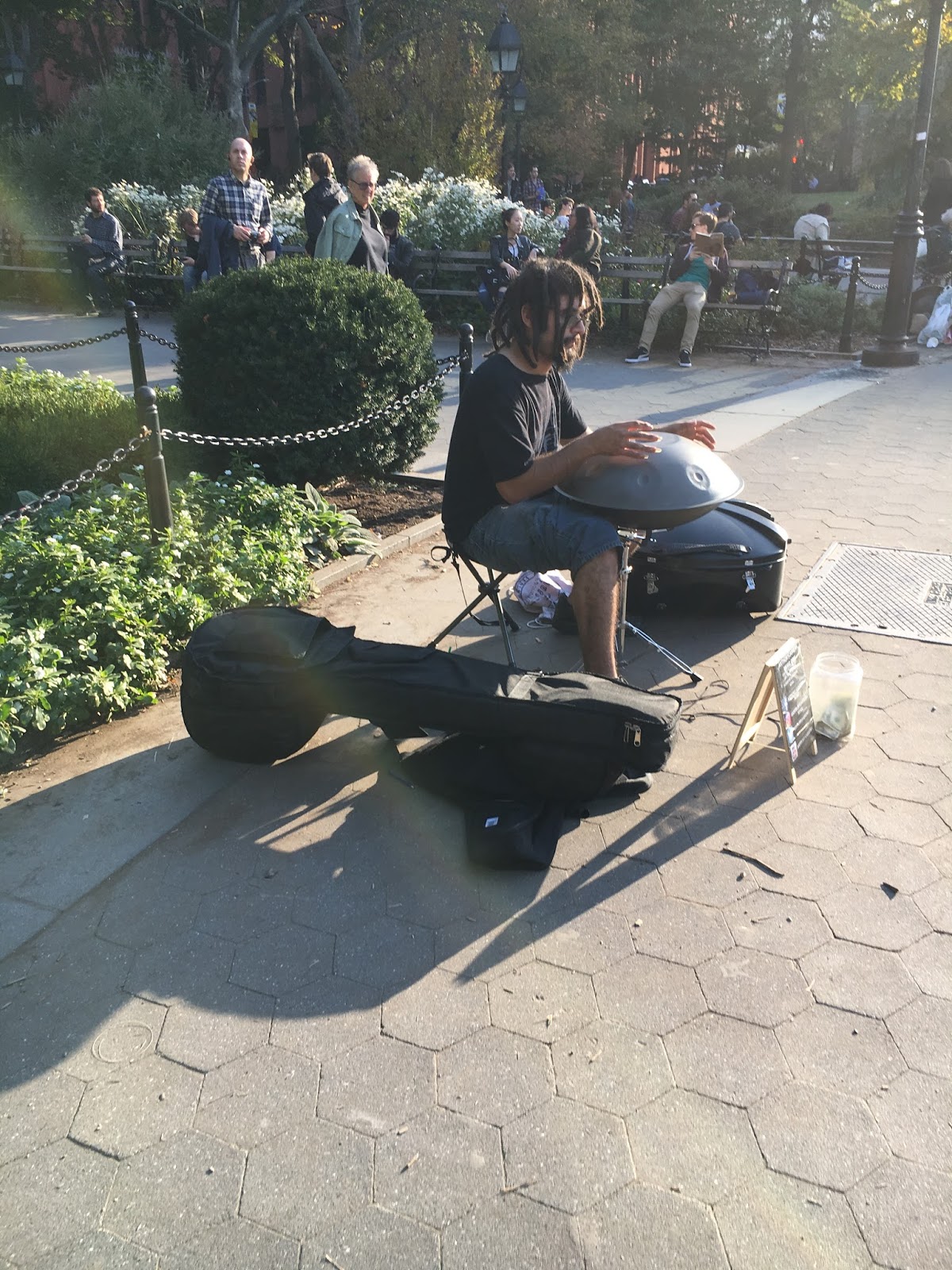
A musician in Washington Square Park
Painting wrought iron in the West Village
Décollage, SoHo 
With Carter Mathes (left) and Evie Shockley (right)
at the Ark of Bones event at Gallery Aferro
in Newark

My colleague Mark Krasovic, an unidentified woman,
Mrs. Loretta Dumas, Henry Dumas's widow,
and my colleague Christina Strasburger
at Gallery Aferro 
Scarlet and Black: The newly issued
scholarly anthology about Rutgers University's
historical involvement with slavery 
College Avenue, Rutgers (New Brunswick)
At the Westside Theater, before the
start of Othello: The Remix 
Mosaic mural featuring Frederick Douglass
quotation, Midtown 
Post-election Grief & Supportive Post-Its,
Union Square Station tunnel, Manhattan
Those Post-Its
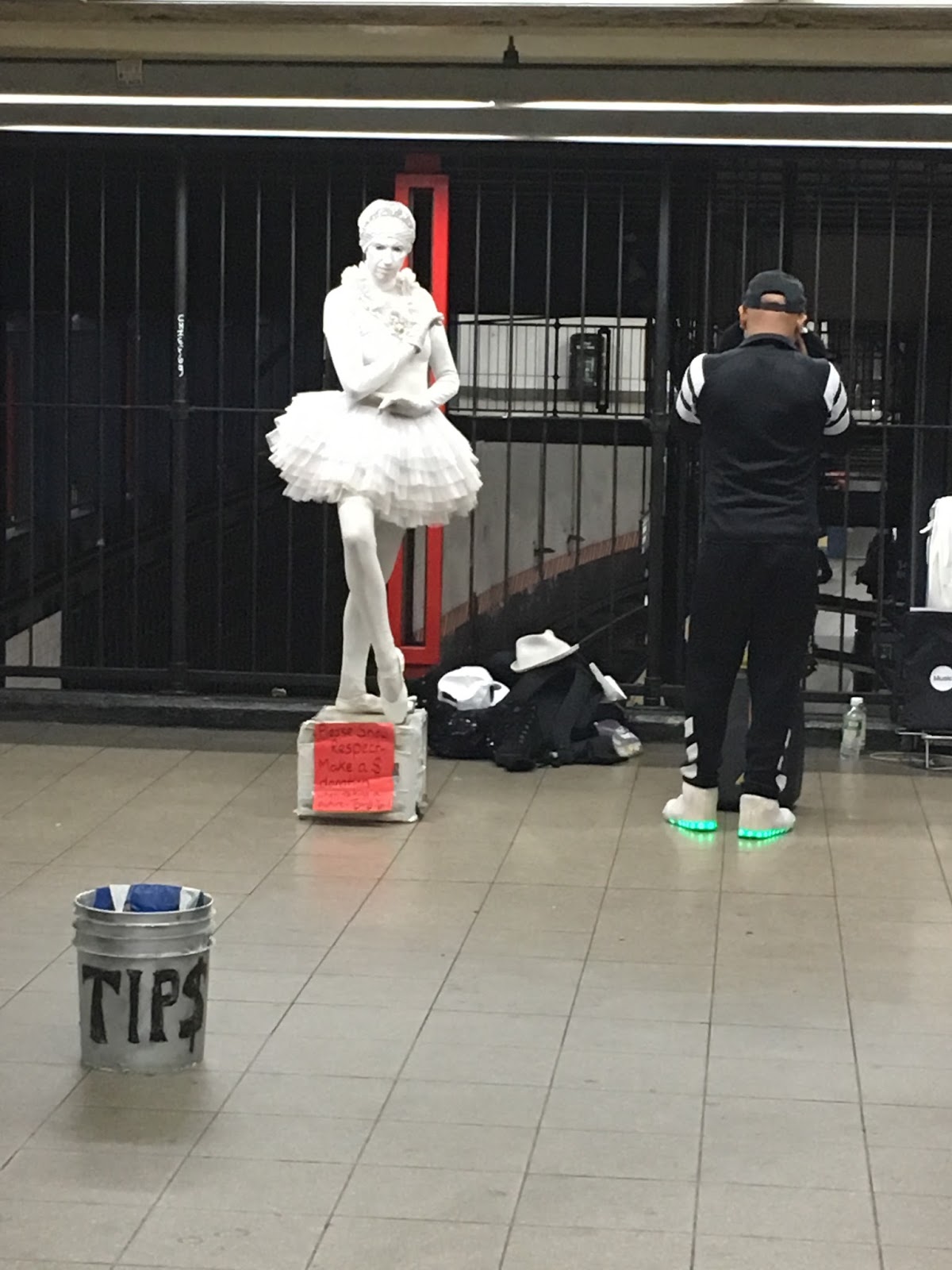
Subway performers 
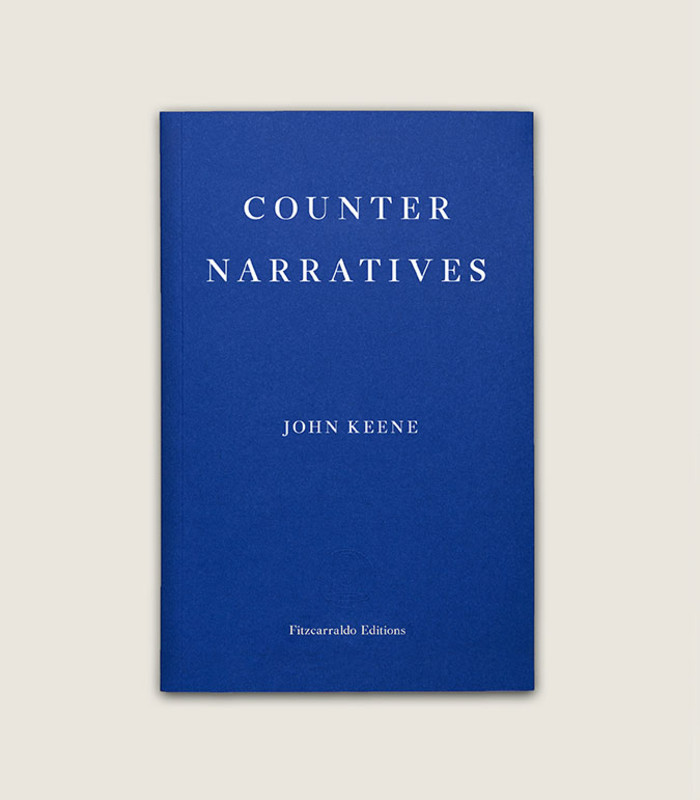
The Strand Bookstore's last copy (for now)
of Counternarratives; they once had over
100+ copies of the hardcover AND the
paperback. Thank you, readers!
Subway rider, with his 40
Rehab work at the Blue Man Group's
 theater, Astor Place
Cooper Square 
Workers at the increasingly
privatized, zombie urban
hot spot, Astor Place
The famous Alamo Cube, cordoned off
(and now longer movable by passersby)
Bikes and skateboards now
forbidden at the branded, neoliberalized
Astor Place

Monday, April 06, 2015

Out of Bonds: The Slave Past & Contemporary Poetry at Rutgers


Last Friday I participated in a great mini-symposium, "Out of Bounds: The Slave Past and Contemporary Poetry," at Rutgers University-New Brunswick. Organized by Douglas Jones, an assistant professor in the English department at Rutgers-New Brunswick, with the assistance of Gabrielle Everett, a doctoral student in English, the event aimed to explore ideas contained in a paper entitled “On Failing to Make the Past Present" by UC-Berkeley English professor Stephen Best, that appeared in a 2012 issue of the journal MLQ, through talks, presentations, discussions, and poetry readings.
To summarize Best's article, in it he suggests that rather than taking the approach of Toni Morrison, in Beloved and other works (though not A Mercy) of reviewing and reanimating the past as a means of understanding the present, which is to say, of viewing slavery and its conditions as part of an epistemological continuum with and prism to understand present day concerns, contemporary black scholars and writers might have followed--and still might follow--Orlando Patterson's 1970s prescription for African Americans to utterly remake ourselves anew as if from a clean slate, or, to put it another way, reading through the lines of argument in A Mercy, rather than racial and historical affiliation, "We seem less held together by race here, and more together in our abandonment."

Meta and Evie
The symposium began with a vibrant, provocative, and probing open conversation, led by Jones and Ivy Wilson, my former colleague and an associate professor at Northwestern University, on Best's article. I arrived halfway into this conversation, which was truly open to all present, which meant not just faculty and graduate students, but undergraduates and other audience members, but the sizable portion of Jones' and Wilson's exchange, as well as the questions and commentary from everyone else, that I caught was superb and highly informative. I kept thinking as I listened that Jones's article echoed in some key ways Kenneth W. Warren's provocative arguments in What Was African American Literature?, which have merited several waves of responses, and Jones articulated this connection with considerable brio, illuminating the parallels before challenging both approaches.

Evie reading her poem,
which is projected on the screen
behind her.
This portion set the stage for the next portion of the afternoon, which was the two sets of conversations pairing contemporary literary and cultural studies scholars, and contemporary poets (though Evie Shockley is also a major scholar in her own right). Radiclani Clytus, a filmmaker, critic and assistant professor of English at Brown University and I began, with Radiclani posing some thoughts about my work, both older poems that directly treated the theme of slavery (I had dug them up for him), leading into a discussion of some of the pieces in Counternarratives, in which slavery and its aftermath is not only thematized in multiple ways, but narrativized and dramatized in half the stories. Radi is as sharp as a laser and kept me thinking on my toes, creating a free-wheeling back and forth. It was easily one of the most enjoyable public conversations I've had in years. I wish it were possible to participate in public discussions like this, with Radi and others, more often.

Tyehimba, reading one of his
syncopated sonnets

Next came Evie, a renowned poet and scholar of poetry, who teaches at Rutgers-New Brunswick, and Meta DuEwa Jones, an acclaimed scholar who teaches at Howard University. Evie and Meta talked about Evie's work, beginning with Evie reading one of her formally and linguistically experimental poems that allowed them talk in and around the notion of the cut--"how does tight, taut form work in relation to damage, monstrous intimacy" (citing Christina Sharpe's brilliant work here)--and so much more. Along the way, Stowe's "Topsy," critics Sylvia Wynter and Alex Weheliye, legal tender, Toi Derricotte, the confluence of multiple heritages, histories and herstories, and M. Nourbese Philip's Zong all arose in the course of their back-and-forth.

Tyehimba, reading one of the poems
that adapts the ghazal form
Tyehimba Jess concluded the events, delivering the keynote presentation, introducing and then reading a series of poems, many dealing with historical figures who emerged during and shortly after the Civil War period, such as Blind Tom, Black Patti, and the McCoy Twins, from his forthcoming collection Olio. His new work, following formally from the inventive, innovative aesthetic vision in his award-winning first collection Leadbelly, includes a number of poems using innovative forms, among them what he has labeled "syncopated sonnets," which incorporate multidirectionality and improvisation into their formal structures, which is to say, multiple possibilities for reading (up-down, across from top to bottom and the reverse, skipping diagonally between lines, and so on) left up to the reader-performer, and Jess did so with panache. He also read poems that adapted the ghazal (and Golden Shovel) form, again showing how the poems themselves suggested certain performativities and how he, as the author and reader, improvised on those, creating at certain points what felt very much like the blues and at others like hip hop. No one does it like Jess!

It was a scintillating afternoon and evening, and I want to thank Doug, Gabrielle and Ivy, and Radiclani, Meta, Evie and Jess, as well as my sister campus in New Brunswick again! And as we said, we have to do this again--soon!


Sunday, September 15, 2013

Poem: "Untitled" (After Hugo McCloud, "Untitled")

As part of the poetry reading and discussion "Experimentation and the Black Aesthetic" at The Museum of Contemporary African Diasporic Art (MoCADA) in Brooklyn, organized by my Rutgers colleague and superlative poet and scholar Evie Shockley, and which included amazing poet-theorist-praxtitioner Dawn Lundy Martin and poet and multi-platform artist LaTasha N. Diggs, all four of us wrote new, short pieces in dialogue with/response to one work on display. Since I was on the panel and was unable to take photos, and was one of the participants, I thought I'd share my piece here, to give a flavor of what we were up to. All of us, it seems, chose a painting by Hugo McCloud. Rather than describe it, here's the artwork and what I wrote. Enjoy.

Hugo McCloud, "Untitled", block print series #2, aluminum coating,
 aluminum paper on tar, 60 x 60 inches, 2013.

(UNTITLED, AFTER HUGO MCCLOUD, "UNTITLED")

Silver: shimmer. Sheen as clamor. Calmer, stroking it with vision: the blackground. There is an answer ground into the black. Stroke by stroke, layer by layer. Texture, here in the place of mirror. Into the surface pace. To peer into the space of reflection, the under-surface. Crossing into the space of aporia. Enter it, beyond the sign. Eyeing the face of reflection, between answer and question. Resting momentarily on the surfacing shimmer. The fragile layer which emerges as identity. What stirs in the reflection of the tinseled plane. Pressing, silver limning an opening: seeing. Identities emerging: artist, other. Compress them. What is the absence that lies behind. What surfaces beneath the surface as the event of recognition. Fragile covering as soft as armor. See necessity. Touching discourse. Reflection and absence. Axial, scene. Stroking vision in the aluminum pane. Abstraction: letting go of the metaphor. To let go of the face and enter allegory. Catching the emblem, the flights of coral. The eye as an open road, letting it pass into you. The I as route into and under the inner worlds. What echoes of the idea lingering at the crossroads. Passing through. Lateral music, not literal. To appear in the debris, the unrecovered, mind it. To you, in order to face it. Through you, making it. Peering at the symbol, calling. Beneath the detritus the glittering space. Down into the black. The call that need not ever be concealed comes back. Listen: the noise as the music of a enduring absence under the surface. Calling all viewers. Only then can you know the seeping. In the blueblackground: let it flow.

Copyright © John Keene, 2013. All rights reserved.

Untitled
Me reading at MoCADA (Evie Shockley on the left, LaTasha
Diggs on the far right. Photo © by David Barclay Moore)

Friday, September 13, 2013

Pattern Recognition: Reading/Panel @ MoCADA in BKYN Tonight!

If you are in or around Brooklyn this evening, drop by MoCADA to catch PATTERN RECOGNITION, an amazing exhibit of contemporary abstract art, and then stay for the reading and conversation I'll be participating in!


POETRY READING & DISCUSSION:
EXPERIMENTATION AND THE BLACK AESTHETIC

Friday, September 13
6:30-8:30PM | MoCADA

Evie Shockley, author of the new black and Renegade Poetics: Black Aesthetics and Formal Innovation in African American Poetry, will join celebrated innovative poets LaTasha N. Diggs, John Keene, and Dawn Lundy Martin for a reading and discussion on craft, language, politics and the search for a “black aesthetic” in contemporary art. 

Seating is limited, please arrive early. Wine will be served and author books will be available in the MoCADA Shop. $3 contribution.

Sunday, March 09, 2008

The Wire: Finis + Travels & Brain Camp

The Wire: is it really over? What a finale! I know folks who haven't yet seen all the prior four seasons, so I'll keep my thoughts to a minimum, but what a series of climaxes and denouements, with narrative braiding and unexpected twists superior to many a novel out there. Another of the strongest and most appealing aspects of the show for me was the way that David Simon, his writers and producers, and his cast, maintained a consistency and depth of characterization over multiple seasons; the only character whose motivation was least clear to me this season was Kima, which I attribute to the writers' inability to find the right character to take the potentially devastating steps she did. Who else could have done it? The characterizations of the newsroom people, save Gus Johnson, were also shallower than what Simon and company served up in previous seasons, and I attributed this to the lack of narrative space and time to fill them out. 10 shows simply were not enough. I cannot figure out what drove the yuppy reporter to his unethical actions, because even his early statement and demonstration of his ambition rang more than a little hollow--and I can't attribute it solely to bad acting--and yet his behavior, reflecting the many journalistic scandals over the last ten years, was all too plausible.

My favorite final notes tonight included the utterly cynical and predictable take on the newspaper industry, with the racial and gender critiques woven in without being uttered; the ridiculously random yet perfect resolution to the "homeless killer" plotline, with its manifold ramifications for all involved; Marlo Stanfield's return, replete with a bit of streetfighting, to the only thing he truly knows; Daniels' final demonstration of an inner ethical compass, despite the consequences, as a counterstatement to the cynicism filling the air of nearly every other space in the show; and little Michael's figurative and literal reprise of the series' anti-hero, Omar, with a hooded accomplice in tow. (Bernie, Reggie and I had broached a possible reading of this after a domestic scene early this scene.) The show's culmination also represented one of the best multi-season explorations of local and state politics that I can recall. I told C that given how close the show sometimes hewed to reality down there I imagine Maryland's governor, the former Baltimore mayor Martin O'Malley, is probably more relieved than almost anyone else that it's finally ended. Then again, I think the most relieved party may be the Baltimore Sun.

◊◊◊

This past week was like brain camp! I want to go back! (Photos coming soon....)

After getting an opportunity to spend some time at home, on Tuesday evening I participated in a Poets House-sponsored panel, The Harlem Renaissance Revisited, which included the marvelous scholar-poet Evie Shockley, who inimitably brought to light the work of poet Anne Spencer, and the amazing multitalented duo Mendi + Keith Obadike, who spoke about the influence of several Harlem Renaissance-era musicians and poets on their own work. I offered some remarks on a longtime hero, Richard Bruce Nugent, whose life and works, such as "Smoke, Lilies and Jade," like other pathbreaking texts from this period and group I see as being integral, in key ways not only to the subsequent development of Black queer literary and cultural production, but also to Black avant-garde and American avant-garde traditions. Amiri Baraka drawing from the notebooks of Nugent and Hughes, Hurston and Spencer: can you picture it? Before the panel, I met with several Borough of Manhattan Community College classes, and answered their questions on the Harlem Renaissance, which ranged from the paucity of high profile female poets, to why Langston Hughes got so many props, to when exactly the Harlem/New Negro Renaissance ended and why. Great questions, and many thanks to the professors and students, one of whom was analyzing a Langston Hughes poem as we walked to the auditorium--you gotta love it!

I was so glad that friends like Tisa, Patricia Spears Jones, and Kaemanje were present, and it was also a pleasure to see Tom Wirth, who edited the Nugent omnibus volume, Gay Rebel of the Harlem Renaissance (Duke) several years ago, and passed on a copy of Nugent's posthumous roman à clef, Gentleman Jigger, which he edited and I am reading now and cannot put down! Langston Hughes, Zora Neale Hurston, Countee Cullen, Carl Van Vechten, Aaron Douglas, Alain Locke, W.E.B. DuBois, A'Lelia Bundles, and many other high-profile Harlem Renaissancers make their appearances herein, sometimes to shocking effect. Had he published this back when he wrote it, he not only might have provoked Wallace Thurman--a central figure ("Rusty") in the text and the foil of Nugent's alter ego, "James 'Stuartt' Brennan"--whose Infants of the Spring is like a mirror of this text (Nugent calls the Thurman character a "plagiarist" in the book, though Wirth's introduction argues that the matter remains unresolved), to an even earlier death, but he might have found himself exiled from New York permanently. I recommend it, and if I hadn't already crammed my spring course with reading material (how on earth is that going to work?), I'd be adding it to the list. Thanks to Stephen Motika of Poets House, and Alison Meyers of Cave Canem, among many others, for making this event possible.

On Wednesday I flew out to Indiana University to participate in a reading with Evie Shockley; our host was the gentle, brilliant, beautiful poet-scholar Ross Gay, along with poet Cathy Bowman, who heads the Creative Writing Program, and Margo Crawford, one of the smartest people I have met. (Margo's mind moves like subatomic particles, and I'm not kidding.) The reading was lots of fun: I read a new story, and Evie TORE IT UP with her poems! I had never heard her read more than a poet or two from her collection, A Half Red Sea--in fact, I don't think I'd ever heard Evie read outside of a CC reading, incredibly enough--so this opportunity was platinum. She also read newer poems whose concision, subtlety and punch could serve as models for any poet, and three final pieces which closed out the evening perfectly. Along the way she invoked Ella Fitzgerald, Henry Bibb, Gwendolyn Brooks, mathematics, Nappyphilia, and countless other things in utter congruence in that way that only Evie can. If only I could figure out a way to bring her and Ross to the university, at least for a day! I will only add that Ross's introductions set the bar high, and you know you gotta bring it when he sets the standard. Later we all hung out, and I got to chat with Cathy and Margo, and Ross and Evie, and another colleague of theirs, who wrote an award-winning bio of Nella Larsen, and had the sort of conversation I often dream would or could occur regularly in these parts. The next day we met with some of the graduate writing students, and Ross, Margo and they all posed excellent questions, with Evie supplying her customary super brain power, and some of which I didn't think of the answers to until I was on the plane back to O'Hare, but what can you do? I still ran my mouth. Oh--and the "non-objective" was part of the philosophical underpinnings of the Black Arts Movement, referring back to the central African principle of muntu. If only I'd have thought of that definition a few days ago. As I said, what can I do? Nevertheless, I felt like my head had expanded from all I learned and I was in one of the best moods I could imagine in Chicago in a long time, even after I got on the road and nearly destroyed my axle on a pothole the size of Lake Michigan.

Then it was back to grind, but Friday provided a LOT more brain-nourishment when, after meeting with highly accomplished prospective graduate students to the English department, and a very talented young person who's been admitted to the African American Studies program, I went to hear Gayatri Spivak give a talk on "Rethinking Comparativisms." One of the most eminent of my colleagues and her former graduate school classmate at Cornell, Samuel Weber, introduced her, and then he let her do her thing. I have seen Spivak talk before, and I place her in the avatar category, so it was a thrilling ride she took me and everyone else on, not only in the lecture, which was supposed to include clips from Sissoko's film Bamako (Keguro, I thought of you!)--only no one could figure out how to work them in that "smart" lecture hall, which meant that Spivak had to act them out! Just imagine that!--but also in the question and answer period. Afterwards, I was able to attend a dinner with Spivak, whom I didn't get to speak to until the very end, as she was departing, but I did meet some new colleagues in the German and Comparative Literature departments, with whom I gabbed about several figures we were mutually interested in (Yannis Ritsos, Alexander Kluge, Immanuel Kant, Walter Benjamin, etc.), I learned a strange new fact about how many Enlightenment philosophers and mathematicians made their keep, and I got to chat at length with a colleague I rarely see on campus, Jillana Enteen, who had some perceptive and enlightening takes on the talk.

One aspect of the talk that most interested me was Spivak's reading of Pascale Casanova's The World Republic of Letters, a book of the month pic on here years ago and also the subject of a short post; I even taught a little of the book a few years ago, to the bafflement of my students, in part because Casanova's theorization was only tangentially germane, though useful I thought, to the subject matter at hand. But Spivak's breakdown of the terms of Casanova's premise, concerning minor literatures' relations to the hegemonic languages and their literatures, as well as the larger global field of literary production and publishing, caught my attention, I only wished she'd have said more about this, though it was clear that her argument's aims were different: "policy," as she put it. And not policy regarding the question of global literary production, reputation-making and historicization, which are Casanova's, as I read them. For that's for another day, of course; perhaps when Casanova returns to the university to speak, since I unaccountably missed her talk here a month ago.

Then on Saturday evening, I went to see Toni Asante Lightfoot participate in a dance performance at Link's Hall in Boystown: Choreographing Coalitions: Dancing the Other in the Self's first show, which included dances by Darrell Jones, Gesel Mason and David Roussève. I'm nobody's dance critic, so I'll keep it brief: Gesel performed two works, the first a brief, smooth piece "No Less Black" (2000), with a text she'd originally written in 1998 or so, which Toni read in accompaniment. After a video interlude, the second startled me beyond speech: called "Jumping the Broom" (2005), it was one of David Roussève's pieces, and linked the horrors encountered by two enslaved people who dared marry to the battles facing many LGBTQ people who want to marry nowadays. As it was a Roussève piece and given Gesel's performance, which was visceral in the pain and struggles it portrayed (she was bound wrist and ankle, crawled and dragged herself across the floor, and wrenched the text out of her core), the equivalence (the subject of Spivak's critique) came off as fitting. After a short break, during which I wasn't sure where my emotions were, a group of five very fabulous young people, four gorgeous young people (Darrell Jones, Damon Demarcus Greene, JSun Howard, and Awilda Rodriguez Lora, accompanied I'm told by a member of the House of Avant-Garde who was wearing a gas mask and white jumpsuit!) began practicing for their piece, excerpts from third Swan from the end (2007), which was perhaps the blackest, gayest dance performance I've seen that wasn't in a club or at a spot like the old, pre-Giuliani West Side Piers. Evoking all manner of black gay public and private (dance) performance and gesture, from keekeeing to vogueing to strutting to runway walking to bodily reads, all to a House soundtrack, these four dancers turned it out (serve!), and even managed to include a hilarious bit that C and I had witnessed live years ago at the Octagon, a performance of one of Oprah's bits from The Color Purple! (Darrell Jones told me afterwards that he indeed gotten it from there!) Had they included Harmonica Sunbeam/Sheila Noxzema's Spiderman hustle, which C and I also saw live years ago (and which I hope appears in a film somewhere someday), I swear I would have jumped through the roof in astonishment or joined them myself. As it was, it was hard not to stay in my seat. Part of what made it all so much fun was that Krista, Abegunde, Toni (after her performance), and Toni's husband Setondji were there, and did our own keekeeing. Thank you Gesel, thank you Darrell and your crew, and thank you Toni, for always coming up with ways to make Chicago feel like one of the most exciting cities in the world!

Tonight I finished an introduction that has been needling me for weeks, to another author's book, and my brain is tired, which means back to the grindstone!

Monday, March 03, 2008

Delirious Hem: Dim Sum + WaPo Trashes Women

Mendi recently pointed me and others towards this site, Delirious Hem: Dim Sum, which I'll let its creators describe:

Some of us wished the women poets we admired would write more about poetry and poetics, experimental, post-avant. Some of them weren’t writing about these things at all. Why not? They’re busy, some of us surmised. Some of them were writing about these things, but some of us were greedy, and wanted them to write more. Some of them were men, and some of us wanted some of them to write about experimental women poets, gender performativity on the page, masculinity via grotesque, etc. Wanted some of them to write about some of these things more/at all.

What if some of us built a platform? What if the parameters were informal, relatively boundless? What if the form invited conversation and huzzah?

But some of us are busy, too. Some of us can’t possibly fit one more dish on our plates, and some of us can’t possibly spin one more plate in the air, and some of us can’t possibly...

You can start with this conVERSation: Tonya Foster and Evie Shockley engage in a radiant, critical dialogue/critical notebook, sparked in part by Juliana Spahr's and Stephanie's essay, "Numbers Trouble," as well as "poetics and politics--specifically Gloria Steinem’s NYTimes piece in support of Hillary Clinton and Ishmael Reed’s BlackTimes response to Steinem’s arguments."

A snippet:


...despite the increased participation of women within the traditionally male-dominated ‘avant-garde,’ and the various advances of feminism, gender politics continues to be a contested site within aesthetic practice and its articulation/translation/ reception in a still largely phallocentric system.
JS & SY (93-94)
ES: Though I’m willing to consider this open to debate, my general feeling is that, indeed, aesthetics still tends to operate in phallocentric terms, especially those aesthetics that have been described as “innovative” or “avant-garde.” Part of what happens when innovative poetics defines itself against “traditional” or “mainstream” poetics is that the latter categories are “feminized,” even in the face of significant or predominant numbers of men practicing such poetics (I’m thinking of Romantic and confessional poetries here). An important related problem is that often African American innovative poetics—in particular, the poetics of the Black Arts Movement—is similarly “feminized” (despite the phallocentrism attributable to BAM itself) as opposed to the (real) (white) avant-garde. This move turns on the significance to BAM “black aesthetics” of asserting a (“black”) “self” in the face of the oppressive and dismissive aesthetic standards that have been imposed upon the writing of African Americans since the era of Phillis Wheatley. An important point related to the foregoing is how critical it is for us to recognize that sexism is racism, at times, without losing the specificity of either category in our analyses.

TMF: This “dismissal” you write of seems related to dismissals of the term ideological as it operates in the world(s) of poetry—too much socially and historically constituted subjectivity is rather passé. I don’t know Evie...I can’t think of phallocentrism without the racialized, nationalized and naturalized. What you point out is important to me in thinking about both the power and the limits of definitions built mainly in opposition. It means that the phallocentric “center” still determines the terms of engagement.

§§§

In an attempt to slam female supporters of Barack Obama and Hillary Clinton, i.e., a large portion of the current US electorate, the Washington Post's Sunday Outlook section has outdone itself, yesterday publishing one of its most ignorant, offensive articles in quite some time. Initially titled "We Scream. We Swoon. How Dumb Can We Get?", the following headlines accompanied the piece: first "Women Aren't Very Bright," which was then changed to "Why Do Women Act Dumb?" An untrammeled burst of misogyny and sexism by a notorious female anti-feminist and conservative crank, Charlotte Allen, it's generating outrage all over Blogistan.

You know what you can do: contact the Washington Post and tell the editor or ombudsperson how disgusted you are by this crap.

Oh, and remind that Washington already has a pro-business, right-wing rag, owned by the Moonies and edited by avowed white supremacists, so the Post ought to consider occupying a different niche in the diminishing world that is major-city newspapering.

And to think this paper seriously claimed it was trying to increase its female readership!