Showing posts with label states. Show all posts

Friday, August 26, 2011

Irene On the Way + What Obama's Read(ing) + Gawker's 50 Worst States

photo
Lower Manhattan, from Hoboken, or The Calm before the Storm
Irene, if I recall correctly from my long-ago high school Greek classes, means "peace." This imminent, ironically named Hurricane Irene, which has already slammed Puerto Rico, DR, Haiti, and the Bahamas, is now hurtling northwards towards the Outer Banks of North Carolina, and weather forecasters expect it to tear into coastal New Jersey and the densely populated New York metro area beginning Saturday evening through Sunday morning. I try not to take storms of this sort too lightly, but I've observed more than once that over the years, the New York-area meteorologists and news reporters in general have tended to overplay them, predicting typhoons and cyclones when what's shown up are, well, bad but not world-ending calamities. If the tenor of the brouhaha is at all credible, all living along the Eastern seaboard should be on trains, planes, buses or in cars to Montana.

New York City's emperor, Mike Bloomberg, began talking about mandatory evacuations from the city's low-lying coastal areas and all its islands yesterday, with similar calls coming from Long Island's two county executives, and New York's governor, Andrew Cuomo, has ordered the MTA trains to stop running tomorrow at noon, the first time there's been such a pre-storm related shutdown in the system's history. (We kept saying that the subway trains ran no matter what the weather problems, but of late that has not been the case. What happened? No one has answers.) The Port Authority is shutting down all the local airports and the PATH trains by midday tomorrow, and New Jersey Transit trains and the light-rail will also be on ice.  Hospitals, eldercare centers, and many other facilities are being evacuated, but not, it seems, Rikers Island, which seems particularly cruel under the circumstances. Here in New Jersey, our Youtube performer masquerading as a governor, Chris Christie, has told people to flee the shore, which apparently is in the direct path of the storm and be nothing more than exposed rock, coral, hulls, siding, syringes, and empty water bottles by the time this storm has passed through, and Jersey City's colorful mayor, Jerramiah Healey, after mulling whether to say something today or tomorrow, has decided to issue a voluntary evacuation order from neighborhoods too close to the Hudson River, New York Harbor, the Hackensack River, or Newark Bay, i.e., anywhere downtown or on the Newark side of Jersey City. We thankfully are not in a flood plain or zone, though if we were, I have yet to see where we're supposed to go (the nearest shelter is at the Izod Center in East Rutherford, in the low-lying, marshy Meadowlands, but maybe they know something I don't). I haven't heard any mention at all of nearby Bayonne, which is in the direct path of the storm (the various evacuation maps leave blank all other municipalities, so New York City's left LI and NJ blank, while Jersey City's stops at the borders with Secaucus, etc.). Do the Bayonnaise not count? Nearly all of Hoboken's waterfront sits fairly low, so it could be a ghosttown come midday tomorrow. And a very pretty, expensive little ghosttown it will be.

photo
NY JET Nick Mangold, signing autographs in Bryant Park today
The local Gay Pride celebration has been moved to...October. The Jets-Giants preseason game will take place on Monday instead of Sunday. Several music festivals are being postponed or canceled outright. No Dave Matthews, no The Roots. (I've seen the latter, live, years ago, in a moshpit in Charlottesville.) I didn't go to the store to but rather to my daily redoubt, the library, but C did go to one on the Jersey side of the river and said that it was a madhouse. No surprise there; people have been whipped up into a frenzy of shopping for provisions, essentials, and things they didn't realize they needed, like Fritos. I guess if Irene does pan out, we can say we were prepared. If it doesn't, the economy gets a needed, though temporary, boost. And all who could afford to will have extra canned goods--and lots of plastic water bottles. Now, what about all the people who cannot afford to evacuate and what about all those prisoners at Rikers?

--

It's no surprise our president is a reader, because he's a damned good writer. Given how much Barack Obama has had to deal with since before taking office, though, I'm amazed he reads anything that isn't a Congressional bill or a précis of one; a PDB; a Blackberry SMS text; snippets of whatever his staff culls from social media sites, newspapers, and so forth; and mash notes from some billionaire or corporation. But he does read books. Not a University of Chicago Law School prof-level any more, but nevertheless an impressive amount, at least compared to most people out there, I'd imagine, who do not have to read books as part of their job, and who have very busy full-time jobs that include dealing with lots of crazy people and quite a few very demanding billionaires and corporations. Recently I came across this list of books that President Obama has read since 2008.

Several things immediately struck me: there is only one book by a woman, and only two by writers of color. Not good. Not good not just because his reading really ought be diverse, but because there are lots of excellent books by women, by people of color, by women of color, by all kinds of people, that he could be reading, and which might even give him a bit of a wake-up call and a reminder of who voted for him. (Lots of women and people of color!)  There's a book by Tom Friedman, as ridiculous a member of the punditocracy as exists (he's the very, very, very wealthy person who suggested the US invade Iraq to show them, or someone, something, in response to 9/11. Real brainiac.) That is not good, unless it's to assist him in his cultivation of negative capability. But I think Barack Obama has demonstrated that he has more than enough negative capability, and deeply grasps the concept.

Also, there's only one book of poetry. This president could stand to read some more poetry. Like, by Langston Hughes and June Jordan and his inaugural poet and a whole lot of other poets, living and only living in print. Hell, given what he's dealing with, John Milton's Paradise Lost wouldn't be a bad place to start. And it's an enjoyable, if long, read too. A so-so novel by formalist poet Brad Leithauser ain't gonna cut it. There're no books about science or technology, especially the net. There are far too few books about economics, and zero about the causes of the economic meltdown. Many are the very good books about that damned economic collapse which most of us are still living through. Someone near the president should gently and firmly pass one to him.

And he doesn't seem to be taking many pointers from the books on or bios of Abraham Lincoln, Teddy Roosevelt, or Franklin Delano Roosevelt. Yes, John Adams was a remarkable person, but not such a good president. (His son was remarkable too, but even worse in that office. He was quite good as a Congressperson, though.) But then it seems the ghost of Herbert Clark Hoover, also a remarkable person and a terrible economic steward, hovers over this administration for various reasons, so perhaps those biographies have gone down like the fiction (Franzen, Mitchell, etc.).

Today I came across this list of books he's taken on his current vacation: "The Bayou Trilogy by Daniel Woodrell, a series of crime stories; Rodin's Debutante by Ward Just, a novel set in Obama's hometown of Chicago; Cutting for Stone, a novel by Abraham Verghese; To the End of the Land, a novel by David Grossman; and The Warmth of Other Suns...by Isabel Wilkerson." Somewhat better, though still mostly men. He is planning to read Wilkerson's superb book on the Great Migration, which is a very good thing. At least one person each has recommended the Grossman and Verghese books to me. Now, more poetry (someone on his staff could go through my April Poetry Foundation twitter feed for names of poets--I quoted over 150 contemporary and past ones, of all backgrounds), more books on science and technology, something on the people that caused the meltdown (hint, hint, Mr. President, they're giving you lots of money now), and some more books on US presidents who figured out how to turn things around for the better; i.e., nothing on James Buchanan, please!

---

I meant to post a link to Gawker's descending ranking of our "Worst 50 States" a few weeks back, but better late than never.  I take some issues with some of their rankings, having lived in about 6 of these states and visited many others, but the writeups are often hilarious, and the comments sections on at least one brims with the kind of craziness that proves the Web can be both an amazing and dismaying reflection of who we are as a society. Just a few points: New York state should not be ranked as the least worst, by far. Also, New Jersey should not be in the top 5 worst. That is just pure New York chauvinism (Ernest has a better word about such things, but I'm not going to use it). As is often the case in some of these lists, people just don't know what to say about certain states at all--South Dakota, Missouri, etc.  I admit that I wouldn't know what to say about South Dakota, though I would know what to say about Missouri. But the puckish paragraphs on Mississippi, South Carolina, Ohio, Delaware, Alabama, Texas, FLORIDA!, and a few others are worth the rest of the entire effort.

Monday, May 30, 2011

Memorial Day's Origins + The 50 States (Stereotypes & More)

What are the origins of Memorial Day, during which we as a nation honor those who've fallen in wars past and current? I always thought I'd known, and would readily have stated it publicly if asked. Yale historian David Blight, however, enlightened me--and thousands of others, perhaps millions--with his article in today's New York Times, "Forgetting Why We Remember," on the holiday's origins and likely earliest celebration. It, as I have repeated several times on here about the Times's Disunion pieces, moved me mightily.

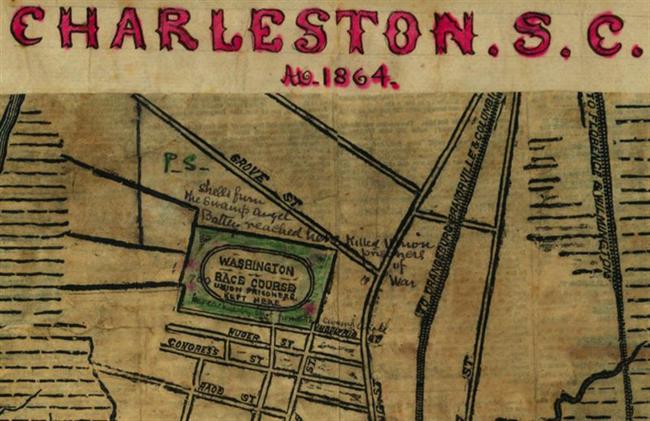
As it turns out, the first Memorial Day celebration probably took place in the South, amidst the ashes of the defeated Confederacy, in Charleston, South Carolina, ironically and poetically, as that was the political and cultural headquarters of the states' plantocracy, who pushed secession from the Union, and the vantage from which soldiers under General P. T. Beauregard first the shots at Fort Sumter, launching the war.  The celebration occurred in, on and around a race track that the Confederates had transformed into a prison and eventual morgue for Union soldiers. Blight writes:

The largest of these events, forgotten until I had some extraordinary luck in an archive at Harvard, took place on May 1, 1865. During the final year of the war, the Confederates had converted the city’s [Charleston's] Washington Race Course and Jockey Club into an outdoor prison. Union captives were kept in horrible conditions in the interior of the track; at least 257 died of disease and were hastily buried in a mass grave behind the grandstand.

After the Confederate evacuation of Charleston black workmen went to the site, reburied the Union dead properly, and built a high fence around the cemetery. They whitewashed the fence and built an archway over an entrance on which they inscribed the words, “Martyrs of the Race Course.”
Note for a second the presence of ritual here--the whitewashing of the fence, and the renaming of the race course, a sports site transformed in a site of horror, and now, a place of remembrance, grieving, and honor. (The 1864 map of the Washington Race Course above comes from the Preservation Society of Charleston's website.)
The symbolic power of this Low Country planter aristocracy’s bastion was not lost on the freedpeople, who then, in cooperation with white missionaries and teachers, staged a parade of 10,000 on the track. A New York Tribune correspondent witnessed the event, describing “a procession of friends and mourners as South Carolina and the United States never saw before.”

The procession was led by 3,000 black schoolchildren carrying armloads of roses and singing the Union marching song “John Brown’s Body.” Several hundred black women followed with baskets of flowers, wreaths and crosses. Then came black men marching in cadence, followed by contingents of Union infantrymen. Within the cemetery enclosure a black children’s choir sang “We’ll Rally Around the Flag,” the “Star-Spangled Banner” and spirituals before a series of black ministers read from the Bible.
Note here more significant elements: the cross-racial union to make the celebration possible, in defiance of the very grounds on which the Confederacy was founded; the presence of teachers, another countersignifier in relation to what African Americans had been subjected to under slavocracy's tenets; children in the forefront of the march, a recognition of their role as the future and vanguard, of the race and nation; the singing and evocation of abolitionist John Brown, a freedom fighter and pre-war martyr whose memory was well known to and not lost on these newly freed people; and then the freedmen followed by, not following, the Union troops, some of them African Americans, as Blight notes. Then come the celebrations of patriotism and, alongside them, religion.

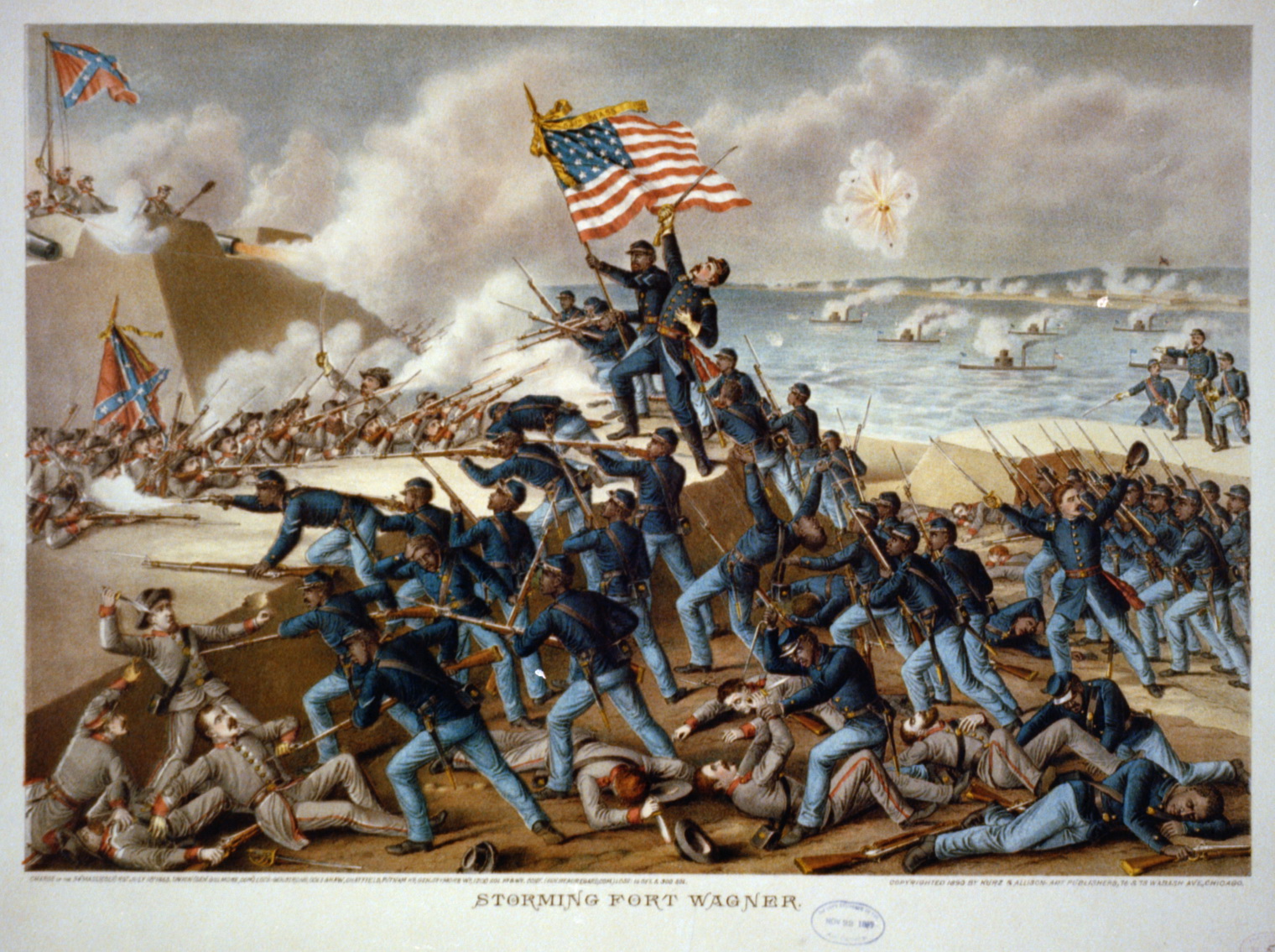
Blight goes on to note that after the processions and tributes, the blacks and whites then began picknicking--sharing food and drink, enjoying each others' companies--and watching military drills by the African-American regiments, including the famous 54th Massachusetts Volunteer Infantry Regiment, one of the first official all-black Union regiment in the war, the subjects of Edward Zwick's 1989, Academy Award-winning film Glory. (At the top of the article is a detail from Augustus Saint-Gaudens' famous Robert Gould Shaw memorial, which sits at a corner of Boston Common, at Park and Beacon Streets, and which Robert Lowell memorialized in his famous poem "For the Union Dead." The second image is an 1890 lithograph by Kurz and Allison of the 1863 storming of Ft. Wagner in South Carolina, the battle at which Shaw died.)

Black Union soldiers, US Civil War, from Civil War Academy
This history somehow got lost to the wider world, though, interestingly enough to me, the Preservation Society of Charleston does mention it, noting it to be the first Memorial Day celebration, on their website at the link above.  Blight does not tarry over the process by which this history has evanesced or its implications, though I would imagine that like so much of our national history, especially anything involving African Americans, cross-racial alliances, and so on, it has suffered both active and passive omission until, voilà, it has been waiting for someone to bring it to wider attention. It is, as I said, on the website above and perhaps on many more too. [I should note that while I have read a great many books of and on American history, I have never heard of this event, though historians very well may have written extensively about it. I have many times heard about the various early Northern and Southern commemorations of the war and those who died in it.] At any rate, as we go about our business today and on every memorial day hereafter, we might keep a kernel of this re-membering of the our polity, led by these brave freed people after the worst war US soil has ever known (and I hope will ever know), fastened to our memories.

+++

On a lighter note regarding the states, I was reading Huffington Post's Comedy page and chuckled at author Chuck Jury's "50 State Stereotypes in 2 Minutes" video, which is a promo for his new book of the same name.  He's tagged some of the states perfectly, though with others it appears he just tossed out whatever he could think, anything he could think of, quickly.  Cf. Indiana. (I also love that he probably filmed the entire 50 entries in California, but chose landscapes that mirrored (or not) those of the states he invokes.


Jury certainly has Illinois down, I'll give him that. (But is he talking about Governor Pat Quinn or Mayor Rahm Emanuel. Hmm.)

With a far different aim, last July I posted an animated tour of the 50 states, primarily for children to learn their years of entry into the United States. Of course I did not advertise it anywhere, so it has gotten about 10 viewers or something, but anyways, after the laughter above, check this out, with your little ones if they haven't already learned this information. It's quite rough, but then I'm no pro at this stuff. But it was fun to do!