Showing posts with label obituaries. Show all posts

Thursday, July 23, 2015

Remembering E. L. Doctorow & John A. Williams

There was a period a few years ago when I was posting memorials so often that I started to feel as if my blog was turning into an obituary site. It wasn't, of course, but I did worry about the morbid cast that posts were beginning to assume, though I realized it was a period of losses that in various ways touched me personally. I wrote but did not complete memorials to my late and dear colleagues Prof. Clement Alexander Price and Prof. Said Samatar, because of a confluence of issues, among them my health challenges earlier this year, but I do hope to finish the joint post in tribute to both of them one of these days soon.

***

E. L. Doctorow (elperiodico.com)
I thought that I should probably post something quickly rather than waiting and mulling when I learned Tuesday about the death from lung cancer of my former professor and thesis advisor, E. L. Doctorow (1931-2015). I had the great fortune both as an undergraduate and a graduate student to study with many remarkable scholars and artists, and E. L. Doctorow--whom I could not bring myself to call "Ed" after graduation, since he would also be "Professor Doctorow" in my mind--was chief among them. He was in fact one of the reasons that I chose to attend New York University's then M.A. program in creative writing; the presence of the marvelous Paule Marshall was another. But before I continue in this vein, let me say a little about E. L. Doctorow's life and work.

Doctorow was a Bronx native and a child of the Depression, and both of these facts profoundly shaped his work. One could read his fiction as an extended, multilayered, highly inventive portrait of New York--and by extension, the United States of America--across multiple books, and the failure of Western capitalism, which included his father's business, colored his perspective. His adolescence unfolded during the New Deal and post-World War II period, but the City that preceded this era profoundly intrigued him, as did decades of Modernist writing and political dissent. He was an experimentalist whose work was accessible to all readers, and though an often outspoken writer of the Left, he did not espouse rigid dogmas. In Ragtime (1975), one of the most important and controversial American novels to appear in the late 20th century, these personal threads, filtered through a capacious imagination, combine to weave a strange and dazzling tapestry of a New York in which white immigrants, politicians and socialites, African American protesters, and the burgeoning city itself all become vibrant characters.

His melding of the real and fictional in this novel sparked considerable criticism. It would, however, prove influential for countless writers who followed, and suggested a more complex engagement with both history and fiction than one found in the work of many writers of his generation. Ragtime in particular demonstrated this, along with the effects of overlapping but distinctive social and economic spaces, which was true to life in the New York of the novel's era as much as it is, despite growing inequality, today. The leaps were probable for fiction, improbable for reality, but not impossible for either. The Eastern European Socialist immigrant and single parent Tateh, then or now, would face incredible challenges going from the working-class tenement streets to becoming a successful movie mogul and the new husband of the Westchester matriarch, but it would not be impossible; nor should we be astonished that Doctorow, in a 40-year-old work of fiction, indelibly captured the struggles, still ongoing today, by a black man--black people--to be treated with dignity, equality and respect in this society. Mirroring contemporary events, Coalhouse Walker does not meet a pretty end.

E. L. Doctorow published 12 novels over his career, roughly one every five years, in the process winning a number of the country's highest literary awards; in addition to Ragtime, which received the very first National Book Critics Circle Award for fiction, his other novels include The Book of Daniel (1971), which explored the Julius and Ethel Rosenberg case; the 1985 novel World's Fair, which received the National Book Award; the acclaimed Billy Bathgate, which also received the National Book Critics Circle Award, as well as the PEN/Faulkner Prize and the William Dean Howells Medal; and his late career masterpiece, The March (2005), which won him his third National Book Critics Circle Award and second PEN/Faulkner Award. His final novel, Andrew's Brain, appeared last year. He also authored a play, Drinks Before Dinner (1978); an assured book of short stories, The Lives of the Poets: Six Stories and a Novella (1984), one of my favorites among his books; and several collections of essays.

Before I ever read his work--and Ragtime was on my mother's bookshelves--I saw the movie version of the film. I didn't learn until I studied with him that he hated the movie version, directed by Milos Forman, which was Jimmy Cagney's final screen role, while providing early breakout roles for Howard Rollins, Elizabeth McGovern, Debbie Allen, Mary Steenburgen, and Mandy Patinkin. Other works of his, including Welcome to Hard Times (1967) and Billy Bathgate, also were adapted into films, and he detested those films too; the cinematic adaptations of his work tended not to work, in his eyes. The Broadway musical version of Ragtime, however, was much more to his liking, as he shared with our second year workshop, and debuted shortly before our sessions began.

He otherwise never talked about himself or his own work; instead, drawing from his earlier career as an editor at NAL and the Dial Press, he was gentle and generous in his critiques, with a laser-sharp ability to identify what was and was not working about a given text. I think he may have written a few words on our manuscripts, but unlike other writing professors, there was no extensive written or spoken commentary. Yet what he said counted, and I like I learned a tremendous deal from him, about my own work, and about teaching, and I have tried to bring some of those lessons to every class, especially writing workshops, that I've taught. At his death, he was the Loretta and Lewis Glucksman Professor in American Letters at NYU, a position he had held for many years. He also played a key roll, as I recall, in securing the New York Times Foundation fellowship that student writers, I included, held, allowing us not only the opportunity to study at NYU, but to teach writing in the New York public schools. That experience also was one of the best--and at times toughest, but always rewarding--of my life.

One final point, which is professional. Toward the end of the time that my fiction cohort and I were finishing up what was then the M.A. program at NYU, and I had been admitted into the Ph.D. program and was going to go with the standard Masters degree, Doctorow announced to us that NYU had received New York state approval to award the M.F.A. I remember him recommending all of us to go for the M.F.A., since we would then all have a final, professional degree, and if we wanted to teach, it would be(come) essential. I ended up publishing my first book, wishing the Ph.D. a fond goodbye, and haven't looked back, though I think all the time about how sage his advice was and how thankful I am that he was looking out for us. As with his mentorship, so with his writing, which continues to point a way forward. RIP, E. L. Doctorow

***

John A. Williams
(Photo by Stathis Orphanos)
A writer that I always wanted to meet but never had the opportunity to was John A. Williams (1925-2015). He passed away on July 14 from complications from Alzheimer's disease. I knew that the prolific Jackson, Mississippi native had been a longtime resident of New Jersey--Teaneck, to be specific--but I had not realized until a few years ago that he also a pioneer in teaching creative writing and journalism at Rutgers-Newark, serving as a professor in the English department from 1979 through 1994, when he retired as the Paul Robeson Distinguished Professor of English. This was long before my arrival, but some of my colleagues who had the good fortune to work with him described him in glowing terms, and deeply mourn his passing.

As I wrote in a response to a university PR query about him: "John A. Williams was one of the major novelists, and one of the most important African-American writers, to emerge from the generation that came of age in the late 1950s and 1960s. Primarily working in a realist mode, Williams captured and reflected many of the major issues of his day, in a vivid, fluid, accessible style, laced with humor and social critique, that was always more complex—and demonstrated a complex grasp of his subject matter—than it appeared. His influence can be seen throughout contemporary African-American prose fiction. His directness in addressing major social and political issues, and his deep interest in African-American history and culture, especially in his marvelous novel Captain Blackman, have been incredibly important to me."

Captain Blackman, a 1972 speculative fiction work in which a soldier travels through time from the Revolutionary War era to Vietnam, was one of his triumphs; his final novel, Clifford's Blues (1999), in which he recounts with nuance, empathy and convincing detail the trials of a black gay saxophonist trapped in Nazi Germany, was another high point. Yet his best-known novel and true masterpiece was The Man Who Cried I Am (1967), a fictionalized account of the lives of exiled black writer Richard Wright, that succeeded in also depicting the US's Cold War shenanigans, including the horrifying "King Alfred Plan," a genocidal CIA-directed project which aimed to erase black people from the face of the earth. So convincing was Williams' account that the King Alfred Plan entered black popular consciousness, leading musician Gil Scott-Heron to write a song, "King Alfred Plan," that appeared on his 1972 LP Free Will.

Williams grew up in Syracuse, New York, served in the US Navy during World War II, and graduated with a degree in journalism and English from Syracuse University in 1950. Encountering difficulty in pursuing a journalistic career, Williams worked at a series of jobs before moving to New York City, where he found employment as a vanity press publicity director and as information director for an organization promoting African liberation movements, though his desire to write for periodicals hardly abated, and by 1958, he was the European correspondent for Johnson Publications' flagship magazines Ebony and Jet, with later stints at Newsweek and the former Holiday magazines.

John A. Williams' first novel, The Angry Ones, appeared in 1960, and he would go to publish 12 in all, including Sissie in 1963 and Click Song! in 1982, which received the American Book Award. The latter novel, like many of Williams' took the measure of racial relations in the US, this time through an acid narrative about the publishing industry. Some 33 years later, Williams' reading of the state of things still holds validity. He also published books in other genres, including the decolonization-era overview Africa: Her History, Lands and People in 1963; the biography The Most Native of Sons: A Biography of Richard Wright, and the more idiosyncraticThe King God Didn't Save: Reflections on the Life of Martin Luther King, Jr., which was sharply criticized; and, in 1991, with his son Dennis, If I Die I'll Stop: The Comedy and Tragedy of Richard Pryor.

Quoting again from my statement to the university, I said that "[Williams] was unfortunately underappreciated as a literary figure, but his literary oeuvre serves as an excellent testament to his many talents and gifts. I continue to read and teach his work, and I hope that his passing sparks a renewed interest in one of the most stylistically versatile and critically engaged writers of the 20th century....I mourn John A. Williams’ passing, and I hope more readers and writers will return to the excellent literary trove he has left us."

There is much to learn and gain upon delving (back) into Williams' large and often daring oeuvre, and I look forward to doing so as soon as I can. RIP to John A. Williams.


Thursday, January 02, 2014

The New Year + Great Early News About Hilst Translation

It feels both strange and exciting to note here that we are now in 2014; this past year seemed to unfold glacially, with ample amounts of time cocooning everything (MLA, AWP, the spring semester, writing this summer, etc.). Perhaps time felt this way because I was still in the midst of transitioning to new--or returning to prior--life rhythms and, like everyone around me, also  recovering from the psychic effects of the fall 2012 hurricane. Time at various points seemed to stand still. This past fall, however, accelerated much more quickly than last year (again, perhaps because we avoided nature's violent, watery intermission), and December in particular raced by so fast it was over before I knew it.

The year brought good news, some of which I'll talk about soon, but very sad news closer to home as well. Three friends, all under 50, passed away: Donald Agarrat, whom I memorialized several months ago, and more recently, my former colleague José Estéban Múñoz, with whom I served on the board of the Center for Lesbian and Gay Studies (CLAGS) in the late 1990s, and Gerard Fergerson, for many years one of my dearest friends, and among the smartest and most dynamic people I have ever known in life, who incidentally, among the many wonderful things he did for me, introduced me to CLAGS. I will post tributes to both of them very soon. Another person that I knew from the time I was in my early 20s, the activist, writer, editor, journalist, and bookstore founder, John Mitzel, also passed away after a long illness in Boston.

As of the second week of December, classes concluded, and as of January 1, I relinquish my post as Acting Chair of AAAS to my predecessor. The fall undergraduate English course, "Introduction to Literary Studies," provoked my usual pangs of apprehension when I learned I'd be teaching it, but it turned out quite well in the end, if my students' coursework, responses and comments are any indication. As far as the Acting Chair stint went, it turned out to be a lot more work than I'd envisioned (though isn't that always the case?), but it was also an excellent introduction to the university system's innards, and I had the opportunity to tackle a few important projects, which I resolved successfully, as well as initiate some exciting events for this upcoming semester.

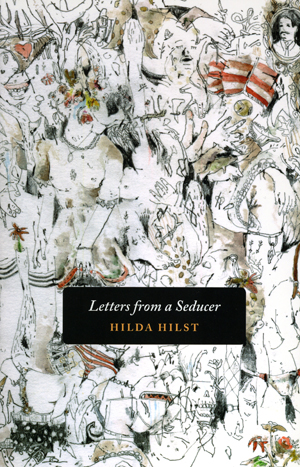
Somehow or other I completed not just the translation but multiple revisions of the Hilda Hilst novel, Letters from a Seducer (Cartas de um sedutor), jointly published by Nightboat Books and A Bolha Editora, and it has not only been repeatedly proofed, blurbed (by Dodie Bellamy, Samuel R. Delany, and Ronaldo V. Wilson!), but has gone to the printer and should be out very soon (the schedule date is now February 4, 2014). (You can even order it from distributor University Presses of New England/UPNEBarnes & Noble or that other behemoth site that I will pass on naming. You know which one I mean.) I have said publicly that it probably was a bit insane to have agreed to translate that book, which even in the Portuguese is no two-step, during a period when I had two sizable classes and lots of other pending duties, but looking back I'm glad I did, and am even happier about the resulting text.


I do wonder how readers who have been enthusiastic about the first Hilst novel that appeared in English, The Obscene Madame D (A obscena senhora D), beautifully and collaboratively translated by Nathanaël and Rachel Gontijo Araújo, will respond to this one, especially given that it is far more sexually transgressive and explicit, the language thornier--there are moments in the text that look wrong even in Portuguese, à la Clarice Lispector, though they are exactly what Hilst intended--and the structure of the novel far more experimental.

In fact, in Letters from a Seducer Hilst produces an anti-novel . I was trying to think of a musical comparison, and instantly and interestingly enough, at least to me, the post-modern work of the late Russian composer Alfred Schnittke came immediately to mind; he is best known for combining an conventional styles (for example, preexisting or pastiche versions of baroque compositions) with one or more very different, disparate styles, holding them all together via a compelling associative vision, profound craft and wit, and, to a huge degree, the willingness of the listener to accept, if not fully grasp, what he's up to and go along. That's what Hilst does in and with this novel, though in it she attempts and achieves many other things as well. In fact the book feels like it could serve as a source text for a course I taught years at at Northwestern on contemporary aesthetics and what I called "danger zones"; in it she treats in various ways aspects of conventional aesthetic theory, as well as those touchier areas I specifically focused on, including pornography, sentimentality, horror, conceptualism, and, to a lesser degree, the posthuman.

Although the translation is not yet on bookshelves it has received some early praise in draft form. Translator, editor, program director, and scholar Daniel Medin wrote the following in the December 17, 2013 edition of Three Percent: a resource for international literature at the University of Rochester:

Occasionally, a work of brilliance will make it possible for a virtuosic translator to outdo, line for line, a great deal of what’s recently appeared in her target language. In 2012, the English of George Szirtes for Satantango’s Hungarian struck me as superior to the sentences of most novels written that year in English. The same’s true of John Keene’s version of Letters from a Seducer by Hilda Hilst. Scheduled to appear this month, it was perhaps my most unforgettable reading experience of 2013. I’m terribly eager to read more Hilst now—and impatient to get my hands on Keene’sAnnotations too.

Medin and Scott Esposito also discuss the translation in their podcast at Two Lines Press. A snippet of the translation will appear in an upcoming edition (No. 10, I believe) of the The White Review.

I am looking forward to discussing and possibly reading from it at an upcoming panel on translation that will take place in Chicago, on January 10th, during the Modern Language Association's annual convention. The event, New Writing in Translation, a roundtable, will take place at 7:30 PM in the Sharp Building of the School of the Art Institute of Chicago, 37 S. Wabash Avenue. As the organizer describes it, "this roundtable event will consist in a self-guided survey of recent translation projects by leading contemporaries in the field. Rather than being led by generalizable themes in the theory and practice of translation, each participant will read a brief excerpt from a recent translation project and then discuss the vicissitudes of working on it." The Writing (MFAW) Program of SAIC will host the event, and other participants include Daniel Borzutzky, Jen Scappettone, Anna Deeny, and Joshua Clover.

Lastly, I will be reading with Vincent Czyz at Word-Jersey City on January 15, 2014. I believe we both will read a little poetry and I'll be reading from the Hilst as well, so if you are in Jersey City, please join us.

Wednesday, May 16, 2012

Remembering Carlos Fuentes & Christine Brooke-Rose

Carlos Fuentes, at home in Mexico, 2001 (Henry Romero/Reuters)
In the mid-1980s, Carlos Fuentes (1928-2011) was at the height of his fame. He had published a dozen novels, many formally experimental, including a handful that made and cemented his reputation, among them his début, Where the Air Is Clear (La Región Más Transparente, 1958); Aura (1961), which continues to be censored in certain countries; The Hydra Head (La Cabeza de La Hidra, 1978); and his masterpieces The Death of Artemio Cruz (La Muerte de Artemio Cruz, 1962); Terra Nostra (1975), a work not unlike Gabriel García Márquez's One Hundred Years of Solitude (Cien Años de la Soledad, 1970) in its scope and ambition; and The Old Gringo (Gringo viejo, 1985), a shorter novel reiminaging the life of writer Ambrose Bierce that garnered tremendous attention and readership in the United States, a country in which Fuentes, one of Mexico's leading authors, had spent many years, including part of his childhood.  He had also by that point published four collections of short stories and five collections of essays, and written four plays and seven or so screenplays. The honors he received for his work steadily increased, from the Xavier Villaurrutia Award in 1976 to the Mexican National Prize for Arts and Sciences in 1984, and a few years later he would win what is arguably the most important prize for a Spanish-language author, the Miguel de Cervantes Prize, in 1987. But this period was significant for another reason: Fuentes had begun to teach at a number of American universities, and it was during one of these stints that I was able to take an undergraduate class with him, an experience that made a profound impression on me and led me, perhaps, to a life of writing and teaching myself.

Fuentes held, I believe, an august chair for visiting writers, and taught a lecture course that permitted him to expound, in magisterial fashion, on all sorts of subjects. The specifics, I must admit, I do not remember. But I vividly recall how he would hold forth, in each class, on stage before a vast crowd, how he wove together a narrative that seemed to capture everything in its net, how he looked and acted the part of an international man of letters, of the engaged writer, which he had been and still was. Tall, handsome, witty, able to range across languages, to cite authors and ideas without recourse to notes, no name dropper but someone who actually knew and had worked with the people he was invoking, he truly loomed larger than life. I had no idea at that time that he'd been a Communist in his youth and a supporter of Fidel Castro and the Cuban Revolution, though I did know his general ideological orientation was on the left, and that his work, as in Where the Air Is Clear and The Death of Artemio Cruz, openly critique the Mexican elite and governing classes, as well as Mexican history itself. But Fuentes had gone much further; a diplomat from 1965 on, he resigned as Ambassador to the UK to protest the 1968 massacre of students in Mexico City, and left the foreign service in 1977 to protest the appointment of Gustavo Díaz Ordaz, the president of Mexico during the 1968 assault, as Ambassador to Spain. Morever, Fuentes refused the 1972 Mazatlán Literature Prize to protest the Mexican state of Sinoloa's actions against students at the State University of Sinaloa. (Such actions sparked criticism within Mexico's commentariat; in 1988, writer Enrique Krauze deemed Fuentes the "guerilla dandy.") I don't think he ever mentioned any of this in his lectures, but it was clear that he stood against dictators and democratically-enabled tyrants both (and this included not only Mexico's long dominant Institutional Revolutionary Party and its leaders, but Hugo Chávez of Venezuela and George W. Bush as well), and that literature, even if seemingly not overtly political, might stand as a bulwark against both. As I said, the specifics of the course I have mostly forgotten, but the model he set is one I have taken to heart, even if I have not thus far been able to come anywhere close to it.

One of my favorite Carlos Fuentes stories entails something I did not personally witness, but which I heard and have recounted many times to fellow writers and to students to let them know that, when they feel they are so deep in a poem or story or novel chapter they almost feel they're in another world, that it's perfectly okay.  It may be utterly apocryphal, but bear with me nevertheless.  Supposedly Fuentes was visiting Rome, perhaps on vacation, and was in his room in the middle of the day.  The chambermaid came to clean the room, and as she approached the door, she could hear raised voices, and then what sounded like a violent argument. A man was yelling, passionately, and then his voice fell to a normal tone, and then another voice, likely a woman's, responded, with fury. This went on for a while, the voices going back and forth, the tempest between them such that the worker thought twice about knocking, let alone opening the door. She also wondered whether she ought contact the concierge, or security, so passionate were the exchanges at certain points.  Other guests staying on the hall paused momentarily at the brouhaha, and went on their way. But finally the voices died down, and she proceeded to rap on the door to find out if she could enter. The gentleman who opened the door beckoned her in. The chambermaid, expecting to see a woman seated somewhere in the room, in a chair, on the bed, peering at the man from an interior doorway, saw instead only him, and a sheaf of papers, on the bedspread, some of them fanned out as just tossed down. The man was clutching a few. The chambermaid asked the gentleman if everything was okay, for she had accidentally overheard a fiercesome quarrel. The gentleman smiled and reassured her that all was fine. There was only he in the room; the quarrel was his reading through his novel, still underway, his voice animating those of the characters. This gentleman, this writer, was Carlos Fuentes.

Carlos Fuentes, Union Sq., 1995 (AP Photo/Rick Maiman, File)

Fuentes, one of the pilots of the Boom movement in Latin American literature, which placed numerous fictional works from across the Hispanophone global south on the literary landscape, was tipped to win the Nobel Prize in Literature several times; his compatriot, the poet Octavio Paz, did win it, in 1990, as did Fuentes's friend, García Márquez, in 1982, but the great Mexican fiction writer did not. (Instead, the most recent Hispanophone writer to receive the award was the right-leaning Mario Vargas Llosa, of Peru, in 2010.) Not that this oversight stopped Fuentes. He kept pouring forth fiction, essays, occasional pieces, everything, publishing the English translation of his 2003 novel, The Eagle's Throne (La Silla del Águila) last year, and an essay on the French election in Mexico's Reforma newspaper the day he died.  His finest works, and the example he set, both in his fiction and criticism, and as a public literary and cultural figure, an ambassador of the word in the fullest sense, will endure. So too will his importance to the literature of his country, a multifaceted portrait of Mexico taking shape in and through his works, and to all writing across Latin America, and the Americas. Carlos Fuentes passed away in a hospital in Mexico City on Tuesday. He was 83 years old.

***

Brooke-Rose, 1970
Perhaps as publicly and widely acclaimed as Fuentes was, so obscure and little known in contrast was, and remains, Christine Brooke-Rose (1923-2011), a writer almost his exact peer, and nearly as prolific too, with 17 novels to her name, and many other works of short fiction, nonfiction, literary translation, and academic literary criticism.  Brooke-Rose passed two months ago, on March 21, at the age of 89. Fuentes was, from the very beginning, experimental in terms of form; perhaps not as experimental, say, as Mexican writers such as Fernando del Paso or Daniel Sada, whom I mentioned in a previous post, but no straightforward realist either. The Death of Artemio Cruz, for example, is narrated by a dead man, shifts in time and voice, and uses the second person to great effect; Christopher Unborn begins, in Sternian fashion, before the character leaves the womb; Destiny and Desire, I believe, is narrated by a severed head. But Brooke-Rose went much, much further. She is, by an easy mark, one of the most innovative writers in English-language prose in the late 20th century, and sui generis in Anglophone letters in many ways, for she went beyond diegetic experimentation to the level of grammar itself, pushing the limits of how one might tell stories as a way of embodying the deeper themes and critical possibilities of those stories, and the enacting the concepts underpinning them.

What do I mean? One of the techniques Brooke-Rose played with was the lipogram. In the hands of a number of writers affiliated with the Ouvroir de littérature potentielle (Oulipo), this lipogrammatic technique, of leaving out a letter, say, across an entire work, presented a constraint that they could nevertheless resolve.  Thus there's the famous example of Georges Perec's La disparution (A Void), which eschews the most frequently used letter in the French language, "e"--which is also, interestingly enough, the most frequently used letter in English as well. (In the prior sentence alone, "e" appears 32 or so times.) Quite a challenge. But Brooke-Rose extended the lipogram to the grammatical level, and thus in her novel Between, which explores the experiences of a translator, she leaves out the most common verb in the English language, which happens to be the verb..."to be." That is, the copulative verb ("I am a writer," "She's hungry," "Are you there?" etc.), also used for the past voice ("I was led to believe you had emailed me"), progressive tenses ("We're heading there now"), and so forth, one of those English language tools, learned at the earliest stages of language acquisition, to which a speaker and writer learns she can attach a subject and predicate and turn anything into a sentence--is missing, in this entire novel. Note of course the multilayered irony of a novel about a translator, a woman trapped between languages (and names, places, everything) without recourse to the very verb--the grammatical form signifying action-- that elementally connects and binds in most European languages, titled "Between."

Such was Brooke-Rose's genius. And she did this again and again. She wrote novels exploring the language and the concept of discourse itself (Out, 1964; Such, 1966; Thru, 1975; Amalgamemnon, 1984), novels that treated questions of cybernetics and the dawning digital age (Xorandor, 1986; Verbivore, 1990; Textermination, 1991), novels that reimagined the human (Next, 1998; Subscript, 1999), and a very personal, autobiographical works that hovered between genres (Remake, 1996; Life, End Of, 2006). Before she wrote any of these, she had already published conventional works in poetry, prose and criticism (Gold: A Poem, 1955; The Languages of Love, 1957; A Grammar of Metaphor, 1958), and then several satirical novels (The Sycamore Tree, 1958; The Dear Deceit, 1960; The Middlemen: A Satire, 1968), but it was with Out that she went truly out beyond almost anything most of her British peers, save a few (J. H. Prynne; B.S. Johnson; Ann Quin; David Jones; Basil Bunting; etc.) were up to, creating an post-apocalyptic world that turned racial identification on its head. Subsequent novels involved leaving out the verb to have (Next); requiring readers to construct, as with a puzzle, the narrative (Thru); writing a work narrated by rocks speaking in what approximates computer language (Xorandor); and picturing a convention, in the United States, in which characters from famous novels convened, absent their authors, with pandemonium breaking loose (Textermination). It is therefore fair to say that Brooke-Rose not only pushed formal boundaries but those of content as well, making many of her works a challenge for readers, and this, coupled with the fact that she spent a great deal of her career teaching in France, and with the fact that while she explicated the likes of writers like Ezra Pound and speculative fiction writers and Harlan Ellison yet spent little time, at least until the end, explicating her own work (which of course should have been left to the works themselves, and to others), and because she was a woman writing the sort of work that men usually get all the acclaim for, she has been critically underexplored and popularly underread.

Her own account of her life is worth savoring, so I'll offer a few points that suggest another reason both for her linguistic curiosity and for her lack of attention. Brooke-Rose was born in Geneva, Switzerland, to an English father and an American-Swiss mother, and grew up mostly in Brussels, Belgium--think of all the languages she was coming into contact with--where she received her education, later heading to Somerville College, Oxford University and University College, London. Already gifted with linguistic ability, she worked as a Women's Auxiliary Air Force (WAAF) in intelligence at Bletchley Park, the UK's main decryption center during World War II, and after the war's end, completed her degree, married, and worked as a journalist and author. Divorced in 1968, she took a position teaching at the University of Paris-Vincennes, the radical, experimental campus outside Paris, and taught there till 1988. Throughout this period, she published steadily and with no loss of imaginative daring, though her only major award came in 1966, when she received the James Tait Black Memorial Prize for Such.

More than once when I have students who turn out to be voracious readers and are seeking out anything that will challenge them, and I hope to get them past the writers they are more likely than not to encounter, contemporary and past, I will recommend Brooke-Rose. I have thus far never had a student tell me that she or he took to Brooke-Rose's work as they have to novels by George Saunders, or Cormac McCarthy, or Renee Gladman, or Nalo Hopkinson, or Kenzaburo Oe, or Maryse Condé, or Ricardo Piglia, or any of the other people I have sent them off to explore. For numerous reasons, the gantlets she throws down are too difficult to tender. (I find the same to be the case with another British experimentalist, J.G. Ballard, whose unparalledly strange vision also never ceases to astonish me.) Or maybe other reasons are at play. I do know that I have found her work enthralling at times, and often quite funny. Life, End Of, even as its textures steep with sorrow because it's clear the author has reached the end of her life, is nevertheless so compelling I found it hard to put down, and I felt the same way about Remake, which tells a personal tale so dramatic and delicious that many a lurid nonfiction writer would be hard-pressed to match it. Then there are her experiments in the speculative realm, which some writers might devote an entire career too. The novels of the late 1960s, on the other hand, should have dissertationists reaching for their (the books') spines. This very well may be occurring somewhere. I don't know.

I do know that in her equally heartbreaking collection of essays, Invisible Author: Last Essays, which, after I finished it, I believe I had to run and call Tisa B. I was so struck by the frustration infusing it, Brooke-Rose points out how almost none of her academic critics ever seemed to be able to figure out what she was doing, instead noodling off on one or other points. She even laid this at the doorstep of a champion, Hélène Cixous, about whom I'll say no more. Instead, I urge people to read Brooke-Rose, perhaps beginning with Remake and Life, End Of (which leave out the pronoun "I"), and then, Out and Textermination. If you dare take up her dare, keep jumping around her fiction after that. Your brain will get a workout, a very good one. And you'll keep the memory of her dazzling originality, sadly too little heralded, alive.

Wednesday, July 06, 2011

Strauss on "'Like' Culture" + Twombly RIP + Geosynchrony: Beck in Bryant Park

About a year and a half ago, I thought of saying goodbye to this blog. It wasn't the first time, though. I'd considered doing this even further back, perhaps after the first year and a half of blogging, which would have been around late 2006. At that time I was still receiving a trickle of comments and the occasional hate post (based, if I recall correctly, on my epithet for George W. Bush, the "warrantless wiretapper"), as well as a small bombardment of spam, but I'd begun to feel like I not only was running out of things to say, but that I was unable because of work and life demands to remain timely, that I was mainly writing them for myself and that perhaps that wasn't enough to keep my commitment to this site. This issues very well could still be the case, but I do know that people read or at least skim this blog from time to time, be it friends old and new, students and colleagues, people referenced on the site, or even, as I learned, perhaps in 2009, people writing dissertations who have cited J's Theater in their arguments, and even, I'm told, at their defenses. (I kid you readers not, and my scholarly colleague who politely told me of one such case was not amused!)  And though comments are rare, I have come to terms with the fact that I enjoy posting here, when I can, and that sometimes the posts resonate beyond this seeming echo chamber in which I cast them.

I say this as a prelude to commenting on Neil Strauss's recent Wall Street Journal article "The Insidious Evils of 'Like' Culture," which ravels one strand from Jaron Lanier's You Are Not a Gadget: A Manifesto (a book he doesn't mention) and similar works (M. Jodi Dean, Nicholas Carr, etc.) and builds an argument around it. The argument: the "like" feature, so prominent on Facebook and increasingly all over the web, is molding what we write and who we are online--and perhaps who we are and become. In order to curry "likes" and provoke "RTs" (retweets), we're performing and conforming, rather than just being ourselves.  (You can block it, of course, but that's not Strauss's point....)

I would not be the first one to point out that in virtual space as in any other who we are is always a performance, that we already are shaping ourselves in various ways wherever we are, based on various contexts, that there is no pure or ideal self that is not at some point affected by the performative and all it entails. In fact this lies at the heart of any number of contemporary fields of critical and scholarly inquiry. That isn't to say that I'm completely disagreeing with Strauss, for I do believe that--and he doesn't mention the economics of the net and web, but Lanier and many others do--he's right on a certain level, and I find the "like" aspect of Facebook one of the most maddening, but I also feel that he doesn't address the facdt that there're benefits if you can conform and commodify yourself in certain ways. Wittier, shorter posts go over better than drier, longer ones, but single-issue blogs and Twitter feeds and Facebook pages probably attract more adherents than eclectic ones. The more personal you are, the more people will be interested, especially if there's a nice serving of (melo)drama tossed into the mix.  Sex goes over better than its absense. If you're criticizing an unpopular president (Bush) vs. one whose still fairly popular and whom people expect you to extol (Barack Obama)....

For Strauss it's both a social and psychological issue. People want and need community, they want and need affirmation and attention...and above all approval, so they--we--are increasingly tailoring ourselves to provoke and be able to cull those "likes," instead of writing or tweeting whatever we--or Strauss and others--think to be "our true selves." Again, I'm not so sure about this "true selves" bit, though. But I get his point. C and I were even joking about this "like" mania a while ago, even using the term as a form of punctuation on the phone, to uproarious laughter. (It's been replaced with, among other things, "Yeezy taught me," but that's another matter.)  Strauss mentions Google's new entry for its ++ service, those +1s that I, as someone publishing the blog via Google, now see at the bottom of these posts.  As I wrote in my review of Lanier's book, he urges people to create in ways that cannot be subsumed within or reduced to forms meriting a simple (and simplistic) "like," which Strauss echoes, saying:

So let's rise up against the tyranny of the "like" button. Share what makes you different from everyone else, not what makes you exactly the same. Write about what's important to you, not what you think everyone else wants to hear. Form your own opinions of something you're reading, rather than looking at the feedback for cues about what to think. And, unless you truly believe that microblogging is your art form, don't waste your time in pursuit of a quick fix of self-esteem and start focusing on your true passions.

He even goes so far as to urge no comments on his post and certainly no "likes," though his employer, tracking page traffic, surely wants some. So I've violated his challenge, and will say that I "liked" his article. But believe me, I didn't click that button on his page nor comment.

(((

Cy Twombly (1928-2011) is no longer with us, I learned this evening from the New York Times. He had been suffering from cancer for the last several years, and passed away in Rome, where he has lived for most of each year since 1957. He is a major figure in the narrative of 20th century American and global art, but not without lingering controversy.  His paintings grabbed me from the first time I saw them, their seeming artlessness suggesting the very inverse, depths that it would take many hours of looking to parse, their almost throwaway charm marking another kind of beauty, or possibility of the beautiful, particularly in the moment and aftermath of sensory engagement.  I wrote in response to a friend's email about his death, referring to without mentioning the specific passages in the obituary:

Quite a loss. I like his attitude about his work, too. Also that he he was able to live long enough to see it come back into fashion and then to be recognized as central to the narrative of the art of his and our time. Of course it helps to have some wherewithal and connections, to be able to make your work, and to have critical champions, peers and those who don't know you from Eve. And to be able to plug into existing belief systems that people cherish, so that you don't have to continually explain what you're doing, unless you have champions who're willing to keep up with you all the way through. So many don't. But the work speaks for itself. The later pieces are gorgeous, so full of life, so redolent of what art can do in speaking to and creating life and reality, while also aware of Thanatos.  I also of course like that he was queer, as primly and Victorianly as the NY Times stated it. Lastly, it's kind of resonant for me that I just snapped photos of his sculptures when my friend Jerry W and I went to MoMa last week, primarily to see the Francis Alÿs show. That was so slick; Twombly felt like a gift from another world. RIP.

Here are those photos of his sculptures; I was permitted to photograph them but not Alÿs's work (not that that stopped me):

Legend for the Cy Twombly sculptures @ MoMa
Legend for the Twombly sculptures
Cy Twombly sculptures @ MoMa
In foreground, "Untitled (Funerary Box for a Lime Green Python)," New York, 1954
Cy Twombly sculptures @ MoMa
Foreground, "Untitled," Lexington, Virginia, 2005
Cy Twombly sculptures @ MoMa
Left to right: "Untitled," Rome, 1984-85; "Untitled," Rome, 1976; and "Untitled," New York, 1955.
Cy Twombly sculptures @ MoMa
In foreground, "By the Ionian Sea," Naples, 1988.

(((

A concept that enthralls that I haven't read a lot about but I'm sure someone is exploring or has already exhaustively looked at is geosynchrony*, which is the name I give (geo = space, place + syn = together + chronos = time) to being in the same place and space and time as someone else, sometimes over long periods, but seeing the same people all the time, perhaps never coming into contact with them or only doing so once or twice. In Care Crosses the River (translated by Paul Fleming; Stanford University Press, 2010), I believe, Hans Blumenberg recounts one of my favorite stories evoking this concept, noting that although Marcel Proust and James Joyce lived in Paris at the same time for a number of years, they reportedly only once encountered each other directly, when in May 1922 they shared a cab, with Sydney and Violet Schiff, after a dinner to honor a Stravinsky-Diaghilev Ballet Russe performance. (Can you imagine Proust and Joyce together in a cab?)  Blumenberg recounts, much like the one I link to above, what occurred, which is to say, Proust, who had not arrived to the dinner until 2 or 3 chattered on, while an inebriated and smoking Joyce was silent, and the cab ride was over before you could say either À la recherche du temps perdu or Finnegans Wake.

I was thinking of this on a much more banal level, though, as I was reviewing some recent photos: one, from last week, was taken on June 29, 2011, in Bryant Park, as I was leaving the New York Public Library and people waiting to see that evenings film were clustering around the lawn to stake out their spots and set up their blankets and personal effects.  Now it turns out that on that evening, if I am reading the news reports correctly, a certain Glenn Beck attended the movie screening and encountered some resistance to his presence there. A young woman, Lindsay Piscitell, accidentally, in her account, knocked over a glass of white wine onto his blanket and apologized profusely, before and after a few people in the crowd expressed their disapproval of him, that was it. In his typical bombastic TV account, he was razzled repeatedly by "hateful people", and the young woman, whom he excoriated as "lost" and "arrogant," spilled wine on his wife. Who knows what really happened, though I'm inclined to take the young woman's account more seriously than Mr. Testeria, but, that said, I was thinking, somewhere, maybe, in that gaggle I photoed edging the grass stands the Beck, his wife and their bodyguard, and had I chosen for the first time ever to stay in the park and catch one of these free films, I very well might have been witness to this event as unfolded, as I can spot people around corners and through doors (even if I cannot remember names to save my life anymore), and could have recounted to any and all who would listen, echoing Ted Hughes' simple Birthday Letters statement, "I was there, I saw it." I do think I would have had enough maturity not even to need to suppress a banal heckle--or gentle chiding--at the very sight (and site) of this man, though, especially given his advocacy of so much that's wrong with this society, and his hatred of the very concept of the commons and public spaces like Bryant Park, which he, his wife and his bodyguard were able to enjoy like anyone else who'd gotten there on time and found a spot, as opposed to the privatized, corporatized spaces he shills for on his programs. But I would certainly have taken his photograph, and posted it here.
Bryant Park before the film
The countdown to seating in Bryant Park on movie night, 6.29.11

Monday, August 23, 2010

Remembering

Abbey Lincoln (1930-2010)


Fred Anderson (1929-2010)


Bill Dixon (1925-2010)


and

Frank Kermode (1919-2010)
From Shakespeare's Language, New York: Farrar, Straus and Giroux, 2000.
 

Tony Judt (1948-2010)
From "Meritocrats," New York Review of Books, August 19, 2010, Vol. 57, No. 13.
I came up to King’s College, Cambridge, in 1966. Ours was a—perhaps the—transitional generation. We were past the midpoint of the 1960s—the Mods had come and gone and the Beatles were about to record Sgt. Pepper—but the King’s into which I was matriculated was still strikingly traditional. Dinner in Hall was formal, begowned—and required. Undergraduates took their seats, awaited the arrival of the Fellows, then rose to watch a long line of elderly gentlemen shuffle past them on their way to High Table.

“Elderly” here is no relative term. Led by (former provost) Sir John Shepherd (born 1881), the Emeritus Fellows typically included Sir Frank Adcock (born 1886), E.M. Forster (born 1879), and others equally venerable. One was made immediately aware of the link between a generation of young men born into the postwar welfare state and the world of late-Victorian King’s: the age of Forster, Rupert Brooke, and John Maynard Keynes, exuding a cultural and social self-confidence to which we could never aspire. The old men seemed to blend seamlessly into the fading portraits on the walls above: without anyone making a point of it, continuity was all about us.

Tuli Kupferberg (1923-2010)
Tuli Kupferberg, "A Short History of the Human Race"


Harvey Pekar (1939-2010)
Center: Evan Agostini/Getty Images Harvey Pekar surrounded by his portraits. The artists are, clockwise from top left, Sean Pryor, Dean Haspiel, Joseph Remnant and Josh Neufeld.
Basil Davidson (1914-2010)
From The Fortunate Isles: A Study in African Transformation, Trenton: Africa World Press, 1989.
 

Carlos Monsiváis (1938-2010)
From "No sin nosotros: los días del terremoto, 1985-2005, México DF: Ediciones ERA, 2005.


Peter Orlovsky (1933-2010)

Snail Poem

Make my grave shape of heart so like a flower be free aired
       & handsome felt,
Grave root pillow, tung up from grave & wigle at
       blown up clowd.
Ear turnes close to underlayer of green felt moss & sound
       of rain dribble thru this layer
       down to the roots that will tickle my ear.
Hay grave, my toes need cutting so file away
       in sound curve or
Garbage grave, way above my head, blood will soon
       trickle in my ear -
       no choise but the grave, so cat & sheep are daisey
       turned.
Train will tug my grave, my breath hueing gentil vapor
       between weel & track.
So kitten string & ball, jumpe over this mound so
       gently & cutely
So my toe can curl & become a snail & go curiousely
       on its way.
1958 NYC

From Clean Asshole Poems & Smiling Vegetable Songs, Pocket Poets Series #37, City Lights Books ©1978 by Peter Orlovsky.

Thursday, June 03, 2010

Last (Really) Day of Classes + BP's Gulf Cataclysm + Griffey Jr. Retires + RIPs + UN: Eat Less Meat

Today, finally, was my last day of classes! It's hard to believe that my quarter is nearly over, but it is. We discussed the final two novellas, all of which will be due, in their revised forms, next week. All of my former fiction students know how enjoyable and difficult--grueling, at times--a process this is, but I must say that even with prior experience and deep enthusiasm, nothing quite prepares you for closely reading, marking up and writing a critical letter (of at least 1-page length) for over 1,590 (or 15students x (2+2+2+5+10+20+20+45 pages each)) pages of fiction* in about 14 weeks. (Just for comparison, Richard Pevear and Larissa Volkonsky's 2007 translation of Tolstoy's War and Peace, sitting beside me on my desk here in Chicago, is a slender 1264 pages.) And I'll still need to read the final versions of all 15 novellas, some of which are approaching 60-80 pages. It nevertheless was an exciting experience, and I can say now that as with my other writing classes, I witnessed ostensible progress and improvement, transformation even, not just aesthetically and technically, but personally, among many of the students. This is one of the things that as a teacher you hope for. Then too there's the reality of their having a portfolio of work they can call their own. By this time two weeks from now, they will have written as much as some writers accomplish in several years: 3-4 complete short stories (during the first half of the sequence), and a novella. Congratulations to all of them!

+++

I've been wanting to write about the horrific catastrophe BP, Transocean and Halliburton (of course their fingerprints all over this) have created in the Gulf of Mexico, but everytime I think about this cataclysm I start to feel such rage, at these environmental terrorists and criminals, who apparently and knowingly flouted all sorts of regulations to cut a few million dollars off their costs, with this inestimable disaster as the result, and such powerlessness at our impotent federal and state governments, who appear to be doing everything they can to coddle BP, to let them control the non-clean-up, set the agenda, and protect their multibillion-dollar Chernobylesque investment, which continues to spew massive quantities of oil and natural gas into the Gulf.

If we had anything but corporate lackeys running the country, we'd have seen BP's domestic operations nationalized, top scientists and engineers brought in immediately to neutralize the leak, and a strict clampdown on any current and future offshore drilling. Instead, we get a president talking out of both sides of his mouth, federal agencies operating like Keystone Cops to the benefit of the oil industry, and corporate liars, led by the Rowan Atkinsonian Tony Hawyward, so dense and incompetent that they actually believe anyone except the fools in the mainstream media Congress and their own lobbyists are gulled anything they're saying. It was clear when BP talked about putting that giant steel condom atop this gusher that they were on a steady track record of FAIL, and it's been nothing but that since. They are determined not to do anything that would radically block up that gusher, no matter how much damage it's causing, no matter how much dead flora, sea life, careers in the Gulf Region, other countries affected, it engenders. According to the administration, we're supposed to just sit by till August, September, who knows, while BP bumbles forward and drills relief wells (or someone does), whining and dissembling, and finagling Congress into limiting its liabilities.

Really it's as simple as this: US (BP) to Gulf Coast: Drop dead!

+++

Ken Griffey Jr., 40, one of the best baseball players of his generation, has announced his retirement after 22 seasons. Never carrying the taint of roids, playing full out year after year, even starring alongside his father for a short time, this former Rookie of the Year was one of the on-field leaders during the 1990s. Though he had many amazing years, especially during his initial 10-year stint in Seattle, perhaps the two most remarkable came in 1997, when he hit .304 with 56 home runs, 147 runs batted in, 125 runs scored, a .646 slugging percentage, a 1.028 OPS, and 393 total bases. He won the League MVP, and Seattle finished first in the AL West, though it lost to Baltimore in the League Division Series. The next year, in 1998, he again hit 56 home runs, drove in 146 runs, scored 120, had a .611 slugging percentage, stole 20 bases, and scored 387 total bases. Alongside these outsized years, Junior Griffey had many very good ones, hitting 40 or more homers 7 times and driving in 100 runs 8 times, and was a stellar fielder for nearly his entire career, winning 10 Golden Gloves. His playing time had dwindled this season to benchwarming, and with a .184 average, no home runs, and just 7 RBIs, he decided to bow out. Seattle and baseball fans in general are indebted to all he brought to the game. He'll be sailing into the Hall of Fame.

Saturday, January 09, 2010

Reg Gibbons Chicagoan of the Year for Literature + Some RIPs

Slowly I have been making my way through my university email account, and so it wasn't until just the other day that I learned that my esteemed colleague Reginald Gibbons, a writer of multifarious talents (a poet whose volume Creatures of a Day (LSU Press) was a 2008 National Book Award finalist, a fiction writer, an essayist, a translator, an editor, among so much else); scholar and teacher; mentor and friend to colleagues and students; administrator and program head; and literary and cultural activist, was named "Chicagoan of the Year" for Literature by the Chicago Tribune! The blurb about him reads:

Sweetbitter
Reginald Gibbons is a poet, essayist, translator and professor of English at Northwestern University. He edited TriQuarterly, one of the nation's premier literary magazines, for 16 years. This year, Gibbons added another line to his resume: muse. A woman whose work he long championed, Angela Jackson, saw the publication of her first novel, “Where I Must Go” (2009).
This of course only scratches the surface; check out Reg's website here, which includes his richly insightful blog and a listing of his many publications. Emerging poets might find his "A Few Cells from the Great Hive: a reading list for new poets" especially useful. He co-directs the university's graduate MA/MFA program, which he helped to create, while also serving as director of the Center for Writing Arts, and teaching in three different departments. I often speak of "greatness" and "amazing" people on this blog, and Reg is one of the people who fits both descriptions. Congratulations, Reg!

***

So as not to turn this blog into an obituaries column, I will only note in passing the recent deaths of such figures as Percy Sutton, the businessman, former Manhattan borough president and Malcolm X's lawyer; Dennis Brutus, one of South Africa's major poets and anti-apartheid activist, whom I witnessed announce live, at the Celebration of Black Writing in Philadelphia, that Nelson Mandela had been released from jail, causing the entire auditorium to cheer and weep for joy; Eunice Johnson, the longtime treasurer of the Johnson publishing business and the pioneering founder of the Ebony Fashion Fairs and cosmetics line; the feminist scholar theologian, philosopher and writer Mary Daly, many years resident as a professor at Boston College, whose works include the Wickedary; the great Color Field painter Kenneth Noland, one of the leading lights of American painting; and, perhaps least known among all of them but a figure whose name I heard all throughout my undergraduate years, because several good friends were studying the European classics, Ihor Sevcenko, whose field was Byzantine history and literatures. To all of them, resquiescant in pace.

Thursday, March 26, 2009

RIP: John Hope Franklin

(Finally posted)
John Hope FranklinI was particularly saddened to learn yesterday of historian John Hope Franklin's death at 94. He was by every measure the most significant living African-American historian, and one of the most important historians of African America that we've ever had. His magnum opus, From Slavery to Freedom: A History of African Americans, first published in 1947 and now in its 7th edition, still offers one of the richest and most complete overviews, in narrative form but buttressed by considerable research, of the history of black people in the north-American British colonies and the United States. (My battered, black and fox-eared copy saw considerable use when I was writing my first book, and I even cite it at the work's end.) It's a book I've recommended to many people alongside Lerone Bennett's more popular volume, Before the Mayflower: A History of Black America (Penguin, 1994), and one that high school students across the US should have to delve into.

Franklin, who was born only 15 years after the end of slavery, also explored specific dimensions of American and African-American history, such as Emancipation and Reconstruction, the South before and during the Civil War, free blacks in the antebellum and post-bellum South, and, most recently, escaped slaves, with significant publications, ranging from papers to books, in each area. In 2005, he published his autobiography, Mirror to America: The Autobiography of John Hope Franklin, and his most recent book, written and edited with his son John Whittington White, was My Life and an Era: The Autobiography of Buck Colbert Franklin, which explored the life of his own father. During the late 1990s, he took an even more public role when he thanklessly led President Bill Clinton's "National Conversation On Race," drawing more criticism that honest dialogue on how race and racism had functioned and does function in this society.

After taking degrees at Fisk University and Harvard University, Oklahoma native Franklin taught at three historically black colleges and universities, St. Augustine's College (NC), North Carolina Central University, Howard University, and then Brooklyn College, the University of Chicago, and Duke University, where he was the James B. Duke Professor Emeritus of History, and for seven years was Professor of Legal History in the Law School at Duke University. The historical profession, black academics, and Americans of all colors can mourn the passing of one of the leading intellectual beacons of the last half-century. His books, thankfully, are still with us.

Thursday, March 19, 2009

Mr. Monceaux in NY Times + Gays In Jamaica + Obits (Richardson, Purdy, Updike)

A few brief thoughts in the midst of endless end-of-quarter reading:

Morgan Monceaux
Chris Hartlove for The New York Times

About two years ago around this time, as I was sunk deep into one of my usual brutal quarters, I posted a little squib on a friend, Morgan Monceaux/Sir Nagrom, a brilliant artist I first met in Providence back in 2001. That mini-piece discussed a show he was participating in at that time, and today's New York Times offers a fuller portrait of Nagrom, focusing on his many series, some of the many vicissitudes he's faced, and a little of the acclaim he's finally receiving, at age 62, for his art. (The "primitive" bit, along with the "living in a shack," miss the mark, but we are talking about the NY Times, which loves its romantic narratives.) If you happen to be anywhere near Baltimore, check out his "Divas" show at the New Door Creative gallery. It runs through May. (H/t to Geoffrey Jacques!)

***

Another squib from that same post focused on the anti-gay violence taking place in Jamaica. I noted that link, sent by Thomas Glave, as I thought about this recent post I came across on Michael Petrelis's blog, which links to the 2008 US State Department report on human rights in Jamaica. In its section on LGBTQs and people with HIV and AIDS, it notes that the anti-gay violence in Jamaica and the government's approach to it have not improved; the report points out that "target shootings" of gays and lesbians are occurring, attacks on Jamaica Forum for Lesbians, All-Sexuals and Gays (J-FLAG), the primary gay rights group in Jamaica, continue, and that the situation is also grave for people with HIV and AIDS. To quote the report (as Petrelis does):

The Jamaica Forum for Lesbians, All Sexuals, and Gays (J-FLAG) continued to report human rights abuses, including arbitrary detention, mob attacks, stabbings, harassment of homosexual patients by hospital and prison staff, and targeted shootings of homosexuals. Police often did not investigate such incidents.

J-FLAG members also suffered attacks on their property, home intrusions as people demanded to know the number of persons and beds in a home, and in one instance, a fire bombing at the home of two men that left one of them with burns on more than 60 percent of his body. In addition homosexuals faced death and arson threats, with some of these directed at the J-FLAG offices. J-FLAG did not publicize its location due to such threats, and its officials reported feeling unsafe having meetings with clients at the organization's office.

In February a mob broke into the home of four presumed homosexual men, killing three of them. The fourth was missing and presumed dead. The men had reported being harassed for their perceived sexual orientation prior to the fatal attack. Police made some inquiries in the case but did not conduct a full investigation or make any arrests by year's end.

The trial of six suspects arrested for the 2005 robbery and murder of Lenford "Steve" Harvey, initially begun and then postponed in 2007, was scheduled to recommence in January 2009.

And there's more. Petrelis argues for a boycott of Jamaican products, but I would urge that people contact the Jamaican Embassy in Washington, by letter and telephone, and urge them to become proactive in addressing this constellation of crises. Thinking about the situation in Jamaica also reminds me that many friends and correspondents have written me asking my thoughts about President Obama's decision to sign onto the United Nations gay rights decree, a decided shift from the prior administration. I do think it's a great move, but other issues, such as federal support for partner benefits, ending the failed Don't Ask, Don't Tell policy, and so on, still loom, and I am hoping that Obama doesn't try to slink away from his campaign promises when it comes to LGBTQ issues.

***

I was sorry to hear about the freak tragic death of actress Natasha Richardson at age 45. I never saw her act on stage, for which she received ample praise, but I thought she shone on screen in a number of roles, including in The Comfort of Strangers (1990) and the film adaptation of Margaret Atwood's dystopian novel The Handmaid's Tale (1990). The circumstances surrounding her death are particular sad; a fall on a downhill baby slope at a Québec ski resort led to a subdural hematoma and swelling of the brain, yet she thought she was okay and refused more extensive treatment at first until she became severely ill 4 hours later. (I've tried nordic skiing, but alpine skiing, which I love watching, terrifies me to no end.) She leaves her husband, actor Liam Neeson, two sons, her mother, the extraordinary figure Vanessa Redgrave; a sister, actress Joely Richardson; and a half-sister, among other family members.

Also passing away recently was author James Purdy, at age 94. This is a slightly expanded version of what I wrote to Reggie H. about Purdy's passing:

Years ago I engaged in a little spat with him, in the then-titled Harvard Gay & Lesbian Review, based on a racist (and anti-Semitic) comment he made after [Toni] Morrison won the Nobel Prize. [He something to the effect that now mainly Blacks and Jews were winning it.] I did like some of his books, though, particularly In a Shallow Grave [which was made into a 1988 film starring a very young Michael Beach and Patrick Dempsey], Malcolm, and Eustace Chisholm and the Works. Garments The Living Wear, the AIDS novel, was a disaster, I thought, rambling, failing in its ironies, verging on incoherent. He, like Coleman Dowell and a few others, was ahead of his time, at least in aesthetic terms.
I do give Purdy--a native West Virginia and longtime Chicago and New York resident who drew upon both cities in his work, and whose combination of raw sexuality and violence always struck me as fitting for our society--credit for having stuck to his vision, even when it meant obscurity; his four novels of the 1970s and 1980s perhaps sank his reputation with the New York publishing industry at a time when that really was the kiss of death.

Some time back, during one of my periods deep in the paper pit, reader Kai had written to ask my thoughts about the passing at age 76 of John Updike, one of the most prodigious and acclaimed writers in contemporary American literature. Reggie H. and I naturally exchanged emails about Updike's death, and I wrote to him:

Wow! He was one of the writers (authors, poets, nontheoretical critics, etc.) who towered over the last 50 years, pretty much from the time he graduated from college. It's strange to think that he's not with us. I had many quarrels with him, his work, his racism or racial [and gender] limitations [and in particular, his sorry excuse for a novel titled Brazil, which led me to write a letter to the newspaper in protest], and so on, but at the same, he was a remarkable figure and often superb writer with greater syntactic and figurative facility than nearly all his peers. His stories again and again show an innate and assured grasp of structure that would take a lifetime to learn. Rabbit At Rest is one of my favorite books, and the first of that tetralogy, Rabbit, Run, is a landmark work of 20th century American literature. [Like perhaps many students over the past four decades, I had to read the book in high school, and found it intermittently enthralling and so tedious I had to force myself to finish it so that I could write a paper on it.] I almost can't believe he's dead, even though I'm typing this.
I used to find it almost unbearable to read his work, since it was so highly extolled during my high school and colleague years (his fiction, that is; I don't think I ever heard much praise for his poetry, and a colleague, one of the major poets out there, recently assessed it as "awful"); its fluency and capacity for almost the most infinitesimal shadings of description and detail were so daunting; and its focus, after the earliest works, on such a narrow stratum of American life, middle-and-upper-middle-class suburban white Northeasterners, was so relentless, but I have cut him some slack over the years, and though I haven't taught an Updike story or novel ever, I do find the novel Memories of the Ford Years, and many of the short stories, such as "A&P" (one of his most famous), "Snowing in Greenwich Village," "The Hermit," "The Killing," and "Playing With Dynamite," among many others, to be exceptional. And they remain, though he's gone.

Saturday, September 27, 2008

Signal On + Memorials + Debate #1 + Brazilian Poets in Chicago

I'm back in the Chi, classes are underway. This fall's load looks to be a little lighter than the past few years, since I'm teaching only a graduate workshop and an undergraduate honors seminar, and I'm supervising just a few undergraduates and graduates, all of whom are sharp and talented as they come, so it should be an enjoyable quarter.

***

In the time since I last posted, nearly a month ago, so much has happened on many fronts out there in the wide world, but I do want to note a few things, starting with the passing of a few important people: the first is Reginald Shepherd, a poet I knew, though not well, but whose poetry and criticism I grew to appreciate a great deal. His early and untimely death still shocks me. On the CC list I wrote the following:

I remember his essay, "On Not Being White," in Joseph Beam's anthology In the Life, which annoyed me for a good while until I reread it and made an effort to understand where he was coming from.* I also remember when Reginald's first book came out and all the buzz around it, and how I excited I was to meet him for the first time back at one of the old OutWrite conferences in Boston, in the late 1990s.

He could be, to use Shakespeare's and everybody else's phrase, a piece of work, but he was certainly a brilliant poet and a lively critic. His passing is a real loss for Black, Black LGBTQ, and American poetry, but I hope he finds real peace.
His lyrical facility, the deep and relentless exploration of desire and yearning for love and acceptance that surged through his stanzas, his skill with metaphor and a particularly deft gift for the music of rhyme are all hallmarks I register when I think of his work. Without hesitation I can say that Reginald was easily one of the most important Black/gay poets to emerge over the last 25 years, and I'm very sorry that we have lost his voice. He was only 45, and leaves his partner, Robert Philen, and many family members.

Also, Edgardo Vega Yunqué, the Puerto Rican/Nuyorican author, also passed away earlier this month. I met him once, at a reading featuring some of New York's important Latino writers that I helped coordinate at one of my former jobs. I wasn't at all familiar with his work, but hearing Vega Yunqué read and talk about his life and work, he struck me as a real treasure. Original, funny, feisty, cantankerous, and like so many, deserving of greater honors and attention than he ever received. After the reading I went and found some of his work, which reminded me in many ways of Ishmael Reed, not least in its caustic humor and social criticism. Like Ishmael, Vega Yunqué was a social activist, and played a key role in building and nurturing Puerto Rican/Nuyorican/Latino letters and arts in New York; he was one of the founders of the vital arts center Clemente Soto Vélez Cultural Center on the Lower East Side. He was 72.

Then there was the news of the tragic death of one of the most celebrated writers of the contemporary era, David Foster Wallace. I've taught his work a few times over the years, and consider his story "The Girl With Curious Hair" to be a comic masterpiece. I'm less a fan of his novel, Infinite Jest, which I admit I advanced only about 300 pages into, but whatever my thoughts about that work, I must say that Wallace was blindingly talented and offered one of the most influential, ironic takes on our society to be found in recent literature. A huge loss.

And then yesterday I read about the passing of one of the consistently superb actors--and activists--of the last half of the 20th century, Paul Newman, at 83. Very sad.

***

I watched the debate between Senators Barack Obama and John McCain last night. My own thoughts about the contest aren't important, because it appears that Obama achieved what was most necessary: positive reviews by many in the influential establishment media, and very positive reviews by independent voters and in quick post-debate polls. While I will definitely be watching the Vice Presidential debate between Joe Biden and the walking disaster known as Sarah Palin, I'm not sure if I can bear another Obama-McCain talkfest, especially if Obama, however successful his tactics, refuses to challenge McCain more and if McCain's rage and contempt have him seething like an old and overheating radiator.

***

One highlight of this week was the series of readings in Chicago by four noteworthy contemporary Brazilian poets, Maria Esther Maciel, Virna Teixeira, Paulo Henriques Britto, and Sérgio Medeiros. The poets, from Belo Horizonte, Fortaleza by way of São Paulo, Rio de Janeiro, and Matto Grosso do Sul via Florianópolis respectively, all appeared in the Brooklyn-based literary journal Aufgabe's issue no. 7 (2007), which featured a special section on Brazilian writing, edited by poet and translator Ray Bianchi. Ray also organized the readings, with Aufgabe editor E. Tracy Grinnell, and they took place at three different venues across Chicagoland: the university, the University of Chicago, and at Chicago's main branch Harold Washington Library in the Loop. Colleagues at the university, along with Litmus Press, the Chicago Poetry Project, and the Consulate General of Brazil in Chicago, all sponsored the events.

I attended the first reading, at the university, which my colleague, prodigious author and translator Reg Gibbons, had helped to coordinate and which he introduced. All four of the poets read either excerpts from longer work or a few short poems in Portuguese, and either they or Ray followed with English translations. One of the things that intrigued me was that two of the poets, Henriques Britto and Teixeira, both wrote in English as well as Portuguese; for Henriques Britto it resulted from his having spent part of his youth in Washington, DC, and he later told me that his first poetic language was English. Teixeira told me that she wrote in English when she was living for several years in Scotland, though now she wrote almost always in Portuguese. In the case of both poets, the English was idiomatic and lyrical, with Henriques Britto's more discursive and assured in its handling of rhyme, and Teixeira's grounded in concise and evocative imagery.

With regard to their Portuguese texts, I noted and asked about the differences during the question and answer session. Medeiros, who told me about a new language melding Portuguese, Spanish and Guaraní that was developing in southern Brazil (where he lives), read from a long poem that was both fragmentary and composed along the lines of what I would identify as the Language poetry movement's "new sentence." Maciel's briefer poems drew upon the rich homophonic, rhyming polysemous possibilities of Portuguese, which she contrasted with a few visually grounded prose poems. Teixeira's short poems moved from image to image, and, as became clear soon enough, were often inspired by works of art. The fourth poet, Henriques Britto, read poems in fixed forms: sonnets, a half-sestina, and a full villanelle. They sounded as adroit and nimble in Portuguese as in English.

When the writers spoke about influences, they listed many of the best known names in 20th century Brazilian poetry: Carlos Drummond de Andrade, João Cabral de Melo Neto, the two de Campos brothers, Augusto and Haroldo, and Cecília Meireles. They also mentioned English-language authors such as Walt Whitman and Emily Dickinson, and the great modernists Wallace Stevens and, from a later generation, Elizabeth Bishop. In reading the poetry in the special section, I wondered about more recent national and international trends and influences, because a number of the writers are in conversation with them. Other questions during the Q&A touched upon the contemporary literary landscape in Brazil, national vs. regional trends there today, the presence and influence of literary journals (which Ray does touch upon in his introduction to the special section), and the problem of a readership for poetry. Three of the writers, I believe, are also university professors, though I didn't gather that any of them taught creative writing per se; that is, it seems, a peculiarity thus far of the English-speaking world (mainly the US, Britain, Canada, and Australia). Teixeira mentioned that she was a medical doctor, and the precision of her work, in retrospect, bore this out.

I attended a second round today at the Harold Washington Library, and got to hear all the writers read more of their work. Maciel read one of my favorite poems from the special section, a poem consisting only of a litany of single words separated by commas, which ends with "palavra" (word). It was titled "Palavras preferidas" in Portuguese, and "Favorite Words" in English. The translator managed to capture some of the richness of the original's sonorities and playfulness, but there is nothing like hearing "ferrugem" (iron) or "ruido" (noise) or "arara" (arara!) pronounced by a native Portuguese speaker, Brazilian or from Europe or Africa. It's almost as if paper's crinkling in the mouth as a song emerges. Lovely: amável!

The event was heartening on many levels, but I also hope it's a signal that more such events will be possible in the future.