Showing posts with label rhythm and blues. Show all posts

Sunday, May 17, 2015

Remembering B. B. King

It felt momentarily like a light went out in the world when Riley B.--"B. B."--King (b. September 16, 1925, near Itta Bena, Mississippi) passed away last Thursday. One of the consummate and best known musicians of his generation, he excelled as a songwriter, singer, and guitarist in a range of musical genres, though he was without a doubt most renowned for his skills as a bluesman and as a pioneering instrumentalist who influenced several generations of blues, R&B and rock & roll guitarists, including Eric Clapton and Jimmy Page. His skillful use of vibrato in his solos, and his style of singing, which matched restraint and deep emotion, are unforgettable once you have heard them. It is no surprise that he gained the nickname "The King of the Blues" and that he was considered one of the "Three Kings of the Blues," along with the late Albert King and the late Freddie King.

King grew up in Indianola and Kilmichael, Mississippi, the home of many of the greatest artists working in the blues, and sang in the church choir as a child, his immersion in church music evident to the very end. Self-taught on the guitar, he began performing as a traveling guitarist with the King John's Quartet while still a teenager, and eventually began to make a name for himself on the radio while playing in Memphis, Tennessee, another major home for the blues and black music. While DJing at WDIA radio station in Memphis, King gained the nickname "Beale Street Blues Boy," which became "Blues Boy" and then the lasting "B. B." by which he would be revered by music lovers across the globe. Although he began playing on an acoustic guitar, he would eventually shift to an electric guitar and develop the style that grew into his trademark.

By the 1950s King had formed his own bands, started composing, recording and touring the US, and garnering fame with the then burgeoning genre of rhythm and blues. Among his major hits from this era were "Woke Up This Morning," "Whole Lotta Love," "Every Day I Have the Blues," "Sweet Little Angel," and "Please Love Me," a number of which were later covered to great acclaim by other musicians. King founded his own record label in Memphis, Blues Boys Kingdom in 1956, allowing him to record and promote other important R&B and blues musicians. As his fame grew, he reached new audiences, appearing as the opening act for the Rolling Stones 1969 tour, recording with U2, Clapton and others, and charting on the R&B and pop charts, but he never lost his deep connection to blues or his distinctive performing style, as recordings and video clips up to the end of his life attest.

B. B. King received a Grammy Award in 1970, the National Medal of the Arts from President George H. W. Bush in 1990, and the Presidential Medal of Freedom from President George W. Bush in 2006. He was inducted into the Rock and Roll Hall of Fame in 1987. In its 2011 list of the 100 greatest guitarists of all time, Rolling Stone ranked him #6. On May 1 of this year, he announced that he was in hospice care, having battled complications caused by diabetes for several decades.

We have his music, though, so that light still burns. Below are a few clips of King performing, from the late 1960s through 2011. They take me back to my childhood and adolescence, when my father would put his records on, sharing his love of the King's music and pointing out one of the sources of the r&b and rock & roll I was listening to. RIP, B. B. King, and do watch and enjoy the YouTube lips.


B. B. King giving what he felt was one of his best recorded performances

Sounding Out (1972)

B. B. King, live in Africa

B. B. King on Ralph Gleason's Jazz Casual, in 1968

B. B. King performing "The Thrill Is Gone," in 1971

B. B. King and Buddy Guy, performing "I Can't Quit You Baby"

B. B. King, with Stevie Wonder and John Legend, performing "The Thrill Is Gone," in 2009

B. B. King, Eric Clapton, Buddy Guy, and Jimmy Vaughan, performing "Rock Me Baby"

Friday, July 06, 2012

Frank Ocean, Anderson Cooper & Coming Out

Frank Ocean
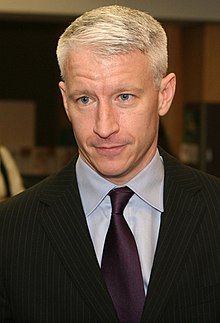
A few days ago, the noted TV news personality and multimillionaire heir (to the Vanderbilt fortune) Anderson Cooper came out, after years of public speculation by his fans and years of being open among a private network of friends, associates and coworkers. To be truthful, Cooper, a very rich and well-placed white man, had very little to lose but his gossamer secret by declaring, in the offhanded way he did via a letter to his friend, conservative writer and pundit Andrew Sullivan, that he was "gay." He did not, as his peer Don Lemon did, come on the air and tell the world. He didn't even pick a gay pride celebration to make his statement. Yet he did it, and in so doing he was not going to lose his post as a CNN media figure; he was not going to lose his fans, most of whom not only couldn't have cared less that he was gay but had long wanted him to publicly come out; he was not going to lose his millions by being cut off by his mother, designer and heiress Gloria Vanderbilt; in fact, he wasn't going to lose much of anything except his key to a gilded yet fairly transparent closet. I say all of this not to attack Cooper, because I praise his public self-affirmation as a gay person, as queer man. I think it's wonderful, especially in light of the ongoing shift in public attitudes in the US and across the globe concerning gay rights and equality, and in light of the ongoing struggles, de facto and de jure, that queer people all over the US and the globe still face in terms of homophobic and heterosexist oppression. I applaud Anderson Cooper with the strongest and gayest claps possible. But he didn't have much to lose, and he didn't have a long walk to take out of a closet that barely existed, though he'd kept its door cracked and its walls intact.

In contrast, on Tuesday the 24-year-old singer and songwriter Frank Ocean, a member of the loose collective Odd Future, which has been rightly criticized for the violently anti-gay and misogynistic raps of some of its members, particularly Tyler the Creator (cf. "Yonkers"), bravely posted on his Tumblr page a two-paragraph letter--who says this ancient form no longer has relevance or power!?--letting the world know that his first love was a man he'd met when they were both 19 years old, and that that experience, however complicated and painful in some ways, however unreciprocal and difficult, had been transformative for him. Ocean did not use the word "gay" or any similar term, preferring instead simply to state for the record that the relationship had existed, what it meant and continues to mean for him, thanking hte unnamed beloved and letting him know that because of it he felt and "feel[s] like a free man." In other words, he acknowledged his queerness by acknowledging the truth of his life, and no labels were nor are necessary, though this did not prevent media outlets, Twitterers and Facebookers, and a good many of everybody else stating that he was "gay" or "bisexual" or trying to pin a label on him.

Ocean's letter, from his Tumblr page
Since then neither Ocean nor his publicists nor his bandmates have posted a retraction. The responses from Odd Future's Tyler the Creator and others across the music industry, especially in the genres that Ocean has worked most extensively, hiphop and R&B, have been almost uniformly positive and affirming. (Tyler tweeted on Wednesday, "My big brother finally f---ing did that. Proud of that n---a cause I know that sh-- is difficult or whatever. Anyway. I'm a toilet." Uh, okay.) Ocean's new and first full album, Channel Orange, is set to drop, and with media speculation percolating about the pronouns he'd chosen in three songs, so he very well could have come up with an excuse or denials and kept hidden the sort of relationship, however one-sided the letter suggests it was emotionally, that Terrance Dean chronicled in his 2008 book Hiding In Hip Hop: On the Down Low in the Entertainment Industry from Music to Hollywood (Simon & Schuster), and played the game as it usually is. Instead, by sharing this aspect of still brief life, he risked quite a bit, and still faces huge risks, but nevertheless took a step that unfortunately far too many figures much further along in their careers--Queen Latifah, for example--are still unwilling to take.

Tyler the Creator and Frank Ocean (© Getty Images)
One may argue that given these risks and dangers are far greater for non-celebrities--Ocean after all appears on one of the best-known tracks on Jay Z's and Kanye West's recent album and is a member of a thriving musical group--and, in the absence of federal civil protections for queer people and the institution of overtly anti-gay laws in some states, as well as persistent homophobic and heterosexist attitudes, rhetoric and behavior by many major religious groups, anyone who is considering coming out has reason to be wary. This is true; one can ask too to what and to whom anyone is "coming out"; in the absence of affirmation and support, being openly queer--gay, bisexual, transgender, intersex, unlabeled but self-posited as a non-heterosexual, as questioning, as emergent, as sexually and gender-fluid--can still be a life or death proposition, for someone of any age. For women, for people of color, for working-class and poor people, for a person with physical or mental challenges, for a religious minority or someone occupying all of these categories, the challenges and risks multiply. Thus the simplistic call for people to come out, born out of the earliest days of the post-Stonewall Rebellion movement towards gay rights and equality--Come Out! was in fact the name of one of the very first gay publications--must always be considered within the context of the specific people for whom it is cast, the society in which it might occur, the risks it entails. One can come out and go back in, or be out and still be continually be coming out. It isn't a one-time proposition, and it won't be for Cooper, if you can believe that, and certainly not for Frank Ocean.

Anderson Cooper
Whatever Frank Ocean decides to do, whatever he decides to call himself tomorrow or down the road, whatever he songs he writes and to whomever he address them, whatever the gender, he has had a major impact on the public discourse through his courageous step, and, I want to note this, those around him in the R&B and hiphop communities have also made a major impact by responding as they did. It is particularly invaluable for young black people, not just in the US but all over the globe, especially in places where internal and outside forces have ramped up homophobia, to see that a young black person, at the center of the forms of cultural production that animates local and global imaginaries, can speak about his life with truth and bravery and not be ashamed or duplicitous, that he can speak about falling in love with another person of the same sex, and talk about his hurt but also how much he gained from that experienced, and how it has brought him a freedom many people dream of, an emotional freedom, and a truthfulness, that so many queer people still struggle to attain.

I praise his courage and his candor, and urge others who can and are able to follow his lead to do so, just as I praise those like Cooper who have already got the world by their fingertips and decide to step out, be out, open up. I also urge all who can work to change the laws, here and abroad, that foment homophobia--which, as Barbara Smith, Eve Sedgwick, Judith Butler, Audre Lorde, and countless other visionaries have in their various ways noted lies at the core of nearly all anti-gay activity--and that foster oppression and inequality to do so, because by doing both, as he suggests, we all might be on the road to being "free."

Saturday, February 11, 2012

RIP Whitney Houston

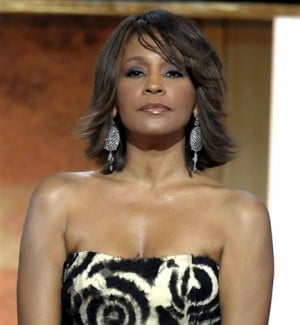
Whitney Houston in 2009 (AP/Evan Evangelisti)

Whitney Houston (1963-2012)

Whitney Houston, "The Greatest Love of All"

I almost cannot believe this news, but this afternoon, but singer and actress Whitney Houston was found dead in her room at the Beverly Hilton hotel in Beverly Hills, California.  One of the finest and most talented singers of her or any generation, with an extraordinarily powerful voice grounded in the gospel tradition, Whitney Houston could have sung almost any kind of music, but primarily made her mark in rhythm & blues and pop. (Yet as she showed on the many times she sang the "Star-Spangled Banner," she could make it sound like you'd never heard it before, and later sang with a 35-piece gospel choir on The Preacher's Wife: Original Soundtrack Album.) The Newark-born daughter of gospel singer Cissy Houston, the cousin of icon Dionne Warwick, and the goddaughter of the musical goddess Aretha Franklin, this beautiful and poised singer, blessed with a once-in-a-lifetime vocal instrument, debuted her first album, the eponymous Whitney Houston in February 1985, and the hits came right away.  They continued well into the 1990s, with perhaps her apogee being her rendition of Dolly Parton's "I Will Always Love Young," from the popular movie The Bodyguard, whose soundtrack won a Grammy award, one of numerous awards Whitney collected over the years.

Whitney Houston, turning out Chaka Khan's hit "I'm Every Woman" (one of my favorite songs of hers)


I have listened to her music since her debut in 1985, and I rushed out to buy her first and subsequents not long after they appeared. Without question her many LPs and CDs have formed part of the soundtrack of my adult life. I'm even old enough to recall staying up to catch her on Byron Allen's old late night show, so enthralled was I by her music and her.  It's hard to put into words how sorrowful her decline over the last 15 years has been to witness, and how saddened I am by today's new. It was clear by 2001 how bad off she was, but I remember how when C and watched her reality show with her then-husband, Bobby Brown, there was no doubt that she had hit rock-bottom, and perhaps was even on the rock and rocks as the cameras rolled. Yet in 2009 it appeared that Whitney Houston had turned things around, but the struggles that she faced are never easy to win and, whatever happened today, it was clear that her many trials had taken their toll.  It is so very tragic, and so inadequate are these words, but as she sang, I will always love her music and her. RIP, Whitney Houston.

Whitney Houston, "I Will Always Love You"

Here, apparently and tragically, is her last performance, last night, at Kelly Price's pre-Grammy party.

Wednesday, August 24, 2011

RIP Nick Ashford

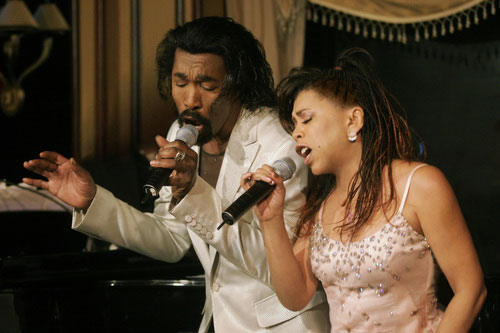
I was so sorry to learn of the death of composer, singer and hitmaker Nick Ashford (1941-2011), who with his fellow songwriter and later wife Valerie Simpson (1946-), wrote hit after hit that I and millions of others grew up on.  It is hard to believe that he was 70 years old.  He had suffered from throat cancer, and died in a hospital in New York on Monday. He leaves his wife, two daughters, and other family members.

A native of Fairfield, South Carolina, Ashford met Simpson in Harlem in 1963 at White Rock Baptist Church, where they began collaborating. Their early recording career did not pan out, but they began writing songs that a number of important figures recorded. These hits included Ray Charles's "Let's Get Stoned"; Marvin Gaye's and Tammi Terrell's "Ain't No Mountain High Enough," "You're All I Need to Get By," "Ain't Nothing Like the Real Thing," "Reach Out and Touch (Somebody's Hand)"; Diana Ross's versions of "Reach Out and Touch (Somebody's Hand)" and "Ain't No Mountain High Enough," and "Remember Me." I had no idea that they had also written such hit songs as Teddy Pendergrass's "Is It Still Good To You"; The Brothers Johnson's "Ride-O-Rocket"; and, according to my mother, my childhood favorite Chaka Khan's "I'm Every Woman" and "Clouds"; and Chaka Khan with Rufus's "Keep It Coming" and "Ain't Nothing But Maybe."

Ashford and Simpson also wrote for Gladys Knight and the Pips, Smokey Robinson & The Miracles, The Supremes, The Marvelettes, The Dynamic Superiors, and other Motown groups.  Ashford lent his voice and instrumental talents to numerous other recordings over the years as well. As the group Ashford and Simpson, they saw their own recording career finally take off in the 1970s, with hits like "Don't Cost You Nothin'" (1977), " "Is It Still Good to Ya" (1978), "Found a Cure" (1979), "Street Corner" (1982), and the hit that was one of the songs my sophomore year of college, "Solid." ("Solid as a rock....") With his wife, Ashford established New York's Sugar Bar in 1996, at 254 W. 72nd Street on the Upper West Side, and it has become an important venue for seeing some of the best local and international talents in R&B, soul, jazz, and Caribbean music.  Yesterday evening, performers, including luminaries such as Freddie Jackson, honored and mourned Nick Ashford's passing at Sugar Bar.

Here are a few clips of Ashford & Simpson's songs, and of the incredible duo themselves, singing their way into listeners' hearts, and history. RIP, Nick Ashford.

Ashford & Simpson, "Solid" (no embedding) Marvin Gaye and Tammi Terrell, "Ain't No Mountain High Enough" Diana Ross, "Remember Me" Chaka Khan, "I'm Every Woman" Teddy Pendergrass, "Is It Still Good To Ya"