Showing posts with label e-books. Show all posts

Thursday, February 12, 2015

eBooks, Surveillance and a New Aesthetics?

(Source: Instagram user hotdudesreading,
from PopSugar)
Perhaps five year ago when, at hiring and committee meetings, readings, or during the rare non-literary performance (as in the crazy Raymond Roussel play John Beer directed with such aplomb in Chicago), I would pull out my iPad and read from it, my use of this technology would spark comments and queries. I seldom saw people reading from an iPad, let alone another e-Reader, in public spaces, including on the MTA subway trains, and even less so on the El, though I did spot a number of early adopters on my flights commuting between Jersey City and the Windy City. My status as a tablet/e-book harbinger, however, did not result from any innovative thinking on my part; it was the direct result of living with an app developer who had bought two machines to test his work on, and I ended up with the more basic one. There was little likelihood that I would have gotten one so quickly otherwise.

Nowadays almost everyone I know has a tablet computer or an e-Reader, and many have both. "Sent from my iPad" pops up at the bottom of perhaps every fourth email. As a present a few years ago I received an updated iPad from C, and I do use it but far less frequently than I once did, for reading, drawing, animation, or anything else. I have not purchased an e-book or downloaded a free one in a while. Instead if I'm reading anything online, I primarily turn to my laptop (which I recently had to have replaced, because the prior one's logic board fried), or my iPhone (which I had to replace because I left the previous one in a US post office near Chelsea Market, and when I rushed back to find it, it was, unsurprisingly, gone). One of my animations (cf. below) expressed in a few images my thoughts about the e-reading experience, which I find far less enjoyable than codex (printed) books, but for many people today, these handheld computers are becoming the default. (I found it telling that at least one recent survey of college students suggests they prefer print books, which tracks my classroom experiences, a small group of phone-centric student readers notwithstanding.)


Still, convenience, physiological comfort, and to some degree costs, make strong arguments on behalf of e-books and e-devices. Rather than having to carry about heavy hardcover or even lighter but still bulky paperback books, as I have done for most of my life, you can store hundreds (thousands?) of books on many e-reading devices, which have increasingly shrunk in their physical dimensions to the point that some are not much bigger than the largest smartphones. (Compare an iPad Mini or smaller Kindle reader to one of the larger Android phones, or Apple's news gigantic iPhone.) On most e-readers you can enlarge print with a swipe or a button, obviating the need, as your eyes age, for squinting at tiny print. E-books also tend to be less expensive (as they should be) than codex books, and with most--all?--e-reading devices you can also easily read .pdfs of anything you can transform into that format, which today is anything you find on a laptop or tablet screen. A vast array of literature can be found free of charge on the web, such that an enterprising person could--and some have--cobble together from existing materials an ever-changing, personalized e-anthology.

Recently, Francine Prose published a short article, "They're Watching You Read," in the New York Review of Books, in which she describes reading William Makepeace Thackeray on her e-reader, and while doing so, she came across an article in the Guardian, "Ebooks can tell which novels you didn't finish," that shares something many readers may be aware of but probably are not thinking about too much, which is that some e-devices are carefully tracking their readers' habits, down to where they break off in reading before resuming, which passages they reread, and how far they get in terms of a book's full length. (Do all e-reading programs do this?) According to e-bookseller Kobo's stats, "less than half of British readers" or 44.4%, of Donna Tartt's immense Pulitzer Prize-winning novel The Goldfinch, finished the 800-page tome. With Solomon Northup's shorter memoir Twelve Years a Slave, returned to public notice by Steve McQueen's Academy Award-garnering film, only 22.8% managed to complete it. On the the other hand, according to Kobo, the most completed book, at 83%, was self-published author Casey Kelleher's Rotten to the Core. Although it did not make the Kobo Bestseller list, it held four-fifths of its readers to the final period. Kelleher has gone to "win a book deal with Amazon's UK publishing imprint." In fact, as Kobo's stats show, its bestseller lists (books purchased) and most completed books (read to the end) are quite distinct, as are the national reading trends it tracked (though the percentages aren't broken down according to gender, age or other readership categories):

Kobo also revealed that the people of Britain were most likely to finish a romance novel, with 62% completion, followed by crime and thrillers (61%) and fantasy (60%). Italians were also most engaged by romance (74% completion), while the French preferred mysteries, with 70% completion.
I wonder what American readers tend to finish the most. Fantasy? Nonfiction books? Something not listed above?

Even raising such questions underlines the basic fact that the collection of data is a form of surveillance. Neither Prose nor the Guardian report says whether the data collection is voluntary, but I imagine it is similar to most online data collection today, which is to say, you have to opt out, sometimes with great difficulty. But then it isn't just online sites that are collecting data. A few years ago on these pages, I raised an uproar over the warrantless wiretapping George W. Bush's government was engaging in, but as Wikileaks and other whistleblowers, including most importantly, I'd argue, Edward Snowden have certified, the surveillance of everyone, via a variety of increasingly networked means, is widespread. To put it another way, every networked device, as well as every data point collected by any means possible, becomes the means to follow, track, quantify, and monetize our existences. Everything we do that can be tracked can be commoditized, among other things. The most sinister aspects of this panoptic society remain to be reckoned with.

But back to Kobo: as the Guardian report and Prose both point out, e-devices allow publishers to know not only which books readers are purchasing but how slowly or quickly we move through them, whether we finish, and where we bog down. Prose goes on to talk about how this knowledge about readers might become public, but then, assuming the perspective of the published writer that she is, wonders about whether publishers may start using these data when to shape the writing the publish. She writes:
Since Kobo is apparently sharing its data with publishers, writers (and their editors) could soon be facing meetings in which the marketing department informs them that 82 percent of readers lost interest in their memoir on page 272. And if they want to be published in the future, whatever happens on that page should never be repeated. 
Will authors be urged to write the sorts of books that the highest percentage of readers read to the end? Or shorter books? Are readers less likely to finish longer books? We’ll definitely know that. Will mystery writers be scolded (and perhaps dropped from their publishers’ lists) because a third of their fans didn’t even stick around long to enough to learn who committed the murder? Or, given the apparent lack of correlation between books that are bought and books that are finished, will this information ultimately fail to interest publishers, whose profits have, it seems, been ultimately unaffected by whether or not readers persevere to the final pages? 
Other than Kobo, it appears most publishers are not (yet) willing to share the full data they have been collecting, but an earlier article along these lines made me wonder about not only about how publishers and readers might respond, which is the ultimate focus of Prose's article, but rather, within a specular regime of surveillance of writers' aesthetic choices how writers ourselves might start to respond as the data haul increases and we have an ever clearer picture of how readers are moving through books. (This also may be of great interest to the big data researchers now active in literary studies.) Publishers, agents and editors already push fiction and nonfiction writers toward certain themes and topics, as well as towards certain styles of writing that have proved, at least by empirical standards, to result in books that readers will purchase, whether they read them all the way through or not. With this new data, analogous to how we modify our behavior (or don't) based on the expectation of widespread surveillance, might some of us start to make even more specific aesthetic decisions based on the data, aware that it's always being collected and will be shared with us?

As things already stand most authors, whose work draws upon the prevailing discourses, frameworks, ideas, and rules of the era in which we are writing, already grasp the parameters for readership and publication, but this is often intuitive, with some recourse to empiricism. For example, most writers know an 800-page novel is going to be harder to sell than one that's 400 pages, though the example of Tartt, Foster Wallace, Catton, and others suggests that it's not impossible. Also, most writers know that language that is too baroque, too ornate, too lyrical, to subtle, and so no, will repel most, though not all, readers off, although the example of Cormac McCarthy's The Road, to give one fairly recent example, suggests that the right writer can write in a prose as finely wrought as that found in the Bible or Shakespeare's plays, and still sell books. (And that McCarthy novel is, I would argue, significantly more simple in its language than an earlier book of his, like Blood Meridian.) Most writers know that certain genres, and the conventions embedded within them--romance, mystery,  horror, science fiction, speculative fiction and fantasy, etc.--sell far more than realist literary fiction, though there are authors who successfully, in aesthetic and market terms, blend and bend all of these genres.

If an emerging or even established fiction writer, to take one example, not only wants to get her work into print, but to have readers engage with it and finish it, however, awareness of these data, let alone the specific data points assembled in descriptive--or prescriptive and proscriptive form--might begin to function like a template or paint-by-numbers guide. How to write? Shorter sentences and paragraphs; stock characters (young, upper middle class, physically abled, white) with certain winning descriptors (the default "blond(e)" or "sun-kissed"); prose so simple and shorn of rhetorical devices a second grader could read it without breaking a sweat; rigid Aristotelianism in terms of form; faster pacing; muted, middle-of-the-road politics; boilerplate, normative sexualities; and so forth. You could call this "e-data aesthetics," I suppose, and in some cases a writer may feel it benefits her work aesthetically. For others, of course, it could prove problematic, on multiple levels. If you know readers in general do not like complex syntax, to much figuration, and complex characters, but you are drawn to write such things, will you change to please (and gain?) readers?

These days such questions may appear farfetched, but you need only look at the increasingly rigid, money-driven template Hollywood employs with regard to mainstream filmmaking to recognize that once enough writers proceed from such premises, it will change writing dramatically. It may help certain writers reach a level of competency, but it may harm the talents and aims of others. This is not to say that won't be other mechanisms, including forms of technology, social and cultural attitudes, as well as economic criteria, and so forth, at play, that determine what people are writing, but "e-data aesthetics" are something we might want to start thinking a bit more about, since the data are only growing and the means to aggregate them are steadily growing too.


Tuesday, August 09, 2011

Publishing Looking Up + New Poet Laureate, Philip Levine

Apple's iPad, with iBook Library & iBook
Up until a few years ago the publishing portion of the undergraduate creative writing major course on the history, sociology, and global cultures of writing, "The Situation of Writing," that some other faculty members and I have taught was popularly known as the "Doom and Gloom" unit. Though we faculty members strove to give our students a wide array of views on publishing's state in the US and across the globe, though there were many buoyant notes amidst the often nostalgic critiques and dire prognostications, and though I personally aimed to convey a broader and more holistic view of the subject, based on my personal experience, I too sometimes wondered where the mainstream publishing industry as it had developed--as I knew it--up through the mid 2000s, was heading, and if it was going to destroy itself or be destroyed by the raft of technological innovations, the financial and technical challenges, the shifts and alleged declines in reading, and other problems it was facing. Doom and gloom.
I noticed after winter's class, however, that many students in the large class told me they felt quite "positive" and "hopeful" about the future of publishing, mainstream, independent, large, small, and otherwise. I too felt the same way after reading the many articles assembled for that portion of the course, and they reframed books like Jason Epstein's The Book Business: Past, Present and Future in positive terms. In today's New York Times, Julie Bosman, in her article "Publishing Gives Hints of Revival, Data Show," reports that this morning's BookStats, "a comprehensive survey conducted by two major trade groups," the Association of American Publishers and the Book Industry Study Group, showed that publishers' net income rose 5.6% from 2008 to 2009, for a net revenue of $27.9 billion, and that in 2010, publishers sold 2.57 billion books, an increase of 4.1 percent over 2008.

The two trade groups surveyed 1,963 publishers, including the 6 largest trade publishers, encompassed 5 major categories of books--
"trade, K-12 school, higher education, professional and scholarly"--and also expanded the categories of what qualified as books, including not only print and softcover codex books and e-books, but "professional and scholarly journals and databases, multimedia teaching materials and mobile apps." Sales of books in all five categories rose, with the largest gains, according to the article, in the higher education area, of 18.7% in three years. Tina Jordan, Vice President of the Association of American Publishers, pointed to the expansion of higher education and increased enrollment as a result of the weakening economy. (I would add that for-profit universities may also be playing a role in this jump.)

As heartening to me were other figures: adult fiction rose by 8.8% over the 3-year period, while scholarly books, once considered a shaky area among not only the trade publishers but even academic publishers, rose by 4.4%. One of the questions that arose repeatedly in articles we looked at in the "Situation of Writing" was whether e-books would depress the overall market for books, or expand it. Early signs from this survey suggest that the latter is occurring, as e-books continue to take off. Though only 0.6% of the trade market in 2008, they were 6.4% in 2010, and Bosman points out that overall sales for e-books in 2010 came to 114 million. That is still a small portion of the larger book sales figure, but the article notes that in 2011 e-book sales continue to rise, and eventually, I think, they will constitute the majority, as more and more younger readers grow accustomed to reading using digital devices such as laptops and desktop computers, cellular phones, e-readers like Barnes & Noble's Nook, Amazon's Kindle, various tablet computers like Apple's iPad, as well as devices not yet perfected, invented or imagined.  Books themselves continue to change too; what is possible with e-books and apps, as the digital The Waste Land proves, offer quite a different book-immersion (because it goes beyond but still encompasses reading) experience.
Barnes & Noble's Nook e-reader
Unsurprisingly as e-books continue to gain, sales of adult hardcover and paper books remained flat, growing only about 1% over the 3-year period, while mass-market paperbacks have declined 16% over the same period. Economically this may signal that publishers will be making far less per book (say $25-$30 now for hardcovers, $12-17 for trade paperbacks, but $5-12 for e-book, less for mobile apps), but could be making up for that financial loss through a larger volume of sales. Certainly their overall and specific costs decline with e-book production, but the terms with and for authors are changing as well. Authors face fewer barriers self-publishing and distributing e-books, and can set more favorable terms for themselves, though gaining attention for these new texts remains an issue as the old gatekeepers remain. This is true too for smaller publishers who don't have media contacts or links to the marketing budgets of the larger publishers. But they too are poised to reward authors better than the old system did, and can earn more for themselves as well.


This is only one article out of many written daily (I do scan Publishers Weekly's daily, dizzying waterfall of tweets to see what the publishing news of the day is, and also glance at other publishing sites when I can), and it thankfully is anything but "doom and gloom." There are readers, they are reading all kinds of books, and while reading may have seemed at risk a few years ago, things appear, at least for now, to have swung back in the other direction.

***

Philip Levine
www.english.illinois.edu
The new Poet Laureate Consultant in Poetry to the Library of Congress of the United States of America, for 2011-12 (and possibly a second year thereafter) will be Philip Levine. Born in Detroit, Michigan in 1928, Levine has been a steady chronicler, in often memorable free verse narratives and monologues, of the lives of working-class Americans. A graduate of Wayne State College (now Wayne State University) and the University of Iowa's Writers Workshop, in 1995 he received the Pulitzer Prize for his collection The Simple Truth, but his best-known volume perhaps is What Work Is (1992), which contains the poignant title poem, and which received the 1991 National Book Award. He has also received the American Book Award and twice been honored with National Book Critics Circle Award and Guggenheim Fellowships. For many years Levine taught at the California State University-Fresno, and later was Poet in Residence at NYU.

When I was in graduate school and he was a visiting poet, he would sit in on at least one graduate literature class I took, taught by Harold Bloom, who seemed both amenable and impervious to having a major poet listening in on his soliloquies on the "Major American Poets"; Levine always appeared to take Bloom's pronouncements with a good deal of respect and humor in return.  Levine is 83 and continues to write and publish his work, though like the previous Poet Laureate, W. S. Merwin, also highly lauded and an octogenarian, it's unclear how much traveling and proselytizing he'll be able to do.  I think he's a fine enough choice, but I really wish that the Librarian of Congress would make more of an effort to regularly appoint more women poets, and to diversify the choices.

I hate always to have to point such things out, but among the last 10 Poet Laureate Consultants in Poetry of these very diverse United States, only 3 have been women--Rita Dove, who held the post from 1993-95; Louise Glück, from 2003-4; and Kay Ryan, from 2008-10.  Since 1986, when Gwendolyn Brooks held the original post of Consultant in Poetry, only one poet laureate has not been white: Dove, and over the entire history of the position, Brooks, Dove and the late Robert Hayden have been the only laureates of color. No Asian American or Pacific Islander, no Latino, no Native-American, no Arab American, no non-black mixed-race poet has ever held the post. Really, the folks in charge can and must do better. We are in the 21st century, in a country more diverse than it has ever been (and it has always been diverse). Though mostly ceremonial, the Poet Laureate is the major face, especially outside of the literary world, of poetry and its chief public advocate.  I can recall how excited I and many others were, especially young people in the nation's capital and across the country, when Dove, a superb poet and lovely person, as well as dynamic figure and excellent teacher, served in this post.

One additional point: it would also be great to have more aesthetic diversity among the Poet Laureates, and this goes in all directions. Having a poet coming from the spoken word direction, a poet also primarily working as a musician, a poet known for more formally innovative work, would all be great ways to go.  This is not to knock mainstream poets, but there are many poetries within the larger American house, and selecting poets representing some of these other traditions and trends would be a great step for the Librarian of Congress to take, because the Poet Laureate should be poetry's chief public, governmental advocate, and many kinds of poets can and would be willing to do that. So congratulations to Philip Levine, but going forward, let's really see some change we can believe in.

On Philip Levine (from Modern American Poetry)
Poems by Philip Levine (from The Poetry Foundation)

Friday, June 24, 2011

St. Mark's Bookshop In Trouble + e-Book Spamistry

If this summer you 1) happen through New York City, 2) are anywhere near the East Village or West Village, and 3) seek a book, particularly a work of distinctive poetry, fiction, creative nonfiction, philosophy, literary or cultural theory, or magazines, zines, art books, and so on, please consider dropping by and shopping at St. Mark's Bookshop, on Third Avenue near E. 9th St., one of the best independent bookstores in the city, and one of the survivors in what was once a city brimming with indie booksellers.  Though old standbyes like Shakespeare & Co. still exist and newer bookstores like McNally-Jackson and Idlewild Books offer great selections, St. Mark's storehouse of zines, obscure critical books, and poetry titles, to name but three of their strengths, remains among the best New York has to offer, at least in my experience. It was at St. Mark's that I first came across Will Alexander's work, after months of buzz from friends about it; where I found maga/zines like Butt before any other non-Christopher St.-area bookstores were carrying them; where I used to grab my copies of Linda Simpson's My Comrade, Sister whenever I visited the City from Boston; and where my own first book initially appeared--before it showed up in any other bookstores.  The staff, though perhaps a bit saturnine as a whole, has tended in my experience to be far more knowledgeable than that of many other bookstores I've come across over the last 10 years.

In previous blogposts I've written about the 2007 closure of stores like the extraordinary Gotham Book Mart, and, I'm sad to say, St. Mark's appears to be teetering on the brink. The overall grim economic situation, the rise of online and e-book sales, problems with publishers, and New York City's exorbitant rental market are proving lethal, so St. Mark's needs every sale it can get. According to Gothamist, last October the bookstore had to lay off all of its part-time staff and reduce the hours of its full-timers, but anemic sales and an unyielding landlord have meant that the store continues to struggle financially. Mark Russo, one of the bookstore's managers, is quoted in Aidan Gardiner's June 23, 2011 article in The Villager stating the case as: "We were in a precarious position and when you add what happened with the economy in general — there you go...We’re particularly vulnerable to that because of the price of our real estate. It’s people turning to e-readers and that sort of thing."

Russo doesn't foresee closing St. Mark's Bookshop anytime soon, but the store is currently on an IV drip at best. One problem, which I admit I've exacerbated in recent years, is that nowadays customers will not buy a book if it's not in stock; waiting even 24 hours for an order to arrive, thus necessitating a return to the store to pick the book up, has become too long a wait in the era of overnight shipping of books directly to your doorstep.  Quoting Russo, "'E-book sellers have changed what people’s perception of service is and what is legitimate to expect in a short period of time....If you say to them that you’ll have to order it, a lot of people have a strange idea of what ‘right away’ means.'" Gardiner's article adds, however, that despite the panoply of challenges, New York booksellers have not suffered as badly as their peers in other cities and regions; a report by the American Booksellers Association in conjunction with Civic Economics says that New York is the "twelfth-best independent-bookstore business market" out of 363 in the US (I'm surprised it's not in the top 10). That said, the article also states that New York-area independent booksellers have noticed a "dip" in their business, though nothing as severe as St. Mark's.

The fate of the independents, once threatened by the megachains but now by online selling and e-books, once again looks bleak, so it's up to readers to do our part. If you're in or around St. Mark's or any other bookstore, especially an independent, please buy a book or several if you can afford to!

˚˚˚

Afternoon coffeeNot all that glimmers from an e-book screen is worth reading, or even a book as we know it. I am a fan of electronic books--though I keep buying and reading codex ones, and just finished Jennifer Egan's superb, Pulitzer Prize-winning A Visit from the Goon Squad (Anchor, 2010--which I bought it at The Strand, an independent bookstore!), but C, an e-book publisher now, forwarded me several cautionary articles about e-books, Amazon and its popular Kindle reader that I recommend. For example, I had no idea that Kindle-targeted "spam" e-books were "clogging" Amazon's store. But, says the LA Times, they are:

Thousands of digital books, called e-books, are being published through Amazon's self-publishing system each month. Many are not written in the traditional sense.

Instead, they are built using something known as Private Label Rights, or PLR content, which is information that can be bought very cheaply online then reformatted into a digital book.

These e-books are listed for sale — often at 99 cents — alongside more traditional books on Amazon's website, forcing readers to plow through many more titles to find what they want. Aspiring spammers can even buy a DVD box set called Autopilot Kindle Cash that claims to teach people how to publish 10 to 20 new Kindle books a day without writing a word.
So now, as with emails featuring hot movie stars or porn actors or emergency appeals or credit card offers in their subject lines, you must be wary of ultraeconomical e-books that will plant worms and Trojan horses on your computer or e-reader. In Salon, Laura Miller offers her witty, informative take on the Spam situation:

Most PLR texts seem to be the product of content farms, quickly-written, work-for-hire informational material cranked out by underpaid writers with little more than a passing knowledge of their subjects. It's the same sort of stuff you'll find on ehow.com. The content packages are filled out with public domain material, usually available elsewhere for free, such as old junior league-style cookbooks ("Cat Head Biscuits And Garlic Fried Chicken") and self-help manuals ("Nice Guys, Shy Guys & Good Guys"). Some e-book spammers publish reformatted classic literature that's gone out of copyright, passing themselves off as the "editor."

One of the first to observe this phenomenon is British marketer Mike Essex, who found, in the Kindle store, nearly 3,000 99-cent e-books "created" by one Manuel Ortiz Braschi. Braschi is purportedly the author of "Canvas Painting 101," "40 Ways to Prevent or Get Rid of Stretch Marks," and "Seven Days to Profitable Blogging," among many, many others. When he's not providing this invaluable guidance to the public, Mr. Braschi somehow finds the time to offer his editorial assistance to such authors as D.H. Lawrence, Leo Tolstoy and Georgette Heyer. (Though how he reconciles publishing both "St. Michael The Archangel -- The Prince Of Angels!" and "Lady Chatterly's Lover" is an interesting question.) Since Braschi's oeuvre first came to Essex's attention in March, this authorial dynamo has added nearly 1000 new titles to his oeuvre.

Braschi's customers are, for the most part, unimpressed. "The book isn't formatted for the Kindle and states specifically that it has been downloaded from a public domain," complained one typical review. "It lists a website for free software that doesn't exist ... It's atrocious."
Beware anything published by Mr. Braschi!  Then, as the LA Times article notes, there are other interlinked problems: plagiarism and theft:
Some of these books appear to be outright copies of other work. Earlier this year, Shayne Parkinson, a New Zealander who writes historical novels, discovered her debut "Sentence of Marriage" was on sale on Amazon under another author's name.

For Amazon, the wave of e-book spam hitting the Kindle could undermine its push into self-publishing and tarnish the Kindle brand, which is set to account for some 10% of the company's 2012 revenue, according to Barclays Capital estimates.
The article points out that these the spamming and plagiary combine in some cases in which a program can rename a top-selling e-book in order to market it to a different demographic. It also states that while the Kindle, with the largest market share among e-readers, has been a target, Barnes & Noble's increasingly popular Nook has not, and makes no mention of the iPad, perhaps because although you can acquire a Kindle reader app for Apple's product, selling anything through its iTunes store, as C has attested, requires running an obstacle course of sorts.  It is anything but simple, straightforward or self-evident.

Finally, author Rahma Krambo, in posting about the issues above, links to possible solutions, including empowering readers to flag spam texts on Amazon, thus filtering out at least some of the bad results (though how can you tell before viewing them which editions of John Milton's Paradise Lost, say, which is a public-domain text, are legitimate republications by scrupulous small publishers and which are spam texts?), but he also suggests a social-networking solution that would involve recommendations by friends. Another idea is for Amazon to charge to upload texts, which would deter at least some of the greediest spammers, especially those churning out crap at no financial or social cost whatsoever to themselves; perhaps some combination of these first and last options might work best. (I say keep Facebook, etc. out of it.) Krambo ends by offering links to a great tool, Plagiarisma.Net, which you may find very useful.  Let me just say that I have utilized this with student papers, thankfully with no upsetting results, and have put some of my own published work through it, again, with no negative results (Amazon's and Google Books' entries were what popped up).

That said, I have found someone appropriating--stealing--content from this blog, down to the photos at times. (And not just from J's Theater.) Who? TITDILAPA.  I'm still not sure how to get Blogger to do anything about this; flagging the spam site doesn't seem to work, and Blogger's (Google's!) language about lawsuits is terrifying. Terrifying, that is, to the one requesting that such sites be taken down. So the other blog, like the spam e-books, remains online....

Wednesday, June 15, 2011

The Waste Land App

Screen shot of Fiona Shaw performing on the Waste Land appWhither publishing today, in this era of e-books and apps, and whither especially poetry publishing, which faces its own set of genre-specific issues? As Reggie H. (naturally) alerted me this morning by sending along the Guardian UK I cite below, the venerable British publishing firm Faber & Faber, in conjunction with Touch Press, an app development/publishing company, suggests through its extraordinary new offering one likely direction for the future, with its Waste Land app. I kid not.

Touch Press takes one of the landmark works of 20th century Anglo-American and world literature, T. S. Eliot's (1880-1964) 1922 long poem, The Waste Land, and, using apps' multiple electronic and digital resources and the iPad's display capabilities, brings Eliot's poem to life in a strikingly refreshing and enthralling way. It's no gimmick, I assure you. Here's the Guardian UK's video report on it, which describes how the app came about.


Not long after Reggie sent me the link to the Guardian piece, I came across Laura Miller's Slate article on the new app, "The Waste Land": T.S. Eliot takes the app store," which walks readers through the app and argues that it represents the best example of how to make a "digital book." So what does the app comprise?

You get, in very easy-to-navigate format
  1. The poem, in full published text version, laid out as it would be in codex book form;
  2. The poem, read by Eliot himself, in 2 different versions (1931, 1947), as well as by Alec Guinness, Ted Hughes, Viggo Mortenson (?), and the remarkable Irish performer Fiona Shaw;
  3. The poem performed by Fiona Shaw, in a Dublin house--I have watched this several times now, and I don't think I've ever heard Eliot's language enlivened, embodied, like this;
  4. Videotaped perspectives, by Seamus Heaney (who needs no intro), Paul Keegan (Poetry Editor at Faber & Faber since 1999), Jim McCue (a leading Eliot expert and publisher), Craig Raine (the poet and critic), Fiona Shaw, Frank Turner (a musician heavily influenced by Eliot), and Jeanette Winterson (the fiction writer and critic), which play alongside selected sections of The Waste Land;
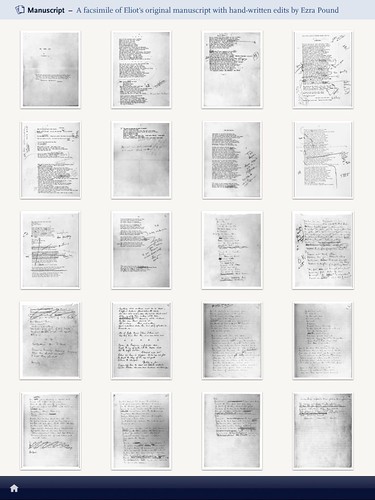
  5. A facsimile of Eliot's original manuscript, edited by Ezra Pound, which you can view page by page, or, by sliding the screen in one direction, interspersed with the final version;
  6. Annotations and other notes explicating the text, in addition to the ones Eliot (in)famous provided;
  7. A gallery of photographs and images linked directly or indirectly to the text; these range from a photo of Eliot's native Saint Louis in the early 20th century to Pablo Picasso's Les demoiselles d'Avignon to a photo of Vivien Eliot, the writer's tragic first wife, to two (why?) photos of Bob Dylan (one would have sufficed).
Eliot, Corbis
This list barely captures the true interactivity of the app, which allows you even with all the gewgaws to, if you please, read the text straight through, as you would in book form, but also, you can, as I've done, read along as Fiona Shaw performs it or even just watch Shaw do her thing. As I said, the text, considered to this day a forbidding work of Modernism, comes alive in ways I'd not considered before. What Faber & Faber and Touch Press have created is perfect for the classroom, but also for anyone interested in poetry, especially Anglo-American poetry.  What also makes it work is the depth of Eliot's masterpiece; it can stand up to all the digital treatment and doesn't suffer from nor is overshadowed by it. The poem has many layers, as scholars have shown since it first appeared and as Eliot's peers quickly recognized, to peel away, savor, mull, return to. A lesser work might not hold up so well, and a work written directly for this sort of publication would probably come off differently, but Eliot's text suggests that masterworks of this kind--I think immediately of Walt Whitman's Leaves of Grass, or Herman Melville's Moby Dick, or Jean Toomer's Cane, or, going further back, any of William Shakespeare's plays, or Dante's Divine Comedy, as being possible options, and see this as the leading edge for the future. (Imagine Erich Auerbach's famous discussion of the Divine Comedy, for example, alongside a number of others being woven into an edition of that book.)  Another option might be Abraham Lincoln's or Frederick Douglass's speeches, if those don't already exist, or a work constellating a range of texts--like The New York Times's Disunion series around the US Civil War. For an enterprising publisher with the resources and interest to work with a work in the public domain, there's no limit. It also suggests to me--as I'm sure it will to others--another and exciting possibility in terms of scholarly editing and publication. This might be what scholarly editions look like, at least to some extent, down the road.

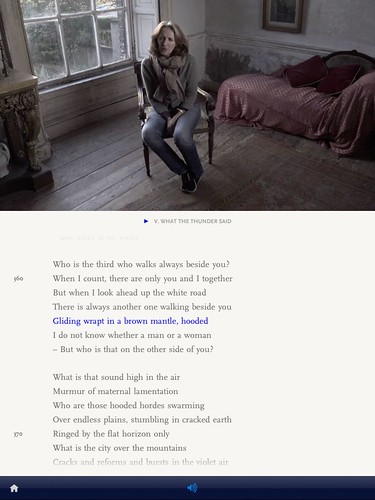
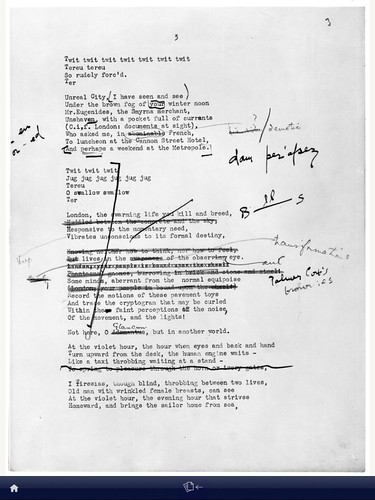
As I mentioned to Reggie, after watching the Guardian piece and reading Miller's report, I had to purchase the app, which is $15 (not cheap, of course, especially given the usual app range of .99-$10), and I'm glad I did. Here are some screenshots of it.

Screen shot of the Waste Land app
A screenshot of the facsimile pages
Screen shot of the Waste Land app
A screenshot of one of the most famous of Pound's emended pages of Eliot's text (note the "B_ll_s")
Screen shot of Fiona Shaw performing on Waste Land app
A screenshot of Shaw performing alongside the scrolling text (the lines she speaks and performs automatically highlight in blue)
Screen shot of Wild Party app
A screenshot of the app with the notes/annotations at left
Screen shot of Fiona Shaw performing on the Waste Land app
A screenshot of Fiona Shaw performing the poem

This is not the first time someone has adapted The Waste Land for new technologies. An older example is this hyperlinked version, which would have been pretty advanced 15 years ago, and which still represents a heightened and very useful option for exploring Eliot's poem. My own introduction to The Waste Land after high school--and I admit to having been somewhat obsessed with Eliot as a teenager--came in my freshman year, when I conned my way into Joel Porte's "American Modernist Thought," most of which went over my head, at least the theoretical parts, but I do vividly remember the marvelous facsimile version of The Waste Land that we read, and I was shocked by all of Pound's excisions. He was, as Eliot rightly noted, at least in this effort, il miglior fabbro, the dedication he added in 1925.  I will be returning to this app again and again, I think, and hope that other publishers, along with Touch, keep producing works of this sort.

It just might get more people reading and thinking about not just poetry, but literature and the arts and humanities in general.

Tuesday, May 17, 2011

CAC Digital Arts First Publication + Chicago's New Mayor + Congrats, Rey Andujar

Earlier today, my partner C's company made two major announcements, both of which are worthy of the heartiest congratulations: formerly named CAC-IT, the company has now officially changed its name to CAC Digital Arts, to reflect its new projects in the digital and electronic publishing fields, and, as part of this shift, released its first e-Book, Maggie da Silva's The Real Family Camping Cookbook (2011), now available for Kindle on Amazon, the Nook on BN.com, and soon to be available for purchase on Apple's iTunes store!

Da Silva, a writer, producer, artist, and publisher of Gooch! magazine, has written, at least from what my minimal research suggests, is the most thorough e-Book compendium of camping recipes you'll find online.  The recipes range from the foolproof to more artfully elaborate options, all campsite ready with a little advanced preparation, and many designed, it seems to me, to bring as much aesthetic delight to campers of all ages as satiety. Many probably would probably also make great backyard option throughout the spring, summer and fall. Another treat are da Silva's line drawings, and the quotes that follow each of the recipes. As one Amazon reviewer notes, "It's like having a bibliography to download and bring along on your camping trip as well!"

I'm especially proud of and amazed by C for taking his company in this exciting new direction, and look forward to more e-books (of fiction, photography, travel nonfiction, and many other areas), iPhone/iPad apps, and other digital products in the future. I also highly recommend his fast news Reader (fnR) (only 99¢), which aggregates a number of popular centrist and progressive sites, like GoogleNews, Reuters, BuzzFeed, Gothamist, Wonkette, DailyKos, and Crooks and Liars, but also allows you to add any site with RSS/Atom feeds (it's extremely easy, and I added Eschaton in a matter of seconds), bookmark pages, access sharing tools, and easily forward articles.

+++

From the moment Rahm Emanuel, formerly a senior advisor to former President Bill Clinton, US Representative from Illinois, and most recently President Barack H. Obama's Chief of Staff, announced that he was stepping down to run for the Chicago Mayor's seat occupied for the last 22 years (1989-2011, or roughly 1/2 my life, it feels strange to say!) by Richard M. Daley, I knew none of his opponents had a real chance. I predicted he'd Rahmbo Chicago, and he surely did. The money and momentum, along with the Democratic Party and the President, were Rahm's from the beginning, and the weak field he faced, which included former US Senator Carol Moseley Braun, who proceeded to self-destruct as quickly as possible; Aldermen Gerry Chico and Miguel del Valle; Carol Van Pelt Watkins; and William "Doc" Walls III, posed little challenge.  Emanuel received 55% (323,546) of the vote, tallying more than all his opponents combined.  He is now the 55th Mayor of the City of Chicago, and was sworn in today at the Pritzker Pavilion at Chicago's famous Millennium Park (Grant Park), the same site where President Obama celebrated his 2008 victory.

I'm not a fan of Emanuel's. I see him as a conventional contemporary Democrat, a centrist pragmatist who will sell out his constituents--Democrats, Republicans, independents, anyone, including the Democratic Party's union stalwarts--as quick as a lipsmack if the demand or dollar requires, and more concerned with fundraising and entrenched wealthy interests than the people who put him in office.  This struck me as his ideological orientation during his stints both with Clinton and Obama, and I see little changing, though he faces serious challenges as Chicago's mayor at a time of economic uncertainty and constrained public financial resources.  I see no sign that his promulgated reformism will go any further than cosmetic changes, at least at the beginning; if anything, the city will probably see more of a continuation of Daleyism, though with fewer--we can and should hope--of the endless scandals, and the same level of city boosterism, which under Daley included beautification, at least in some places like The Loop, that admittedly helped to transform Chicago from a shrinking metropolis to the booming Midwestern capital it is today.

Emanuel is known for being tough, sometimes to the point of thuggishness, but this might come in handy in a city like Chicago where toughness is required, especially in politics. He has already declared he's cutting $75 million from Daley's previous budget, and has been able to effect some changes concerning the Board of Aldermen, who were under Daley's thumb.  He'll likely end up using his wiles and knuckles to wring concessions and accomodation from any opposition, though the city's many problems can be screamed or threatened away. He also faced vocal hostility when he campaigned at times on Chicago's predominantly black South Side, so it remains to be seen how he will win those residents over.  Emanuel's larger vision of the city, remains unclear, at least to me, but if he can do something about the potholed streets, which have kept my car in the shop these last few years; the school system, which doesn't need any more fashionable but ineffective reforms, but a greater focus on what has led to increased NAEP scores for black and latino children around the country; and bring more jobs for middle and working-class people back to the city, he will have done more than I, at least, envisioned.

+++

Finally, congratulations to a writer I have mentioned before here, Rey Emmanuel Andújar, whom, my friend Herbert Rogers wrote to tell me, has been named the winner in the General Story category of the Youth Poetry and Fiction Prizes for the International Festival of the Book (Feria Internacional del Libro), which I was very fortunate to have attended back in 2006. His story was entitled "UGDU."

Rey, who entered the contest under the name "Emeterio" (referring perhaps, as Herbert suggested, to Puerto Rican nationalist Ramón Emeterio Betances, whose family origins were from Hispaniola, but perhaps also playing on the resonances of the word "emeterio"), is an exceptional young writer of poetry/hip hop, fiction and plays, and will continue to be a writer to watch, follow and read.

Quoting Redaccion:

El Ministerio de Cultura de la República Dominicana, a través de la Dirección General de la Feria Internacional del Libro, anunció los ganadores del Premio de Poesía y Cuento Joven como parte de las actividades celebradas en el espacio ferial de dicho país.

En el género cuento el escritor dominicano Reynolds (Rey) Emmanuel Andújar, resultó ganador con su obra titulada “UGDU”, sometida bajo el seudónimo Emeterio.

Friday, April 22, 2011

Animation: Codex vs. Tablet

Last summer, when I immersed myself in making simple animations on the iPad, I created a shorter version of the following animation, "Codex vs. Tablet." It's one of the longest animations I've ever created, and the issues it broaches are fairly straightforward and relevant, especially now that we're in a material shift, at least in the US and other developed countries, in terms of the relationship between print books and other printed materials, and their electronic and digital cognates. At the end of my winter quarter class, "The Situation of Writing," I realized that this video would illustrate some of the key points we'd explored all along, so I played it for the class. But it was the shorter (3/4 frames/sec) version, and it zipped by so fast that they urged me to lengthen it. So here it is, slowed down. J's Theater readers should be able to watch it without a problem. Also, please note that the animation software doesn't allow me to type in text, thus my crude lettering, to match my rough drawings. Enjoy!

PS: Do wait for the note at the very end!

Tuesday, December 21, 2010

Darnton's The Library: 3 Jeremiads + Brathwaite's Elegguas + National Book Foundation's New Reading Prize

Last spring I checked out from the university's library the esteemed Enlightenment historian and (Harvard University) librarian Robert Darnton's The Case for Books: Past, Present, and Future (New York: PublicAffairs, 2009) to gauge his arguments about the present and future state of the world of books and literature for my own edification and to preview it for a class. Darnton, one of the most important figures in his fields, has a gift for subtle argumentation and narration, and I ended up skimming the book, which replicated in longer and more polished form a number of the essays he has been publishing along these same lines in the New York Review of Books, for the last several years. Many concern the role of the computer behemoth Google, and its relationship to the publishing and library worlds, and he has also made a passionate case in the pages of the NYR for a national (which would also be an international) digital library, drawing from the resources of private libraries like the one he heads, public ones like the unmatched Library of Congress, and the trove of 7 million and counting books that Google has already scanned in, with the cooperation of institutions like Harvard and the New York Public Library, but also against the wishes of some publishers and authors, who successfully prosecuted a lawsuit to gain compensation from Google for copyright infringement.

In the current issue of the NYR, in "The Library: Three Jeremiads," Darnton returns to the arguments he has made before, but this time with a trio of "jeremiads," as he calls them, concerning three pressing economic and resource-related issues that American research libraries face which also negatively affect scholarly publishing; universities and college library collections, along with those of public libraries; library patrons, which is to say, readers; and, to a degree not yet fully understood, the humanities, intellectual life, and knowledge production themselves. The first two of Darnton's jeremiad's focus on the exorbitant cost and terms, verging on extortion, of subscriptions to scholarly journals, especially in the sciences, relative to other kinds of texts, which has forced libraries to cut their purchase of scholarly monographs, thus harming libraries' budgets and university presses' bottom lines. Over the longer haul, this economic problem, juxtaposed with constrained university and research library budgets, threatens the sustainability of the academic research enterprise as a whole.  To give a sense of the astronomical prices charged by some publishers, information about which many professors are completely unaware and which have far exceeded the cost of inflation, the chemistry journal Tetrahedron costs $39,082 per year, while The Journal of Comparative Neurology costs $27,465 per year, and both, like many journals from a given publisher, must be purchased in bundles, with high kill fees to end subscriptions for specific journals and so forth. Humanities and social science journals total less per year but are still high and part of this system, with the result that the average cost in 2009 of a US journal title was $2,031 and $4,753 for a non-US title, and that year the journal publishing giant Elsevier made $1.1 billion in profits.  Moreover, there is little transparency in this system, according to Darnton, giving the journal publishers an advantage over libraries, which, for the sake of the scholars they serve, cannot opt out.

Scholars and librarians have attempted to respond, with mixed reuslts.  In the case of the Mellon Foundation-funded Gutenberg-e program, which sought to publish digital monographs of award-winning PhD dissertations in scholarly areas under greatest threat, the potential was great but it did not work out as planned, and the project is now defunct; in the case of digital, open-access scientific journals, there has been some success after scientists at University of California-Berkeley and Stanford circulated a petition in 2001 calling for colleagues to patronize only these journals. The publisher BioMed Central, according to Darnton, has shown since 1999 that this model can work. But the larger question of the effects on libraries and particularly on the humanities and social sciences remains. Darnton had been holding out hope for the Compact for Open-Access Publishing Equity (COPE), founded this year, would lead universities towards the open-access model in terms of publishing, and also subsidize authors who could not get grants or subvention money from their home institutions, with the texts ultimately available in both digital and print form via the Espresso Book Machine, about which I've written on here. But, and this is the core of his third jeremiad, there loometh Google.

Tuesday, March 16, 2010

Senior Readings + Epstein on Publishing's Future + Problems of Digital Media Preservation

Customarily in the university's undergraduate writing program, graduating senior majors and minors read at the end of the academic year, in late May and early June. This year, however, the readings moved to this just-concluded winter quarter, which meant that the spring quarter wouldn't be so overloaded, but it also translated into 2 readings per week for several weeks at first, and then 1 reading, usually on Tuesday evenings, up through this--exam--week. For the last three months, 2 to 3 seniors, paired with a faculty member who teaches in the program, have read.  I participated this evening in what was the final reading, with three seniors, Allie Keller (whom I taught in her introductory fiction class), poet Meriwether Clarke, and Aaron Kuper (a poet who was in my Situation of Writing Class). I hadn't heard Allie present her fiction in several years, and had never heard Meriwether or Aaron read, so it was a pleasure to hear all three of them. Aaron, who has a connoisseur's eye for books (once he brought for show-and-tell a well-maintained, hardbound, mid-20th century copy of Oscar Wilde's The Ballad of Reading Gaol at a midwestern bookshop), seemed to have taken to heart one key suggestion of one our class readings, of reading other poets' work in addition to your own, in Dana Gioia's "Can Poetry Matter?" I didn't know that he was going to do so (he read poems by Millay, Verlaine, and Sandburg), but I'd decided, after the panel discussion on Saturday and a review of all the translations I have done, a great many of them for and on this blog, that I'd pick a selection of them, and read four to end the program.

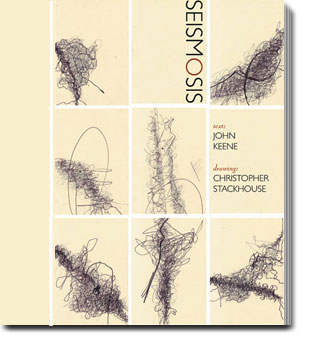
I've never read any of my translations at the university, so this was a first for me, but I'd also never read any non-English texts aloud either, so I chose one poem each from French (Alain Mabanckou's "Séjour Terrestre"), Portuguese (Manuel Bandeira's "Desencanto"), Spanish (Severo Sarduy's final poem from his series, "Cuadros de Franz Kline"), and Italian (Eugenio Montale's motetto "Il fiore che ripeti"), and read both the original and my English translation. It was, to put it simply, really fun. I ended by reading one of my favorite poems from Seismosis, "Color," which with several others was recently translated into French. I didn't want to overdo it, though, so I read only the French translation of "Process," the one-line poem that opens and closes the volume. The English and French ("Processus") rhythms differ, but the words themselves are quite similar. And with that, I helped to bid our wonderful seniors goodbye. Congrats to all of them, and as I said at the reading, it's been a honor to work with and teach them.

∫∫∫

I mentioned before that in the Situation of Writing class we read Jason Epstein's charming, memoiristic survey of his profession, Book Business: Publishing Past, Present and Future (W. W. Norton, 2001), which explores both the transformations in the last half-century of mainstream literary publishing in the US and Epstein's particular role in them.  In "Publishing: The Revolutionary Future," a short piece that appeared in the March 11, 2010, New York Review of Book, Epstein revisits many of the themes in his book. He once again discusses many of the major challenges facing his industry, as well as the current possibilities inherent in the electronic and digital platforms that had only just begun to appear a decade ago. In particular, he touches upon several issues that he didn't explore as much in the earlier work in part because of the state of e-publishing then: the question of social networking sites' role in the creation of new works; the potential proprietary problems with digitization; and the "cloud" approach not only increasingly central to computing but to thinking itself.