Showing posts with label Kamau Brathwaite. Show all posts

Monday, April 23, 2012

Poem: Kamau Brathwaite

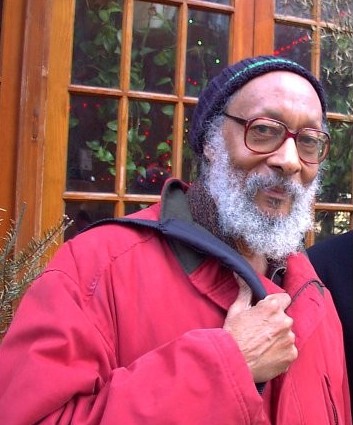
Edward Kamau Brathwaite (from repeatingislands.com)
I was trying to remember if I had featured Kamau Brathwaite (1930-) on J's Theater before, and I was pretty sure I had, but it turns out that while I have mentioned him many times, including in my very first post, the only work of his that I've ever featured is his highly anguished call for help to save CowPastor/Cow Pasture, the large open areas near where he lives in Christ Church, Barbados, that the government and private entities seized control of through which to lay roads. Not to aestheticize the letter, but it bears many of the hallmarks of Brathwaite's poetry, from its orthography to its reconstitution of language itself. As it turns out, poet Tom Raworth set up a site, Save Cowpasture, that's still up, and last fall Brathwaite wrote Raworth to thank him for keeping the site up. He also mentions the TIME OF SALT, and there's a link to +++SaVing CowPastor & the KB Cultural Lynching 2004-2011+ by clicking this link, which is, to put it mildly, an extraordinary document, a setting of the letters, accounts, recountings, the stories, of the fight for CowPastor/CowPasture and Brathwaite's struggles in New York and Barbados.

Extraordinary really only scratches the surface when it comes to Brathwaite. I know. I studied with him, and count the experience among the most fortunate in my life. I'm not just talking about him as a teacher, critic, theorist, historian, or raconteur, nor as the sort of person who, almost out of nowhere, announces that a graduate class should begin preparing to go to a foreign country for a class trip (he did this), or who tells of how he witnessed another famous writer's wife walking through a wall (he did this). I don't want to start delving into mysticism, metaphysics and the supernatural, but let me just say that when you spend some time around someone operating at this level, a true konjur man with a mind like the libraries of Alexandria and an ability to see into the hidden heart of things you tend not to doubt them. He pulled off that trip. That transmural passage as a result didn't seem so inconceivable. There are keys all throughout his work that he operates or accesses many different channels. You really could spend a lifetime teasing some of these keys out, following the threads, raveling and reraveling them again, and if you read him carefully enough he points them out. A sharp graduate student will probably elect to do this at some point down the road.

To put it another way, he is the one of the most important and original living Caribbean poets, one of the major poets writing in English, a signal figure of African Diasporic poetry and poetics, and a living treasure. He has proved this over nearly 40 books of poetry, critical prose, and memoirs, many of these works constituting works of hybrid genre that defy easy categorization. Through this rich body of work, he has developed a language drawn from his native Barbados, the Caribbean and Latin America, his readings, studies and experiences in Britain and the US, strikingly singular and personal, but also transnational and universal. To fully capture this language, informed by the principle, in part of nommo (from the Bantu) and nam, he created typography/textual form, the Sycorax Dub script (I believe that's the name). He has garnered, among his many awards, the Neustadt International Prize for Literature, which used often to be a tip for the Nobel Prize; the Griffin Poetry Prize, one of the highest awards for world poetry, handed out in Canada; and Premio de la Casa de las Américas, awarded by the Cuban government for an exceptional from the Caribbean.  I know him because he has served for two decades as Professor of Comparative Literature at New York University.

This potted intro hardly does him justice, though. There is no substitute for his poetry, which is so verbally and visually powerful it dazzles. The poem below, which I recalled from a journal I had in my office, is a distillation. If you can, read it aloud, and you will feel the bird rising off this screen; it might even guide you to places you had not ever imagined.

BIRD RISING

Until it come to the time for the great bird the Mithurii .
    to begin its ascent
its challenge against the eart . the paradoxical oracle of wind . the
    the wings beating
unchaining. out. boarding as seamen might say . the gret beast
    ruffled & rising
as in all the great legends

and this happening here before me now under me now wonderfully
    surrounding me
the white silver louvered feather shift & chevron stretching out
    across the sunlight
the great terrible beauty & beating we have always heard about
beating beating upward & forward . the planks of its shape
    shivering at first like a ship

like a dhow . then spheering down into smooth as we scool
    up. wards

Now the first hills at the darker mountains of english . the sea
    below all shard
& silver like our shadow . the beacon topaz eyes unblinking even
    through all the shudder
the wings now stretched across all space openly & awesomely . so
    that we are not beating
any. more but ahh sailing something like singing . because at last
    I have been able

to use all the wounds in the language . as long as I lay them out
    softly & carefully
like these unfluttering feathers of song . like the sea below
    turning into a grey ball of wine
without fishes or sperm . like the darkness no longer lingering
    above us
but we moving towards it as part of its fuse & its future . the àxé
    & ayisha of sails

one last time in our ears . the earth gone a long time now from
    green spur arrogance
of john crow mountain. strange
not even the memory of a veiled carefree river in these high
    places . too far up now
for sunsets through all this rain & distance in our eyes. in our
    sleep. in our silence

the metaphor at last afloat almost alight in the darkness
 
Copyright © Edward Kamau Brathwaite, "Bird Rising," in Conjunctions: Bi-Annual Volumes of New Writing, No. 27, The Archipelago: New Writing From and About the Caribbean, Edited by Robert Antoni and Bradford Morrow, pp. 89-90. All rights reserved.

Tuesday, December 21, 2010

Darnton's The Library: 3 Jeremiads + Brathwaite's Elegguas + National Book Foundation's New Reading Prize

Last spring I checked out from the university's library the esteemed Enlightenment historian and (Harvard University) librarian Robert Darnton's The Case for Books: Past, Present, and Future (New York: PublicAffairs, 2009) to gauge his arguments about the present and future state of the world of books and literature for my own edification and to preview it for a class. Darnton, one of the most important figures in his fields, has a gift for subtle argumentation and narration, and I ended up skimming the book, which replicated in longer and more polished form a number of the essays he has been publishing along these same lines in the New York Review of Books, for the last several years. Many concern the role of the computer behemoth Google, and its relationship to the publishing and library worlds, and he has also made a passionate case in the pages of the NYR for a national (which would also be an international) digital library, drawing from the resources of private libraries like the one he heads, public ones like the unmatched Library of Congress, and the trove of 7 million and counting books that Google has already scanned in, with the cooperation of institutions like Harvard and the New York Public Library, but also against the wishes of some publishers and authors, who successfully prosecuted a lawsuit to gain compensation from Google for copyright infringement.

In the current issue of the NYR, in "The Library: Three Jeremiads," Darnton returns to the arguments he has made before, but this time with a trio of "jeremiads," as he calls them, concerning three pressing economic and resource-related issues that American research libraries face which also negatively affect scholarly publishing; universities and college library collections, along with those of public libraries; library patrons, which is to say, readers; and, to a degree not yet fully understood, the humanities, intellectual life, and knowledge production themselves. The first two of Darnton's jeremiad's focus on the exorbitant cost and terms, verging on extortion, of subscriptions to scholarly journals, especially in the sciences, relative to other kinds of texts, which has forced libraries to cut their purchase of scholarly monographs, thus harming libraries' budgets and university presses' bottom lines. Over the longer haul, this economic problem, juxtaposed with constrained university and research library budgets, threatens the sustainability of the academic research enterprise as a whole.  To give a sense of the astronomical prices charged by some publishers, information about which many professors are completely unaware and which have far exceeded the cost of inflation, the chemistry journal Tetrahedron costs $39,082 per year, while The Journal of Comparative Neurology costs $27,465 per year, and both, like many journals from a given publisher, must be purchased in bundles, with high kill fees to end subscriptions for specific journals and so forth. Humanities and social science journals total less per year but are still high and part of this system, with the result that the average cost in 2009 of a US journal title was $2,031 and $4,753 for a non-US title, and that year the journal publishing giant Elsevier made $1.1 billion in profits.  Moreover, there is little transparency in this system, according to Darnton, giving the journal publishers an advantage over libraries, which, for the sake of the scholars they serve, cannot opt out.

Scholars and librarians have attempted to respond, with mixed reuslts.  In the case of the Mellon Foundation-funded Gutenberg-e program, which sought to publish digital monographs of award-winning PhD dissertations in scholarly areas under greatest threat, the potential was great but it did not work out as planned, and the project is now defunct; in the case of digital, open-access scientific journals, there has been some success after scientists at University of California-Berkeley and Stanford circulated a petition in 2001 calling for colleagues to patronize only these journals. The publisher BioMed Central, according to Darnton, has shown since 1999 that this model can work. But the larger question of the effects on libraries and particularly on the humanities and social sciences remains. Darnton had been holding out hope for the Compact for Open-Access Publishing Equity (COPE), founded this year, would lead universities towards the open-access model in terms of publishing, and also subsidize authors who could not get grants or subvention money from their home institutions, with the texts ultimately available in both digital and print form via the Espresso Book Machine, about which I've written on here. But, and this is the core of his third jeremiad, there loometh Google.