Showing posts with label black LGBTQ. Show all posts

Monday, March 21, 2022

Punks is a Lammy & Publishing Triangle Finalist!

Last December when I posted about Punks I noted that the positive response felt almost inconceivable, in no small part because this was a book that I thought might never appear, and whose publishing history was a long and tortured one (until The Song Cave entered the picture). It has, however, continued to garner good reviews, and recently was even nominated for two different awards. 

I learned a week ago that it is a finalist for the Lambda Literary Award for Gay Poetry, and then today, thanks to Reggie H. (thank you!), that it's a finalist for the Publishing Triangle's Thom Gunn Award for Gay Male Poetry. In both instances it is in excellent company (and all of the finalists for the Publishing Triangle Award are Black gay writers), and I extend my congratulations and best wishes to all my fellow finalists and nominees. Whatever happens, do read their books if you can, and urge your local libraries and bookstores to order them if they already have not.


2022 Lammy Award finalists in Gay Poetry:

  • Tenderness by Derrick Austin
  • Punks: New & Selected Poems by John Keene
  • Shoreditch by Miguel Murphy
  • Creep Love by Michael Walsh
  • Besiege Me by Nicholas Wong

2022 Publishing Triangle Thom Gunn Award in Gay Poetry finalists:
  • Shoreditch by Miguel Murphy
  • Punks: New & Selected Poems by John Keene
  • The Monster That I Am: Leontine Price and a Life in Verse by Kevin Simmonds
  • Mutiny by Phillip B. Williams

Saturday, May 19, 2018

Quotes: Dionne Brand

Dionne Brand
(The Canadian Encyclopedia)
"VERSO 5.5

I have plans; I have no plans. They disappear in the Gulf of Mexico like brown pelicans and hermit crabs in an oil spill. Isn't it time we stopped saying spill? That wasn't a spill it was a deluge. It has no mercy, nation. I have no mercy. I'm jaundiced. All the while through the hoots of democracy, I was looking for the women in Tahrir Square, in Yemen, in Tunisia. I am listening. Whatever, the author says. I don't want to hear any more about waiting. In September, and now October, I am unpinned from all allegiances. Of course you're not. But what if I wrote like this? Unpinned."


***


"VERSO 16

On hearing of my left-hand pages, ASJ, a poet, sent me this note from Edmond Jabès:

A book without room for the world would be / no book.
It would lack the most beautiful pages, / those on the left,
in which even the smallest / pebble is reflected.

Then I sent away for Jabès's book, The Book of Questions, and received it from England after some weeks. And there was his handwriting: pour Jane et Sidney Shiff / j'ai été heureux / de connaître / En souvenir et / avec la cordiale pensée / d' E. Jabès. This last note arrived with his cordial thoughts, says the clerk. Yes, so I suppose it is a sign that we continue, says the author."


***

"VERSO 41

Tonight my brain is full of beautiful things collected over three weeks: the ring around Jupiter in the southern hemisphere; three flamingos dancing brine shrimp to the surface; the mirages of harbours only I have seen; the lithium salt desert; the rush for the local train at Ollantaytambo; a frantic scramble for a bundle of goods left behind; the electrochemical sky. The silence was the best thing."

-- Dionne Brand, from The Blue Clerk: Ars Poetica in 59 Versos, Durham: Duke University Press, forthcoming in August 2018.

Tuesday, April 10, 2018

Cecil Taylor (1929-2018)


Another one of the greats, Cecil Taylor, is gone. He passed away on April 5. As longtime J's Theater readers know, I've posted about Taylor many times, including on his 86th birthday, back in 2015; when he appeared on NPR back in 2012 (along with my poem about him and his music, "Dark to Themselves," which appeared in Jazz Poems, edited by Kevin Young); my afternoon in 2007 watching the marvelous documentary Imagine the Sound with Northwestern colleagues Kevin Bell and Ed Roberson; back in 2005, on his 75th birthday; and again in 2005, when I saw him perform live at the Blue Note, in Manhattan ("Apraxia, apraxia, apraxia!"). (I wanted to meet him then but only got a glimpse of him peering out through the crack in his green room door.)

I described how he opened the performance like this (the Keith I mention is Keith Obadike, who was there with his wife and fellow artist Mendi, as were Christopher Stackhouse, his partner Kelly Kivland, and a friend of theirs named Lute):

Taylor, as Reggie H. and others have described, entered dramatically, this time in his striped socks after his bassist and drummer had opened the set as a duo, Balgochian doing some interesting moanful bow-work with the lowest portion and register of his bass strings. Then he extracted a handwritten score/graph/chart, which I assume, in my gross musical ignorance, contained the melodic kernel he was going to develop and improvise off of, as well as some harmonic guides and cues, some text and the gods know what else (scribbles? quotes?), CT proceeded to recite an opening poem that riffed off "Chinampas 1," which I listened to again today. Then he and the trio launched into this long and furious set. Afterwards I told Mendi and Keith that it reminded me of a player piano that had caught the Spirit (and spirits) and was revved up by multiple motors. Keith put it more succinctly: "A player piano speaking tongues." Krall, who appears on CT sessions from around 1996 forward, seemed to flow well with CT, sometimes pacing, other times mirroring, other times chasing CT's polymetric races along the keyboard, but Balgochian sometimes seemed out of sync as if he couldn't catch up or missed some of his cues (sometimes his expression betrayed this) or just wasn't up for it, though he gave it a valiant effort. He did know enough to stop on a dime, like Krall, when CT (maybe giving a visual cue) ended the pieces.


Reading some of the obituaries of Taylor, I appreciated how they captured differing facets of who he was and what he accomplished. He was, as the 2005 performance demonstrated, at his very core a poet--experimental, searching, daring, profound, uncompromising, his medium and grammar extending from words into space, and onto the keyboard, via notes themselves. Sound and time were his true media. Pushing the evolving jazz conventions from the very beginning, Taylor kept developing and trying out new possibilities, individually and with ensembles. A native of Queens, he deftly combined a wide array of influences, drawing from the blues, other African-American, Euro-American and European sources--he studied at the New York College of Music and the New England Conservatory--to an often sublime invention, and though one could draw throughlines from his early career to the works of the last few year, Taylor almost never repeated himself.

Among the musicians Taylor recorded with are innumerable greats: Earl Griffith, Steve Lacy, Buell Neidlinger (who passed earlier this year), Sunny Murray (who passed late last year), John Coltrane, Gil Evans, Jimmy Lyons, Andrew Cyrille, Mary Lou Williams (!), Max Roach, Dewey Redman, Elvin Jones, and Peter Brötzmann. He also performed with dancers, including Min Tanaka and Mikhail Baryshnikov. Taylor's detractors, including Miles Davis (another great innovator) and Branford Marsalis, were legion, but so were his admirers, including former President Jimmy Carter, who invited him to perform at the White House. (Just imagine the current resident even vaguely considering such a thing.) One of my favorite albums of his is Great Paris Concert of 1966, which includes the masterpieces "Student Studies (Part 1)," "Student Studies (Part 2)," and "Niggle Feuigle." I also love his late-career trio recording with Dewey Redman and Elvin Jones, Momentum Space, particularly the songs "Is," "It," and "Spooning." One commemoration I especially appreciated was Jason Moran's discussion of Taylor's artistry, and how it took him years to grasp what Taylor was up to.

Cecil Taylor was outed by the critic Stanley Crouch, and became one of the most high-profile gay figures in jazz, though he sidestepped that term while remaining unapologetically himself. His oeuvre, I would argue, queered jazz as we know it, and its influence continues to ripple out in instrumentalists who may or may not appear to have any direct ties to him. Taylor's relationship to his blackness was solid and complex, and was a topic about which he could be combative, as when, back in 1964 while participating in a "Jazz Weekend" at Bennington College, he defined  what jazz was and could be, avowing its roots in African-American life, culture and experience, to the displeasure of some on a panel discussion and in the crowd. In 2013, he received the prestigious Kyoto Prize; the Inamori Foundation, the award's grantor, praised his life's work, though "free jazz" only scratches the surface:
One of the most original pianists in the history of free jazz, Mr. Cecil Taylor has developed his innovative improvisation departing from conventional idioms through distinctive musical constructions and percussive renditions, thereby opening new possibilities in jazz. His unsurpassed virtuosity and strong will inject an intense, vital force into his music, which has exerted a profound influence on a broad range of musical genres.
A contractor he had befriended stole nearly the entire amount, before being caught, tried and convicted.

A few videos about Taylor, including one of my favorites, "Les grandes répétitions":

"Les grandes répétitions"

A fragment from Ron Mann's Imagine the Sound

Interview, from the Snapshots Foundation (full interviews here)

Cecil Taylor performing at Ornette Coleman's memorial, in 2015

Dark to Themselves

As I concluded in my poem tribute, "Their ears are still learning." 

Monday, June 20, 2016

Quote: Michelle Cliff + RIP


-- Copyright © Michelle Cliff, from "If I Could Write This in Fire I Would Write This in Fire," from Homegirls: A Black Feminist Anthology, edited by Barbara Smith, New Brunswick: Rutgers University Press, 1983. All rights reserved.

(In memoriam to Michelle Cliff, who passed away on June 12, 2016. Born on November 2, 1946, in Kingston, Jamaica Cliff would go on to a long and important career as one of the major queer Jamaican-American and Caribbean-American novelists, short story writers, and essayists of her generation.
Michelle Cliff (1946-2016
Cliff's articulations of feminist and queer intersectionalities in relation to history and society played important roles in the development of Black Diasporic feminist thought and writing, and her ongoing experimental approach to her fiction, like her political engagement and ethical example offered models for all who have followed her. Her partner, the great poet Adrienne Rich, predeceased her in 2012.

Among my favorite of her works of fiction are her first book, Abeng, published in 1985 and which I first came across when I was in college--though not in a college class, but on a bookstore shelf--and the very playful and inventive The Store of a Million Items, from 1998. Her last book, the novel Into the Interior, appeared in 2010.)

Friday, June 17, 2016

Mourning the Orlando Massacre Victims

Several days have passed and I find myself still heartbroken, reeling really, in the wake of the horrific mass murder this past Sunday, June 12, at the Pulse Nightclub in Orlando, Florida. Not long after 2 AM EST, gunman Omar Seddique Mateen slaughtered 49 people, and wounded 53, on the club's Latin Night, before police finally killed him several hours later. Nearly 90% of those slain were Latino, with the rest being Black American or both, and nearly 50 percent had familial links to Puerto Rico. The youngest victim was 18, and the oldest was 50. One of the murdered, 49-year-old Brooklyn native Brenda Marquez McCool, is said to have shielded her son from death by urging her son to flee rather than come back to get her, and thus also be killed in cold blood. (I should note that I cannot type this sentence, let alone think about or read it, without tearing up.) The Pulse Nightclub shooting was one of the deadliest mass shootings in the US since the 19th century Civil War and massacres of Native peoples, and the early 20th century anti-black riots.

Here, courtesy of the Orlando Sentinel, is the full list of the murder victims, with brief stories about their lives. Every single one is poignant and worth reading. Please let's not ever forget them. If you are interested in helping out the families of the deceased and wounded, you can do so here.


Out for a night of fun and joy, in a space they thought was safe--multiply so, in that they could be themselves as Latinx and Black queer people where their sexual orientations, gender identities, and intersectional presentations of self would be affirmed; where they could be themselves as working-class queer people in a society and larger culture that regularly demeans, marginalizes and dehumanizes them; and where they could be themselves in a space where their race and ethnicity would not subject them to the erasures of the mainstream white LGBTIQ community--the 300+ people at Pulse instead found themselves in a killing field. How many of us brown and black queer people have been in these very spaces, carefree, shedding the burdens of the day, of everything, for music, dancing, companionship, laughter, the possibilities and enjoyment of friendship and love?

Instead, by early Monday morning, the news was of so many lives cut down, so many at the beginning of adulthood and in their prime, once again by homophobia, and common to so many instances of recent mass murder in the US, gun violence.

There currently are conflicting reports about the terrorist Omar Mateen's background and actions on the night of the massacre, but what is clear is that he is a native of New York City, and moved to Florida as a child. His parents are immigrants from Afghanistan, and the day after the murder, Mateen's father claimed that his son's response to witnessing two men kissing publicly might have been a factor in his decision to launch his rampage. Mateen was twice married, and has one child; his first wife, who now lives in Colorado, alleges that he beat her and was often angry, and that she had to be rescued from him by her parents. The FBI twice investigated Mateen, but supposedly dropped its investigation for lack of evidence. Despite this background he was still able to buy semi-automtic weaponry and deadly ammunition with relative ease. His second wife appears to have known about Mateen's plans, and allegedly even cased the bar with him and tried to dissuade him, though whether this is true has yet to be established. Whether she will be charged an accessory and conspirator is unknown. During a lull in the rampage, Mateen is alleged to have pledged allegiance to ISIS, and reports suggest that he had previously avowed support for the Taliban and Hezbollah.

Within a day of the massacre, witnesses came forward to say that Omar Mateen had frequented the bar and had repeatedly gotten so drunk he had to be carried out. A former classmate at the police academy told a reporter that Mateen had asked him out, and because the classmate was closeted he did not accept Mateen's overtures. Alongside this, there have been accounts that Mateen cruised people on gay male dating and sex apps, like Jack'd, and his first wife's Brazilian fiancé told a Brazilian news program that she told him Mateen was gay and that his father had called him an anti-gay slur. At least one account I've read, however, states that the FBI quashed all of these facts, but I find it hard to believe that so many people could have misidentified the wrong person. Whatever the case, and no matter to which religious or political group Mateen had affiliated himself, homophobia, cis-heterosexism, and a toxic form of macho masculinity, coupled with easy access to guns, appear to have fueled this terrible tragedy.

Once upon a time I would have said that a horrific event of this kind would occasion real change in our politics, towards a saner approach to the proliferation of guns, to hysteria about Muslims and immigrants, towards a shift against racism and homophobia. As we have seen time and again, however, over the last decade and a half, the opposite seems to be the result. Both parties appear to be in the thrall of the National Rifle Association. The GOP, which controls Congress, and its tribune, presidential candidate Donald Trump, are using Daesh and Islamophobia to gain votes and stir up fear. And although we have experience a sea change since the end of the 20th century on LGBTIQ rights, and have an African American president, we are neither post-racial nor post-gay, with racism, homophobia and misogyny still serving as potent toxins in the US body politic.

Where do we go from here? How do we heal? One step must be to be remember the names of those who were murdered in Orlando, to read up on their lives, and to vow to transform this society for the better, with one step being to vote, and urge others to, in November.

***

A few years ago, I wrote a series of poems recalling various gay/LGBTIQ bars in Boston. Here's one of them I've never published, but am doing so here, in tribute to the victims in Orlando.

NAPOLEON CLUB

Navy sky, white moon, red brick,
door and bell:  discretion was the precondition
for elegance.  Inside, gray hair peers

from every other head and open-collared chest.
There’s currency here in being the youngest.
I pass my dollars across the bar—no beer

for me though it’s butcher. A gin-and-tonic.
I sip and see how far my smile and wit and calves
sculpted in high school sprints can get me.

Nearby, men hover around a sleek black
grand piano, singing "My Funny Valentine"
in unison because it’s February, "Somewhere

Over the Rainbow" because it’s Judy.
On the dance floor beats tap gently
between the spinning bodies.  I ignore

the first two guys who ignore me, approach
a third brother, debonaire in his military-cut suit
and patent leather loafers, stout as a general,

ageless as a vampire.  To Duran Duran,
Gloria Gaynor we twirl out a sweat, mouthing
the lyrics to songs we recall without effort

into each other’s grins, glide closer, kiss,
return to bopping.  We agree that rhythm’s
a bridge to the soul and we'll cross it, grab

our overcoats, trot out into the Boston dark, fingers
popping to steps as hot as the groove in our hips, melting
night snow on the tips of our tongues: "Ain't no stopping us…."

Copyright © John Keene, 2000, 2016.

Friday, October 16, 2015

Fire & Ink IV: Witness

Over the span of four days a week ago Detroit hosted Fire & Ink IV: Witness, the fourth national gathering of black GLBT (LGBTIQA+) writers and activists. The inaugural Fire & Ink took place in 2002, and this year's conference, which focused on the theme of "witnessing," embodied Fire & Ink's vision of serving as an "influential supporter and advocate for GLBT writers of African descent," and its mission of sponsoring regular forums focused on black GLBT writing; advocating for black GLBT works to be included in libraries, academic curricula and bookstores; and organizing workshops that nurture GLBT writers of African descent and foster our writing. I have not verified the attendance figures with the conference's organizers, Lisa C. Moore (President); Steven G. Fullwood (Vice President); Reggie Harris; Anthony R. G. Hardaway; Shawn(ta) Smith-Cruz; and Steven J. "Lula-Bell" Fields, about many people attended, but many of the workshops, performances and screenings were packed, and I know that writers came to the Motor City from all corners of the US as well as from across the globe.
The view from my hotel window
This was my second time participating in Fire & Ink. The first one occurred in Chicago just before I arrived to teach at Northwestern, and I did not know about the second one, so it was not until the 2009 event in Austin, Texas that I had an opportunity to attend. That gathering, like this one, left me feeling incredibly invigorated about the future of black LGBTIQA writing, while also providing an opportunity to catch up with writers and artists I had not seen in a long time, and to meet and experience the work of new ones. As with the Detroit gathering, I wished after Austin that it were possible to have Fire & Ink occur annually or biennially, as the mission statement posits as a goal, but the realities of organizing and fundraising, particularly for an organization without limitless resources, and that strives to provide scholarships and support for its attendees, mean that the conferences occur when they can. I am grateful that I have been able to attend at least two of them.
Jack Waters, Skyping in for the Q&A
after the Jason and Shirley screening
The conference's lineup of workshops and panels began Thursday evening and concluded on Sunday. I unfortunately had to miss the final day because of Monday teaching responsibilities, but to the extent that I could, I tried to sample a little of everything. Among the highlights for me were Reggie Harris's Thursday afternoon workshop on "The Black Body," which included an array of useful exercises that not only disarmed and united everyone in the room, but also sparked candid conversations. Reggie interspersed his thoughts and questions with readings of poetry and prose that felt perfectly appropriate for the topic. Another highlight were the screenings that Ernest Hardy and Tisa Bryant hosted.
An edible handout from Samiya
Bashir's M A P S performance
I caught several screenings, including Stephen Winter's new film, Jason and Shirley (2015), starring Jack Waters and Sarah Schulman, and playing until October 27 at MoMA. I originally thought Winter had remade in fictional form Shirley Clarke's disturbing original 1967 documentary, Portrait of Jason, starring the eponymous Jason Holliday, but Winter instead tried to imagine what Clarke had not depicted, including her own selfish manipulation of her star, as well as Jason's torment and wily resistance, and Clarke's lover Carl Lee's emotionally brutal intervention. The film, despite its brevity, was wrenching, with a strong performance by Schulman and an unforgettable one by Jack Waters, who spoke briefly about the film and took questions via Skype after the screening. (I will try to post a fuller review if I can find a free moment.) Robert Phillipson's short documentary Tain't Nobody's Bizness: Queer Blues Divas of the 1920s, narrated by Jewelle Gomez, was also a gem I am glad I did not miss. Despite my belief that I had a fairly extensive knowledge of the subject, I learned quite a bit from Phillipson's documentary, as my in-the-dark note-taking will attest. I left wanting to know more particularly about Gladys Bentley, a heroine (as were the film's other figures) if there ever were one.
Samiya in peformance, stage right
Another film that Ernest and Tisa screened, Arthur Jafa's Dreams Are Colder than Death (2014), was a particular treat since it was not clear whether Jafa would agree to release the film, as earlier versions had been leaked and were circulating. Ernest and Tisa made sure that this color-corrected version was secure, and it was a visual and sonic feast. Jafa's aim, as I understand it, was to explore the current post-utopian moment created by the fading ideals of Rev. Dr. Martin Luther King, Jr.'s famous March on Washington "I Have a Dream" speech through arresting imagery, a futuristic soundtrack, and the voices of leading scholars and artists, and veteran black activists, including Fred Moten, Saidiya Hartman, Kathleen Cleaver, Arthur Fielder, Charles Burnett, Wangechi Mutu, and others. Jafa's, Hans Charles and Malik Hassan Sayeed's cinematography and Melvin Gibbs' score were enthralling, but I did not find the collage of voices, brilliant as they were, especially illuminating or fresh, and the near absence of prominent out LGBTIQA heads was glaring, as was the heteronormative presentation of sex work as a proxy for black sexual liberation. Perhaps I misread or misunderstood the role of the nude female strippers in the film, but this felt a bit retrograde especially in light of the complexities of black sexualities going back several hundreds years, let alone today. I was glad to have had the opportunity to see Jafa's film, and I hope someone takes up the thread but flips the script a bit more.
Jewelle Gomez, talking about
the documentary Tain't Nobody's
Bizness
Topping off Friday's events, I went to see Samiya Bashir perform M A P S: a cartography in progress, a section of a larger piece based on the great Somali writer Nuruddin Farah's highly regarded novel Maps, but refracted through Samiya's imaginative lens to become, as she describes it, "a poetry of emergence" that "resists a resolution" of the novel's child protagonist's key question about desire, in the process charting a trajectory that crisscrossed themes of family, sexuality and diaspora. On Saturday afternoon I split my time between two different panels, one of which was titled "Multiplying Personalities: The Writer Witnessing Self and the Many Characters We Create," comprising G. Winston James, Ana-Maurine Lara, Charles Rice-Gonzalez, and Marvin K. White, which was also a very diasporic panel. All four speakers, with Glen moderating, offered compelling commentary about their own work and processes, and satisfactory replies to the audience's queries. The second panel I popped into was "Dig: Queer Archaeologies," at which Jonathan Bailey, Alexis Pauline Gumbs, Lisa C. Moore, Zaneli Muholi, and Julia Roxanne Wallace each spoke persuasively about the richness of the black queer archive(s).

Reggie Harris, leading his workshop
on "The Black Body"
My notebook nearly bursting with jottings, I head to main event, which was the keynote lecture by acclaimed writer Randall Kenan. The recipient of numerous awards; a professor of English at the University of North Carolina; and author of the novel A Visitation of Spirits; the story collection Let the Dead Bury Their Dead; and two works of nonfiction, Walking on Water: Black American Lives at the Turn of the Twenty-First Century and The Fire This Time, Randall delivered a powerful, sometimes circuitous and in the end quite effective speech on the theme of witnessing, beginning by recourse to a critique of Roland Emmerich's financial and aesthetic debacle of a film about the 1969 Stonewall Uprising. What he stressed was something that was threaded throughout the conference's very reason for existence, which is to say, the importance of the work that everyone in the audience was undertaking in terms of bearing witness to our present and past, as well as imagining a viable future for black LGBTIQA people to come. An apt counterpoint came later that evening when Jewelle Gomez's Waiting for Giovanni, a two-act dream play that imagined a split second--yes!--in the mind of the great James Baldwin as he contemplated the publication of his landmark second novel amid the socially and politically fraught landscape, particularly after the murder of Emmett Till and in the course of the surging US Civil Rights movement. It bore witness in some of the very ways that Randall spoke about.

Reggie introducing Randall Kenan
I was not just a spectator, however. At the Austin event I gave a presentation on translating black LGBTIQA authors, and I reprised that this year through a workshop under the new title "Translating Black LGBTQ Writing: Expanding the Global Conversation," since the need for learning about and connecting with black people across the globe has grown even more important in light of the Black Lives Matter movement and in the wake of the challenges we face all over the globe, particularly in the Americas, Europe, and the Middle East. This time I had a few more facts about the paucity of translation in the US in general, and particularly of black and LGBTIQA authors of African descent to share. It also felt different to speak of translation as a practice having published a book in this area, and I hope by the next Fire & Ink, if I am around and able to attend it, to have more, including a book by a non-Anglophone LGBTIQA author to share with attendees. The conversation with the audience went very well, and I was able to meet a longtime hero as well as younger translators who were very interested in taking up this work.
Randall Kenan, delivering the keynote
A week or two before arriving in Detroit, several writers realized there would a critical mass of people working in innovative forms at the event, so Tisa and Samiya organized a panel for Saturday morning that also included Duriel Harris, Alexis DeVeaux, Rosamond S. King, and me. We each chose different ways to introduce ourselves (I perhaps ill advisedly read the very beginning of my short story "Blues," which only gives a glimpse of what is to come, rather than the ending, before speaking about how I viewed this and my other work, so I am not sure that I made the best case for what my work in Counternarratives or elsewhere sought to do), before a passionate and often illuminating series of presentations and discussions ensued. I believe the entire panel presentation was recorded and will become a podcast at the Los Angeles Review of Books' website, so that when that is available, I'll post a link on this blog if I can remember to do so.
Ernest Hardy, Duriel Harris,
and Tisa Bryant
Two final things were touches you probably would not find--or that I would not--at other conferences. These included an altar room the organizers established to honor both deceased predecessors as well as living figures who could not be present. Many were the faces and tongues that had blazed the path that made Fire & Ink possible, and which now filled that room. Another wonderful touch was the literary stretches, held from 7-8 am, that Rev. Marvin K. White led. I was never out of my room in time to bend myself into blissful pretzels that early, but I heard they were very enjoyable. As for the hotel, the Crowne Plaza Hotel Downtown, which sat right across the street from the Cobo Center, where the conference took place, I can't rave or rage about it. The view from my room was as picturesque as one could ever imagine in Detroit, but the room itself I found it passable. One day a too-early visit from the cleaning staff person, which I declined, led to my room being left untouched for a day. OK, I can deal with that. I extremely fortunate had no encounters with the bedbugs that at least two guests reported, or the roaches that others have cited online. Thank the gods and ancestors for small favors, and thank Fire & Ink's organizers and all its attendees for an amazing conference!

Fire & Ink President Lisa C. Moore
The group portrait
Rickey Laurentiis
The cast from the staged reading
of Gomez's staged reading

Monday, March 31, 2014

Split This Rock Poetry Festival in DC

L-r: Reggie Harris, me, Kevin Simmonds, Tisa Bryant
Two years ago I attended my first Split This Rock Poetry Festival, the biennial Washington, DC-based gathering that brings together socially engaged poetries and poets, and had such a great experience that I vowed I would be back in two years. Although poets who teach in academe are integral to Split This Rock's lineup, one of the most refreshing aspects of the festival is its separateness from any academic institution, college, university or otherwise, and the aesthetic range of poetries, from experimental to spoken word. This year, panels and readings were held at a range of not-for-profit and historical sites, including The Human Rights Campaign's offices (where we read), The Charles Sumner School, the Wilderness Society, and the Institute for Policy Studies, as well as the Beacon Hotel, which was a conference sponsor.

The poets who participate work not only in classrooms at all levels, but in prisons, running nonprofits, as booksellers and waiters, as poker pros, you name it. The aim is not the usual official verse culture game of trying to impress the high priests and priestesses of the AWP (Associated Writing Programs) and the MLA (Modern Language Association), but rather, as Split This Rock's tag points out, to call "poets to a greater role in public life and [foster] a national network of socially engaged poets." As William Carlos Williams, a socially committed poet among his Modernist peers, wrote in his great, late long poem "Asphodel, That Greeny Flower," and as we could say of so many aspects of our society and globe, "men die miserably every day / for lack / of what is found there [in poetry]."

This year, I returned as part of a quartet reading poetry by and in tribute to some of the major Black LGBTQ writers from the Harlem Renaissance through the 1990s. Our group, under the rubric of Gathering Forces, performed singly, in pairs, and in ensemble fashion, the works of a number of major Black LGBTQ writers. Our list was not comprehensive, and in some cases, we included poets who might raise (critical and cultural) eyebrows, like Ai, who was not publicly out in her lifetime (though she was outed shortly after her death by Gay and Lesbian Review Online), and Robert Hayden, who is still not usually thought of as a queer poet. Moreover, in retrospect, I think several of us thought about how might have exchanged some of our choices so that we could have included more poets from the past, like Countee Cullen, or other kinds of texts, like excerpts of letters, manifestos, and the like. Nevertheless, despite no opportunity for extended rehearsal, we met up on Friday morning (March 28) in DC, did a very run-through of portions of each poem, and when the crowd arrived--and we had a very good turnout despite so many other compelling concurrent sessions--we did the ancestors proud.

Our lineup went as follows:

Lorraine Hansberry, from her annual lists of "Likes and Dislikes"
Pat Parker, "My Lover Is a Woman" (Tisa)
Langston Hughes, "I loved my friend" (Kevin, beautifully sung)
Angelina Weld Grimké, "Grass Fingers, " (Reggie)
Roy Gonsalves, "X" (John)
David Alan Frechette, "Non, Je Ne Regrette Rien" (John)
Essex Hemphill, "The Brass Rail" (Reggie and I)
Pat Parker, "My Brother" (Tisa)
Reginald Shepherd, "God With Us" (Reggie)
Melvin Dixon, "Hungry Travel" (Kevin)
Marlon Riggs, "Tongues Untied" (John)
Ai, "Ice" (Tisa)
June Jordan, "Kissing God Goodbye" (all of us)
Claude McKay, "Jasmine" (Reggie)
Claude McKay, "Commemoration" (John)
Ai, "Why I Can't Leave You" (Tisa)
Stephen Jonas, "IV" (Reggie)
Audre Lorde, "Pirouette" (John)
Stephen Jonas, "What You Can See" (Reggie)
Audre Lorde, "Power" (Kevin)
Ai, "Salome" (Tisa)
Robert Hayden, "The Tattooed Man" (Reggie)
Richard-Bruce Nugent, excerpt from "Smoke, Lilies and Jade" (John)

I only had a day to spend at Split This Rock, so I tried to catch some of the other panels. One I attended was "Women and War/Women and Peace II," featuring poets Samiya Bashir, Lisa Suhair Majaj, Melanie Graham, Robin Coste Lewis, and Kim Jensen. Unfortunately Robin could not attend, and the panel moderator, whose intentions appeared great, did not seem to know how to frame the conversation, at one point having us all respond to an exercise she used in her class (in which we were to write down our greatest fear on a piece of paper, ball it up, and throw it across the room at someone (!) and keep doing so until we had dispersed our own; the one I received was "I fear white women will co-opt my voice," and while I didn't discuss this fear, Jennifer Karmin, who is white and who was sitting beside me, did do so). At another point, she cited her recent dissertation, quoting Theodor Adorno and Herbert Marcuse (I added my thoughts to this discussion point), but the poets' presentations of their own work focused the panel back onto the topic at hand.

I slipped out partway through to catch a little bit of the panel dedicated to the legendary Black Rooster Collective, which was entitled "The Black Rooster Collective: 'You' Street Poets of Witness." Although only four of the poets affiliated with this collective were present, each of them, Joel Dias-Porter, Brandon D. Johnson, Gary Copeland Lilley, and Ernesto Mercer, read poems and recounted enough history to give a rich overview of who they were when they began, and how they continue, despite having moved to various parts of the US (New Jersey, Virginia, etc.), to remain in contact and aesthetic and political conversation. I should note that several of them (Joel, Brandon, and Ernesto, as well as Toni Asante Lightfoot, who was not present) were among the most talented and dynamic poets I encountered during my first few years at Cave Canem, and their dialogue reminded me that poetry has lived and continues to live, and thrive, far beyond university walls or powerful academic critics' perspectives and dicta. Two years from now, I hope to attend the next Split This Rock Poetry Festival, and urge others to consider attending too.

At the "Women and War/
Women and Peace II" panel,
Lisa Suhair Majaj (at left, in green),
Samiya Bashir (at center in purple)

The Black Rooster Collective panel,
(l-r) Brandon Lewis, Ernesto Mercer, Joel
Dias-Porter, and Gary Copeland Lilley


Sunday, April 14, 2013

In the Life @ Whitney Museum Today!

For any and all in and around New York, a wonderful event will take place this afternoon! Please come if you can.

BLUES FOR SMOKE PERFORMANCE SERIES  

GREGG BORDOWITZ: “IN THE LIFE”

A READING OF WORKS BY GAY BLACK MEN FROM THE 1980S AND ’90S

SUNDAY, APRIL 14, 2013  2 PM   

FILM AND VIDEO GALLERY

For “in the life,”* artist and writer Gregg Bordowitz will host readings from the literary work of gay, male, African American poets and writers, who chronicled sexuality, illness, and death during the height of theAIDS crisis in the 1980s and ’90s. Many of the writers are now dead, and their works have been collected in anthologies, such as In The Life, edited by Joseph Beam, and Brother to Brother, edited by Essex Hemphill. Bordowitz will be joined by a diverse group of readers including Ari Banias, John Keene, Rickey Laurentiis, Glenn Ligon, Eileen Myles, Other Countries, Robert Reid-Pharr, and Pamela Sneed to pay tribute to artists such as Donald Woods, Essex Hemphill, Marlon Riggs and many more.

*In the Life: A Black Gay Anthology was a groundbreaking collection of writing edited by Joseph Beam and published in 1986.

Free with Museum admission; no special tickets or reservations are required. Members enjoy complimentary and express entry to the Museum.


Sunday, January 13, 2013

"The Black Female Body in Art" Panel at the Brooklyn Museum

"How has the black female body been idealized and misread in visual culture?" And: "How might these tendencies affect black women today?"

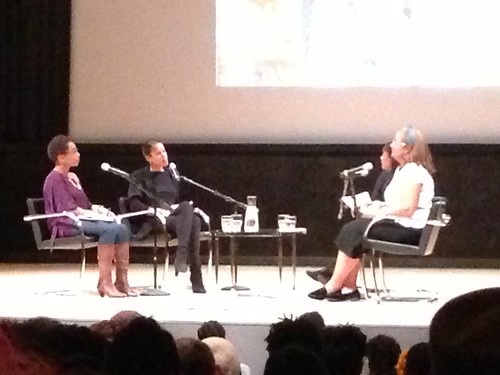
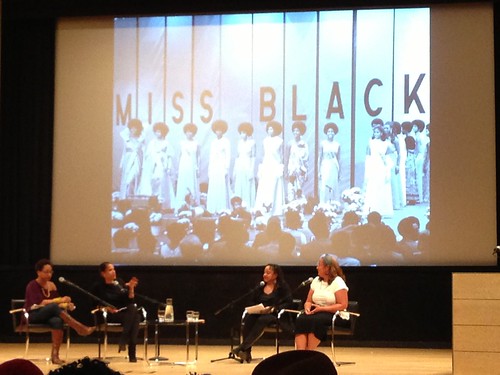
Tisa Bryant, Isolde Brielmaier, Deborah Willis, and Carla Williams
Tisa Bryant, Isolde Brielmeier, Deborah Willis, Carla Williams
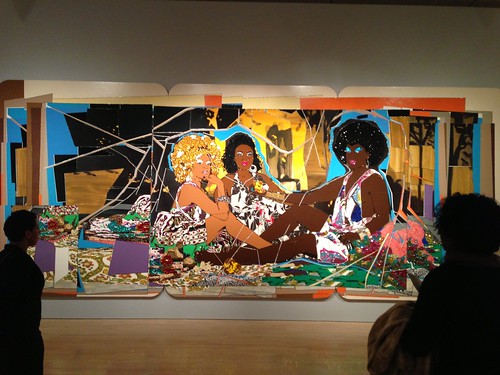
These were just two of the many provocative questions posed yesterday at a Brooklyn Museum of Art panel discussion entitled "The Black Female Body in Art," which took place in conjunction with the museum's superb current exhibit, Mickalene Thomas: Origin of the Universe. The exhibit, featuring a range of Thomas's (1971-) current work, includes a mural, large scale paintings, smaller mixed-media works, photographs, a room-sized multi-part installation, and a video, and is located in the Morris A. and Meyer Schapiro Wing, on the museum's 4th floor. It runs through January 20, 2012. The panel comprised four distinguished participants, each of whom brought distinctive perspectives to their viewings of and discussions on Thomas's work, and on the broader topic: visual artist, photographer, curator, historian, and NYU professor Deborah Willis; Isolde Brielmaier, Chief Curator at Savannah College of Art and Design (SCAD) and Visiting Assistant Professor of Art at Vassar; Carla Williams, coauthor of The Black Female Body: A Photographic History; and my very good friend, writer, art and cultural critic and CalArts professor Tisa Bryant.

The conversation, which ran for about 2 hours, somewhat skirted the very open-ended questions I noted above, yet did provide insightful context for and readings of Mickalene Thomas's show, and of topics and themes related to and deriving out of it. One of the issues the panel spoke about involved Thomas's revisioning and reappropriation of imagery from the European art historical tradition. The very title of her show, "The Origin of the Universe," derives from Gustave Courbet's controversial 1866 painting of a nude, head-and-limb-obscured white woman's genitalia, "L'origine du monde," though as Tisa and other panelists queried, what happens when the artwork and the gaze implicit in it is a woman's, a lesbian's, a black woman's, a black lesbian's (and Thomas is a black lesbian) how does that resituate the image, as well as its relation to Courbet's image? (No one noted that Courbet was a committed ideological and political leader of the French avant-garde, and how that underpinned the vision, gaze and gestures implicit in his work, including this one.) Moreover, Tisa pointed out the metonymic resonances in Thomas work, among them black physicality, sensuality, reproductive agency and power, and an invocation of Lucy/Dinknesh, the first human mother/female ancestor. (Other figures Thomas riffs on, directly in terms of images and styles, include Edouard Manet, Pablo Picasso, and David Hockney, though I also saw a bit of Richard Diebenkorn, the Cubists, and Romare Bearden in her collagistic compositions.)

"Déjeuner sur l'herbe" @ Mickalene Thomas show, Brooklyn Museum
Mickalene Thomas's "“Le Dejeuner sur l’herbe: Les Trois Femmes Noires, Fractured” (2011),
a direct riff on Edouard Manet's "Le Dejeuner sur l'herbe"
Some other topics I'm still thinking about include Carla Williams's point about the specifics of Thomas's technique and images, and how, despite the artist's direct engagement with the Euro-American (male) artistic past, one could come to and connect with them without "the history of [Euro-American] art," in part because of their rich, bedazzled surfaces, their inviting and provocative imagery, and the personal histories a viewer, especially a black female viewer, might bring. (I thought as well of Kehinde Wiley, Thomas's contemporary, and his use and appropriation of Renaissance iconography, as well as of predecessors like Robert Colescott and Bob Thompson, just to name a few.) For Tisa, the "bling" of the rhinestones--one of the most arresting aspects of Thomas's work, from a distance and up close--brought to mind associations such as the celestial, cosmology, stars and the star system (of mass culture, the art world, etc.), high and low culture, the earthly and the heavenly. "What shines?" she asked aloud, much as the paintings ask us as we look at them. Mouths, eyes and eyelids, sometimes jewelry, areola, fleshly contours, pubic hair and genitalia: what happens when Thomas focuses our gaze on these aspects of her paintings? Where is the feminine, the queer gaze, and how is she activating it? (My question.)

The topic of black woman's gazes, and black women looking at, seeing, and painting/creating artwork about and for each other, arose several times, including when Deborah Willis asked Tisa specifically about the "diaristic" aspect of the work. Isolde Brielmeier had just noted the "multiple directionality of the gaze," echoing Thomas's own comments, the many "points of entry," the queerness of looking. For Tisa, in the installations was where "subjectivity was most palpable." Carla Williams added that Thomas was one of only a few very well-known and high profile contemporary out black queer female artists, which made even more significant the ways in which she was changing "iconography." I thought about this and about what it means for a black queer woman, especially in an art world that continues to be dominated by white male artists, and which primarily has elevated black male (straight and queer) artists while overlooking many black women, to portray one's mother, one's female friends, one's female lovers, as subjects and objects of love, desire, fantasy, beauty--and manage to shift viewer's expectations, while also not losing your own focus.  This issue of looking led Tisa to note the presence of mirrors in Thomas's work--calling to mind Oshun, among others--and the concept of women, regular women, as sources of inspiration, as "muses," to use Willis term and an idea long known to male artists. As Tisa asked, "Who do we look at?" In Thomas's work, "reverb(erations)"--reappropriations, repurposings, revisionings--she answered, are taking place.

The panel @ Mickalene Thomas show, Brooklyn Museum
The panelists before one of the many evocative images
that accompanied their conversation

Saturday, July 07, 2012

George Dureau @ Higher Pictures + Rotimi Fani-Kayode @ The Walther Collection

Laurence, George Dureau exhibit, NYC
Laurence Patterson, 1970s (© George Dureau, Higher Pictures)

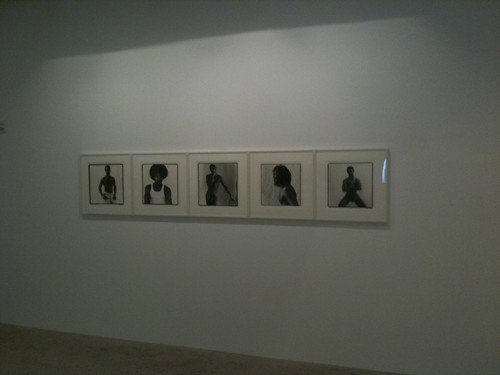
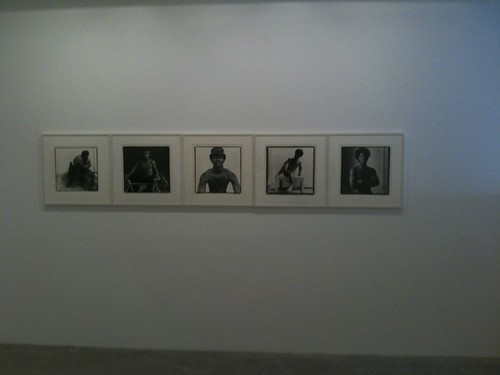
By splendid coincidence, two exhibits, both quite small but nevertheless impressive, of queer photography from the heyday era of the late 1970s through the mid-1980s are still up in New York City, so yesterday, despite the heat, which turns Manhattan sidewalks into griddles and the subway stations into kilns, I ventured out and over (or under) to catch both.

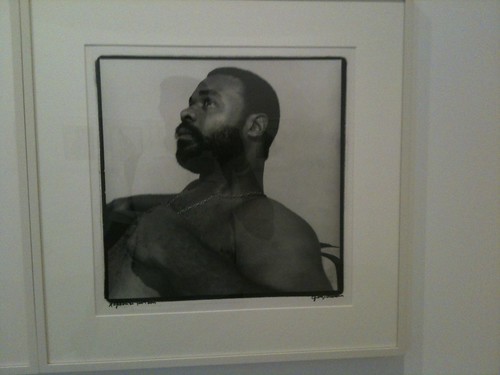
The first was a tiny exihibit at Higher Pictures gallery, on the Upper East Side, entitled George Dureau Black 1973-1986, totaling only 15 pictures total by the New Orleans-based photographer (1930-), who has been taking photographs for over 50 years, and snapped these as studies for his paintings. All of these were black and white prints from 1973 through 1986, and to my astonishment, it turned out that this is Dureau's first solo exhibit in New York. I'd first seen Dureau's work in book form when I was in my early 20s and working at the old Glad Day Bookshop in Boston, and flipped through it often enough; in that volume, which included many of the images in the show, Dureau creates portraits, suffused with homoeroticism, of young working-class and poor men, some of them with physical challenges.

The portraits bear strong similarities of focus and style with those of Robert Mapplethorpe, but it was Dureau who influenced the younger photographer, who went to New Orleans in the early 1970s to meet and study the senior artist's work, evening restaging them in some cases. Unlike Mapplethorpe's work, Dureau's portraits manage to portray without objectification, possessing a simplicity of composition and manipulation of light and shadow without being simplistic, a casualness of depiction that never feels like happenstance, and an eroticism, even with the nudes, that leaves a great deal to the viewer's imagination. Far more so than Mapplethorpe's work, the subjects of the portraits seem to retain their subjectivity, their individuality, the richness of lives only captured for an instant by the photographer in his studio or on the street. In the gallery's news release, the literary scholar Claude J. Summers describes the difference between the two as "foremost a matter of empathy."

Though we cannot see the milieus from which these men emerge, we can imagine and glimpse them in a way that is not always possible with Mapplethorpe's images. Nevertheless, though Dureau's have documentary power, they represent their subjects as more than indices of a particular time and place; they come alive, as works of art, burning through the moment of their original creation to touch the viewer today. But I don't want to belabor the contrasts; Dureau's pictures speak for themselves. If I have any complain I only wish there were many more on display. Several things I found myself wondering, as I always do when I see such work, is who these men are, what their lives were like, whether they're still around to answer these questions.  Dureau's rich images keep me wondering, and thinking.

The exhibit closes on July 13, 2012.

George Dureau photos, NYC

George Dureau photos, NYC
Alphonse Dotson, 1977 (© George Dureau, Higher Pictures)
George Dureau photos, NYC

George Dureau photos, NYC

***

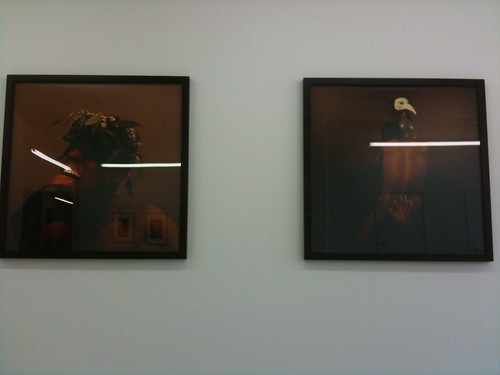
I took the 6 downtown to Union Square and switched over the L to get to Chelsea, where The Walther Collection is featuring the first solo New York show (no less astonishing), Rotimi Fani-Kayode: Nothing to Lose, of the late Nigerian-British photographer (1955-1989) whose work represents some of the most evocative visual cultural production from period in the late 1970s and early 1980s when Black Diasporic queer arts and letters truly emerged.  As with Dureau's photographs, I first came across Fani-Kayode's in books, anthologies and journals when I was in my early 20s and he was still alive, and to this day I associate them with the wide array of Black queer art of that moment, but I'd never had the opportunity to see them up close until today, and for that I thank the Walther Collection tremendously. (The exhibit runs until July 28, 2012.)

Gathering a little over a dozen large color and small-scale black-and-white portraits that Fani-Kayode, who was born in Lagos and emigrated with his family to the UK in 1966, after the Nigerian military coup and burgeoning conflict that became the Biafran War, produced during the final years of his life.  Fani-Kayode studied at Georgetown University and Pratt Institute, and got to know Robert Mapplethorpe, even drawing upon the latter poet's body of work as he constructed his own.

© Rotimi Fani-Kayode, The Walther Collection

If I may quote The Walther Collection's press release,
the photographs on view at The Walther Collection Project Space represent ke works from the series "Nothing to Lose," commissioned as part of the 1989 group exhibition Bodies of Experience: Stories About Living with HIV, which feature primarily portraits and self-portraiture; and from the series "Ecstatic Antibodies," included in the 1990 group exhibition Ecstatic Antibodies: Resisting the AIDS Mythology, which display transformations of the body through the use of masking. In addition, a selection of other black-and-white and color photographs, produced between 1986 and 1989, will also be on view.

The color photographs, some of which have become iconic, depict Fani-Kayode and others in spiritually grounded, ritualistic poses that queer elements of Christian and Yoruba iconography, presenting visual depictions of cultural connection and difference that still feel original, despite the passage of nearly two and half decades and numerous photographers who have taken up his threads.  Many present rites that might allow the subject, and the viewer, to transcend the temporal and physical realm; others suggest menace, danger, a choice--as in a bite of a toxic fruit--that might have dire consequences. As the Walther Collection's press release states, they merge Fani-Kayode's "fascination with Yoruba 'techniques of ecstasy' and homoerotic self-expression through symbolic gestures, religion, sexuality, and elaborate decoration."  Other motifs that occur in these portraits include exile, death and blackness.

As he was making these images, Fani-Kayode was dealing with HIV/AIDS, and his personal struggle, which mirrored his outspoken public activism regarding the HIV/AIDS pandemic, informs all of these portraits.  The bodies here, Fani-Kayode's and others', black, male, queer, even while visually bestilled, often appear to be in motion, transition, in flight, but not away from the horrors of this disease, then at the apogee of its destruction, but toward and against it, in resistance to it, as well as toward zones of possibility, of healing and restoration, of connection of body and spirit, and differing cultural traditions. Rather than depictions of alienation or suffering (which too are here), the images are sites of potentiality, and Fani-Kayode's compositional choices, his use of vibrant color, and his pairing of obvious and more hidden symbols combine to charge each portrait on display.

Yet central to this potentiality and resistance is eros.  The eroticized, painted and adorned, partially masked or hidden, anointed and transformed black body, his and other bodies, lose none of their beauty or appeal despite the specter of HIV/AIDS not just hovering over them, but within them. Whereas Mapplethorpe, in hiding a face or focusing on a penis, sometimes slid into objectification, the effect in Fani-Kayode's portraits is synecdochic, and metonymic. The feet or hands or head of hair stand in for the whole body, in the fight of its life and facing down death, the whole body pointing to and standing alongside all the other black male and queer bodies that HIV/AIDS would carry away from this human realm. The spiritual nature of Fani-Kayode's portraiture then is especially important, because it suggests he was in touch with other worlds, that his subjects might, even if leaving this world, would be prepared for other ones.

One final note: the gallery had several books for sale, including one featuring the work of Fani-Kayode and his late partner Alex Hirst, and while flipping through it I came across a number of Fani-Kayode's portraits featuring writers and artists I knew many years ago, among them the writer and scholar Guy-Mark Foster; one of the images I stopped on was titled "The Kiss" (or perhaps it was "Kiss"), featuring two beautiful young black men embracing, one cradling the other, about to kiss. I noted to the young gallery attendant that the two people in the photo were Essex Hemphill and Isaac Julien, two figures who played key roles in the emergence of Black Diasporic queer art. (He asked who Hemphill was, but certainly knew Julian.) For me, the image, like the others in the show, threaded the needle in terms of demonstrating that Fani-Kayode was and is another such figure. It also underlines his centrality to an era now gone, but captured in the literature and films and images that thankfully endure.

Photographs, Rotimi Fani-Kayode exhibit, NYC

Friday, July 06, 2012

Frank Ocean, Anderson Cooper & Coming Out

Frank Ocean
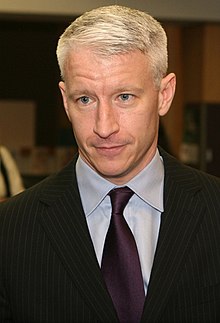
A few days ago, the noted TV news personality and multimillionaire heir (to the Vanderbilt fortune) Anderson Cooper came out, after years of public speculation by his fans and years of being open among a private network of friends, associates and coworkers. To be truthful, Cooper, a very rich and well-placed white man, had very little to lose but his gossamer secret by declaring, in the offhanded way he did via a letter to his friend, conservative writer and pundit Andrew Sullivan, that he was "gay." He did not, as his peer Don Lemon did, come on the air and tell the world. He didn't even pick a gay pride celebration to make his statement. Yet he did it, and in so doing he was not going to lose his post as a CNN media figure; he was not going to lose his fans, most of whom not only couldn't have cared less that he was gay but had long wanted him to publicly come out; he was not going to lose his millions by being cut off by his mother, designer and heiress Gloria Vanderbilt; in fact, he wasn't going to lose much of anything except his key to a gilded yet fairly transparent closet. I say all of this not to attack Cooper, because I praise his public self-affirmation as a gay person, as queer man. I think it's wonderful, especially in light of the ongoing shift in public attitudes in the US and across the globe concerning gay rights and equality, and in light of the ongoing struggles, de facto and de jure, that queer people all over the US and the globe still face in terms of homophobic and heterosexist oppression. I applaud Anderson Cooper with the strongest and gayest claps possible. But he didn't have much to lose, and he didn't have a long walk to take out of a closet that barely existed, though he'd kept its door cracked and its walls intact.

In contrast, on Tuesday the 24-year-old singer and songwriter Frank Ocean, a member of the loose collective Odd Future, which has been rightly criticized for the violently anti-gay and misogynistic raps of some of its members, particularly Tyler the Creator (cf. "Yonkers"), bravely posted on his Tumblr page a two-paragraph letter--who says this ancient form no longer has relevance or power!?--letting the world know that his first love was a man he'd met when they were both 19 years old, and that that experience, however complicated and painful in some ways, however unreciprocal and difficult, had been transformative for him. Ocean did not use the word "gay" or any similar term, preferring instead simply to state for the record that the relationship had existed, what it meant and continues to mean for him, thanking hte unnamed beloved and letting him know that because of it he felt and "feel[s] like a free man." In other words, he acknowledged his queerness by acknowledging the truth of his life, and no labels were nor are necessary, though this did not prevent media outlets, Twitterers and Facebookers, and a good many of everybody else stating that he was "gay" or "bisexual" or trying to pin a label on him.

Ocean's letter, from his Tumblr page
Since then neither Ocean nor his publicists nor his bandmates have posted a retraction. The responses from Odd Future's Tyler the Creator and others across the music industry, especially in the genres that Ocean has worked most extensively, hiphop and R&B, have been almost uniformly positive and affirming. (Tyler tweeted on Wednesday, "My big brother finally f---ing did that. Proud of that n---a cause I know that sh-- is difficult or whatever. Anyway. I'm a toilet." Uh, okay.) Ocean's new and first full album, Channel Orange, is set to drop, and with media speculation percolating about the pronouns he'd chosen in three songs, so he very well could have come up with an excuse or denials and kept hidden the sort of relationship, however one-sided the letter suggests it was emotionally, that Terrance Dean chronicled in his 2008 book Hiding In Hip Hop: On the Down Low in the Entertainment Industry from Music to Hollywood (Simon & Schuster), and played the game as it usually is. Instead, by sharing this aspect of still brief life, he risked quite a bit, and still faces huge risks, but nevertheless took a step that unfortunately far too many figures much further along in their careers--Queen Latifah, for example--are still unwilling to take.

Tyler the Creator and Frank Ocean (© Getty Images)
One may argue that given these risks and dangers are far greater for non-celebrities--Ocean after all appears on one of the best-known tracks on Jay Z's and Kanye West's recent album and is a member of a thriving musical group--and, in the absence of federal civil protections for queer people and the institution of overtly anti-gay laws in some states, as well as persistent homophobic and heterosexist attitudes, rhetoric and behavior by many major religious groups, anyone who is considering coming out has reason to be wary. This is true; one can ask too to what and to whom anyone is "coming out"; in the absence of affirmation and support, being openly queer--gay, bisexual, transgender, intersex, unlabeled but self-posited as a non-heterosexual, as questioning, as emergent, as sexually and gender-fluid--can still be a life or death proposition, for someone of any age. For women, for people of color, for working-class and poor people, for a person with physical or mental challenges, for a religious minority or someone occupying all of these categories, the challenges and risks multiply. Thus the simplistic call for people to come out, born out of the earliest days of the post-Stonewall Rebellion movement towards gay rights and equality--Come Out! was in fact the name of one of the very first gay publications--must always be considered within the context of the specific people for whom it is cast, the society in which it might occur, the risks it entails. One can come out and go back in, or be out and still be continually be coming out. It isn't a one-time proposition, and it won't be for Cooper, if you can believe that, and certainly not for Frank Ocean.

Anderson Cooper
Whatever Frank Ocean decides to do, whatever he decides to call himself tomorrow or down the road, whatever he songs he writes and to whomever he address them, whatever the gender, he has had a major impact on the public discourse through his courageous step, and, I want to note this, those around him in the R&B and hiphop communities have also made a major impact by responding as they did. It is particularly invaluable for young black people, not just in the US but all over the globe, especially in places where internal and outside forces have ramped up homophobia, to see that a young black person, at the center of the forms of cultural production that animates local and global imaginaries, can speak about his life with truth and bravery and not be ashamed or duplicitous, that he can speak about falling in love with another person of the same sex, and talk about his hurt but also how much he gained from that experienced, and how it has brought him a freedom many people dream of, an emotional freedom, and a truthfulness, that so many queer people still struggle to attain.

I praise his courage and his candor, and urge others who can and are able to follow his lead to do so, just as I praise those like Cooper who have already got the world by their fingertips and decide to step out, be out, open up. I also urge all who can work to change the laws, here and abroad, that foment homophobia--which, as Barbara Smith, Eve Sedgwick, Judith Butler, Audre Lorde, and countless other visionaries have in their various ways noted lies at the core of nearly all anti-gay activity--and that foster oppression and inequality to do so, because by doing both, as he suggests, we all might be on the road to being "free."