Showing posts with label black culture. Show all posts

Monday, February 13, 2017

Visiting the National Museum of African American History and Culture

The National Museum of African American
History and Culture, from the north view
Last week I ventured to Washington, DC to attend the annual Associated Writing Programs Conference, which I'll say a little more about in a subsequent post, but one of the highlights of the trip to DC was the opportunity to visit the Smithsonian National Museum of African American History and Culture (NMAAHC). Designed by British architect David Adjaye in conjunction with the Freelon Group and Davis Brody Bond, the museum sits on the National Mall, across the road from the Washington Monument. Long in planning, the NMAAHC was authorized for construction by the Congress and George W. Bush in 2003, and opened in ceremony led by the United States' first African American president, Barack Obama, last fall, September 14, 2016, to considerable acclaim for its architectural beauty and substantial collection.

The flag of the Bucks of America,
an American Revolutionary War
Black regiment
I'd been warned that acquiring tickets to the NMAAHC would be a challenge, but a colleague, Tayari Jones, was able to score me a ticket for 3:15 pm, and I made sure not to be late. The NMAAHC's building immediately commands the eye, rising in bronze from its site like a series of stacked wicker baskets or bowls that both convey solidity while also shimmering with the shifts in light. (The bronze carapace aims to and convincingly symbolizes a Yoruban crown, invoking one of the ethnic groups from which a sizable portion of African peoples in the New world share descent.) As it turns out, the museum is too large to see in one day, so I chose to head to the historical section, which presents a rich panorama, full of visual and material artifacts, from the 1400s through the present day. To view this section, museumgoers have to descend in an elevator to the bottom-most floor, and then slowly ascend, via a ramp, stairs and escalator, to reach return to the ground floor. In essence, everyone viewing this portion of the museum is physically and symbolically in the ship and in the hold, to borrow two key phrases from Christina Sharpe's remarkable study In the Wake: On Blackness and Being (Duke, 2016).

More manacles and shackles
On the day I went, the afternoon crowd wasn't especially heavy at first, though my cabdriver assured me that the museum was, in his experience of the last few months, the most and best-attendance attraction in the city. By the time I'd begun the tour, however, the waves of museumgoers, of all races, ethnicities and backgrounds, began increasing, and I found it a challenge at times, especially at the beginning of the exhibit, to linger over the displays and artifacts. It was also at times uncanny to read the plaques and descriptions, since I was familiar with much of the material from prior study in college and personal research, including in preparation for Counternarratives and other works, but I nevertheless found myself learning a lot that was new, and was impressed at how well the exhibits accessibly contextualized the various eras and moments from the dawn of the Atlantic Slave trade through its decline and the Civil War. At times I found the artifacts so moving I was moved nearly to tears--and at least once did tear up. Among the exhibit's revelations for me was a flag by the Bucks of America, an organization of Revolutionary War veterans whose members included a historical figure who serves as the model for the protagonist of the novel I'm currently working on; another was a whip, formerly wielded by a plantation overseer, whose metal end and thick cording exceeded most models you would find today and emblematized the brutal conditions of African American labor not only in the past but today.

As I walked through the exhibit, taking notes and snapping photos (which are, thankfully, allowed), stopping to discuss the experience with friends, and frequently moved by what I was seeing and reading, I felt incredibly grateful that this institution now existed, that millions of people would have the opportunity to see and experience it, that millions of black people, from the US and across the globe, as well as million of non-black people, would be able to walk through its rooms and learn and see and feel. What I also felt and feel, however, as a black person, as an African American, is that one museum or even several dozen, if one adds in all the smaller and single-person related museums, the various Civil Rights memorials and museums, and various key archives, collections and monuments, will only scratch the surface of my and the collective black experience, especially compared to the many thousands of museums, as well as the vast and expanding network of interlinked and dominant media, dedicated to white people, European culture, and so forth, that exist all over the United States and the globe. That said, the NMAAHC is a gift to the country and the world, and I highly recommend visiting it. I plan to return as soon as I can, to explore more of it. To all who made it possible, I say thank you!

My timed pass 
The ground floor
The beginning of the historical exhibit
A visual display featuring scenes
from African American history
Closeup: James Baldwin and Zora Neale Hurston
In the elevator: Booker T. Washington
From the 1400s on
"The Atlantic Creoles"
Actual slave manacles and shackles 
Timber and iron ballast from
a slave ship, the São José 
Nat Turner's Bible 
A close-up of Nat Turner's Bible
An important historical list
And another
The country, divided after the entry
of my native state, Missouri
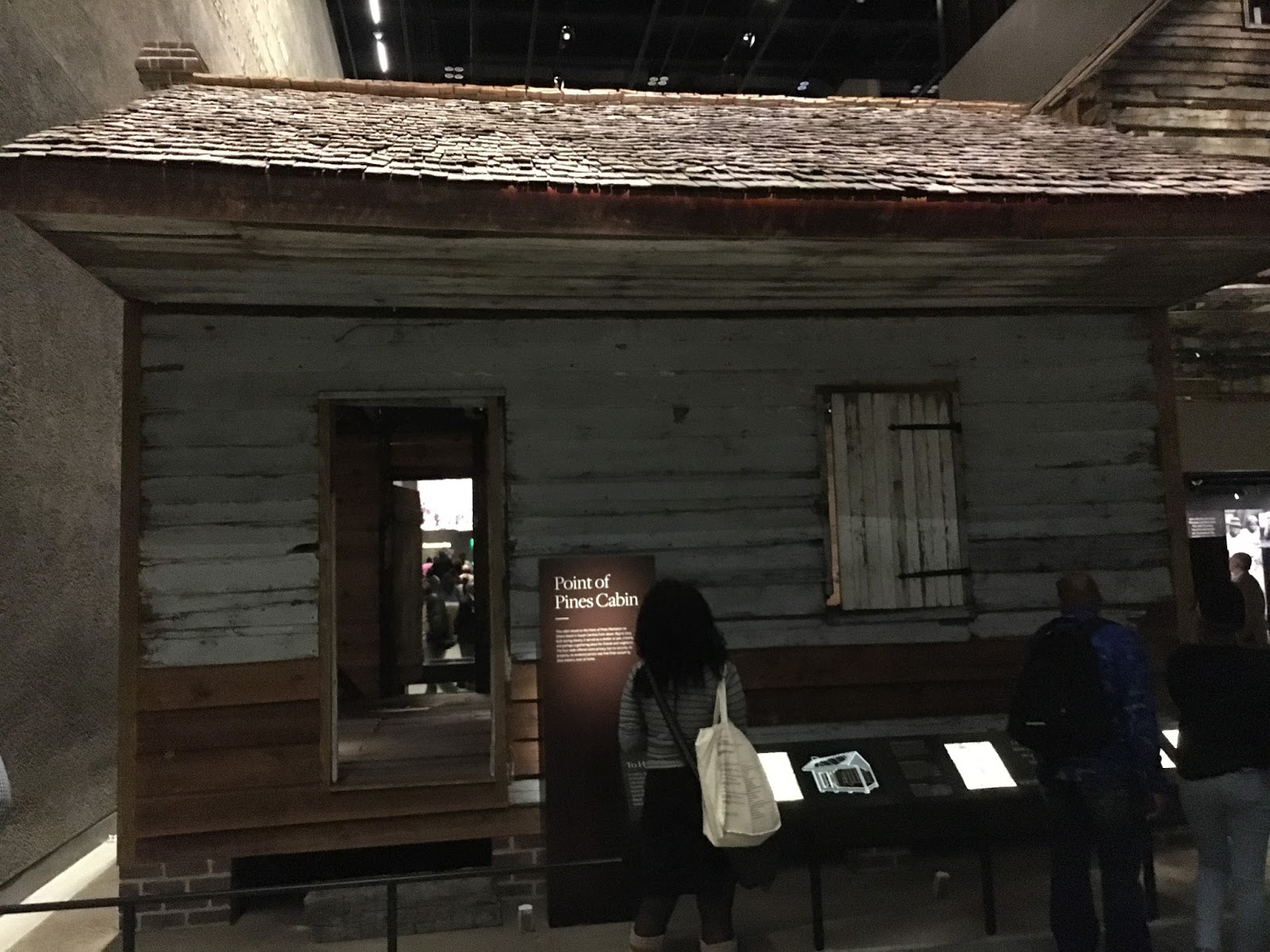
Point of Pines Cabin, an actual stlave
cabin from Edisto, South Carolina
Artifacts, including a note in Arabic 
Harriet Tumbman's artifacts,
including a shawl and a Bible
Historical marker for Nicodemus,
one of the original free Black town
established in Kansas 
Inside one of the formerly segregated
train cars, from the 1940s 
A multimedia tableau from the
Civil Rights era, with Medgar
Evers at bottom right 
Bayard Rustin display
(Rev. Dr. Martin Luther King Jr.
with Rustin at right)
Malcolm X
("by any means necessary")
A Black Unity jacket
(belonging to a Vietnam veteran) 
Amiri Baraka and Stokely Carmichael (Kwame Toure)
Black Power display 
Muhammad Ali and
Black Panther badges
A young Nikki Giovanni
Toni Morrison receiving
the Nobel Prize in Literature, 1993 
The 1990s
Public Enemy

A Langston Hughes quote that graces
the final wall leading out of the
history exhibit
Oprah Winfrey Theater
(Oprah donated $22 million+ to the museum)
Yours truly (photo by Tayari Jones)

Thursday, December 13, 2012

Fin de Semestre

As of yesterday, my fall courses at Rutgers-Newark have ended, and once I receive all the final papers, read and grade them, and submit final grades, my first fall semester will also conclude.  All in all it was a good semester, I think, and the classes, especially the graduate one, went better than I imagined. The disruption that Tropical Storm Sandy wrought, however, was significant. Many of my undergraduate students lost power, and some did not get it back for several weeks, but many of them also suffered a significant enough break in their psychic and academic rhythms that it took them a while to recover.  The university urged us to be flexible with the students and assignments, but I'd already decided to do so. One assignment became an extra-credit project which a number of students undertook. With one week completely lost and discombobulation lingering like a wake, I compressed the readings, but we managed not to to skip any of the major creative works in either class. 
Board (but I hope not "bored") work

With the undergraduate class, "Letras Negras: Afro-Latin Literature," which was a new preparation, we got through all eight works, seven novels (by Edgardo Rodríguez Juliá, Edwidge Danticat, Marilene Felinto, Luz Argentina Chiriboga, Mayra Montero, Junot Díaz, and Charles Rice-González) and one memoir (Piri Thomas).  If I have the opportunity to teach this class in the future (and I hope to), I've grasped better how to reorder the readings for a smoother chronological and theoretical flow, and situate the historical and cultural contexts for each of the texts. I also will aim to find at least one other work by a non-Caribbean non-US-based Afro-Latin writer; I now feel that, as much sense as it made to select the writers I did and as well as their works did bear out, I ought to cast my net even wider. (Translators of Afro-Latin literature, please, help potential readers and teachers out!) One of the fortuities, which I'd intuited but not fully foreseen,  was how they all nevertheless fit together, especially the final three, which each took up questions of Afro-Latin(o) masculinities within a US context. I also have a better sense of which historical and theoretical readings to keep, which to add, and which to jettison. I did not give an exam this semester, but in a future course of this sort I probably will at least give a midterm, since it requires a more cumulative approach, on the students' part, to all the course material encountered up to that point. I will shortly see their appraisal of the course, though, and learn as much as I can from what they have to say.

With the graduate course, "Topics in Postmodernism: Transhumanism and Posthumanism," I had initially fretted a great deal about the coherence of the material and the level at which I was pitching it, but by the third week I felt our conversations in class were going well and the students appeared not only to be gaining something valuable from all the readings but also to be enjoying them. As with the undergraduate class, the readings ultimately did connect, sometimes in a much smoother fashion than I could ever have foreseen, and I realize my decision to shift between genres (by starting with prose works by Mary Shelley, Ellen Ullman, Clarice Lispector, Octavia Butler, Philip K. Dick, and Ray Bradbury, interspersed with films such as Gattaca and 2001: A Space Odyssey, and online projects by Stelarc and Christian Bök) also afforded everyone the opportunity to toggle between different critical skills in assessing what we were exploring. Another serendipitous occurrence was the New Museum's Ghosts in the Machine show, which was winding down just as our course was beginning, and its foundational aspects coincided with our initial discussions about technology, so the class field trip, in addition to being enlightening and a lot of fun, also provided some germane heft to our discussions.

The theoretical texts (by a range of authors, from Neil Badmington and Brian Massumi to Donna Haraway, Jean-François Lyotard and N. Katherine Hayles, to Mary Midgely and Sylvia Wynter) also appeared to provide useful optics and lenses through which to examine the creative works. Historical and journalistic articles also proved helpful, but perhaps most crucial were two choices I made after a lot of hawing: to explore humanism as a topic first, grounding in its European Renaissance origins, and then turning to Frankenstein (alongside Jeffrey Jerome Cohen's still effective, speculative article on "monster theory"), the first of which laid down an excellent foundation for understanding the spectrum on which transhumanism and posthumanism (as well as modernism and postmodernism) lay, and the second of which offered texts from which nearly everything else we looked at sprung, even if but intellectually, and with which every subsequent text was in conversation. As with the undergraduate course this one gibed more than once with current and ongoing interests of mine, and so neither was an additional marathon I devised for myself, but part of a larger intellectual project whose pieces continue to fall into place.

The two new courses at a new institution with new students, very different in so many ways from my former ones, though akin in their deep interest in the subject matter, enthusiasm, and desire to learn and work hard, have all left me feeling quite grateful, and I thanked both classes at our final meetings. The classes and all the events of this fall have left me a bit bedraggled too. I fortunately will not have to  run an airport security theater gantlet and hop back on a plane as I used to head home for the holidays, but I do have to complete my syllabi for the new semester (in Pavlovian fashion I still often say "quarter") which begins after Rev. Dr. Martin Luther King Jr. Day, revise a paper for the MLA (thankfully Reggie H. reminded me I was on a panel on January 4!--I had not thought at all about conferences or anything, beyond a few Dark Room-related events in the New Year, and continue with my personal writing and translation projects. Then I will be sure to get some sleep!

Friday, July 06, 2012

Frank Ocean, Anderson Cooper & Coming Out

Frank Ocean
A few days ago, the noted TV news personality and multimillionaire heir (to the Vanderbilt fortune) Anderson Cooper came out, after years of public speculation by his fans and years of being open among a private network of friends, associates and coworkers. To be truthful, Cooper, a very rich and well-placed white man, had very little to lose but his gossamer secret by declaring, in the offhanded way he did via a letter to his friend, conservative writer and pundit Andrew Sullivan, that he was "gay." He did not, as his peer Don Lemon did, come on the air and tell the world. He didn't even pick a gay pride celebration to make his statement. Yet he did it, and in so doing he was not going to lose his post as a CNN media figure; he was not going to lose his fans, most of whom not only couldn't have cared less that he was gay but had long wanted him to publicly come out; he was not going to lose his millions by being cut off by his mother, designer and heiress Gloria Vanderbilt; in fact, he wasn't going to lose much of anything except his key to a gilded yet fairly transparent closet. I say all of this not to attack Cooper, because I praise his public self-affirmation as a gay person, as queer man. I think it's wonderful, especially in light of the ongoing shift in public attitudes in the US and across the globe concerning gay rights and equality, and in light of the ongoing struggles, de facto and de jure, that queer people all over the US and the globe still face in terms of homophobic and heterosexist oppression. I applaud Anderson Cooper with the strongest and gayest claps possible. But he didn't have much to lose, and he didn't have a long walk to take out of a closet that barely existed, though he'd kept its door cracked and its walls intact.

In contrast, on Tuesday the 24-year-old singer and songwriter Frank Ocean, a member of the loose collective Odd Future, which has been rightly criticized for the violently anti-gay and misogynistic raps of some of its members, particularly Tyler the Creator (cf. "Yonkers"), bravely posted on his Tumblr page a two-paragraph letter--who says this ancient form no longer has relevance or power!?--letting the world know that his first love was a man he'd met when they were both 19 years old, and that that experience, however complicated and painful in some ways, however unreciprocal and difficult, had been transformative for him. Ocean did not use the word "gay" or any similar term, preferring instead simply to state for the record that the relationship had existed, what it meant and continues to mean for him, thanking hte unnamed beloved and letting him know that because of it he felt and "feel[s] like a free man." In other words, he acknowledged his queerness by acknowledging the truth of his life, and no labels were nor are necessary, though this did not prevent media outlets, Twitterers and Facebookers, and a good many of everybody else stating that he was "gay" or "bisexual" or trying to pin a label on him.

Ocean's letter, from his Tumblr page
Since then neither Ocean nor his publicists nor his bandmates have posted a retraction. The responses from Odd Future's Tyler the Creator and others across the music industry, especially in the genres that Ocean has worked most extensively, hiphop and R&B, have been almost uniformly positive and affirming. (Tyler tweeted on Wednesday, "My big brother finally f---ing did that. Proud of that n---a cause I know that sh-- is difficult or whatever. Anyway. I'm a toilet." Uh, okay.) Ocean's new and first full album, Channel Orange, is set to drop, and with media speculation percolating about the pronouns he'd chosen in three songs, so he very well could have come up with an excuse or denials and kept hidden the sort of relationship, however one-sided the letter suggests it was emotionally, that Terrance Dean chronicled in his 2008 book Hiding In Hip Hop: On the Down Low in the Entertainment Industry from Music to Hollywood (Simon & Schuster), and played the game as it usually is. Instead, by sharing this aspect of still brief life, he risked quite a bit, and still faces huge risks, but nevertheless took a step that unfortunately far too many figures much further along in their careers--Queen Latifah, for example--are still unwilling to take.

Tyler the Creator and Frank Ocean (© Getty Images)
One may argue that given these risks and dangers are far greater for non-celebrities--Ocean after all appears on one of the best-known tracks on Jay Z's and Kanye West's recent album and is a member of a thriving musical group--and, in the absence of federal civil protections for queer people and the institution of overtly anti-gay laws in some states, as well as persistent homophobic and heterosexist attitudes, rhetoric and behavior by many major religious groups, anyone who is considering coming out has reason to be wary. This is true; one can ask too to what and to whom anyone is "coming out"; in the absence of affirmation and support, being openly queer--gay, bisexual, transgender, intersex, unlabeled but self-posited as a non-heterosexual, as questioning, as emergent, as sexually and gender-fluid--can still be a life or death proposition, for someone of any age. For women, for people of color, for working-class and poor people, for a person with physical or mental challenges, for a religious minority or someone occupying all of these categories, the challenges and risks multiply. Thus the simplistic call for people to come out, born out of the earliest days of the post-Stonewall Rebellion movement towards gay rights and equality--Come Out! was in fact the name of one of the very first gay publications--must always be considered within the context of the specific people for whom it is cast, the society in which it might occur, the risks it entails. One can come out and go back in, or be out and still be continually be coming out. It isn't a one-time proposition, and it won't be for Cooper, if you can believe that, and certainly not for Frank Ocean.
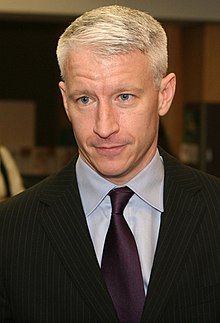
Anderson Cooper
Whatever Frank Ocean decides to do, whatever he decides to call himself tomorrow or down the road, whatever he songs he writes and to whomever he address them, whatever the gender, he has had a major impact on the public discourse through his courageous step, and, I want to note this, those around him in the R&B and hiphop communities have also made a major impact by responding as they did. It is particularly invaluable for young black people, not just in the US but all over the globe, especially in places where internal and outside forces have ramped up homophobia, to see that a young black person, at the center of the forms of cultural production that animates local and global imaginaries, can speak about his life with truth and bravery and not be ashamed or duplicitous, that he can speak about falling in love with another person of the same sex, and talk about his hurt but also how much he gained from that experienced, and how it has brought him a freedom many people dream of, an emotional freedom, and a truthfulness, that so many queer people still struggle to attain.

I praise his courage and his candor, and urge others who can and are able to follow his lead to do so, just as I praise those like Cooper who have already got the world by their fingertips and decide to step out, be out, open up. I also urge all who can work to change the laws, here and abroad, that foment homophobia--which, as Barbara Smith, Eve Sedgwick, Judith Butler, Audre Lorde, and countless other visionaries have in their various ways noted lies at the core of nearly all anti-gay activity--and that foster oppression and inequality to do so, because by doing both, as he suggests, we all might be on the road to being "free."