Showing posts with label HIV/AIDS. Show all posts

Saturday, September 01, 2018

Farewell, Village Voice


For the last decade or so, I have only occasionally read Village Voice, mostly online, but once upon a time, when I was in my 20s and living in Boston, acquiring a copy of the Voice at one of the news stands there, and perusing it to find out what was happening in New York, was one of the highlights of my week. (Back then I also read the New York Times in print almost every day too.) The Voice provided a trove of news about politics, in New York and beyond, as well as some of the most invigorating criticism about art, entertainment, the broader culture and the world, that you might find anywhere. For me it constantly outmatched Boston's own Phoenix, that city's alternative paper, and was part of a national ecosystem of similar papers that offered fresh, often left-leaning and progressive but always counter-mainstream perspectives on the state of the world. Now, the Voice is gone.

It's where I first learned about New York's legendary Public Theater and its pathblazing directors Joseph Papp and George C. Wolfe; it was one of the mainstream places where I regularly found informative reportage, Andrew Kopkind, Richard Goldstein and others, about about HIV and AIDS. It was a regular-go to learn about the newest and less common films, books, music, theater and performances of all kinds. The Voice also brought to me and countless readers original photography (Sylvia Plachy, C. Carr, etc.), cartoons by Jules Feiffer, Ted Rall, Lynda Barry, Mark Alan Stamaty, and Tom Tomorrow, and literature (I recollect reading a story by the great poet Elizabeth Alexander's there, among other gems). I was enthralled by Greg Tate's, Joan Morgan's and Gary Indiana's criticism, and when my friend Scott Poulson-Bryant (now Dr. Poulson-Bryant, and a professor at Fordham University) secured an internship and then a job there, it seemed like an unimaginably wonderful thing had occurred. Other than Greg Tate, the one columnist I made sure never to miss was Michael Musto, whose tour through NYC's once inimitable queer club scene will probably never be equalled again.

When C and I moved to the New York area, the Voice remained a paper I rarely missed reading. I'd even looked in its ads section in my search for an apartment when heading to NYU. When Annotations appeared, a young writer named Colson Whitehead wrote one of the most insightful, praiseworthy reviews the book received, and it meant everything to me that it appeared in the Voice. When the Voice became free in New York in 1996--which I loved but also figured was a bad sign--I would grab a copy in Manhattan before heading back to New Jersey, where we still had to pay for them. Yet I also paid attention to the labor strife that was wracking the paper in 2005 and 2006, and again in 2013: editors fired or resigning, writers sharing their fears over decreased benefits and the new owners' tunnel vision, and worse. Even as its leadership changed, the Voice remained one of the rare news organs that seemed not to coddle the rich and powerful--I recall Wayne Barrett's extensive  reporting on Rudy Giuliani's administration, and the time it ran an article outing New York's conservative Catholic Cardinal Edward Egan--and continued to employ incisive writers like Steven Thrasher. Yet in the end, its most recent owner, and the shifts in the media industry, ensured its demise.

Established in 1955 by Dan Wolf, Ed Fancher, John Willcock, and Norman Mailer, the Voice was the US's first alternative weekly, and received a wide array of honors over its 63-year existence, including Pulitzer Prizes, National Press, and George Polk awards. It survived a number of owners over the years, until it was sold in October 2015, by its penultimate owner, Voice Media Group, to billionaire heir Peter Barbey. In August 2017, the Voice announced it would cease to exist as a print publication, and its final print issue appeared on September 17, 2015. Although Barbey said that he wanted to save the Voice, and despite his considerable financial reserves, he claimed that financial exigencies required him to shut down the paper, even as he allegedly has been searching for someone to buy it. Yesterday, the electronic edition ceased publication, half the staff were laid off, and those who remain will assist for a limited period in archiving the paper's rich store of articles and materials. Yet the fact remains that one of the once truly vital organs of reportage, investigation and criticism, for New York, the US and the globe, is gone, and with it passes an era--many really--that we will somebody


Sunday, December 01, 2013

World AIDS Day

World AIDS Day. December 1. Today is the  25th World AIDS Day. Around 35 million people across the globe are living with HIV/AIDS, and new HIV seroconversions are declining. Embracing and helping to foster public policies that advance this decline are part of what World AIDS Day aims to do.

You can find more information on the global approach to HIV/AIDS at the World AIDS Campaign's website.

Here are some basic facts about HIV/AIDS, from the UK's World AIDS Day site, that we all should know.

HIV can be passed on through infected bodily fluids, most commonly via sex without a condom or by sharing infected needles, syringes or other injecting drug equipment.

And:

There is no vaccine and no cure for HIV.

And:

Please consider getting tested for HIV so that you know your serostatus.

[Use the AIDS.gov locator below, if it appears on your browser, to find a testing site near you.]

Also:
  • You can now get tested for HIV using a saliva sample
  • HIV is not passed on through spitting, biting or sharing utensils
  • You can get the results of an HIV test in just 15-20 minutes
  • There are a number of things you can do to reduce the risk of serotransmission and seroconversion

Also, HIV/AIDS seroconversion is not a moral judgment, you cannot tell whether you or someone else has HIV/AIDS just the way she or he looks, and it's what one does that is the key factor for HIV seroconversion. These all seem like old hat some three decades into the HIV/AIDS pandemic, but it remains the case that too many people still don't know or fully understand these facts, and many others.


You can find many more facts about HIV/AIDS, including discussions of risk reduction, HIV testing and counseling, prevention and research, and ways to find help, support and treatment if you or someone you know is diagnosed with HIV/AIDS, legal rights, steps for discussing serostatus with family and friends, other health-related issues, and more here.

The much-maligned Affordable Care Act includes coverage for HIV/AIDS treatment and support!

USCA 2013 Federal Plenary on the Affordable Care Act

UPDATE: The ever on-top-it Rod 2.0 featured the following excellent graphic about HIV/AIDS and young gay men. You can find more information on Rod's excellent blog.


Friday, October 18, 2013

Random Photos

These last few weeks have been very, very busy. I sometimes don't know if I'm coming or going. A few photos from various journeys here and there.

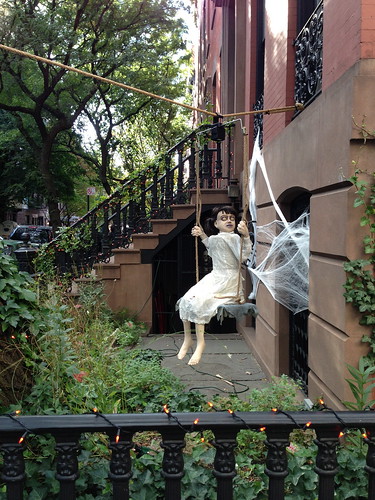
Halloween display
Halloween display, West Village
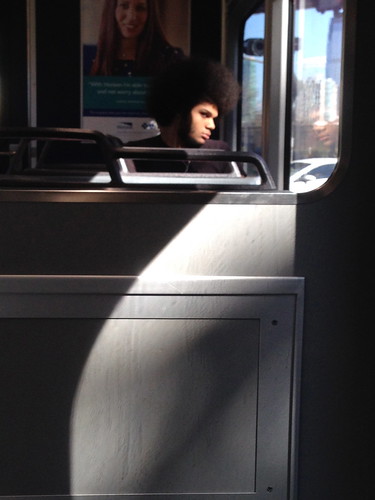
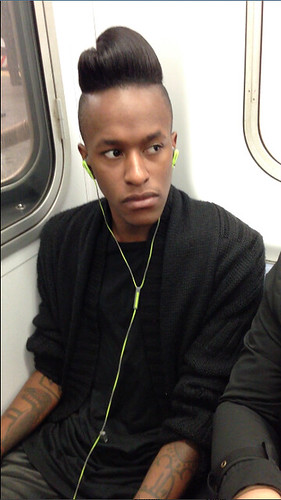
Pensive
Pensive young man, HB Light Rail
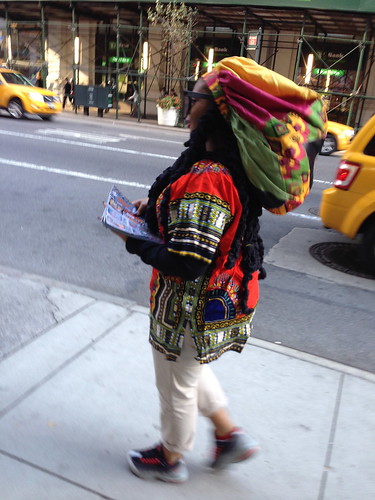
Handing out flyers
Handing out flyers, Midtown
(of course it was the cap that got me)
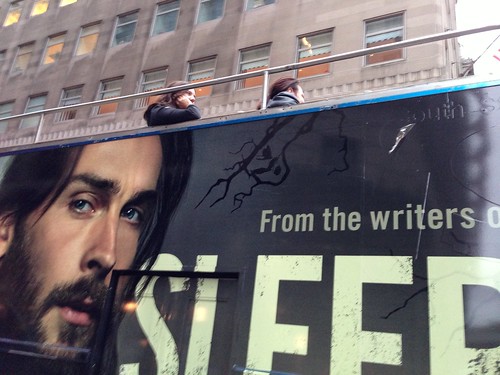
Tourist bus
Tourist bus, Manhattan
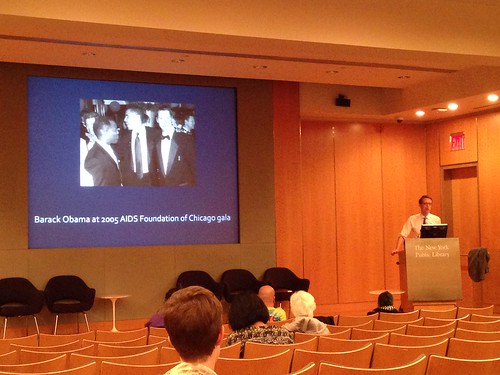
At Timothy Stewart-Winter's talk @ NYPL
My Rutgers colleague Timothy Stewart-Winter's
talk, "Race and Sexual Politics in the AIDS Crisis,
1981-1996," New York public library
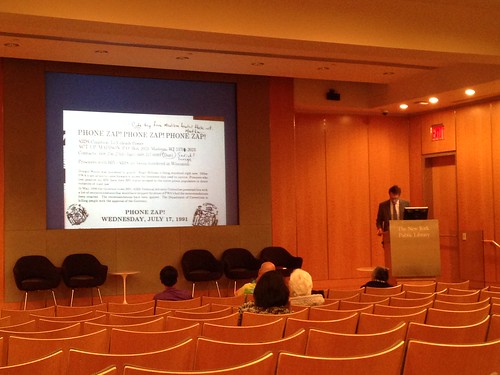
Timothy Stewart-Winter's talk @ NYPL
During Timothy's talk, he showed a "phone zap" flyer
featuring annotations mentioning "Dan  (Savich? Savage?) [Savage]"
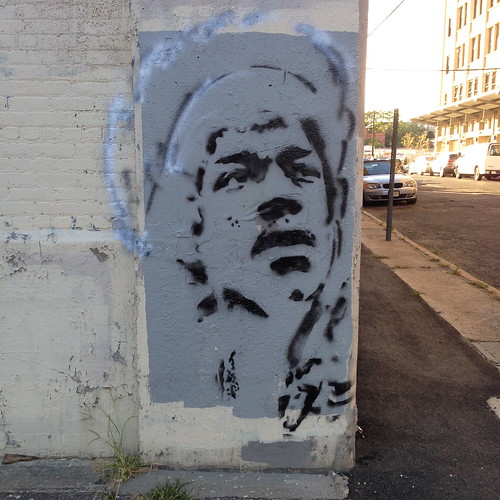
Jimi Hendrix street art, JC
Jimi Hendrix graffiti, downtown Jersey City
Harvest from the garden
Some of the recent garden harvest
On the subway
On the subway
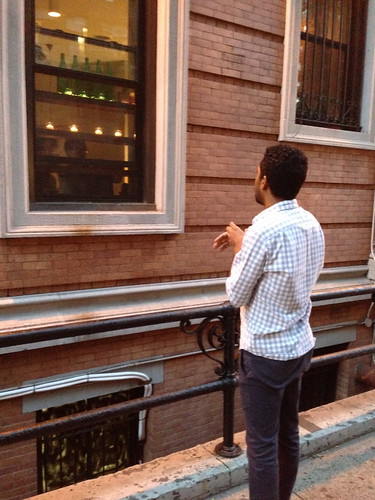
Arranging candles in the window
Arranging candles in the window, Chelsea
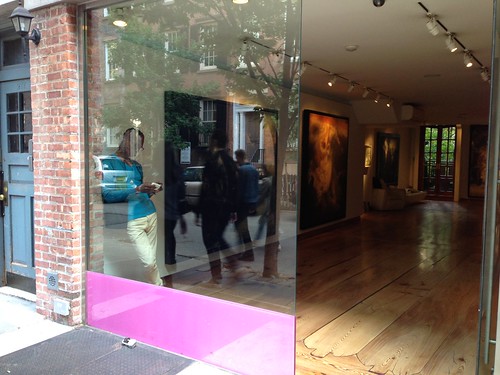
Nearly empty gallery
Near empty gallery, West Village
Artist Ike Ude
Artist and publisher Iké Udé, Chelsea
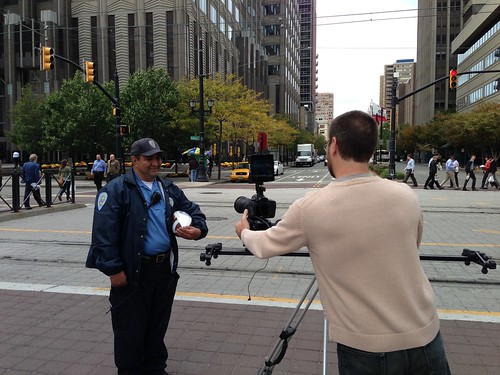
Filming commercial, downtown JC
Filming a commercial, Jersey City
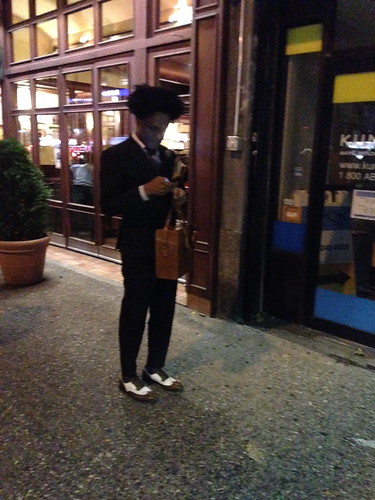
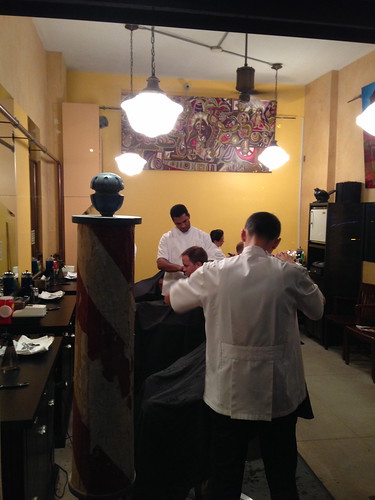
Haircuts, at night (Chelsea)
Night cuts, Chelsea
10th Avenue
Street vendor packing up, 10th Avenue
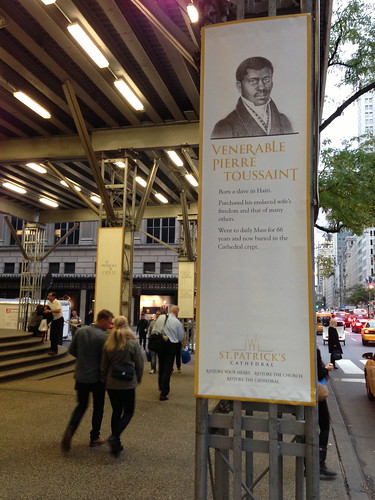
Pierre Toussaint banner, St. Patrick's Cathedral
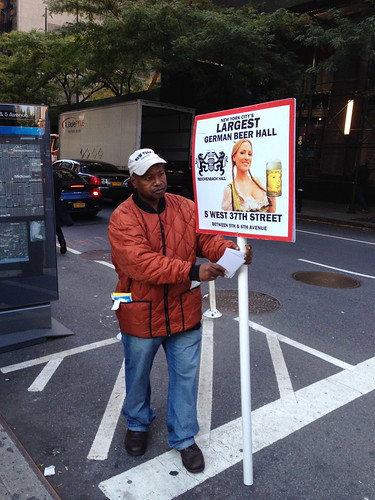
Shilling for a beer garden
Shilling for the ubiquitous beer gardens, Manhattan
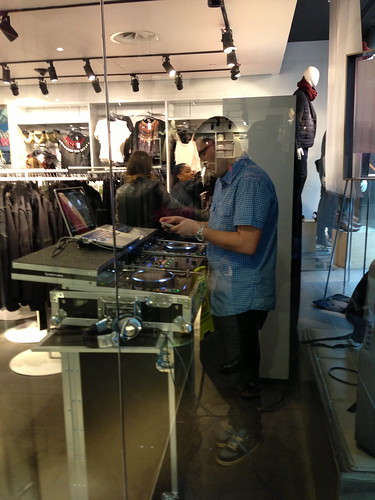
DJ at H&M
In-house DJ, H&M, 51st Street

Friday, June 21, 2013

"not only this but "New language beckons us'" @ NYU

AIDS art exhibit, NYU
Vernissage at Fales Library and Special Collections, NYU
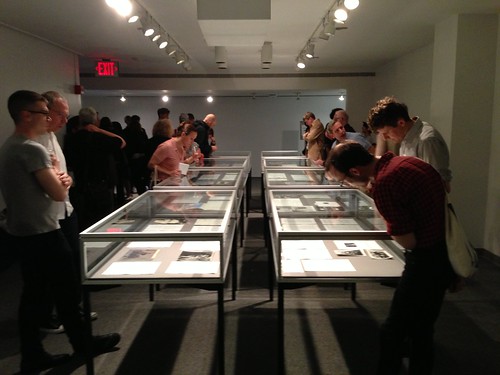
For those in NYC or visiting before July 27, 2013, do check out a wonderful exhibit organized and curated by Andrew Blackley for Visual AIDS at New York University's Fales Library and Special Collections, entitled "not only this, but 'new language beckons us'." 

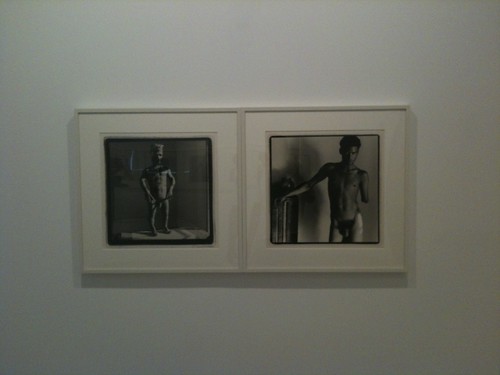
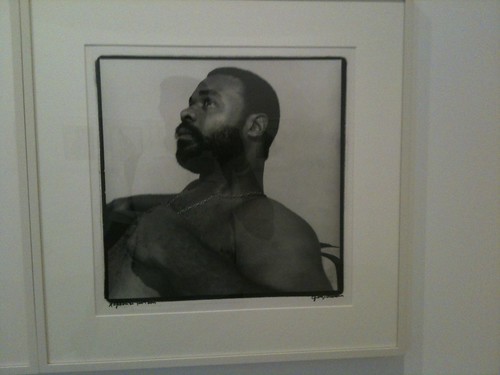
The exhibit features original works by artists in NYU's collections as well as new works by authors in conversation with these artists and their works, including Julie Ault, Dodie Bellamy, Gregg Bordowitz, Nancy Brooks Brody, AA Bronson, Elijah Burgher, Kathe Burkhart, Sean Carrillo, Peter Cramer, Lia Gangitano, Matthias Herrmann, Jim Hubbard, Doug Ischar, William E. Jones, Kevin Killian, Nathanaël, John Neff, Uzi Parnes, Mary Patten, Nina Sobell, Ela Troyano, Ultra-red, Jack Waters, Joe Westmoreland, Danh Vo, and yours truly.

IMG_9882
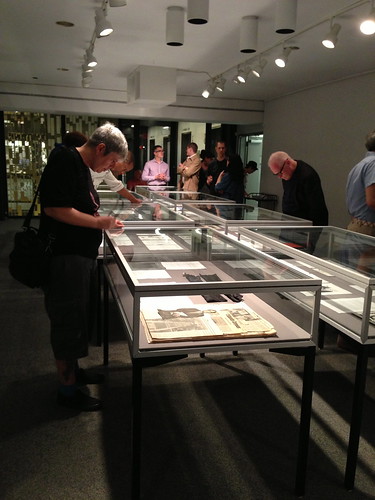
People viewing the cases
As Andrew's announcement states:

This exhibition is composed of archival objects from the Fales Library's Downtown Collection coupled with newly commissioned texts from contemporary artists and writers. Each text corresponds to a figure or object from the collection and highlights interpersonal affinities and adjacencies, influences and recollections. These couplings give voice to still-present narratives and discourses orbiting the intersection of art and HIV/AIDS—a theme that speaks to Visual AIDS' ongoing mission: to serve as an advocate for artists with AIDS and to recognize art as a tool for education and activism in the fight against AIDS.

Art exhibit, Fales Library, NYU
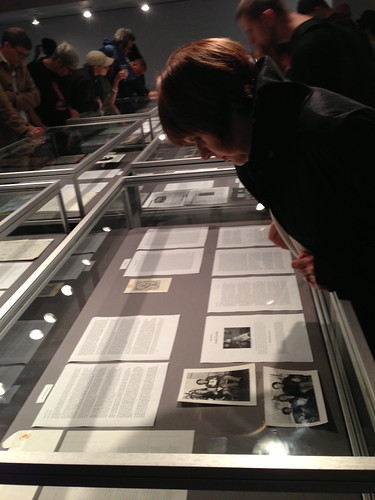
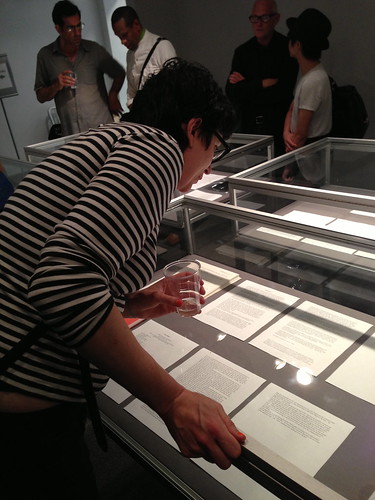
Some of the texts on display
My contribution is a prose piece riffing specifically on "Hypnos and Thanatos," as well as the drawing books and other artworks by the late painter, graffiti artist and collector, and set designer Martin Wong (1946-1999), onetime lover of the playwright and poet Miguel Piñero (1946-1988) and an important figure in the emerging 1980s Lower East Side/East Village art scene. Other pieces include essays, meditations, poems, one-line provocations, and new visual pieces, and the works from the Fales Collection range across genres, but offer glimpses of a world, or worlds, now almost completely invisible, if not gone, in hypergentrifying Manhattan and New York City. Below are some photos from the opening, which took place on May 23.

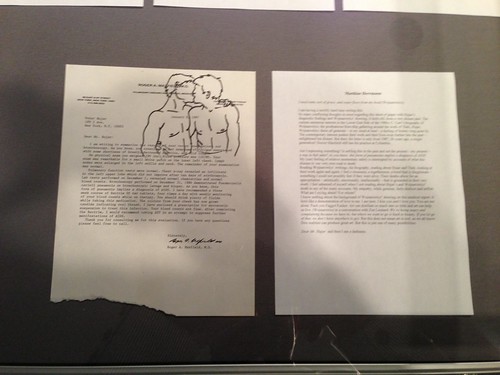
David Wojnarowicz/Peter Hujar document & responding text, Fales Library, NYU
A Peter Hujar/David Wojnarowicz piece at left,
with a corresponding response
Art & text exhibit, Fales Library NYU
The exhibit, at NYU

Friday, April 26, 2013

Poem: Adam Johnson

Adam Johnson (1965-1993), not the recent Pulitzer Prize winner but the late lyric poet bearing his name, was one of the promising British versifiers of his generation when he died of HIV-related disease in the early 1990s. A native of Stalybridge, Cheshire, he arrived on the London literary scene in 1984, and cut a stylish figure, while also producing poems very much in keeping with the mainstream conventions of that era. What began to set him apart was his fastidiousness with language and his openness in writing from the perspective of an openly queer young poet, taking up the thread that predecessors Thom Gunn, W. H. Auden and others had bequeathed him. Like so many queer male poets of that moment, of that generation, my generation, he was cut short before he even reached his prime. Johnson published one book in his lifetime, a second appeared only weeks after his death at 28; his Collected Poems, edited by Neil Powell, did not appear until 2002. Johnson's poems are usually only a few stanzas long, show almost no formal experimentation or elaborate wordplay, draw upon observations of nature, and often invoke an unnamed beloved, though he was quite clear who, in later years, this was: James Levondowski, his love for whom underlines many lines. Below is "Nocturne," one of Johnson's earlier poems that shows the talent he possessed and gives a hint of what might have been possible had he lived longer. All art is ultimately in part a memorial, and in the case of those many artists struck down before they were able to accomplish what they hoped to, it's but a tiny cenotaph, yet one that, especially in Johnson's case, keeps drawing us back, to read, and remember.

NOCTURNE

October makes censers
Of these wooded places.
Out of the cool ether
Of darkness strike the
Branching crystals of trees,
By night's definition
Of a rarer substance -
The texture of bark
Is wholly light's privilege.

The path leads us to
A locked gate we climb. There is
Tension in our nearness -
The feel of you, our hands
Clasped in recognition
Of their own engaged warmth.

In embracing we earth,
Here, where a stream's course
Through banks of cypresses
Designs a garden,
The motion of its cool blade
As purposeful as blood.

Now the spell of your voice
Concedes to other sounds,
Falling into dark air
That cherishes each note -
This water easing
Over known rocks, through reeds,
The soft consent of leaves.
Drawing me close, there is
Nothing you would not give.

December 1986

Copyright © The Estate of Adam Johnson, from Adam Johnson, Collected Poems, edited by Neil Powell, Manchester: Carcanet, 2003. All rights reserved.

Tuesday, April 16, 2013

Poem: Aaron Shurin

I cannot find my copy now (it is hidden among the shelves of writing study books that this summer will enjoy reorganization), but Aaron Shurin's (1947-) A's Dream (O Books, 1989), was one of those revelations that serendipity in a bookstore brought me. I had never heard of him or his work, pulled the book off the shelf, realized quickly that I could not put it down, and then read it a number of times, letting its lush, lyrical language seep in and steep. A queer text in theme and form, it enfolds you in its prose, particularly the sequence "City of Men," which I read as specifically about San Francisco, where Shurin has lived for many years and where he directs MFA program at the University of San Francisco, but which I analogized to many an urban setting.

What I particularly love about this sequence is the specificity in the elusiveness; there is something always both before you and just out of reach, like desire itself, though what also overshadows this series of poems is the AIDS pandemic, which was well underway when Shurin wrote the poems. The poems incorporate that horror, but also each day's quotidian beauties. About his work Shurin has said (according to Wikipedia): "Poetry remains for me an act of investigation, by which the imagination makes itself visible in a real world - and through which the inhabitants of that realer world become dimensional." As the little snippet below demonstrates (the "disappear" is not a typo, just to be clear), we can see an imagination crystallizing in words; desire, a life, a world rendered, in its complexity, as poetry.

from CITY OF MEN

I heard my name, the day rose and disappear over the beach. the day on each breath tasted my food,that night roll slowly cover in the cool, his face around my breast. the day inhaling grow pale and disappear, water on his way, up the shores hissing. under the night stillness inclined my morning beach, undressing the friend of my liquid, my most same. at evening while whispering from the bed by me, his way was accomplished. his full perfect arm a health of ripe waters. the day received moon laughing, love lay me that night.

Copyright © Aaron Shurin, from The Paradise of Forms: Selected Poems, Jersey City: Talisman House, 1999. All rights reserved.

Sunday, April 14, 2013

In the Life @ Whitney Museum Today!

For any and all in and around New York, a wonderful event will take place this afternoon! Please come if you can.

BLUES FOR SMOKE PERFORMANCE SERIES  

GREGG BORDOWITZ: “IN THE LIFE”

A READING OF WORKS BY GAY BLACK MEN FROM THE 1980S AND ’90S

SUNDAY, APRIL 14, 2013  2 PM   

FILM AND VIDEO GALLERY

For “in the life,”* artist and writer Gregg Bordowitz will host readings from the literary work of gay, male, African American poets and writers, who chronicled sexuality, illness, and death during the height of theAIDS crisis in the 1980s and ’90s. Many of the writers are now dead, and their works have been collected in anthologies, such as In The Life, edited by Joseph Beam, and Brother to Brother, edited by Essex Hemphill. Bordowitz will be joined by a diverse group of readers including Ari Banias, John Keene, Rickey Laurentiis, Glenn Ligon, Eileen Myles, Other Countries, Robert Reid-Pharr, and Pamela Sneed to pay tribute to artists such as Donald Woods, Essex Hemphill, Marlon Riggs and many more.

*In the Life: A Black Gay Anthology was a groundbreaking collection of writing edited by Joseph Beam and published in 1986.

Free with Museum admission; no special tickets or reservations are required. Members enjoy complimentary and express entry to the Museum.


Saturday, July 07, 2012

George Dureau @ Higher Pictures + Rotimi Fani-Kayode @ The Walther Collection

Laurence, George Dureau exhibit, NYC
Laurence Patterson, 1970s (© George Dureau, Higher Pictures)

By splendid coincidence, two exhibits, both quite small but nevertheless impressive, of queer photography from the heyday era of the late 1970s through the mid-1980s are still up in New York City, so yesterday, despite the heat, which turns Manhattan sidewalks into griddles and the subway stations into kilns, I ventured out and over (or under) to catch both.

The first was a tiny exihibit at Higher Pictures gallery, on the Upper East Side, entitled George Dureau Black 1973-1986, totaling only 15 pictures total by the New Orleans-based photographer (1930-), who has been taking photographs for over 50 years, and snapped these as studies for his paintings. All of these were black and white prints from 1973 through 1986, and to my astonishment, it turned out that this is Dureau's first solo exhibit in New York. I'd first seen Dureau's work in book form when I was in my early 20s and working at the old Glad Day Bookshop in Boston, and flipped through it often enough; in that volume, which included many of the images in the show, Dureau creates portraits, suffused with homoeroticism, of young working-class and poor men, some of them with physical challenges.

The portraits bear strong similarities of focus and style with those of Robert Mapplethorpe, but it was Dureau who influenced the younger photographer, who went to New Orleans in the early 1970s to meet and study the senior artist's work, evening restaging them in some cases. Unlike Mapplethorpe's work, Dureau's portraits manage to portray without objectification, possessing a simplicity of composition and manipulation of light and shadow without being simplistic, a casualness of depiction that never feels like happenstance, and an eroticism, even with the nudes, that leaves a great deal to the viewer's imagination. Far more so than Mapplethorpe's work, the subjects of the portraits seem to retain their subjectivity, their individuality, the richness of lives only captured for an instant by the photographer in his studio or on the street. In the gallery's news release, the literary scholar Claude J. Summers describes the difference between the two as "foremost a matter of empathy."

Though we cannot see the milieus from which these men emerge, we can imagine and glimpse them in a way that is not always possible with Mapplethorpe's images. Nevertheless, though Dureau's have documentary power, they represent their subjects as more than indices of a particular time and place; they come alive, as works of art, burning through the moment of their original creation to touch the viewer today. But I don't want to belabor the contrasts; Dureau's pictures speak for themselves. If I have any complain I only wish there were many more on display. Several things I found myself wondering, as I always do when I see such work, is who these men are, what their lives were like, whether they're still around to answer these questions.  Dureau's rich images keep me wondering, and thinking.

The exhibit closes on July 13, 2012.

George Dureau photos, NYC

George Dureau photos, NYC
Alphonse Dotson, 1977 (© George Dureau, Higher Pictures)
George Dureau photos, NYC

George Dureau photos, NYC

***

I took the 6 downtown to Union Square and switched over the L to get to Chelsea, where The Walther Collection is featuring the first solo New York show (no less astonishing), Rotimi Fani-Kayode: Nothing to Lose, of the late Nigerian-British photographer (1955-1989) whose work represents some of the most evocative visual cultural production from period in the late 1970s and early 1980s when Black Diasporic queer arts and letters truly emerged.  As with Dureau's photographs, I first came across Fani-Kayode's in books, anthologies and journals when I was in my early 20s and he was still alive, and to this day I associate them with the wide array of Black queer art of that moment, but I'd never had the opportunity to see them up close until today, and for that I thank the Walther Collection tremendously. (The exhibit runs until July 28, 2012.)

Gathering a little over a dozen large color and small-scale black-and-white portraits that Fani-Kayode, who was born in Lagos and emigrated with his family to the UK in 1966, after the Nigerian military coup and burgeoning conflict that became the Biafran War, produced during the final years of his life.  Fani-Kayode studied at Georgetown University and Pratt Institute, and got to know Robert Mapplethorpe, even drawing upon the latter poet's body of work as he constructed his own.
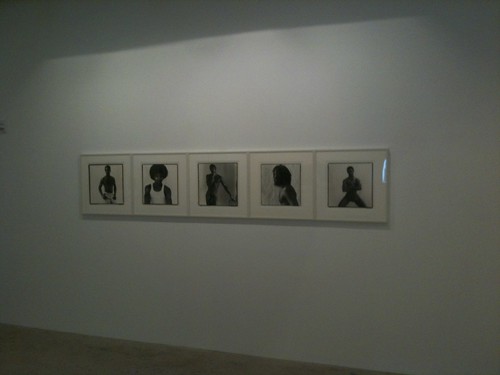
© Rotimi Fani-Kayode, The Walther Collection

If I may quote The Walther Collection's press release,
the photographs on view at The Walther Collection Project Space represent ke works from the series "Nothing to Lose," commissioned as part of the 1989 group exhibition Bodies of Experience: Stories About Living with HIV, which feature primarily portraits and self-portraiture; and from the series "Ecstatic Antibodies," included in the 1990 group exhibition Ecstatic Antibodies: Resisting the AIDS Mythology, which display transformations of the body through the use of masking. In addition, a selection of other black-and-white and color photographs, produced between 1986 and 1989, will also be on view.
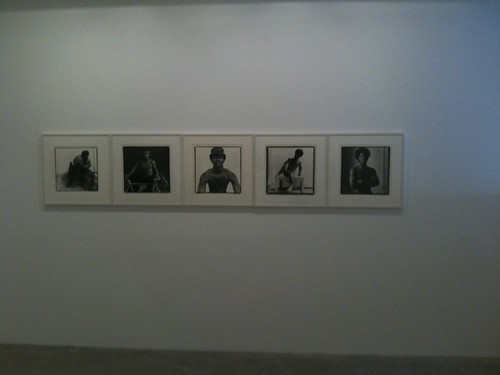
The color photographs, some of which have become iconic, depict Fani-Kayode and others in spiritually grounded, ritualistic poses that queer elements of Christian and Yoruba iconography, presenting visual depictions of cultural connection and difference that still feel original, despite the passage of nearly two and half decades and numerous photographers who have taken up his threads.  Many present rites that might allow the subject, and the viewer, to transcend the temporal and physical realm; others suggest menace, danger, a choice--as in a bite of a toxic fruit--that might have dire consequences. As the Walther Collection's press release states, they merge Fani-Kayode's "fascination with Yoruba 'techniques of ecstasy' and homoerotic self-expression through symbolic gestures, religion, sexuality, and elaborate decoration."  Other motifs that occur in these portraits include exile, death and blackness.

As he was making these images, Fani-Kayode was dealing with HIV/AIDS, and his personal struggle, which mirrored his outspoken public activism regarding the HIV/AIDS pandemic, informs all of these portraits.  The bodies here, Fani-Kayode's and others', black, male, queer, even while visually bestilled, often appear to be in motion, transition, in flight, but not away from the horrors of this disease, then at the apogee of its destruction, but toward and against it, in resistance to it, as well as toward zones of possibility, of healing and restoration, of connection of body and spirit, and differing cultural traditions. Rather than depictions of alienation or suffering (which too are here), the images are sites of potentiality, and Fani-Kayode's compositional choices, his use of vibrant color, and his pairing of obvious and more hidden symbols combine to charge each portrait on display.

Yet central to this potentiality and resistance is eros.  The eroticized, painted and adorned, partially masked or hidden, anointed and transformed black body, his and other bodies, lose none of their beauty or appeal despite the specter of HIV/AIDS not just hovering over them, but within them. Whereas Mapplethorpe, in hiding a face or focusing on a penis, sometimes slid into objectification, the effect in Fani-Kayode's portraits is synecdochic, and metonymic. The feet or hands or head of hair stand in for the whole body, in the fight of its life and facing down death, the whole body pointing to and standing alongside all the other black male and queer bodies that HIV/AIDS would carry away from this human realm. The spiritual nature of Fani-Kayode's portraiture then is especially important, because it suggests he was in touch with other worlds, that his subjects might, even if leaving this world, would be prepared for other ones.
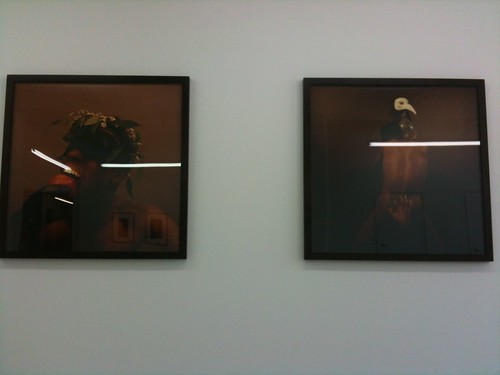
One final note: the gallery had several books for sale, including one featuring the work of Fani-Kayode and his late partner Alex Hirst, and while flipping through it I came across a number of Fani-Kayode's portraits featuring writers and artists I knew many years ago, among them the writer and scholar Guy-Mark Foster; one of the images I stopped on was titled "The Kiss" (or perhaps it was "Kiss"), featuring two beautiful young black men embracing, one cradling the other, about to kiss. I noted to the young gallery attendant that the two people in the photo were Essex Hemphill and Isaac Julien, two figures who played key roles in the emergence of Black Diasporic queer art. (He asked who Hemphill was, but certainly knew Julian.) For me, the image, like the others in the show, threaded the needle in terms of demonstrating that Fani-Kayode was and is another such figure. It also underlines his centrality to an era now gone, but captured in the literature and films and images that thankfully endure.

Photographs, Rotimi Fani-Kayode exhibit, NYC

Saturday, April 12, 2008

Poems: Kwame Dawes

Late in 2006 I posted about a reading poet Kwame Dawes gave at Naïeveté Studios, and also referenced him when I wrote about poet Uche Nduka, whom I finally got to meet at this year's AWP conference. Kwame (b. 1962-) whose site bills him as "the busiest man in literature today," is a remarkable figure on many levels, not least because he manages to do contribute a larger portion of his time to community-based activities, not only in South Carolina, where he lives and teaches, but also in Jamaica, where he grew up.

One of the important and extraordinary projects in Jamaica he's been involved with for several years now is Hope: Living & Loving with HIV Jamaica, commissioned by the Pulitzer Center, which describes its various components.

Poet and writer Kwame Dawes travels to Jamaica to explore the experience of people living with HIV/AIDS and to examine the ways in which the disease has shaped their lives. The journey brings him in touch with people who tell their stories, share their lives and teach him about resilience, hope and possibility in the face of despair. Some are living with the disease; others have committed their lives to HIV/AIDS care.

Hope: Living and Loving with HIV in Jamaica is a multi-media reporting project: an extended essay by Kwame Dawes for The Virginia Quarterly Review (Spring 2008), two short documentaries for the public-television program Foreign Exchange, a collection of poetry inspired by his reporting, a performance of the poems set to music by composer Kevin Simmonds, and LiveHopeLove.com, an interactive web presentation that synthesizes audio and text versions of the poems, the Foreign Exchange videos, additional video interviews, the music, and photography by Joshua Cogan.

I can't copy any of the poems directly, so please click on the image below to read them and also hear Kwame Dawes read them, see the accompanying photographs, and learn about the people, stories and experiences behind them.

Wednesday, January 02, 2008

Cosas Generales

I was going to type that I almost couldn't believe that the new year was underway, but then I realized I'd been waiting for it for a while. Still, there are times when I can't believe that 7 years have passed since 2001 and the turn of the millennium, which was, you'll remember, preceded by a year of frenzy when 2000 rolled around. Often I can recall the 90s, especially the years from 1995 through 2000, vividly, whereas much of the 2000s are a blur. Nevertheless, here's to what I hope is a lively and enjoyable year, personally and for all, even though some of the major economic signs, at least, appear exciting but not in a good way.

+++

Tomorrow promises ones of the biggest public excitements of the new year, the first (quasi-)primary in the 2008 presidential election calendar, the Iowa caucuses. (I'm glad someone on the Newshour with Jim Lehrer walked me and other viewers through these klatsches-over-kaffee-with-votes-thrown-in yesterday.) Truth be told, what a ridiculous means for selecting anything beyond wall colors for a community center. Not only is Iowa unrepresentative on so many counts in terms of the overall makeup of the US, but this system itself is both hyperdemocratic and at the same time, because so many Iowa voters might not be able to participate in it, undemocratic. It, and the whole Iowa-and-New Hampshire first mindset, should be scrapped.

I think the parties should designate 5 regions of the country, say: Northeast, Southeast, Southwest, Pacific Coast and Rocky Mountain, and Midwest, and have a monthly randomly-selected round robin set of primaries, on the same day, in at least one state from each region, with two others selected at random from different regions, for about 7-8 total. 8 would bring the primaries to June, 7 to July. The four largest states, California, Texas, the ever-shrinking New York, and Florida, would be included in the mix. Thus, January's primaries might include: Rhode Island, Georgia, Nevada, Washington, and Missouri, plus Wyoming and Maryland; or Maine, Alabama, Arizona, California, and Wisconsin, plus New Mexico and Michigan. Or something along those lines. These primaries would be one-person one-vote, open, and tallied by paper ballot (in person or via mail). Every state would eventually have an opportunity to gather the early attention, money and swag, the candidates would have to tailor a national platform more quickly, and the execrable national media might have to really do some work for a change. Will it happen? I doubt it, but one can only hope.

I'm not going to make any predictions and the whole "horse race" and money-raising focuses drive me up the wall, but I can say that I have received more emails and calls (thank the Lord they haven't turned to text messaging yet) from the Obama campaign, despite the fact that I've responded harshly both online and in yet another letter, which I sent out today. One of the most annoying email came several months from Michelle Obama, one of which carried the casual and aggressive subject line "Hey." That was it. "Hey" is supposed to make me want to support her husband, whom she recently said has "deign[ed]" to enter the race? Why, thank you. Most of the Obama missives center on campaign strategy, the evils of the other Democratic candidates, and fundraising, which are the last three things I want to hear about. In fact, I would much rather that Obama offer a concrete progressive platform for his proposed administration and address current and long-term political issues, even in a more philosophical, less specific way, while also explaining his frequent invocation of empty post-bipartisanship discourse and use of rightwing frames and rhetoric, which are going to be thrown right back at him or any of the Democrats (along with the anti-Muslim smears that are being steadily churned up). But I gather his campaign advisors don't care about this, since they are already wooing independents and some liberal Republicans, and they just may win Iowa, and New Hampshire. Or not. Oh well, either way, I'm curious to see the outcome tomorrow night. Ultimate, he, Hillary Clinton, John Edwards, Bill Richardson, and the other Democrats, save Dennis Kucinich and Mike Gravel are fairly close in terms of politics and policies, and will have to be ready for the fights of their lives against the Republicans, the mainstream media, and general public ignorance, in the general campaign.

+++

I haven't commented on the ongoing electoral crisis in Kenya, but I had a strong feeling in the days leading up to the presidential election there that incumbent Mwai Kibaki was somehow going to be declared the victor despite articles and polls I'd read suggesting that opposition candidate Raila Odinga had the edge. There have been a number of rather sketchy presidential and governmental elections across the globe over the last few years, from Mexico to Nigeria to Russia to Pakistan to, yes, the USA, all of which underline the fact that in many countries rulers and ruling elites that are intent on holding on to power will readily do so under the pretext of "democracy," or some flimsy version thereof, and dare anyone to challenge them, while also seeking international sanction to legimitize and normalize the chicanery, unless their hands are forced.

I mention the US in particular, because the present administration perhaps feels it cannot simply refrain from commenting on the situation in Kenya, and yet it's really the height of irony for anyone from this gang to be uttering a word about voting irregularities, fraud, or working with the opposition. I guess Florida 2000 and Ohio 2004, along with all the shenanigans leading up to and after both elections should be completely forgotten. (Have most people simply blanked on both?) Maybe the most powerful thing would be for Condoleezza Rice simply to state publicly that the W Gang knows a thing not only about misgoverning and pitting groups against each other, but also about engineering and stealing elections, and Kibaki didn't do such a good job at it, but, like Musharraf, they've (still) got his back. It is, really, a mess. Gukira's inimitable take(s) are here.

+++

Amidst the news and ramblings in today's New York Times was this Sarah Kershaw piece, on how HIV seroconversions are falling overall in NYC, but still rising among young gay men. The rise is comparatively highest for young African-American and Latino men. Sewall Chan links to the piece in today's Times City Room Blog, and notes that Kershaw identified several important co-factors, including "higher rates of drug use among younger men, which can fuel dangerous sex practices, optimism among them that AIDS can be readily treated, and a growing stigma about H.I.V. among gays that keeps some men from revealing that they are infected." Yet another that she glosses and which a younger (in his 30s) friend mentioned to me a few years ago was a certain fatalism and belief that he was sure to seroconvert no matter what he did, that he expected to do so. He was, in a word, fated to become HIV positive. I've posted about this before, so I ask: thoughts? Responses?

RANDOM PHOTO

Crèche scene, on Houston Street, last month