 |
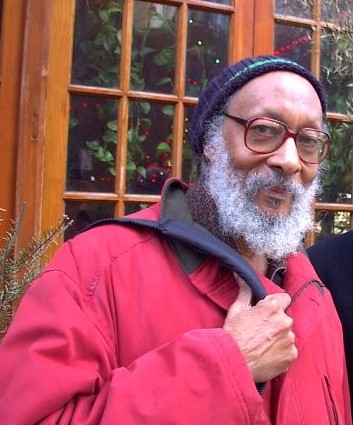
| Edward Kamau Brathwaite (from repeatingislands.com) |
I was trying to remember if I had featured
Kamau Brathwaite (1930-) on J's Theater before, and I was pretty sure I had, but it turns out that while I have mentioned him many times, including
in my very first post, the only
work of his that I've ever featured is his
highly anguished call for help to save
CowPastor/Cow Pasture, the large open areas near where he lives in
Christ Church, Barbados, that the government and private entities seized control of through which to lay roads. Not to aestheticize the letter, but it bears many of the hallmarks of Brathwaite's poetry, from its orthography to its reconstitution of language itself. As it turns out, poet
Tom Raworth set up a site,
Save Cowpasture, that's still up, and last fall Brathwaite wrote Raworth to thank him for keeping the site up. He also mentions the
TIME OF SALT, and there's a link to
+++SaVing CowPastor & the KB Cultural Lynching 2004-2011+ by clicking this link, which is, to put it mildly, an extraordinary document, a setting of the letters, accounts, recountings, the
stories, of the fight for CowPastor/CowPasture and Brathwaite's struggles in
New York and
Barbados.
Extraordinary really only scratches the surface when it comes to Brathwaite. I know. I studied with him, and count the experience among the most fortunate in my life. I'm not just talking about him as a teacher, critic, theorist, historian, or raconteur, nor as the sort of person who, almost out of nowhere, announces that a graduate class should begin preparing to go to a foreign country for a class trip (he did this), or who tells of how he witnessed another famous writer's wife walking through a wall (he did this). I don't want to start delving into mysticism, metaphysics and the supernatural, but let me just say that when you spend some time around someone operating at this level, a true konjur man with a mind like the libraries of Alexandria and an ability to see into the hidden heart of things you tend not to doubt them. He pulled off that trip. That transmural passage as a result didn't seem so inconceivable. There are keys all throughout his work that he operates or accesses many different channels. You really could spend a lifetime teasing some of these keys out, following the threads, raveling and reraveling them again, and if you read him carefully enough he points them out. A sharp graduate student will probably elect to do this at some point down the road.
To put it another way, he is the one of the most important and original living Caribbean poets, one of the major poets writing in English, a signal figure of African Diasporic poetry and poetics, and a living treasure. He has proved this over nearly 40 books of poetry, critical prose, and memoirs, many of these works constituting works of hybrid genre that defy easy categorization. Through this rich body of work, he has developed a language drawn from his native Barbados, the Caribbean and Latin America, his readings, studies and experiences in Britain and the US, strikingly singular and personal, but also transnational and universal. To fully capture this language, informed by the principle, in part of
nommo (from the
Bantu) and
nam, he created typography/textual form, the
Sycorax Dub script (I believe that's the name). He has garnered, among his many awards, the
Neustadt International Prize for Literature, which used often to be a tip for the Nobel Prize; the
Griffin Poetry Prize, one of the highest awards for world poetry, handed out in Canada; and
Premio de la Casa de las Américas, awarded by the Cuban government for an exceptional from the Caribbean. I know him because he has served for two decades as Professor of Comparative Literature at
New York University.
This potted intro hardly does him justice, though. There is no substitute for his poetry, which is so verbally and visually powerful it dazzles. The poem below, which I recalled from a journal I had in my office, is a distillation. If you can, read it aloud, and you will feel the bird rising off this screen; it might even guide you to places you had not ever imagined.
BIRD RISING

Until it come to the time for the great bird the Mithurii .
    to begin its ascent
its challenge against the eart . the paradoxical oracle of wind . the
    the wings beating
unchaining. out. boarding as seamen might say . the gret beast
    ruffled & rising
as in all the great legends

and this happening here before me now under me now wonderfully
    surrounding me
the white silver louvered feather shift & chevron stretching out
    across the sunlight
the great terrible beauty & beating we have always heard about
beating beating upward & forward . the planks of its shape
    shivering at first like a ship

like a dhow . then spheering down into smooth as we scool
    up. wards

Now the first hills at the darker mountains of english . the sea
    below all shard
& silver like our shadow . the beacon topaz eyes unblinking even
    through all the shudder
the wings now stretched across all space openly & awesomely . so
    that we are not beating
any. more but ahh sailing something like singing . because at last
    I have been able

to use all the wounds in the language . as long as I lay them out
    softly & carefully
like these unfluttering feathers of song . like the sea below
    turning into a grey ball of wine
without fishes or sperm . like the darkness no longer lingering
    above us
but we moving towards it as part of its fuse & its future . the àxé
    & ayisha of sails

one last time in our ears . the earth gone a long time now from
    green spur arrogance
of john crow mountain. strange
not even the memory of a veiled carefree river in these high
    places . too far up now
for sunsets through all this rain & distance in our eyes. in our
    sleep. in our silence

the metaphor at last afloat almost alight in the darkness
Copyright © Edward Kamau Brathwaite, "Bird Rising," in
Conjunctions: Bi-Annual Volumes of New Writing, No. 27, The Archipelago: New Writing From and About the Caribbean, Edited by Robert Antoni and Bradford Morrow, pp. 89-90. All rights reserved.