Showing posts with label Left. Show all posts

Saturday, September 01, 2018

Farewell, Village Voice


For the last decade or so, I have only occasionally read Village Voice, mostly online, but once upon a time, when I was in my 20s and living in Boston, acquiring a copy of the Voice at one of the news stands there, and perusing it to find out what was happening in New York, was one of the highlights of my week. (Back then I also read the New York Times in print almost every day too.) The Voice provided a trove of news about politics, in New York and beyond, as well as some of the most invigorating criticism about art, entertainment, the broader culture and the world, that you might find anywhere. For me it constantly outmatched Boston's own Phoenix, that city's alternative paper, and was part of a national ecosystem of similar papers that offered fresh, often left-leaning and progressive but always counter-mainstream perspectives on the state of the world. Now, the Voice is gone.

It's where I first learned about New York's legendary Public Theater and its pathblazing directors Joseph Papp and George C. Wolfe; it was one of the mainstream places where I regularly found informative reportage, Andrew Kopkind, Richard Goldstein and others, about about HIV and AIDS. It was a regular-go to learn about the newest and less common films, books, music, theater and performances of all kinds. The Voice also brought to me and countless readers original photography (Sylvia Plachy, C. Carr, etc.), cartoons by Jules Feiffer, Ted Rall, Lynda Barry, Mark Alan Stamaty, and Tom Tomorrow, and literature (I recollect reading a story by the great poet Elizabeth Alexander's there, among other gems). I was enthralled by Greg Tate's, Joan Morgan's and Gary Indiana's criticism, and when my friend Scott Poulson-Bryant (now Dr. Poulson-Bryant, and a professor at Fordham University) secured an internship and then a job there, it seemed like an unimaginably wonderful thing had occurred. Other than Greg Tate, the one columnist I made sure never to miss was Michael Musto, whose tour through NYC's once inimitable queer club scene will probably never be equalled again.

When C and I moved to the New York area, the Voice remained a paper I rarely missed reading. I'd even looked in its ads section in my search for an apartment when heading to NYU. When Annotations appeared, a young writer named Colson Whitehead wrote one of the most insightful, praiseworthy reviews the book received, and it meant everything to me that it appeared in the Voice. When the Voice became free in New York in 1996--which I loved but also figured was a bad sign--I would grab a copy in Manhattan before heading back to New Jersey, where we still had to pay for them. Yet I also paid attention to the labor strife that was wracking the paper in 2005 and 2006, and again in 2013: editors fired or resigning, writers sharing their fears over decreased benefits and the new owners' tunnel vision, and worse. Even as its leadership changed, the Voice remained one of the rare news organs that seemed not to coddle the rich and powerful--I recall Wayne Barrett's extensive  reporting on Rudy Giuliani's administration, and the time it ran an article outing New York's conservative Catholic Cardinal Edward Egan--and continued to employ incisive writers like Steven Thrasher. Yet in the end, its most recent owner, and the shifts in the media industry, ensured its demise.

Established in 1955 by Dan Wolf, Ed Fancher, John Willcock, and Norman Mailer, the Voice was the US's first alternative weekly, and received a wide array of honors over its 63-year existence, including Pulitzer Prizes, National Press, and George Polk awards. It survived a number of owners over the years, until it was sold in October 2015, by its penultimate owner, Voice Media Group, to billionaire heir Peter Barbey. In August 2017, the Voice announced it would cease to exist as a print publication, and its final print issue appeared on September 17, 2015. Although Barbey said that he wanted to save the Voice, and despite his considerable financial reserves, he claimed that financial exigencies required him to shut down the paper, even as he allegedly has been searching for someone to buy it. Yesterday, the electronic edition ceased publication, half the staff were laid off, and those who remain will assist for a limited period in archiving the paper's rich store of articles and materials. Yet the fact remains that one of the once truly vital organs of reportage, investigation and criticism, for New York, the US and the globe, is gone, and with it passes an era--many really--that we will somebody


Thursday, July 05, 2018

Andrés Manuel López Obrador (AMLO) Wins Mexican Presidency

Andrés Manuel López Obrador speaks
at a press conference in Mexico City, July 3,
2018 (Photo: Manuel Velazquez/Getty Images)
from New York Magazine
Three times can sometimes produce a seismic charm, or so it appears for Andrés Manuel López Obrador (AMLO) (1953-), who was finally elected President of Mexico on July 1, this past Sunday. Though a longtime member the leftist Partido de la Revolución Democrática (Democratic Revolution Party, or PRD) and a failed candidate in the contested 2006 and 2012 national elections, AMLO, a former Governor of the Federal District, ran under the aegis of a new left-leaning coalition, Juntos Haremos Historia (Together We Will Make History), that comprised the progressive Movimiento de la Regeneración Nacional (National Regeneration Movement/MORENA) and Partido de Trabajadores (Labor Party/PT) parties with a socially conservative party, Partido Encuentro Social (Social Encounter Party/PES). AMLO will assume office on December 1, 2018, which, given Mexico's current parlous state, will not be a moment too soon.

AMLO's chief rivals in this year's presidential election were Ricardo Anaya of the Partido Acción Nacional (National Action Party/PAN), the center-right party of former president Vicente Fox (who served from 2000-2006) an antagonist of US Republican presidents George W. Bush and Donald Trump; José Antonio Meade of the Partido Revolucionario Institucional (Institutional Revolutionary Party/PRI), the neoliberal, longtime ruling party to which incumbent president Enrique Peña Nieto (2012-2018) belongs; and two independent candidates, Jaime Rodríguez Calderón, who had previously become the first independent candidate to win a state governorship when he helmed Nuevo Leon; and Margarita Zavala, a noted lawyer, and the wife of former president and PAN figurehead Felipe Calderón (in office from 2006-2012).

In essence, AMLO was not just leading a visibly left coalition but represented the only left-leaning option for Mexican voters in this presidential election. As the campaign progressed, Mexico's political and social elites grew increasingly alarmed, and perhaps rightly so. Yet the hiccuping economy, metastasizing violence, which even marked the lead-up to the election, and continuing allegations of extensive, high-level government corruption, blunted the right's blizzard of "Mexico will turn into Venezuela"-scare tactics, some with racist and classist tones, including advertisements, robocalls, videos, and social media attacks, not unlike ones that had doomed AMLO's chances in the prior two elections.

In one instance, a PRI operative named Enrique Ochoa Reza tweeted that PRI politicians who switched parties to MORENA were "Prietos que no aprietan" (Dark-skinned/black people who can't get a hold), playing on the double meanings of "moreno/a" (brown/black man/woman) and "prieto" (dark/black person), as well as the feminine form of the former word (morena=brown woman/black woman) and the verb aprietar (not being able to keep somebody). Ochoa Reza did apologize for the racist aspect of his slur, but not the misogynistic one. Additionally, there were allegations of US and Guatemalan meddling in the campaign, and Ochoa Reza accused Russia of interfering on behalf of AMLO, a charge the eventual victor laughed off.

The attacks, however numerous and outrageous, could not overcome Mexican voters disgust at the current state of affairs. AMLO won in a landslide, defeating Anaya by 21 percentage points while winning 53% of the total vote and popular vote. The final tally in an election that saw a 63.6% turnout (or 56.6 million voters out of 89.9 registered voters) was as follows, with AMLO winning 31 of Mexico's 32 states, and the first outright majority for a presidential candidate since 1989:

2018 Mexican Presidential Candidate & PartyVote Total
AMLO (National Regeneration Movement/Juntos Haremos Historia)30,112,109
Ricardo Anaya (PAN/Por México al Frente)12,609,472
José Antonio Meade (PRI/Todos por México)9,289,378
Jaime Rodríguez Calderón (Independent)32,743
Margarita Zavala (Independent)31,983

While his ideology has long been diametrically opposed to what we see with a figure like Donald Trump, they share a vocal populist nationalism, AMLO's rooted in the left and democratic socialism instead of Trump's ethnonationalist and racist authoritarian approach. What this might mean for the cozy relationship between Mexico's large corporations and land owners and the government and for an approach to a renegotiated North American Free Trade Agreement (NAFTA) that privileges international structures and rules over the country's laws remains to be seen, but given the Juntos Haremos Historia/MORENA's capture of 312 of 500 seats in the Chamber of Deputies, and the strong popular mandate for the coalition and new president, AMLO could throw wrenches in Mexico's steady march towards privatization and economic (classical) liberalization, in favor of policies that more effectively and immediately address the rising economic inequality and insecurity that millions of Mexicans are facing.

During the campaign AMLO announced that he would push to reform some of the perks of the presidency, including cutting his salary and that of top officials, selling presidential planes, creating a public park out of the presidential grounds, and ending the lifetime pension former presidents receive, with the savings being directed towards Mexican seniors, who have a far less secure and comparatively robust retirement savings system than US's fixed pensions, 401K savings plans, and Social Security (which itself is admittedly always under threat from US conservatives and neoliberals). He also attacked the International Monetary Fund as an enabler of and participant in Mexico's corruption, suggesting he might pull back not just from the IMF but from other international financial systems that have long kept Mexico under yoke. One key question would be how projected new NAFTA negotiations might change as a result of this approach.

As Nathaniel Parish Flannery argues in a recent Forbes article, "The AMLO Era: Why Mexico's 2018 Election Matters," nearly half of Mexicans live in poverty, and despite the country's prowess in manufacturing, wages remain abysmal. Stemming governmental corruption and addressing the country's sluggish growth rate, rising economic and social inequality, the persistent lack of jobs in the formal economy, and low, stagnant wages across all labor sectors could have beneficial, ramifying effects on all aspects of Mexican society. The question for AMLO and Mexico's congress is how to spur all of this such that all the wealth does not continue to flow upwards to the relatively tiny sector of rich elites. Strategies to create a viable and vibrant middle class, which would necessitate a retreat from the neoliberalization of the prior PRI and PAN administrations, transformed tax and business policies, support for public education and farmers, and a strengthened safety net, could be among AMLO's and the new left-leaning Congress's potential steps.

Some of this, beyond NAFTA talks, will hinge on the "new relationship" AMLO has vowed to forge with Mexico's often domineering neighbor the United States. While the US and Mexico are among each others' largest trading partners and cooperate extensively in a range of areas, the two current leaders, Trump and Peña Nieto, have been at loggerheads, in part because of Trump's persistent attacks on Mexico and Mexicans, beginning the day he announced his presidential campaign and slandered Mexican immigrants, and because Peña Nieto understandably has refused to pay for Trump's desired border wall. AMLO has already challenged the border wall idea in a pamphlet he published, entitled Oye Trump (Listen Up, Trump). One goal AMLO outlined was development of Mexico's "internal market," so that "Mexicans can work and be happy where they were born, where their family is, where their customs and cultures are." Creating an expanding middle class is crucial to ensuring this market can flourish, and to transforming the migrant flows.

Another challenge for AMLO will be to figure out a way to lower the violence that has plagued Mexico. Neither Calderón's nor Peña Nieto's approaches worked; corruption remains endemic at all levels, and organized crime is strong as well. In addition, since September 2017, 130 political figures, from the municipal to the national level, have been murdered, and journalists across Mexico have been targeted for investigative and critical work. AMLO supposedly has suggested amnesty for low-level drug offenders, which sparked criticism, but it also is the case that Peña Nieto's initial policy approach of militarized attacks on the cartels failed, as did prior attempts to negotiate with organized crime. Rising pay for all workers, and better wages for domestic security and military forces could help to thwart the power of organized crime to infiltrate them, but AMLO also has suggested a "peace plan," involving human rights organizations, religious organizations, among others, to negotiate a decline in the murder rate.

I see less of a parallel with Hugo Chavez, to who AMLO has been repeatedly compared, and more of one with the presidency of Luiz Inácio "Lula" da Silva, Brazil's now imprisoned but still widely popular former president. Formerly a firebrand leftist from his country's Worker's Party, Lula lost three elections before finally becoming president in 2003, and governed for two terms. Lula moderated his platform in his successful campaign, presiding over a series of liberalized economic policies that on the one hand led to considerable growth, but which included a range of social policies that helped lift millions of Brazilians out of poverty, increased Brazil's safety net, and created a visible if fragile middle class. Unfortunately, Lula did not target systemic corruption with the same zeal, and now finds himself crucified not only because of his opponents' vengeance, but as a result of his and his successor's failure to truly wrestle with the beast of corruption during the height of their successes. With AMLO, domestic economic policies and global financial trends could prove his ally or enemy, but a failure to address systemic corruption, impossible a task as that may be, could destroy not only the tremendous support he now enjoys, but damn his and his coalition's future, let alone Mexico, for decades to come.


Wednesday, January 15, 2014

Two Poems: Juan Gelman (RIP)

Juan Gelman, the politically committed and supremely inventive and talented Argentinian poet and winner of the Cervantes Prize, one of the highest for Spanish-language literature, passed away yesterday in Mexico City at the age of 83. Here are two poems by him, the first in translation, the second in Spanish and, according to the Spanish newspaper El país, the last poem he wrote. RIP.

Juan Gelman (from Coffee and
Saturday: Cultura y arte)
SAINT THERESA

and with many birds and their songs in the /
highest part of the mind or head / and rumblings
in it like the sea / or laments /
or winds or movements / suns

that clash / go out / then burn again / or powers
like thousands of animals that track        
up the suburbs of the soul / suffering
terrible ordeals i mean / even so

the soul goes on whole in its quiet state /
or desire / or clear light untouched
by sorrow / scorn / misery /
suffering or ruin / so

what is this peace without vengeance / or memory
of a future heaven / or tenderness
coming down from your hands / spring water
where birds in the highest part of the mind

rally to drink / sing sweetly / or are silent
like light issuing from you / wing
flying softly above war and fatigue
like the flight of passion itself?

Copyright © "Saint Theresa" by Juan Gelman (2014), translated by Hardie St. Martin, from Exquisite Corpse, 2014. All rights reserved.

and

according to Coffee and Saturday: Cultura y arte, the last poem Gelman wrote, by hand:

VERDAD ES

Cada día
me acerco más a mi esqueleto.
Se está asomando con razón.
Lo metí en buenas y en feas sin preguntarle nada,
él siempre preguntándome, sin ver
cómo era la dicha o la desdicha,
sin quejarse, sin
distancias efímeras de mí.

Copyright © Juan Gelman, 2014. All rights reserved.

Sunday, May 06, 2012

France Elects Socialist Hollande + A Black, Gay Olympic Male Gymnast?

New French President François Hollande
with his partner, journalist Valérie Trierweiler (AP)
Leave it to France to show the world how it's done. Today, after 5 years of right-wing governance that helped to solidify the pro-austerity approach now ravaging Europe, the French people began the process of revolt, voting in their presidential contest's second round to send their globe-trotting, pro-US, plutocrat-enabling head of state, Nicolas Sarkozy, back to the wealthy suburb of Neuilly-sur-Seine. In his place they elected the former First Secretary of the Socialist Party, François Hollande, as the 24th President of the French Republic (and Co-Prince of Andorra), with a vote of 52% to 48%. Sarkozy becomes only the second French President to serve one term in the last 40 years.

Where Sarkozy has maintained a non-stop narcissistic show and meddlesome razzle-dazzle within France and globally, punctuating it with extremist rhetoric and policies at times, Hollande has suggested he will remain "M. Normal," and has promised to take a more measured approach politically.  But he has proposed measures such as raising the federal marginal tax rates to 75%; reducing France's dependence on nuclear power in favor of renewable sources; recruiting 60,000 more teachers, as well as judges and police officers; push for full marriage equality; restoring the retirement age to 60 for workers who have contributed more than 41 years of labor; and building more public housing. These policies, as well as more centrist ones such as lowering the corporate and small-business tax rates and creating a public investment bank,  while not going as far as his last Socialist predecessor François Mitterand (whose radical, nationalizing, pro-worker policies in 1981 sent shockwaves throughout the country and continent), are all to the left of Sarkozy (or most of the leaders of Europe, the United States, or even Canada, for that matter).
 
Light in touch as he may hope to be, Hollande cannot proceed too slowly or at too far a remove on the global stage, for the Eurozone, especially the countries (Ireland, Spain, Portugal, Italy, and certainly Greece) on its periphery, its ill.  As President he has the power and platform to rethink the German-led fiscal and monetary approach that is strangling the periphery nations; whether he can persuade Germany's Chancellor Angela Merkel to adopt a different approach or pressure the European Common Bank toward more effective monetary policies remains to be seen.  Too, his election, is only the first step; French voters next have the opportunity to elect their parliament, which has been under the control of the combined conservative parties, led by Sarkozy's UMAP party, but which will likely shift to the left, giving President Hollande a Prime Minister he can work with, and legislative power.  On economic issues his power could increase as well if  if Marine LePen's extreme-right National Front party, which now has no representatives either in the National Assembly (Lower House) or Senate (Upper House), cannibalizes seats at the expense of Sarkozy's UMAP.

As an aside or adjunct, it struck me that most of Europe, like many of the major industrialized countries across the globe, save in Latin America, either has been under the control of center-right or right parties or has fallen under their control, so France's shift is a dramatic one. But I also realized--and perhaps I am making too much of this--that the United States, having been under truly far-right control for 8 years, under George W. Bush, began the shift in 2006 by handing control of Congress to the Democrats, and cemented the shift in 2008 by electing Barack Obama by a 53%-47% margin over John McCain and returning the Democrats to power in both houses. Though the president, who has governed along the lines of Dwight Eisenhower, with an interventionist foreign policy and mini-wars, and phantasmally liberal social and economic policies adopted by his predecessors, has been repeatedly deamed a "socialist" by his opponents, the American voters, seeking changes in direction on the social, economic and political fronts in 2008 have gotten more continuity than they sought, which has meant a slow and stuttering economic recovery crippled to a great degree by de facto fiscal austerity, a glacial deescalation of the foreign wars, and increasing assualts on civil liberties. One might then say that US voters, having lived through the worst of the worst--though certainly Silvio Berlusconi ranks up there, and Jacques Chirac, another rightist politician, was no dance in a nightclub--sought but did not get what the French voters think they've achieved now. One can only hope that Hollande can secure a National Assembly (the more powerful of France's two houses) to support his vision and push it, and that President Obama, who looks like he will be reelected, and the Democrats in Congress, even if they only retain control of the Senate, as well as whatever remains of the moderate elements of the GOP, pay attention. Forward, yes, but change, absolutely!

Also: Here's Professor Paul Krugman on François Hollande's win, and the elections in Greece, in which voters drubbed the two major parties, the center-right New Democracy (Conservative) party and center-left Pasok (Socialist), selecting legislators from much farther to the left (Syriza--Coalition of the Radical Left, which finished second, after ND, and the Democratic Left) and to the right (the Independent Greek Party and the ultra-rightwing neo-Nazi Golden Dawn). An anti-austerity, anti-bailout coalition, led by Syriza, with rightist elements, very well could take power, sending the markets tanking and Greece out of the eurozone....

===

Robert G. sent this link to Cyd Ziegler Jr.'s article today on the Outsports site, which reported that the United States very well could, for the first time ever, have an out, gay gymnast on its Olympic men's gymnastic team. Who is he? Josh Dixon, a 2011 Stanford University graduate and seven-time All American, who yesterday finished second out of 72 competitors at the US men's qualifiers in Colorado Springs, Colorado, also tying for the top spot in two events, the floor exercise and the high bar. Oh, and Dixon is an African-American and Japanese-American adoptee who grew up in a multiracial, accepting home, which led him to feel comfortable coming out, an experience that his Stanford teammates, and fellow students, as well as gymnastic competitors, have nurtured through their support over the last few years.

According to Ziegler, his next challenge is the Visa Championships in June (7-10) in St. Louis; the top 15 finishers at that meet will proceed to the Olympic Trials, which run June 28 to July 1, in Dixon's hometown of San Jose, and he very well could be one of the 6 young men to compete for the USA. I just knocked on wood, and am wishing him the best.


Here's a YouTube video of Dixon during his sophomore year, in 2009, competing for the Cardinal in the floor exercises:

Wednesday, February 15, 2012

Excerpt: Noam Chomsky

An excerpt from: Noam Chomsky's "'Losing' the World": American Decline in Perspective, Part 1, znet.com, February 14, 2012

"There are important lessons in all this for today, even apart from another reminder that only the weak and defeated are called to account for their crimes. One lesson is that to understand what is happening we should attend not only to critical events of the real world, often dismissed from history, but also to what leaders and elite opinion believe, however tinged with fantasy. Another lesson is that alongside the flights of fancy concocted to terrify and mobilize the public (and perhaps believed by some who are trapped in their own rhetoric), there is also geostrategic planning based on principles that are rational and stable over long periods because they are rooted in stable institutions and their concerns. That is true in the case of Vietnam as well. I will return to that, only stressing here that the persistent factors in state action are generally well concealed.

"The Iraq war is an instructive case. It was marketed to a terrified public on the usual grounds of self-defense against an awesome threat to survival: the “single question,” George W. Bush and Tony Blair declared, was whether Saddam Hussein would end his programs of developing weapons of mass destruction. When the single question received the wrong answer, government rhetoric shifted effortlessly to our “yearning for democracy,” and educated opinion duly followed course; all routine.

"Later, as the scale of the U.S. defeat in Iraq was becoming difficult to suppress, the government quietly conceded what had been clear all along. In 2007-2008, the administration officially announced that a final settlement must grant the U.S. military bases and the right of combat operations, and must privilege U.S. investors in the rich energy system -- demands later reluctantly abandoned in the face of Iraqi resistance. And all well kept from the general population."

Monday, April 18, 2011

Santorum Stupidity Over: Poem: Langston Hughes

This weekend brought news of a brouhaha involving the extreme right-wing, homophobic Republican former US Senator from Pennsylvania, Rick Santorum, he whose last name has, through the deft work of columnist and author Dan Savage, become a particularly vivid eponym. But our concern here isn't with the eponym and its figurative associations, apt as they are for Santorum, but with a bit of foolishness on his part. (C can probably already hear me pronouncing this word in the Deep South-fashion as "foolnish.") For Santorum selected a phrase that to him sounded just right for his potential Presidential campaign, Quixotic though we all know it will be--or Quayline, since he lacks even an iota of Don Quixote's sense and all of Dan Quayle's limitations; a phrase that, to his, or his campaign staff's ears, sounded just right: "Let America Be America Again."

As it turns out, the progressive website Think Progress saw this slogan and grasped that it came from Langston Hughes's (1902-1967) "Let America Be America Again," a pro-union, pro-immigrant, pro-equality--progressive!--poem he published in 1935, during the era of the Great Depression.  Hughes, as I need not tell anyone, was black, and gay, and a committed leftist. He was a cosmpolitan and an internationalist, a strong advocate of black consciousness and of Diasporism. He was the grandson of the abolitionist Charles Langston and a nephew of abolitionist and educator John Mercer Langston. He was even a correspondent for and member of Communist organizations, etc. All of this is searchable on Google, as is the slogan Santorum selected, which was, for those of us with even the slightest memory, already in the political air as Democratic Presidential candidate John Kerry had not just sampled, but recited a selection of it in 2004. (How could anyone forget a Presidential candidate being able to quote a poem, especially one by Hughes?)

Nevertheless, Santorum went with the slogan. Until a Think Progress reporter, Lee Fang, asked him about the words and their background. This is how Gawker reported it:

"No I had nothing to do with that," he said. "I didn't know that. And the folks who worked on that slogan for me didn't inform me that it came from that, if it in fact came from that."

When he was later asked what it means to him, Santorum replied: "Well, I'm not too sure that's my campaign slogan, I think it's on a web site."

But he also used it in the official press release announcing his exploratory committee earlier this week....

Et cetera. Santorum isn't getting anywhere the White House, the Senate, or the Pennsylvania State House for that matter, but the flap did provoke the following question: can he read? Because if or his minions did even pass a cursory eye over the following poem, it would be evident what Hughes was arguing here. Some poems are admittedly difficult to grasp. I have written a few of those myself. Hughes has as well. But some do not, as Wallace Stevens wrote in his poem "Man Carrying Thing," "resist the intelligence / Almost successfully." Some are quite straightforward and evident even to the dullest of minds. A category that, as his past record would attest, includes Santorum.

Here is Hughes's poem in full, easy to grasp, and quite beautiful and moving, in my humble opinion. It shakes me up a bit every time I read it. More of our politicians need to read it, and recite it to themselves as they cut deals with plutocrats and carve what remains of our government and society up, what remains of our threadbare social safety net, for their friends and patrons.

LET AMERICA BE AMERICA AGAIN

Let America be America again.
Let it be the dream it used to be.
Let it be the pioneer on the plain
Seeking a home where he himself is free.

(America never was America to me.)

Let America be the dream the dreamers dreamed--
Let it be that great strong land of love
Where never kings connive nor tyrants scheme
That any man be crushed by one above.

(It never was America to me.)

O, let my land be a land where Liberty
Is crowned with no false patriotic wreath,
But opportunity is real, and life is free,
Equality is in the air we breathe.

(There's never been equality for me,
Nor freedom in this "homeland of the free.")

Say, who are you that mumbles in the dark?
And who are you that draws your veil across the stars?

I am the poor white, fooled and pushed apart,
I am the Negro bearing slavery's scars.
I am the red man driven from the land,
I am the immigrant clutching the hope I seek--
And finding only the same old stupid plan
Of dog eat dog, of mighty crush the weak.

I am the young man, full of strength and hope,
Tangled in that ancient endless chain
Of profit, power, gain, of grab the land!
Of grab the gold! Of grab the ways of satisfying need!
Of work the men! Of take the pay!
Of owning everything for one's own greed!

I am the farmer, bondsman to the soil.
I am the worker sold to the machine.
I am the Negro, servant to you all.
I am the people, humble, hungry, mean--
Hungry yet today despite the dream.
Beaten yet today--O, Pioneers!
I am the man who never got ahead,
The poorest worker bartered through the years.

Yet I'm the one who dreamt our basic dream
In the Old World while still a serf of kings,
Who dreamt a dream so strong, so brave, so true,
That even yet its mighty daring sings
In every brick and stone, in every furrow turned
That's made America the land it has become.
O, I'm the man who sailed those early seas
In search of what I meant to be my home--
For I'm the one who left dark Ireland's shore,
And Poland's plain, and England's grassy lea,
And torn from Black Africa's strand I came
To build a "homeland of the free."

The free?

Who said the free? Not me?
Surely not me? The millions on relief today?
The millions shot down when we strike?
The millions who have nothing for our pay?
For all the dreams we've dreamed
And all the songs we've sung
And all the hopes we've held
And all the flags we've hung,
The millions who have nothing for our pay--
Except the dream that's almost dead today.

O, let America be America again--
The land that never has been yet--
And yet must be--the land where every man is free.
The land that's mine--the poor man's, Indian's, Negro's, ME--
Who made America,
Whose sweat and blood, whose faith and pain,
Whose hand at the foundry, whose plow in the rain,
Must bring back our mighty dream again.

Sure, call me any ugly name you choose--
The steel of freedom does not stain.
From those who live like leeches on the people's lives,
We must take back our land again,
America!


O, yes,
I say it plain,
America never was America to me,
And yet I swear this oath--
America will be!

Out of the rack and ruin of our gangster death,
The rape and rot of graft, and stealth, and lies,
We, the people, must redeem
The land, the mines, the plants, the rivers.
The mountains and the endless plain--
All, all the stretch of these great green states--
And make America again!

From The Collected Poems of Langston Hughes, published by Alfred A. Knopf, Inc. Copyright © 1994 the Estate of Langston Hughes. Used with permission.

Saturday, April 02, 2011

Manning Marable (1950-2011)

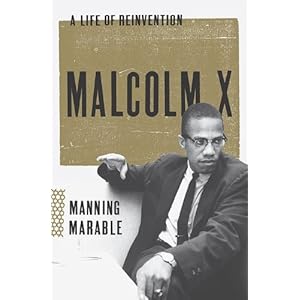
It saddened me tremendously to learn of Manning Marable's (1950-2011, Photo by Mario Tama/Getty Images) passing this past weekend from pneumonia after many years of battling sarcoidosis.  Marable had not long ago completed his magnum opus, his huge, deeply researched and richly revelatory biography (including, it has been reported, an outing) of Malcolm X (1925-1965), one of African-America's iconic figures.  The 600-page biography is slated to appear on store shelves tomorrow. I am planning to dive into the Malcolm X biography, entitled Malcolm X: A Life of Reinvention, as soon as I can, so I'll write more about that later, but I did want to point out that Marable was not just a major scholar--he taught history most recently at Columbia University, where he founded and directed the Institute for Research in African-American Studies, and where I met him in person at a conference in the late 1990s--but a lifelong Left activist and Black culture worker, who figured out a way to make this multi-pronged approach to life, scholarship, and political engagement work. Among his many achievements, in addition to teaching at the Cornell University, Fisk University, Colgate University, University of Colorado-Boulder and Ohio State University, he founded the journal Souls; served as chair of the Movement for a Democratic Society (MDS); served on the Advisory Board of the Committees of Correspondence for Democracy and Socialism, the Board of Directors for the Hip-Hop Summit Action Network (HSAN); was active in the 1970s in the New Democratic Movement; and wrote, co-wrote, edited, or co-edited over 20 books, including the one that almost immediately made him famous, 1983's How Capitalism Underdeveloped Black America (South End Press, 1983).

I can attest to the fact that this is a book people who probably have picked up few books of history (outside of school) over the last 30 years actually read, and discussed; I can recall being a 20-something in Cambridge and Boston, and hanging out with politically savvy, cult-nat types, and Marable's arguments were as fluent on their tongues as Marx's or anyone else's. Marable, to the little extent I knew him, was the kind of person who could easily and would have joined us, and chatted and listened to us, schooled us, without ever being pedantic or talking down. Even publishing with Boston's progressive South End Press was a noteworthy step.  Though he didn't know me from the wallpaper at the Columbia conference, he was pleasant, generous, funny, and encouraging, the very model of what I imagined and still hope the best professors would be like. And, I should add, he was not, at least in my experience, homophobic either. With his wife, anthropologist Leith Mullings, and Sophie Spencer-Wood, he published the beautiful volume Freedom: A Photographic Portrait of the African American Struggle (Phaidon, 2002), which offers not only indelible imagery from the long Black American struggle for freedom, but also the editorial expertise of leading scholars. The work represented something I wish more of the best scholars, especially those of color, would aim for: producing works that might allow non-academics to enjoy the fruits of their hard work and brilliance.

One of the things I most admired about him was his willingness to speak out. We don't have a media system that gives voices like his much hearing, but that never stopped him, nor did careerism or fear or indifference or the many other things that do curb people, however necessary--people have to live--these limitations are.  His passing is a great loss for Dr. Mullings and his family, for the history and African-American Studies professions, for African American scholars and thinkers, for politically engaged people on the Left, for Columbia University and his colleagues and students, and for the United States.  My deepest condolences to his family, and please, go buy his biography of Malcolm X if you can afford it.