Showing posts with label John Ashbery. Show all posts

Tuesday, September 12, 2017

Poems: John Ashbery (RIP)

John Ashbery
(from KCRW Bookworm.com)
One of the greatest poets in contemporary American literature, John Ashbery, passed away this past week (1927-2017). Ashbery's work has been one of my enduring inspirations, and I have blogged about him numerous times, including on his 90th birthday this past July, when I reviewed Karen Roffman's biography of his youth and early career.

As a memorial tribute, I am posting two of my (many) favorite poems by him, "My Erotic Double," from his 1979 collection As We Know (I had previously posted it on this blog some years ago), and "Street Musicians," from Houseboat Days, which he published 1977.

MY EROTIC DOUBLE
He says he doesn’t feel like working today.
It’s just as well. Here in the shade
Behind the house, protected from street noises,   
One can go over all kinds of old feeling,
Throw some away, keep others.
                                     The wordplay
Between us gets very intense when there are   
Fewer feelings around to confuse things.
Another go-round? No, but the last things
You always find to say are charming, and rescue me   
Before the night does. We are afloat
On our dreams as on a barge made of ice,
Shot through with questions and fissures of starlight   
That keep us awake, thinking about the dreams
As they are happening. Some occurrence. You said it.

I said it but I can hide it. But I choose not to.   
Thank you. You are a very pleasant person.   
Thank you. You are too.


John Ashbery, “My Erotic Double” from As We Know. Copyright © 1979 by John Ashbery. Reprinted with the permission of Georges Borchardt, Inc. for the author. Source: As We Know (Viking Press, 1979)

STREET MUSICIANS
One died, and the soul was wrenched out   
Of the other in life, who, walking the streets   
Wrapped in an identity like a coat, sees on and on   
The same corners, volumetrics, shadows   
Under trees. Farther than anyone was ever   
Called, through increasingly suburban airs   
And ways, with autumn falling over everything:   
The plush leaves the chattels in barrels   
Of an obscure family being evicted
Into the way it was, and is. The other beached   
Glimpses of what the other was up to:
Revelations at last. So they grew to hate
                         and forget each other.

So I cradle this average violin that knows   
Only forgotten showtunes, but argues
The possibility of free declamation anchored
To a dull refrain, the year turning over on itself   
In November, with the spaces among the days   
More literal, the meat more visible on the bone.   
Our question of a place of origin hangs
Like smoke: how we picnicked in pine forests,
In coves with the water always seeping up, and left   
Our trash, sperm and excrement everywhere, smeared   
On the landscape, to make of us what we could.

John Ashbery, “Street Musicians” from Houseboat Days. Copyright © 1987, 1979 by John Ashbery. Reprinted with the permission of Georges Borchardt, Inc. on behalf of the author. Source: Houseboat Days (Farrar Straus and Giroux, 1977)

Friday, July 28, 2017

Happy 90th, John Ashbery + Roffman's New Ashbery Bio

John Ashbery receiving the National Medal for
the Arts from President Barack Obama, in 2012
Today is the 90th birthday of John Ashbery, one of the most influential American and English-language poets of late 20th and now 21st century literature. Ashbery's career has had its ups--in addition to having won nearly every major award in the United States, he is the only poet, I believe, to have received the National Book Award, National Book Critics Circle Award and Pulitzer Prize for a single collection, his 1975 masterpiece Self-Portrait in a Convex Mirror--and downs, which included critic John Simon famously using Ashbery's own words to trash the poet's second book, The Tennis Court Oath, as "garbage," an assessment that other peer poets like James Dickey agreed with, using different terms.

One might also surmise that from the vantage point of the late 1950s and early 1960s when he began publishing his collection, Ashbery would not have appeared to be the most likely candidate for major status. Among his near-exact contemporaries (born in the 1920s, and including several who were former classmates at Harvard) were quite a few white, mostly straight male poets who began publishing at the same time as him, and in some cases more swiftly achieved critical attention and received most of the major poetry and literary awards. Think Ammons, Blackburn, Bogardus, Creeley, Davison, Dickey, Dorn, Dugan, Gilbert, Ginsberg, Hall, Halpern, Hecht, Hoffman, Hollander, Kinnell, Koch, McClure, Meredith, Merrill, Merwin, Snyder, Whalen, Wilbur, and James Wright. In addition, two poets and close friends who were part of Ashbery's New York School poetic coterie were also poised to become significant figures in the American poetic firmament. (And I have not even mentioned the many white women poets, like Maxine Kumin, Denise Levertov, Ann Sexton, Mona Van Duyn, and Sylvia Plath, as well as poets of color, like African American poets Bob Kaufman, Ted Joans, Etheridge Knight and James Emanuel, of roughly the exact same generation, or who came of age shortly afterwards, like Amiri Baraka, who also made their mark.)

Yet Ashbery's persistence and distinctive aesthetics have paid off. The Tennis Court Oath, which provoked bafflement at its appearance, is from today's perspective is a visionary text that foresaw the emergence of Language poetry and other contemporary trends. Ashbery's prose poetic foray, Three Poems, while not the first text of its kind, also represented a pointer for texts that followed it. Moreover, as Susan M. Schultz's edited collection The Tribe of John: Ashbery and Contemporary Poetry noted, one can find his influence across a wide array of English-language poets and poetics, ranging from John Yau, who was his student, to Jorie Graham, to countless contemporary younger poets. The influence also extends beyond the US: as someone quipped to me years ago, how unfortunate to be the English poet John Ash, whose poetry not only shows Ashbery's strong imprint but also whose name itself sounds like a truncated derivation. Contemporary French poetry, as well as Hispanophone poetry, among others, also have taken lessons from Ashbery's approaches to lyric poetry, even as he has kept moving, shifting, and inventing.

To add a personal note, I first heard of John Ashbery when I was in college. In fact, I kept hearing his name--he was winning acclaim for A Wave (1984) by then, and had been on the Harvard Advocate, as I was--but for whatever reason, I did not read any of his poems. Perhaps the hype turned me off. Nor did I take a single class where we read his poetry. Allen Ginsberg's, yes. James Merrill's, yes. (I read these poets, and others like Gwendolyn Brooks and Robert Justice, in high school, and had read still others, like Robert Frost, Amiri Baraka, and Ishmael Reed, in childhood or on my own.) When I think of the various journals and magazines I was reading, I still happened to miss Ashbery's poetry. A few years later, however, I was working at MIT as an office drone, and regularly visited their humanities library, where every book seemed to stay on the shelves. It was then that I checked out Some Trees (1956), The Double Dream of Spring (1970), and my initial favorite, Rivers and Mountains (1966). It was like little bombs went off in my head; this was a poet I had been waiting to read all my life. As many who know me will attest, I have been a fan of Ashbery's ever since.

Ashbery has now lived long enough to sound utterly contemporary and a few years ago was even named the Poet Laureate of MTV (a fact I once heard another senior poet dismiss by suggesting that Ashbery was already part of the "establishment," and yet I thought as he said that I could count more than a few poets I knew who thought Ashbery was unintelligible, a sham, and really not worthy of all the acclaim or, to their mind, interest by younger poets). He also is recognized as a significant gay poet, and studies like my former undergraduate TA John Shoptaw's On the Outside Looking Out: On John Ashbery's Poetry (1995) have opened up readers' understanding of Ashbery's work, particularly how sexuality marks its poetics, in relation to the larger socioeconomic and political contexts in which Ashbery wrote it. At 90 he continues to write and publish, with his most recent book  and to draw new generations of readers.

***

Earlier this summer, I finished Karin Roffman's rewarding new biography of Ashbery's early life and budding career, The Songs We Know Best (Farrar Straus & Giroux, 2017). Roffman's account opens with the story of Ashbery's parents, Chester and Helen Lawrence Ashbery, who lived on a farm in Sodus, in western New York State, and his grandparents, Addie and Henry Lawrence, a physics professor at the University of Rochester, who profoundly encouraged him in his literary pursuits, and moves adroitly through his childhood, when he lost his younger brother, Richard, and later appeared on the national TV show Quiz Kids, showing that he was famous long before truly achieved lasting fame. From childhood on, Ashbery's intellect, his interest in literature, music and visual art, and his queerness, marked him out as different and proved an ongoing source of tension with his father, who favored the more outgoing, athletic Richard. Again and again, we see the portrait of the artist as a young child, his gifts and vision shaped by circumstances and the contexts in which he grew up, and how he adopted strategies of self-concealment that would later develop into what we think of as his adult style. One of Roffman's revelations, based on copious childhood diaries Ashbery kept and later shared with her, was his pre-adolescent fragmentation and abstraction of his queer desire, into poetic entries that read like later Ashbery, to prevent his mother from figuring out what he was describing.

Pursuing this thread, Roffman delves into Ashbery's difficult experiences at the elite, then all-boy's Deerfield School, where a wealthy, troubled classmate who was somewhat obsessed with him stole his poems and sent them to Poetry, where they were published under the classmate's name. When Ashbery later sent the same poems into Poetry, the editors mistook him as the plagiarist. At Deerfield, his distinctive poetic gifts began to flower, but it was at Harvard College, where he fell in with an artistic milieu and began several gay relationships, that he wrote a number of the poems that would fill his first collection, the Yale Younger Poets Series Prize-winning Some Trees (1956), which was selected, with some disaffection and after a convoluted process, by W. H. Auden. Roffman traces out Ashbery's literary influences and the various personal and immediate and broader cultural strands that led to these distinctive, still provocative poems, while also giving an account of how Ashbery negotiated being gay at a time when it was not just still extremely fraught but illegal. Through the Harvard Advocate--which Roffman reveals had a kibosh on gay, Black and Jewish students--he met Kenneth Koch, who remained a friend till the end of Koch's life and, at the very end of Ashbery's senior year, Frank O'Hara, who became his fast, and best friend until O'Hara's early death in 1966. Koch, Ashbery and O'Hara all nurtured each other's avant-garde interests, and O'Hara in particular offered another model for out queerness during the Cold War and the McCarthy era. Roffman ends her account with Ashbery's immersion in New York City's mid-century art world, which he navigated as a young writer bouncing from job to job and then as a graduate student at NYU and Columbia, before his departure for France on a Fulbright.

If I have any quarrels with Roffman's book it would lie in what I felt were his misreadings of the poems, hewing closely to his biography while overlooking what the words themselves say, though this is common in many a literary biography. Roffman's sense of pacing, her skill and judiciousness in weaving facts together, and her eye for telling details make this a valuable text for glimpsing a white, cis-queer, middle-class, male writer's formation in the pre-Stonewall Era. What also comes into focus is the politics of Ashbery's style; the New York School poets were criticized, in part because of flippant comments by O'Hara during the Vietnam War, for their lack of overt politics, but what this book suggests, alongside ones like Shoptaw's Ashbery study On the Outside Looking Out, was that Ashbery's and James Schuyler's--and more overtly, Frank O'Hara's poetry, could be viewed through other lenses as insistently political, especially in how it subverted the conventions of then contemporary American lyric poetry and in its recurrent pursuit of queer--in broad terms--themes and subject matter, as well as its incorporation of wit, camp, and irony. A poem like "The Instruction Manual," Roffman and Shoptaw lead us to see, is not just about reverie, fantasy, and the drudgery of office labor, but also a critique of idealized heteronormativity and an expression, in negative, of what could not be expressed so openly at that moment, same-sexual desire, love, and coupling. If you are a fan of the New York School poets or Ashbery, I recommend Roffman's biography.

Saturday, July 14, 2012

John Ashbery @ Poets House + Poem: Ashbery

He is 85 years old, and one of the most famous living American poets, a vital figure in mid-to-late 20th century experimental poetics, a central member of the literary coterie that came to be known as a New York School, the winner of every major US poetry prize including the Pulitzer Prize-National Book Award-National Book Critics Circle Award triad in 1975-76, a highly lauded translator of note and a former art critic, and the poet laureate of MTV. I am of course talking about John Ashbery (1927-), who read this past week at Poets House as part of their summer series and the River to River Festival. He had been scheduled to read earlier this year at Poets House, I believe, but had taken ill, and although I have seen Ashbery read many times, all over New York City, I decided under the circumstances that I ought not miss this appearance. Evidently quite a few other people did as well, and I had to join the overflow audience upstairs, to catch him on the TV monitor. And still people kept arriving! And yet Marjorie Perloff claims nobody likes or pays attention to poetry!

He was, once settled into his dovecoat downstairs and with a few sips of water, in fine form, and after Stephen Motika graciously introduced him, Ashbery read both from his most recently published book, 2009's Planisphere, and from his forthcoming one, Quick Questions. (I think I got the name right.) His poems were frequently hilarious. This is one aspect of Ashbery's poetry that I think often gets underplayed; he is one of the funniest poets writing, and his humor is not only droll and witty, but sometimes verges on verbal slapstick. Yes, there is that wistful tone, drenched in a kind of counternostalgia, that he can evoke (belatedness!), but there is also the highly comic in his work as well. He often is not that far either from Laurel and Hardy, whom he cited several times, or The Three Stooges, or Monty Python. Or the Firesign Theater, about which I knew and know nothing, but which Reggie H. told me Ashbery, and his partner, David Kermani (and Reggie too), were and are afficionados. It was initially warm downstairs, but cooled upstairs at least as Ashbery declaimed, and Poets House kindly provided sparkling wine and water afterwards, including to those who were waiting to get their book (for only one was allowed) signed. I got him to sign his translation of Arthur Rimbaud's Illuminations.

Innumerable are the Ashbery poems that I love, but here is one from one of his books that I have always found particularly beguiling, The Double Dream of Spring. It appeared a few years after he returned from his decade-long stay in France, and the poems, dreamlike in their logic (cf. Giorgio deChirico, whose painting inspired the title) but less syntactically disjunctive or overtly playful in their sentiments than his poems of the French years, marked a shift in Ashbery's work and to me pointed to a mastery of idiom that would reach its apogee in his poetry of the next decade and a half, including his most famous book, Self-Portrait in a Convex Mirror, and the difficult but I think equally beautiful book, Houseboat Days, before he shifted into his next phase, which I call "overheard chatter," and which so many younger poets I knew first encountered and have found utterly baffling. Go back to the early poems, and then the ones of the 1970s, I always say--and then Ashbery begins to make a lot more--well, if not sense, at least impact.

Here are some photos from the event, and then, "For John Clare."
The overflow room crowd, John Ashbery reading at Poets House
The overflow audience upstairs (there was a packed room downstairs too)

John Ashbery (Reggie Harris at right)
John Ashbery exiting the green room (Reggie H. at right)

Ashbery reading on the monitor
The bard of Sodus on the screen

People waiting for John Ashbery's signature
The line of people snaking up the stairwell waiting to get his autograph

John Ashbery signing books
Ashbery signing books


FOR JOHN CLARE

Kind of empty in the way it sees everything, the earth gets to its feet and salutes the sky. More of a success at it this time than most others it is. The feeling that the sky might be in the back of someone's mind. Then there is no telling how many there are. They grace everything--bush and tree--to take the roisterer's mind off his caroling--so it's like a smooth switch back. To what was aired in their previous conniption fit. There is so much to be seen everywhere that it's like not getting used to it, only there is so much it never feels new, never any different. You are standing looking at that building and you cannot take it all in, certain details are already hazy and the mind boggles. What will it all be like in five years' time when you try to remember? Will there have been boards in between the grass part and the edge of the street? As long as that couple is stopping to look in that window over there we cannot go. We feel like they have to tell us we can, but they never look our way and they are already gone, gone far into the future--the night of time. If we could look at a photograph of it and say there they are, they never really stopped but there they are. There is so much to be said, and on the surface of it very little gets said.

There ought to be room for more things, for a spreading out, like. Being immersed in the details of rock and field and slope --letting them come to you for once, and then meeting them halfway would be so much easier--if they took an ingenuous pride in being in one's blood. Alas, we perceive them if at all as those things that were meant to be put aside-- costumes of the supporting actors or voice trilling at the end of a narrow enclosed street. You can do nothing with them. Not even offer to pay.

It is possible that finally, like coming to the end of a long, barely perceptible rise, there is mutual cohesion and interaction. The whole scene is fixed in your mind, the music all present, as though you could see each note as well as hear it. I say this because there is an uneasiness in things just now. Waiting for something to be over before you are forced to notice it. The pollarded trees scarcely bucking the wind--and yet it's keen, it makes you fall over. Clabbered sky. Seasons that pass with a rush. After all it's their time too--nothing says they aren't to make something of it. As for Jenny Wren, she cares, hopping about on her little twig like she was tryin' to tell us somethin', but that's just it, she couldn't even if she wanted to--dumb bird. But the others--and they in some way must know too--it would never occur to them to want to, even if they could take the first step of the terrible journey toward feeling somebody should act, that ends in utter confusion and hopelessness, east of the sun and west of the moon. So their comment is: "No comment." Meanwhile the whole history of probabilities is coming to life, starting in the upper left-hand corner, like a sail.

Copyright © John Ashbery, "For John Clare," from The Double Dream of Spring, New York: E. P. Dutton, 1970. All rights reserved.

Thursday, April 05, 2012

Excerpt: Frank O'Hara

Kenneth Koch, Patsy Southgate, Frank O'Hara
Here is a snippet from one of the Lost and Found: The CUNY Poetics Document Initiative chapbooks I picked up last weekend, a letter circa Spring 1955, from Frank O'Hara (1926-1966) to Kenneth Koch (1925-2002), during the years when they were consolidating their friendship, and just beginning to publish the poetry that subsequent generations of readers now know as the earliest examples of New York School writing. I like this letter because it gives a clear sense of O'Hara's jaunty and campy sensibility and style, as well as little hints of what he (then toiling at the front desk at the Museum of Modern Art) and Koch (then traveling in Europe with his wife, Janice Elwood Koch) were up to. It mentions one of the famous episodes in American mid-century poetry history, the initial rejection of both O'Hara's and John Ashbery's (1927-) [called "John Ash" and "J A" below] first collections of poetry by the Yale Series of Younger Poets Prize in 1955, a situation that the judge, W. H. Auden (1907-1973), later rectified when he asked that O'Hara and Ashbery send their collections to him directly, and he chose--though not enthusiastically, according both to his then assistant and eventual close friend and associate of O'Hara, Koch and Ashbery, James Schuyler (1923-1991), and to his somewhat disaffected introduction--Ashbery's volume, which was published the next year, in 1956, as Some Trees. The CUNY chapbook includes notes to all the references, but here are some clues if you're not familiar with these names: Larry [Rivers] (1923-2002), Grace [Hartigan] (1922-2008), and [Jean-Paul] Riopelle (1923-2002) were visual and plastic artists; Joe [Brainerd] (1941-1994) was an author, collagist, cartoonist and painter; Wystan is W. H. Auden; and Koch's two versions of "The Circus," the first one praised here, are among his best and most famous single poems). I highly recommend them.

***

May 9, 1955
New York

Dear Kenny,

Not knowing where you are, I'm writing you back in Paris. Doubtless you two have gone to Labrador or Aden, there's no way of guessing.

Have you see the art show we sent to the Orangerie?  and have you seen the Musée d'Art Moderne show, which has a Hartigan in it? Write me your impressions.

I'm sending you my first poem in French. If you find any mistakes please let me know. Otherwise, I hope you'll be able to get it printed in the French Vogue with a suitable decoration by Riopelle. Does it sound French, I wonder?

How is Janice? Would she like to sell me her painting of Joe by Larry I have grown passionately fond of it and would buy it at whatever price (but I know she only paid $25, honey, and ten years have not yet passed), but couldn't afford anything over $50, I don't think unless it were long-range. The money might come in handy, however, as your stay continues so let me know.

John Ash has writen a miraculous new 3 act play which takes place in the Canadian Northwest and is full of Mounties and Indians. It is more or less of an homage à Rin Tin Tin, with Pirandelloesque touches. It is full of something like fresh mountain air and has a simplicity like quicksand. You'll adore it.

We both sent books to Yale with disastrous results. Mine was returned because it arrived too late and then John's was returned because they are so stupid. And now Wystan will not see either of them. That preliminary screening gimmick is a crime--there can't be so many each year. You'd think he'd realize that no lesser person than himself should be allowed to make even the first rejections--what's the sense of his being editor if his choice is limited to the final 15 manuscripts and they are weeded out by a perfectly ordinary commercial publishing system? He was complaining before he left that there were so few interesting ones, and this certainly explains that. Oh well, who cares? But he might have liked John's enough to do it...

Are you too busy traveling to write? or writing to travel? Send me another delicious postcard, a note, some poems (I loved the ones you sent J A, especially Geography and the Circus). As you always do, give me the feeling about your works that "Alps on Alps arise" or whatever that line is.

Love to both,
Frank

From "this pertains to me which mean to you": The Correspondence of Kenneth Koch & Frank O'Hara 1955-1956 PART 1. Josh Schneiderman, editor. New York: Lost and Found: The CUNY Poetics Document Initiative, Series 1, Number 2, Winter 2009.

Thursday, September 22, 2011

Classes Underway + End-of-Summer Poems: Basho & John Ashbery

September is nearly over, the quarter charges forward, my classes have begun.  This fall I am teaching two fiction classes, one undergraduate, the other a graduate workshop. The undergraduate course, "The Theory and Practice of Fiction," is a required course for all the fiction majors and minors, and runs into the winter quarter's midpoint, or early February, making it one of the rare semester-long classes in the university's undergraduate curriculum.  (All three major/minor required tracks, poetry, fiction and nonfiction, have this course.) As part of the class students read short stories by established writers (this year ranging from Anton Chekhov and Flannery O'Connor to Jhumpa Lahiri and ZZ Packer) and (practical) theoretical texts (including Francine Prose's Reading Like a Writer) on fiction writing, and produce three draft short stories (as well as in-class reports, critical papers and commentary), which they'll revise and submit by the end of the long-course, at which point I guide them to my colleague who will lead through the writing of a novella, which they'll complete by next June.  They are a very sharp, talented group, and I'm greatly looking forward to working with them. I also have a wonderful MFA student who is conducting a practicum this quarter, and will be joining me as a teaching assistant.

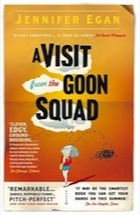
The graduate course is the standard fiction workshop for all MA/MFA students, and it too brims with smart, skilled writers.  Earlier this year, at Reggie H.'s urging, I read Jennifer Egan's Pulitzer and National Book Critics Circle Award-winning novel, A Visiting from the Goon Squad (Knopf, 2010), and among the many things about this outstanding work that struck me, I realized it might offer another way of thinking about negotiating the relationship between writing short stories and novels, which the graduate students often are thinking about. Egan's consists of chapters that could work as free-standing short stories, and she has in fact said that she wrote two of them first, then thought about how to relate them to each other, which produced the inventive novel that resulted. In addition to Egan's book, with which we'll be concluding the class, I've assigned chapters from works that comprise interrelated short stories, novellas, or near-autonomous story-like texts that also have been termed, by the authors themselves, critics or readers novels. These include texts by Rebecca Barry, Ray Bradbury, Sandra Cisneros, J. M. Coetzee, David Mitchell, Nami Mun, Gloria Naylor, Tim O'Brien, and W. G. Sebald. I'm excited about the potential discussions to arise out of these works, as well as about the work the students will be submitting.

This year I have several graduate literature students I'm working with, several graduate fiction students, and one honors creative writer, who is writing a novel to submit as his thesis.  A lot of reading, and this is only one aspect of my job, but one I'm definitely glad about so far!

+++

Today is the last day of summer. Could I have written that more prosaicly? What about: today summer's over. There's a touch of poetry there. Here, however, are two great poems elegizing summer's end. One by one of the greatest poets of concision, the Edo-era master of haiku no renga and other forms, Basho Matsuo (松尾 芭蕉, 1644-1694), the other by one of the most important living poets writing in English, American poet John Ashbery (1927-). Its opening sentence enacts what it describes, and is one of my favorites among all his poems. Enjoy!

A statue of Matsuo in Hiraizumi, Iwate (from Wikipedia)
[Farewell, my old fan]

by Basho

Farewell, my old fan.
Having scribbled on it,
What could I do but tear it
At the end of summer?

***

Summer

by John Ashbery

There is that sound like the wind
Forgetting in the branches that means something
Nobody can translate. And there is the sobering “later on,”
When you consider what a thing meant, and put it down.

For the time being the shadow is ample
And hardly seen, divided among the twigs of a tree,
The trees of a forest, just as life is divided up
Between you and me, and among all the others out there.

And the thinning-out phase follows
The period of reflection. And suddenly, to be dying
Is not a little or mean or cheap thing,
Only wearying, the heat unbearable,

And also the little mindless constructions put upon
Our fantasies of what we did: summer, the ball of pine needles,
The loose fates serving our acts, with token smiles,
Carrying out their instructions too accurately—

Too late to cancel them now—and winter, the twitter
Of cold stars at the pane, that describes with broad gestures
That state of being that is not so big after all.
Summer involves going down as a steep flight of steps

To a narrow ledge over the water. Is this it, then,
This iron comfort, these reasonable taboos,
Or did you mean it when you stopped? And the face
Resembles yours, the one reflected in the water.


Copyright © John Ashbery, from The Double Dream of Spring, New York: Dutton, 1970, 2011. All rights reserved.

Monday, August 27, 2007

AG Says Bye-Bye + Eberstadt on Saramago + Ashbery, mtvU Laureate + Adios a Cos Causse

Months after many Congressional Democrats and some of their Republican colleagues, along with many critics in the blogosphere, repeatedly called for his resignation, and a week after rumors began circulating that Michael Chertoff, the semi-competent Secretary of Homeland Security had the inside track on his job, the farcical, perjurious current Attorney General, Alberto Gonzales, announced this morning that he is stepping down, effective September 17. Like other rats jumping what remains of Bush's ship of fools, Gonzales has decided--or had someone decide for him--that hanging around another year was not worth it.

Gonzales still faces investigation on multiple issues, including the political firings of 9+ US Attorneys and his role in the illegal warrantless wiretapping schemes that were imposed after the September 11, 2001 attacks. That he lasted so long is remarkable, and a testament to the tenacious hold, which I have never understood, that his boss has over his own and the opposition party.


Gonzales's welcome resignation gives the Democrats one less person to consider impeaching, so they might as well get going on Cheney while there's still time. And Democrats, how about enforcing some of those damned contempt citations? Huh?

More on Gonzales's resignation from The Raw Story, the Washington Post, and the New York Times.

‡‡‡

SaramagoIn yesterday's New York Times Magazine, Fernanda Eberstadt profiled Nobel Laureate José Saramago under the headline "The Unexpected Fantasist," though if you were to base it on the general thrust of her piece, it would probably be better described as "the Incorrigible Idealist/Fatalist." Eberstadt covers the general contours of Saramago's life: his impoverished childhood in rural Portugal and Lisbon, his youth and young adulthood under the durable dictatorship of Antonio Salazar; his dearth of publications between his 20s and his 50s, when he began to pen the books which secured his fame, such as In the Year of the Death of Ricardo Reis and Balthasar and Blimunda; his second marriage to a dutiful, protective spouse; his exile from Portugal, over a religious proscription of one of his books; his incredulity and nonchalance, as it were, about his international fame and laureateship.

Amidst this we're told about his political immaturity, as assessed, incredibly enough, by Harold Bloom, his ongoing Stalinism and tendency to lecture as if the world had stopped in pre-perestroika days, his general unpopularity among his fellow Portuguese intellectuals. (This put me in mind of my Portuguese tutor and conversational partner of many years ago, an Azorean, who disdained many of Portugal's modern writers as having to rely either on politics and war (Lobo Antunes) or fantasy (Saramago), and constantly urged me towards the authors who dealt with realistic, often folk-inspired themes, like the fiction writer Fernando Namora or the poet and novelist Jorge de Sena, whose propensity towards translation I've never forgotten.) It's not clear how much Eberstadt buys this criticical discourse, so I would have appreciated her having pressed the matter a bit more, particularly on the political front, to find out the real tenor of his ongoing commitment to politics far to the left of Portugal's social democratic system, whose birth, at the end of the dictatorship and the collapse of a worker-led government he allegedly marks as a negative turning point. Does he seriously think the Soviet Union's economic system approximated capitalism, or was the author of The Gospel According to Christ playing a bit of the eiron? And while I grasp his physical isolation from Portugal, he is, nevertheless, living in Spain, a country whose political system not only paralleled Portugal's, dictator and all, but which not only practices a similar form of social democracy but remains a monarchy. And Spain is one of the global engines of capitalism, and which is still reckoning with its own history over the last 100 years. Thankfully artists--including many of the greatest--thrive on internal contradictions, as do their works, so Saramago is hardly an outlier.

I was also curious about his comments about death, which he seemed to take less stoically--in the broad and not philosophical sense--than his other attitudes might imply. More contradictions. Then there was the offhanded appraisal of his post-exile novels, which have tended increasingly towards the fabular. Blindness, perhaps his best-known novel, is a masterpiece of speculative fiction, but I am fascinated by the dense, metaphysical and yet existential investigations of works like The Double, which I read a few years ago, and The Cave. What they lose in specificity of mimetic, materialist detail they make up, at least in my opinion, in a rich freedom of querying discursivity, as if the mind itself were puzzling out implications liberated from the rules and demands of realist narrative. Eberstadt tells that Blindness will soon be a film to be directed by Fernando Mireilles (City of God), which got me wondering, why doesn't Saramago or someone with influence and funds to realize such dreams suggest that Manoel Oliveira, who is still going in his 90s, or someone working in a similar vein, consider transforming Ricardo Reis or The Double into cinema? I'd buy a ticket script unseen.

‡‡‡

The Tennis Court OathLeave it to MTV to be a pioneer: in a move that I doubt will inspire other stations to follow (BET, Logo, Oxygen, Spike, Sundance, take note!), a university-based version, mtvU, of forward-looking youth-oriented channel has selected its first Poet Laureate, and it isn't someone from Generation X, Generation Y, or Generation Z. It is a poet from the "greatest generation," the 80-year-old John Ashbery (b. 1927). According to Melena Ryzik's Times article, snippets of Ashbery's poetry from across his 50+-year career will appear in 18 spots over the 12 months, and another highly regarded--though considerably younger--poet, Yusef Komunyakaa, will judge a collegiate poetry contest that will publish a student author's book under Harper Collins's imprint. Stephen Friedman, the general manager of mtvU, is a poetry fan and states that Ashbery in particular resonated with college students. (He remains one of the poets who generates the most interest when I've taught his work in the past, perhaps as much or more so than when I was in college, and his major series of works--from the pitch-perfect volume Self-Portrait in a Convex Mirror (1976) and Houseboat Days (1977) to A Wave (1984) and Flow Chart (1991) were still fresh.) mtvU will run excerpts from Ashbery's poetry, chosen by his business manager and former scholar David Kermani and three 20-somethings. The youngsters supposedly have selected things with a raunchy edge, of which there more than a few such examples in Ashbery's vast corpus. Daniel Halpern, the noted author and Ecco Press-Harper Collins (I still have to pause when I state these two presses in the same breath) publisher, isn't sure what will come of this, but I like the idea. As I said, now we need to get the other channels to feature poets, fiction writers, playwrights, and sponsor televised readings, staged performances, and so on. Ashbery's getting no cash for the gig, though he may sell a few more books, which would bring satisfaction to any poet, I imagine.

Just think of what might happen if they got the cast of High School Musical or some of the enfants terribles featured on My Sweet 16 to read the snippets aloud? For the idea, I'd be willing to settle for a 15% cut.

An Ashbery poem, one of my all-time favorites, from the National Poetry Foundation website:

These Lacustrine Cities

These lacustrine cities grew out of loathing
Into something forgetful, although angry with history.
They are the product of an idea: that man is horrible, for instance,
Though this is only one example.

They emerged until a tower
Controlled the sky, and with artifice dipped back
Into the past for swans and tapering branches,
Burning, until all that hate was transformed into useless love.

Then you are left with an idea of yourself
And the feeling of ascending emptiness of the afternoon
Which must be charged to the embarrassment of others
Who fly by you like beacons.

The night is a sentinel.
Much of your time has been occupied by creative games
Until now, but we have all-inclusive plans for you.
We had thought, for instance, of sending you to the middle of the desert,

To a violent sea, or of having the closeness of the others be air
To you, pressing you back into a startled dream
As sea-breezes greet a child’s face.
But the past is already here, and you are nursing some private project.

The worst is not over, yet I know
You will be happy here. Because of the logic
Of your situation, which is something no climate can outsmart.
Tender and insouciant by turns, you see

You have built a mountain of something,
Thoughtfully pouring all your energy into this single monument,
Whose wind is desire starching a petal,
Whose disappointment broke into a rainbow of tears.


John Ashbery, “These Lacustrine Cities” from Rivers and Mountains. Copyright © 1962,
1966 by John Ashbery. Reprinted with the permission of Georges Borchardt, Inc.
on behalf of the author.

Source: The Mooring of Starting Out: The First Five Books of Poetry (1997).
‡‡‡

Audiologo wrote to tell me that Cuban poet Jesús Cos Causse (1945-2007, at right, Carnevale di Venezia) had just died. A native of the eastern cultural capital Santiago de Cuba, Cos Causse was known as the "Quijote de Cuba." The short obituary she sent stated that his renown came from his literary artistry, which included plays, journalism, anthologies, and his poetry, which was deeply influenced by Afro-Cuban and African Diasporic literary traditions, but also from his political activism on behalf of the people and arts of Cuba and of the Caribbean. He was vice president of the Union of Cuban Writers (UNEAC), and at the time of his passing, was president of the Taller Internácional de Poesia El Caribe y El Mundo, and of the World Poetry Congress, whose annual meeting took place in Santiago in conjunction with the Festival del Caribe or the Fiesta del Fuego.

Here's one of the poems, in its wistful simplicity so moving, that was in the email:
MIRANDO FOTOS

Dagmaris alejándose en la playa.
Asunción su abanico su peinado breve.
Gloria dos días antes de morir.
Roberto señalando nada.
Idermis detrás Oscar después Jorge.

Yo tan lejos que casi no me distingo.
Mi hermano gastando una sonrisa.
Mi tía fea hasta el fondo de la palabra.
Abuela en sus mejores tiempos.
Abuelo con una corbata contenta.
Mi padre embriagado otra vez.
Mi madre como un perfume derramado distante.

Copyright © 2007, Jesús Cos Causse.

If you speak Spanish and/or Italian, here is a link to a video interview with Cos Causse at the 2006 Carnevale di Venezia. My friend Herbert Rogers mentions Cos Causse in an interview on his cultural exchange and humanitarian travels to Cuba at the ChickenBones site.