Showing posts with label German literature. Show all posts

Tuesday, October 25, 2016

Alexander Kluge & Ben Lerner at Goethe-Institut

Alexander Kluge
Pioneering author, critical theorist, New German cinema writer and director, and TV pioneer Alexander Kluge is 84. The last time I found out he was going to be in New York, I was in Chicago and Evanston, teaching and so had to miss his events. I am a huge fan of Kluge's work, especially his fiction and films, and have posted about his work many times on this blog, including my translations of his prose, the New York Review of Books' translations of his writing, quotes by him, and more. His work has never ceased to intrigue me.

Kluge recently returned to participate in a series of events, running from October 21 through the 24th,  that were sponsored by the Goethe-Institut USA and titled "Alexander Kluge in New York." They included a film series at the Anthology Film Archives and an evening with Kluge at the Museum of Modern Art. I decided to see Kluge and Ben Lerner in conversation on Sunday at a "soiree," which Kluge ensured that the evening became. I had imagined a joint reading, followed by a conversation, which is the US standard, but instead we got a fantasia of sorts: Kluge and Lerner did read, primarily from Kluge's newest book, The Great Hour of Kong (Kongs Große Stunde, Suhrkamp 2015), and only in English, but interspersed amidst the texts were Kluge's digressions, film clips, and a live pianist's accompaniment.

Lerner, the translator, and Kluge
Kluge reading 
In addition, there was a translator (whose name I missed), who didn't have that much to do; Kluge's English was quite strong, and only a few times did he turn to her for assistance. Instead, he tossed out pithy phrase after phrase, talking of the affinities he felt with Lerner's poetry, which he thought achieved what he was trying at times to convey, which was "knowledge without a subject." Other subjects included outer space, the bombing of Halberstadt, Hitler's death, and Ladino-speaking Sephardim who were able to escape the Holocaust--and fortunately, very little Kong. Throughout, Lerner was game--he read along, offered thoughts where needed, and kept the show rollicking along.

Here are some of the quotes I wrote down:

"We have inside an antirealism of feeling."
"The search for safe space is the beginning of philosophy."
"Life is richer than experience."
"Never wake a collective subject." - A quote from one of Lerner's poems, which he repeated and expatiated on.
"Narration saves life."
"Absolute design equals absolute poetry."
"We are all nobleman...descended from 18,000 people who came out of Africa."

The pianist played music by Offenbach and Verdi, and the films, some of which unfolded like Kluge's microstories, included one using a Luigi Nono composition, which made me think of Nono's father-in-law Arnold Schönberg, though his name was never mentioned (I think), and Schönberg's star pupil Anton Webern (him neither), whose extremely distilled compositions struck me as models, but with a much more playful underpinning, for Kluge's films. Eventually, the piano playing turned into a brief accompaniment, with the accented English sounding almost like a counterpoint to the keys' melodies. Kluge concluded the evening by having not just Lerner and himself reading in unison, which they did several times, but invited the translator to join them. It was an apt conclusion to an unusual and refreshing literary evening, giving "soiree" (or "variety show" in the best way) a new meaning and creating an invigorating model for future events, I hope.

Lerner and Kluge reading in unison
Lerner, the translator and Kluge concluding
with a piece read in unison

Tuesday, September 10, 2013

Translation: Three Microstories by Alexander Kluge

Alexander Kluge
(from muni.com)
Obergrenze der Raublust
Ein Raubtier, das sich von Adlern und Löwen ernährt, braucht eine Heimat von der Grösse ganz Schottlands. So wie Macbeth und der "Zug der Schattenkönige", die er ermordete, eine Unterwelt brauchen, die von Schottland bis Gibraltar reicht. Dieser Raumbedarf setzt der Raubtiergrösse innerhalb der Evolution Grenzen.

Rapacity's Upper Limit
A predator that feeds on eagles and lions needs a home the size of all of Scotland. Just as Macbeth and the "pull of the shadow king" that he murdered need an underworld spanning Scotland to Gibraltar. This space requirement comprises predator size within evolution's limits.

***

Stufen des Lebens
Vier Stufen sind es vom Plankton zum Mörderwal. Die Stufe vom Wal zum massiven Walfangschiff in japanischer Bauweise erzeugt keinen zusätzlichen biologischen Tatbestand, behauptet der Analytiker T. Sachse, es sei denn, man betrachtet die gierigen Mäuler der Walesser und die Einfüllstutzen der Maschinen, mit denen Walöl geschmeidig und als Putzmittel geeignet gemacht wird (oder die Interaktion zwischen Greenpeace und den Walfängern), als eine Stufe des Lebens.

Stages of Life
There are four stages from plankton to killer whale. The stage from the whale to the massive whaling ship under Japanese construction generates no additional biological facts, the analyst T. Sachse says, unless one considers the greedy mouths of the whale eater and the filler pipes of the machines by which whale oil is rendered supple and as an appropriate cleaning agent (or the interaction between Greenpeace and the whalers), as a stage of life.

***

Ende des Lebens
Ein junger Russe des Jahrgangs 1929, der 1937  beide Eltern verloren hatte, übernachtete als 82jähriger in dem Berlin Hotel "Brandenburger Hof" und ging noch spätabends durch die Strasse des Scheunenviertels, die er als Soldat 1945 zum letzten Mal gesehen hatte. Steine des Trottoirs, unregelmässig geworden durch Kriegseinwirkung, lagen noch so desolat wie damals frisches Gras dazwischen. Während rings Neubauten prangten, zu denen er keine Verbindung mehr aufnahm.

End of Life
A young Russian of 1929 vintage who in 1937 had lost both parents stayed until the age of 82 at Berlin Hotel "Brandenburger Hof" and ventured out late at night through the streets of the Barn Quarter, which he had last seen as a soldier in 1945. The pavement's stones, having become irregular as a result of the war damage, still lay as desolate as the once fresh grass in between them. While all around blazed new buildings, to which he no longer held any connection.
--Copyright © Alexander Kluge, from Das fünfte Buch: Neue Lebensläufe, 402 Geschichten. Berlin: Suhrkamp Verlag, 2012, p. 526, p. 528, 519 respectively. Copyright © all translations by John Keene, 2013. All rights reserved.


Thursday, January 17, 2013

Three From Kluge & Richter in NYRB

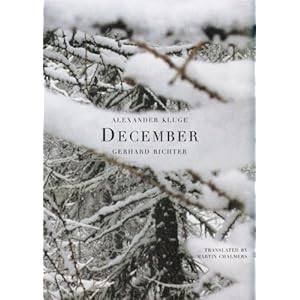
Alexander Kluge, Germany's living avatar of analytical fiction (and a cinematic pioneer in the l950s and 60s), and Gerhard Richter, one of its most important living visual artists, have collaborated on a book entitled December, which Seagull Books, distributed by the University of Chicago Presspublished early last year in an English translation. (Seagull posted a pre-publication interview with Kluge  in December 2011.)

There are few fiction writers who can pack as much critical thought into condensed, vivid narration as Kluge, and in December it appears he is still working at at the level of adamantine economy he displayed with prior books such as The Devil's Blind Spot (New Directions, 2004) and Cinema Stories (New Directions, 2007).  The 80-year-old author's 39 calendar-based narratives here, as in prior books dating back to the 1960s, draw from German, European and global histories as well as from his lively imagination, and sometimes run no longer than a page or two, in concert with Richter's 39 beautiful, enigmatic photographs of wintry landscapes.

The Decembers in these stories, however, bear little of the holiday cheer we associate with the winter holidays or the conclusion of the calendar year. Instead, one story--or prose poem, so brief and clipped is its unfolding--concerns German children collecting scrap metal in 1941. What is not said--the fascist state, brutal war, the Holocaust--looms behind this and other narratives, as it does behind the tranquil but ominous images of nature. A few of the texts present in fictional form realist flashes of Kluge's life; born in 1932 in Halberstadt, in what is now the German state of Saxon-Anhalt (formerly part of East Germany), he likely would have experienced circumstances not unlike these. Most, however, transmit the theoretical and emotional clarity that Kluge's work so often offers, whether he's writing about the near death in 1931 of Adolf Hitler or an obscure monk whose sense of time upends our own sense of temporality. Kluge's prose pieces always come pierced, as Rilke might have written, with rays of wisdom and feeling, usually through metaphors and aphorisms, that most other writers would take sentences to achieve.

Last month, The New York Review of Books published three Kluge excerpts, alongside three Richter images. I found myself rereading the Kluge pieces several times despite their brevity, and studying the Richter photographs, which grew more ominous with each view. You can read the pieces at the NYRB link above. (You can download some of his movies here.) Below is one of the photographs. If you were to compose a short prose piece for December to accompany this image, what would it be?

© Gerhard Richter


Saturday, September 03, 2011

Herta Müller's Nadirs: Poetry (In Translation)

HERTA MÜLLER
(Andreas Rentz/
Getty Images)
When Herta Müller was awarded the Nobel Prize in Literature in 2009, I admit that I rolled my eyes in exasperation and thought, another obscure European fiction writer!?, when there are so many others who deserve this global honor, and could use the money on top of it?  (I was, however, glad that a woman was being honored.) I am quite capable of changing my mind on the "obscure European fiction writer" part as on many other things, though, and although I cannot claim to have read any of Müller's oeuvre in the original German (she was born in 1953 into the German-speaking minority in Nitzkydorf, Banat, Romania, during the dictatorship of Nicolae Ceaucescu, and later moved to Germany, a journey echoed in several of her works, including The Passport and Traveling on One Leg), I have now dipped into several of her books in English translation, including the two named above as well as The Land of Green Plums, and her first (published 1982 in Romania, 1984 in Germany), which was the first of hers I came across, in the university library (I later found it for almost nothing at a now-defunct Borders in Chicago), Niederungen, translated and with an afterword by Sieglinde Lug, and published as Nadirs published by the University of Nebraska Press (1999).

EXCURSUS: German speakers and readers will immediately note that Nadirs is a good but imperfect translation of the original title, which has its cognate in several very old English roots and words, including "-neath" (as in "beneath") and "nether," as in nether regions or the Netherlands (i.e., the low countries, which in French is les rendered exactly as Pays-Bas.).  Niederungen means, then, the "low things"--"ung" approximating English's gerundive "ing," or similar words with Latinate endings such as "-ion" or the Norman "-ment," with the sense of "thing" related to the root of that word and an abstracting element; think of "understanding, agreement" (G: Verständigung [understanding-thing]) or "illumination" (G: Beleuchtung [be-light-ing, light-thing], Erläuterung, Illuminierung, etc.) or "opinion" (G: Meinung [minding, mind-thing], to give three examples. "Low" or "beneath" refers to the earthy content and raw language of the stories, the lowly status of the people depicted in them, and, I think, to the fact that a female child, a person of particularly low status in the society rendered so unforgettably by Müller, tells these stories.  (I find such close but untranslatable words in every language endlessly fascinating.) If Nebraska had used as its title Netherings or Nether Things or Lowly Things or Lowlinesses, would it have had as much punch as Nadirs, which though an Arabic-derived word, nevertheless captures the sounds, rhythm, and, in English, some of the meaning, of the German?

I am still not decided on whether Müller deserved the Nobel Prize (probably yes), but that is neither here nor there because who am I but a reader? I must say, though, that her sentences, as rendered in English, and her stories and novels in toto, beguile me. They unfold in the form of a particular visionary or deeply-peering child's or adult's poetry strung together as prose texts, with plots and atmospherics reminiscent of a syntactically distilled Franz Kafka, but with the horror notch were turned up several volumes in terms of the plots.  What poetry, what strangeness!  The title story of the collection is worth the entire volume, but each piece, no matter how brief, offer something to reread more than once, though I also have found that the bleakness of this world she presents requires that I break from it periodically.  I should add that too much of this with the wrong writer comes off really sounding precious and pretentious, like an overworked, well, writing project. But Müller's novels do have plots, bizarre though they may be, and the authenticity of her alienation, as Lug aptly describes it, matches the almost childlike prose evoking the brutalities her characters live through.

A year ago, I told my graduate class about Nadirs in an effort to explicate a point about describing familial memories and personal traumas, which the book abounds in, and shortly thereafter wondered whether it was a good idea to recommend this book instead of something more, oh, conventional. But I have come to realize that anyone writing can learn from a writer like Müller, and even if her work is poles away from the mainstream of American literature, particularly American fiction, it offers ample if idiosyncratic pleasures and lessons.

Here are a few passages, translated by Lug. You will have to turn to the German to see their beauty and strangeness in the original, but I think what I'm suggesting above will, I hope, become clear.

"I wanted to get up from my chair, but my dress was frozen to the wood. My dress was transparent and black. It crackled whenever I moved. I rose and touched Father's face. It was colder than the objects in the room. It was summer outside. Flies were dropping their maggots in flight. The village stretched out along the wide sandy road. The road was hot and brown, and burned out your eyes with its glare." - from "The Funeral Sermon," p. 2

"The long alley with its wild vine, the ink-colored grapes cooking in the sun under their delicate skin. I bake sand pies, I grind bricks into red paprika, I scrape the skin off my wrists. It burns in my bones." - from "Nadirs," p. 11

"The gardens are intensely green. The fences are floating after moist shadows. The window panes glide bare and bright from one house to the other. The church tower is turning, the heroes' crucifix is turning. The names of the heroes are long and blurred. Käthe is reading the names from the bottom to the top. The third from the bottom is my grandfather, she says. She makes the sign of the cross in front of the church. The pond shines in front of the mill. The duckweeds are green eyes. - from "Rotten Pears," p. 76

"Mother lays the black silk stockings on the table. The silk stockings have thick sheer calves. They are black glass. The silk stockings have opaque heels and pointed opaque toes. They are black stone." - from "Oppressive Tango," p. 84

"My blouse is soft, its buttons are small, its buttonholes big. My skirt is like dusk and rises like fog. Tony's hands burn on my belly. My knees float apart and swim as far as my thighs are long. My belly twitches, my temples press down on my eyes. The bridge is hollow and groans, and its echo falls into my mouth. Tony pants and the grass sighs. My skirt rises up under my elbows. Tony's back is sweating on my hands. Up there in the moon, behind my hair, forgotten dogs bark and the night guard is leaning on the long wall of the chalky veins of the old mill and he sleeps. The bridge whirls around my hands, and my tongue turns in Tony's mouth.  With faltering breath Tony digs a hole into my belly. My knees are floating to the edge of the bridge. The bridge falls into my eyes. Hot slime flows into my belly and spreads over me, and seals up my breath and buries my face." - from "The Window," p. 91

"Yesterday during the night shift, a boy got his hands cut off by the five-ton press. The foreman fired a mechanic and gave him a bottle of schnapps and then screwed in the missing light bulbs. In the changing-room they caught the mechanic pouring schnapps into the boy. They pounced on the mechanic, he is in the hospital now." - from "The Intervillage Bus," p. 111