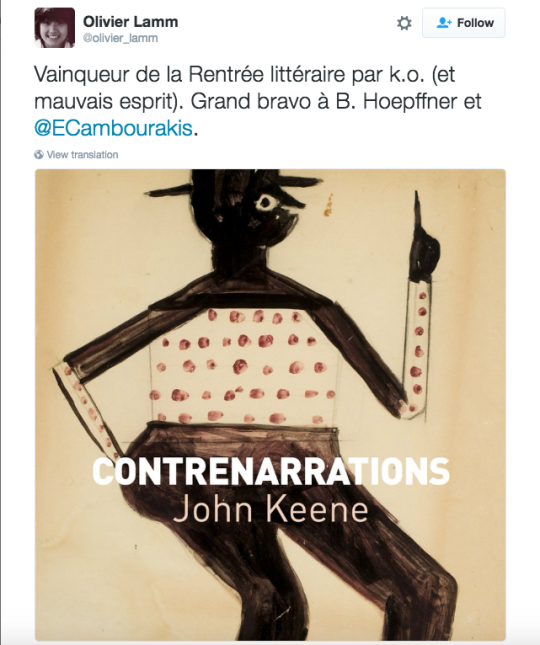
A few weeks ago, sound engineer and radio host Alain Cabaux spoke with Emmanuel Requette, from Brussel's Librairie Ptyx (Ptyx Bookstore), hosted a lively, enthusiastic conversation about the French edition of Counternarratives on Radio Campus, based at the Université Libre du Bruxelles.
It would take a while to translate the entire thing and they unfortunately do not provide a written transcript, but it was clear that both Cabaux and Requette enjoyed the book and were sparked to think quite a bit about it, even broaching a few topics that haven't received much discussion in US reviews, on topics such as religion.
If you speak French, you can hear the entire conversation here, as well as music by Matana Roberts and the great Bluesman Robert Johnson. Many thanks to both of them and to my brilliant translator, Bernard Hoepffner and publisher, Éditions Cambourakis, because of whom the book is on Librairie Ptyx's bookshelves. Enjoy! (H/t to James Oscar for telling me about meeting Mr. Cabaux, and his kind comments on the book, too.)

***
Also, in the French journal En Attendant Nadeau, Claude Grimal pens a throrough, praiseworthy review of Contrenarrations, titling it "Sujétion, Liberté et Imagination" (Subjection, Liberty, and Imagination), with the summary that "Le romancier américain John Keene fait preuve dans son Contrenarrations de beaucoup d’ambition, d’érudition et de talent. La force épique de son livre et l’extrême attention qu’il porte à l’écriture sont la preuve d’une foi énergique en la littérature." (Translation: "The American novelist John Keene show evidence of great ambition, erudition and talent in his book Counternarratives. The epic force of his book and his extreme attention to writing are evidence of an energetic faith in literature.")
The review continues in that very positive. He concludes the review by saying:
L’auteur, qui dote ses personnages d’une remarquable imagination afin de montrer qu’elle est en elle même émancipatrice, est pourvu comme eux de ce don. Il faudrait adapter pour lui les pensées qu’il attribue à Melle LaLa, flottant au dessus du sol, reliée par la bouche à son fil : « je voudrais suspendre la ville entière de Paris ou même la France elle-même à mes lèvres… je cherche à dépasser les limites imposées à moins que je ne les aies placées là, car c’est à cela que je pense quand je pense à la liberté ». Penser à la liberté est un chemin pour les écrivains, autant que pour les assujettis comme le montre, avec un brio acrobatique, les histoires de Contrenarrations.Many thanks to Mr. Grimal for this reading, to En Attendant Nadeau for publishing it, and of course, to Bernard Hoepffner and Éditions Cambourakis.
(The author, who endows his characters with a remarkable imagination in order to show that it is in itself emancipatory, is provided like them with this gift. It would be necessary to adapt for him the thoughts he attributes to Miss LaLa, floating above the ground, connected by her mouth to her wire: "I want to suspend the entire city of Paris or even France itself from my lips...I aim to exceed every limit placed on me unless I place it there, because that is what I think of when I think of freedom." Thinking about freedom is a way for writers, as much as their subjects, as Counternarratives' stories show, with an acrobatic brio.)
***
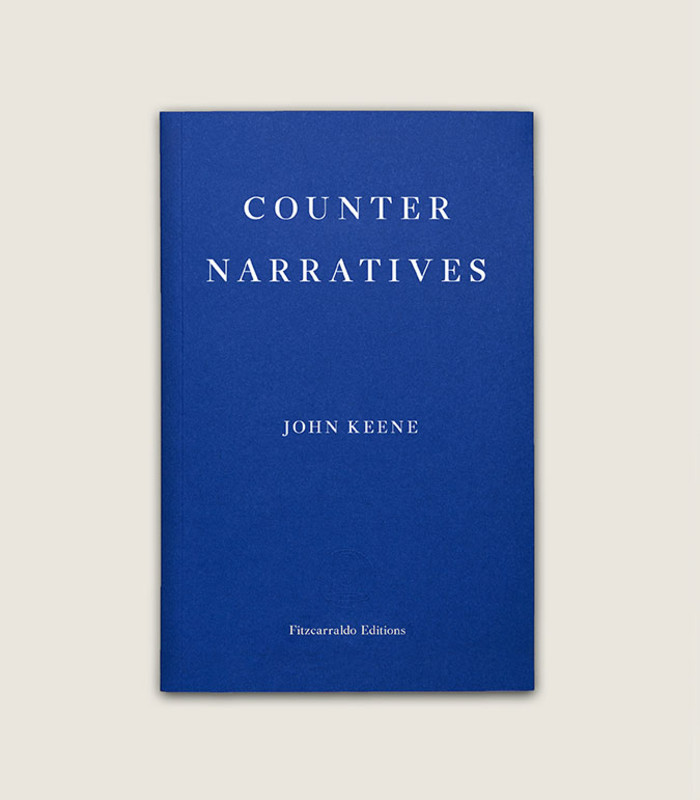
Finally, on the other side of the English Channel, or La Manche, depending upon your perspective, a new prize, The Republic of Consciousness Prize for Small Presses, has named Counternarratives to its Longlist! What's the rationale behind this prize? Here's what writer and publisher Neil Griffiths, its founder, has to say.
The winner will be chosen based on two criteria, perfectly expressed on the Galley Beggar website as ‘hardcore literary fiction and gorgeous prose’.
Eligible publishers will have a maximum of five fulltime paid people working for them. The prize is open to UK and Irish publishers.
One novel or single author collection of short stories per publisher can be summited in the calendar year. With one wild card entry per judge.The Times Literary Supplement wrote about this prize, quoting Griffiths:
"Whatever one thinks about awards in the arts, they do tend to attract attention, boost sales, and provide a little momentum – which is always a good thing. And even though the money won’t be Booker or Costa levels, any money is always welcome. And if the prize can include the independent bookshops – as judges and points of sale – then everyone wins".It also noted that the 9 judges are "Griffiths, his co-chair Marcus Wright, and the booksellers Sam Fisher (Burley Fisher Books, London) Gary Perry (Foyles, London) Anna Dreda (Wenlock Books, Shropshire) Helen Stanton (Forum Books, Northumberland) Lyndsy Kirkman (Chapter One Books, Manchester), Emma Corfield (Book-ish, Crickhowell, Wales) and Gillian Robertson (Looking Glass Books, Fife, Scotland)." The Guardian also wrote it up.
Originally, the Longlist wasn't to be announced until November 30, but it appears to have been moved up. The Shortlist won't be determined until next January, and the prize won't be awarded until March 2017. At the Review 31 site, Mr. Griffiths elaborates on the prize, and writes blurbs about each of the book. Here's the marvelous summary he wrote about Counternarratives, which is the kind of comment you can't pay for!
Fitzcarraldo Editions for Counternarratives by John Keene
Counternarratives is a work of great distinction, a once in a generation addition to short form fiction. It moves the form on; it deepens it. Few works of fiction operate on this kind of intellectual and textural level and still remain rooted in the human experience. Spanning four centuries, many countries, using different narrative forms as inspiration, each story unfolds with a control and wisdom that is startling. When compared to this, most other prose seems oddly ingratiating, as if Keene has decided that to ask for our indulgence is to undermine some fundamental truth being enacted in the stories. Few novels are works of art and few works of art are moral acts – this is one of them. And what’s more it’s a pleasure to read. That this set of stories and novellas has not made every shortlist its eligible for is a travesty.
Here's Mr. Griffith's announcement of the prize:
Whatever happens, it's wonderful for the book and its British publisher to receive some recognition, and many thanks to Mr. Griffiths, his committee, and Fitzcarraldo Editions!