Thursday, August 18, 2011

Kynaston McShine

Kynaston McShine
at the Art Show,
the 7th Reg. Armory
1997 (artnet.com)
(b. 1935) is one of the most important but least known and unheralded curators of his generation, and one of the very few black people to play such a key role in the development of contemporary art and curatorial discourse and practice, particularly at elite American and international institutions, during this era. His 1970 landmark show, "Information" at New York's Museum of Modern Art (MoMa), is widely considered to be the first survey of conceptual art by a major American museum, it crossed disciplines, was interactive, and represented a critical and curatorial protest (at one of the most elite of art institutions) against the then-raging Vietnam War. It gathered 100 artists, among them now legendary figures such as Hans Haacke, Vito Acconci, Robert Smithson, On Kawara, and Ed Ruscha. I thought I ought to post this entry after listening to a MoMa podcast in which scholars discussed two other noted past curators Dorothy Miller and Frank O'Hara, yet my searching their online offerings brought no discussion of McShine, and then I realized he didn't even have a Wikipedia entry.

Kynaston (1963, by Alex Katz)
A native of Trinidad, McShine graduated from the Queen's Royal College (the oldest secondary school in Trinidad and Tobago, located in the capital, Port of Spain) and Dartmouth College (AB in philosophy, 1958). He later undertook graduate work at the University of Michigan and New York University's Institute of Fine Arts. McShine has taught art history at Hunter College, CUNY and The School of the Visual Arts. He has received honorary degrees from the San Francisco Institute of the Arts and The University of the West Indies. Over the years he has edited and published numerous catalogues.

McShine has spent nearly his career at MoMa, which he joined in 1959 as a member of its Department of Circulating Exhibitions. In 1965, however, he joined the Jewish Museum in New York as a curator, going on to serve as its acting director from 1967-68. McShine returned to MoMa in 1968 as associate curator, was named curator in 1971, and in 1980, he became senior curator in MoMa's Department of Painting and Sculpture, a position he served in until 2001, when he became Acting Chief Curator of the department. In 2003, he was named Chief Curator at Large.

At the Jewish Museum, he organized several important shows, including Primary Structures: Younger British and American Sculpture (1966) and Yves Klein (1967). At MoMa McShine has curated a slew of that institution's most important and high-profile shows of the last 40 years, including Information (1970); Ways of Looking (1971); Marcel Duchamp (1973, with Ann d'Harnoncourt, who later became the director and CEO of the Philadelphia Museum of Art); The Natural Paradise: Painting in America, 1800-1950 (1976, an exhibit that coincided with the Bicentennial celebrations across the country); Joseph Cornell (1980); Berlinart 1961-1987 (1987); Andy Warhol: A Retrospective (1989); The Museum as Muse, The Artists Reflect (1999), Edvard Munch: Beyond the Scream (2006), and Richard Serra at MoMa (2007, with Lynne Cooke, of the Dia Foundation for the Arts).  In 1971, McShine initiated MoMa's Projects series, which focused on works by younger experimental artists.
Clara Weyergraf-Serra and Kynaston
McShine (DPC/NYSD.com)
McShine's exhibits for MoMa's Department of Circulating Exhibits include Josef Albers: Homage to the Square (1964); American Collages (1965); Four American Sculptors (1965); New Media: New Methods (1969); and Color As Language (1975). In 1988, he coordinated the New York exhibition of Anselm Kiefer, a show jointly organized by MoMa, the Art Institute of Chicago and Philadelphia Museum of Art. As far as I can tell, McShine has never organized a show devoted primarily to black, Caribbean or African-American arts or artists of at all, though a number have appeared in the broader surveys he has curated (I am thinking of Fred Wilson's work, for example, in The Museum as Muse, for example), and artists of color have numbered among the participants in the Projects series.  [UPDATE: McShine did curate solo shows featuring the work of Sam Gilliam and Rafael Ferrer; perhaps there were other solo shows featuring artists of color as well.)

In one of the pieces I link to above, an article in The Economist, the writer describes McShine as "discreet." I would love someday (he's 72 [76?], so I suppose I should get on it) to interview him, and discuss his background, life and career, his deep interests in the art of his time and his central, publicly un(der)acknowledged role in bringing that art to critical and public consciousness.  Perhaps an interview of this sort already exists; I just haven't seen it. Then, where to publish it?

Also: there's this kynastonmcshine, in the UK. I wonder if he knows about and has given his blessing to them?

Tuesday, August 16, 2011

On the Road to Vegetarianism 3 + Homemade Marinara Sauce

In 2010, I blogged twice (first in March and then again in May) about my adoption of a mostly vegetarian--vegetarianish is probably the correct term--diet. In those posts I described how I'd moved away from eating almost all meat except for the occasional seafood--and had also decided to forgo almost all processed foods with a few exceptions. I noted that I had not, however, become a vegan. Cutting out meat was a huge step; while I'd cut back on beef years before for a variety of reasons, until that January I regularly ate chicken, lamb, turkey, and, to a lesser extent, pork and duck. It was a rare meal that did not include meat of some sort.  Other changes included more baking, daily cooking, and meals based more on seasonal and local options. I started eating vegetables I had infrequently eaten (eggplant, cauliflower) or infrequently since childhood (turnips, beets), and devising all kinds of dishes that combined them, often drawn from South Asian and Mediterranean cuisines in particular.

In my initial post I remarked on my amazement at being to go a week without meat; in my second, I said that I had gone weeks without it. I have now passed the year and a half mark (August 15 is about a year and 8 months to be exact), and I am happy to say that I've been able to maintain doing without meat (and processed foods in general), both in Chicago and Jersey City, and during travels here and there, with only a few exceptions (holidays like Thanksgiving; a meal at the home of a poet friend in Los Angeles, where only hamburgers--and lettuce--were available; etc.).  I still don't miss meat, and I still have not gotten into tofu, seitan or meat-like substitutes, but I do like eggs, some dairy (mostly cheese), and fish and shellfish on occasion that have not decided to become a vegan.  Not going the vegan route has also meant less disruption for C, though he eats less meat than he once did, even when I'm halfway across the country.

From the beginning, my shift to vegetarianism included recognizing the ethical dimensions of doing so, as a range of philosophers, critics, food writers, and others have articulated over the centuries, but those initially were less crucial than my personal desire, for health and economic reasons, to make the shift.  Over the last year and a half, I've watched, as I used to with horror, the ongoing massive recalls of US meat products and produce, the increasing epidemic of obesity in this country and in rich and developing nations, and the exploding price of food in general, and feel that moving towards a vegetarian diet was the way to go.  Countless revelations, in print, film and video, about the horrors of industrial meat production in the US and the West have underlined my conviction. Yet I've striven to maintain my stance of not proselytizing for or pushing my shift on anyone else, though as I mentioned, several people close to me have moved more towards this way of eating. I've kept myself in check because I realize full well that traditions and cultures of meat-eating are deeply ingrained in this society--I once bought into them--and across the West, and all the appeals anyone makes to anything beyond sheer economics, or in specialized cases to spiritual and religious traditions, will have little impact on most people's eating habits.

I also realize that we live in a time where in the US at least, many of the least nutritional foods are cheaper than basic staples, because of the structure of government subsidies of various crops and processed foods, and it continues to be the case that those with the least resources can economize, to the extent possible, by eating fast and processed foods, rather than healthier options, including a diet mostly comprising of fruits and vegetables.  Such a diet also requires the added efforts of planning and cooking--with improvisation thrown in--which our society had for decades come to deprioritize, though the vogue over the last decade of food TV, foodieism and culinary education in general has reversed this to some extent. Alongside all the reality shows like Top Chef, Iron Chef, and the glut of Gordon Ramsey-related programming remystifying cooking, there have been more than enough shows guiding attentive viewers through simple, delicious meals.

I am glad I learned to cook as a child, having watched my mother and grandparents do so (my father could cook only the simplest meals, though he could barbecue anything) and having done so for most of my adulthood after college, but I have come across a large portion of people who never grew up learning how to cook and, even with the culinary vogue over the last decade, have not learned to do much beyond prepare already prepared meals. One thing that cooking vegetarian meals has done is to make me a more skillful cook in some ways, and a confident cook overall.  Knowing that I'll have to whip something up that tastes good without revolving around meat means that I've had to learn new ways of cooking,  combining types of foods, trying things I hadn't thought of, because I could always default to: meat + starch + vegetable or even just meat + vegetable + bread.  Over the years I can attest to having assimilated many recipes and techniques, by the likes of Julia Child, Martha Stewart, Jacques Pépin, Lidia Bastianich, Rachael Ray, Paul Dean, G. Garvin and others, and then there is my Lonely Planet of cooking, Mark Bittman's How to Cook Everything, which has yet to fail me in any regard (it sits alongside cookbooks like The Joy of Cooking and by figures like Patti Labelle and institutions like Cupcake Café), but aside from a vegetarian cookbook Reggie H. provided, most vegetarian cookbooks I've seen have tended towards an older way of thinking about vegetarianism that leaves out a range of possibilities.  Thus learning new techniques and improvising have proved the way to go so far. And I hope to keep going forward along these lines.

None of this is new to some of you, I know. So please indulge me. I welcome any thoughts J's Theater readers have about vegetarianism and veganism, vegetarian and vegan diets, and anything else related to this topic.  I also have included a recipe for intrepid home cooks who've never made their own tomato sauce. I tried this last year, after we got a great harvest of tomatoes, and then again recently, and it was better the second time around. You can make your own marinara sauce at any time, though, using canned tomatoes, and it will taste better--and less sweet and salty--than almost any brand you buy in a jar.

HOMEMADE VEGETARIAN MARINARA SAUCE
Based on several online recipes, including author John Mariani's, and a bit of experimentation

1/2 cup olive oil
1 large white or yellow onion
5 cloves of garlic, peeled and crushed or diced
2 Tbsp fresh or dried herbs (basil, oregano, rosemary, thyme, etc.)
1/2 cup red wine
12 cups peeled and seeded tomatoes (or 2 (28 oz.) cans of crushed or chopped Italian-style tomatoes, with sauce)
2 carrots, diced
2 stalks of celery, diced
1 1/2-2 cups white mushrooms, sliced
1 teaspoon of sugar (you can skip, but add if using canned tomatoes to counteract their acidity)
salt and pepper to taste

In a large pot, heat the olive oil. Add the onions and cook slowly, till they sweat. Do not burn them, as this will affect the taste of the sauce. When the onions are translucent and soft (if yellow, they'll be golden brown), add the garlic and dried or fresh herbs (fresh herbs retain their flavor if added later, but it's okay to add them at this point), carrots, celery (and any other vegetables, like yellow squash or zucchini) and cook for 5-7 minutes. Add 1/2 cup of red wine, to deglaze the pan, and let this mixture cook for 2 minutes. Add the peeled and seeded tomatoes or canned tomatoes and their juice, and the mushrooms, and stir to combine all the ingredients. [Again, for simple marinara, you can skip the mushrooms.] Bring to a simmer, and cook on low heat, stirring occasionally for 2 hours. As the sauce is cooking, add 1 tsp. of sugar, and salt and pepper to taste. Serve with freshly cooked whole wheat pasta!

[Note that if you are making simple marinara, you can start with onions and garlic alone, skip the rest of the vegetables and the red wine, keep or remove the onions and garlic before adding the tomatoes and sauce, and just cook the vegetable-less tomatoes for 20-25 minutes. This version goes well with linguine, spaghetti or any other pasta.]

How to Peel and Seed Tomatoes
First core all the tomatoes, and gently score their bottoms with a +. This will help to pull the skin the tomatoes. When you have done this with all the tomatoes, use a slotted spoon or laden to lower them into boiling water and let them cook for 15-30 seconds. (If you drop them in you could get boiling backsplash. Not good!) Do not overcook them. Add 3-4 tomatoes at a time. After they've boiled immediately transfer them to a bowl of icewater. Do with the next set until you have blanched all the tomatoes. You should be able to peel off the skins with ease. Next, using a strainer over a bowl, split the tomatoes apart with your fingers, and gently rub them against the inside of the strainer to remove as many of the seeds as you can. The juice will run into the bowl, and you can place the seeded tomato right into the bowl as well. After you've collected the seeds, dump them on a paper towl or bowl (you can save them if you want to plant tomatoes for next year!), and proceed until you have completely seeded all the tomatoes. You should have a bowl of tomato sauce and pulp, with no skin and no seeds when you're done.

Photos
Tomatoes from the backyard garden
Tomatoes from the backyard garden Scoring the tomato bottoms
Lightly scoring the tomatoes' bottoms The cored tomatoes
The tomatoes cored
Blanching the tomatoes (1st the boil)
Blanching the tomatoes, part 1 (a brief boil)
Blanching the tomatoes (this removes the skin)
Blanching the tomatoes, part 2 (cooling in icewater)
Peeling the tomatoes
A peeled tomato
A peeled tomato
Seeding the tomatoes
Gently seeding a tomato
Seeding the tomatoes
Seeding a tomato and collecting its juice The tomatoes after being peeled and seeded
The tomatoes after being peeled and seeded Sprig of oregano, from the garden
Sprig of oregano from the backyard garden
Thyme from the garden
Sprig of thyme from the backyard garden  Vegetables (save the mushrooms) cooking
Diced vegetables (basically a mirepoix), before the tomato paste has been added
Marinara sauce, with tomatos added
After the tomato sauce is added
Marinara sauce, almost done
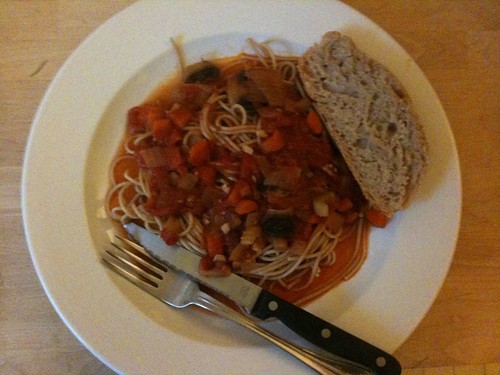
The tomato sauce cooking Homemade spaghetti sauce w/ homemade bread Homemade sauce with homemade baked bread

Monday, August 15, 2011

Review: Gun Hill Road

TV and film depictions of latino male convicts and ex-cons are hardly rare; I could rattle off the titles of several without much deliberation. TV shows and films portraying these men's attempts at reintegration into society are not uncommon either. The narrative arc usually goes as follows: ex-con gets out and wants to go straight; ex-con struggles with temptations from his past, the constraints society and the law place on him, intrafamily tensions, etc.; ex-con succeeds and creates a new life or ex-con fails and heads back to jail. (And for every film or TV focusing on latino men facing such options there are triple that number featuring black men on--or running off--the same, troubled track.) Young and talented director and writer Rashaad Ernesto Green tackles this scenario to varying degrees of success, but his new film, Gun Hill Road (2011), I say without reservation, marks a strong debut and deserves to be seen.

The latino ex-con in this film is Enrique "Quique" Rodríguez (adequately played by the still very handsome Esai Morales), who has been imprisoned for 3 years on a host of charges. Enrique nearly makes it to the end of his term without a problem, but just before his scheduled release he attacks a fellow prisoner, a predator--on him, Green shows us, quite subtly at first--which only temporarily delays his release back into his native Bronx. Enrique faces the trials enumerated above; in fact, he's late for his homecoming party because he decides, against his better judgement, to sample a forty and hang out with his corner-bound group of old Gs (among them Franky G).

For Enrique's wife, Angela (the splendid Judy Reyes), his tardiness, in addition to the disappointment and annoyance it causes, is an immediate harbinger of how difficult readjusting to his return will be for both of them. Further complicating matters for both is a passionate relationship she has developed with her mechanic Hector (Vincent Laresca) during her husband's absence; she quickly squelches it, but that only goes so far.  For Enrique's parole officer Thompson (the reliably bulldoggish Isaiah Whitlock Jr.), it's a countdown until Enrique screws up and heads back to prison. None of this feels or plays especially fresh, and Enrique's character is just not as deep or complicated as he needs to be, but Green's characterization of Angela in particular and her recognition of the well of pain and frustration her husband carries around, as well as her own ambivalence, begin to push the story towards something compelling.

Harmony Santana
Yet the real center of the film is Enrique's only child, Michael (Harmony Santana, in one of the best performances of this year or many). For Michael, whom we see soon thereafter as Vanessa, a beautiful young transwoman, Papi's return obviously poses problems of a different sort. Santana's portrayal of Michael/Vanessa is one of the most vivid and assured performances by and presentations of a young trans person of color I have ever seen. When she is on the screen, the film is hers. In some ways Michael/Vanessa's story parallels that of the young black lesbian Brooklynite Alike in Dee Rees's breakout film Pariah (2011)--down to the one virulently homophobic parent-one understanding parent (here reversed, as Angela is poignantly supportive of her child, while Enrique, in part for reasons noted above and machismo more generally, is not), the chameleon-like changes in selves and clothes when at home and away from it, the interest in poetry and school in general, the sympathetic teacher at school, and so on--though I chalk this up to the common experiences many young queer working and middle-class urban people of color face rather than a lack of imagination. With Michael/Vanessa, Green adds complications that feel true and real, down to a conflicted jerk Chris (Tyrone Brown) who wants her body but can't deal with who she really is, and actual DIY trans-formation procedure that painful to watch. Throughout Santana embodies Michael/Vanessa from the inside out, offering a nuanced, complex picture that could easily have been the film's sum total.

Instead, and predictably, the film turns on the axes of Enrique's inabilities to deal with his child, which Green treats in several unfortunately trite moments (at a baseball game, and when Michael is forced to visit a prostitute), and to stay out of trouble.  Those Gs, that anger, that parole officer, of course. Green does, however, adroitly tie these two strands together, culminating both in a scene of horrifically violent revenge and a quest that tragically concludes the narrative. Still I wondered by the end of the film whether we ought and could not have had more of Michael/Vanessa's story and less of Enrique's. Or rather, what might the story have looked like if the balance of narrative had shifted a bit more in Michael/Vanessa's favor. That film's day, I hope, is coming soon.
Harmony Santana and Esai Morales
In this one, though, there are a number of additional elements to praise. Daniel Patterson's cinematography offers both grit and grace to every scene. Actors in the smaller parts, like Robin de Jesus as Michael/Vanessa's BFF Fernando, work their roles out. The depictions of the family's, Enrique's friends' and Hector's feelings about and dealings with Michael/Vanessa, are impressively complicated and feel true to life.  There are no false notes in the slice of the Bronx featured here.  Despite what I imagine was a tiny budget, the film gleams from start to finish.  Above all, Green presents a world that we too infrequently see, of working-class Latinos, in a multiracial and multiethnic New York or elsewhere, living--and struggling to live and thrive in--their lives.  For that, and for these wonderful actors, especially Judy Reyes and the incandescent Harmony Santana, and for his having achieved all that he did, I thank Rashaad Ernesto Green, and will be looking out for any films he makes in the future.

Quote: Virginie Despentes

"What, in fact, is required of a real man? The repression of emotions and the silencing of sensitivity. Being ashamed of gentleness or vulnerability. Leaving childhood brutally and definitively behind: overgrown boys get bad press. Neurosis about the size of his dick. Being able to make women come without their knowing or being willing to share what makes them feel good. Not showing weakness. Gagging his sensuality. Dressing in dull colors, always wearing the same pair of drab shoes, not having fun with his hair, not wearing too much jewellery, or any make-up. Always having to make the first move. Without the slightest sexual education to improve his orgasm. Not knowing how to ask for help. Having to play brave, even while being a coward. Valuing strength, whatever his personality. Displaying aggression. Limited access to fatherhood. Being a success, so he can seduce the best women. Fearing his homosexuality, since real men must never be penetrated. Not playing with dolls when he was a kid, having to make do with little cars and ugly plastic guns. Not taking care of his body. Subjecting himself to the brutality of other men without complaint. Knowing how to defend himself, even if he is a sweet person. Being cut off from his femininity, just as women abandon their masculinity, not in response to situation or personality but because society demands it. Thus ensuring that women continue to provide children for war, and men continue to be willing to get themselves killed to protect the interests of three or four short-sighted idiots."


"Unless we step into the uncharted territory of the gender revolution, we know exactly where we will be regressing. An all-powerful State that infantilises us, interferes in all our decisions for our own good and—under the pretext of protecting us—keeps us in a childish state of ignorance, fear of punishment and exclusion. The special treatment until now reserved for women, with shame as the primary tool for ensuring their isolation, passivity and lack of protest, could now be extended to all. To understand the mechanics of how women have been made to feel inferior, and induced to willingly maintain themselves in this state, is to understand how the entire population is kept under control. Capitalism is an egalitarian religion, in the sense that it demands general submission, making everyone feel trapped—as all women are." --Virginie Despentes, from King Kong Theory, tr. Stéphanie Benson, London: Serpent's Tail, 2009, pp. 20-21.

Wednesday, August 10, 2011

Stephen Sondheim on the Revamped 'Porgy and Bess'

From left, the director Diane Paulus with the actors Phillip Boykin and Audra McDonald at a rehearsal for “Porgy and Bess” at the American Repertory Theater. (Chad Batka for The New York Times)
For today's post, I'm turning this blog over to a professional...musician, that is. One of the great living American composers, Mr. Stephen Sondheim, who was so exercised by New York Times arts reporter Patrick Healy's August 5, 2011 article, "It Ain't Necessarily Porgy," that he wrote a long letter to that newspaper to critique the proposed production.

The short of it: three brilliant figures, playwright Suzan-Lori Parks; director Diane Paulus; and composter Diedre L. Murray, have decided to revamp and reenvision George and Ira Gershwin's and Dubose Heyward's 1935 opera, Porgy and Bess, as a Broadway-ready musical, starring Norm Lewis and Audra McDonald. The new name of the piece will be The Gershwins' Porgy and Bess, the same title as Trevor Nunn's earlier version of the work. No Heyward.

As for the changes, which include a happier ending, more character backstory, and some tightening of the plot, one quote from the Healy people might suffice:

I’m sorry, but to ask an audience these days to invest three hours in a show requires having your heroine be an understandable and fully rounded character,” Ms. Paulus said of Bess, whose motives and viewpoints are muddied in the opera, where she is largely an appendage of Porgy or Crown."
(I'm agnostic about this; I do enjoy Gershwin's opera, which I've listened to on CD a number of times but have only ever seen in the movie version, which is to say as a musical--I'm thinking specifically of the 1959 version, starring Dorothy Dandridge, Sammy Davis Jr., Pearl Bailey, and Sidney Poitier--so I am curious to see what Paulus, Parks and Murray have devised. I should also say that I would love to see these three talented people create a new work that embodies much of what they want to impart to the Gershwin-Gershwin-Heyward work. Why not write a new musical for our day, based on archetypal characters as Porgy and Bess is, without the stereotypes, with women characters at its center, and grounded in the experiences of people today? Or some other day, but not that of the earlier work? I know if I could afford to I'd pay to see such a work. Given the artists involved it could not help to be intriguing at the very least.)

Left, Todd Duncan and Anne Brown in the title roles of the 1935 production of “Porgy and Bess"; right, Norm Lewis and Audra McDonald, who play the roles in a new version being staged by the American Repertory Theater in Cambridge, Mass. (Culver Pictures; Chad Batka for The New York Times)
At any rate, take it away, Mr. Sondheim (from today's New York Times Arts Beat Blog):

The article by Mr. Healy about the coming revival of “Porgy and Bess” is dismaying on many levels. To begin with, the title of the show is now “The Gershwins’ Porgy and Bess.” I assume that’s in case anyone was worried it was the Rodgers and Hart “Porgy and Bess” that was coming to town. But what happened to DuBose Heyward? Most of the lyrics (and all of the good ones) are his alone (“Summertime,” “My Man’s Gone Now”) or co-written with Ira Gershwin (“Bess, You Is My Woman Now”). If this billing is at the insistence of the Gershwin estate, they should be ashamed of themselves. If it’s the producers’ idea, it’s just dumb. More dismaying is the disdain that Diane Paulus, Audra McDonald and Suzan-Lori Parks feel toward the opera itself.

Ms. Paulus says that in the opera you don’t get to know the characters as people. Putting it kindly, that’s willful ignorance. These characters are as vivid as any ever created for the musical theater, as has been proved over and over in productions that may have cut some dialogue and musical passages but didn’t rewrite and distort them.

What Ms. Paulus wants, and has ordered, are back stories for the characters. For example she (or, rather, Ms. Parks) is supplying Porgy with dialogue that will explain how he became crippled. She fails to recognize that Porgy, Bess, Crown, Sportin’ Life and the rest are archetypes and intended to be larger than life and that filling in “realistic” details is likely to reduce them to line drawings. It makes you speculate about what would happen if she ever got her hands on “Tosca” and ‘Don Giovanni.” How would we get to know them? Ms. Paulus would probably want to add an aria or two to explain how Tosca got to be a star, and she would certainly want some additional material about Don Giovanni’s unhappy childhood to explain what made him such an unconscionable lecher.

Then there is Ms. Paulus’s condescension toward the audience. She says, “I’m sorry, but to ask an audience these days to invest three hours in a show requires your heroine be an understandable and fully rounded character.” I don’t know what she’s sorry about, but I’m glad she can speak for all of us restless theatergoers. If she doesn’t understand Bess and feels she has to “excavate” the show, she clearly thinks it’s a ruin, so why is she doing it? I’m sorry, but could the problem be her lack of understanding, not Heyward’s?

She is joined heartily in this sentiment by Ms. McDonald, who says that Bess is “often more of a plot device than a full-blooded character.” Often? Meaning sometimes she’s full-blooded and other times not? She’s always full-blooded when she’s acted full-bloodedly, as she was by, among others, Clamma Dale and Leontyne Price. Ms. McDonald goes on to say, “The opera has the makings of a great love story … that I think we’re bringing to life.” Wow, who’d have thought there was a love story hiding in “Porgy and Bess” that just needed a group of visionaries to bring it out?

Among the ways in which Ms. Parks defends the excavation work is this: “I wanted to flesh out the two main characters so that they are not cardboard cutout characters” and goes on to say, “I think that’s what George Gershwin wanted, and if he had lived longer he would have gone back to the story of ‘Porgy and Bess’ and made changes, including the ending.”

It’s reassuring that Ms. Parks has a direct pipeline to Gershwin and is just carrying out his work for him, and that she thinks he would have taken one of the most moving moments in musical theater history — Porgy’s demand, “Bring my goat!” — and thrown it out. Ms. Parks (or Ms. Paulus) has taken away Porgy’s goat cart in favor of a cane. So now he can demand, “Bring my cane!” Perhaps someone will bring him a straw hat too, so he can buck-and-wing his way to New York.

Or perhaps in order to have her happy ending, she’ll have Bess turn around when she gets as far as Philadelphia and return to Catfish Row in time for the finale, thus saving Porgy the trouble of his heroic journey to New York. It will kill “I’m on My Way,” but who cares?

Ms. McDonald immediately dismisses any possible criticism by labeling anyone who might have objections to what Ms. Paulus and her colleagues are doing as “Gershwin purists” — clearly a group, all of whom think alike, and we all know what a “purist” is, don’t we? An inflexible, academic reactionary fuddy-duddy who lacks the imagination to see beyond the author’s intentions, who doesn’t recognize all “the holes and issues” that Ms. Paulus and Ms. McDonald and Suzan-Lori Parks do. Never fear, though. They confidently claim that they know how to fix this dreadfully flawed work.

I can hear the outraged cries now about stifling creativity and discouraging directors who want to reinterpret plays and musicals in order to bring “fresh perspectives,” as they are wont to say, but there is a difference between reinterpretation and wholesale rewriting. Nor am I judging this production in advance, only the attitude of its creators toward the piece and the audience. Perhaps it will be wonderful. Certainly I can think of no better Porgy than Norm Lewis nor a better Bess than Audra McDonald, whose voice is one of the glories of the American theater. Perhaps Ms. Paulus and company will have earned their arrogance.

Which brings me back to my opening point. In the interest of truth in advertising, let it not be called “The Gershwins’ Porgy and Bess,” nor even “The Gershwin-Heyward Porgy and Bess.” Advertise it honestly as “Diane Paulus’s Porgy and Bess.” And the hell with the real one.
 Strong stuff, no doubt. He makes some great points. We shall see.

Tuesday, August 09, 2011

Publishing Looking Up + New Poet Laureate, Philip Levine

Apple's iPad, with iBook Library & iBook
Up until a few years ago the publishing portion of the undergraduate creative writing major course on the history, sociology, and global cultures of writing, "The Situation of Writing," that some other faculty members and I have taught was popularly known as the "Doom and Gloom" unit. Though we faculty members strove to give our students a wide array of views on publishing's state in the US and across the globe, though there were many buoyant notes amidst the often nostalgic critiques and dire prognostications, and though I personally aimed to convey a broader and more holistic view of the subject, based on my personal experience, I too sometimes wondered where the mainstream publishing industry as it had developed--as I knew it--up through the mid 2000s, was heading, and if it was going to destroy itself or be destroyed by the raft of technological innovations, the financial and technical challenges, the shifts and alleged declines in reading, and other problems it was facing. Doom and gloom.
I noticed after winter's class, however, that many students in the large class told me they felt quite "positive" and "hopeful" about the future of publishing, mainstream, independent, large, small, and otherwise. I too felt the same way after reading the many articles assembled for that portion of the course, and they reframed books like Jason Epstein's The Book Business: Past, Present and Future in positive terms. In today's New York Times, Julie Bosman, in her article "Publishing Gives Hints of Revival, Data Show," reports that this morning's BookStats, "a comprehensive survey conducted by two major trade groups," the Association of American Publishers and the Book Industry Study Group, showed that publishers' net income rose 5.6% from 2008 to 2009, for a net revenue of $27.9 billion, and that in 2010, publishers sold 2.57 billion books, an increase of 4.1 percent over 2008.

The two trade groups surveyed 1,963 publishers, including the 6 largest trade publishers, encompassed 5 major categories of books--
"trade, K-12 school, higher education, professional and scholarly"--and also expanded the categories of what qualified as books, including not only print and softcover codex books and e-books, but "professional and scholarly journals and databases, multimedia teaching materials and mobile apps." Sales of books in all five categories rose, with the largest gains, according to the article, in the higher education area, of 18.7% in three years. Tina Jordan, Vice President of the Association of American Publishers, pointed to the expansion of higher education and increased enrollment as a result of the weakening economy. (I would add that for-profit universities may also be playing a role in this jump.)

As heartening to me were other figures: adult fiction rose by 8.8% over the 3-year period, while scholarly books, once considered a shaky area among not only the trade publishers but even academic publishers, rose by 4.4%. One of the questions that arose repeatedly in articles we looked at in the "Situation of Writing" was whether e-books would depress the overall market for books, or expand it. Early signs from this survey suggest that the latter is occurring, as e-books continue to take off. Though only 0.6% of the trade market in 2008, they were 6.4% in 2010, and Bosman points out that overall sales for e-books in 2010 came to 114 million. That is still a small portion of the larger book sales figure, but the article notes that in 2011 e-book sales continue to rise, and eventually, I think, they will constitute the majority, as more and more younger readers grow accustomed to reading using digital devices such as laptops and desktop computers, cellular phones, e-readers like Barnes & Noble's Nook, Amazon's Kindle, various tablet computers like Apple's iPad, as well as devices not yet perfected, invented or imagined.  Books themselves continue to change too; what is possible with e-books and apps, as the digital The Waste Land proves, offer quite a different book-immersion (because it goes beyond but still encompasses reading) experience.
Barnes & Noble's Nook e-reader
Unsurprisingly as e-books continue to gain, sales of adult hardcover and paper books remained flat, growing only about 1% over the 3-year period, while mass-market paperbacks have declined 16% over the same period. Economically this may signal that publishers will be making far less per book (say $25-$30 now for hardcovers, $12-17 for trade paperbacks, but $5-12 for e-book, less for mobile apps), but could be making up for that financial loss through a larger volume of sales. Certainly their overall and specific costs decline with e-book production, but the terms with and for authors are changing as well. Authors face fewer barriers self-publishing and distributing e-books, and can set more favorable terms for themselves, though gaining attention for these new texts remains an issue as the old gatekeepers remain. This is true too for smaller publishers who don't have media contacts or links to the marketing budgets of the larger publishers. But they too are poised to reward authors better than the old system did, and can earn more for themselves as well.


This is only one article out of many written daily (I do scan Publishers Weekly's daily, dizzying waterfall of tweets to see what the publishing news of the day is, and also glance at other publishing sites when I can), and it thankfully is anything but "doom and gloom." There are readers, they are reading all kinds of books, and while reading may have seemed at risk a few years ago, things appear, at least for now, to have swung back in the other direction.

***

Philip Levine
www.english.illinois.edu
The new Poet Laureate Consultant in Poetry to the Library of Congress of the United States of America, for 2011-12 (and possibly a second year thereafter) will be Philip Levine. Born in Detroit, Michigan in 1928, Levine has been a steady chronicler, in often memorable free verse narratives and monologues, of the lives of working-class Americans. A graduate of Wayne State College (now Wayne State University) and the University of Iowa's Writers Workshop, in 1995 he received the Pulitzer Prize for his collection The Simple Truth, but his best-known volume perhaps is What Work Is (1992), which contains the poignant title poem, and which received the 1991 National Book Award. He has also received the American Book Award and twice been honored with National Book Critics Circle Award and Guggenheim Fellowships. For many years Levine taught at the California State University-Fresno, and later was Poet in Residence at NYU.

When I was in graduate school and he was a visiting poet, he would sit in on at least one graduate literature class I took, taught by Harold Bloom, who seemed both amenable and impervious to having a major poet listening in on his soliloquies on the "Major American Poets"; Levine always appeared to take Bloom's pronouncements with a good deal of respect and humor in return.  Levine is 83 and continues to write and publish his work, though like the previous Poet Laureate, W. S. Merwin, also highly lauded and an octogenarian, it's unclear how much traveling and proselytizing he'll be able to do.  I think he's a fine enough choice, but I really wish that the Librarian of Congress would make more of an effort to regularly appoint more women poets, and to diversify the choices.

I hate always to have to point such things out, but among the last 10 Poet Laureate Consultants in Poetry of these very diverse United States, only 3 have been women--Rita Dove, who held the post from 1993-95; Louise Glück, from 2003-4; and Kay Ryan, from 2008-10.  Since 1986, when Gwendolyn Brooks held the original post of Consultant in Poetry, only one poet laureate has not been white: Dove, and over the entire history of the position, Brooks, Dove and the late Robert Hayden have been the only laureates of color. No Asian American or Pacific Islander, no Latino, no Native-American, no Arab American, no non-black mixed-race poet has ever held the post. Really, the folks in charge can and must do better. We are in the 21st century, in a country more diverse than it has ever been (and it has always been diverse). Though mostly ceremonial, the Poet Laureate is the major face, especially outside of the literary world, of poetry and its chief public advocate.  I can recall how excited I and many others were, especially young people in the nation's capital and across the country, when Dove, a superb poet and lovely person, as well as dynamic figure and excellent teacher, served in this post.

One additional point: it would also be great to have more aesthetic diversity among the Poet Laureates, and this goes in all directions. Having a poet coming from the spoken word direction, a poet also primarily working as a musician, a poet known for more formally innovative work, would all be great ways to go.  This is not to knock mainstream poets, but there are many poetries within the larger American house, and selecting poets representing some of these other traditions and trends would be a great step for the Librarian of Congress to take, because the Poet Laureate should be poetry's chief public, governmental advocate, and many kinds of poets can and would be willing to do that. So congratulations to Philip Levine, but going forward, let's really see some change we can believe in.

On Philip Levine (from Modern American Poetry)
Poems by Philip Levine (from The Poetry Foundation)

Sunday, August 07, 2011

Violent Protests Rock North London Boroughs

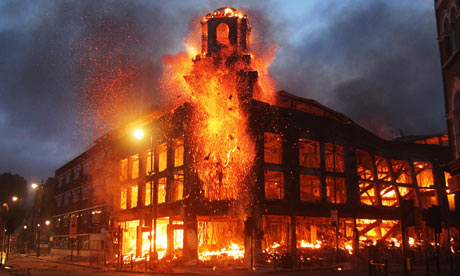
Fire rages in Tottenham, Saturday night (Lewis Whyld/PA)
This morning, buildings in the northern London borough of Tottenham were still smoldering after riots, arson and looting succeeded what began as a peaceful public protest against the killing this past Thursday, by Metropolitan police, of 29-year-old Londoner Mark Duggan, after he was stopped in a taxi near Tottenham Hale. According to the Guardian, on Saturday around 5:30 pm 120 or more marchers, organized by Duggan's family and friends and community leaders, and led by the mother of three of his children, Semone Lewis, wended their way from the Broadwater Farm area, the site of a popular uprising in 1985, towards Tottenham Police Station. They reportedly could not get the police to engage their concerns. Around 3 hours later, additional protesters with weapons allegedly appeared, and events escalated with a car being set on fire and some protesters breaking through barricades and attempting to storm the police station, "pelting police officers with bricks, bottles and eggs."  At various points thereafter people looted a number of shops in the borough, setting some ablaze, and police apprehended some looters as late as 5:00 am today. The photos tell part of the story, and it is an ugly one.  Thus far 55 people have been arrested, 26 police were injured with 8 hospitalized, and the physical toll includes 2 burnt police cars, a bus and several shops. 

The uprisings occur during a long year and several months of public distress at the "austerity" program the coalition Conservative-Liberal Democratic government, headed by Prime Minister David Cameron since May 2010, has continually imposed.  The Tory-Liberal Democratic economic approach, which has included government service cutbacks and reduced spending across a range of formerly state-funded projects, as well as hikes in state university tuitions and increased fees for other services, has thus far (and unsurprisingly) failed to reverse the British economy's contraction in the wake of the 2008 economic collapse.  The uprisings also come as London's police metropolitan police organization, headquartered at Scotland Yard, is under state investigation and public suspicion as a result of allegations that its officials, including its past leaders, aided and abetted Rupert Murdoch's News International's newspapers, including the now shuttered News of the World, in illegally accessing the personal information, via hacking, wiretapping and other means, of a vast array of Britons, ranging from members of the royal family to a kidnapping victim, and possibly of Americans including the families of those killed during the 9/11 bombings.

The unrest has since continued, with eruptions in other London-area districts such as Enfield, Edmonton, Dalton, Walthamstow, and Brixton, the last of which was the site of three of the most momentous British riots of the late 20th century, in 1981, 1985, and 1995. As today, in 1981, the predominantly Black Caribbean community in Brixton was disproportionately suffering from high unemployment, terrible housing, and an already high crime rate, and a series of confrontations with police culminated in riots confrontations between police and locals, of all races, between April 10-12, 1981. That burned into public consciousness the racial and ethnic and class crises that had long been festering in British society, worsened by the approach of the Conservative Thatcher government, and marked the beginning of a series popular uprisings, often turning on the axes of race and poverty, throughout Britain.  One result was a change, after the 1981 Scarman Report, in police search procedures, but only 4 years later, the shooting of Dorothy Groce, a Jamaican immigrant, by police sparked yet another violent uprising, which was followed a week later by the Broadwater Farm riot in Tottenham, after the death of Cynthia Jarrett, an Afro-Caribbean woman, during a police search of her home. And so it goes.
Tottenham uprisings, Saturday, August 6 (GoogleMaps/Guardian Online)
An early report in tomorrow's Guardian states that initial forensic tests may show that a bullet lodged in a police radio, alleged to have been fired by Duggan, may have come from a police weapon. Additionally, a Guardian editorial today talks about the rising sense of alienation the cuts in government services and rising unemployment have provoked. Previous London protests since the Tory-Liberal Democratic coalition took power a year and two months ago have included a November 2010 protest by the National Union of Students that culminated in some of the protesters shattering the glass façade of the Conservative Party Headquarters and reaching the roof, from which one hurled a fire extinguisher onto the street below, and a student protest last December against raised tuition that resulted in an attack on the car carrying Prince Charles and his wife Camilla as they were leaving their residence at Clarence House to attend a performance at Palladium House. Economic concerns, especially around persistent unemployment and gross inequalities based on financial and governmental élites' control of wealth and resources, have also been central to the protests that shook the Middle East this past spring and which are ongoing in countries such as Syria and Yemen.  Today New York Times reported on the ongoing protests in Israel, which has seen crowds of upwards of 200,000 people decrying the high costs of living and the failure of the government to address economic inequality.

It would be an intellectual failure to draw too simple conclusions about the situation in Britain, but it is clear that the government's broader approach to the economy has been a debacle, thus disparately disadvantaging the very people who live in boroughs like Tottenham and Brixton, as well as the working and middle-classes in general; that the axes of race and class profoundly inflect the still-ongoing unequal power relations between the still predominantly white state security forces (and British national and local governments) and many multiracial communities they serve; and that there will be no easy solutions if people, especially those without power or any sense of stake in a society's direction, have few viable channels to express their concerns and see mechanisms to address them.  From the reports I've seen, local governmental authorities are taking note of the exploding crises, but the solutions must to be horizontal and vertical, cutting across and deep into every layer of British--and every other--society, and must involve the people who not only feel but have been left out, economically, politically, socially, culturally. These solutions also have to start happening right away, or Tottenham could be just one of many boroughs to catch fire, and more than a few times, before the summer, and the year, are out.

Friday, August 05, 2011

Rara Avis: Alexander McQueen @ the Met

photo
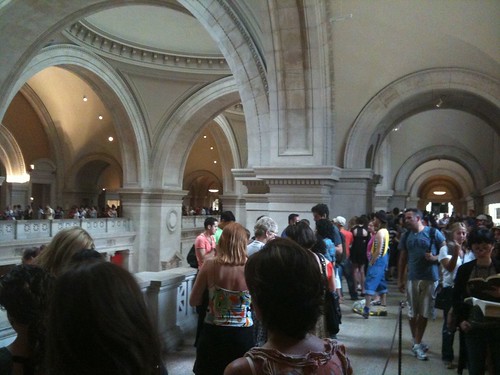
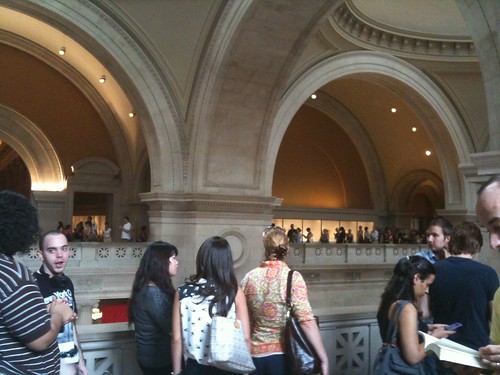
The line around the atrium
This Sunday, the blockbuster New York art show of the year, Alexander McQueen: Savage Beauty, at the Metropolitan Museum of Art, will finally close. Having opened on May 4, it was set to end this past Sunday, but the Met wisely decided to extend it a week to allow stragglers--thousands of them, including yours truly--to catch it. Several friends had urged me to check it out as soon as I got back from Chicago in June, but I kept thinking I would go eventually and then, as always happens during the summer...the clock wound down. So I headed uptown on Wednesday, thinking that midweek in the early afternoon would be fairly slow, only to find that the wait (for non-Met members, I later learned) was estimated at 2 1/2 HOURS at best, and that the line I joined, which doubled back at its start, stretched all the way around the main atrium of the Met up through the 19th Century European Art galleries. It was probably about 3/4ths of a mile, if not the entire length. And the Met's atrium was warm. Quite warm.  And endless line in a hot space is not a good combination.
My notebook drawings of Savage Beauty
photo
The line
So long was the wait that I twice considered quitting the line and just heading straight to grab something to eat and then going to the library, but by the time I'd made it halfway around the atrium, I decided to stick it out. I had also worn my daily library-ready backpack, which meant I had my (heavy and growing ever heavier by the minute) laptop (whose screen had to be inspected by museum guards), books and notebooks, and writing materials stuffed in it. Perhaps an hour into the wait, the weight felt like one of Auguste Rodin's statues--the big ones--was nesting on my shoulders, and even though I kept setting it down as the line moved, by the time I got to the exhibit I felt like I'd carried one of Richard Serra's large tilting steel arcs the entire length of the line. (There was a show of Serra's drawings that intrigued me, but I was too exhausted to stick it out after the McQueen mosh.)
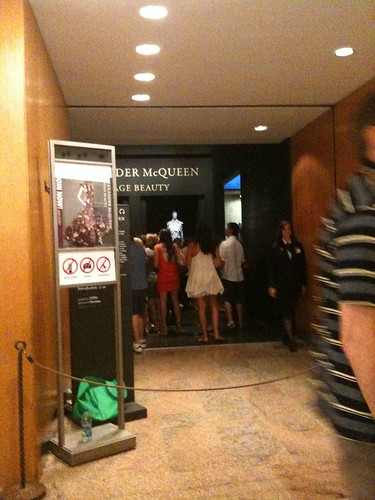
photo
Entering the exhibit
Before I say anything about the exhibit, let me also add that as much as I love Alexander McQueen's work and a great deal of the Met's innumerable treasures, it is very, very unpleasant to be packed into a museum exhibit as if one were on an extremely crowded subway train; the 6 heading north or south at rush hour comes to mind. Show-as-spectacle is a moneymaker for the museums, but for the viewers, it becomes as much about the experience of the spectacle as about the artworks themselves. In addition to not being able to see anything, every step, every turn, every movement is impeded by all of the others around you trying to do the same thing, move, look, experience. To see artwork of any sort in depth, to take it in as fully as possible, you--I--need a bit of space and time. But that was not to be. It was a moshpit in the galleries, and when I realized that I'd accidentally walked past one of alcoves and tried to go back, it was like scaling the wall beneath a cataract, with the momentum completely against me and only my determination (and madness) keeping me pressing ahead. I did manage to slip back into that other gallery, and was glad I did.  But what a workout! Yet such is the nature of blockbusters and the experience of catching such spectacles at their end, especially in New York City in the summer. And perhaps a bit of discomfort was necessary to fully engage with and experience this show.

My notebook drawings of Savage Beauty
In fact, I was very glad I stuck out that line and the quicksand of fellow exhibitgoers to catch the show, because while I have long been a fan of McQueen's work, having even watched his last full, incalculably brilliant runway show during his lifetime, featuring his Plato's Atlantis spring/summer 2010 collection and broadcast on the net in the fall of 2009, it was an altogether different and continually astonishing experience to see his clothes up close. I say clothes, which these creations are and which women have worn and will continue to wear, but they are, without question, works of art.  One thing I know would probably have been impractical but which I wish the Met, with its ample (though not infinite) resources had arranged was for a model or two to wear some of the clothes, so that exhibit attendees could see them in motion, fitted onto and, in some cases, into, a body.  The mannikins did suffice, but there were more than a few of his clothes, whether the VOSS dress of spring/summer 2001, whose bodice comprised red-stained medical slides, with a skirt of dyed ostrich feathers, or the ensemble consisting of a skirt made of perforated balsa wood and a leather top that resembled a straightjacket, or the exquisite, faint-inducing Sarabande gown, spring/summer 2007, of nude silk organza embroidered with real and cloth flowers, let alone all the medieval-to-BDSM-inspired accessories, that I would have loved to see someone--a woman, or a man able to fit them--wear and in-habit, embody them. In some cases they verged on being unwearable, or at least required supreme concentration and effort, and betokened extreme discomfort, a physical experience so difficult and disorienting that it might alter one's sense of self; and yet, as Daphne Guinness, Lady Gaga, Kate Moss, and his many other models and muses have proved, they were wearable.

McQueen (b. 1969), who tragically took his own life at age 40 on February 11 of last year, demonstrated vision and skill from his earliest post-school collections. The exhibit, which artfully and successfully culls and mixes pieces from his vast store of masterpieces, shows this in the relatively pared-down, mostly monochromal early pieces that offer a short course in skillful tailoring, aesthetic refinement and innovation, and witty sexiness.  His "Bumster" pants and skirt, in the Highland Rape show of 1995-96, ride so low they barely top the buttocks or pelvic bone, yet manage not to appear vulgar but deliciously stylish, offer one example. Another would be the military motif worked to exciting ends in the Joan show Autumn/Winter 1998-9 collection.  Every piece in this show testifies to McQueen's technical adroitness, gifts for playing with differing and often difficult materials, colors, juxtaposition, and volume. But whether imagining tattered, post-shipwreck gowns or aluminum corsets or garbage-bag-like layered petticoats or pheasant-plumed sheaths, these pieces as a whole make clear that he achieved much more than just taking standard garments to exciting ends. As I slugged through the displays, I remembered some of the wilder shows he had staged, some provoking questions about his feelings towards women--there was the show titled Highland Rape of course, and another that staged scenes in a madhouse, a clip of which was playing in one of the exhibit rooms, and then the clothes and shoes themselves at times seemed like they would induce as much physical pain as aesthetic pleasure if worn--but what I began to think about even more was that in a sense, his work over the years seemed to be pushing constantly in the direction not only of the "romantic," the term McQueen used to describe himself and that seemingly graced almost every wall of the show, along with "futuristic," or the fantastical and gothic, though those certainly are certainly key, as would the "queer" (did that term appear--I may have missed it), but especially of the post/trans-human.

Cephalopod
Again and again, I kept keying on all those feathers, the robotic metallic bodices and carapaces, the heavy leathers, that wooden skirt, the blouse made of mussels (!), the gown with the fake and real flowers, the prints--those extraordinary prints!--often symmetrical, that in that Plato's Atlantis show featured insectlike and larval imagery abstracted into something else so beautifully strange it was hard to take your eye off it. Sublimity at points, certainly, for what other word could describe that "Jellyfish" ensemble from Plato's Atlantis, with its dress, leggings and those dizzying marvelous "Armadillo" boots embroidered with iridescent enamel paillettes, giving the wearer and anyone viewing her an experience beyond anything we might fully take in in a single or multiple glances, and exceeding our capacity to fully comprehend what we were seeing--as human?  A stunning woman-cephalopod, more likely. But that outfit also spoke to a kind of becoming-animal, or becoming-other, perhaps not so much in the Deleuzian sense, but in a way auguring the transformations, technological/bionic, Darwinian and otherwise, that we certainly are undergoing as I type this, and which McQueen envisioned and attempted to push fashion fully towards. Western tradition, outside of mysticism, and magic, makes little space for this except as fantasy, as futurism, or via science. And McQueen would not be the first person, and certainly not the first gay man, to have dreamt of becoming someone or something that the human could not encapsulate or limit. In the West, one acceptable way to address these possibilities other than through religion or mysticism or science, or which has brought them all together imaginatively, has been through art.  In so many of these clothes-artworks, he presented artistic models for what the external forms of a post- or trans-human might look like.

"Jellyfish" ensemble
Of the "Jellyfish" ensemble and the entire show, McQueen himself said: "[This collection predicted a future in which] the ice cap would melt . . . the waters would rise and . . . life on earth would have to evolve in order to live beneath the sea once more or perish. Humanity [would] go back to the place from whence it came." Climate crisis--yes. But instead of death, or perhaps through the horror preceding it and the transfiguration after, we get something else, a glimpse of adaptation and the beauty that might result.  These ensembles, like the VOSS dress that births feathers, betoken a point of view that fascinates me to no end. Whereas other designers (and artists) aim to address the zeitgeist or shape it, or create clothes that flatter women or torment them or some mean between (or allow misogyny to take fabric form), or sew pieces that fly off racks at the highest end stores or the lowest or all, or mine the history of fashion and art and everything else to come up with something to fill a runway, or riff off the world around or inside them, or explore philosophical and aesthetic pathways that lead through a dress or pantsuit, or simply follow the leader, these clothes say over and over that McQueen, who was given to all of the above, also kept imagining, especially from the 2000 collections on, what might exist after the human, which is to say, the feminine and masculine, the fashionable and clothing and fashion itself, after art: What then? And his merware, his avian extravaganzas, his floral and cephalopodic artifacts, offer some clues and answers.
My notebook drawings of Savage Beauty
Dress, Horn of Plenty
The Romantics not only extolled the relationship between art and nature, but saw the former often as a form of the latter. This certainly factors into McQueen's view, but he went further, melding, in real time, the former and latter, in the process rethinking the two, offering a series of fusions and transformations, to then be realized--borne and born, carried and carried off--by intrepid models and later by women lucky and wealthy enough to be able to afford, let alone wear his clothes.  This was not simply clever futurism, but something much more far-reaching. I thought of this as I viewed his sumptuous, almost unbelievably beautiful and wrought--perhaps overwrought--posthumous collection, the Horn of Plenty fall/winter 2010 line, first in real time in photos presented in the New York Times in the spring of 2010, and then again, in select examples, in this show. One breathtaking dress, crafted of black-dyed duck feathers and  eatured in the Savage Beauty surpasses costumery and enters the realm of the become-avian; in as much as it draws upon a range of references, from the literary (the raven, a Romantic symbol of death) to the historical (its lines evoke 1950s haute couture), it exceeds them all. In fact many of the grave, sublime clothing-artworks in this final collection, which looked far back into the past while simultaneously well into the future, made me think that McQueen might have been thinking even more intently of a place beyond. Beyond human life--which is not to psychologize him, but to consider a possible philosophical perspective--or the constraints of the human, that au delà as French so ingenously puts it reachable only by the here in which he achieved but also suffered so much.

There is one dress that I have looked at again and again, both online and in this show, that seems almost like a vision drawn from a place beyond, akin to one imagined centuries ago by Aristophanes in his play The Birds, but in this quite different Cloud Cuckoo Land, this dress would adorn the Queen or members of the exalted court--for there is nothing democratic or parliamentary about most of these clothes, I must admit--the Bird-women or Women-birds or Bird-people, and you could imagine similar garments for the king, or androgynous/trans royal as well. It is costumey and yet not.  I think McQueen was giving us glimpses of post-ness and trans-ness all along, but especially by the late 1990s, and by these final collections, as he said, "There is no way back for me now. I am going to take you on journeys you’ve never dreamed were possible," (WWD, February 12, 2010); but also: "It is important to look at death because it is a part of life. It is a sad thing, melancholy but romantic at the same time. It is the end of a cycle—everything has to end. The cycle of life is positive because it gives room for new things." (Drapers, February 20, 2010). He had already begun to give us those new things, and a few of them, thankfully for all who were able to see this show, were on display here.

Wednesday, August 03, 2011

Quote: Linda Hogan

"Perhaps there are events and things that work as a doorway into the mythical world, the world of first people, all the way back to the creation of the universe and the small quickenings of earth, the first stirrings of human beings at the beginning of time. Our elders believe this to be so, that it is possible to wind a way backward to the start of things, and in so doing find a form of sacred reason, different from ordinary reason, that is linked to forces of nature. In this kind of mind, like in the feather, is the power of sky and thunder and sun, and many have had alliances and partnerships with it, a way of thought older than measured time, less primitive than the rational present. Others have tried for centuries to understand the world by science and intellect but have not yet done so, not yet understood animals, finite earth, or even their own minds and behavior. The more they seek to learn the world, the closer they come to the spiritual, the magical origins of creation."
--Copyright © Linda Hogan, from Dwellings: A Spiritual History of the Living World, New York: Touchstone, 1995, p. 19.

Tuesday, August 02, 2011

Debt-Limit Ceiling Blues II (The Fix Is In) + Video: James Baldwin

President Obama signing the bill to raise the debt limit ceiling (Pete Souza/The White House)
So the bill to raise the debt-limit ceiling has passed both houses of Congress and the President has signed it. The GOP, the President and presumably a large number of Democrats in both the House and Senate got what they wanted, which is a plan to impose massive cuts to discretionary spending, with potential cuts to the social safety net and non-discretionary sectors of the government down the road, and above all no guarantees of future federal income tax increases whatsoever, including no repeal of the deficit-expanding Bush tax transfers to the rich.  We currently are suffering through 9% unemployment, with about 25 million of people are more jobless, many of them for years, and perhaps double that in underemployment. We are still facing record domestic housing foreclosures. The economy is barely growing and contracted far more severely than previously estimated between 2007 and 2009.  There simply is not enough demand to power the economy forward, because millions of people have little or no money, and millions have no jobs or are barely working. 

Despite this the President and Democratic leaders--save House Minority Leader Nancy Pelosi (R-CA)--could not be bothered to make a compelling, let alone a weak case, to the American people that an all-out push, using all the levers of the federal government and Federal Reserve, to create jobs would lower the deficit by ensuring more revenues.  They were silent about the fact that reverting to the Clinton-era rates, in conjunction with the Affordable Care Act (the health insurance reform bill), would also dramatically lower the deficit at least by the same margins or more as the current bill's spending cuts. Because, it's clear, the fix was in. The President, the Democrats and the Republicans, for all their pantomime, they achieved their main goal: not to raise any additional federal taxes on rich people. That's it. That's what this is all about.

Oh well. My federal legislators took opposing sides on this mess. I did my usual spiel of calling and sending emails, but my Congressperson, Albio Sires (D-NJ), still voted for this horrible, job-and-Democratic-Party-killing legislation. My two US Senators, Robert Menendez and Frank Lautenberg, however, were among the 26 members of that body who voted against it. Senator Menendez said that "it simply does not force shared sacrifice as the American people have demanded," while Senator Lautenberg rightly said, "This legislation was a shakedown, not a compromise." As the American people demanded. Not that anybody leading either party really cares about what the "American people," if multiple polls or economic statistics or indicators are to be believed, demand or want or, most importantly, need. Not that following failed economic policies will lead to more failure. Ideology and politics are the most important thing, as is the chimera also known as "centrism" or "bipartisanship" or whatever label it assumes, particularly when invoking "tax reform." Because that "centrism" or "bipartisanship" ensures one thing these days: not to raise any additional federal taxes on rich people.  Don't believe me? Here's Secretary of the Treasury Tim Geithner stating it quite clearly to George Stephanopoulos (h/t Digby) during an ABC interview yesterday:

TIM GEITHNER: Get this budget agreement in place behind us so we remove the threat of default in the economy. Pass these trade agreements to help expand exports. Find a way to help make sure we can expand investment infrastructure so more people particularly in construction get back to work, and find ways through tax reform we can strengthen
GEORGE STEPHANOPOULOS: How can you strengthen investment when you’re calling for overall deficit reduction?

TIM GEITHNER: Well, you have to figure out a way to pay for it responsibly but there -- we've got a long term tradition of making sure we finance infrastructure over time in a way that's deficit-neutral. We can do that. We can afford to do that.
Nice work if you can get it....

≈≈≈

87 years ago today, the one and only James Arthur Baldwin was born in Harlem.  I think of him as one of the most important and still undervalued figures in 20th century American life. An author, preacher, public intellectual, political activist, cultural pioneer, sage and mentor, and fearless figure, Baldwin blazed multiple paths that I and countless others have, with deepest gratitude to him, since trod. 

I cannot but think that were he still alive, as overjoyed as he would have been at the election of President Obama and his political gifts, he also would be dismayed at his policies, and might also be speaking out, as one of the nation's eminent octogenarians, on a range of issues affecting us today. What, I wonder, might he think of many of the other shifts in racial, gender and sexual politics since the end of the Reagan era? What might he say about same-sex marriage or where the LGBTQ movement has gone?  How would he appraise contemporary American literature and culture, and African-American arts, letters and culture more broadly? How might he talk about contemporary France and Europe more broadly, where he spent a large portion of his life? I do often wonder. 

When I was younger I often wished I could have met him, but unfortunately never had an opportunity to do so, but several of my friends of mine did, and his passing in December of 1987 was the trigger for the founding of the Dark Room Writers Collective, to which I belonged for many years.  Baldwin's name and spirit were frequently invoked there, and as they have been in many other creative spaces in which I have spent time. Here is a video from the film James Baldwin: The Price of the Ticket, that offers a glimpse, a tiny one, of who he was.  Enjoy.


From Third World Newsreel's James Baldwin: The Price of the Ticket