Sunday, December 07, 2008

Weekend Notes

I saw today that President Elect Obama is backing the laid off workers who've staged a sit-in since the beginning of this weekend at the Republic Windows & Doors plant (here) in Chicago. The roughly 300 employees were told on Tuesday that because of financial problems caused by Bank of America's cancelation of a line of credit, they would be let go by the end of the week, which was last Friday; one problem is that they didn't receive severance or benefit pay. The article implies the union is working to resolve the issue, while the owners of the company are engaging in shell games and not responding to media queries about what's going. Local politicians are condemning Bank of America, which is an easy target since it's one of the few remaining banking behemoths, although it's doubtful that such posturing will have any effect. Meanwhile, the protesting workers are wondering when they'll get their pay and what will they do just as the holiday season is rolling around. Any bailout coming for them and the hundreds of thousands now out on the street?

+++

To add insult to injury, the parent company of the newspaper to which I'm linking, the vaunted Chicago Tribune, for decades the Second (now Third) City's leading, conservative paper, is on the knife's edge of bankruptcy. As in, it could come as swiftly as this week. The Tribune Company's owner, Sam Zell, took the company private for about $8 billion, an insane amount even factoring in the portfolio's sterling pieces, the Chicago Cubs, and the major league baseball temple, Wrigley Field, neither of which he can unload right now, and repeated decimating waves at the company's various units, including the Los Angeles Times, Baltimore Sun, and the Tribune paper itself, haven't brought in the fantastical revenue needed to service the debt. As I wrote to some correspondents earlier, "the media entities under Tribune control are like those insects that are devoured from the inside out, leaving the appearance, though sickly, of being alive, while being utterly hollow on the inside." Well, not completely hollow, but they're getting there, and we can certainly thank greed and deregulation, alongside the technological challenges the newspaper industry is facing, for hastening these events. At this rate, the nation's second and third largest cities could find themselves with one less major newspaper by January 1, 2009, if things continue on the track they're on now.

(On yet another point, this grim news about the publishing industry came out last week. As James Schuyler once wrote, another day, another dolor.)

+++

On a completely different note, I found Marc Lacey's New York Times article on the muxe, transgender/gender-queering people and related social matrix in Oaxaca, Mexico, both fascinating and a bit confounding. Confounding because the article proceeds as if, despite the wealth of material on gender and sexuality among indigenous peoples and a great deal of work on global performances of gender and sexuality, and despite the extensive contemporary discourse in gender studies and queer theory, there were little context whatsoever beyond the notion there are gay people, there are straight people, and there are some men who don't exactly fit either category but many of them dress up like women, consider themselves women, assume important roles in their community and are mostly and widely accepted, yet how do we define them according to the very fixed rubric of gay/straight? (Of course the word "lifestyle" has to enter the picture!) Etc. I say this not to criticize Lacey so much as to note that for the umpteenth time I'm registering the vast gulf between how things are discussed within academe and outside it, here in the putative newspaper of record. What might an article that were graspable by most readers yet that took into account contemporary discourse on gender and sexuality look like? How might it read so that anybody could read and engage in and with it, and how might academics, and non-academics open up conversations even more to make this happen?
Muxe
“Thalía,” who was named princess the night before at a vela, or community celebration, for the muxes, waits for a parade to begin (New York Times, Katie Orlinsky)

+++

I was going to write about how I've been baking bread of late, and how it deepened my appreciation first for anyone who does this regularly, for homemade food and cooking, for the felicities of the Internet as an archive and resource, for the simple and profound joy you can derive from successfully accomplishing a task of this sort, for C's marvelous examples as a cook, for my ancestors who had to do this sort of thing with far less at hand, for the delight of finding another way to be thrifty, for finding a way to take my mind of the mounting stacks of material to be read and my own glacially proceeding writing projects, and for the ending of Raymond Carver's famous story "A Small, Good Thing," which I regularly teach and which, despite its evident exemplary status in the contemporary, American realist canon, still carries a faint whiff of the ridiculous with its suggesting that devouring freshly baked bread might create an affective, emotional and social bridge between a grieving couple, parents who've lost their only son, and a crank of a baker whose isolation has led him to behave in an unconscionable way. But then, I made and baked and ate this bread--C. had already done so a number of times--and I realized that Carver might be on to something. I'm not saying that freshly baked bread is the best offering to patch up a broken friendship or any other sort of inimical situation, but the smell of the bread coming out of the oven, and the taste, with just a little butter, or olive oil, or olive tapenade, is enough to calm even pretty severe personal tensions. Or at least I thought so after this last loaf came out of the oven. It really is delicious. Since I've heard that a few readers enjoyed the mulled wine, I'll post a recipe for the bread soon. I need to try it a few more times to make sure I've got it right, and then I'll post it here. A photo, though, of the penultimate loaf:

Friday, December 05, 2008

Friday Notes

Day by day we careen ever deeper into what is being called a Recession (a year late, mind you), but feels like a Depression. A steady tide of horrible economic news daily fills our computer monitors, the radio airwaves, and TV screens; millions of people are now out of work, including several people I know, and several more are wondering whether they'll have a job in January; my employer, like many others, has announced retrenchment in the face of the market's collapse, and businesses across industries are suffering and fearful about the future; economic anxiety is a common script on all my graduating undergraduate students' faces; and the hope that so many felt immediately after the election is dissipating as we watch this lamest of lame dodos, George W. Bush (Emperor Katrina, Warrantless Wiretapper, Worst President Ever) blithely blather on about his failed tenure.

Several people in the Congress, including Barney Frank (D-MA), however, are demanding that the President Elect, Barack Obama, take a more active role in addressing the economic crisis. I find these calls ironic because people like Frank--whom I do support--have yet to acknowledge fully how they helped create the problems we're facing by enabling Bush's misrule through repeated capitulation over the years, except for on a few key issues, and for not holding him and Cheney responsible for their crimes through impeachment. Based on what we've known for at least three or four years now, Bush and Cheney should have been removed from office by Congress beginning in 2006. They also are showing their continued ignorance of the US Constitution, which is quite clear on when Barack Obama will have to address the mess we're all in; like his Democratic predecessor, Franklin Roosevelt, Obama has repeatedly stated that there is only one president until the Electoral College meets and the inauguration occurs, and right now, that is W, the man that was foisted upon us in 2000 and that a bare majority of American voters, who have yet to atone for having done so, kept in office in 2004. On January 21, Barack Obama will not be able to deflect anything on Bush or anyone else, despite the widespread recognition that this current administration has set a standard so abysmal we should hope it will never be equaled again; but up to and even after that point, the Democrats who have controlled Congress since 2006 ought to meditate very seriously about their own complete failure of vision and leadership, their incapacity, except on a few key issues, to Oppose this horrendous president and his wrecking crew. We wouldn't be where we are, I think it's fair to say, if they had.

&&&

Odetta (Holmes, at left, New York Folklore), the revolutionary singer and activist, passed away on Tuesday. She was one of the important figures in a generation that made possible many of the changes in society, political, social, cultural, that we take for granted today. The civil rights movement, and related struggles for equality for all people, are battles Odetta directly and dynamically took part in through her songs and writings. It's probably fair to say that her soulful presence, voice and art constituted vital contributions to the soundtrack and living text of these battles. Her gifts, however, were aesthetic as well: she also helped to blaze the paths in which a wide array of musicians, and indeed a school of music, folk, flourished, from the late 1950s to the early 1970s. It's easy to overlook the significance of someone who isn't at the center of contemporary popularity, but Bob Dylan, Joan Baez, and many others have acknowledged their debt to Odetta, to her courage, her grace, her art, and it's a debt, or better, an example, that continues and endures, along with the multiple battles we still face every day.

Here's a YouTube video of her singing "The House of the Rising Son" just last year, on Governor's Island:


&&&

It's a rare day when I find something online before Reggie H. and send it his way, but today I sent him. and Bernie a link to this New York Times article on 67 Orange Street, a new Harlem speakeasy on Frederick Douglass Boulevard. I haven't been there yet, but I'm looking forward to checking it out. I also love these kinds of stories, not simply because they document the vibrancy of our culture and the links that exist across history's gulfs, but also because they offer a glimpse of the past that is far richer and more interesting than anything we are likely to see on a TV or movie screen anytime soon.

From the article:

“I saw the parallel between Five Points, written off as a slum, and Harlem,” said Mr. Williams, who moved to the United States from St. Vincent when he was 6 years old. Five Points was the first free black settlement in New York City, but the influx of Irish immigrants soon made it a mixed-race area. Likewise, as Harlem has gentrified it has become increasingly diverse (for better or worse). The gentrification has brought a demand for more upscale places to eat, like 67 Orange and Society Coffee.

The swirl of multicultural music and dance at Almack’s and other clubs in Five Points had a profound influence in the direction of American arts. The dance halls of Five Points were considered the predecessors to Harlem’s famous “black and tan cabarets” of the 1920s. Dance competitions between native-born whites, Irish immigrants and blacks inspired a cross-fertilization of styles. Tap dancing was born in the interaction between the blacks’ shuffle and Irish jig.


&&&

Pinkie Gordon LaneWord came today via the CC list that Dr. Pinkie Gordon Lane (1923-2008), the former poet laureate of Louisiana and a longtime professor at Southern University in Baton Rouge, had passed away. When I read the news, I thought back to the first Furious Flower Conference, staged by Dr. Joanne Gabbin in 1994 at James Madison University. Not only did I get to hear Gwendolyn Brooks read (with Rita Dove!) for the first time at that event, but I finally was able to see and meet a number of important Black Southern poets, like Dr. Lane, Alvin Aubert, Tom Dent, and Gerald Barrax, whose work I'd been familiar with through my job at the time, but who were not and perhaps still are not as much discussed as some of their contemporaries writing in other parts of the country. What a revelation that was, and how gracious Lane and the other poets were! She was also a pioneer: in 1967 she became the first black woman to receive a Ph.D. from Louisiana State University. While teaching at Southern, from which she retired in 1986, she published 8 books including 5 poetry collections, beginning with Wind Thoughts in 1972; her last published collection was Elegy for Etheridge (2000). The words, thankfully, are still with us.

You can read an interview with Pinkie Gordon Lane here.

Thursday, December 04, 2008

Poem: W. G. Sebald

W.G. SebaldAlthough he is best known as one of the exemplary prose writers of the late 20th century, W. G. Sebald (1944-2001) also wrote poetry, and a few years ago, in one of my favorite used bookstores in Chicago, I found a little book of his poetry, with artwork by the abstractionist Tess Jaray. Here's one of the poems from this collection, which are all written in the following style. It reads like an epigraph for so much of his work:

It was as if

I was lying
under a low
sky breathing
through the eye
of a needle

Copyright ©, from W. G. Sebald, For Years Now (images by Tess Jaray), London: Short Books, 2001, p. 57. All rights reserved.

Monday, December 01, 2008

World AIDS Day

Today is World AIDS Day. In the past I've posted remembrances of those I knew who were lost to HIV/AIDS, an essay on the state of HIV/AIDS, and links to World AIDS Day commemorations. Today I'm linking to several different articles by others on HIV/AIDS that readers might fight interesting.

"AIDS: This is no time for complacency," by Jay A. Levy, San Francisco Chronicle (December 2008)

"AIDS: A stigma endures," by Susan Blumenthal and Melissa Shive, San Francisco Chronicle (December 2008)

"On World AIDS Day, consider the impact on youth," by Sam Ho, Allentown Morning Call (December 2008).

"AIDS fight requires resources, even in tough times," by Archbishop Desmond Tutu, Chicago Tribune (November 2008)

And because I can't find a link to it but received it in an email and thought others might find it as interesting as I did:
"Reconstruction," by Charles Stephens (whose blog was one of the inspirations for my starting this one back in 2005) and Craig Washington, courtesy of AID Atlanta and the National Black Justice Coalition

Over 20 years ago, the writer Joseph Beam proclaimed that "black men loving black men is the revolutionary act." Writing in the midst of an historical catastrophe, Beam was able to articulate a phrase eerily beautiful and simple, yet potent. That was an era when black gay men were the invisible element in the AIDS epidemic, and arguably are still invisible. There was daring and urgency to his message that we must revisit to give us the inspiration and perspective necessary to move forward. As we think about how HIV/AIDS has impacted our communities, lives, and relationships with ourselves and each other, Beam's phrase has never been more appropriate, valuable or relevant. Moving forward we must consider the value of love. Black gay men, black lesbians, and black transgendered people loving themselves and each other. In that love, we must consider the following strategies to provide a paradigmatic and methodological shift, in an effort to energize and recharge our movement.

Re-emphasize the impact of HIV/AIDS on black gay men. The AIDS epidemic was first presented to the public as a white gay men’s health issue. Although GRID (Gay Related Immune Disorder) was quickly redefined as AIDS, non-gay Blacks, Latinos, and women of color were recognized as "the changing face of AIDS", and safer sex education became focused on behaviors. Even with that shift, many non-gay minorities continued to see their risk as determined by their identity. Instead of taking that opportunity to address stigmas attached to queer sexual orientations and sexuality in general, the HIV/AIDS industry dissociated AIDS from "gay" to encourage heterosexuals, especially black heterosexuals to give it priority. Two decades later, despite the irrefutable statistics confirming black gay men as the group most heavily HIV burdened, the campaign to de-gay AIDS rolls on. Black gay men are often missing or underrepresented in prevention marketing strategies, AIDS drug ads, and community mobilization efforts. We cannot effectively respond to the spread of HIV until we recognize that gay men matter.

Rethink home-based testing. The move toward HIV testing in nontraditional venues and outside of clinical settings should be applauded. These efforts can reach individuals who might not go to an AIDS service organization or ask their doctor for testing. Now we must not be afraid to move to the next step - home-based HIV testing. We cannot be afraid to empower our most at-risk populations with immediate access to their HIV status. Having access to one’s HIV status is one of the most effective forms of prevention. Though pre and post test counseling can be an effective tool in HIV prevention, its absence should not a barrier to our people knowing their HIV status.

Restore pleasure to safer sex. People like having sex without condoms because it feels good. But we tend to automatically label those who engaging in consensual sex without condoms as suicidal, self-hating, irresponsible, lacking in self esteem, or mentally unbalanced. When we do that, we underestimate the pleasure principle. Sex is one of our most primal drives and it facilitates pleasure, intimacy, power, comfort and love like no other form of engagement. By imposing a singular medical framework on these acts, we deny the profound spiritual, psychological and emotional value they provide. By deploying fear based incentives, we may briefly capture attention, but scare tactics do not motivate a sustained behavioral change. We instead need to open a broader dialogue with people regardless of their condom use, and help them negotiate harm reduction in ways that respect their sexual proclivities. Skills building workshops, discussions and counseling groups that focus on enhancing sexual pleasure and not merely making condom use "sexy" may reach more people and help them develop healthier, safer and more fulfilling sexual behaviors. Instead of mandating abstinence or consistent condom use as the only viable prevention methods, we can better serve our communities without judging or scaring them.

Re-imagine the range of Prevention options. Though the condom is a necessary and effective part of any HIV prevention strategy, it’s imperative that we develop, improve and sustain newer technologies and approaches to sexual health. As the rates of new HIV infections among black gay men, particularly young black gay men climbs to new heights, we must unshackle ourselves and our work from behavioral approaches exclusively. This means advocating for biomedical and structural methods in HIV prevention, while we continue to develop and innovate behavioral models. With regard to biomedical approaches to HIV prevention, we must insist on the development and distribution of pre and post-exposure prophylaxis, vaccines and rectal microbicides. For structural interventions, we must explore and address the litany of causes that facilitate risk among black gay men: socioeconomic disparities, the lack of a living wage, the lack of housing, and other societal factors that create fertile conditions for risk among our brothers. We must also ensure that those who are HIV positive have access to adequate healthcare and treatments that maintain low viral loads which can reduce their rate of infectiousness. We must be proactive, innovative and willing to think outside the box.

Reinforce our pride. Our struggles with gay identity are much more grounded in our reinforced repression of our inner feminine beings than any conflicts with historical white cultural oppression. We must help gay men work through self hatred and embrace the feminine being within themselves and each other. We also have to de-stigmatize gay identity throughout black communities. Most media images of sexual minorities tend to depict African Americans as irrevocably homophobic. Yet many of us have narratives of love and acceptance from within our community. These narratives are rarely broadcast as culturally normative. We should develop a campaign that conveys messages of acceptance and breakthroughs that occur among black families. Right wing organizers and black demagogues have been marketing homophobia in black communities for decades. It’s about time we started working our own positive campaigns to promote black love among black people. ??

Charles Stephens is the African-American Gay Outreach Coordinator for AID Atlanta. He is committed to art, social justice, and gay men’s health.

Craig Washington, MSW, is a Prevention Programs Manager at AID Atlanta. He is a writer, organizer, and consultant on HIV and social justice issues.

Sunday, November 30, 2008

Post-T-Day Notes

I am, as is often the case these days when I fly, recuperating from a (terrible) cold. For once I did get a flu shot, and try to prep for the Petri dish conditions on the plane, but this time I was ringed by ill travelers, so I think my fate was sealed, despite the best efforts of Zicam, Emergen-C, orange juice, lots of water, and so on. My and our Thanksgiving was nevertheless wonderful, and I'll be working off the added pounds for weeks to come, but I do wish there were a way not to get sick from flying short of wearing a (gas/surgical) mask. One of these days I hope to figure it out.

===

I should note that one of the first bits of international news I heard on Thanksgiving Day morning concerned the horrific series of attacks, lasting for three days, in Mumbai, India. As of the most recent tally, over 195 people were killed, nearly 300 were injured, and the physical destruction to Mumbai's chief attractions and the psychological damage to its people and to India more broadly, as well as the further destabilization of India's already fraught relationship with neighbor Pakistan, are as of this point still incalculable. According to this Daily Mail account by the lone surviving terrorist, the original aim of this gang was to kill around 5,000 people and cause inestimable destruction. 3 RDX bombs they had planted which could have raised the death and destruction totals and razed the Raj, were thankfully either defused or did not go off. The recriminations in the Indian government have begun, as have accusations of Pakistan's complicity, but I sincerely hope before anything escalates at the national level between these two nuclear powers that they, and other nations, including the United States, can sit down and figure out what happened and how, even in light of the intractable problem of Jammu and Kashmir, as well as other issues, to prevent it in the future.

People hold a candle-light vigil, for the victims of the terrorist attack in Mumbai. (AP Photo)
‡‡‡

On a different continent, another horror was playing out: the politically oriented, socially fractious riots in Jos, Plateau State, Nigeria, where over 350 (or considerably more, depending upon the source) people have died, countless have been injured, and residents of certain neighborhoods have had to flee their homes (photo at left, IRIN). The Plateau state governor has dispatched troops to calm the violence, which was led by armed bands of opposing political factions that closely mirrored the Muslim and Christian divisions in many parts of central and northern Nigeria. What appeared to spark the riots were allegations that the People's Democratic Party (PDP) had unfairly won the elections. As the first article I linked to suggests, the Nigerian federal government should probably step in to calm the tensions and assure, to the extent possible, the fairest and most transparent resolution to the electoral contest.

+++

On a completely different note, I've been following of late in some of the conversations composer and Juillard School professor Greg Sandow has initiated on his blog around current problems with classical/European-American art music. He is now compiling a list of what he suggests are ways that classical music "doesn't connect" with contemporary audiences. There have been some excellent thoughts and suggestions, from Sandow and others in the classical music field, and I haven't had too much to add, except on a few points where I can speak without sounding like too much of a fool. Sandow has more than once attempted to analogize the condition of the contemporary classical music world--meaning more than just composers and compositions, for example, and encompassing all of the related institutions--to other art genres and forms, noting for example that classical music concerts tend to emphasize a fairly historically and formally narrow collection of composers and works, especially at the expense of the new.

One of my first thoughts about this was that, in fact, if you take literature, every single genre, in almost every nation, society, and culture around the world, presents new works alongside the classics, and it would be very strange, for example, to read only or primarily works from 200+ years ago, whether they were poetry, drama, fiction, nonfiction, criticism, and so on, even though in some cases those works still hold tremendous sway over contemporary literary production. In the case of American literature, of course, British literature from Modernism backwards looms large, which is unsurprising, but there isn't a single major institution in the academic or publishing realms, no matter how fixated it might be on the importance of British literature in relation to American or any other literature, that would primarily or only teach British texts from, say, the British Renaissance, employ scholars in this area, invite people to present talks on or read from texts written during that period. I don't think even British Renaissance (and perhaps say Italian, French, and German Renaissance) scholars and enthusiasts would find that all too interesting. And yet it is very much the case in the classical music world that the music produced from the late Baroque period through the late Romantic era (roughly Bach to Mahler), primarily in German-speaking countries but with some selections from France, Italy, and Britain, garners the overwhelming share of attention and programming at most orchestras. In some cases, most work produced in the 20th and now 21st centuries, beyond selected composers and works, does not get played very much if at all.

One could make all sorts of arguments about why this happens, and that is what Sandow and company have been engaging in for some time (years, really). I'm interested to know what other J's Theater readers think about this. If we were to look at other genres of say, music, especially popular music, which Sandow does reference quite frequently, I would argue that if the musical genre is still living, which is to say, if people are still creating within the generally accepted forms and modes of that music, it's common to hear both the older, sometimes oldest, forms of that music as well as the most recent. Jazz would be one example, but rock & roll, or the much younger hip hop would also fit the bill. Or maybe none of these musical forms can be analogized to classical music in the same way, because of incommensurabilities, like history and chronology and technology and systems of distribution and performance, and so on. What do you think?

===

I didn't post anything on the 125th edition of "The Game," and I truly didn't pay much attention to it, but when I learned the results, I was quite happy that a certain team based in New Haven did not win (they did not score a point). Nevertheless, the Crimson and the Bears finished in a tie for the league championship. The University's team, the Wildcats, finished 9-3, ranked 25th in the country, which means a Bowl visit.

***

Lastly, this Sierra Leonean begs to differ on a key, recent US historical point, while a black St. Louisan demonstrates he's living in a parallel universe. Chacun à son goût, I think the phrase goes....

Thursday, November 27, 2008

Monday, November 24, 2008

Over the Weekend

A few notes and photos from this past weekend.

On Friday, two distinguished writers and three graduate students affiliated with the university's MA/MFA program read their work at the new Center on Halstead in Lakeview, easily one of the sites most seeing in the Boystown-Belmont area of Chicago. MA/MFA faculty and Center for Writing Arts visiting fiction writer-in-residence Sefi Atta read from the opening of her novel Everything Good Will Come (Interlink USA), while Chicago Tribune columnist and Brenda Starr comics writer Mary Schmich offered three short essay-columns, one of which involved hang-gliding in Rio. (She captured the experience perfectly.) Aubrey Henretty (creative nonfiction), Nate Zoba (poetry), and Kelly Burgess Mayer (fiction-creative nonfiction), one of my past and current students, presented their works as well.

MA/MFA co-director and author Sandi Wisenberg introducing Nate Zoba, Kelly Burgess Mayer, Aubrey Henretty, Mary Schmich, and Sefi Atta

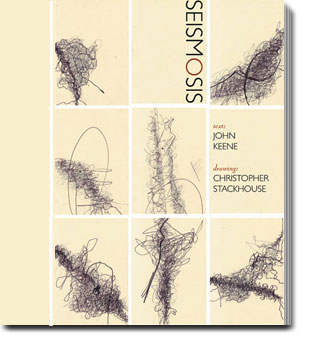
On Saturday evening, a group of Joshua Marie Wilkinson's poetry students from Loyola University in Chicago, led by Charles Gabel, invited me to read with them and Loyola professor Terence Boyle, at a poetry reading-salon they regularly host in Rogers Park. It was tremendous fun, an honor to read with Terrence, and also so encouraging and exciting to hear these young poets, whose interests range widely, who're publishing chapbooks and journals, and who're collaborating on projects of all kinds. One highlight was when one of the writers (a student at Columbia College) and her girlfriend performed Chris Stackhouse's and my "unreadable" poem, "Index," from Seismosis, giving (doubled) voice and body/ies to the concrete-ish poem and its twin image. Thanks again to Charles and all these poets, and we must do it again!

Terence Boyle reading his work

The performance of "Index"

Wednesday, November 19, 2008

Sports + Barkley L. Hendricks at Studio Museum in Harlem

Okay, at first I was thinking, nothing literary today. The "apparatus with which I think" (Bierce) is tired. So: sports. And specifically: baseball.

Yesterday, St. Louis Cardinals first baseman Albert Pujols was named the MLB's 2008 National League Most Valuable Player. Pujols hit .357 with 37 home runs and 116 RBI, and had an on-base percentage of. He beat out the World Champion Philadelphia Phillies' (and native St. Louisan) strapping slugger, Ryan Howard, who hit 48 homes (first in the league) and drove in 146 runs (first), while hitting only .251.


Albert Pujols, aka El Hombre (or Prince Albert, Phat Albert, The Machine, and my personal tag for him, Big Papa, Photo: Emily Rasinski/P-D)

Pujols was easily a more consistently dangerous threat at the plate, with an on-base percentage of .462, and a .653 slugging average, both well ahead of Howard. He was second only to Atlanta's Chipper Jones (.364) in the batting title race.

This is Pujols's second MVP award, making him the first Latino and Dominican player to achieve this status; his first came in 2005. He has been in the top five every single year he's been in the league, save last year, and is the only player in MLB history to have 30 home runs and 100 RBIs in this first 8 seasons. It's not unlikely that if he had better protection in the lineup he could have hit even better. As it was, despite being out 12 games because of injuries, he still helped kept the Cardinals in contention for most of the season, until their late fade, when they finished in 4th place.

Other MLB awards: AL MVP, Dustin Pedroia (Boston); AL Cy Young, Cliff Lee (Cleveland); NL Cy Young, Tim Lincecum (San Francisco); AL Rookie of the Year, Evan Longoria (Tampa Bay); NL Rookie of the Year, Geovany Soto (Chicago); AL Manager of the Year, Joe Maddon (Tampa Bay); NL Manager of the Year, Lou Piniella (Chicago).

***

Bernie T.
pointed out this amazing story to me, and Reggie H. posted about it yesterday, so I'll send you to his blog to read more. Take it away, Reggie:

Since my partner and I got hooked on Rugby thanks to watching the Wallabies, the All-Blacks, and the Tri-Nations tournament on Fox Sports, I can't resist pointing to this video and article about The Hyde Leadership Public Charter School in Washington DC, from the New York Times.

When the team starts the post-game singing of "Lift Every Voice and Sing," I get all choked up....

Aim High, boys!
***
I seldom read Newsweek magazine, but I did flip through it today while waiting at the pharmacy, and saw Sarah Bell's article, "Urban Outfitters," which among other things asks why Kehinde Wiley, whose gorgeous new paintings are lighting up New York (in the exhibit "Down" at Deitch Projects and elsewhere) hadn't acknowledged his debt to Barkley L. Hendricks.

Who is Barkley L. Hendricks? Well, interesting that you ask, because today the New York Times offered a brief focus on Hendricks that's worth checking out. Hendricks is an important but little heralded painter whose work from the 1970s on has mapped out a new area in African-American and American vernacular, photorealist portraiture. To give one example of his work, I've posted of my all-time favorite of his works, "North Philly Nigga (William Corbett)," [1975. Oil and acrylic on cotton canvas, 72 ½ x 48 ½ inches. Collection of E. Blake Byrne, Los Angeles], which resoundingly evokes a world I and many others know and recall so well. Many of his most famous paintings, full-size in scope, depict urban black male subjects, sometimes in dandyish fashions, sometimes in street wear, but he also has painted numerous portraits of black women and group images, some inspired by prior works in the Euro-American art tradition, others drawn from his own photos and mass media imagery, as well as from his personal life. He also has exhibited some of his photography, which mines a similar vein.

Hendricks, it turns out, is having his first major retrospective exhibit this year; titled Barkley Hendricks: Birth of the Cool, it's now at the Studio Museum in Harlem (it runs from November 12, 2008-March 15, 2009). (You can hear the great art historian Richard Powell on Hendricks' work, from the exhibit's previous stop at the Nasher Museum of Arts at Duke University website.) A graduate of the Pennsylvania Academy of Fine Arts and Yale's art school (BFA, MFA), and a longtime professor at Connecticut College, he has been making his art almost concurrently with the rise of late 20th century vernacular forms such as hip hop, funk and r&b, and his work is the epitome of soul, wit, grit, rawness, queerness, and realness. Although work of this kind hardly seems revolutionary now, especially with the "return" of painting, especially representational and realist painting over the last few years, Hendricks is and should be acknowledged as an important pioneer. His DNA is all up in Wiley's and others' work. So give some props, bruh. And let's all get up to the Studio Museum (and Deitch) if we can!

Hendricks on YouTube (doesn't he sound a little like Chris S.?)

He received a United States Artist award as well this year (congrats to all the other winners, including folks I know, like Harryette Mullen, A. Van Jordan, Tayari Jones, and Forrest Gander, and many I've long admired, like Muhal Richard Abrams, Henry Threadgill, Joy Harjo, William Greaves, Jawole Wille Jo Zollar, Ela Troyano, and lê thi diem thúy!)

(Also running simultaneously with this exhibit is AACM philosopher-musician George E. Lewis's Travelogue, a SMH StudioSound exhibit that he writes was "twenty years in the making.)

Tuesday, November 18, 2008

Snow + Mulled Wine

Sometimes I wonder if I'm going to look back on these past few years in Chicago outside of my classes as little more than a mostly endless avalanche of documents--not books of poetry or fiction or creative nonfiction or biographies written by others or even by me, etc.--that have to be read by a certain date and letters and reports and so forth that have to be produced by a certain date and endless meetings involving documents that have to be read and reports that have to be read and written and so forth...but I do know that one of the things I will not ever forget is the weather, which has never failed to surprise or stir me from the dumps. Of course there are other places where it can be in the 30s one day and 75 F the next, or in the high 40s one day and snow the next, or be cool near one's apartment and like an antechamber to the arctic just 25 blocks away and then merely chilly only a few hours later. Or so freezing and windy that you are sure you have died and are cast into you know where. But I don't live in those places and can't speak to them. Chicago's vagaries, however, I do know a bit. See for example the photo below, taken on Sunday evening.

By the time I snapped the photo, the snow had stopped. A cashier in the bookstore I'd dropped into mentioned that because of the less extreme weather earlier, he hadn't even worn a coat or jacket to work, and now wasn't sure what he was going to do. I suggested he call a family member or friend to bring a jacket, or a coworker heading in to work to lend him the same. I felt so bad for him that I almost wanted to go buy him a jacket myself. Unfortunately for both of us, whatever desire I had to carry out that altruistic act was dispelled when I saw the ticket nestled in the snow atop my windshield. I guess someone has to pay for all those appealing new banners across the cityLoop area congratulating our President-Elect.

There was still a little snow on the ground but tonight the sky was clear as I walked from class to the El. I'd felt crappy earlier in the day but this evening class always picks me up. A group of students and I were heading west on Superior and one mentioned how much she enjoyed having a glass of wine when she got home from class, and the cold weather immediately made me think of mulled wine, which I will always associate with the Second Sun readings at Naïeveté Studios, and especially with Toni Asante Lightfoot (who is now the mother of Leontyn Ella Gbegan!!!-congratulations, Toni and Setondji!) and Krista Franklin. I suggested mulled wine to some of the students, a few of whom hadn't heard of it, so in honor of little Leontyn, and my great grad students, here's the recipe, from an earlier J's Theater, for mulled wine:

Mulled Red Wine (hat tips go to Toni A. L., Krista F. and James Earl H. and Donald A. for their delicious version).

MULLED RED WINE

2 bottles of merlot, red zinfandel or a similar wine ($5-9 range, not too cheap, not to expensive)
2/3rds cup of sugar or honey
zest from 1/2-1 orange
10 cloves
2 cinnamon sticks
1/2 cup of brandy or cognac (not too cheap)
+ non-reactive pot, muddler/spoon, non-reactive bowl/mortar, stirring spoon, mugs/coffee cups/warming cups.

1. Pour the red wine in a non-reactive pot (non-stick, tempered glass/Pyrex, stainless steel, etc.), and heat over a low flame. Avoid very cheap wines, since they grow unpalatable when heated, and avoid aluminum, which will react with the wine.
2. With a vegetable peeler, zester or paring knife, zest the orange, making sure to avoid the white backing of the peel and rind, since there's less flavor and it can be bitter.
3. Muddle (or mash with a pestle or spoon) the zest/peel, releasing the oils, in a non-reactive (glass, porcelain) bowl or mortar.
4. Add the zest/peel to the wine.
5. Stir in the sugar, making sure it dissolves, then add the cloves and cinnamon sticks.
6. Add the 1/2 cup of brandy or cognac (the better the quality, the better the taste--and it adds real bite).
7. Heat until the wine is steaming, but try not to let it boil.
8. Set it aside, let it cool, and then ladle it into mugs, and enjoy!

(And remember, if you have more than a glass, designate a responsible driver, hire a cab or hit the public transportation!)

Monday, November 17, 2008

Photos: Stop Prop H8 March

FIRST: I did fix the "Long Nightmare Will Be Over" gif--yes, it should be January 20, 2009!

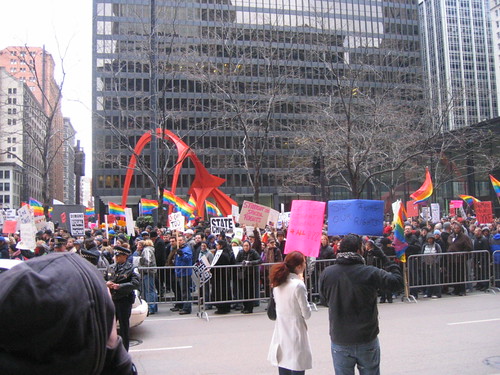
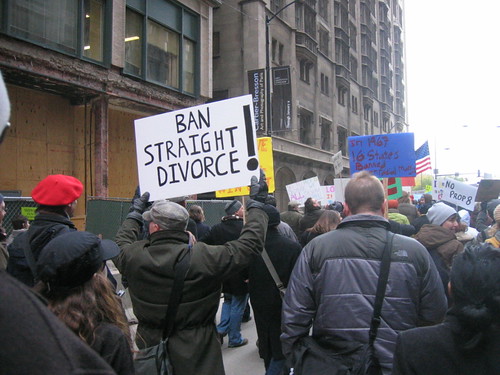
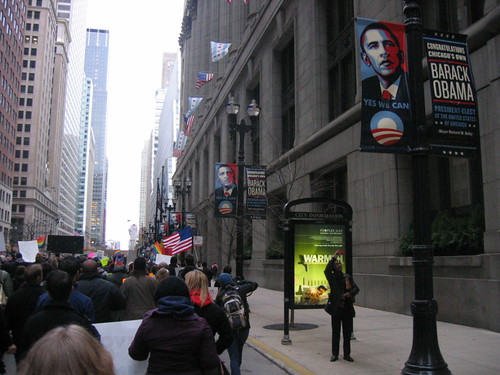
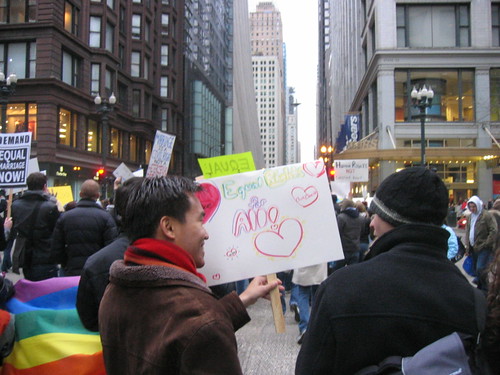
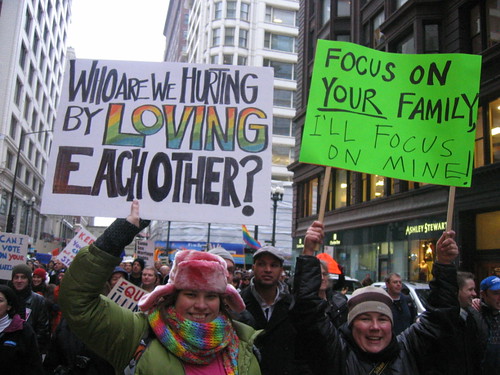
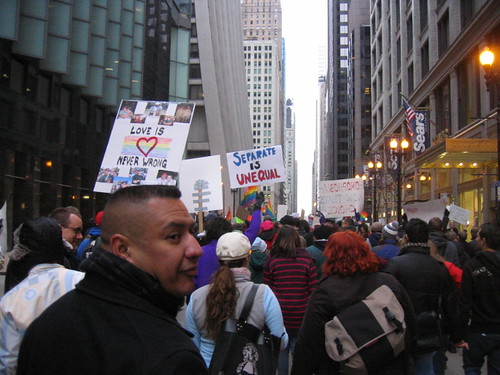
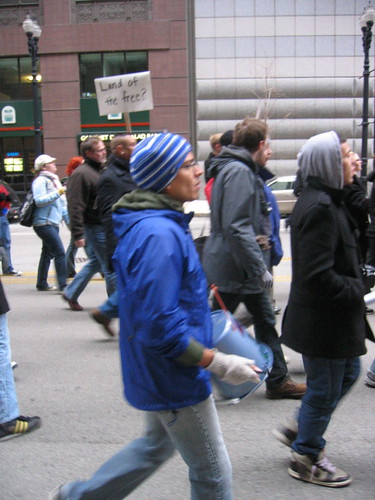
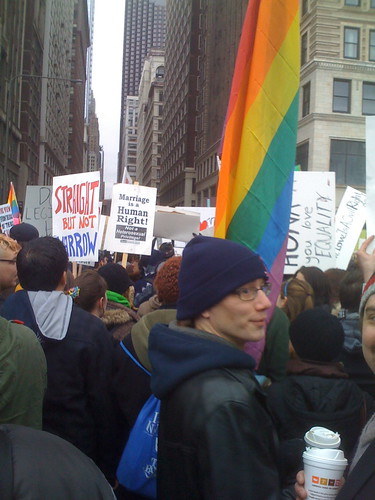
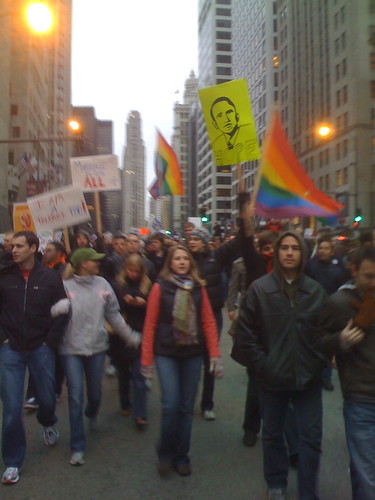
Now, some photos from the Rally which became a (permit-less) March.
IMG_7809
The rally area, at Federal Plaza (Calder sculpture in the background)
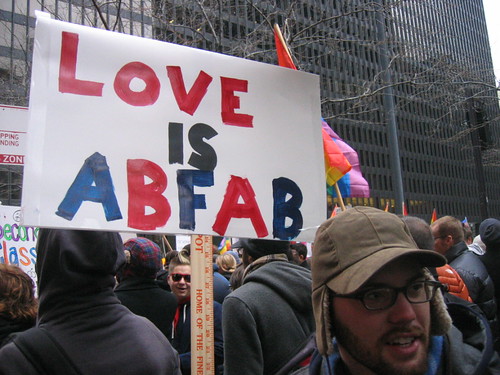
IMG_7806
One of my favorite (silly) placards
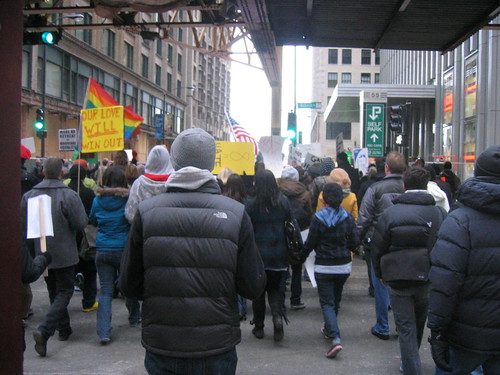
IMG_7818
Heading towards Michigan
IMG_7822
Protesters
IMG_7852
On the street, beneath the new banners celebrating our President Elect, Barack Obama
IMG_7840
Protesters have fun
IMG_7843
Two ebullient protesters
IMG_7842
Not sure where this is (but in the Loop!)
IMG_7853
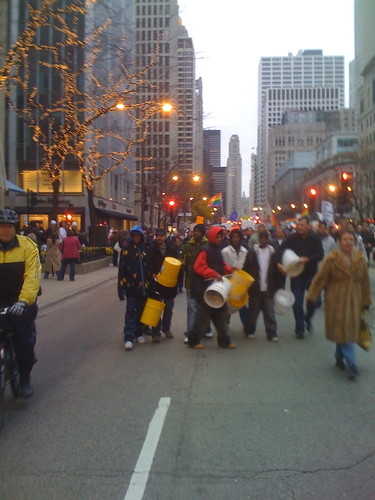
A drummer, heading back towards Michigan Ave.
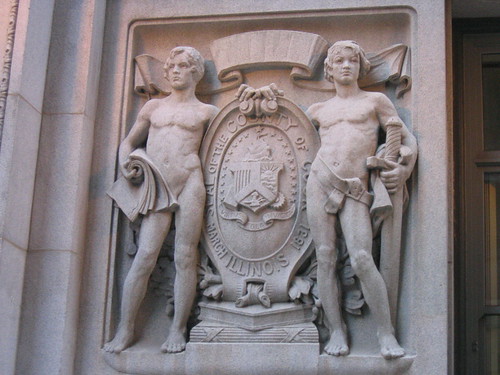
IMG_7866
Illinois's very gay state seal
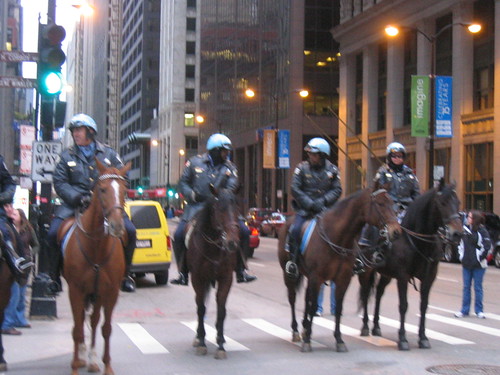
IMG_7869
The Chicago mounties
IMG_7883
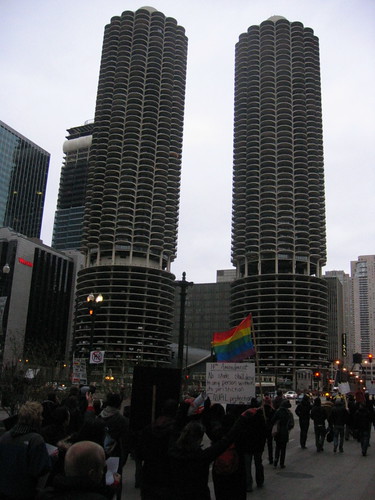
Near Wacker Drive (and those famous Marina "Honeycomb" Towers)
IMG_7886
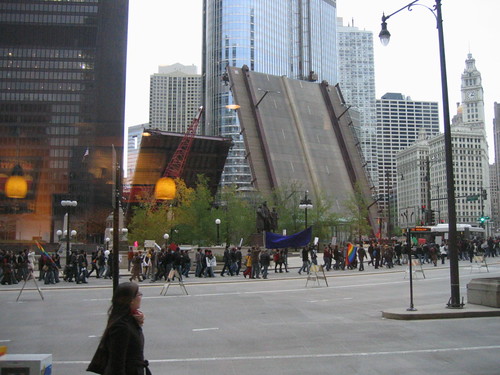
Alongside the Chicago River on Wacker Drive (I took this photo from Starbucks window--the young black folks working in there were quite supportive)
IMG_0467
Back on the street
Impromptu marcher/drummers
Some impromptu young marchers who joined on Michigan Ave.'s Miracle Mile
IMG_0479
On Michigan Avenue's Miracle Mile

Politics Politics

It looks like quite a few people are still very interested in what our soon-to-be president and his wife have to say.

Foto: João Laet / Agência O DiaHe's still provoking tremendous excitement across the globe, including among African-descendant people in Latin America (thanks, HBR!), and in particular in Brazil (from left, singer Toni Garrido, actor and model Walter Rosa, actor and MC André Ramiro, and actor Rocco Pitanga, photo: João Laet, Agência O Dia). Though black and brown French people and Britons are energized by Obama's victory, France's lone black governmental minister remains pessimistic that a French Obama is possible with the current political crowd. Yet his French enthusiasts have formed committees to discuss and push for change, and have the support of France's first lady, Carla Bruni Sarkozy. In the UK, it's not likely anytime soon, given the political system and comparatively smaller black and brown populations, but some believe the electorate would be ready.

There's a subset in this country, however, who aren't happy at all at the election results (just as they weren't by the very prospect of Obama's candidacy or victory), and are acting out in horrid ways. It's imperative that while we respect people's free speech rights, the authorities do not write off as "knuckleheads" or "aspirational," that is, take lightly the threats against the president or anyone else, or dismiss violent or deadly acts by these folks. As the Oklahoma City bombing 13 years ago demonstrated, domestic terrorists can be as great a threat and as deadly as foreign ones.

We're hardly in a post-racial world; this is part of what poet Brian Gilmore eloquently argues in his Bookforum review of historian David R. Roediger's How Race Survived U.S. History and law professor and my college classmate Ariela J. Gross's What Blood Won’t Tell, books that Brian says "chart the ongoing legacy of the legal apartheid system in the United States." Not that I need to say this, but no one should be celebrating the end of "race" or racism, two terms that unfortunately that often elided into one another to efface the latter and misrepresent the former.

Back to President Elect Obama, I'm trying not to focus too much on the ideological-political casts of his appointees (I've been disappointed by some of the picks, like Rahm Emanuel, and heartened by others, like Mona Sutphen), or get too caught up in the drama involving any mention of Senator Hillary Rodham Clinton's role in the new administration. Certainly I think she'd be an excellent Secretary of State, or really anything he appointed her too, because she's brilliant and dogged to the point at times of ruthlessness, but then several of the people whose names have been bandied about for this post could serve with distinction. The real issue as I see it is would this post be enough for Hillary? Then again, short of the presidency, what would a comparable platform? One person he pray he does not pick is Colin Powell, has irrevocably disgraced himself through his active participation in putting us in Iraq. His endorsement of Obama was great, but that was more about his own atonement. Another, and this goes without saying of course, is John McCain--President Obama, just say no, seriously. With regard to his larger staffing process, I sincerely hope he is considering many more new faces and fewer of the Clintonistas, and lots of Latinos and Asian Americans, since he won among both groups overwhelmingly. There's a reason the vote totals in California, New York, Illinois, New Mexico, and other states weren't close at all.... His first two choices for the US Supreme Court should be Elena Kagan and Harold Hongju Koh. Sí se puede!

I'm glad to see that it's increasingly unlikely that the longest-serving Republican Senator, now a convicted felon, will not be heading back to Washington. This means no Palin appointee, including herself, and a moderate-progressive Democrat, Mark Begich, will be holding the junior Alaska seat for at least the next 6 years. Al Franken remains in limbo, though the way things are looking incumbent Norm Coleman could be facing not just a recount but a judge and jury fairly soon. I keep getting emails from Jim Martin's campaign about the runoff in Georgia; the voting begins today.

Sunday, November 16, 2008

Videos: Anti Prop H8 Rally & March

"Do not feel shame for how I live." - Essex Hemphill

I'll write another post, with photos, from yesterday's extraordinary Anti Prop H8 rally and impromptu march (it wasn't planned, but the police complied) in downtown Chicago, but here are some video clips I took.


Wednesday, November 12, 2008

Video: Michigan Avenue/Grant Park Election Celebration

Way too much work today, so here's one of the videos from last Tuesday's celebration. It's taking place on Michigan Avenue. Enjoy!

Monday, November 10, 2008

Our Long Nightmare Will (Soon?) Be Over

Update: Gif fixed!
Our Long National Nightmare Will Soon Be Over

Monday Notes

Many thanks to Joshua Marie Wilkinson and his colleagues at Loyola University of Chicago who hosted the talks + reading that I was fortunate to participate in last Friday. Joshua, who opened the event by reading one of Barack Obama's poems, invited six of us to speak about poetry and something else we were doing that inflected our work, and my co-speakers offered great remarks. Jennifer Karmin spoke about poetry and activism; Robyn Schiff (I miss her!) spoke about poetry and publishing; Abraham Smith spoke about poetry and performance; Quraysh Ali Lansana (Q!) spoke about poetry and history; and Lisa Fishman spoke about poetry and farming. I read some remarks on collaboration in relation to my work, extending it to my translation projects (another form of collaboration, and one in which this blog has played a great part), and some art stuff. (Dear collaborators...hint, hint....)

After a delicious lunch, we all read briefly, and then I had to go catch a plane, missing what was billed as a "snow storm." I was very glad to see so many local poets and students there (a group from the university came down), and to see them really getting into the poetry as well.

+++

Rapturous reviews of Roberto Bolaño's final, unfinished magnum opus 2666 (FSG, 2008) have been appearing over the past week. The persnickety Adam Kirsch says that it has the "confident strangeness of a masterpiece." (Francisco Goldman's summer 2007 review of a portion of Bolaño's collective oeuvre, including the Spanish version of 2666, can be found here.) The Spanish version graced my carrel at the library this summer, though I wasn't able to get far in it. Would that there were a parallel vein of time.... But the English translation, by Natasha Wimmer, who deserves an award, is out, and although I have only grazed a few pages, I can say, as I did in an email to Reggie H., that it confirms for me that Bolaño will join that cadre of exception writers since 1900--Rilke, Proust, Tolstoy, Hughes, etc.--who are among the finest in the literary tradition but never received the Nobel Prize. You can get the book in one hardcover volume or a boxed three-volume set; I bought the box. Bolaño originally suggested five volumes, but his heirs and executors wisely, it seems, kept the entire work (mostly) together.

Also receiving rhapsodic treatment is Toni Morrison's new novella, A Mercy (Alfred A. Knopf, 2008). Reviewer after reviewer discusses its exploration of slavery's early form and praises its poetic language, tautness, haunting qualities, and links it to Morrison's masterwork, Beloved (1987). Even the nation's toughest critic, who hasn't spared Morrison harsh criticism in the past, is jumping on the bandwagon. If you missed her reading selections from it on NPR, you can hear it here. It's on my list, for the winter break...

One of the books that recently crossed my desk is Asher Ghaffar's Wasps in a Golden Hum Dream a Strange Music (ECW Press, 2008). It looks gorgeous, from cover to cover, and I've also added it to my list!

+++

Family membersOne of the most dismaying bits of recent news was the horrific school collapse in Pétionville, Haiti, just outside the capital, Port-au-Prince. More than 94 children and adults have died, and the international search and rescue effort, which did pull 4 surviving children from the rubble on Saturday, will now likely turn to a recovery of bodies. Up to 250-300 people were thought to be in the building at the time of its collapse. (Above left, a woman in anguish for her missing child is assisted by relatives at the site of the collapsed the church-run school, La Promesse, in Petion-ville, Haiti on November 10, 2008, AFP/Getty Images.)

It now appears that the school's owner, Pastor Fortune (Fortin?) Augustin, who had voluntarily turned himself in, is being charged with involuntary manslaughter; when the building collapsed, workers were adding an additional floor, and the pastor is alleged to have constructed the building without engineering help. Haiti is still trying to recover from the quartet of devastating storms which have battered the Caribbean islands since the late summer. Haiti lost 2/3rds of its crops and entire neighborhoods still remain under water.

If you are able to, you can contribute relief funds here or here.

+++

I'm not going to speculate on President-Elect Barack Obama's transition team or his putative cabinet picks, though I found this short New York Times piece on Valerie Jarrett quite illuminating. Really, I think we should just wait and watch. Despite the right's claims that he was the second coming of V. I. Lenin (yeah, right!), and the desire among some in Washington for the second coming of Dwight Eisenhower (whom the contemporary Republicans have banished from their roster, along with other decent Republican presidents like Teddy Roosevelt and Calvin Coolidge, who was Ronald Reagan's favorite), he has mostly been a center-left legislator, both in the Illinois State Senate and the US Senate. This maps closely onto what I read as his ideological orientation, which is center-left, with the emphasis on the center. Obama isn't and hasn't ever been a left radical, though he often announces leftist intentions and demonstrates progressive tendencies. But he will likely govern from the center-left, perhaps further to the left, because he received a greater popular vote mandate, than any of his previous three predecessors. He is, nevertheless, going to appoint DLC-prototype folks like Rahm Emanuel and his ilk to high posts, bring in a host of Clintonistas, and draw upon the University of Chicago braintrust he hung with for quite some time, and not just the progressive ones.

Some of the early news we're getting, such as his team's careful review of Bush's executive orders and his plan to reverse many of them and his intention to close the abomination at Guantánamo Bay, more than balance out his accommodating stance towards someone like Connecticut's independent senator, Joe Lieberman. Uggh!

Now, can anyone scare up some inauguration tickets for C, me, and family members? (Former classmates...help!)

+++

Speaking of Obama, poet John Murillo sent along a link to an article noting the President-Elect was recently spotted carrying a copy of Derek Walcott's Selected Poems (Edward Baugh, ed., FSG, 2007) as he was dropping his daughters off at school. I noted to the CC folks that "So much marvelous work in this collection that I'm sure hits Obama at a very deep level," and posted the poem I'd posted on here a month ago, "As John to Patmos." Given that he's already alluded to Langston, Alice Walker (tell me you knew that!), and others, I thought that we might hear snippets of Walcott and many others from our literature in his speeches, including his inaugural. Get your ears and eyes ready!

+++

One of the greats to remember and honor: Miriam Makeba. Singer, actress, activist-fighter, visionary, "Mama Africa": beautiful. She was 76.

Sunday, November 09, 2008

Quote: Rosario Ferré

"I think that magic has to do with the subconscious, much as the ancient sorcerers believed. The identification of man with his material surroundings and his active participation in that world are detailed in books of Carlos Castañeda, for example, as well as, on a different level, with the books of sociologists like Lévy-Bruhl and Ernst Cassirer, or Lévi-Strauss. The magical identification has a lot to do with literature, this alternate way of viewing the world."
-Rosario Ferré (b. 1938-), in Marie-Lise Gazarian Gautier, Interviews with Latin American Writers, Normal, Illinois: Dalkey Archive Press, 1992, p. 85.

Thursday, November 06, 2008

Sweet Tea + Podcasts + Farewells

So let's shift gears a bit. There are tons of things I've been meaning to post about, but here are a few.

Sweet TeaWeeks ago I went to see my colleague E. Patrick Johnson perform pieces from his remarkable new work, Sweet Tea: Black Gay Men of the South (University of North Carolina Press, 2008). A collection of interviews, with extensive, clarifying commentary, that E. Patrick conducted in 2004 and 2005, the work gives voice to a wide array of men who are rarely represented, especially so thoughtfully and with such complexity, in our culture. You can order the book online, and as I've urged friends, please do go see Patrick perform selected interviews if he comes to your city or town.
***

One of the major issues we face is the lack of affordable, universal comprehensive health care and prescription drug benefits. I am lucky to have employer-provided insurance, but despite having very good coverage, I can attest to how exorbitant my bills have been, and I know that without insurance, there'd be no way I could have paid for them. So many people either go without necessary health care and prescriptions, or go bankrupt as a result of necessary care, every single day. The SEIU wants to keep health care at the forefront of our new President Obama's agenda. You can sign on here to support their effort.

***

I went through about a week of Apple Appstore Appophilia--there're so many interesting ones! And they're free! And you can get ones that perform the most useful or obscure things for you, at least in theory!--but it waned quickly, right around the time I realized that no matter how hard I tried, I couldn't properly record my voice on Jott and ended up writing down the list of library call numbers I'd been trying record to my phone. Then yesterday I saw my colleague John Bresland's video essay-in-progress about his fascination with iPhone Apps (and so many other things; it was outstanding) and that Appophilia started up again. Sort of--I've downloaded a few since yesterday, which I guess points to my suggestibility or something. But the truth is, I'm actually more enthralled now with iTunes' Podcasts, which I listen to when I'm driving to work, waiting to hop on the plane, working out at the gym...yes, I admit it. In place of Common, Jazmine Sullivan, Belasco, Ghostface, N.E.R.D., Janet Jackson, Q-Tip, and all the rest of my favorite playlist residents, I actually have been listening to (CUNY series) Mark Anthony Neal lecturing on rethinking contemporary Black identity; Paul Krugman on health care and the economy; (NYPL) Daniel Mendelsohn, James Wood and Pico Iyer (who has an almost surreally high voice and loves V.S. Naipaul far too much) on literature, criticism and new media; Frank Bidart and (92nd St. Y, 1968) Adrienne Rich reading their poems; John Edgar Wideman reading his fiction; and William Rhoden on Black athletes and responsibility, just to name a few.

Some podcasts are just inappropriate for an elliptical trainer or free weights, though. Saul Kripke, for example; why on earth did I think I could get through more than a few minutes of this, doing anything except sitting very quietly, notebook in hand, and concentrating to the full extent of my capacities? Or a very old (1961) pair of Nadine Gordimer stories from the 92nd Y, which were about as engaging as a piece of toast discovered behind a refrigerator. I managed about two minutes and then had to say enough. Yes to Gordimer, no to her voice and those pieces. Driving in New Jersey, I found listening to the New Yorker's podcast of Mary Gaitskill reading Vladimir Nabokov's "Signs and Symbols" so entrancing that I had to make sure I was watching traffic lights and stop signs. But Donald Antrim's enthusiastic version of Donald Barthelme's "I Bought a Little City" didn't grab me. So it goes.

I've never been a fan of audiobooks, since I love to hold the physical book in my hand, but I do love readings, lectures and talks, and conversations, and anything along these lines conducted by very smart people, so I can't get enough of these podcasts. What really got me going after my few early dabblings was when a particularly brilliant colleague also suggested I check out the iTunes U offerings. I haven't looked back. At the risk of singling out several universities, Stanford by far has the best offerings, while MIT's courses are the most thorough, and Yale has lots of material but a lot of seems geared towards Yalies. Other universities whose materials I've downloaded include Carnegie Mellon, Case Western, Oxford, SVA, UC Berkeley, UC Davis, DePaul, Vanderbilt, and Villanova. The university doesn't appear to have any materials on iTunes right now.

A few times I've rewound the talks so many times trying to get into them that I realize, it's time for some music. And then I'm back to Janelle Monáe, Tom Zé, TV on the Radio, Ben Harper, Kelis, Kid Sister, Violator.... Looking at the iTunes offerings, I realized I haven't explored the video casts much beyond comedy shorts, so I'll have to try more of those, especially the lectures. There's a whole series on Kara Walker, including a reading by Kevin Young and a lecture by Dorothy Walker, that I've got to check out. On my list for a plane trip tomorrow: Claudia Rankine reading from her work and Elizabeth Boyi on African and Caribbean Francophone writers!

***

Also, I must say goodbyes to Chicago icon, writer, historian, and social activist Studs Terkel, who passed away on Halloween; South African author Es'kia Mphahlele, who died on October 27; and the inimitable critic and visionary John Leonard, whose sentences could induce vertigo. He died on Wednesday. Last week Chicago Public Radio made my day by devoting a chunk of airtime to celebrating Terkel, and you can hear some of that material, and find links to other great stuff, like Terkel chatting with Langston Hughes, here.

Wednesday, November 05, 2008

The Day After

"I'm rocking with Obama but I'm not a politician...."
--Jay-Z, "Jockin Jay-Z"

I was so elated and disoriented this morning (I went to bed at about 3 am, after relaying between the TV post-election chatfests on CNN and MSNBC and all of my favorite political websites) that I wasn't sure I would be able to get through the day, but I couldn't cancel student meetings or my class and didn't want to miss my colleagues Eula Biss's and John Bresland's reading/screening or a program event, so I headed up to the university determined to make it through until 5 pm. I must say that I wasn't fully there, and as I type this entry, I still am not. Obama's election still doesn't fully feel real, but I know that last night's results are not a mirage, and that the country--63 million Americans and counting--decisively rejected George W. Bush's and Dick Cheney's continuous disaster of an administration that has dominated the last 8 years, and took a huge leap into the future by electing Obama and Biden. Further proof of this were the vote tallies that increased the Democrats' margin in the Senate and in the House.

About five years ago, at the Evanston home of two very distinguished university colleagues, I met Barack Obama in person. He was running for the US Senate seat that he will now forgo to assume the presidency. I remember telling C after I left the event how struck I was by Obama's charm, brilliance, poise, political acumen, and vision. He spoke without notes about his aims for the position, and while he was articulating mostly standard liberal positions, he did so in a way that felt fresh and persuasive. I realized that night that Obama was going to win the Senate seat, even though he faced a field of around 6 or 7 other Democrats in the primary, and then 1 of 5 or so Republicans. He saw that he had and has that elusive it that cannot be acquired or taught. I also felt that his sense of timing was uncanny; Peter Fitzgerald's open seat was a likely Democratic pickup at the very moment when the state was turning against Bush and the war, and Illinois had already shown the nation that it was willing to make history by electing a Black candidate doing so in exemplary fashion when Carol Moseley-Braun was elected in 1992. Obama demonstrated these gifts at the Democratic convention, before a national audience, and after he won his Senate seat in a landslide, I figured he'd eventually run for the presidency, but not for a decade or more. But he realized that the clock was ticking, and launched his campaign in 2007, and the rest, as we can now say, is history.

I've met and known a few politicians and political figures in my time (one of our most recent Republican Undersecretaries of Indian Affairs is my high school classmate), but few have impressed me immediately in the way that Obama did several years ago. All of those struggles, those battles, for centuries, from the 17th century through the Abolition movement through the Civil Rights struggle and Black Power movements, the words and deeds of history's well-known and unknown fighters, were going to take symbolic and material form in someone, and yesterday, they did so in him. Certainly I've had my moments of disenchantment with his politics and fence-straddling, as I made clear when he capitulated on the FISA bill, but I remain convinced that he is an extraordinary figure. What the next four years and after will spell I cannot say, but I do know that he has the skills and talents to match the very best presidents we've had, and it'll be up to all of us, those who supported him and those who didn't, to ensure that he achieves all that he's--and we're--capable of.

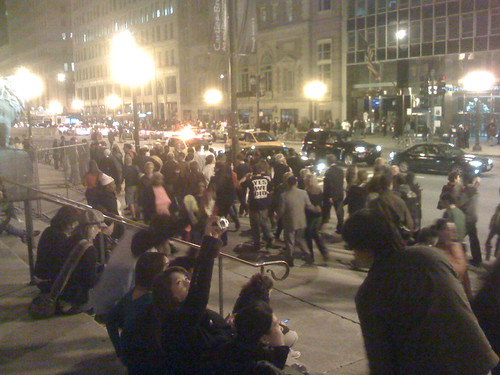
I was at Grant Park (though not in the ticketed section) and was able to participate in the mass celebration, which I described to colleagues today as something akin to all of Chicago's sports teams winning at the same time, though everyone was on her or his best behavior, polite, brimming with smiles and teary eyes, laughing, saying hello and apologizing for accidental bumps, breaking into spontaneous songs and dances and cheers, almost a kind of Kantian ethical dreamworld filled not with Prussian burghers but Midwesterners of every age, color, race and ethnicity, physical status, and so on.

The official tallies claim that only 200,000 people were there, but I think far more were on the streets (Michigan Avenue, the various side streets all the way down to Congress Parkway, and west well to State) surrounding the park. Out of the thousands who went to the park, I missed some colleagues who were there, but ran into a handful of students, all as excited as I was, on the El, on the street, and at the park's edges. I'm going to post a few pictures below, and will post a video from my other camera, from which I haven't yet downloaded lots of pictures, but it was as festive an experience as I've ever had.

‡‡‡

One thing that has tempered my ongoing elation is the news that all of the major state-based anti-gay ballot measures passed last night. In Florida (same-sex marriage ban), in Arizona (same-sex marriage ban), in Arkansas (gay adoption), and most notoriously in California, voters approved measures that would restrict or remove rights and equality for LGBTQ people. California's Proposition 8, the anti-same sex marriage amendment, did pass by a vote of 52.5% vs. 47.5%, and as CNN's exit polling suggests which should be taken with qualifications, black voters overwhelming claimed to have supported it:
Prop 8 Exit Polling
This was very disappointing news, though not exactly surprising. Although some of the most pro-LGBTQ figures in our society are Black leaders (public intellectuals, politicians, business people, etc.), and many Black people are very accepting of LGBTQ friends and family members, an issue like this California same-sex marriage ban, presented in the abstract, especially without a sustained chorus of prominent Black and other POC gay and non-gay people advocating against it, was likely to receive a homophobic backlash, and the Obama turnout had a converse effect, it appears. My first question was, what effect will this have on same-sex couples who have already married? Do those marriages stand or once this new amendment takes effect will they invalidated, even though they would be recognized in two other states (Massachusetts and Connecticut)? Can another Supreme Court ruling or a legislative act trump this referendum amendment to California's constitution?

One thing I told C is that from this day forward, one thing that all Black LGBTQ people, our Black non-LGBTQ and non-Black queer and non-queer allies must do is make a much greater effort to educate those segments of our fellow folks who still hold fast to heterosexism and homophobia. I have said and will say again that Black people are no more homophobic than any other group. At the same time, we as Black communities do have pockets of homophobia that we must address. However you feel about marriage or same-sex marriage, it is inconceivable that we should be taking away rights and legalizing civil discrimination against any of us. Black people over these hundreds of years in America have fought too hard, sweat and bled and died to secure equality, and we should absolutely not be helping in any way to further discrimination, which affects all of us, including those of us who are Black and lesbian, gay, bisexual, transgender, and queer, who want to and demand to be treated equally and fairly, by other Black people and by everyone else. So as I said, we need to redouble our efforts from today forward, however we can, to address this issue in our community, even as we strive to address homophobia in the broader American society.

Please do read blogger Pam Spaulding's great take on things here at Pam's House Blend.

I am also glad that civil rights groups are immediately challenging the Proposition 8 results in the courts. As I told colleagues today, I take consolation in the fact that yesterday's vote, particularly among the young, points to a better future in so many ways. We will have a female president sooner rather than later, as well as political and social leaders from all backgrounds, and the politics of demonization and discrimination, which the vile right wing and cowards on the left have utilized as a mechanism of power and dominance, are losing their salience. So while yesterday brought a very saddening note, I have tremendous hope for the future, our American future.

‡‡‡

Those photos:


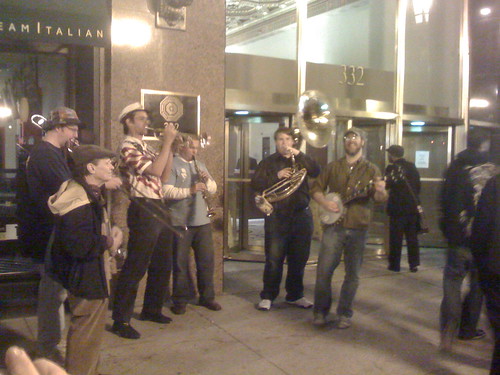
A band on Michigan Ave.
A band on Michigan Avenue
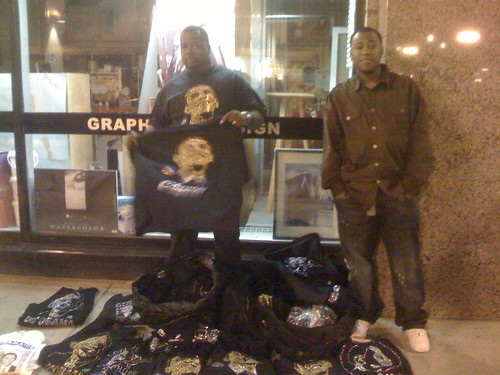
T-shirt vendors
T-shirt vendors
An artist
Artist and instantaneous art
On Michigan Avenue
On Michigan Avenue, from the steps of the Art Institute of Chicago
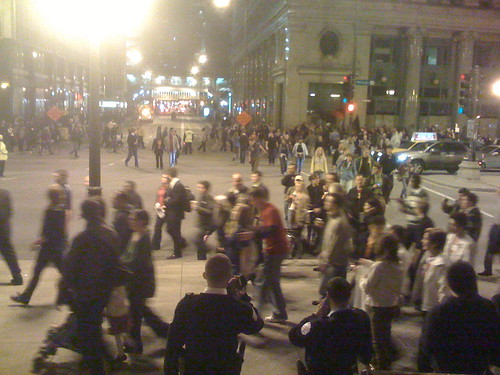
On Michigan Avenue
The crowd proceeding up Michigan towards Grant Park
On the steps of the Art Institute
From the steps of the Art Institute of Chicago, looking south down Michigan