Showing posts with label analytical fiction. Show all posts

Tuesday, October 25, 2016

Alexander Kluge & Ben Lerner at Goethe-Institut

Alexander Kluge
Pioneering author, critical theorist, New German cinema writer and director, and TV pioneer Alexander Kluge is 84. The last time I found out he was going to be in New York, I was in Chicago and Evanston, teaching and so had to miss his events. I am a huge fan of Kluge's work, especially his fiction and films, and have posted about his work many times on this blog, including my translations of his prose, the New York Review of Books' translations of his writing, quotes by him, and more. His work has never ceased to intrigue me.

Kluge recently returned to participate in a series of events, running from October 21 through the 24th,  that were sponsored by the Goethe-Institut USA and titled "Alexander Kluge in New York." They included a film series at the Anthology Film Archives and an evening with Kluge at the Museum of Modern Art. I decided to see Kluge and Ben Lerner in conversation on Sunday at a "soiree," which Kluge ensured that the evening became. I had imagined a joint reading, followed by a conversation, which is the US standard, but instead we got a fantasia of sorts: Kluge and Lerner did read, primarily from Kluge's newest book, The Great Hour of Kong (Kongs Große Stunde, Suhrkamp 2015), and only in English, but interspersed amidst the texts were Kluge's digressions, film clips, and a live pianist's accompaniment.

Lerner, the translator, and Kluge
Kluge reading 
In addition, there was a translator (whose name I missed), who didn't have that much to do; Kluge's English was quite strong, and only a few times did he turn to her for assistance. Instead, he tossed out pithy phrase after phrase, talking of the affinities he felt with Lerner's poetry, which he thought achieved what he was trying at times to convey, which was "knowledge without a subject." Other subjects included outer space, the bombing of Halberstadt, Hitler's death, and Ladino-speaking Sephardim who were able to escape the Holocaust--and fortunately, very little Kong. Throughout, Lerner was game--he read along, offered thoughts where needed, and kept the show rollicking along.

Here are some of the quotes I wrote down:

"We have inside an antirealism of feeling."
"The search for safe space is the beginning of philosophy."
"Life is richer than experience."
"Never wake a collective subject." - A quote from one of Lerner's poems, which he repeated and expatiated on.
"Narration saves life."
"Absolute design equals absolute poetry."
"We are all nobleman...descended from 18,000 people who came out of Africa."

The pianist played music by Offenbach and Verdi, and the films, some of which unfolded like Kluge's microstories, included one using a Luigi Nono composition, which made me think of Nono's father-in-law Arnold Schönberg, though his name was never mentioned (I think), and Schönberg's star pupil Anton Webern (him neither), whose extremely distilled compositions struck me as models, but with a much more playful underpinning, for Kluge's films. Eventually, the piano playing turned into a brief accompaniment, with the accented English sounding almost like a counterpoint to the keys' melodies. Kluge concluded the evening by having not just Lerner and himself reading in unison, which they did several times, but invited the translator to join them. It was an apt conclusion to an unusual and refreshing literary evening, giving "soiree" (or "variety show" in the best way) a new meaning and creating an invigorating model for future events, I hope.

Lerner and Kluge reading in unison
Lerner, the translator and Kluge concluding
with a piece read in unison

Thursday, January 17, 2013

Three From Kluge & Richter in NYRB

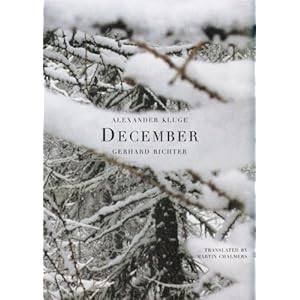
Alexander Kluge, Germany's living avatar of analytical fiction (and a cinematic pioneer in the l950s and 60s), and Gerhard Richter, one of its most important living visual artists, have collaborated on a book entitled December, which Seagull Books, distributed by the University of Chicago Presspublished early last year in an English translation. (Seagull posted a pre-publication interview with Kluge  in December 2011.)

There are few fiction writers who can pack as much critical thought into condensed, vivid narration as Kluge, and in December it appears he is still working at at the level of adamantine economy he displayed with prior books such as The Devil's Blind Spot (New Directions, 2004) and Cinema Stories (New Directions, 2007).  The 80-year-old author's 39 calendar-based narratives here, as in prior books dating back to the 1960s, draw from German, European and global histories as well as from his lively imagination, and sometimes run no longer than a page or two, in concert with Richter's 39 beautiful, enigmatic photographs of wintry landscapes.

The Decembers in these stories, however, bear little of the holiday cheer we associate with the winter holidays or the conclusion of the calendar year. Instead, one story--or prose poem, so brief and clipped is its unfolding--concerns German children collecting scrap metal in 1941. What is not said--the fascist state, brutal war, the Holocaust--looms behind this and other narratives, as it does behind the tranquil but ominous images of nature. A few of the texts present in fictional form realist flashes of Kluge's life; born in 1932 in Halberstadt, in what is now the German state of Saxon-Anhalt (formerly part of East Germany), he likely would have experienced circumstances not unlike these. Most, however, transmit the theoretical and emotional clarity that Kluge's work so often offers, whether he's writing about the near death in 1931 of Adolf Hitler or an obscure monk whose sense of time upends our own sense of temporality. Kluge's prose pieces always come pierced, as Rilke might have written, with rays of wisdom and feeling, usually through metaphors and aphorisms, that most other writers would take sentences to achieve.

Last month, The New York Review of Books published three Kluge excerpts, alongside three Richter images. I found myself rereading the Kluge pieces several times despite their brevity, and studying the Richter photographs, which grew more ominous with each view. You can read the pieces at the NYRB link above. (You can download some of his movies here.) Below is one of the photographs. If you were to compose a short prose piece for December to accompany this image, what would it be?

© Gerhard Richter