Showing posts with label Poets House. Show all posts

Friday, November 15, 2013

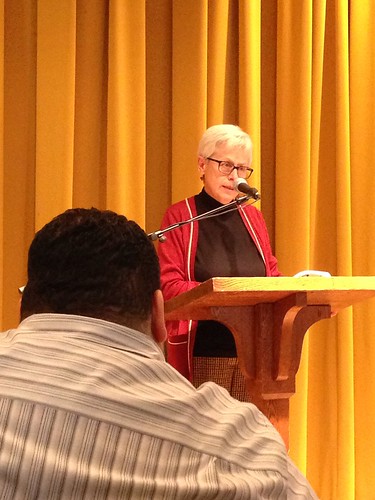
Adélia Prado & Ellen Doré Watson @ Poets House

More than once on this blog I've championed the poetry of Adélia Prado (1935-). I've even touted her as a potential candidate for the Nobel Prize, and she's apparently been nominated by others, though it appears the Swedish Academy has quite different ideas than I and Prado's other supporters about who should get its annual literary honor totaling around $1 million dollars. Her 8 collections of poetry nevertheless strongly recommend her for the highest honors. She combines the earthly and the mystical, the simple and the fathomless, in language that does not stint on the colloquial, the witty, the figurative. She has a gift for making metaphorical leaps that I especially admire. I have never translated Prado's poetry, however, in part because she has been lucky to have the esteemed poet Ellen Doré Watson bringing her work into English, and I would venture that it's without question as to the superlative job she's done.

Adélia Prado
Earlier this summer Prado and Doré Watson were to appear at Poets House for a reading, but it was postponed until this fall. On Thursday afternoon, I emailed Reggie H. to find out if the event was still on, and he assured me it was, so I trooped downtown to Poets House's Kray Hall to see Prado and Doré Watson present the poetry live. I think I heard it said that this was Prado's first visit to the US in some 25 years. After a welcome by Poets House director Lee Bricetti and a lovely, brief introduction by Poets House's Stephen Motika, Doré Watson took the stage to offer a fuller introduction not only of Prado, but of her experiences translating Prado's work. She guided the audience through how she initially was drawn to Prado's poetry (via a lackluster translation by a graduate student) and how she became the first Anglophone poet to translate Prado's work. Among her quotes about Prado: her "poetry is written neither from the head nor from the heart but from the gut." And, from a poem: "Everything is small compared to my heart's desire / the sea is a drop."

They then read a series of poems they had jointly selected, first in Portuguese and then in English, based on the English-language volumes of Prado's work. There were a number of Lusophones (many of them Brazilian, I imagine) in the room, and they laughed at those moments of humor in Prado's Portuguese renditions of her poems, while the English speakers and readers were able to get almost as much from Doré Watson's meticulous and emotionally resonant translations. After they read about a dozen poems (was it that many? that few?), they participated in a question and answer session that included a question reporter from Prado's native town of Divinópolis, in Minas Gerais state (the huge interior state, named after its general mines, that has been one of the major political and cultural poles of 19th, 20th and 21st century Brazilian culture). Only in New York City!

Ellen Doré Watson
Watson and Prado, beginning
their joint reading
Prado shared many palavras boas (good words), as it were, in both her poems and her responses, and Doré Watson was an able simultaneous translator. A good deal of her replies circled around the idea of suffering and its necessity for the poet, which for her meant many things, including a working-class youth, the loss of parents, being the first in her family to be educated, being a woman, a wife, a mother, and an artist, and so much more, though I took her to be suggesting that everyone suffers at some point, suffering being a constitutive aspect of our humanity, and the poet is one who can draw upon this experience. To put it more bluntly, she even said, "To exist is to suffer." Of course "sofrer" in Portuguese can also mean to "experience, to put up with," and think there was a bit of this in what she was saying and implying. I asked the question (in English) about her poetic influences, since this came up in a prior comment, in which she noted that she had not really broken free of her influences until the age of 40, and she mentioned that poets like João Cabral de Melo Neto, Cecília Meireles, and others, major figures in Brazilian poetry, were her influences from childhood, but also that she drew from the other arts, and from the Roman Catholic liturgy. She did not mention non-Brazilian poets, though predecessors who combine the carnal and the mystical would certainly be in conversation with her.

Prado, reading in Portuguese
Doré Watson and Prado during
the Q&A session
Doré Watson listening as Prado
offers one of her quotable answers
The announcement for the event projected
in light in front of Poets House
Here is one of the briefest poems in Ex-Voto (Tupelo Press, 2013), Doré Watson's newly translated collection of Prado's poems, which conveys the sacred and the witty, in just three lines. Enjoy!

PARAMETER

God is better-looking than I am.
And He's not young.
That's consolation.

Copyright © Adélia Prado, translation © by Ellen Doré Watson, from Ex-Voto: Poems, North Adams: Tupelo Press, 2013. All rights reserved.

Thursday, July 25, 2013

Poet's Showcase at Poets House

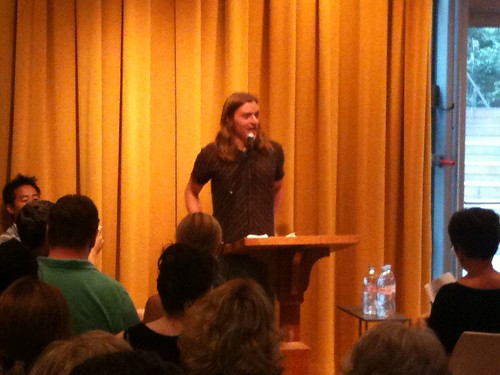
Every year Poets House has its marvelous Showcase of newly published books, and its series of readings that coincide with the display.  This past Tuesday featured two writers I know and deeply admire, and two whose work I was not at all familiar with, but now have some appreciation for. What I loved about the reading is that although Poets House has one of the largest libraries of poetry, of all kinds, in New York or anywhere else, it also invites writers in other genres to present their work, and the final two writers, Thomas Glave and Rachel Levitsky, though they are published poets, read from new prose works.

Thomas, whom I've known for two decades, read an essay on beauty, violence, homophobia, and courage set in and drawn from his experiences in his ancestral Jamaica and in particular with the human rights organization J-FLAG (Jamaica Forum for Lesbians, All-Sexuals and Gays), which appears in his newly published and acclaimed book of essays and imaginative prose pieces, Among the Bloodpeople: Politics & Flesh (Akashic Books, 2013).  One of the many things his reading, which began with his invocation of a vulnerable queer Jamaican person viewing the astonishingly beautiful sea and sky that envelope the island, stirred in me was a reminder yet again not only of how precious and precarious life remains for some of us, but how important art can be in focusing our attention on addressing pressing problems, and on what is most important and crucial not only in our own lives, but in the lives of others, especially those we cannot otherwise see or understand, which art can help to do. I look forward the reading the entire collection and sharing it with my students.

Rachel, whom I've also known for many years, also read from a new prose work, a novel entitled The Story of My Accident Is Ours (Futurepoem Books, 2013), and before beginning she talked about her poetic practice and how she had already been writing in and around prose, thereby paving the way for her transition to her lyrical novel. One theme I took away from her work was the vitality of the novel form, which a certain sector of the literary commentariat continues to pronounce dead, much in the manner that a similar sector regular decries the death of poetry, or its obsolescence, or lack of social relevance or public appeal, especially as more women, writers of color, queer writers, writers using new technologies and creating new genres, emerge. The snippet I heard of Rachel's novel suggests it makes a vital contribution, and I am looking forward to reading the entire work.

Catherine Barnett, the evening's first reader, shared poems from her new collection The Game of Boxes (Graywolf Press, 2012), as well as some very new poems, many short, all attentive to the possibilities of their internal music, cadence, and silence, and her final one, from even more recent poems struck me as very simple in its effects but moving in the way she made a casual, personal observation into something profound and memorable. The fourth reader, Peter Filkins, a noted translator as well as poet, presented poems from his collection The View We’re Granted (Johns Hopkins University Press, 2012). He opened with a poem about two unusually thick birches that had stood in the front yard of the home in which he grew up and once again lives in, in western Massachusetts, and closed with a poem about maple trees, filling the space between them with poems brimming with his erudition, but handled with a light touch.

All in all a wonderful way to spend a warm mid-summer evening. Photos follow:

Stephen Motika, at Showcase Reading, Poets House
Stephen Motika of Poets House, introducing the reading
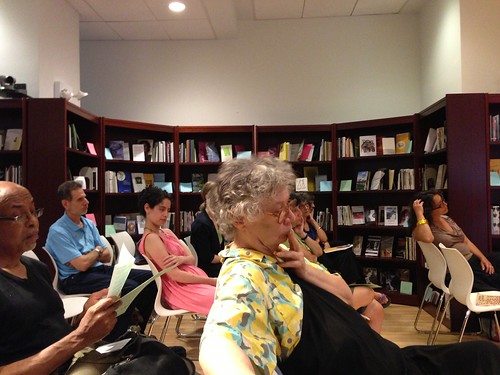
The audience, at Showcase Reading, Poets House
Part of the audience
Catherine Barnett, at Showcase Reading, Poets House
Catherine Barnett
Peter Filkins, at Showcase Reading, Poets House
Peter Filkins
Thomas Glave, at Showcase Reading, Poets House
Thomas Glave
Rachel Levitsky, at Showcase Reading, Poets House
Rachel Levitsky

Sunday, March 17, 2013

Book Launches @ Poets House

Though still recovering from AWP I headed over to Poets House last Sunday to catch Nightboat Books's book launch party to celebrate the publication of Coming Events (Collected Writings) by Susan GevirtzMusic for Porn by Rob Halpern; and Sisyphus, Outdone. Theatres of the Catastrophal by Nathanaël. Poet and Nightboat Books publisher Stephen Motika introduced all three writers, who read snippets of their work, and then all three participated in a conversation that poet Douglas A. Martin moderated.

As the names of the writers suggest, these were three challenging texts that defy conventional genres. Nathanaël's text, which incorporate its footnotes as side notes and takes on a number of themes and topics, circled around the question of translation, in particular a prior text of hers, even as it unfolded as an autonomous text-critique in its own right. Halpern's work aimed, in his words, to explore "the allegorical figure of a soldier's wound," redressing Whitman's similar project via Charles Olson and the strategies of Genet. Gevirtz first delivered a talk aimed in part at addressing the relationship between poetry and thought, challenging Socrates's statement in the Ion that "For not by art [techne] do the poets sing, but by divine inspiration." Fluidity of genre--gender, as Nathanaël pointed out, in tracing back the root of the English word to its French antecedent--appeared central to her thinking. She followed the short essay with a selection of one of her poems from her collection.

The question and answer session ranged over these issues and others, proceeding from Martin's initial questions, which cited Gertrude Stein and Martin Heidegger, who had already arisen in Gevirtz's essay. The concept of mystery (Geheimnis) was one Martin mentioned and that several of the writers returned to, though Nathanaël deftly avoided invoking that philosopher and instead talked about other figures in her work, a chief one being that the seisme, or earthquake/aftershock, suggesting--while also avoiding explaining or defending her work--that, if I understood this correctly (and I might not have), that its implicit anteriority informed Sisyphus. For Halpern, the potential problem his text sparked in its abstraction of the soldier's body (and specificity), as well as that of the migrant worker (among others), was one he mentioned he had attempted to address on his text's first page, but he admitted he was not sure if he had resolved it. I had already purchased a copy of Nathanaël's book, so I bought Halpern's and Gevirtz's, and imagine spending a while reading and thinking about all three of them.

Poet and publisher Stephen Motika
Poet and publisher Stephen Motika, introducing the reading
Nathanaël
Nathanaël reading
Rob Halpern
Rob Halpern, reading
Susan Gevirtz
Susan Gevirtz, reading
Douglas Martin, Rob Halpern, Nathanaël, and Susan Gevirtz at the Nightboat Books reading and book launch @ Poets House
Douglas Martin, Rob Halpern, Nathanaël, Susan Gevirtz

Yesterday, I headed back to Poets House for a reading by three poets published by Los Angeles's Red Hen Press: Dan Vera, Eloise Klein Healy, and Jane Hirshfield. In terms of poetic form, this reading was at the other end of the spectrum from the Nightboat books reading, but all three poets, like those at the reading last Sunday, took up political issues and questions in their work. Poet and Letras Latinas editor Francisco Aragón opened the event by introducing Dan, who read from his second book, Speaking Wiri Wiri, which won Red Hen Press's inaugural Letras Latinas/Red Hen Press Prize (2013). I'd picked up Dan's book at AWP, so I especially enjoyed hearing him bring the words to life in his own voice ("that property produces progeny").

Red Hen Press's Kate Gale followed by introducing Healy, named last year to be the first ever Poet Laureate of Los Angeles. She read from her just-published book, A Wild Surmise: New & Selected Poems (2013), drawing from her earliest to her most recent poems. I especially happy that she read several poems from Artemis in Echo Park (1991), the first book of hers I read and the one I most associate with her. Last up was Hirshfield, whose poetry I am not that familiar with, though I enjoyed what I heard. What I took most from her work was a feeling of concision, and striking metaphors ("shoaling bees"). Unlike last week's reading there was no question and answer session, but Red Hen did host a nice reception upstairs.

Francisco Aragon, introducing Dan Vera
Francisco Aragón, introducing Dan Vera
Dan Vera reading
Dan Vera reading
Eloise Klein Healy, at the Red Hen Press reading
Eloise Klein Healy introducing her poetry
Jane Hirshfield, about to sign a book
Jane Hirshfield, about to sign a copy of one of her books

Saturday, July 14, 2012

John Ashbery @ Poets House + Poem: Ashbery

He is 85 years old, and one of the most famous living American poets, a vital figure in mid-to-late 20th century experimental poetics, a central member of the literary coterie that came to be known as a New York School, the winner of every major US poetry prize including the Pulitzer Prize-National Book Award-National Book Critics Circle Award triad in 1975-76, a highly lauded translator of note and a former art critic, and the poet laureate of MTV. I am of course talking about John Ashbery (1927-), who read this past week at Poets House as part of their summer series and the River to River Festival. He had been scheduled to read earlier this year at Poets House, I believe, but had taken ill, and although I have seen Ashbery read many times, all over New York City, I decided under the circumstances that I ought not miss this appearance. Evidently quite a few other people did as well, and I had to join the overflow audience upstairs, to catch him on the TV monitor. And still people kept arriving! And yet Marjorie Perloff claims nobody likes or pays attention to poetry!

He was, once settled into his dovecoat downstairs and with a few sips of water, in fine form, and after Stephen Motika graciously introduced him, Ashbery read both from his most recently published book, 2009's Planisphere, and from his forthcoming one, Quick Questions. (I think I got the name right.) His poems were frequently hilarious. This is one aspect of Ashbery's poetry that I think often gets underplayed; he is one of the funniest poets writing, and his humor is not only droll and witty, but sometimes verges on verbal slapstick. Yes, there is that wistful tone, drenched in a kind of counternostalgia, that he can evoke (belatedness!), but there is also the highly comic in his work as well. He often is not that far either from Laurel and Hardy, whom he cited several times, or The Three Stooges, or Monty Python. Or the Firesign Theater, about which I knew and know nothing, but which Reggie H. told me Ashbery, and his partner, David Kermani (and Reggie too), were and are afficionados. It was initially warm downstairs, but cooled upstairs at least as Ashbery declaimed, and Poets House kindly provided sparkling wine and water afterwards, including to those who were waiting to get their book (for only one was allowed) signed. I got him to sign his translation of Arthur Rimbaud's Illuminations.

Innumerable are the Ashbery poems that I love, but here is one from one of his books that I have always found particularly beguiling, The Double Dream of Spring. It appeared a few years after he returned from his decade-long stay in France, and the poems, dreamlike in their logic (cf. Giorgio deChirico, whose painting inspired the title) but less syntactically disjunctive or overtly playful in their sentiments than his poems of the French years, marked a shift in Ashbery's work and to me pointed to a mastery of idiom that would reach its apogee in his poetry of the next decade and a half, including his most famous book, Self-Portrait in a Convex Mirror, and the difficult but I think equally beautiful book, Houseboat Days, before he shifted into his next phase, which I call "overheard chatter," and which so many younger poets I knew first encountered and have found utterly baffling. Go back to the early poems, and then the ones of the 1970s, I always say--and then Ashbery begins to make a lot more--well, if not sense, at least impact.

Here are some photos from the event, and then, "For John Clare."
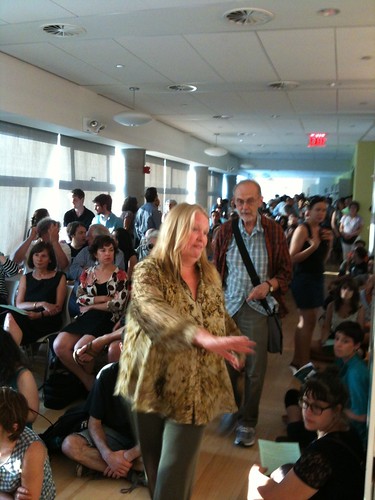
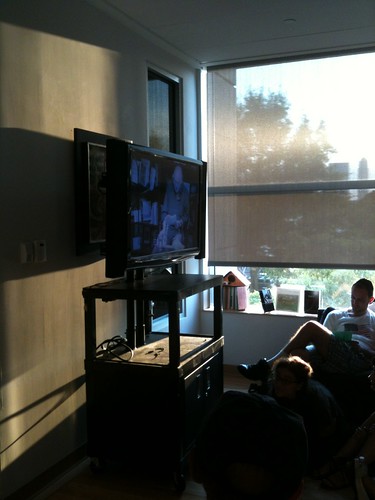
The overflow room crowd, John Ashbery reading at Poets House
The overflow audience upstairs (there was a packed room downstairs too)

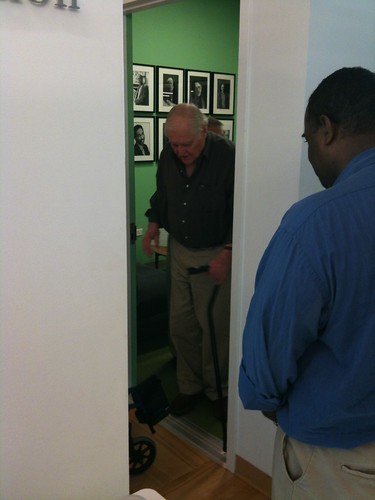
John Ashbery (Reggie Harris at right)
John Ashbery exiting the green room (Reggie H. at right)

Ashbery reading on the monitor
The bard of Sodus on the screen

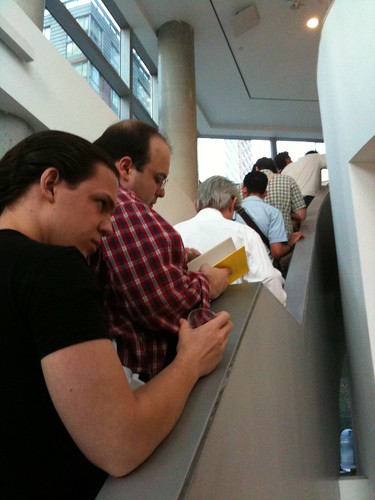
People waiting for John Ashbery's signature
The line of people snaking up the stairwell waiting to get his autograph

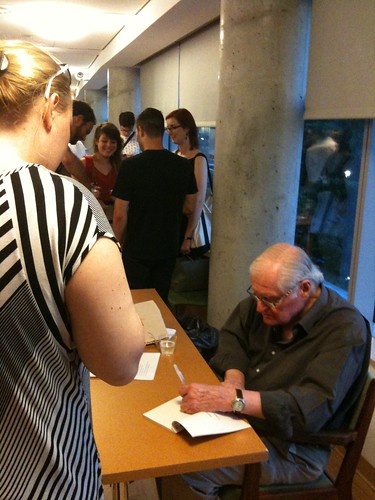
John Ashbery signing books
Ashbery signing books


FOR JOHN CLARE

Kind of empty in the way it sees everything, the earth gets to its feet and salutes the sky. More of a success at it this time than most others it is. The feeling that the sky might be in the back of someone's mind. Then there is no telling how many there are. They grace everything--bush and tree--to take the roisterer's mind off his caroling--so it's like a smooth switch back. To what was aired in their previous conniption fit. There is so much to be seen everywhere that it's like not getting used to it, only there is so much it never feels new, never any different. You are standing looking at that building and you cannot take it all in, certain details are already hazy and the mind boggles. What will it all be like in five years' time when you try to remember? Will there have been boards in between the grass part and the edge of the street? As long as that couple is stopping to look in that window over there we cannot go. We feel like they have to tell us we can, but they never look our way and they are already gone, gone far into the future--the night of time. If we could look at a photograph of it and say there they are, they never really stopped but there they are. There is so much to be said, and on the surface of it very little gets said.

There ought to be room for more things, for a spreading out, like. Being immersed in the details of rock and field and slope --letting them come to you for once, and then meeting them halfway would be so much easier--if they took an ingenuous pride in being in one's blood. Alas, we perceive them if at all as those things that were meant to be put aside-- costumes of the supporting actors or voice trilling at the end of a narrow enclosed street. You can do nothing with them. Not even offer to pay.

It is possible that finally, like coming to the end of a long, barely perceptible rise, there is mutual cohesion and interaction. The whole scene is fixed in your mind, the music all present, as though you could see each note as well as hear it. I say this because there is an uneasiness in things just now. Waiting for something to be over before you are forced to notice it. The pollarded trees scarcely bucking the wind--and yet it's keen, it makes you fall over. Clabbered sky. Seasons that pass with a rush. After all it's their time too--nothing says they aren't to make something of it. As for Jenny Wren, she cares, hopping about on her little twig like she was tryin' to tell us somethin', but that's just it, she couldn't even if she wanted to--dumb bird. But the others--and they in some way must know too--it would never occur to them to want to, even if they could take the first step of the terrible journey toward feeling somebody should act, that ends in utter confusion and hopelessness, east of the sun and west of the moon. So their comment is: "No comment." Meanwhile the whole history of probabilities is coming to life, starting in the upper left-hand corner, like a sail.

Copyright © John Ashbery, "For John Clare," from The Double Dream of Spring, New York: E. P. Dutton, 1970. All rights reserved.

Friday, July 22, 2011

New Directions' 75th Anniversary Reading @ Poets House

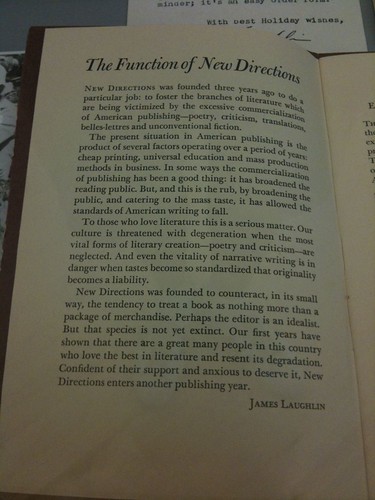
James Laughlin's rationale for New Directions Publishing Corp.
"New Directions was founded three years ago to do a particular job: to foster the branches of literature which are being victimized by the excessive commercialization of American publishing--poetry, criticism, translation, belles-lettres, and unconventional fiction."
***

New Directions was founded to counteract, in its small way, the tendency to treat a book as nothing more than a package of merchandise. Perahps the editor is an idealist. But that species is not yet extinct. Our first years have shown there are a great many people in this country who love the best in literature and resent its degradation. Confident of their support and anxious to deserve it, New Directions enters another publishing year." - James Laughlin, 1939

So wrote New Directions Publishing Corporation's founder, poet and steel company heir James Laughlin (1914-1997), three years after the publication, when Laughlin was a 22-year-old Harvard sophomore, of New Directions in Poetry & Prose, an anthology that featured the work of writers, some of whom were already acclaimed but many of whom would eventually be recognized as among the most important in 20th century American literature: William Carlos Williams, Ezra Pound, Elizabeth Bishop, Henry Miller, Marianne Moore, Wallace Stevens, and e. e. cummings.  75 years and countless authors, from the modernist canon and from literary traditions all over the world, later, New Directions is still publishing, having introduced US readers to the work of major American and international writers like H.D., Delmore Schwartz, Gregory Corso, Michael McClure, Robert Duncan, Denise Levertov, Clarice Lispector, Raja Rao, Muriel Spark, Thomas Merton, Anne Carson, Jorge Luis Borges, Allen Grossman, Jerome Rothenberg, Victor Pelevin, Bei Dao, W. G. Sebald, Roberto Bolaño, and Javier Marías, to name just a few.

Last night, Poets House in New York, one of the finest repositories of poetry books in the US, hosted a dodranscentennial celebration and reception for New Directions, to coincide with its debut, on its second floor, of selected materials from New Directions' rich archive. The reading featured eight authors and translators, some from New York and some from farther away, who read from authors published by New Directions or their own work.  After Poets House Program Director and publisher Stephen Motika opened the program, he introduced the first reader, translator Susan Bernofsky, who has translated several works from German by Swiss author Robert Walser, read from her recent translation of Microscripts (New Directions, 2010). Subsequent readers were NYU French professor Richard Sieburth, who read two selections from the work of Ezra Pound; poet, translator, scholar, and Bomb editor Mónica de la Torre, who read translations (by Laura Healy) from poet Roberto Bolaño's funny, provocative Tres (New Directions, forthcoming in September 2011).

After Mónica, Brown professor and translator Forrest Gander read selections from his newest book, published by New Directions; Eliot Weinberger read from Lawrence Ferlinghetti's 1958 volume A Coney Island of the Mind, one of New Direction's and American poetry's best selling volumes; poet and Duke professor Nathaniel Mackey, who received the National Book Award for his New Directions-published collection Splay Anthem in 2005, read from that and a more recent collection, then offered a snippet from Djuna Barnes's 1936 volume Nightwood; and he was followed by the final reader, poet, critic and Buffalo professor Susan Howe, who began with a small selection from William Carlos Williams's Paterson (1946-1958), before finishing with a thrilling little sliver, which included a passage she performed almost like sound poetry, from her most recent book, THAT THIS (New Directions, 2010). New Directions editor and poet Jeffrey Yang concluded the event with brief remarks, and a fine reception followed upstairs.

If you are in New York and want something engaging to do--and afterwards you might stroll along the picturesque riverwalk just a few steps awa--before October 8, 2011, please visit Poets House during their regular hours and view their wonderful exhibit, in vitrines and along the upstairs walls, of New Directions books, manuscripts, correspondence, book cover mockups, and ephemera. There are some real treasures in the vitrines and along the walls; I've posted a few images below, but I intend to go back when it's a bit quieter to explore the wonderful treasures on display.  Poets House also has its 2011 Poetry Book Showcase on display on the first floor, and will be hosting a celebratory event in conjunction with it, with readings by Rachel Eliza Griffiths, Evie Shockley, Albert Mobilio, and Jena Osman next Tuesday!

Poets house program director and publisher Stephen Motika
Poets House Program Director and publisher Stephen Motika, delivering his beautiful introduction of the evening's events
Translator Susan Bernofsky
Susan Bernofsky, who has translated Robert Walser for New Directions, reading from her translation of his Microscripts
NYU Prof. Richard Sieburth
NYU French and Comp Lit professor Richard Sieburth, reading Ezra Pound
Mónica de la Torre
Poet and translator Mónica de la Torre, reading from translations (by Laura Healy) of Roberto Bolaño's prose poems Tres
Brown prof. Forrest Gander
Brown professor Forrest Gander, reading from his poetry
Eliot Weinberger
Eliot Weinberger, before he read from Lawrence Ferlinghetti's A Coney Island of the Mind (1958), one of New Directions' and American poetry's most popular and best selling volumes
Nathaniel Mackey
National Book Award winning poet and professor Nathaniel Mackey, reading from Splay Anthem, the first of his books published by New Directions
Susan Howe
Poet and professor Susan Howe, who began her reading with a selection from William Carlos Williams's Paterson
New Directions editor Jeffrey Yang, closing the event
Poet and New Directions editor Jeffrey Yang, closing the event