Showing posts with label Nathaniel Mackey. Show all posts

Wednesday, October 07, 2015

Who Will Receive the 2015 Nobel Prize in Literature?


UPDATE: Svetlana Aleksijevitj/Alexievich, a Ukrainian native now long resident in Belarus, and author of several major works of nonfiction and fiction, including Voices from Chernobyl: The Oral History of History of a Nuclear Disaster, her masterpiece, was awarded the 2016 Nobel Prize in Literature.

You can read more about Alexievich's life and work here. Voices from Chernobyl: The Oral History of History of a Nuclear Disaster was translated into English by Keith Gessen and has been republished by Macmillan Publishers (and Picador). A documentary based on this work is forthcoming next year.

The Swedish Academy's official announcement, with more information about Alexievich, is here.

***

This is Nobel Prize week, and as I have done nearly every year over the last decade, I cannot help but speculate on this blog, which began in 2005 with a focus on literature, about this year's winner in the literary category. The honoree will be announced tomorrow, I believe. (Here are my posts from 2005 (and after Harold Pinter won in 2005); 2006; 2007; 20082009; 20102011; 20122013; and post-award to Patrick Modiano in 2014.)

My batting average has admittedly been poor, in part because I keep thinking that the Swedish Academy, which awards the prizes, will end its focus on Europe in favor of the broader literary world, and yet for the past decade, the annual prizes have been weighted towards European writers, or, in the case of Alice Munro--whose work I am a huge fan of--writers of European descent across the globe. The last 15 Nobelists include Patrick Modiano (2014); Alice Munro (2013); Mo Yan (2012); Tomas Tranströmer (2011); Mario Vargas Llosa (2010); Herta Müller (2009); Jean-Marie Gustave LeClézio (2008); Doris Lessing (2007); Orhan Pamuk (2006); Harold Pinter (2005); Elfriede Jelinek (2004); J. M. Coetzee (2003); Imre Kértesz (2002); V. S. Naipaul (2001); and Gao Xiangjin (2000).

Three of these writers, LeClézio, Lessing and Coetzee, come from Africa, but all are of European descent; one, Vargas Llosa, is Latin American, and again, primarily (wholly?) of European descent; and two come from the most populous country on earth, China, which before the selection of Gao, an exile living in France, had never had a Nobel Laureate in literature. Of this gathering, I wholeheartedly endorsed the selections of Munro, Tranströmer, Pinter, Coetzee, and Kértesz. I did not know of either Mo's or Gao's work before their selections. I have long been a fan of Modiano's, as my linked post above makes clear, but I think there are better Francophone fiction writers, with far greater range, such as Michel Tournier, or the much younger Alain Mabanckou (French-Congolese), and in any case, because of both Modiano's and LeClézio's awards, France's greatest living poet, Yves Bonnefoy, was overlooked yet again.

 Orhan Pamuk was clearly a political choice, and is a fine writer, but I slogged--as if wading through mucilage--through several of his books, including Snow and Black Book. Each had great moments and set pieces, but in general, I am not a fan. I may be alone in this judgment, though. I do think Müller is an exceptionally gifted writer and have written before on the blog about her prose, particularly in Nadirs, but there are other German-language writers of great talent who should have been higher in the queue, like Alexander Kluge, one of the true originals in any language. I also believe Vargas Llosa is prolific and not the worst choice, but with so many other talented Latin American fiction writers who have been overlooked, I thought his selection was a wasted choice. Lessing's selection made an important political point, though I do not like her work at all, and it was a very good choice to select writers from China, about whose literature I am completely ignorant (though I have since read one novel by Mo Yan in translation and am trying to catch up). Meanwhile, a path-blazing writer like Assia Djébar (of Algeria), for example, who in some key ways renovated the literature of her country while adding a vital voice to contemporary letters, not only was passed over, but passed away in the meantime.

Of course the Europeanist slant is the Swedish Academy's prerogative. They are Europeans, after all, and hold the literatures of that continent in the highest regard, which should hardly be a surprise. Yet the Nobel Prize has long been a global literature prize, sometimes given for a lifetime's achievement, and at other times for a work or series of works that seem to capture the spirit of the age. Many of its winners have been major innovators in their national and global literatures, and have had an outsized influence on writing that follows. Others have been eccentric choices that few people knew of and perhaps even fewer read today. And then there have been other choices like Jelinek that remain confounding. Her choice, in fact, led one member of the committee to resign in disgust. I am not sure if it merited that level of response, but apparently the rancor around her selection was significant.

So: given the tendencies of the Swedish Academy, who will they choose tomorrow? Critic and book lover Shigekuni makes some smart picks on his eponymous blog. High at the top of his list is someone I have repeated touted since 2005, and one of my favorite writers in the world, the highly original Guyanese-British writer--there really is no one who writes like him--Wilson Harris, who is now 94 years old, and who published his last novel several years ago. Harris would be an excellent and inspired choice, but for that reason I doubt it will happen. Another writer from the Anglophone world that Shigekuni points to is John Ashbery, now 88. Ashbery is one of the writers who survives from the remarkable generation of American poets born between 1925 and 1935, whose oeuvres still loom larger in our national literature, and he has been, like Harris, utterly original as he has also become, without question, one of the most influential poets not just in the English language, but globally. (To the dismay of some, I should add.) I am not sure, however, whether Ashbery's recent poetry, which sometimes reads like a parody of his best work, may have harmed his chances.

Shigekuni additionally mentions Nathaniel Mackey, another major American--and African American--poet (and fiction writer), who has finally begun to receive his due. Given two of Mackey's (and our) direct literary ancestors, the extraordinary poets Jay Wright and Edward Kamau Brathwaite, are still alive, I almost feel that either or both of them should receive the award first, but any of these authors, but especially Harris, Wright and Brathwaite, would be excellent. An African writer that Shigekuni cites, the Nigerian fiction writer Buchi Emecheta, strikes me as unlikely, though she certainly has a large and strong body of work. I have feeling that as with Guadeloupean writer Maryse Condé, one of my perpetual favorites, Nicaraguan fiction writer Claribel Alegría, and Brazilian poet Adélia Prado, all of these incredibly talented will continue to be overlooked by the Nobel committee, though the work of any of them should the award. Two other Latin American poets who probably will be passed over but who merit the award are Raúl Zurita, the singular, innovative Chilean poet so beautifully translated into English by poet Daniel Borzutzky, and his fellow Chilean Nicanor Parra, who is aging towards the clouds at 101--yes, he is 101 years old!--but whose poetry still cuts like a well-honed razor.

Other writers Shigekuni mentions who would be top choices, and one of whom may emerge as the Prize recipient, include Ngugi wa Thiong'o, whose prodigious writing not only sets a high standard but also helped to spark a crucial shift in African and decolonialist/post-colonial writing in general when he elected to write in Gikuyu, a language indigenous to Kenya, rather than in English. Ngugi also has been outspoken politically throughout his career, and as Shigekuni mentions, was jailed and went into exile as a result. Another is the lyrical master of Arabic poetry Adonis (Adunis, pen name of Ali Ahmad Said), a native of Syria, who has more than established himself as one of the leading figures in his language. Adonis's poetry is politically aware and clear-sighted, and has been widely and deeply praised. (I featured one of his poems back in 2005; in 2013 I had the almost inexpressible pleasure of meeting him in person, and shared a photograph of him on J's Theater.)

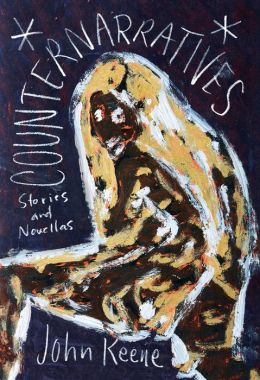
My thought is that given the turmoil in the Middle East, and the fact that the Swedish Academy has not honored a poet since Tranströmer and few others in the last 15 years, as well as no writer working in Arabic since Egyptian fiction writer Naguib Mahfouz in 1988, Adonis will be the pick, though it very well could be Ngugi, who more than deserves it. Ladbrokes, the betting site, has Ngugi third at 6/1, and Adonis twelfth at 20/1 but either really should be a top choice. Will the Swedish Academy do the right thing, or will it be one of the usual suspects high on Ladbroke's list? First there is the Ukrainian writer Svetlana Aleksijevitj, whose work I am not at all familiar with, though I know she is a journalist of some note.  Also high on their list are Japan's Haruki Murakami, a writer I do enjoy reading and have taught many times; Joyce Carol Oates (???); and Jon Fosse, whom I read as I was writing Counternarratives, and found compelling and somewhat like a more abstracted Pinter.

Also on the list are perennials Philip Roth; Peter Handke, who may be disqualified because of the controversy that still surrounds his pro-Serbian statements; John Banville, a writer's writer I think is very good but perhaps not Nobel-worthy; and Nawal El Sadawi, the Egyptian feminist I remember reading in my early 20s with enthusiasm. If it must go to a European writer, and it isn't one of the very senior figures like Bonnefoy, Lászlo Krazsnahórkai, who received last year's Man Booker International Prize, and whose most recently translated book into English, Seiobo There Below (New Directions, 2014), merits the epithet "sublime," ought to be the choice. That novel is peerless, and, like the late Roberto Bolaño's 2666, represents a possible, vital path for other writers to follow. (Krasznahórkai) currently is in New York City, so I am angling to find a way to meet him before he heads back to Hungary).

Lastly, there are the Swedish Academy's geographical gaps. Since Rabindranath Tagore received the Nobel Prize in 1913, no writer from that country has received the Nobel, yet India abounds in superb writers, as does much of South Asia in general. No Korean has won the award, though Ko Un is often cited as a likely choice. Indonesia's literature also has gone unrecognized. In the Americas, Brazil's rich literary tradition has never been honored with a Nobel; should it go to a Brazilian, I predict it will be either Lygia Fagundes Telles, now up in years, or the prodigious João Gilberto Noll, from the far south of the country, who published, as my colleague put it, several very "strange"--but to me striking--novels several decades ago, and who seems to be at the top of favorite lists among Brazilianists I know. (I had the pleasure of meeting Noll several years ago at a dinner in Evanston, and though he had lived and taught for a while in the United States, we rambled about haltingly, more because of my nerves than his, in Portuguese.)

Whomever they pick, the Swedish Academicians will certainly spur us to comment. If it's an obvious choice, we'll say, Of course we knew this was coming. If things go as they have of late, though, we might just be saying, well, of course I knew Mia Couto (Mozambique) or Patricia Grace (New Zealand) was going to receive the award! But really, we didn't! I will most certainly update this blog post either way.

Tuesday, February 03, 2015

Nathaniel Mackey Awarded Bollingen Prize + Poem: Nathaniel Mackey + NBCC Nominees

Nathaniel Mackey
The Bollingen Prize for American Poetry, administered by the Yale University's Beinecke Library, is one of the most prestigious awards of its kind. Since its initiation in 1948 by the Library of Congress, in a firestorm of controversy because of the inaugural winner, avowed fascist and bedrock Modernist Ezra Pound, it has recognized many of the US's most important and innovative poets. The Bollingen shifted to its home at Yale by 1949, and originally was conferred on a yearly basis until 1962, when it switched to a biennial calendar, in some years honoring two poets at the same time. Throughout its history nearly all the honored poets have been white and the overwhelming majority male, and this has mostly remained the case, though some of the country's greatest women poets, including Marianne Moore (1951), May Swenson (1981), Adrienne Rich (2003), and most recently Susan Howe (2011). The sublime Jay Wright was the first African American recipient of the award, which I recognized in my very first post at J's Theater in 2005.

Yesterday another extraordinary, prolific poet--as well as fiction writer and critic--Nathaniel Mackey, has been selected to receive the Bollingen Prize. Mackey first came to wider public notice when he won the National Poetry Series in 1985 for Eroding Witness, but he has been publishing his poetry since 1978's Four for Trane, for a total of nine books or chapbooks of poetry, and a forthcoming tenth volume, Blue Fasa, to be published this year by New Directions. His collection Splay Anthem, also published by New Directions in 2006, received the National Book Award for Poetry. Among the other awards he has received for his work are the Stephen Henderson Award from the African American Literature and Culture Society, a Whiting Writer's Award in 1993, a Guggenheim fellowship in 2010, and the Ruth Lilly Prize from the Poetry Foundation in 2014. In 2001, he was elected a Chancellor of the Academy of American Poets, serving until 2006. He currently is Reynolds Price Professor at Duke University, and has for decades published the literary journal Hambone.

Nearly all of the works since Eroding Witness can be read as constituting a long, serial poem under the rubric of the Song of the Andoumboulou and Mu, combining with consummate artistry cross-cultural strands drawn from African and African American mythological and musical traditions, tuned to a peerless pitch. The ear never errs in Mackey's work; he has a gift for generating an often entrancing music, full of mix and dance, that carries the complex and profound knowledge his lyric imparts. For many years during his long tenure at the University of California-Santa Cruz, Mackey hosted a radio program on local public radio station KUSP, "Tanganyika Strut," that featured African music, and this well of familiarity with the language of music, with song's cadence and power, along with his grasp of multiple literary, philosophical and critical traditions, richly informs the poems' form, texture and content. As the Bollingen Prize committee said of Mackey's poetry:

“Nathaniel Mackey’s decades-long serial work—Songs of the Andoumboulou and Mu—constitutes one of the most important poetic achievements of our time. Outer Pradesh (2014)—jazz-inflected, outward-riding, passionately smart, open, and wise—beautifully continues this ongoing project.”

and, of the 2014 book Outer Pradesh:

“The book’s epigraph is Jean Toomer’s assertion of modernist open-endedness and generic not-belonging: ‘There is no end to ‘out.’’ Mackey applies this endlessly outward-going passage to an ecstatic, exilic experience, as a group of travelers—a ‘philosophical posse’—makes its way across an Indian province. What they and we encounter on this journey is a pre-history embodied by ‘old-time people’ whose songs must be heard. Together we find ourselves within an improvised social continuum that grows larger, stranger, more remote, and more consoling at every turn. Memory becomes a site of social commentary and collective vision. Mackey’s epic of fugitivity forms a stunning meditation on being.”

I must note Mackey's fiction as well; he has published four novels that together constitute another serial project, this time in prose: From a Broken Bottle Traces of Perfume Still Emanate. The first volume, Bedouin Hornbook, published in 1986, went off like a volcano when I first came across it during my Dark Room Collective days. I still have that volume, which I peer into periodically; it is a book that, like its intense and probing companion volumes, From A Broken Bottle Traces of Perfume Still Emanate: Bass Cathedral (2008), Atet A. D. (2001), and Djbot Baghostus's Run (1993), could sustain repeated and extended readings--and studies--for years.

Congratulations to a nonpareil writer, Nathaniel Mackey!

***

Before I post a poem by Nate Mackey, I wanted to offer congratulations to all the writers nominated for this year's National Book Critics Circle Awards, which will be announced on March 12. It is a remarkable lineup, and I can say that I know and admire the work of many of the nominees, and reviewed one of the books, Ian S. McNiven's biography of James Laughlin, a few posts back.

Among this year's honorees, Claudia Rankine, a poet whose work I hold in the highest esteem, was nominated not only in the poetry category, but also in the criticism category for her superlative volume Don't Let Me Be Lonely, which should have received the National Book Award last fall. My  brilliant former Northwestern colleague, Eula Biss, who received the National Book Critics Circle Award a few years ago, was nominated again in the criticism category. Another former Northwestern colleague, Chris Wiman, who was also the editor for many years of Poetry magazine, received a nomination in poetry too, as did Saeed Jones, a dazzlingly talented young poet who graduated from Rutgers-Newark a few years before I started, and Willie Perdomo, a superb poet I've known and read since my early 20s.

Also, the great Toni Morrison, who received the National Book Critics' Circle Award for her 1977 novel The Song of Solomon, will receive the Ivan Sandrof Lifetime Achievement Award. Congratulations to Claudia, Christian, Eula, Rasheed, Willie, and all the other nominees!

AUTOBIOGRAPHY:
Blake Bailey, “The Splendid Things We Planned: A Family Portrait” (W.W. Norton & Co.)
Roz Chast, “Can’t We Talk About Something More Pleasant?” (Bloomsbury)
Lacy M. Johnson, “The Other Side” (Tin House)
Gary Shteyngart, “Little Failure” (Random House)
Meline Toumani, “There Was and There Was Not” (Metropolitan Books)

BIOGRAPHY:
Ezra Greenspan, “William Wells Brown” (W.W. Norton & Co.)
S.C. Gwynne, “Rebel Yell: The Violence, Passion and Redemption of Stonewall Jackson” (Scribner)
John Lahr, “Tennessee Williams: Mad Pilgrimage of the Flesh” (W.W. Norton & Co.)
Ian S. MacNiven, “Literchoor Is My Beat”: A Life of James Laughlin, Publisher of New Directions (Farrar, Straus & Giroux)
Miriam Pawel, “The Crusades of Cesar Chavez” (Bloomsbury)

CRITICISM:
Eula Biss, “On Immunity: An Inoculation” (Graywolf Press)
Vikram Chandra, “Geek Sublime: The Beauty of Code, the Code of Beauty” (Graywolf Press)
Claudia Rankine, “Citizen: An American Lyric” (Graywolf Press)
Lynne Tillman, “What Would Lynne Tillman Do?” (Red Lemonade)
Ellen Willis, “The Essential Ellen Willis,” edited by Nona Willis Aronowitz (University of Minnesota Press)

FICTION:
Rabih Alameddine, “An Unnecessary Woman” (Grove Press)
Marlon James, “A Brief History of Seven Killings” (Riverhead Books)
Lily King, “Euphoria” (Atlantic Monthly Press)
Chang-rae Lee, “On Such a Full Sea” (Riverhead Books)
Marilynne Robinson, “Lila” (Farrar, Straus and Giroux)

NONFICTION:
David Brion Davis, “The Problem of Slavery in the Age of Emancipation” (Alfred A. Knopf)
Peter Finn and Petra Couvee, “The Zhivago Affair: The Kremlin, the CIA, and the Battle over a Forbidden Book” (Pantheon)
Elizabeth Kolbert, “The Sixth Extinction: An Unnatural History” (Henry Holt & Co.)
Thomas Piketty, “Capital in the Twenty-First Century,” translated from the French by Arthur Goldhammer (Belknap Press/Harvard University Press)
Hector Tobar, “Deep Down Dark: The Untold Stories of 33 Men Buried in a Chilean Mine, and the Miracle that Set Them Free” (Farrar, Straus & Giroux)

POETRY:
Saeed Jones, “Prelude to Bruise” (Coffee House Press)
Willie Perdomo, “The Essential Hits of Shorty Bon Bon” (Penguin Books)
Claudia Rankine, “Citizen: An American Lyric” (Graywolf Press)
Christian Wiman, “Once in the West” (Farrar, Straus & Giroux)
Jake Adam York, “Abide” (Southern Illinois University Press)

NONA BALAKIAN CITATION FOR EXCELLENCE IN REVIEWING
Alexandra Schwartz

Finalists:
Charles Finch
B.K. Fischer
Benjamin Moser
Lisa Russ Spaar

IVAN SANDROF LIFETIME ACHIEVEMENT AWARD
Toni Morrison

JOHN LEONARD PRIZE Phil Klay, Redeployment (Penguin Press)

***

A now, a poem by Nathaniel Mackey:

SONG OF THE ANDOUMBOULOU: 50
-ring of the well-                        


Fray was the name where we came
to next. Might’ve been a place,
might not’ve been a place but
we were there, came to it
                     sooner
than we could se... Come to
so soon, it was a name we stuck
pins in hoping we’d stay. Stray
was all we ended up with. Spar
was another name we heard
                           it
went by... Rasp we also heard it
                              was
called...          Came to it sooner
than we could see but soon enough
saw we were there. Some who’d
come before us called it Bray...

Sound’s own principality it was, a
pocket of air flexed mouthlike,
meaning’s mime and regret, a squib of
something said, so intent it
seemed. At our backs a blown
                       conch,
bamboo flute, trapic remnant,
                        Lone
Coast reconnoiter come up empty
but for that,          a first, forgotten
warble trafficked in again even so,
                              the
mango seed’s reminder sent to what
end we’d eventually see...

                              We had
Come thru there before we were
told. Others claiming to be us had
come thru... The ubiquitous two lay
bound in cloth come down from on
                                high,
hoping it so, twist of their raiment
                             steep

integument, emollient feel for what
might not have been there. Head in the
clouds he’d have said of himself,
                                she’d
have said elsewhere, his to be above and
below, not know or say, hers to be
alibi, elegy otherwise known...

have said elsernrheren

Above and below, limbo what fabric
intervened. Limbo the bending they moved
in between. Limbo the book of
                            the
bent knee... Antiphonal thread
attended by thread. Keening string
by thrum, inwardness, netherness...
                                   Violin
strings tied their hair high, limbo
the headrags they wore... The admission
of cloth that it was cover, what
was imminent out of reach,          given
                                   what
went for real, unreal,                                          

                         split,
silhouetted                                          
redress 
                                                     
“Song of the Andoumboulou: 50” from Splay Anthem by Nathaniel Mackey, copyright © 2006 by Nathaniel Mackey. New Directions Publishing Corp., all rights reserved.

Friday, July 22, 2011

New Directions' 75th Anniversary Reading @ Poets House

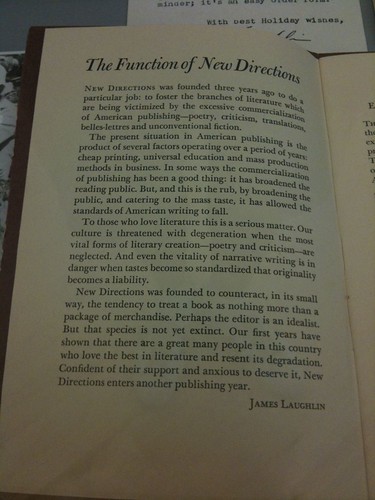
James Laughlin's rationale for New Directions Publishing Corp.
"New Directions was founded three years ago to do a particular job: to foster the branches of literature which are being victimized by the excessive commercialization of American publishing--poetry, criticism, translation, belles-lettres, and unconventional fiction."
***

New Directions was founded to counteract, in its small way, the tendency to treat a book as nothing more than a package of merchandise. Perahps the editor is an idealist. But that species is not yet extinct. Our first years have shown there are a great many people in this country who love the best in literature and resent its degradation. Confident of their support and anxious to deserve it, New Directions enters another publishing year." - James Laughlin, 1939

So wrote New Directions Publishing Corporation's founder, poet and steel company heir James Laughlin (1914-1997), three years after the publication, when Laughlin was a 22-year-old Harvard sophomore, of New Directions in Poetry & Prose, an anthology that featured the work of writers, some of whom were already acclaimed but many of whom would eventually be recognized as among the most important in 20th century American literature: William Carlos Williams, Ezra Pound, Elizabeth Bishop, Henry Miller, Marianne Moore, Wallace Stevens, and e. e. cummings.  75 years and countless authors, from the modernist canon and from literary traditions all over the world, later, New Directions is still publishing, having introduced US readers to the work of major American and international writers like H.D., Delmore Schwartz, Gregory Corso, Michael McClure, Robert Duncan, Denise Levertov, Clarice Lispector, Raja Rao, Muriel Spark, Thomas Merton, Anne Carson, Jorge Luis Borges, Allen Grossman, Jerome Rothenberg, Victor Pelevin, Bei Dao, W. G. Sebald, Roberto Bolaño, and Javier Marías, to name just a few.

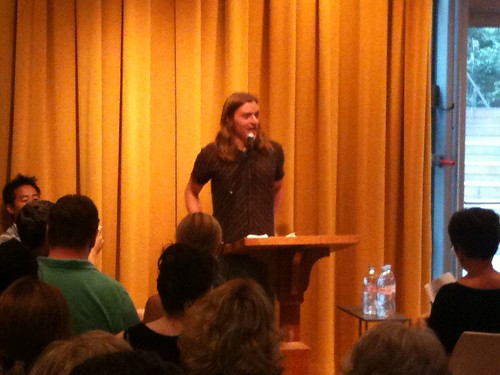
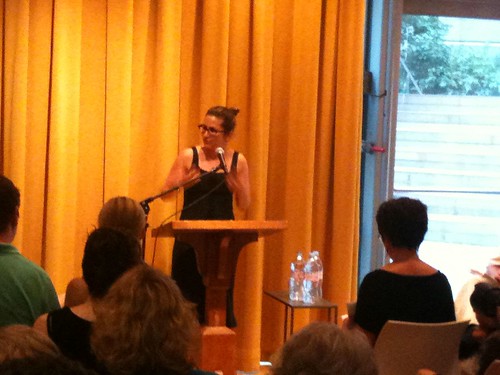
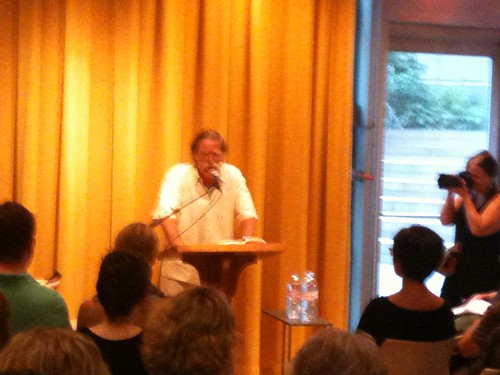
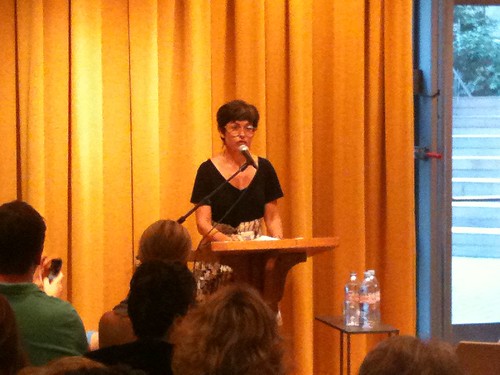
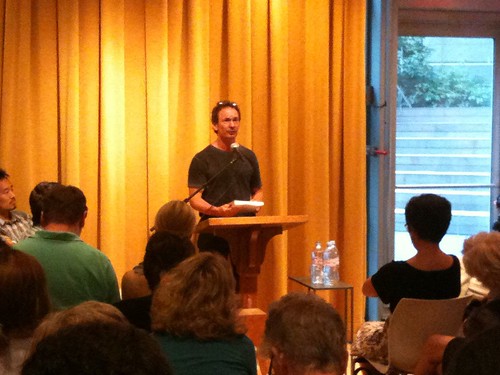
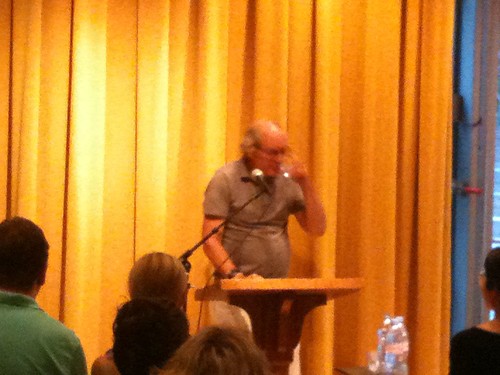
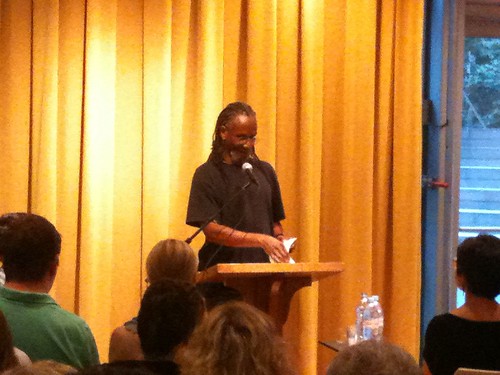
Last night, Poets House in New York, one of the finest repositories of poetry books in the US, hosted a dodranscentennial celebration and reception for New Directions, to coincide with its debut, on its second floor, of selected materials from New Directions' rich archive. The reading featured eight authors and translators, some from New York and some from farther away, who read from authors published by New Directions or their own work.  After Poets House Program Director and publisher Stephen Motika opened the program, he introduced the first reader, translator Susan Bernofsky, who has translated several works from German by Swiss author Robert Walser, read from her recent translation of Microscripts (New Directions, 2010). Subsequent readers were NYU French professor Richard Sieburth, who read two selections from the work of Ezra Pound; poet, translator, scholar, and Bomb editor Mónica de la Torre, who read translations (by Laura Healy) from poet Roberto Bolaño's funny, provocative Tres (New Directions, forthcoming in September 2011).

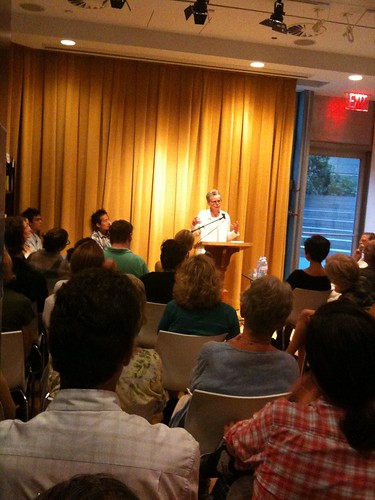
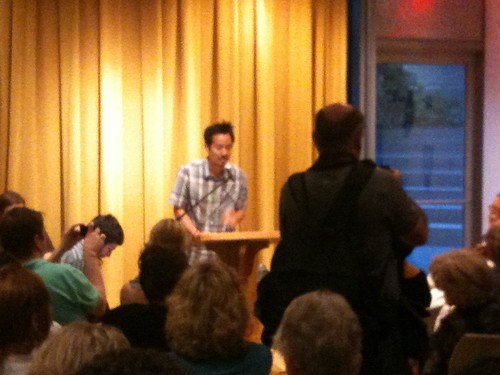
After Mónica, Brown professor and translator Forrest Gander read selections from his newest book, published by New Directions; Eliot Weinberger read from Lawrence Ferlinghetti's 1958 volume A Coney Island of the Mind, one of New Direction's and American poetry's best selling volumes; poet and Duke professor Nathaniel Mackey, who received the National Book Award for his New Directions-published collection Splay Anthem in 2005, read from that and a more recent collection, then offered a snippet from Djuna Barnes's 1936 volume Nightwood; and he was followed by the final reader, poet, critic and Buffalo professor Susan Howe, who began with a small selection from William Carlos Williams's Paterson (1946-1958), before finishing with a thrilling little sliver, which included a passage she performed almost like sound poetry, from her most recent book, THAT THIS (New Directions, 2010). New Directions editor and poet Jeffrey Yang concluded the event with brief remarks, and a fine reception followed upstairs.

If you are in New York and want something engaging to do--and afterwards you might stroll along the picturesque riverwalk just a few steps awa--before October 8, 2011, please visit Poets House during their regular hours and view their wonderful exhibit, in vitrines and along the upstairs walls, of New Directions books, manuscripts, correspondence, book cover mockups, and ephemera. There are some real treasures in the vitrines and along the walls; I've posted a few images below, but I intend to go back when it's a bit quieter to explore the wonderful treasures on display.  Poets House also has its 2011 Poetry Book Showcase on display on the first floor, and will be hosting a celebratory event in conjunction with it, with readings by Rachel Eliza Griffiths, Evie Shockley, Albert Mobilio, and Jena Osman next Tuesday!

Poets house program director and publisher Stephen Motika
Poets House Program Director and publisher Stephen Motika, delivering his beautiful introduction of the evening's events
Translator Susan Bernofsky
Susan Bernofsky, who has translated Robert Walser for New Directions, reading from her translation of his Microscripts
NYU Prof. Richard Sieburth
NYU French and Comp Lit professor Richard Sieburth, reading Ezra Pound
Mónica de la Torre
Poet and translator Mónica de la Torre, reading from translations (by Laura Healy) of Roberto Bolaño's prose poems Tres
Brown prof. Forrest Gander
Brown professor Forrest Gander, reading from his poetry
Eliot Weinberger
Eliot Weinberger, before he read from Lawrence Ferlinghetti's A Coney Island of the Mind (1958), one of New Directions' and American poetry's most popular and best selling volumes
Nathaniel Mackey
National Book Award winning poet and professor Nathaniel Mackey, reading from Splay Anthem, the first of his books published by New Directions
Susan Howe
Poet and professor Susan Howe, who began her reading with a selection from William Carlos Williams's Paterson
New Directions editor Jeffrey Yang, closing the event
Poet and New Directions editor Jeffrey Yang, closing the event