Showing posts with label Poetry Month. Show all posts

Tuesday, May 08, 2012

April Poets on Poems Stats

One of the things I like about the new(er) version of Blogger is that it allows you to see all kinds of page and related stats easily, much more so than the earlier version allowed. Periodically I'll review the stats to see what posts garner the most page views, and from where, and since Poetry Month has officially concluded (though every month is poetry month), I have been curious to learn which poets and poems attracted the most viewers.

The tally so far:
1) Ishmael Reed - 89 views
2) Elizabeth Alexander - 83 views
3) Tess Gallagher - 80 views
4) Ana Cristina César (my translations) - 75 views
5) Robert Duncan & Sonia Sanchez joint post - 74 views
6) Tracy K. Smith - 73 views
7) W. H. Auden - 72 views

I cannot discern a pattern beyond the fact that the first and last posts received considerable attention, that Tracy K. Smith's Pulitzer also generated page views (and a Google +1!), and that the direct beauty of Gallagher's and Sanchez's posts also drew readers. With César, I' not sure what brought eyes into the theater; with Auden, perhaps it was the name and the poem.

As I noted before, there were a number of well-known poets and poems on poetry I tried to avoid posting (Stevens, Ashbery, Padgett, etc.) simply because they often do receive attention, and I wonder if those would have drawn more viewers. I did include a few, like Marianne Moore and Gary Snyder, both of whom finished in the middle of the poetic pack. I was surprised that Edward Field, an important but sadly overlooked queer poet, whose poems of the 1960s in particular really deserve greater readership and scholarly treatment, had among the fewest readers of all. Oh well, what can you do, but present the poems and let people make their way to them. Lastly, I was interested to see that one of the poets who received the fewest pages views, Denise Levertov, nevertheless received two comments, the most of any of the posts.

What poets writing about poems would have wanted to see? Do let me know.


Monday, April 30, 2012

Poem: Ishmael Reed

Ishmael Reed (National Black Writers Conference)
We come to the end of Poetry Month. Since I began the month with a poem by a poet I know and have had the great luck to study with, I shall choose a final poem about poetry by another poet, of an earlier generation, whom I also had the good fortune to study with. This writer's poem "i am a cowboy in the boat of ra" was my favorite in childhood and for many years after, even though it took me years to fully understand what he was talking about. In fact, I would have chosen that poem, but it doesn't foreground thinking about poets or poetry as a medium in the way that the poems I've selected all month do, so I must pass it by, this time.  This poet first introduced me to the work of Mei-Mei Berssenbrugge (in person, no less); Adrienne Kennedy; and Jessica Hagedorn.  He also invited me to participate in the only reading I gave as a college student (which, it turns out, several of the Dark Room Writers Collective founders attended, though we didn't know each other then), and has over the years been an advocate. I know he is a controversial figure for many, but he was an excellent teacher, and, when I think of his work in prose fiction, in poetry, in playwrighting, in nonfictional and critical essays, and in lyric writing for musical accompaniment (whether it be jazz, hiphop, or other musical genres) I can only say that he remains one of the more original American and African American authors of his and subsequent eras.

He also has been a diehard champion of underrepresented perspectives in American literature, whether championing the work of Native American, Latino and Latina, Asian American, Arab American and mixed race writers, or founding Konch, which provided a venue for those writers, or editing over a dozen anthologies, such as From Totems to Hip-Hop: A Multicultural Anthology of Poetry Across the Americas, 1900–2001 (2003), featuring writers of all backgarounds, or establishing with others the Before Columbus Foundation and PEN/Oakland, which has given out the American Book Awards to writers whom the mainstream literary world often ignored.  His most frequent mode is satire, which often works very well, but sometimes not; but it has provided him with a means for engaging in one of the longest sustained critiques of of American exceptionalism, imperialism and structural racism of any American writer living. While producing this large and impressive body of work, he taught for 35 years at the University of California, Berkeley and elsewhere (which is where I encountered him). In 1998, the John D. and Catherine T. MacArthur Foundation, perhaps considering not just his many literary works but his literary advocacy and community building efforts, honored him with their "Genius" Award.

Who am I talking about? I am talking about Ishmael Reed (1938-). And I will end this month with one of his best known--and, according to Gale Research, one of the most widely taught--poems in the curriculum. You may know which one I mean: "Beware: Do Not Read this Poem."  It is a masterful post-modern poem about poetry's seductive power, the satire undercutting the figurative and literal horror Reed invokes when he talks about the film's and the poem's voracious, anthropophagic appetite, but then cites the US Census figures on missing persons, a stat whose bureaucratic and ominous significance shifts through its connection to poetry.  Reed is saying, I think, through and amidst his satire, that poetry does have power, even if it might be rendered hyperbolic and linked to the obvious artifice of a "horror film" scenario and character.  It makes you laugh and think. Look at yourself, the poem says: not just the poem, but the poet and the readers themselves, have quite a bit of power. The power to devour each other, but of a voraciousness that might not be so bad. If you let it, if it lets you.

BEWARE: DO NOT READ THIS POEM

tonite, thriller was 
abt an ol woman , so vain she 
surrounded herself w/ 
          many mirrors

it got so bad that finally she 
locked herself indoors & her 
whole life became the 
          mirrors

one day the villagers broke 
into her house , but she was too 
swift for them . she disappeared 
          into a mirror 
each tenant who bought the house 
after that , lost a loved one to 
          the ol woman in the mirror : 
          first a little girl 
          then a young woman 
          then the young woman/s husband

the hunger of this poem is legendary 
it has taken in many victims 
back off from this poem 
it has drawn in yr feet 
back off from this poem 
it has drawn in yr legs

back off from this poem 
it is a greedy mirror 
you are into the poem . from 
         the waist down 
nobody can hear you can they ? 
this poem has had you up to here 
          belch 
this poem aint got no manners 
you cant call out frm this poem 
relax now & go w/ this poem

move & roll on to this poem 
do not resist this poem 
this poem has yr eyes 
this poem has his head 
this poem has his arms 
this poem has his fingers 
this poem has his fingertips

this poem is the reader & the 
reader this poem

statistic : the us bureau of missing persons re- 
         ports that in 1968 over 100,000 people 
          disappeared leaving no solid clues 
          nor trace     only 
a space     in the lives of their friends 

Copyright © Ishmael Reed, "Beware: Do Not Read This Poem," from New and Collected Poems, 1966-2006, New York: Carroll & Graf, 2006.

Sunday, April 29, 2012

Poem: W. H. Auden

W. H. Auden
(Photo © Jill Krementz)
I mentioned him in yesterday's (or a recent) post, so here a poem by the one and only W. H. Auden (1907-1973), one of the lodestones of 20th century Anglo-American poetry, whose life and work really need no introduction.  The fifth line in this poem's second stanza is one of the most quoted by poets, though the fuller thought often is not. Ireland remains (even today) torn, and the Irish Republic finds itself saddled with one of the worst economic collapses in all of Europe (blame those bankers and their government enablers), so in that regard, as with the weather, Yeats' poetry might not have made anything happen, but on the other hand, it's clear that Yeats and countless other writers prepared the way, politically, culturally, socially, discursively, for the Free Irish State and the Republic that followed, and provided a framework through which an Ireland, no matter how governed, could imagine itself as constituting a(n even illusory) whole.

That was in part the aim of Modernism, shoring fragments up against ruin, to echo T. S. Eliot, trying to create a whole from the shards modernity, in its multifarious ways, had left behind.  Auden continues: "For poetry....survives/In the valley of its making where executives/Would never want to tamper, flows on south/From ranches of isolation and the busy griefs,/Raw towns that we believe and die in; it survives,/A way of happening, a mouth." In effect, it does make things happen, by its every survival, which, he astutely noticed, passes right by the "executives" out of the mostly solitary conditions (this was in the days before MFA programs) of poets' affective and material labor ("busy griefs"), onto pages, into eyes and ears, through and out of every "mouth" that utters or imagines uttering a poem. So it was with Yeats's poetry, so it is with Auden's, so it will be with every poem that survives. There is so much more to say about this poem, a tribute, a memoriam, an elegy, an invocation, but I will leave it to Auden himself, one of the best rhetoricians of his or any age.

IN MEMORY OF W. B. YEATS   

I


He disappeared in the dead of winter:
The brooks were frozen, the airports almost deserted,
And snow disfigured the public statues;
The mercury sank in the mouth of the dying day.
What instruments we have agree 
The day of his death was a dark cold day.

Far from his illness
The wolves ran on through the evergreen forests,
The peasant river was untempted by the fashionable quays;
By mourning tongues
The death of the poet was kept from his poems.

But for him it was his last afternoon as himself,
An afternoon of nurses and rumours;
The provinces of his body revolted,
The squares of his mind were empty,
Silence invaded the suburbs,
The current of his feeling failed; he became his admirers.

Now he is scattered among a hundred cities
And wholly given over to unfamiliar affections,
To find his happiness in another kind of wood
And be punished under a foreign code of conscience.
The words of a dead man
Are modified in the guts of the living.

But in the importance and noise of to-morrow
When the brokers are roaring like beasts on the floor of the Bourse,
And the poor have the sufferings to which they are fairly accustomed,
And each in the cell of himself is almost convinced of his freedom,
A few thousand will think of this day
As one thinks of a day when one did something slightly unusual.

What instruments we have agree
The day of his death was a dark cold day.

II

     You were silly like us; your gift survived it all:
     The parish of rich women, physical decay,
     Yourself. Mad Ireland hurt you into poetry.
     Now Ireland has her madness and her weather still,
     For poetry makes nothing happen: it survives
     In the valley of its making where executives
     Would never want to tamper, flows on south
     From ranches of isolation and the busy griefs,
     Raw towns that we believe and die in; it survives,
     A way of happening, a mouth.


III

          Earth, receive an honoured guest:
          William Yeats is laid to rest.
          Let the Irish vessel lie
          Emptied of its poetry.

          In the nightmare of the dark
          All the dogs of Europe bark,
          And the living nations wait,
          Each sequestered in its hate;

          Intellectual disgrace
          Stares from every human face,
          And the seas of pity lie
          Locked and frozen in each eye.

          Follow, poet, follow right
          To the bottom of the night,
          With your unconstraining voice
          Still persuade us to rejoice;

          With the farming of a verse
          Make a vineyard of the curse,
          Sing of human unsuccess
          In a rapture of distress;

          In the deserts of the heart
          Let the healing fountain start,
          In the prison of his days
          Teach the free man how to praise.

From Another Time by W. H. Auden, published by Random House. Copyright © 1940 W. H. Auden, renewed by The Estate of W. H. Auden. Used by permission of Curtis Brown, Ltd.

Thursday, April 26, 2012

Poems + Translations: Ana Cristina César

Ana Cristina César (from http://tomzine24.wordpress.com)
Several years ago I came across the poetry of Ana Cristina César (1952-1983), and was immediately struck by how different they looked and sounded in Portuguese, to much of the Brazilian poetry I had been reading. Or they looked different primarily because I did not yet have a context for them. As I read more and studied up on César, I learned that there were, in fact, a number of poets (Cacaso, Chacal, Francisco Alvim and Paulo Leminski, among others) with whom and with whose work hers was in conversation, though that did not diminish the singular quality of her poems for me. I also learned that she was and is still considered one of the most important Brazilian poets of the 1970s era.  A native of São Paulo, she lived in Rio de Janeiro, studied and spent time in London, and later resided in Brasília. What I was detecting in the Portuguese was a poetry that, whether written in verse or prose, often unfolds like a conversation or dialogues, the intimacy enhanced and mitigated by Cesar's quiet, often irreverent, sometimes quite dark humor; a wide range of references, allusions and irony; and above all by her attentiveness to the power and limits of eros.  A queer, feminist poet, César produced poetry that represents a critique, in important ways, of the traditions, in Brazilian and more globally, of poetry as it has developed.  Sometimes her poetry doesn't look like poetry at all; it approximates what another poet I've am drawn to, Nicanor Parra, has called anti-poetry.  At the very least it raises the question of what is poetic, what is literary, and who has the power to designate it as such. American literature and culture was particularly important to her at one stage in her life, and one her strangest little poems comprises nothing more than an index of names of figures she considered significant to her life and art. It is, appropriately, titled "Index of Proper Names" ("Index onomástica"); I include it below.

As the dates above suggest, hers was a brief life, though she began publishing her poetry in childhood, and by the time she was in her 20s, she had gained public notice as an avant-garde pioneer, ranking among the best of the Poetas marginas (Marginal Poets). She was also queer, and her work espoused a discernible feminism. Her fame inside and outside Brazil has steadily grown since her death, by suicide, at the age of 31. During her lifetime she published several collections, including the acclaimed Luvas de pelica (Kid Gloves, 1980), and A teus pés (At Your Feet, 1982), as well as the prose work Literatura não é documentação (Literature Is Not Documentation), on the politics of documentary filmmaking.  I have translated a number of her poems, and featured a rough translation of one (with a companion poem by another Brazilian poet favorite of mine, Leminski), on this blog back in 2010.  Although there is a fine British selection of her poems, Intimate Diary, translated by Cecilia McCullough, Patricia E. Page, and David Treece (Boulevard Books, 1997), I don't believe an American one exists. A fellow translator told me the other day, however, that a very famous American poet is now translating Cesar, so her translations will probably appear in book form before any of mine do. At least I have this blog.

Here then are "First Lesson" and "Index of Proper Names," both of which I translated from a bilingual Spanish-Portuguese anthology of her work entitled Álbum de Retazos: Antología Critica Bilinguë, Ana Cristina César, edited by Luciana Di Leone; Florencia Garramuño; and Ana Carolina Puente, Buenos Aires: Corregidor, 2003. The first is overtly about poetry of a particular kind, the second about literature more broadly. Both press at the very limits of what lyric poetry is; are they--especially the second--even poems as we usually know them? Also it's Poem in Your Pocket Day; both of these poems are short enough to carry around in a pocket or your memory, whichever's easier.

FIRST LESSON

The genres of poetry are: lyric, satirical, didactic,
    epic, light.
The lyric genre comprises lyricism.
Lyricism is the translation of a subjective feeling, sincere
    and personal.
It is the language of the heart, of love.
Lyricism is also so named because in other times
    sentimental verses were declaimed to the sound of
    the lyre.
Lyricism can be:
a) Elegiac, when it treats sad matters, almost always death.
b) Bucolic, when verse about rustic subjects.
c) Erotic, when verse about love.
Elegiac lyricism comprises the elegy, the dirge, the
    threnody, the epitaph, and the epicedium, or funeral
    oath.
Elegy is poetry which treats dolesome topics.
The dirge is poetry in homage to a dead person.
It was declaimed beside a bonfire on which the corpse was
    incinerated.
Threnody is a poetry which reveals the heart's sorrows.
Epitaph is a short verse form engraved on tombstones.
Epicedium is a poetry which relates to the life
    of a dead person.
I look for a long while at a poem's body
until I lose sight of whatever is not body
and feel, separated between my teeth,
a filament of blood
on my gums

INDEX OF PROPER NAMES

Alvim, Francisco
Augusto, Eudoro
Bandeira, Manuel
Bishop, Elizabeth
Buarque, Helô
Carneiro, Angela
Dickinson, Emily
Drabik, Grazyna
Drummond, Carlos
Freitas F°, Armando
Holiday, Billie
Joyce, James
Kleinman, Mary
Mansfield, Catherine
Meireles, Cecilia
Melim, Angela
Mendes, Murilo
Muricy, Katia
Paz, Octavio
Pedrosa, Vera
Rhys, Jean
Stein, Gertrude
Whitman, Walt

All poems, Copyright © Ana Cristina César, 2006, 2012; Translations by John Keene, 2010, 2012. All rights reserved.

Wednesday, April 25, 2012

Poem: Kamran Mir Hazar

The US has occupied Afghanistan for a decade. The war, or something approximating one, grinds on; drones ply the skies over Khost; Afghan people, like the coalition soldiers, are still dying and suffering serious psychological and physical injuries; the government there teeters on...the brink? I would venture that most Americans know as little about Afghanistan today, save for the names of a few cities--Kabul, Kandahar, Mazari Sharif--and politicians--Hamid Karzai--than we did before the war began. About Afghan literature, I would imagine our knowledge remains as minimal as ever. I am not excepting myself. Today, then, I am posting a poem--about writing and so much more--by an Afghan poet [کامران میرهزار], Kamran Mir Hazar (1976-), who has garnered internatioal praise for his poetry, his journalism, and his political efforts to promote human rights and civil society in Afghanistan.

A member of the Hazara people, and poet and journalist in Dari and Hazaragi, Kamran Mir Hazar founded and has edited the websites Kabul Press and Refugee Face, the former of which the governments of Afghanistan and Iran block access to. Hazar also has served as a radio journalist and editor. For his journalistic and human rights projects he has won the 2006 Hellman/Hammett Grant from Human Rights Watch, and a 2007 Freedom Award from the Afghanistan Civil Society Forum. He has published two collections of poetry, Ketâb e Mehr (The Book of Mehr) and làhn-e tond-e àsbi dàr ezlâ'-e parvân-e sjodan (The Cry of a Mare about to become a Butterfly), as well as a literary critical book on Afghan literature. Of his most recent book, Johnny Cheung's translated introduction on the Poetry International Website says:

Mir Hazar’s most recent book, Censorship in Afghanistan, has recently been published by Norway’s IP Plans e-Books. It is the first book to explore the systematic suppression of free speech in Afghanistan, which has been a feature of its ruling authorities for hundreds of years.
Hazar now lives and works in Hønefoss, Norway. You can click here to read several Guardian articles on him. He also has a threadbare, multilingual website (including one English-language links) at kamranmirhazar.com.

I obviously cannot speak or read Dari or Hazaragi, so I cannot comment on the original poem, posted below, nor can I comment on the quality of the translation (though I did slightly change two things, transposing one nominal phrase ("crashed computer"), and changing a preposition ("on" for "behind" the "diesel-powered laptop," to make the language more idiomatic), but the story it tells is significant, and the questions provoked by the speaker--who is the lyric speaker here? where is s/he at the moment of this poem? how can our understanding of the poem's multiple ironies, its shifting discourses, its satire, aid us in locating her or him?--are ones that made me sit up and think, ask questions, reread the poem several times. That the medium cited is the net is also significant for this blog, which serves as one my means for connecting with people all over the world.  Too many viruses, of imperialism and militarism, authoritarianism and orthodoxy, of sexism and homophobia, of ignorance and indifference, mark humanity at this moment in time; this poem calls attention to them, at the local and the global level. "Just what is mankind up to?" someone asks a "Kabul sparrow," a term that has multiple meanings, and Hazar tells us the sparrow's answer. Whether a boom accompanies it and it's blown to smithereens is another question.

Nevertheless, we still have this poem, this poet, his and others' poetry. There is hope yet.

VIRUS WRITING


1.
Writing viruses
And electronic labyrinths
With a blackout and no computer
In a rented house, at seven thousand a month;
Kabul, the Afghan capital!
What silly poem is this?

You ask yourself, is poetry the same lonely words
    that wander in electronic corridors,
Cut off from their existence,
Thrown away, with no choice but to become a poem?
You watch imagination wandering through paths, over
    the paths,
You throw the leash at yet another word,
Trying to subdue this wild one,
And if you fail,
You stop functioning,
Like a crashed computer.

2.
There was someone, someone who wrote viruses
On a diesel-powered laptop
Looking for URLs and
An anonymous mail would be sent
Connecting you to a site, infected;
“I am from Florida, the USA, and 23 years of age,
Looking for someone to follow the link, and
    make happy”;
To open the mail and to make someone happy?
First, stop the programs;
Passing through security, typing 97, 98, 99,
Approaching the death of romance between zero
    and one.

A virus-writer drank half a beer bottle at once;
Then, computer deaths;
First to the east of Paris, a house,
Australia, three minutes more,
A man is waiting out the last minutes of
    an office shift
Needs to get home;
A party is starting in half an hour;
The Philippines, minutes later,
A 19-year-old girl
In a chat room,
Showing off a used body;
In Egypt, more or less the same time,
And the next morning, Kabul.

3.
You, and you, also you,
Yes, you and also you,
You are all arrested!

4.
They tell me, stop writing!
You write and we’ll show you Guantanamo
    at home,
You write, we’ll kill you.
Kabul, summer of ’07
Hands in handcuffs, feet tied up;
This is Afghanistan, and this here where it is
    going,
Dead bodies over dead bodies.
The poem has no choice but to stop writing
    itself.
This is prison.

5.
They asked a Kabul sparrow
Just what is mankind up to?
The sparrow considered this and died!

© Translation: 2010, Nushin Arbabzadah (with slight modifications)
Publisher: First published on PIW, 2010

And the original, in Hazara:


Copyright © 2010, Kamran Mir Hazar, Publisher: First published on PIW, 2010

Tuesday, April 24, 2012

Poem: Denise Levertov

Denise Levertov
Do students read Denise Levertov (1923-1997) in high school or college these days? Do high school teachers or college professors teach her work?  I never hear anyone mention her name, and it's a shame. It was in junior high that I first read a poem of hers, though I don't remember which; I made a faint impression, but an impression it did make. I decided to learn more about her when I started coming across books of hers from the 1960s and 1970s at used bookstores in Boston, and became curious about her poems, how they worked, why they worked--because compared to other poets I was reading a lot of then, they seemed deceptively understated, quiet, sometimes even casual, shorn of metaphor and allusion, often given to descriptions of objects, scenes, people, places--and then about her, her life, her relationship with the poets closely and loosely grouped about the Black Mountain school and her political stances, especially during the Vietnam War.

She wrote a number of poems about her opposition to this conflict and against war in general, especially in the volume The Sorrow Dance (1967) and The Freeing of the Dust (1975) and her progressive views on many different topics are evident in her poetry. Yet it is the poetry itself, limpid and lucid, proceeding often as if she were speaking but carefully shaped, full of internal music, that testifies to her importance in American letters.  Levertov was born in the United Kingdom, however; her father was a Russian Jewish immigrant who converted to Christianity, and her mother was Welsh. She served as a nurse during World War II, and came to the US only in 1948, a year after marrying an American writer, Mitchell Goodman. From then on, through her affiliation with the Black Mountain writers, on to her final works, which include more personal and sometimes overtly confessional lyrics, she published regularly and to considerable recognition, while taking stands on behalf of women's liberation and civil rights, and teaching and mentoring younger writers, including at Stanford University from 1981 to 1994.

Here's one of her poems, "To the Reader," which gives a sense of how effortlessly profound she can be. At first, she contrasts the experience of the reader with an almost generic scene occurring somewhere in nature (which of course could be and is, ironically, a scene in this book), which quickly becomes much more specific and memorable with that "saffron" (note too the subtle, but effective music here, born of deftly deployed prosody, consonance and rhyme), and then in the second stanza, she shifts to a more ambigious scene--where is it taking place, described as it is with evocative lyric precision--"lie among lianas: eyes of obsidian"--and then, only in the final paragraph, do we get a metaphor, the sea turning the pages of its waves, like the reader of the book, the final repetition both mirroring the action of the reader and the sea, while also inverting the action through personification so that it's the sea's "dark pages" that now have agency, turning the pages, of life and time; the natural world is set into motion by the work of art, this poem. Of course analogically these shifts are akin to what reading offers, what a good book, a great poem, can do: leaps of all kinds are possible, not just between stanzas, but between words, images, metaphors, or, as is the case here, metonyms and images, activating the world and life itself. I do hope readers turn to her from time to time; there is much to gain from doing so, and much to love.

TO THE READER

As you read, a white bear leisurely
pees, dyeing the snow
saffron,

and as you read, many gods
lie among lianas: eyes of obsidian
are watching the generations of leaves,

and as you read
the sea is turning its dark pages,
turning
its dark pages.

Copyright © Denise Levertov, "To the Reader," from The Jacob's Ladder, London: Jonathan Cape, 1965. All rights reserved.

Monday, April 23, 2012

Poem: Kamau Brathwaite

Edward Kamau Brathwaite (from repeatingislands.com)
I was trying to remember if I had featured Kamau Brathwaite (1930-) on J's Theater before, and I was pretty sure I had, but it turns out that while I have mentioned him many times, including in my very first post, the only work of his that I've ever featured is his highly anguished call for help to save CowPastor/Cow Pasture, the large open areas near where he lives in Christ Church, Barbados, that the government and private entities seized control of through which to lay roads. Not to aestheticize the letter, but it bears many of the hallmarks of Brathwaite's poetry, from its orthography to its reconstitution of language itself. As it turns out, poet Tom Raworth set up a site, Save Cowpasture, that's still up, and last fall Brathwaite wrote Raworth to thank him for keeping the site up. He also mentions the TIME OF SALT, and there's a link to +++SaVing CowPastor & the KB Cultural Lynching 2004-2011+ by clicking this link, which is, to put it mildly, an extraordinary document, a setting of the letters, accounts, recountings, the stories, of the fight for CowPastor/CowPasture and Brathwaite's struggles in New York and Barbados.

Extraordinary really only scratches the surface when it comes to Brathwaite. I know. I studied with him, and count the experience among the most fortunate in my life. I'm not just talking about him as a teacher, critic, theorist, historian, or raconteur, nor as the sort of person who, almost out of nowhere, announces that a graduate class should begin preparing to go to a foreign country for a class trip (he did this), or who tells of how he witnessed another famous writer's wife walking through a wall (he did this). I don't want to start delving into mysticism, metaphysics and the supernatural, but let me just say that when you spend some time around someone operating at this level, a true konjur man with a mind like the libraries of Alexandria and an ability to see into the hidden heart of things you tend not to doubt them. He pulled off that trip. That transmural passage as a result didn't seem so inconceivable. There are keys all throughout his work that he operates or accesses many different channels. You really could spend a lifetime teasing some of these keys out, following the threads, raveling and reraveling them again, and if you read him carefully enough he points them out. A sharp graduate student will probably elect to do this at some point down the road.

To put it another way, he is the one of the most important and original living Caribbean poets, one of the major poets writing in English, a signal figure of African Diasporic poetry and poetics, and a living treasure. He has proved this over nearly 40 books of poetry, critical prose, and memoirs, many of these works constituting works of hybrid genre that defy easy categorization. Through this rich body of work, he has developed a language drawn from his native Barbados, the Caribbean and Latin America, his readings, studies and experiences in Britain and the US, strikingly singular and personal, but also transnational and universal. To fully capture this language, informed by the principle, in part of nommo (from the Bantu) and nam, he created typography/textual form, the Sycorax Dub script (I believe that's the name). He has garnered, among his many awards, the Neustadt International Prize for Literature, which used often to be a tip for the Nobel Prize; the Griffin Poetry Prize, one of the highest awards for world poetry, handed out in Canada; and Premio de la Casa de las Américas, awarded by the Cuban government for an exceptional from the Caribbean.  I know him because he has served for two decades as Professor of Comparative Literature at New York University.

This potted intro hardly does him justice, though. There is no substitute for his poetry, which is so verbally and visually powerful it dazzles. The poem below, which I recalled from a journal I had in my office, is a distillation. If you can, read it aloud, and you will feel the bird rising off this screen; it might even guide you to places you had not ever imagined.

BIRD RISING

Until it come to the time for the great bird the Mithurii .
    to begin its ascent
its challenge against the eart . the paradoxical oracle of wind . the
    the wings beating
unchaining. out. boarding as seamen might say . the gret beast
    ruffled & rising
as in all the great legends

and this happening here before me now under me now wonderfully
    surrounding me
the white silver louvered feather shift & chevron stretching out
    across the sunlight
the great terrible beauty & beating we have always heard about
beating beating upward & forward . the planks of its shape
    shivering at first like a ship

like a dhow . then spheering down into smooth as we scool
    up. wards

Now the first hills at the darker mountains of english . the sea
    below all shard
& silver like our shadow . the beacon topaz eyes unblinking even
    through all the shudder
the wings now stretched across all space openly & awesomely . so
    that we are not beating
any. more but ahh sailing something like singing . because at last
    I have been able

to use all the wounds in the language . as long as I lay them out
    softly & carefully
like these unfluttering feathers of song . like the sea below
    turning into a grey ball of wine
without fishes or sperm . like the darkness no longer lingering
    above us
but we moving towards it as part of its fuse & its future . the àxé
    & ayisha of sails

one last time in our ears . the earth gone a long time now from
    green spur arrogance
of john crow mountain. strange
not even the memory of a veiled carefree river in these high
    places . too far up now
for sunsets through all this rain & distance in our eyes. in our
    sleep. in our silence

the metaphor at last afloat almost alight in the darkness
 
Copyright © Edward Kamau Brathwaite, "Bird Rising," in Conjunctions: Bi-Annual Volumes of New Writing, No. 27, The Archipelago: New Writing From and About the Caribbean, Edited by Robert Antoni and Bradford Morrow, pp. 89-90. All rights reserved.

Sunday, April 22, 2012

Poem: Martha Collins

Today's poem is by a poet I've never featured before, but this poem, and this poet's work, have intrigued me, not least because of one rhetorical device (of the many) she uses so well: repetition. In several of the poems by Martha Collins (1940-) that I've read, repetition serves as the means for what might in music be called motivic variation, at least if I'm grasping the concept right.

She will introduce a word, a phrase, an idea, and then repeat it with variations in its placement, context, meaning, function. In one of her better known poems, "Lines," she spins from that word's many meanings a complex little poem about composition, connections, relationships, the algebra of love. In many poems she plays with the mechanics of syntax, semantics and spatiality, allowing her to make quite complex works with the seemingly simplest of tools--think Williams Carlos Williams's machine made of words, but with hidden, powerful gears.  It should hardly be surprising, then, that she has written books titled Some Things Words Can Do (Sheep Meadow Press, 1999), and The Arrangement of Space (G. Smith Publisher, 1991).

The poem below operates a little differently, but as you read it you start to see how she can take an idea and draw all sorts of interesting things out of it, using, among her tools, repetition. This is not to say, however, that her focus is only on language; in her 2006 book-length poem, Blue Front (Saint Paul: Graywolf Press), she took on history directly, writing about a lynching that occurred in her father's hometown of Cairo, Illinois, bringing to bear her poetic skills to render unforgettable one of many too-forgotten, horrible moments in American history.

Martha Collins is a native of Omaha, Nebraska, and established  the creative writing program at the University of Massachusetts Boston. She currently is the Pauline Delaney Professor in Creative Writing at Oberlin College. She has published five books of poetry, and one chapbook, and has edited a book of critical essays on poet Louise Bogan, and translated two books of poetry from Vietnamese, The Women Carry River Water by Nguyen Quang Thieu (1997), edited with Ba Chung Nguyen; and Green Rice by Lam Thi My Da (2005). Among her awards are the Anisfield-Wolf Book Award for Blue Front, and fellowships from the Ingram Merrill Foundation, the National Endowment for the Arts, and the National Endowment for the Humanities.

SEVERAL THINGS

Several things could happen in this poem.
Plums could appear, on a pewter plate.
A dead red hare, hung by one foot.
A vase of flowers. Three shallots.

A man could sing, in a burgundy robe
with a gold belt tied in a square knot.
Someone could unite the knot.
A woman could toss a gold coin.

A stranger could say the next line,
I have been waiting for this,"
and offer a basket piled with apples
picked this morning, before the rain.

It could rain in this poem,
but if it rained, the man would continue
to sing as the burgundy silk fell
to the polished parquet floor.

It could snow in this poem:
remember how the hunter stamped his feet
before he leaned his gun in the corner
and hung his cap on the brass hook?

Perhaps the woman should open the ebony bench
and find the song her mother used to sing.
Listen: the woman is playing the song.
The man is singing the words.

Meanwhile the hunter is taking a warm bath
in the clean white tub with clawed legs.
Or has the hunter left? Are his boots
making tracks in the fallen snow?

When does the woman straighten the flowers?
Is that before the hunter observes
the tiny pattern on the vase?
Before the man begins to peel the shallots?

Now is the time for the woman
to slice the apples into a blue bowl.
A child could be watching the unbroken peel
spiral below the knife.

Last but not least, you could appear.
You could be the red-cheeked child,
the hunter, or the stranger.
You could stay for a late meal.

A Provencal recipe.
A bright red hare, shot at dawn.
Shallots. Brandy. Pepper, salt.
An apple in the pan.

Copyright © Martha Collins, "Several Things," from The Catastrophe of Rainbows, Cleveland: Cleveland State University Press, 1985. All rights reserved.

Saturday, April 21, 2012

Poem: Carl Phillips

Today's poem is one of congratulations! to a poet I've read for nearly 20 years. I met and befriended him right before he was to publish his first book, the award-winning In the Blood (Boston: Northeastern University Press, 1992, selected by Rachel Hadas), when he connected with the Dark Room Writers Collective, which I've mentioned a bit here over the last few weeks. I am talking about the one and only Carl Phillips (1959-), who is, as I write this, one of the most important writers of his generation, a major American and African-American poet, a highly esteemed teacher and subtle critic and dedicated mentor of many other poets and writers. He has published 11 books of poetry, and 1 of criticism, I believe, and received, among many honors, the Kingsley Tufts Prize, Lambda Literary Prize, and the Fellowship of the Academy of American Poets. He also serves as the judge for the Yale Series of Younger Poets Prize.

For many years he has taught at Washington University in St. Louis, where he now holds a chair, and he also has taught at the Cave Canem Foundation's summer workshops. When I first met him, Carl was a soft-spoken, disarmingly funny, dazzlingly smart person, and these traits, along with his distinctive gift for syntax (which he once told an interviewer, I believe, he learned from his study of Classical poetry, a field he explored in graduate school for a while), also mark his poetry, which often unfolds in slow, serpentine fashion, the effect almost like wandering into a cloud, or fog, in which are suspended particular moods, or feelings, only partially perceptible at first, but then, and this happens not infrequently in Carl's poems, what follows a line or stanzaic break might be an image, a truth, a recognition or realization embedded in either, that cracks like a whip right at the center of your consciousness, so quickly you don't and can't realize what hit you.

It one of his many gifts as a poet. Between the hypotaxis, the enjambment, the suspension, not just in Latinate but sometimes in the fashion almost of German syntax of key words and ideas, and his precision with regard to imagery and recurring symbols (cf. arrows, sheep, and so forth), his careful use of conceits and extension of metaphor across an entire poem, and, as I said, a wry humor that springs on you without warning, his poetry works real magic. It was already thus from the very first book. Here is a poem from another early book of his, my favorite, Cortège (Saint Paul: Graywolf Press, 1995), whose raison d'être will gel if you sit with it for a bit. Oh, and I mentioned that this was a post of congratulations: last night Carl received the Los Angeles Times Book Prize for Poetry, for his most recent book (also nominated for many other awards), Double Shadow: Poems (New York: Farrar, Straus & Giroux, 2011). Congratulations to an exceptional poet.

ÉTUDE IN D

Late-American. A boy mostly, but with a
man's half-concerns about letting his hair

go, or how his eyes and just under, tired
of waiting him out, show signs of going

without him. Other times--weekends,
the odd stolen day off--any man in boy's 

armor: big-boy boots, pants that fail
to hide enough ankle. A name, spelled

backwards, falling somewhere between god
and what's good. All the promise of salt,

how it hangs back on the tongue for a while
after. Connect, miss briefly, try again:

his method. Every word has meaning, but the
way something simple--a flower, a bird--

means. A song, but with all the notes left
pending, so a poem. So a kind of music.

Himself the last to give a name to it.

Copyright © Carl Phillips, "Étude in D," from Cortège, Saint Paul: Graywolf Press, 1995. All rights reserved.

Friday, April 20, 2012

Poem: Gary Snyder

Gary Snyder (l), Allen Ginsberg (r), 1965
Glacier Peak, Washington State (Photo © Allen Ginsberg)
When this Poetry Month posting business began, I said I was going to refrain from intros, précis(es), and the like. Or keep them brief.  But then I think every day as I'm selecting these poems, it isn't fair just to post them without saying something. Sometimes that something can fit into a tiny box of concision. Other times it just pours forth from my fingertips like a sluice. I guess it depends on the day. Today, in honor of my selection, Mr. Gary Snyder (1930-), a poet of such distinction (including a Pulitzer Prize, back in 1975, for Turtle Island (New Directions)) that he really needs no introduction, and who can pack an entire landscape into a small stanza, I shall be ultra-brief.

Of this figure allied with the Beats (he was the prototype of Jack Kerouac's character "Japhy Ryder" in The Dharma Bums) and the San Francisco Renaissance, this longtime Zen Buddhist and environmentalist, this former professor at the University of California, Davis, I will say that his poetry's attentiveness to nature and its material and spiritual dimensions, his gifts for simplicity, brevity and the telling detail, his openness to non-US influences, and his generosity as a poet, all recommend reading him as much as possible. The poem below also shows another gift of his, wit, which glides right up on you. I like to listen to podcasts of Snyder sometimes, just to hear his laugh. The seriousness of intent and lightness of touch in his work fit together like a hand in a glove, or, using a metaphor of his, a handle to an axe-head.

(NB: I am unable to replicate the glyphs that appear between stanzas in the original text.) 


AS FOR POETS

As for poets
The Earth Poets
Who write small poems,
Need help from no man.

The Air Poets
Play out the swiftest gales
And sometimes loll in the eddies.
Poem after poem,
Curling back on the same thrust.

At fifty below
Fuel oil won't flow
And propane stays in the tank.
Fire Poets
Burn at absolute zero
Fossil love pumped backup

The first
Water Poet
Stayed down six years.
He was covered with seaweed. 
The life in his poem 
Left millions of tiny
Different tracks
Criss-crossing through the mud.

With the Sun and Moon
In his belly,
The Space Poet
Sleeps.
No end to the sky-
But his poems,
Like wild geese,
Fly off the edge.

A Mind Poet
Stays in the house. 
The house is empty
And it has no walls.
The poem 
Is seen from all sides,
Everywhere,
At once.

Copyright © Gary Snyder, "As for Poets, " from Turtle Island, New York: New Directions Publishing Corporation, 1975. All rights reserved.

Thursday, April 19, 2012

Poem: Lorna Dee Cervantes

I was trying to figure out how to introduce the following poem, by Lorna Dee Cervantes (1954-), which I thought of when I read the hedging admission by the House Majority Whip, Eric Cantor (R-VA) that anti-Semitism and racism were (still) a problem in his (the Republican House) caucus.  Well, duh. (Yet does he realize how he's been part of the problem?) I read this poem many years ago and recall it every so often because of how it captures so much of what was surging through me back then, and what I still sometimes feel, beginning with her opening line, "In my land there are no distinctions." Yet she must qualify her utopian statement rather quickly by noting that despite this view, despite the fact that "there are no boundaries," there is a system that is trying to destroy her, there are people whose words and actions are killing her, people who do not want her be alive, that there "is a real enemy / who hates me," and that even some of the best and best-meaning people seem unwilling to do or say anything to stop this.

I also know that she wrote it when she was very young and yet it shows such nuance, such sophistication, then ends with a bang that I feel we shouldn't forget.  We are a country at war, sadly, without our selves, "our various selves," as Amiri Baraka once put it. At any rate, I was thinking of introductions when I came across this 2007 blog post by none other than Cervantes herself, from her blog Lorna Dice, in which she explains to a student named Emily her motivations, the writing of the poem, and what she thinks it means. (Can I just say, I love that with I can read Lorna Dee Cervantes' musings after a few seconds' search via DuckDuckGo. She actually has two other blogs: Lorna Dee Cervantes, and Mission Poetry Center--La Misión Poética)  Cervantes, for those who may not be familiar with her, is a Chicana/Native American (Chumash) poet long active in feminist, progressive, antiracist causes, and has been writing and fighting since the 1970s.

Her first, perhaps best known book, is the award-winning volume Emplumada (Pittsburgh: University of Pittsburgh Press, 1981).  Ten years later she published her second book, From the Cables of Genocide: Poems on Love and Hunger (Houston: Arte Público Press, 1991), and has gone on to publish two more volumes, while also serving as editor or co-editor of journals and anthologies, teaching (for many year at the University of Colorado, Boulder, and now at University of California, Berkeley), and keeping the dream of a better world alive through her work in many communities.  Her blog is an extension of this; on it you see she not infrequently responds to young people who contact her about her work, theirs, life in general, the issues they're going through, and it represents yet another aspect of her longtime efforts to improve literacy among young people, especially young Latinos.

One thing I want to note about Cervantes' poetry, especially since I have called attention to her emphasis on social activism, is how much it summons vivid, sensuous details of the natural world, particularly flowers, details of the urban terrain, material aspects of the everyday world, to etch sharp pictures in the mind. In my mind, when I think of her poems, I often see them beginning with the naming of a plant whose blooms, colors, scent, grounds me immediately. She writes many other kinds of poems, but her work also makes clear that one doesn't have to surrender social concerns no matter what or how one is writing a poem.

Now, this famous poem, which seems especially fitting given the rhetoric that regular fills the airwaves and the numerous tragedies, arising out of sexism and misogyny, racism, homophobia, classism, religious intolerance, and general disrespect for the humanity of others, for difference and pluralism, that have scarred the news of late. Do read her blog if you get a moment; she doesn't disappoint there or in her poems.

POEM FOR THE YOUNG WHITE MAN
WHO ASKED ME HOW I, AN INTELLIGENT,
WELL-READ PERSON, COULD BELIEVE IN
THE WAR BETWEEN THE RACES

In my land there are no distinctions.
The barbed wire politics of oppression
have been torn down long ago. The only reminder
of past battles, lost or won, is a slight
rutting in the fertile fields.

In my land
people write poems about love,
full of nothing but contented childlike syllables.
Everyone reads Russian short stories and weeps.
There are no boundaries.
There is no hunger, no
complicated famine or greed.

I am not a revolutionary.
I don't even like political poems.
Do you think I can believe in a war between the races?
I can deny it. I can forget about it
when I'm safe,
living on my own continent of harmony
and home, but I am not
there.

I believe in revolution
because everywhere the crosses are burning,
sharp-shooting goose-steppers round every corner,
there are snipers in the schools...
(I know you don't believe this,
You think this is nothing
but faddish exaggeration. But they
are not shooting at you.)
I'm marked by the color of my skin.
The bullets are discrete and designed to kill slowly.
They are aiming at my children.
These are facts.
Let me show you my wounds: my stumbling mind, my
"excuse me" tongue, and this
nagging preoccupation
with the feeling of not being good enough.

These bullets bury deeper than logic.
Racism is not intellectual.
I cannot reason these scars away.

Outside my door
there is a real enemy
who hates me.

I am a poet
who yearns to dance on rooftops,
to whisper delicate lines about joy
and the blessings of human understanding.
I try. I go to my land, my tower of words and
bolt the door, but the typewriter doesn't fade out
the sounds of blasting and muffled outrage.
My own days bring me slaps on the face.
Every day I am deluged with reminders
that this is not
my land

and this is my land.

I do not believe in the war between the races.

but in this country
there is war.

Copyright © Lorna Dee Cervantes, "Poem For The Young White Man Who Asked Me How I, An Intelligent, Well-read Person, Could Believe In The War Between The Races," from Emplumada, Pittsburgh: University of Pittsburgh Press, 1981.

Wednesday, April 18, 2012

What Is Metarealism?

As I noted in a previous post, yesterday I attended a Poetry and Poetics Colloquium-sponsored discussion about--it was more of a conversation, with a very brief reading sandwiched in between, in whispered Russian, by--author Andrei Levkin (1954-).

Two of my Northwestern colleagues, Reginald Gibbons and Ilya Kutik, both poets and scholars, and both long involved in bringing a trove of Russian literature into English, introduced him and are current translating Revkin's and other Russian poets' texts. Reg I have written about extensively on here, but he is, for those unacquainted with his work, an award-winning poet, novelist and short-story writer, and an equally regarded translator from Spanish and Ancient Greek. Among his many honors, his collection Creatures of a Day (LSU Press, 2008), was nominated for the 2009 National Book Award. He cofounded and codirects Northwestern's MA/MFA program, and was formerly chaired the English department.  Ilya, a native of Lvov (Lviv), and graduate of the Gorky School of Literature, teaches in Northwestern's Slavic department and is one of the founders of the "meta-realist" or "meta-metaphorist" school of Russian poetry, and was close to Allen Ginsberg and Joseph Brodsky, among other major poets.  He has published a number of volumes, several translated into English, and his most recent critical studies include Writing as Exorcism: The Personal Codes of Pushkin Lermontov, and Gogol (Northwestern University Press, 2005), and Hieroglyphs of Another World: On Poetry, Swedenborg, and Other Matters (Evanston: Northwestern University Press, 2000).

The writeup of the event read as follows:

Andrei Levkin (who will be visiting from Moscow) is a writer of "poetic prose" related in style and stance to the contemporary Russian poetic school known as "metarealism." The latter is centered on a particular mode of thought--unfamiliar in English-language poetry and prose--that is highly metaphorical, often apophatic, and fast-moving. Metarealism began in the 1980s (Ilya Kutik was a founder and remains one of the primary figures) and has produced a number of very widely known and highly honored poets, including Alexander Eremenko, Aleksandr Chernov, Elena Schwarts, Olga Sedakova, the late Alexei Parshchikov. It is also poetically affiliated in spirit and approach with such predecessors as Boris Pasternak, Marina Tsvetaeva and Osip Mandelshtam, as well as more recent luminaries like Bella Akhmadulina, Victor Krivulin, and Arkadii Dragomoshchenko (translated in the US by Lyn Hejinian).
I was curious both to hear what Levkin, as well as Ilya and Reg had to say about "meta-realism" and to hear Levkin reading his prose. But as I said, there was only a tiny bit of reading, and a great deal of trying to unpack what "metarealism" is. Here's what I took away: metarealism (meta = something setting beside or with + realism) entails heavy use of a figure, apophasis, traditionally understood as "mentioning without mentioning," that is not exactly metaphor (or simile), nor metonymy, but involves a bit of both. In it, an absence becomes a presence, and figuration proceeds from that absent presence. Thus, a chain of figures can unfold from a metaphor (or metonym, depending) signifying an absent object, or person, or anything, and thus a signifying chain is set in motion that a Russian reader can and will pick up, but which not click for non-Russians.

The idea of a negative space, or absence, as the starting point, seems key, as opposed to the way metaphor (and metonymy) work in English, whereby the presence of something stands in for something else (or in contiguous relation to it). A "double-saying," to use Reg's term. Thus apophasis, even as a figure, is far less common in English, though certain poets (George Herbert, Wallace Stevens, etc.) do utilize apophatic figures. In Russian as in English, the apophatic carries mystical (metaphysical?) resonances that English translations cannot capture, and extends beyond literature to visual arts as well. In apophatic theology, the ineffability of God requires that rather than describing Him or Her or Them in positive terms (immanence, which is to say, presence), that the description proceed by what S/He or They are not (transcendence, which is to say, presence).

I should note that there is a form of apophasis that isn't uncommon in English, and it's known as paralipsis, praeteritio, preterition, parasiopesis, or cataphasis, and was a favorite of Richard Nixon's, among other politicians (keep your ear ready to see if and when it appears during this election cycle). It involves saying something while denying you're saying it. So (and these my versions, not Nixon's actual words), "I will not question the motives of those on the other side pressing for my impeachment," or "My opponent is a lying thief who hates babies and puppies, but I'm not going to say a bad words about him." Other related figures include epanorthosis (accumulation and statement by negation) and occultatio (statement of something by not stating it). And so forth. It is clearly related to the rhetorical figure of irony, and as such can be quite effective. Apophasis, though, as the metarealists use it, is more subtle.
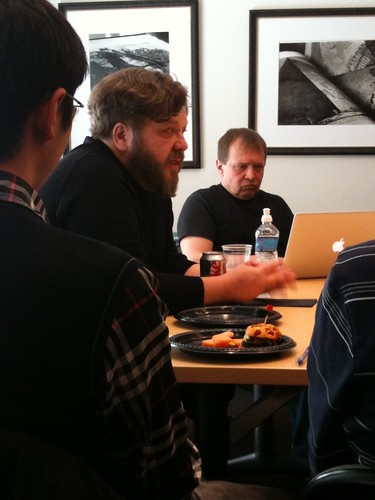

Ilya Kutik and Andrei Levkin
Ilya Kutik (l) and Andrei Levkin (r)

A clearer example: Reg and Ilya discussed translating a poem by Andrei Voznesensky (1933-2010), a homage to Robert Lowell (1917-1977), in which Voznesensky notes the angle of Lowell's head, tilted as if there were an invisible violin there. But there is no violin. Yet by the end of the poem that Voznesensky hopes to hear the music of that absent violin. Or, in the same poem, Voznesensky notes a notch, cut by Peter the Great (1672-1725) in a hut, and how Lowell was tall enough to touch the notch. In the poem the apophatic figure involves Lowell not becoming that notch or in some connective relation to it, and thus becoming the Czar, but fitting into the space of that notch, the absent space that notch creates, which thus invokes Lowell's presence. Lastly, in the same poem, Reg pointed out, Voznesensky mentions how tombstones in a grave are like Post-It notes. One can imagine this metaphor with ease, and a grave metonymically links to the dead, and death itself.  So Voznesensky goes searching among them for Lowell, now buried in a grave, and the absent Lowell and the Post-it notes, in aggregate, transpose  into the book of Lowell, the books of Lowell, that Voznesensky can read.

Hmm.  I think I get it, sort of. Ilya also spoke about the iconostasis, and how in a Russian Orthodox Church, a wall stood between the altar and the congregation, unlike in Roman Catholic or Protestant churches, and how the presence of this wall of icons made active the presence of the hidden altar.A senior colleague, Larry Lipking, asked whether in all this there was not the residue of the theological, of Orthodox traces, and Ilya averred, saying that in fact there were. He also pointed out how the idea of "the word made flesh," a theological idea that also carries back to orality, of course, still remained active for Russian poets and readers, and noted how Kasimir Malevich's (1879-1935) famous black square painting was also called "The New Icon," not simply to be provocative or blasphemous, but because, in an apophatic gesture, the black square represented the absence of the icon, so central to Orthodoxy, only the (white gessoed) canvas frame remaining. Double hmm.

Finally Andrei Levkin, who is a very highly regarded journalist and experimental author, and editor-in-chief of the political ezine www.polit.ru, read from his text, which, as I said, Ilya and Reg have been translating. He read so softly, in Russian, I had to lean forward in my chair just to hear the words. He noted how he was interested in a kind of installation of words to create his prose works, almost as if he were talking about an art installation as opposed to a narrative. This got me thinking about the various Russian prose--fiction--writers I know of, all of whom do not stint on plot or characterization, and how different his work sounded and felt. Levkin pointed out that most of the people I was probably thinking about were carrying on a specifically Russian tradition, while he, a native of Riga, Latvia, though part of that larger tradition, took a different approach.

As he was speaking and Reg, I believe was responding to him, I thought about his comments about the relationship between his work and contemporary art, and about how Jean-François Lyotard, in his famous essay on Barnett Newman and the idea of the "contemporary sublime," noted that one of the most important shifts to take place among the 40s and 50s generation of artists, the Abstract Expressionists and their peers, was to ask the question not of "what is it?" or "why is it?" but rather, "Is it there?" which is also to say, "what is there?"  The idea of filling space, as opposed to filling it with an image or a particular kind of composition or color, to question pictorial space itself as presence and negation, seemed to be operating, in some way, with Levkin, in contrast to the other Russian prose writers, like Tatyana Tolstaya say, or Vladimir Sorokin, of whom I've written some on here. Thus for Levkin "what is there?" and "is it there?" perhaps functioned apophatically instead of the more usually prose fictional question, from which narrative proceeds: what is happening, and who is doing what in relation to what's happening. That of course is the ground of fiction across the globe.

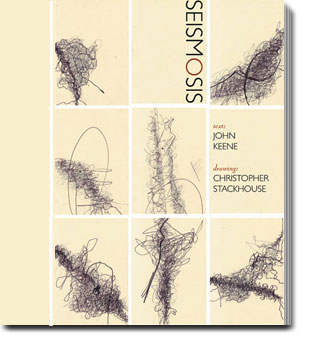
I still must say I'm not sure I fully grasp "metarealism" or apophasis, and I also thought about the widespread presence of the negative--down to actually statements, as in "Analysis III," questioning what absence itself reveals--in Seismosis, not that I knew then or now that much about negation, apophasis, or so on, but all of that's for another discussion. I will raise my antennae when I'm reading Levkin's work in translation, or that of any of the many Russian poets of the 20th century, especially those in the metarealist school, linked to it or inspired by it, trying to be aware of how the apophatic works.

Poem: Luis Alberto Urrea

Luis Alberto Urrea (saveethnicstudies.org)
I have always been drawn bothto poetry that is very complex in its forms and meanings but also, conversely, to poetry that appears to be simple but turns out to be complex. Such marks some of the work of Luís Alberto Urrea (1955-), a writer I have unaccountably never featured on this blog, though I greatly enjoy his work. Urrea was born in Tijuana, Mexico, and grew up in the United States. A prolific writer, he (like Kwame Dawes) belies the genre-specificity so dominant in contemporary American literature culture, representing an older model of the person of letters, who just writes, and writes well.

Of course not everyone can do this, but some writers foreclose the possibility without even trying. It is even endemic in undergraduate and in some cases high school literary education, when all writers should be encouraged to try all genres and forms, and Urrea offers a model of how one might do this. He has published three books of poetry, one book of short stories, four novels, two memoirs, and three works of nonfiction, and teaches at the University of Illinois, Chicago. Despite our being in the same city for nearly a decade, I have never seen him read or even come across an announcement for his reading, though perhaps that will occur at some point in the future. His work has garnered many awards, among them: the Christopher Award for Across the Wire, his first book, a nonfictional work; the Colorado Book Award and the Western States Book Award for The Fever of Being; the American Book Award for his memoir, Nobody's Son: Notes from An American Life; and the Lannan Literary Award and a finalist selection for the Pulitzer Prize for The Devil's Highway.

The poem below is one of those seemingly simple but actually complex works. It's a litany, consisting of the anaphoric refrain "All the vatos," whom he ironically notes will never be in a poem, though, as we see, they are.  And he presents them in their diversity, the poem taking on many different notes and tones as it unfolds, full of humor, social critique, absurdity, linguistic registers and languages, realness as documentary as a snapshop, yet so lyrical that it's almost song--it could be sung--the first half issuing the same call, appeal, even perhaps an apostrophe (to those homeboys), the second half of each line, after the caesura, mostly but not always in trochaic trimeter (the entire line is trochaic pentameter), as in "down por vida homeboys" or "arms around their sisters"-- '~ '~ '~ --which endows each response with a feel that is not that of the usual English iambic (penta)meter, but something closer to Spanish (vato, gato, hombre, libre), yet also strikes the ear as perfectly appropriate. We know from the rhythm what's coming even though we don't know what's coming, so we experience a twinned sense of anticipation and surprise.

There are microclimates in this poem. One of my favorites is when the poem becomes self-reflexive towards the end, and another is at the very end, when with artful simplicity it combines history, politics, culture, resistance, into just a few lines, invoking the discourse that many young and old Xicanos and Xicanas have had remind themselves in the face of societies that would erase or efface or reduce their humanity: "All the vatos  beautiful young Aztecs / All the vatos  sons of Guadalupe / All the vatos   bad as la chingada / All the vatos  call themselves Chicanos...."  I'd say the vatos couldn't have asked for a better tribute, and without a doubt, Luis Alberto Urrea is the ish!

hymn to vatos who will never be in a poem

All the vatos  sleeping on hillsides
All the vatos  say goodnight forever
All the vatos  loving their menudo
All the vatos  faith in la tortilla
All the vatos  fearing the alarm clock
All the vatos  Wino Jefe Peewee
All the vatos  even the cabrones
All the vatos  down por vida homeboys
All the vatos  using words like ranfla
All the vatos  who woke up abandoned
All the vatos  not afraid of their daughters
All the vatos  arms around their sisters
All the vatos  talking to their women
All the vatos  granting their foregiveness
All the vatos  plotting wicked paybacks
All the vatos  sleeping under mota
All the vatos  with tequilla visions
All the vatos  they call maricones
All the vatos  bleeding in the alley
All the vatos  chased by helicopters
All the vatos  dissed by pinches white boys
All the vatos  bent to pick tomatoes
All the vatos  smoked by Agent Orange
All the vatos  brave in deadly classrooms
All the vatos  pacing in the prisons
All the vatos  pierced by needle lightning
All the vatos  who were once our fathers
All the vatos  even veteranos
All the vatos  and their abuelitos
All the vatos  proud of tatuajes
All the vatos  carrying a lunch pail
All the vatos  graduating law school
All the vatos  grown up to be curas
All the vatos  Jimmy Spider Tito
All the vatos  lost their tongues in Spanish
All the vatos  can't say shit in English
All the vatos  looking at her photo
All the vatos  making love till morning
All the vatos  stroking their own hunger
All the vatos  faded clear as windows
All the vatos  needing something better
All the vatos  bold in strange horizons
All the vatos  waiting for tomorrow
All the vatos  sure that no one loves them
All the vatos  sure that no one hears them
All the vatos  never in a poem
All the vatos  told they don't belong here
All the vatos  beautiful young Aztecs
All the vatos  warrior Apaches
All the vatos  sons of Guadalupe
All the vatos  bad as a la chingada
All the vatos  call themselves Chicanos
All the vatos  praying for their children
All the vatos  even all you feos
All the vatos  filled with life eternal
All the vatos  sacred as the Sun God
All the vatos  Flaco Pepe Gordo
All the vatos  rising from their mothers

Copyright © Luis Alberto Urrea, "hymn to vatos who will never be in a poem," from Vatos, El Paso: Cinco Puntos Press, 2000. All rights reserved.

Tuesday, April 17, 2012

Poem: Kwame Dawes

Continuing with the theme of congratulations, I want to extend my heartiest best wishes to another poet, Kwame Dawes (1962-), who was one of the select few recipients of this year's John Simon Guggenheim Foundation Fellowships, an honor accorded to artists, scholars, scientists, and others who have achieved a high level of distinction in their fields. Kwame combines many talents in one person. A prodigious, acclaimed poet, featured before on J's Theater, he has published a dozen or more complete collections since the early 1990s; yet he has also published novels, a book of short stories, a biography of Bob Marley, and a play, and edited at least five books of poetry of various kinds (Reggae poetry, Black British poetry, Caribbean writing, and poetry from South Carolina). This constellation may seem a bit unusual, but it touches upon Kwame's background and his connections within and across communities. A native of Accrah, Ghana, he grew up in Kingston, Jamaica, attending the University of the West Indies for college, before heading to the University of New Brunswick in Canada for graduate school. He taught literature and creative writing for 20 years at the University of South Carolina, achieving the Louis Frye Scudder Professorship of the Liberal Arts there, while also directing the USC Arts Initiative, and advising the student publication Yemassee. In the last year, he has moved to the University of Nebraska, where he holds a chair and also edits the highly regarded literary journal Prairie Schooner

But I'm not done; during his South Carolina years, he deeply engaged with the local and state arts communities, serving as director of the South Carolina Poetry Initiative, whose annual poetry contest he established, and whose winning books he edited. His links to South Carolinians took other forms, including works like his book Wisteria: Twilight Poems from the Swamp Company (Los Angeles: Red Hen, 2006), which he later translated into a musical work, with artist and photographer Kevin Simmonds, the staged version debuting at Royal Festival Hall in London.  I could of course go on, but I'll only mention one further thing before getting to one of his poems; between 2007-2009, he again collaborated with Kevin Simmonds, and photographer Andre Lambertson, on a project documenting the HIV/AIDS pandemic in Jamaica. I previously blogged about this important effort, titled Hope: Living and Loving with HIV Jamaica, or Livehopelove. It is still live and if you haven't visited it, I urge you to. As all this background suggests, Kwame is indefatigable, but he also draws from many different rivers of experience, and his poetry reflects this pluralism and richness. His poems bear the influence of the Jamaican, Caribbean and Anglophone literary and popular cultures of his youth; Diasporic exchanges also nourish his poetics; his decades in Canada and the United States brought him into closer contact with American and African-American poetries, and he has influenced poets in his turn.

The poem below, from Wisteria, comes directly out of his experiences and time in South Carolina; its immediate story, of a domestic who worked for a segregationist (the real story, not the Hollywoodized The Help version), is American down to its phonemes (though a similar sentiment we know exists not just in countries that have had legalized apartheid, like South Africa, but throughout the colonial and post-colonial world). The younger poet's witnessing, however, is universal, one starting ground of and for the art itself. "I, scavenger poet / swoop and pick // at the living thing"--isn't this what so much poetry, so much literature, so much art does? There is an ethical grounding here, too. The poet isn't just taking to make something out of someone else's life, but seeks to bear witness, and the fidelity of the voice he listens to, records, is crucial: "I let my mother down / and commit sins of the soul."  He does not back away from her truth telling realization, nor from his role in setting it down, but for both poet and lyric speaker, the fact of seeing the now blind segregationist have to live with his beliefs balances this out, providing a "gourmet of irony" different from, and yet not so different from that of the poem.  So here, then, is Kwame's poem.

POEMS IN EVERYDAY PLACES

     Your story told,
     Your poem made,

     I, scavenger poet,
     swoop and pick

     at the living thing,
     to make my own

     feast of metaphor
     gourmet of irony.

He said those words,
spat them out in my face:

"Not as long as I live
will I see no colored child

riding a school bus."
Roosevelt looking down

like God almighty,
and the flag curled in the corner.

Well, he never saw them,
those colored children

climbing onto the yellow bus
books in hand, and riding,

but someone whispered it into his ear
while he stared into the black.

My mother never said rejoice
in the infirmities of others;

sometimes I let my mother down
and commit sins of the soul.

I am singing this song for him
and dancing on his grave:

"What you wish for,
that's what you're gonna get."

Monday, April 16, 2012

Poem: Tracy K. Smith

In honor of her having received the Pulitzer Prize in Poetry today (CONGRATULATIONS!), for her most recent book of poems, Life on Mars (Minneapolis: Graywolf Press, 2011), here is a poem by Tracy K. Smith (1972-), whom I've known and whose work I've deeply admired since she was a fellow member of the Dark Room Writers Collective back in the 1990s. (She is the fourth African-American woman to receive this prize, following in the brilliant tradition of Gwendolyn Brooks, Rita Dove, and Natasha Trethewey, also a former Dark Room Collective member.) Tracy graduated from Harvard and Columbia, and spent two years in the late 1990s at Stanford as a Stegner Fellow. She is an assistant professor--soon, I imagine, she will become a FULL professor, if she wants--at Princeton University.

Tracy has published three books, including The Body's Question (Graywolf, 2003), which received the Cave Canem Book Prize, and Duende (Graywolf, 2007), and has received numerous awards for her work, including a Whiting Writers Award, the James Laughlin Prize from the Academy of American Poets, the Rona Jaffe Award, and the Essence Literary Award. Her poetry is precise, focused in its observation, sensuous but controlled in its language, suffused with emotion but never sentimental, and capable of drawing into clarity a world in just a few lines. Whatever she writes about--moments in history, her own or others--she brings all the tools of poetry to bear.  She knows her stuff through and through. Here's a poem from her first book, The Body's Question.

A HUNGER SO LATE

Driving home late through town
He woke me for a deer in the road,
The light smudge of it fragile in the distance,

Free in a way that made me ashamed for our flesh—  
His hand on my hand, even the weight
Of our voices not speaking.

I watched a long time
And a long time after we were too far to see,
Told myself I still saw it nosing the shrubs,

All phantom and shadow, so silent
It must have seemed I hadn’t wakened,
But passed into a deeper, more cogent state—

The mind a dark city, a disappearing,
A handkerchief
Swallowed by a fist.

I thought of the animal’s mouth
And the hunger entrusted it.  A hunger
So honed the green leaves merely maintain it.

We want so much,
When perhaps we live best
In the spaces between loves,

That unconscious roving,
The heart its own rough animal.
Unfettered.

                           The second time,
There were two that faced us a moment
The way deer will in their Greek perfection,

As though we were just some offering
The night had delivered.
They disappeared between two houses,

And we drove on, our own limbs,
Our need for one another
Greedy, weak.

Copyright © Tracy K. Smith, "A Hunger So Honed," from The Body's Question, Minneapolis: Graywolf Press, 2003. Al rights reserved.

Sunday, April 15, 2012

Poem: William Carlos Williams

One of the most famous lines in American poetry about the importance poetry lies in one of the most beautiful long poems by one of America's finest poets, Dr. William Carlos Williams (1883-1963), a poet whose career spanned the entire first half of the 20th century, and whose impact continues to resonate among poets many generations after.  Williams, for anyone unaware of his work, was one of the chief figures in American--and trans-Hemispheric--modernism, an Imagist in his early career, a pioneer in prosody and the hybrid poem, a mentor to innumerable poets, one of the most famous of them being Allen Ginsberg (1926-1997). Born in Rutherford, New Jersey the son of a Puerto Rican (Basque + Dutch Jewish) mother and an English father who grew up in Puerto Rico, Williams attended primary and secondary school in the US and briefly in Switzerland, before attending University of Pennsylvania Medical School, where he befriended Ezra Pound and H.D. (Hilda Doolittle).

He published his first book, Poems, in 1909, and would go on to publish dozens more, as well as short stories, novels, critical texts, plays, translations, you name it, while living most of the rest of his life in New Jersey and practicing medicine. In my post on Marianne Moore, I mentioned the little magazine Others, and Pound joined this group in 1915, but he would eventually come to know nearly every one of his major American peers, including T. S. Eliot, Wallace Stevens (with whom he carried on a long correspondence), Conrad Aiken, among many others. One of the things I love about Williams as a poet was that he wrestled with two tendencies, which often clash: on the one hand, he was restlessly and relentlessly experimental, something that gets overlooked because of the seeming simplicity of his work, but what is a poem like "Spring and All" or "The Figure Five in Gold" (I love!!! this poem) or "The Red Wheelbarrow" or the almost completely assimilated "This is just to say" if not a challenge to the pre-existing body of English and American poetry? And yet as each of these poems demonstrates, he also aimed for simplicity, sometimes for a American plainspokenness, grounded in everyday speech, that made (and still makes) his poetry appear at times artless, especially when compared to works like Eliot's "The Waste Land" or Stevens's Harmonium or anything by Gertrude Stein.

In fact he was criticized more than once by his peers for his radical experiments, some of which, like Paterson, are brilliant failures, and which opened up vast spaces for poets writing alongside him and those who came after.  One of this later and most beautiful poems, from the 1955 collection Journey to Love, is the final long love lyric "Asphodel, that Greeny Flower"--notice how he balances out the meter of the title by added the extra syllable to "green," also intensifying and defamiliarizing, and simultaneously imbuing with affection this simple word--which is not just a hymn to his beloved, but a four-part pastoral that bears many dark notes, of self-criticism, regret, admonition, affirmation; it is a composition built to bear a great deal, and Williams, at the height of his powers, knew how to pull it off. I am including a long excerpt of it, up to the point of one of its most famous lines, which makes an argument for the poem itself and for poetry's power; however we take his words, it is clear that he knew what he was talking about, and knew, as the very best poets do, how to transform it into poetry.  If you can, read it aloud, for the entire excerpt, like the poem, rolls off the tongue like song. Should you want to read the entire poem or his other late masterpieces, they're collected in Pictures from Brueghel and other poems by William Carlos Williams: Collected Poems 1950-1962 (New Directions Publishing Corporation). Enjoy!

ASPHODEL, THAT GREENY FLOWER
(an excerpt)

Of asphodel, that greeny flower,
  like a buttercup
    upon its branching stem-
save that it's green and wooden-
  I come, my sweet,
    to sing to you.
We lived long together
  a life filled,
    if you will,
with flowers.  So that 
  I was cheered
    when I came first to know
that there were flowers also
  in hell.
    Today
I'm filled with the fading memory of those flowers
  that we both loved,
    even to this poor
colorless thing-
  I saw it
    when I was a child-
little prized among the living
  but the dead see,
    asking among themselves:
What do I remember
  that was shaped
    as this thing is shaped?
while our eyes fill
  with tears.
    Of love, abiding love
it will be telling
  though too weak a wash of crimson
    colors it
to make it wholly credible.
  There is something
    something urgent
I have to say to you
  and you alone
    but it must wait
while I drink in
  the joy of your approach,
    perhaps for the last time.
And so
  with fear in my heart
    I drag it out
and keep on talking
  for I dare not stop.
    Listen while I talk on
against time.
  It will not be
    for long.
I have forgot
  and yet I see clearly enough
    something
central to the sky
  which ranges round it.
    An odor
springs from it!
  A sweetest odor!
    Honeysuckle!  And now
there comes the buzzing of a bee!
  and a whole flood
    of sister memories!
Only give me time,
  time to recall them
    before I shall speak out.
Give me time,
  time.
When I was a boy
  I kept a book
    to which, from time
to time,
  I added pressed flowers
    until, after a time,
I had a good collection.
  The asphodel,
    forebodingly,
among them.
  I bring you,
    reawakened,
a memory of those flowers.
  They were sweet
    when I pressed them
and retained
  something of their sweetness
    a long time.
It is a curious odor,
  a moral odor,
    that brings me
near to you.
  The color
    was the first to go.
There had come to me
  a challenge,
    your dear self,
mortal as I was,
  the lily's throat
    to the hummingbird!
Endless wealth,
  I thought,
    held out its arms to me.
A thousand tropics
  in an apple blossom.
    The generous earth itself
gave us lief.
  The whole world
    became my garden!
But the sea
  which no one tends
    is also a garden
when the sun strikes it
  and the waves
    are wakened.
I have seen it
  and so have you
    when it puts all flowers
to shame.
  Too, there are the starfish
    stiffened by the sun
and other sea wrack
  and weeds.  We knew that
    along with the rest of it
for we were born by the sea,
  knew its rose hedges
    to the very water's brink.
There the pink mallow grows
  and in their season
    strawberries
and there, later,
  we went to gather
    the wild plum.
I cannot say
  that I have gone to hell
    for your love
but often
  found myself there
    in your pursuit.
I do not like it
  and wanted to be
    in heaven.  Hear me out.
Do not turn away.
I have learned much in my life
  from books
    and out of them
about love.
  Death
    is not the end of it.
There is a hierarchy
  which can be attained,
    I think,
in its service.
  Its guerdon
    is a fairy flower;
a cat of twenty lives.
  If no one came to try it
    the world
would be the loser.
  It has been
    for you and me
as one who watches a storm
  come in over the water.
    We have stood
from year to year
  before the spectacle of our lives
    with joined hands.
The storm unfolds.
  Lightning
    plays about the edges of the clouds.
The sky to the north
  is placid,
    blue in the afterglow
as the storm piles up.
  It is a flower
    that will soon reach
the apex of its bloom.
  We danced,
    in our minds,
and read a book together.
  You remember?
    It was a serious book.
And so books
  entered our lives.
The sea!  The sea!
  Always
    when I think of the sea
there comes to mind
  the Iliad
    and Helen's public fault
that bred it.
  Were it not for that
    there would have been
 no poem but the world
  if we had remembered,
    those crimson petals
spilled among the stones,
  would have called it simply
    murder.
The sexual orchid that bloomed then
  sending so many 
    disinterested
men to their graves
  has left its memory
    to a race of fools
or heroes
  if silence is a virtue.
    The sea alone
with its multiplicity
  holds any hope.
    The storm
has proven abortive
  but we remain
    after the thoughts it roused
to 
  re-cement our lives.
    It is the mind
the mind
  that must be cured
    short of death's
intervention,
  and the will becomes again
    a garden.  The poem
is complex and the place made
  in our lives
    for the poem.
Silence can be complex too,
  but you do not get far
    with silence.
Begin again.
  It is like Homer's
    catalogue of ships:
it fills up the time.
  I speak in figures,
    well enough, the dresses
you wear are figures also,
  we could not meet
    otherwise.  When I speak
of flowers
  it is to recall
    that at one time
we were young.
  All women are not Helen,
    I know that,
but have Helen in their hearts.
  My sweet,
    you have it also, therefore
I love you
  and could not love you otherwise.
    Imagine you saw
a field made up of women
  all silver-white.
    What should you do
but love them?
  The storm bursts
    or fades!  it is not
the end of the world.
  Love is something else,
    or so I thought it,
a garden which expands,
  though I knew you as a woman
    and never thought otherwise,
until the whole sea
  has been taken up
    and all its gardens.
It was the love of love,
  the love that swallows up all else,
    a grateful love,
a love of nature, of people,
  of animals,
    a love engendering
gentleness and goodness
  that moved me
    and that I saw in you.
I should have known,
  though I did not,
    that the lily-of-the-valley
is a flower makes many ill
  who whiff it.
    We had our children,
rivals in the general onslaught.
  I put them aside
    though I cared for them.
as well as any man
  could care for his children
    according to my lights.
You understand
  I had to meet you
    after the event
and have still to meet you.
  Love
    to which you too shall bow
along with me-
  a flower
    a weakest flower
shall be our trust
  and not because
    we are too feeble
to do otherwise
  but because
    at the height of my power
I risked what I had to do,
  therefore to prove
    that we love each other
while my very bones sweated
  that I could not cry to you
    in the act.
Of asphodel, that greeny flower,
  I come, my sweet,
    to sing to you!
My heart rouses
  thinking to bring you news
    of something
that concerns you
  and concerns many men.  Look at
    what passes for the new.
You will not find it there but in
  despised poems.
    It is difficult
to get the news from poems
  yet men die miserably every day
    for lack
of what is found there.
  Hear me out
    for I too am concerned
and every man
  who wants to die at peace in his bed
    besides.

Copyright © 1962 by William Carlos Williams, in Pictures from Brueghel and Other Poems by William Carlos Williams: Collected Poems 1950-1962.  New York: Directions Publishing Corporation. All rights reserved.