Showing posts with label Reg Gibbons. Show all posts

Saturday, August 30, 2014

"Pensées" in Recours au Poème

UPDATE: Daily Telegraph art critic Alistair Sooke writes on the August 28, 2014 BBC.com site about Yves Klein's successful development of the ultramarine pigment that cemented his fame: "Yves Klein: The Man Who Invented a Color."

One of the chief reasons I translate writing by non-Anglophone writers is to make their work available to readers who would otherwise have no access to it. However imperfect and faulty my translations I always do hope they offer a glimpse into the work of the translated writers and the worlds from which they come. As a writer myself I always appreciate the opportunity to be translated; it has happened several times, and the most recent instance is one of the best, because the translator is one of the best, a poet in all senses of that word, with a philosophically inclined mind such that she is able to convey multiple layers in every text she carries across languages, including her own. I am speaking with tremendous gratitude about Nathanaël, whom I was incredibly fortunate to have translate one of my very recent poems, "Pensées (After Yves Klein)," a tribute in part to the great, problematic French conceptual artist whose work has haunted me since I first saw it years ago.

Years ago through my job at NYU's Faculty Resource Network I met an artist-scientist, Dr. Adrienne Klein, also a fan of Yves Klein's, and our shared moments of Kleinophilia led in part to the poem "Klein Bottle," which references yet another Klein, the German mathematician Christian Felix Klein (1849-1925), whose non-orientable surface, a staple of topology, the poem invokes. That was an oblique reference to Klein (Yves)--and of course Adrienne and Felix Klein, and mathematics and science--but "Pensées (After Yves Klein)" is more direct. Klein also was one of the intellectual spurs behind one of the most enjoyable classes I ever taught, "Topics in Creative Writing: Conceptual Writing/Art," in 2010. (I fantasize about teaching an updated version of that course at Rutgers-Newark!) I want to say that until that same year, as a result of a mini-exhibit of Klein's work at the Art Institute of Chicago I had never seen any of his paintings or sculptures in person, but this is not correct; a little retrospection reminds me that I certainly did see Klein's work in other museums, including the Guggenheim Museum, which owns several of his works, and MoMA. Encountering Klein's "Blue Sponge Relief" (pictured above) and other images at the Art Institute back in 2010 laid a deep anchor, though, and recently, as I was writing poems about artists and artworks, the "Pensées" emerged.

Since they were about a French artist I sent them to Recours au poème's founding editor, poet and critic Matthieu Baumier, with whom I'd exchanged some emails around the time the online site first began publishing, and did not hear anything back, so it was a surprise and pleasure to learn that Nathanaël would be the translator (she had previously translated some of the poems from Seismosis and succeeded in bringing into French the English rhythms yet also creating a similar, novel music in French), and that she also was preparing a short introductory essay, "Arraisonner le vide" (roughly "Investigating the Void") which manages to encapsulate in a paragraph much of the conceptual richness I was seeking to convey. She also discusses some challenges in translating between the two languages that English in particular produces. I had not thought about it when writing these "Pensées," which are haiku-like in their brevity, but Nathanaël astutely identifies in so many words English's parallel vocabularies, which I drew on. "White" (from English's Germanic roots) and "blank" (from its Norman-Latin ones) are the same word in French, blanc; the same is true with "emptiness" (from Old English) and "void" (from Norman and Latin), which translates as vide. In addition, Nathanaël finds not just an equivalent, but a convincing French music for the English, even as she stays very close to the English syntax. That is quite an accomplishment.

You can find the essay and the entire poem in translation at the Recours au poème site, which if you read French is a bonanza of contemporary Francophone poetry, and I highly recommend it. My former colleague Reginald Gibbons has a series of poems, also beautifully translated by Nathanaël, on the site. Below is a snippet of my poem. Now I just need to find a place to publish the English original!

***

From "Pensées (After Yves Klein)"

Monochrome:
une couleur,
infinité.

*

Monotone:
un accord, puis silence:
une symphonie.

*


Je signe le ciel
J’assigne au ciel
un sens nouveau.

Copyright © John Keene, translation by Nathanaël, 2014. All rights reserved.

Wednesday, April 18, 2012

What Is Metarealism?

As I noted in a previous post, yesterday I attended a Poetry and Poetics Colloquium-sponsored discussion about--it was more of a conversation, with a very brief reading sandwiched in between, in whispered Russian, by--author Andrei Levkin (1954-).

Two of my Northwestern colleagues, Reginald Gibbons and Ilya Kutik, both poets and scholars, and both long involved in bringing a trove of Russian literature into English, introduced him and are current translating Revkin's and other Russian poets' texts. Reg I have written about extensively on here, but he is, for those unacquainted with his work, an award-winning poet, novelist and short-story writer, and an equally regarded translator from Spanish and Ancient Greek. Among his many honors, his collection Creatures of a Day (LSU Press, 2008), was nominated for the 2009 National Book Award. He cofounded and codirects Northwestern's MA/MFA program, and was formerly chaired the English department.  Ilya, a native of Lvov (Lviv), and graduate of the Gorky School of Literature, teaches in Northwestern's Slavic department and is one of the founders of the "meta-realist" or "meta-metaphorist" school of Russian poetry, and was close to Allen Ginsberg and Joseph Brodsky, among other major poets.  He has published a number of volumes, several translated into English, and his most recent critical studies include Writing as Exorcism: The Personal Codes of Pushkin Lermontov, and Gogol (Northwestern University Press, 2005), and Hieroglyphs of Another World: On Poetry, Swedenborg, and Other Matters (Evanston: Northwestern University Press, 2000).

The writeup of the event read as follows:

Andrei Levkin (who will be visiting from Moscow) is a writer of "poetic prose" related in style and stance to the contemporary Russian poetic school known as "metarealism." The latter is centered on a particular mode of thought--unfamiliar in English-language poetry and prose--that is highly metaphorical, often apophatic, and fast-moving. Metarealism began in the 1980s (Ilya Kutik was a founder and remains one of the primary figures) and has produced a number of very widely known and highly honored poets, including Alexander Eremenko, Aleksandr Chernov, Elena Schwarts, Olga Sedakova, the late Alexei Parshchikov. It is also poetically affiliated in spirit and approach with such predecessors as Boris Pasternak, Marina Tsvetaeva and Osip Mandelshtam, as well as more recent luminaries like Bella Akhmadulina, Victor Krivulin, and Arkadii Dragomoshchenko (translated in the US by Lyn Hejinian).
I was curious both to hear what Levkin, as well as Ilya and Reg had to say about "meta-realism" and to hear Levkin reading his prose. But as I said, there was only a tiny bit of reading, and a great deal of trying to unpack what "metarealism" is. Here's what I took away: metarealism (meta = something setting beside or with + realism) entails heavy use of a figure, apophasis, traditionally understood as "mentioning without mentioning," that is not exactly metaphor (or simile), nor metonymy, but involves a bit of both. In it, an absence becomes a presence, and figuration proceeds from that absent presence. Thus, a chain of figures can unfold from a metaphor (or metonym, depending) signifying an absent object, or person, or anything, and thus a signifying chain is set in motion that a Russian reader can and will pick up, but which not click for non-Russians.

The idea of a negative space, or absence, as the starting point, seems key, as opposed to the way metaphor (and metonymy) work in English, whereby the presence of something stands in for something else (or in contiguous relation to it). A "double-saying," to use Reg's term. Thus apophasis, even as a figure, is far less common in English, though certain poets (George Herbert, Wallace Stevens, etc.) do utilize apophatic figures. In Russian as in English, the apophatic carries mystical (metaphysical?) resonances that English translations cannot capture, and extends beyond literature to visual arts as well. In apophatic theology, the ineffability of God requires that rather than describing Him or Her or Them in positive terms (immanence, which is to say, presence), that the description proceed by what S/He or They are not (transcendence, which is to say, presence).

I should note that there is a form of apophasis that isn't uncommon in English, and it's known as paralipsis, praeteritio, preterition, parasiopesis, or cataphasis, and was a favorite of Richard Nixon's, among other politicians (keep your ear ready to see if and when it appears during this election cycle). It involves saying something while denying you're saying it. So (and these my versions, not Nixon's actual words), "I will not question the motives of those on the other side pressing for my impeachment," or "My opponent is a lying thief who hates babies and puppies, but I'm not going to say a bad words about him." Other related figures include epanorthosis (accumulation and statement by negation) and occultatio (statement of something by not stating it). And so forth. It is clearly related to the rhetorical figure of irony, and as such can be quite effective. Apophasis, though, as the metarealists use it, is more subtle.
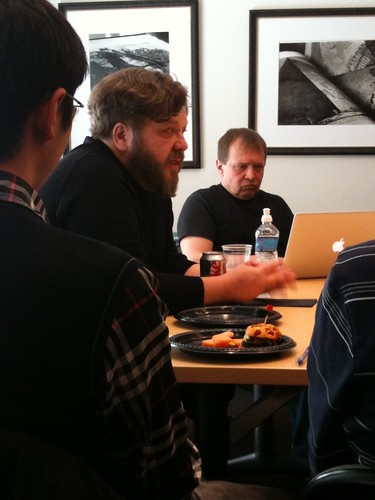

Ilya Kutik and Andrei Levkin
Ilya Kutik (l) and Andrei Levkin (r)

A clearer example: Reg and Ilya discussed translating a poem by Andrei Voznesensky (1933-2010), a homage to Robert Lowell (1917-1977), in which Voznesensky notes the angle of Lowell's head, tilted as if there were an invisible violin there. But there is no violin. Yet by the end of the poem that Voznesensky hopes to hear the music of that absent violin. Or, in the same poem, Voznesensky notes a notch, cut by Peter the Great (1672-1725) in a hut, and how Lowell was tall enough to touch the notch. In the poem the apophatic figure involves Lowell not becoming that notch or in some connective relation to it, and thus becoming the Czar, but fitting into the space of that notch, the absent space that notch creates, which thus invokes Lowell's presence. Lastly, in the same poem, Reg pointed out, Voznesensky mentions how tombstones in a grave are like Post-It notes. One can imagine this metaphor with ease, and a grave metonymically links to the dead, and death itself.  So Voznesensky goes searching among them for Lowell, now buried in a grave, and the absent Lowell and the Post-it notes, in aggregate, transpose  into the book of Lowell, the books of Lowell, that Voznesensky can read.

Hmm.  I think I get it, sort of. Ilya also spoke about the iconostasis, and how in a Russian Orthodox Church, a wall stood between the altar and the congregation, unlike in Roman Catholic or Protestant churches, and how the presence of this wall of icons made active the presence of the hidden altar.A senior colleague, Larry Lipking, asked whether in all this there was not the residue of the theological, of Orthodox traces, and Ilya averred, saying that in fact there were. He also pointed out how the idea of "the word made flesh," a theological idea that also carries back to orality, of course, still remained active for Russian poets and readers, and noted how Kasimir Malevich's (1879-1935) famous black square painting was also called "The New Icon," not simply to be provocative or blasphemous, but because, in an apophatic gesture, the black square represented the absence of the icon, so central to Orthodoxy, only the (white gessoed) canvas frame remaining. Double hmm.

Finally Andrei Levkin, who is a very highly regarded journalist and experimental author, and editor-in-chief of the political ezine www.polit.ru, read from his text, which, as I said, Ilya and Reg have been translating. He read so softly, in Russian, I had to lean forward in my chair just to hear the words. He noted how he was interested in a kind of installation of words to create his prose works, almost as if he were talking about an art installation as opposed to a narrative. This got me thinking about the various Russian prose--fiction--writers I know of, all of whom do not stint on plot or characterization, and how different his work sounded and felt. Levkin pointed out that most of the people I was probably thinking about were carrying on a specifically Russian tradition, while he, a native of Riga, Latvia, though part of that larger tradition, took a different approach.

As he was speaking and Reg, I believe was responding to him, I thought about his comments about the relationship between his work and contemporary art, and about how Jean-François Lyotard, in his famous essay on Barnett Newman and the idea of the "contemporary sublime," noted that one of the most important shifts to take place among the 40s and 50s generation of artists, the Abstract Expressionists and their peers, was to ask the question not of "what is it?" or "why is it?" but rather, "Is it there?" which is also to say, "what is there?"  The idea of filling space, as opposed to filling it with an image or a particular kind of composition or color, to question pictorial space itself as presence and negation, seemed to be operating, in some way, with Levkin, in contrast to the other Russian prose writers, like Tatyana Tolstaya say, or Vladimir Sorokin, of whom I've written some on here. Thus for Levkin "what is there?" and "is it there?" perhaps functioned apophatically instead of the more usually prose fictional question, from which narrative proceeds: what is happening, and who is doing what in relation to what's happening. That of course is the ground of fiction across the globe.

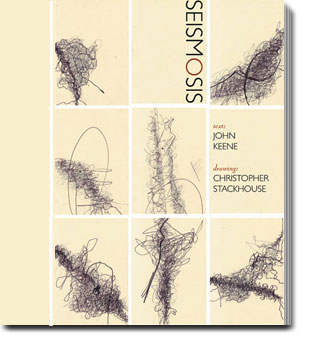
I still must say I'm not sure I fully grasp "metarealism" or apophasis, and I also thought about the widespread presence of the negative--down to actually statements, as in "Analysis III," questioning what absence itself reveals--in Seismosis, not that I knew then or now that much about negation, apophasis, or so on, but all of that's for another discussion. I will raise my antennae when I'm reading Levkin's work in translation, or that of any of the many Russian poets of the 20th century, especially those in the metarealist school, linked to it or inspired by it, trying to be aware of how the apophatic works.

Saturday, January 09, 2010

Reg Gibbons Chicagoan of the Year for Literature + Some RIPs

Slowly I have been making my way through my university email account, and so it wasn't until just the other day that I learned that my esteemed colleague Reginald Gibbons, a writer of multifarious talents (a poet whose volume Creatures of a Day (LSU Press) was a 2008 National Book Award finalist, a fiction writer, an essayist, a translator, an editor, among so much else); scholar and teacher; mentor and friend to colleagues and students; administrator and program head; and literary and cultural activist, was named "Chicagoan of the Year" for Literature by the Chicago Tribune! The blurb about him reads:

Sweetbitter
Reginald Gibbons is a poet, essayist, translator and professor of English at Northwestern University. He edited TriQuarterly, one of the nation's premier literary magazines, for 16 years. This year, Gibbons added another line to his resume: muse. A woman whose work he long championed, Angela Jackson, saw the publication of her first novel, “Where I Must Go” (2009).
This of course only scratches the surface; check out Reg's website here, which includes his richly insightful blog and a listing of his many publications. Emerging poets might find his "A Few Cells from the Great Hive: a reading list for new poets" especially useful. He co-directs the university's graduate MA/MFA program, which he helped to create, while also serving as director of the Center for Writing Arts, and teaching in three different departments. I often speak of "greatness" and "amazing" people on this blog, and Reg is one of the people who fits both descriptions. Congratulations, Reg!

***

So as not to turn this blog into an obituaries column, I will only note in passing the recent deaths of such figures as Percy Sutton, the businessman, former Manhattan borough president and Malcolm X's lawyer; Dennis Brutus, one of South Africa's major poets and anti-apartheid activist, whom I witnessed announce live, at the Celebration of Black Writing in Philadelphia, that Nelson Mandela had been released from jail, causing the entire auditorium to cheer and weep for joy; Eunice Johnson, the longtime treasurer of the Johnson publishing business and the pioneering founder of the Ebony Fashion Fairs and cosmetics line; the feminist scholar theologian, philosopher and writer Mary Daly, many years resident as a professor at Boston College, whose works include the Wickedary; the great Color Field painter Kenneth Noland, one of the leading lights of American painting; and, perhaps least known among all of them but a figure whose name I heard all throughout my undergraduate years, because several good friends were studying the European classics, Ihor Sevcenko, whose field was Byzantine history and literatures. To all of them, resquiescant in pace.

Wednesday, May 06, 2009

May Thoughts

It's 6 days into May and I've only managed to update my May book selections, but I guess that's better than nothing. The final poetry posts for April are still in draft form, but by the end of this week I should be over the (reading) mountain and able to post a bit more frequently. I think. I have been reading for pleasure and edification a bit more, and not just online articles, blog pieces and news stories as happens when I'm bogged down in work-related reading. I'm nearly finished with Thomas Glave's new collection of stories, The Torturer's Wife (City Lights, 2008) and had the pleasure of hearing him read from the title story and the final, arresting final one (set in Jamaica), and I've also gotten about halfway through Forrest Gander's first novel, As a Friend (New Directions, 2009), whose chapter that can only be described as a poetic tour-de-force. Written by an accomplished poet, no less. One thing I love about books of stories (and publishers really could do more to emphasize this) is that you can dip in and read 1-2 at a time, or, if you're really motivated, read as many as you like, though some authors' short fictions require breaks (Alice Munro, Haruki Murakami, etc.) to process even one piece, and Thomas's work is like that. You really have to let what you've just read steep a little. Short novels and novellas, the queer fish of American publishing, are also a blessing. Forrest's prose slows your reading and requires focus, and yet the book is still short and tight enough that you can get through it fairly quickly. I've got such a huge stack following these two that I may have to pick up the/my speed, though.

***

Speaking of reading, I haven't gotten to Colson Whitehead's new novel, Sag Harbor, but Reggie H. forwarded the link to Touré's New York Times review, in which he launches provocatively on a bit about "post-blackness" as if his take on it is a settled matter. I'm not a big fan of Touré's work (though when I met him years ago at Bread Loaf, before his ascendant fame, he was pretty cool), and I feel like his whole "post-black" prologue is trying to mark out some sort of conceptual space for reframing Touré's work rather than offering anything insightful to say about Whitehead's novel, which Reggie H. tells me is quite good. (Whitehead is a very talented novel, and wrote one of the freshest novels of the last 25 years, The Intuitionist.) It's as if he never heard or read any critiques about the term and is unfamiliar with Trey Ellis's "The New Black Aesthetic" essay, which animated conversations at the Dark Room more than 20 years ago.

What I also wrote on the CC list, where a lively series of responses ensued, was this (or some of it):

I'm glad Brian [Gilmore, a lawyer, poet and journalist] mentioned Trey Ellis's famous essay,which caused (and is still causing a stir) when it first appeared, just as Thelma Golden's term set it off too and is still provoking discussion. But then Kyle listed Hughes's "The Racial Artist and the Negro Mountain" on his syllabus, and Hughes's is making an argument heading in this direction at the end of that essay, and also challenging DuBois's "Criteria of Negro Art" and other prescriptive, racially responsible-focused readings of black art and blackness, so perhaps the conversation, the contestation, is a longstanding one.

I wonder if the issue isn't really that post-black is supposed to equal post-essential(ist).

As others have noted, blackness DOES mean many things, always has, with tremendous complexity, in the realm of ideas and in the world. Blackness has conceptual, discursive and ontological power and meaning, and isn't just an empty signifier, just as whiteness isn't. Blackness (and whiteness) have been central organizing principles and tropes for modernity broadly, as [Paul] Gilroy notes for European and American modernities in particular, and as [Toni] Morrison and others have pointed out, for American society, politics, economics, and culture. Randall [Horton]'s citation of various sources is great, and perhaps a course on post-blackness would look at theoretical discussions of race, racism, racial production, blackness as concept, idea, performance, and so on, in order to pivot into a discussion of what "post-blackness" might look like and how it is produced discursively and in other ways, what its effects are, and so on.

In terms of Toure, I won't get personal, but I do wonder if he's not just trying to position himself, as [Tyehimba] Jess says, in a vanguard of some sort, since his work continually fails to do that for him. I'm suspicious of the people who keep labeling [President Barack] Obama and his administration "post-black," or talking about the "post-racial" society we now live in especially given the frequent racist outbursts we've witnessed since January, but also the continued non-spectacular displays and systems of racism that continue. Just look at who's suffering the worst from the economic crisis; the housing crisis; the employment decline. Who still fills our jails? Who's being targeted for attacks because of this current flu outbreak? I can assure it ain't the industrial meat industry.

And I added, responding to a specific point by Reggie:

As for Michael Steele, I think he's quite happy to be black; it gives him a unique space in which to perform his buffoonery. Shelby Steele is the one who has always struck me as trying to flee blackness, but both would do well to listen to Claude Steele, who's the one who got all the smarts.
Really, if we do have to hear from one of these Steeles, let's push for it to be Dr. Claude, okay? And let's stop calling Obama "post-black," at least people who're informed about such things and have good sense, anyway.

***

I also want to highlight two bits of good news about colleagues and friends. Sarah Schulman received the 2009 Kessler Award, which means that she has been selected to deliver the David Kessler Lecture this upcoming fall by the Center for Lesbian and Gay Studies (CLAGS) at the City University of New York Graduate Center. This is a huge honor, as the Kessler lecturer is always someone who has made a major contribution to LGBTQ studies and cultures, and previous Kessler lecturers have included such renowned figures as Samuel R. Delany, Eve Kosofsky Sedgwick, Cherrie Moraga, Judith Butler, Monique Wittig, Barbara Smith, Joan Nestle, John D'Emilio, and Esther Newton, among others. Sarah's important and pioneering work, which continues to combine a powerful, original and vital imagination with an unremitting activist vision and an ethnographer's attentiveness to lived experience, has helped to create the space in which several generations of creative writers and scholars have done their work, especially at the intersection of feminism, discussions of economics and class, and lesbian and anti-racist writing and studies. She has also been a mentor to a number of younger writers, especially women and writers of color, and has put her career on the line more than once to advance causes that benefit countless others, including her recent efforts to address the ongoing paucity of work by female playwrights on New York stages. She is the real deal. Congratulations, Sarah!

Also, congratulations to my colleague Reg Gibbons, who recently received the from the Texas Institute of Letters' Soeurette Diehl Fraser Award for Literary Translation for his exceptional volume of translations, Sophocles' Selected Poems: Odes and Fragments (Princeton, 2008). Reg, you may remember, received a 2008 National Book Award nomination for his beautiful collection Creatures of a Day (LSU Press, 2007), which includes a number of fine short lyrics and a moving long poem, "Fern-Texts," that draws from and converses with Samuel Taylor Coleridge's notebooks. His other translations include such texts as Sophocles' Antigone and, with the late classicist Charles Segal, The Bakkhai (Bacchae), as well as Spanish and Mexican (Luis Cernuda and Jorge Guillén, among others) and Russian poets (Ilya Kutik--these are on their way, I believe). The last set of translations has also seeded, in part, a series of sparkling and profound essays in The American Poetry, on such topics as rhyme's cognitive power and effects, and I hope these become a book as well, very soon. Somehow he does and did all this while teaching full time, producing many volumes of highly regarded poetry and fiction, and, for many years serving as an literary magazine editor, before later serving as department chair (how!?) and now director of a literary center. The prodigiousness deserves an award all its own. Congratulations, Reg!

***

I'll end on the sad note that a good friend, Larry Knight, a brother in spirit, really, passed away earlier this week. It's tough to think and talk about , but let me just say that may his memory live long, may he rest in peace, and may his surviving partner Roberto V.'s sorrow be lifted soon.

Saturday, November 10, 2007

Reading with Students & Reg Gibbons @ High Risk Gallery

Poet Reg GibbonsAnd we keep on sprinting...last night, after a full day of classes and required attendance at day-ending scholarly talk, I read with three students (Steve Jordan, Christine Pacyk, and Nicole Xylouris Osborne, who's currently in my class) and one of my senior colleagues, whom I've mentioned many times here, Reg Gibbons (at left) in one of the university's graduate Masters in Creative Writing program periodic author/student readings. The event took place at High Risk Gallery (Thanksgiving is still at least a week away, but the gallery already had Christmas trees up!) on W. Belmont in the Boystown neighborhood, and just a few blocks from where I lived the first year I stayed in Chicago.

It was exhilarating to see so many of the students I've worked with and their families and friends present, and to see some other Chitown folks in the house as well. And it was a tremendous honor to read (photo of me at left, by author and artist Cornelia Spelman, Reg's wife) with the three students and with Reg, whom I've never read with despite my being at the university for five years. The students repped the three genres we teach (creative nonfiction, poetry, and fiction), and Reg read a few of his stellar translations from Ancient Greek and from his forthcoming collection, while I read (at length!) two linked, still pretty rough early sections--which included dialogue, a forward-moving timeline, and yes, action--I'd never read publicly from my novel in progress, Palimpsests.
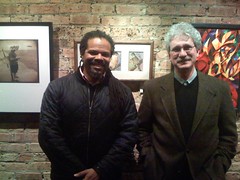
With Reg Gibbons after our readingReading new work always terrifies me, but this time my nerves were settled by the time I took the mic. Afterwards I joined writer friend Rone Shavers, who's also taught in the program (and caught the Dessalines reference, which I did not throw in to keep him on his toes, though I was glad he got it), and some former (Michael, Kayte, Adrienne, Andrea!) and current students on a little bar crawl, then skedaddled back north shortly after the (be)witching hour. The word for the evening, despite my exhaustion, was FUN. In fact, I didn't realize till I got home how drained I really was.