Showing posts with label Afghanistan. Show all posts

Monday, May 28, 2012

On Memorial Day

Installation View, Emily Prince
at the Saatchi Gallery,
via Saatchi Gallery
Today, with Memorial Day in mind, I was thinking of artists who've attempted to capture the scale of loss the US and other countries have experienced as a result of the two recent wars (one sort-of-but-not-really-ended, in Iraq, the other ongoing with a sort of-deadline-in-sigh, in Afghanistan), and I recalled having come across the work of Emily Prince, a California-based artist specializing in process-driven, often durational art, who since 2004 has been, in her words, "drawing wallet-photo sized portraits of the American servicemen and women who have died in the wars in Iraq and Afghanistan." (Each of the images includes a drawn portrait, information on the casualty, and color-coding keyed to the deceased soldier's skin color.) The project's title is American servicemen and women who have died in Iraq and Afghanistan, but not including the wounded, nor the Iraqis, nor the Afghans, and she has exhibited in in various cities across the globe for the last 7 years.

Emily Prince’s Installation American Servicemen and Women
at the Saatchi Gallery, via ArtDaily

I learned about her powerful metonymic artwork via an online article I read on her 2010 show at the Saatchi Gallery. She is still drawing the portraits, and reconfiguring them, and so long as we have troops stationed in Iraq and a war, however hazy its aims since the deposition years ago of the Taliban and the subsequent assassination of Osama bin Laden, she will have portraits to draw, stories to record. But on day like today, her drawings can stand, as I see it, not just for the soldiers lost in these two wars, but for all the US servicepeople and civilians working with or on behalf of the military who have sacrificed their lives throughout US history.

American servicemen and women who have died in Iraq and Afghanistan, but not including the wounded, nor the Iraqis, nor the Afghans, by Emily Prince

As naïve and simplistic as it sounds, we have to push for a time when Emily Prince will have no more US soldiers slain in Iraq or Afghanistan to draw.  A time when no artist, for that matter, will have cause to draw any deceased or wounded US or US-coalition military personnel, or the civilians in the countries they have been ordered to invade. It is not impossible. War should be as rare as coelacanths, or pure rose alba, or fullerenes, or byssus, or Escorial wool, no matter how frequently warmongers invoke it, or commanders-in-chief send troops to prosecute it. Let's remember our fallen servicemembers today, but also let's work to ensure they will be few in number in the future.

Some below images from Emily Prince's project; all images copyrighted, and for illustrative use only.

Kaite M. Loenksen (© Emily Prince)

Curtis L. Glawson, Jr. (© Emily Prince)

Gabriel J. Figueroa (© Emily Prince)

Wednesday, April 25, 2012

Poem: Kamran Mir Hazar

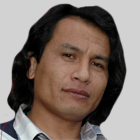
The US has occupied Afghanistan for a decade. The war, or something approximating one, grinds on; drones ply the skies over Khost; Afghan people, like the coalition soldiers, are still dying and suffering serious psychological and physical injuries; the government there teeters on...the brink? I would venture that most Americans know as little about Afghanistan today, save for the names of a few cities--Kabul, Kandahar, Mazari Sharif--and politicians--Hamid Karzai--than we did before the war began. About Afghan literature, I would imagine our knowledge remains as minimal as ever. I am not excepting myself. Today, then, I am posting a poem--about writing and so much more--by an Afghan poet [کامران میرهزار], Kamran Mir Hazar (1976-), who has garnered internatioal praise for his poetry, his journalism, and his political efforts to promote human rights and civil society in Afghanistan.

A member of the Hazara people, and poet and journalist in Dari and Hazaragi, Kamran Mir Hazar founded and has edited the websites Kabul Press and Refugee Face, the former of which the governments of Afghanistan and Iran block access to. Hazar also has served as a radio journalist and editor. For his journalistic and human rights projects he has won the 2006 Hellman/Hammett Grant from Human Rights Watch, and a 2007 Freedom Award from the Afghanistan Civil Society Forum. He has published two collections of poetry, Ketâb e Mehr (The Book of Mehr) and làhn-e tond-e àsbi dàr ezlâ'-e parvân-e sjodan (The Cry of a Mare about to become a Butterfly), as well as a literary critical book on Afghan literature. Of his most recent book, Johnny Cheung's translated introduction on the Poetry International Website says:

Mir Hazar’s most recent book, Censorship in Afghanistan, has recently been published by Norway’s IP Plans e-Books. It is the first book to explore the systematic suppression of free speech in Afghanistan, which has been a feature of its ruling authorities for hundreds of years.
Hazar now lives and works in Hønefoss, Norway. You can click here to read several Guardian articles on him. He also has a threadbare, multilingual website (including one English-language links) at kamranmirhazar.com.

I obviously cannot speak or read Dari or Hazaragi, so I cannot comment on the original poem, posted below, nor can I comment on the quality of the translation (though I did slightly change two things, transposing one nominal phrase ("crashed computer"), and changing a preposition ("on" for "behind" the "diesel-powered laptop," to make the language more idiomatic), but the story it tells is significant, and the questions provoked by the speaker--who is the lyric speaker here? where is s/he at the moment of this poem? how can our understanding of the poem's multiple ironies, its shifting discourses, its satire, aid us in locating her or him?--are ones that made me sit up and think, ask questions, reread the poem several times. That the medium cited is the net is also significant for this blog, which serves as one my means for connecting with people all over the world.  Too many viruses, of imperialism and militarism, authoritarianism and orthodoxy, of sexism and homophobia, of ignorance and indifference, mark humanity at this moment in time; this poem calls attention to them, at the local and the global level. "Just what is mankind up to?" someone asks a "Kabul sparrow," a term that has multiple meanings, and Hazar tells us the sparrow's answer. Whether a boom accompanies it and it's blown to smithereens is another question.

Nevertheless, we still have this poem, this poet, his and others' poetry. There is hope yet.

VIRUS WRITING


1.
Writing viruses
And electronic labyrinths
With a blackout and no computer
In a rented house, at seven thousand a month;
Kabul, the Afghan capital!
What silly poem is this?

You ask yourself, is poetry the same lonely words
    that wander in electronic corridors,
Cut off from their existence,
Thrown away, with no choice but to become a poem?
You watch imagination wandering through paths, over
    the paths,
You throw the leash at yet another word,
Trying to subdue this wild one,
And if you fail,
You stop functioning,
Like a crashed computer.

2.
There was someone, someone who wrote viruses
On a diesel-powered laptop
Looking for URLs and
An anonymous mail would be sent
Connecting you to a site, infected;
“I am from Florida, the USA, and 23 years of age,
Looking for someone to follow the link, and
    make happy”;
To open the mail and to make someone happy?
First, stop the programs;
Passing through security, typing 97, 98, 99,
Approaching the death of romance between zero
    and one.

A virus-writer drank half a beer bottle at once;
Then, computer deaths;
First to the east of Paris, a house,
Australia, three minutes more,
A man is waiting out the last minutes of
    an office shift
Needs to get home;
A party is starting in half an hour;
The Philippines, minutes later,
A 19-year-old girl
In a chat room,
Showing off a used body;
In Egypt, more or less the same time,
And the next morning, Kabul.

3.
You, and you, also you,
Yes, you and also you,
You are all arrested!

4.
They tell me, stop writing!
You write and we’ll show you Guantanamo
    at home,
You write, we’ll kill you.
Kabul, summer of ’07
Hands in handcuffs, feet tied up;
This is Afghanistan, and this here where it is
    going,
Dead bodies over dead bodies.
The poem has no choice but to stop writing
    itself.
This is prison.

5.
They asked a Kabul sparrow
Just what is mankind up to?
The sparrow considered this and died!

© Translation: 2010, Nushin Arbabzadah (with slight modifications)
Publisher: First published on PIW, 2010

And the original, in Hazara:


Copyright © 2010, Kamran Mir Hazar, Publisher: First published on PIW, 2010

Wednesday, September 02, 2009

Visiting the Met

A friend, D, and I had made plans a few weeks back to go to the Museum of Modern Art to catch the James Ensor and conceptual art shows now on exhibit, but we had to keep rescheduling, and finally we settled on yesterday to head up to MoMa, only to learn that unlike most of the other local major museums, it's closed on Tuesdays rather than Mondays. Instead, we agreed upon the Metropolitan Museum of Art, that infinite-seeming cabinet of marvels, and decided to see the Afghanistan: Hidden Treasures from the National Museum, Kabul show, running through September 20 (2009), in the Cantor Exhibition space on the museum's second floor.

I've rhapsodized about the Met before on here, so I'll spare readers that bit, but I will say that if you are visiting New York and are at all disposed to art and you have some spare time and you don't have a particular show in mind, the Met is the museum to visit. (I would place the Brooklyn Museum second in this regard, plus you get the added option of taking the subway train to Brooklyn.) Whatever your area of aesthetic interest, the Met probably has something to sate it, or at the very least, whet it. Optimally you would have several weeks to explore the museum section by section, savoring its troves, but that's rarely possible, so I suggest picking an area--the arts of Japan, say, or the Temple of Dendur--and then just devote a few hours to it, viewing what the Met has to offer. It's never time wasted. (Just remember that the "suggested" fee is now $20. Keeping up with the MoMas, you know.)

But back to the Afghanistan exhibit, I found it a great choice. Most of the pieces had been unearthed or preserved up until the period of the Russian invasion, in 1979, which led to untold horrors, not the least the US's arming of the mujihadeen, including someone named Osama bin Laden, almost continuous instability in many parts of the country, and the Taliban regime, whom the US is still ostensibly engaged in a war against. Another effect of this chain of events was widescale destruction of Afghanistan's artistic and cultural patrimony. Perhaps one of the most notorious moments occurred in March 2001, when the Taliban, in an attempt to prevent idolatry, blew up the giant 6th century, sandstone Buddhas of Bamyan, in the Hazarajat region of central Afghanistan.

To prevent looting and the complete destruction of the country's ancient treasures, members of the Kabul Museum's staff secreted them away in vaults in the Central Bank area of the presidential palace. It wasn't until 2004 that many of these artifacts, dating from 2200 BCE to the 2nd Century AD, when regions of northern Afghanistan, such as the area around Mazar-i-Sharif, and known as Bactria among ancient writers, represented a central crossroads along the centuries-long Silk Road trade, were exhumed and again available for viewing not only by Afghans, but by the wider world.

As the catalogue and exhibit literature suggests, the art shows contact with of a variety of traditions, including Greece, Persia, Mesopotamia, India, China, and the Eurasian steppes. Some of the pieces seemed redolent of certain traditions more so than others; in the case of carved ivory panels that would have been part of a throne or chair for a dignitary, the imagery, stylizations, and iconography reminded me strongly of eastern Indian art. Other works, such as figurines, looked like similar work on display in the Greek and Roman galleries. There were even some signet rings, found in nomadic tombs in Tillya Tepe, on the Eurasian steppes, which could easily have been fashioned during the most psychadelic periods of the late 1960s and early 1970s. In fact, the art on display came from four sites, according to the Met's literature:

the Bronze Age site of Tepe Fullol; the Greco-Bactrian city of Aï Khanum, founded by the successors of Alexander the Great, who conquered the region in the fourth century B.C.; the major trading settlement of Begram, which flourished at the heart of the Silk Road in the first and second centuries A.D.; and the roughly contemporary necropolis of Tillya Tepe, where a nomadic chieftain and members of his household were buried with thousands of stunning gold objects and ornaments, many inlaid with turquoise and other semiprecious stones.
The intricacy of detail and extraordinary craftspersonship of the pieces on display impressed me, and though it was cursory at best, I felt like I gained some insight, through these artifacts and the elaborate contexts that museum attempted to delineate through the various wall plaques and related literature, into the lifeworlds of the people who originally made and made use of them.

Their functionality and centrality to various daily experiences, rituals, spiritual and cultural practices, to the life of the communities in which they were created, to particular and quite distant political and social economies that in some ways still reflect our own, became apparent as I walked through the show and viewed and read. The heroism, which to put it another way might be the determination, of the museum staff, to preserve these vital links to Afghanistan's--and our human--past, also impressed me deeply, and made me think for a bit about what we value in this society, what we have valued, what we leave for those to come, whether we call it art or have no name for it at all, who has access to it and what its roles and functions are.

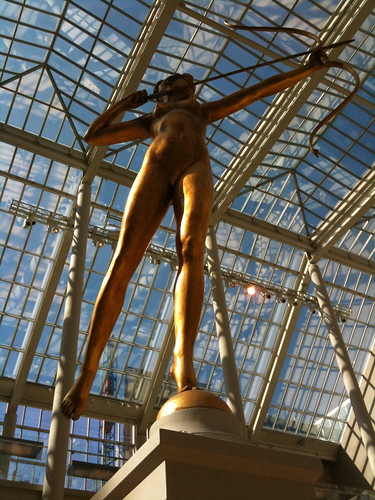
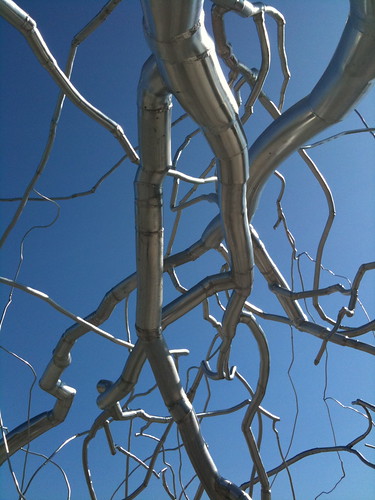
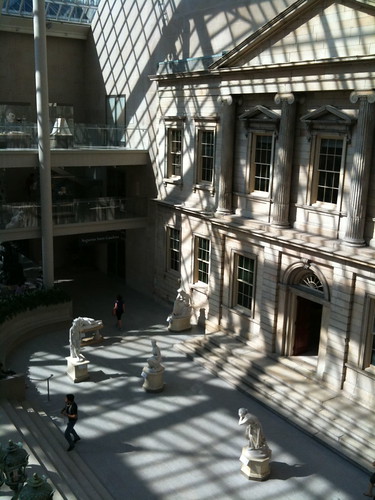
I bore this with me as we left this particular exhibit and viewed a few other things in the museum, including the Roxy Paine sculpture, Maelstrom, a gigantic (130-foot-long by 45-foot-wide) stainless steel "dendrite," in the Cantor Roof Garden; the new American Wing of the Museum, since May 19 comprising the bright, airy Engelhard Court and several floors of period rooms; some works in the Oceanic art collection; and a smallish exhibit (or room) I can't find online, featuring some landmarks of 20th century design. We spent a good amount of time in the Engelhard Court, the centerpiece of the new American Wing, which First Lady Michelle Obama helped to inaugurate back in May; an exhibit of sculptures by Augustus Saint-Gaudens, whom I always associate with Boston and the Common, and with Robert Lowell (because of his famous poem "For the Union Dead"), graced that space. It felt a bit haphazard, scattered, though some of the pieces, such as the "Diana" which had once stood atop the old Madison Square Garden before its leveling, matched the vastness and grandeur of the room. I did not visit more than a few of the period rooms, something I must return there to do soon, and am looking forward to the completion of the painting galleries, which will not open, if I read the note correctly, for several more years. Still, the Engelhard Court would probably be a great place to pause and reflect, perhaps even have a cup of coffee, and reflect upon what you've seen, before heading to another part of the museum.

And as always, photos:
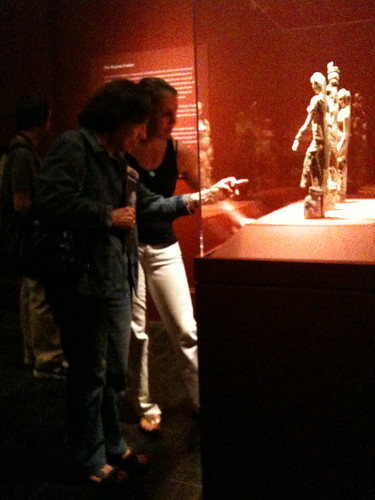
Hidden treasures of Afghanistan exhibit, Met
People looking at some of the sculptures, Hidden Treasures of Aghanistan exhibit
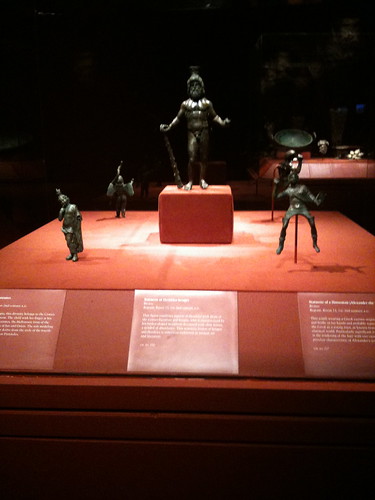
Statuettes, Afghan art exhibit, Met
Statuettes and figurines, Afghan art exhibit
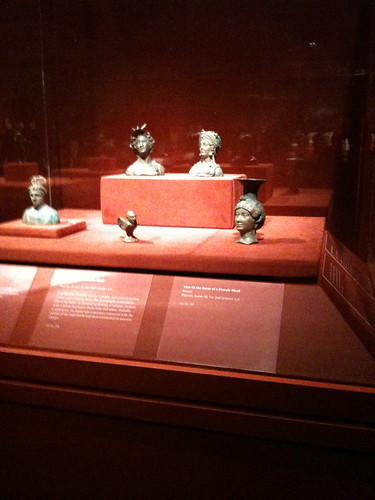
Miniature busts, Afghan art exhibit, Met Museum
Busts and vases, Afghan art exhibit
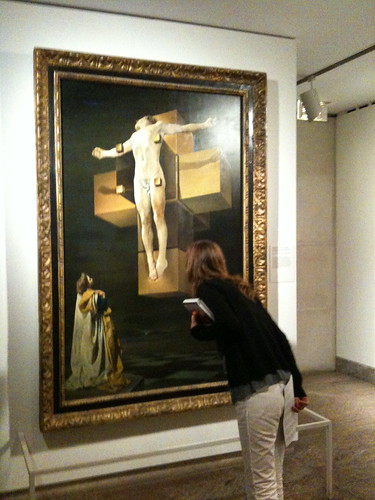
Salvador Dalí painting, Met Museum
Salvador Dalí's "Crucifixion," 1954
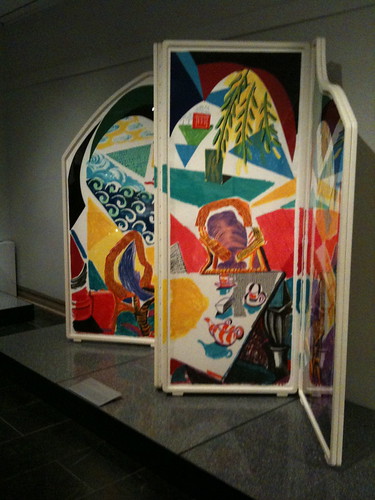
David Hockney screen, design show, Met Museum
David Hockney screen, in the design show
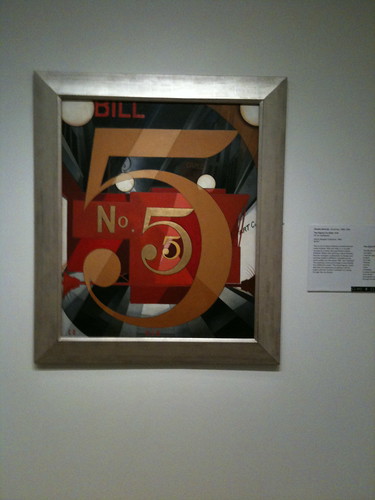
Charles Demuth's "The Figure 5 in Gold"
Charles Demuth's "The Figure Five in Gold," 1928
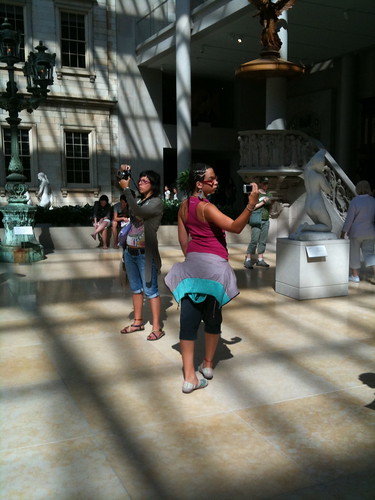
Photographers, Met Museum
Photographers in the Engelhard Court
Diana, Engelhard Court, Met Museum
Augustus Saint-Gaudens, Statue of Diana, Engelhard Court
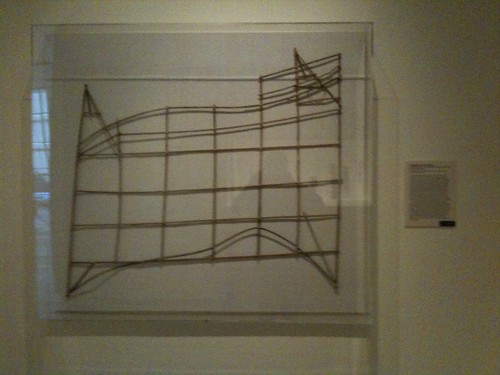
Oceanic fishing chart, Met Museum
South Sea Islander Fishing Chart, Arts of Oceania collection
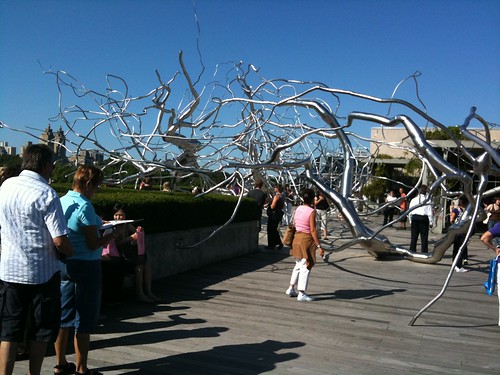
Roxy Paine roof sculpture, Met Museum
Roxy Paine's Maelstrom
Roxy Paine sculpture, Met Museum
Maelstrom
Photographers in the Engelhard Court
Interior façade, Engelhard Court, Met Museum
The Engelhard Court's south end, featuring the installed façade of Martin E. Thompson's Branch Bank of the United States (1822-24), originally located at 15 1/2 Wall Street in New York City