One of the newer areas of literary scholarly and critical inquiry, at least over the last 10 years, has involved exploring philosophical
theories of mind, cognitive linguistics and
neuroscience, each distinct, related but not always commensurate fieds, in relation to literature and the arts more broadly. What also has occurred over this same period is that psychologists and brain scientists have increasingly been thinking and conducting research on how the various artistic genres function and what effects they have, in a cognitive and biological sense. (Humanists and scientists in other older fields, such as philosophers going back to
Plato, have extensively examined and theorized about the functions and operations of literature and the arts;
aesthetics is one of the oldest rooms in the house of Western philosophy, and factors into philosophies across the globe.) I won't dare speak to the literary scholarship involving theories of mind and cognitive neuroscience, but I found two recent articles on psychologists' studies of
fiction's effects quite fascinating, not only for what they have to say about the genre's power, but also for what one researcher argues the effects this new understanding about the art form might play, especially on public policy.
Before describing the studies, let me posit that many artists and many who appreciate the arts intuitively grasp how specific artistic genres and forms work. This is no less true for architects or dancers as it is for poets or fiction writers. For fiction writers in particular, I would also posit that many recognize in their own experience as writers and readers what's discussed in the studies mentioned below. As I pointed out in my
July review of James Geary's fine survey I is an Other: The Secret Life of Metaphor and How it Shapes the Way We See the World (New York: HarperCollins, 2011), sometimes what we grasp intuitively is correct, that our understanding of how things, especially language, function is, if not always empirically verified or verifiable, sometimes still right at a deeper level, and yet there remains so much still hidden to us and only slowly being revealed concerning how language works; there is so much that exceeds or eludes many of the popular or dominant theories, including some long held by major scholars and critics. As Geary's book points out,
othering--making oneself
an other--is constitutively wired into language; it is built into our understanding of the world through language. As he argues quite effective, the subject of his book,
metaphor, turns out to be more than a mere trope or rhetorical device, but intimately connected to our mental and bodily experience in the world.
But what does this have to do with the articles I'm talking about? According to two studies recently
cited in the Guardian, passages in fiction or fictional works in toto appear to "improve" and affect empathetic feeling in their readers. Concerning those fictional passages,
Alison Flood relates how a
University of Buffalo team, led by
Shira Gabriel and
Ariana Young, "gave 140 undergraduates passages from either
[Stephanie] Meyer's
Twilight or
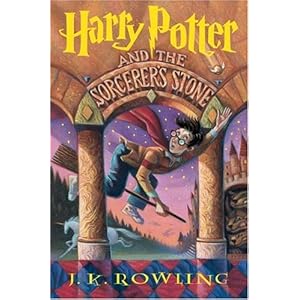
JK Rowling's
Harry Potter and the Philosopher's Stone to read." In the former text (which I have not read), a character describes what it is like to be a vampire; in the latter, the young wizards are sorted into their respective
Hogwarts Academy houses. The researchers then conducted successive computer tests, using personal pronouns and keywords, to measure identification with and as vampires, and then and as wizards. As it turns out, the study, published in
Psychological Science, found that the students reading the text involving a description of vampirism were more likely to identify as vampires, while the students reading the text involving the youthful wizards self-identified as wizards. What the researchers also found was something that writers and readers have long known, which is that
"Belonging" to these fictional communities actually provided the same mood and life satisfaction people get from affiliations with real-life groups. "The current research suggests that books give readers more than an opportunity to tune out and submerge themselves in fantasy worlds. Books provide the opportunity for social connection and the blissful calm that comes from becoming a part of something larger than oneself for a precious, fleeting moment," Gabriel and Young write.
Eat your heart out,
Facebook and
Twitter!
In a second study Flood cites,
University of Toronto psychologist and novelist
Keith Oatley gave 166 readers either a translation of
Anton Chekhov's actual story "The Lady with the Little Dog" (which my undergraduates and I will be reading and discussing in just a few weeks!) or a more linguistically neutral, documentary account of the plot and characters featured in the story. What Oatley found upon measuring readers' personality traits and emotions before and after the story was that those who read Chekhov's "unadulterated" story, a profound and deeply complex essay in imagination and feeling, were found "to have gone through greater changes in personality--empathising with the characters and thus becoming a little more like them," while those reading the documentary account were less likely to have done so. (I also thought of
Rainer Maria Rilke's extraordinary poem "The Archaic Torso of Apollo," which lyricizes and dramatizes what this study demonstrates; the experience with the statue marks the speaker not just empathetically, but transforms him, leading to that final, arresting line: "du mußt dein Leben ändern": you must change your life, but also: you must make yourself
an other/another ("other" in German is
ander).)
To quote Oatley:
"I think the reason fiction but not non-fiction has the effect of improving empathy is because fiction is primarily about selves interacting with other selves in the social world," said Oatley. "The subject matter of fiction is constantly about why she did this, or if that's the case what should he do now, and so on. With fiction we enter into a world in which this way of thinking predominates. We can think about it in terms of the psychological concept of expertise. If I read fiction, this kind of social thinking is what I get better at. If I read genetics or astronomy, I get more expert at genetics or astronomy. In fiction, also, we are able to understand characters' actions from their interior point of view, by entering into their situations and minds, rather than the more exterior view of them that we usually have. And it turns out that psychologically there is a big difference between these two points of view. We usually take the exterior view of others, but that's too limited.
Or to put it another way: reading fiction allows us to enter those other lifeworlds quite deeply, imaginatively, psychologically and affectively; we become those other people, or identify with them, even if negatively. We
become part of the fictional world, even if temporarily; we change our lives, if only in the moments while in and shortly after leaving a fictional text. (I would argue this occurs in an engagement with other works of art too, as many others have written far more eloquently and persuasively than I ever could.) A connection occurs--our inner and outer worlds fuse in the experience of reading the text, we draw upon and redraw the fictional world in our heads. And we leave it changed, even if temporarily. (Think of
J. W. G. von Goethe's
The Sorrows of Young Werther, and its powerful, often deleterious effects on the youth of Romantic-era Germany; think of the Victorian era concerns about the effects of fiction on young women, both good and bad; think of the
Beat era's poetry and fictional narratives, which not only captured the experiences of youthful social and cultural rebellion, but provided pointers for readers. And so on.) To those who've read a bit of philosophy or literary theory of an older sort, doesn't this sound familiar?
But it's not just empathy. In
the September 7, 2011 issue of Miller-McCune,
Tom Jacobs describes a
Brigham Young University research team study, led by psychologist
Sarah Coyne, on the relationship between fictional accounts of two types of aggression and behavioral responses. Coyne previously conducted studies on violence and popular culture, but had not previously studied fiction, so she focused on it in this one. According to Jacobs's article, the study shows that exposure to an account of violence in literature can effect an aggressive response to provocation. Jacobs is clear to state that Coyne's study does not claim that "reading a fictional account of an aggressive action increases belligerent behavior," but that reading fiction containing one of two types of aggression, physical, or outright physically assaultive action, and "relational," or actions that upset a person's relationship in a group, resulted in responses marked by the particular type of aggression featured in the work. In the first study, readers of material featuring physical aggression were more likely to respond with physical aggression when provoked during a video game test; in the second study, readers of texts featuring relational aggression responded with that form of aggression when provoked in a similar virtual game. As Jacobs says:
In both cases, provoked people who were given the opportunity to engage in a specific form of retaliatory violence were more likely to do so if they had just read a fictional account of similar activity.
He again notes that reading fiction does not increase aggressiveness, but that having a scene or mental experience, even fictional, of aggression--not a mere picture or mental image, as
Wittgenstein might caution us to be wary of describing it, but something more complicated and nuanced, involving neural mirroring and affect, and embedded and embodied in language--can impact our subsequent behavior. This also parallels what Geary suggested in terms of how certain words, terms, and figuration of many kinds, can affect and effect responses in us that we do not consciously register.
I mentioned that one aspect of these accounts that interested me was the implication one of the researchers, Keith Oatley, drew from the knowledge his study provided. He argues that his is the first "empirical finding" he knows of--though, as we see, there are apparently others--demonstrating a psychological effect produced by reading fiction. What philosophers and literary scholars have long argued, he has demonstrated through a scientifically validated experiment, i.e., an empirical method. Professor Oatley thus thinks we could--and ought--make the case that fiction writing might have instrumental value for readers--students, everyone--and thus "economic" value, in our society. Oatley's specific argument is that "reading fiction improves understanding of others" in that it can improve interpersonal understanding, and thus might be useful in a range of fields, including business studies, law, and so on. While I agree that reading fiction can have instrumental value, I'm not sure I would go so far as to say it "improves understanding of others," let alone for everyone, because as I see the studies, what's going on is that it might
not entail more understanding, but rather something antecedent to that, which is to say, pre-rational emotional connection and empathy, or, as the latter study suggests, negative behavioral responses to provocation.
Either way, what all these studies suggest is what writers and readers know--and what Plato warned about concerning
poetry, which is to say, imaginative uses, in particular forms, of language--which that literature, and fiction specifically, are more important to and powerful for and on us than they're often taken to be, even by people interested in studying them. In that sense, then, Oatley is writing--reading fiction is certainly worthwhile, and studying what it does is worthwhile too. Learning to read it, write it, and understand its effects are also truly worthwhile. (He does not discuss it at all, but we should also be aware of another instrumental possible use of this mode of language, which Geary suggests is possible:
propaganda.) I'll only add that none of these studies look at language
at the micro level; none studied syntax, meter, pacing. None studied word choice, connotation, denotation, rhetoric. None studied figuration or tropes in any way. None of the three explore the narratives morphologically. Instead, they look only at fictional narrative in the holistic or macro level, but suggest that fictional narrative, by itself--and the range in terms of talent, skill and art between the work of Stephanie Meyer and Anton Chekhov, I will dare to say, is great indeed--has powerful effects that should be explored more, and estimated in a different way. I cannot think of a serious fiction writer or poet I know who doesn't already.