Showing posts with label movies. Show all posts

Friday, April 30, 2021

Moviegoing (Pandemic) - April (Final)

And now, one year and one month later, I have wound down my pandemic-spurred moviewatching (I of course will continue to watch films and TV shows avidly), to conclude with the following films I shoehorned in during a very busy April. It was almost a blur, but I did remember to write down the following films and shows. Please do share your thoughts about any of these films or entries, throughout the entire past year, in the comments!

April's films:

Señorita* (a trans gem from the Philippines, by Isabel Sandoval)

Yellow Fever* 

Caught

Monkey Business*

Horse Feathers*

Relic (1, 2, 3, 4)*

Charles and Lucie* (a Nelly Kaplan film, my first introduction to her work)

A Very Curious Girl* (Kaplan's feminist masterpiece)

Papa, the Lil' Boats*

Watermelon Man* (I'd seen this a few times in the past) 

How to Take a Bath

Lovers & Lollipops

The Homecoming* (rewatched this)

Outside the Wire* (Damson Idris & Anthony Mackie + SF = worth it)

Monsoon* (Henry Golding's & Parker Sawyers's characters in love - well done)

Lime

Copa 181 (It needed a bit more depth, but interesting nevertheless)

Dr. Strangelove*

Guilt 

Wednesday, March 31, 2021

Moviegoing (Pandemic) - March (One Year)

So one year has passed--one year of the pandemic (which actually arrived in the US in December 2019 or perhaps January 2020, to be a bit more factual--since I began recording the films I watched during the dog days of Covid-19's devastating rampage, which is not over, let me state in no uncertain terms, though we now have more effective vaccines and greater knowledge about how it spreads, infects, and so on. As I noted in March of last year, I began watching films (I always watch TV shows) because I was struggling to read for pleasure or get through anything not work-related and thus required; my anxiety was off the charts but I found I could sit through films. I have catalogued thus far many of the ones I watched, though I'm sure I missed quite a few few, but reviewing the list, it really represents quite a range in terms of style and approach, with a strong emphasis, as I noted last year, on features and shorts, and far less on documentaries. (My cinematic mind is akin to my literary one, it seems, with a preference for poetry and fiction over nonfiction.)

Here is my list for March of this year:

One Night in Miami* (imagine Dr. King, Muhammad Ali, Malcolm X, and Sam Cooke all convened for one night in Miami -- enough said)

You Only Live Once* (the 1937 version, not the more recent one)

A New Leaf (this movie, directed by Elaine May, is so odd and awful it's actually quite interesting)

The Palm Beach Story* (Claudette Colbert, Joel McCrea, classic Hollywood divorce shenanigans)

Song of Freedom* (beautiful Paul Robeson film)

Rock 'n Roll High School* (an old fave)

Boneshaker* (a short, by Nuotoma Bodomo)

The Pleasure of Love* (Oh, Nelly Kaplan....!)

Other People (Molly Shannon is the main reason to watch this)

The Lady Eve* (Barbara Stanwyck & Henry Fonda one of her iconic roles)

Sullivan's Travels* (Veronica Lake in one of her iconic roles)

The Legend of Nigger Charley* (Fred Williamson stars as an escaped, self-empowered enslaved man, pursued by a bounty hunter)

Sergeant Rutledge* (Woody Strode in a career-defining performance as a soldier accused of raping a White woman)

Posse* (an old fave)

Kevin Jerome Everson films* - We Demand, Fastest Man in the State, Black Bus Stop

Owusu films* - Drexciya, Reluctantly Queer, Pelourinho: They Don't Really Care about Us

Plastic Bag* (Rahmin Bahrami's short about a...a plastic bag)

Putney Swope* (a successful racial satire of the kind we rarely see today)

Queen of Diamonds (Nina Menkes film, did little for me)

Permanent Vacation* (an early Jim Jarmusch film that gives a glimpse at what was to come in his work, as well as the New York of its era (1980))

The Reflecting Skin* (a vampire movie with a twist - eerie & refreshing)

The Inland Sea* (visually striking film about one of Japan's interior seas)

Insignificance* (Nicolas Roeg's unusual film that somehow works)

Love The One You're With* (the 2021 Black gay Sampson McCormick film about a couple's dying relationship)

Red Carpet, Hashtags & Heartbreak (a Black gay dramedy)

[Wyatt Cenac's commentary on Criterion Channel] 

Sunday, February 28, 2021

Moviegoing (Pandemic) - February

I posted a bit on my Blogaversary (Blogiversary?), not too long ago, so I will keep this entry brief. Every day of almost every week day this month was packed with one thing or another, I have been Zooming nonstop yet sitting still (go figure), chairing, conducting remote readings, and so forth. I also have a new book (poetry!) in the works for later this year (wish me luck!).

Here's February's list:

Lupin* (series - I could watch Omar Sy in anything but this was an immense treat)

Plutão (short)

Urano* (Brazilian short by Daniel Nolasco)

The Breeding* (Extremely disturbing, on many levels)

The One You Never Forget* (tender queer short)

Gay Agenda films on HereTV: Bill & Robert, Diary Room, Floss

My Culture (Mario Bobino film, not super memorable)

Pretend It's a City (Scorsese & Leibowitz - it got a bit tiresome after a while, though I'm a fan of his and hers)

The Tall Target* (a historical thriller, starring Dick Powell & Adolphe Menjou & directed by Anthony Mann about a thwarted attempt to assassinate Abe Lincoln)

Ghost Dog, The Way of the Samurai* (an old favorite)

Thomasine & Bushrod* (Gordon Parks' take on the western, starring Vonetta McGee and Max Julien, star of The Mack)

A Season in France* (my introduction to Mahamet- Saleh Haroun & one I highly recommend)

Abouma* (another Mahamet-Saleh Haroun success)

Cotton Comes to Harlem* (Chester Himes' detective novel vividly realized, starring Godfrey Cambridge & yummy Calvin Lockhart & Raymond St. Jacques, directed by Ossie Davis)

Take a Giant Step* (Philip Leacock's 1959 film about a Black teen coming of age in a racist environment, the film stars Ruby Dee, Beah Richards, Estelle Helmsley and budding singing star Johnny Nash ("I Can See Clearly Now"))

Daratt* (translating to Dry Season, this is one of this Mahamet-Saleh Haroun's masterpieces)

A Screaming Man* (another haunting & remarkable film from Mahamet-Saleh Haroun, Chad's gift to the world of filmmaking)

Pressure* (Horace Ové's powerful portrait of 1970s Black London/Britain)

Celebration* (YSL documentary - very good)

The Brother from Another Planet* (an old fave)

Black Lightning* (series, new season - love love love) 

Sunday, January 31, 2021

Moviegoing (Pandemic) - January

A new year has begun and we are already at the end of its first month, though not without drama. On January 6, 2021, supporters of DJT attempted to storm the Capitol and overturn a legitimate election in which Joe Biden and Kamala Harris soundly and roundly defeated DJT and Mike Pence. In addition to extensive damage, several dead cops, one dead coup participant, unfulfilled threats to kill the sitting Vice President (some of the coup participants erected a gallows outside the Capitol and others chanted "Hang Mike Pence") and extensive destruction to the buildings, as DJT watched on, failing to quell the violence, the House and Senate were able to certify Biden's victory and he is now President of the United States. Covid-19's strains are still raging, but there are vaccines, social distancing continues, we have adapted in ways large and small at home, at work and in the wider world, and while we're not out of the abyss, there seems to be path upward and forward. My January films included:

Hasaki Ya Suda*

Twaaga*

The French Lieutenant's Woman* (I read Fowles' novel before I saw the film years ago & both, I must say, are very good)

Ministry of Fear*

The Age of Swordfish

Easter in Sicily

The Pub

Snuck Off the Slave Ship*

Lo Cal Hero

Frantz Fanon: Black Skin, White Mask

Les Saignantes* (I want to see much more by this director)

Yeelen* (remarkable)

Phoenix

White Elephant

Zumbi Child*

Blackmail

Kill List

Sorry We Missed You

Draw Me Now

Intimate Stranger

Space Is the Place* (I love Sun Ra & this film)

Marianne & Julianne

Mon Oncle*

Date with Dizzy*

Moonbird*

Dadli*

Flores* (I watched it again, it's short & beautiful)

Money Movers

Rome, Open City* (a classic)

Persona* (I have watched this film maybe 10 times!)

Poetry In Motion*

The Grass Is Always Greener

What Women Want: Gay Romance

Living for the Weekend* (series)

The Boys of Rio

Stranger than Paradise* (an old fave) 

Thursday, December 31, 2020

Moviegoing (Pandemic) - December

It seems almost unreal that 2020, this tumultous year, is coming to an end. There are positive signs on the horizon when it comes to Covid-19--vaccines, with more on the way!--though we are still not out of the woods. The same is true with the US as a whole; it remains to be seen if DJT will leave office peacefully, since he has continued to claim the election was stolen--it wasn't, he lost handily--and the recovery, on every level, after four years of his tenure, particularly the horrendous year that just concluded, will require a herculean effort. I did keep watching movies during December (Criterion featured an Afrofuturist-focused curated set to end the year) and here they are:

Crumbs* (Miguel Llansó's post-apocalyptic trip across the Ethiopian desert)

My Culture

T

Afronauts* (a reimaging of the space race from a Zambian perspective)

White In, Black Out* (one of Brazil's most exciting young Afro-Brazilian filmmakers, from Brasília & a revelation) 

Robots of Brixton* (a short triumph from Kibwe Tavares)

Ballad of Genesis & Lady Jane* (documentary about Genesis Breyer P-Orridge & his wife Lady Jaye's ongoing Pandrogyne project)

The Awful Truth* (classic screwball film centering on divorce & featuring Cary Grant and Irene Dunne - what's not to like)

Zombies*

Once There was Brasilia* (another Adirley Queirós film that rocked my world)

The Changing Same* (a gem from Cauleen Smith)

Entertainment* (Rick Alverson's portrait of a truly bizarre, broken comedian)

The Becoming Box (Afrofuturist short)

Hannah Arendt* (severe but effective, from Margarethe von Trotta)

Torch

Jonah* (Kibwe Tavares's short featuring Daniel Kaluuya and playing off the Biblical story)

Holiday* (Katharine Hepburn is so peppy & brittle in this film it's unreal)

1968 < 2018 > 2068* (Keisha Rae Witherspoon's 7-minute meditation on the future)

The Go-Between* (one of my favorite Joseph Losey films, starring Julie Christie, with a Pinter screenplay, and tackling the potentially dire ramifications of the intersections of class and desire)

The Eloquent Peasant* (Chadi Abdel Salam's short set in around 2160 BC)

To Die Like a Man (João Pedro Rodrigues's take on a trans woman's attempt to grapple with her past and present)

The Undoing (a Ryan Crepack film I didn't full vibe with)

Four Women* (Julie Dash - I wish she'd gotten so much more money & support to direct so much more)

Illusions* (a Julie Dash fave)

Pool Sharks* (WC Fields)

The Golf Specialist (WC Fields)

Queen Sono* (I enjoyed the series but felt it should have been extended)

Cat People* (I saw the 1982 version when it debuted & later the Jacques Tourneur version, which was this one - I like it better than the update)

The Legend of Rita* (another Schlöndorff political thriller that was really well written & directed & gave a sense of the stakes of ultraradical politics)

The Ogre (nowhere near as good as the Tournier novel)

Tchoupitoulas* (a documentary about seeing New Orleans, from the perspective of three young Black New Orleanians)

Wild Strawberries* (Bergman is so severe but so talented)

Caché* (a Haneke psychological thriller that's unsolvable through logic)

The Best Man* (the Schaffner film from 1964, written by Gore Vidal, based on his play, not the later romantic comedy starring Taye Diggs, which I also love)

The Public Enemy* (Jimmy Cagney, in one of his best roles, as a White street hustler who attempts to rise in the world of organized crime)

The Comedy* (I cannot state enough how disturbing this film, by Rick Alverson, truly is; it is White male trolling elevated to the level of art)

The Body Beautiful (Ngozi Onwurah's short about her White mother's experience with breast cancer)

The Chase (Brando & Jane Fonda, directed by Arthur Penn, written by Horton Foote & Lillian Hellman - still fell a bit flat for me)

My Favorite Wife (more Cary Grant & Irene Dunne)

Industry* (series)

Cheer* (series)

Catharsis (I think this is the Cédric Prévost film about filmmaking and spectatorship--but I can't remember beyond writing the name down)


Monday, November 30, 2020

Moviegoing (Pandemic) October-November

I've already blogged about the election, which turned DJT out of office (if he leaves, that is, for which there is no guarantee) and will bring back Joe Biden, this time as president, with Kamala Harris as VP. So much else has gone on over the last few months that I basically smushed the two together, so instead of individual entries for October and November, here's my tally for both months. It's a long list, but an interesting one. One thing I'll note again is that it was refreshing to see both Criterion Channel and Amazon Prime respond, in their differing ways, to the Floyd murder and the Black Lives Matter push, with diverse and unexpected offerings. What remains to be seen is how long this lasts. The other streaming channels (Netflix notwithstanding), like the cable TV ones, need to up their games.

My list for the two months:

Beau Travail* (an old fave)

Career Girls* (I'd always heard about this film & it was worth the wait)

Suburbia (a 1984 Penelope Spheeris that felt less engaging than many films from that era on a similar theme)

Tomboy* (one of Céline Sciamma's best)

Viridiana* (a film of considerable formal and plot restraint that is nevertheless quite outrageous)

Luminous Motion (Bette Gordon realist film from 1998)   

Variety* (I watched it again!)

Born in Flames* (Lizzie Borden's masterpiece, IMHO)

Calendar* (Atom Egoyan film about a woman who decides to stay in Armenia once her husband finishes his photographic assignment & heads home to Canada - visually striking & full of Egoyan's signature touches)

Lola Montès* (the Max Ophüls masterpiece I first read about years before actually being able to watch it; this was my 3rd viewing)

Henry Gamble's Birthday Party (a good introduction to Stephen Cone's oeuvre if you haven't ever watched one of his films)

The Gates* (I saw this in real time--the exhibit inaugurated this blog!--& the film was a delight)

The Headless Woman* (by the director of La Ciénaga--I definitely want to watch this again)

Pauline Alone (one of my first introductions to the work of Janicza Bravo)

Salut les Cubains* (Agnès Varda, introducing viewers--me--to revolutionary Afro-Cuban filmmaker Sara Gómez)

Vitalina Varela* (a performance so searing you won't soon forget it--my favorite of Pedro Costa's films that I've seen so far)

Affirmations* (Marlon Riggs--love love love)

100 Boyfriends Mix Tape* (Brontez Purnell)

Lovecraft Country* (series)

Two Drifters (a João Pedro Rodrigues film from 2005; not among my top films by him but suitably strange and full of unexpected twists)

A Drop of Sun Under the Earth* (Shikeith Cathey's marvelous short)

Anthem*

The Joy of Life* (Jenni Olson's lesbian hymn to San Francisco)

2001: A Space Odyssey* (one of my all-time faves)

Mildred Pierce* (Joan Crawford's greatest role)

The Ornithologist* (the incomparable João Pedro Rodrigues at his best--utterly bizarre and unpredictable yet still able to weave everything together)

O Fantasma* (Rodrigues's first major international success & one I've seen many times now)

Videodrome* (an old Cronenberg fave)

The Lost Honor of Katharina Blum* (jointly directed by Volker Schlôndorff & Margarethe von Trotte, this is a ironic political film in the best sense & one you seldom if ever get from Hollywood these days)

Burroughs: The Movie

The Night of Counting the Years* (Shadi Abdel Salam's version of The Mummy, but really a neo-realistic, groundbreaking essay in filmmaking)

Flores* (visually arresting)

Coffee Colored Children* (Ngozi Onwurah's experimental film about growing up mixed-race in the UK)

Jáaji* (Hopkinka films)

Anti-Objects of Space Without Boundaries*

Lore* 

A Spell to Ward Off the Darkness* (a Ben Russell film, starring Robert Aiki Aubrey Lowe -- whew!!!)

Terence Nance films*: Swimming in Your Skin Again, Their Fall Our All, No Ward, Jimi Could Have Fallen from the Sky, You and I and You

8th Continent* (compelling short about the aftermath of migrancy and refugee arrivals)

Buck Privates* (Abbott & Costello film - pure silliness)

Accident* (Joseph Losey's campus entanglement film, starring Dirk Bogarde, Stanley Baker, Michael York, Delphine Seyrig, and Vivien Merchant, with a screenplay by Harold Pinter)

Welcome to the Terrordome* (Ngozi Onwurah's groundbreaking SF film)

An Oversimplification of Her Beauty* (A Terence Nance joint, very inventive)

A Dream Is What You Wake From* (Third World Newsreel's documentary film about three Black women and their lives)

Tender Game* (animation by John Hubley)

Totally F***** Up* (perhaps my favorite Gregg Araki film & his most racially diverse - I watched it again)

Working Girls* (Lizzie Borden's feminist film about a young woman trying to fund her own business and the steps she has to take, including sex work, to get there)

The Dark Past* (William Holden vehicle about a psychopathic hostage taker, starring Lee J. Cobb as a psychiatrist)

Mangrove (Small Axe)* - (this and the other Steve McQueen mini-films are some of my favorites of his work. I wish he'd make many more)

The Homecoming* (an adaptation of Pinter's brilliant, frightening play--I'm a huge fan of Pinter's but I appreciated this cinematic adaptation)

Vente et Loquamur (Hopinka)

Wawa (Hopkina)

When You're Lost in the Rain (Hopinka)

The Crown* (series, Season 4 - when is this show never not entertaining?)

The Wise Kids (another Stephen Cone film)

Portugays* (O Ninho) (A series about queer 20-somethings in Porto Alegre, Southern Brazil)

Conframa* (series, new season)

Freefall

Borat


Wednesday, September 30, 2020

Moviegoing (Pandemic) - September

The number of films & series I watched this past month dwindled to its lowest level since March, for a range of reasons, not least my slow and steady recuperation, though an ultrasound late this month showed healing (thank the gods). The pandemic rages, classes have begun, online, I have new colleagues in the MFA program, a new (longstanding but with a new position) colleague in Africana Studies, Rutgers-Newark has a new Dean of the School of Arts and Sciences, and Rutgers University (all three campuses) has a new president, Jonathan Holloway (I served on the committees that selected all of them). Fingers crossed things will work out OK in all cases.

As for the movies:

The Future (a Miranda July film that didn't hit)

The Third Generation* (Fassbinder's take on radical left politics in West Germany)

Town Bloody Hall* (the deliciousness of seeing Norman Mailer getting his public comeuppance drums on like a tattoo)

Zama* (the original di Benedetto novel is brilliant and Lucrecia Martel's adaptation is superb)

Duck Soup* (an old favorite)

Lost in America* (an old fave)

Princess Cyd* (a queer coming of age film by Stephen Cone)

The Wise Kids* (the first Stephen Cone film I'd ever watched)

Bacurau (this was hyped but fell flat for me)

La Ciénaga* (one of the month's highlights)

Personal Problems, Part 2*

Imagine the Sound* (an old favorite)

Black Narcissus*

The Last Tree* (Shola Amoo's exploration of a young Black man from rural England who moves to London)

Residue* (Meriwa Gerima's version)

Dames

Wolf* (Ya'ke Smith's 2012 film)

Before I Do 


Monday, August 31, 2020

Moviegoing (Pandemic) - August

It is hard to believe that August is here and gone. I have been hobbling around, having torn (or severely strained) a tendon behind my knee, and trying to avoid the heat, as well as Covid-19, which continues its rampage. This month I watched fewer movies and TV shows than any of the prior months, for a variety of reasons (see above), but I did watch at least 20, and here they are:

Bolden (I had been waiting on this one, in part because it starred Gary Carr and because of its long production history, and it was a bit of a bust)

Push Comes to Shove (a Bill Plympton animated feature)

Sun Don't Shine* (an Amy Seimetz film, full of mystery)

The Lonedale Operator* (a Guy Madden short, focusing on none other than John Ashbery, though not his poem of the same name)

Sabotage* (a still compelling thriller)

The Chant of Jimmy Blacksmith* (heartbreaking and powerful)

Rafiki* (a gem of African queer cinema)

Snows of Grenoble* (a documentary on the 1968 Winter Olympics, featuring one of the greatest skiers of all time, Jean-Claude Killy)

Suzanne, Suzanne* (Camille Billops's compelling 1982 documentary

Wolf (a bizarre film with lycanthropic elements I'd probably have to watch again)

Happy-Go-Lucky* (Mike Leigh's character study of a relentlessly happy teacher)

Losing Ground* (a Kathleen Collins fave & testament to her originality & talent)

Things to Come* (Isabelle Huppert in one of her better performances)

Personal Problems, Part 1* (Ishmael Reed's highly original series--what if independent series had taken off in this vein rather than the ones they did?)

Bill Gunn Interview*

Foreign Correspondent*

Gohatto* (my favorite Nagisa Oshima film--visually it's exquisite)

Don't Look Now* (haunting 1970s thriller)

Friday, July 31, 2020

Moviegoing (Pandemic) - July

145,000+ people in the US have officially died from Covid-19 and the totals of those who've gotten it once or multiple times far exceeds that number. The US continues to stagger forward, in crisis and chaos, under DJT's misrule. I kept up my moviewatching, though I tallied far fewer films this month than prior ones. Here's my July 2020 total:

Aguirre, Wrath of God*

Made in U.S.A.*

Detour

Their Own Desire

Red Road

The Human Factor

Between the Lines*

Me and You and Everyone We Know* (I loved this film when it came out but I felt a bit more critical of it this time through)

Love Is the Devil* (Francis Bacon!)

Sleepwalk

Soleil Ô* (Med Hondo's film was a highlight for the month)

Young Ahmed* (chilling but a sharp psychological portrait of fanaticism)

Dear Mom

Birthright

Zora Neale Hurston's Fieldwork Footage*

My Own Private Idaho* (an old fave)

Death in Venice*

Sidewalk Stories* (an old fave--so good)

Stille Nacht

In Absentia (the Quay brothers, enough said)

The Scar of Shame* (I first saw this in a Black film class in college)

Border Radio* (rewatched)

The Exile

Barbarella* (very light entertainment)

Company: The Original Cast Album* (I love this film and the musical as well)

Vazante* (a lovely historical film from Brazil, by Daniela Thomas)

The Lovebirds (Issa Rae & Kumail Nanjani but it didn't gel for me)

Mucho Mucho Amor: The Legend of Walter Mercado* (magnificent!) 

Tuesday, June 30, 2020

Moviegoing (Pandemic) - June

The horrors--the pandemic continues, with 120,000 now officially reported dead (and who knows how many deaths remain unreported), the aftermath of George Floyd's murder by Minneapolis police, the steady tide of state murders, the growing protests against the administration and the state security apparatus, the administrative crisis plaguing the federal government, the general sense of chaos and misrule....I won't list the roll of devastation except to note that the economy is cratering, people continue to get sick and die from Covid-19, the administration's and countless others' disinfo and misinfo continue, and we are supposed, somehow, to function. Make it make sense! (I also rang in my birthday and thanked the gods I made it to another year, so far Covid-free.) Perhaps in response to the ongoing catastrophe I did watch more movies this past month than during prior ones. I think my tally exceeded 40. Does that sound right?

Movies & TV shows watched during June:

Greetings from Africa

Symphony in Black*

A Rhapsody of Negro Life* 

Totally F***** Up*

The Owls

Hoagy Carmichael

Variety*

Janine

A Bundle of Blues

Je, Tu, Il, Elle* (It wasn't what I thought but it's still groundbreaking)

She Don't Fade* (one of my favorite of Cheryl Dunye's films)

The Potluck and the Passion*

St. Louis Blues

Artie Shaw's Swing Class

And When I Die I Won't Stay Dead* (Bob Kaufman, resurrected in this documentary)

Cab Calloway's Hi-De-Ho

People Like Us

Bazodee* (a Trinidadian love story)

Pretty Dudes 

Homecoming* (series, season 2)

El Violinista* (a stunning documentary about a young Haitian violinist who heads to the DR & resumes his passion for the violin)

A Miami Love Story*

Kafou* (Haitian filmmaking with wit)

Before I Do

Discrete Charm of the Bourgeoisie* (Buñuel at his late career best)

The Dark Past

The Fountainhead (as bad as I remembered)

Tristana*

Vanilla Sex

A Rhapsody in Black and Blue* 

Audience* (Lesbian filmmaking pioneer Barbara Hammer's film about the impact of her work with audiences around the country)

Guerrillière Talks* (Vivienne Dick's experimental shorts)

Two Knights of Vaudeville*

Dirty Gertie from Harlem* (landmark early Black cinema)

Urban Rashomon (my favorite Khalik Allah entry on Criterion Channel)

Water Lilies* (a Céline Sciamma gem)

Angst Ist Seele Auf / Ali: Fear Eats the Soul* (an old fave)

My Josephine* (early Barry Jenkins)

Portrait of Jason* (one of the all-time great, complicated Black queer portraits, esp. for its era) 

Sunday, May 31, 2020

Moviegoing (Pandemic) - May

The pandemic continues, as does life these days in all of its strangeness. This past month 38,000+ Americans died from Covid-19 related causes, and 65,000+ died in April. The scenes in New York, the disparate impact here in New Jersey, the vulnerability of frontline workers and Black and Latinx Americans, the poor and working-class and elderly in urban areas, all juxtaposed with the scattered government response, fills me with dread. And then there was the police murder of George Floyd, as cameras rolled, on May 23 of this month. Four cops, led by Derek Chauvin, pinned Floyd down and choked the life out of him. The disposibility of Black life, already amplified by countless other state murders and this pandemic's toll, was made clear to everyone in this country and across the globe. BLACK LIVES MATTER, a phrase as important today as it ever has been.

During the interstices of my days out of solace and engagement I did continue watching movies and here is my tally for May:

Homecoming* (season 1)

Mauvais Sang*

The Juniper Tree* (this film gave me nightmares--Björk, I hate to blame you, but....)

Wuthering Heights (the 2011 version)

Aves* (by my namesake Nietzchka Keene)

Still

Elles

Separate Tables*

You Were Never Lovelier

The Pawnbroker*

Unknown Pleasures* (Jia Zhangke, you know it's going to be a banger!)

Cane River* (a standout for me)

Bless Their Little Hearts* (Billy Woodberry's heartbreaker--so beautiful)

Bunny Lake Is Missing* (a thriller, starring Olivier and Carol Lynley)

The Fits* (a moving glimpse at Black girlhood)

I Am Not a Witch* (a Zambian entry by Rungano Nyoni--I recommend it)

Listen* (a fascinating film about a family in crisis)

Pygmalion*

Staying Vertical* (Alain Guiraudie's unusual & always queer takes merit a viewing)

So Dark the Night

Bonjour Tristesse

Border Radio*

David Holzmann's Diary (I couldn't get into this film)

That Obscene Object of Desire* (an old fave--I could watch anything by Buñuel)

Diamantino (interesting but I wasn't feeling it)

Al fin y al Cabo

The Chadwick Chronicles (series 1 & 3)

Undercover* (series)

A Quiet Place

LUV Don't Live Here

People Like Us (series)

As I Am

Chem Sex* (grim but revelatory) 

Thursday, April 30, 2020

Moviegoing (Pandemic) - April

Last month I tallied up all the films I'd watched throughout March as the pandemic wrought havoc, and I noted that I would try to continue doing so, if possible. The pandemic rages and my moviegoing (at home) proceeded accordingly. To quote last month's post: 

One thing I decided to do this month, since I have found it hard to concentrate on non-work-related reading, is to watch films, and so I'm listing the films and TV shows I watched this month, and plan to do so, if I can, for the foreseeable future. These films and TV shows have been a balm, an education, a conversation, points of departure, entryways into critique and deeper thought, and so forth. My filmwatching was not systematic and, as you'll see, heavier on features and shorts than on documentaries (though I did watch some). There may be duplicates and the list is likely incomplete, as my level of distraction is at an all-time high. I won't include descriptions for all of them but I may star films I felt stood out, and provide some other indicator for films that were particular duds. I also am listing them in the order I watched them and not alphabetically (unless otherwise indicated). I watched most on the Criterion Channel, Netflix, Kanopy, HereTV, Hulu, HBOMax, Youtube, and various cable channels, of course.

Here are my April 2020 films:

The Draughtsman's Contract* (Peter Greenaway's marvelously strange 1982 offering)

Vertical Features (remake)

Windows*

Intervals

Raging Sun, Raging Sky* (Julián Hernández's striking essay in queer desire--remarkable)

A Walk Through H

The Naked Prey

The Wonders

Corpo Celeste* (my intro to Alice Rohrwacher, one of Italy's best contemporary directors)

Blackboard Jungle* (an old fave)

Diva* (an old fave)

Day of the Condor*

Thank God It's Friday*

H is for House

The Eyes of Laura Mars*

Shaft*

Affair in Trinidad

So Dark the Night

Pixote* (always stuns me with its candor & brutality)

Slightly French

Canterbury Tales* (Pasolini's brilliance on display)

A Dandy in Aspic* (an Anthony Mann-Laurence Harvey confection, worth seeing)

Targets (very disturbing and apropos for today)

The Flying Ace* (early Black American cinema--do not miss this if you can catch it)

Veiled Aristocrats* (early Black American cinema)

Mishima: A Life in Four Chapters* (I was enthralled by this film when I was in my 20s) 

Brother (NF)

Surface Tension

And Breathe Normally* (interesting film about migration, social tension, etc. in Europe)

Miriam Miente* (a moving Dominican film about a young Afro-Dominican girl)

Sócrates* (what a performance by the lead)

Ka Bodyscapes* (queer Indian cinema)

Conframa (series)

Onisciente* (series)

Sintonia (series)

Martyr 

Tuesday, March 31, 2020

Moviegoing (Pandemic) - March

Earlier this year, and particularly this month, a horror the likes of which we haven't seen in some time, a deadly viral pandemic, SARS-Covid-19, descended upon the USA and globe, shaking the country to its core and necessitating a shift to very different modes of living. Covid-19 has led to scenes unimaginable perhaps since the Spanish influenza epidemic 100 years ago across the country, but particularly in New York, New Jersey and other densely packed urban areas. In our case, it has meant making sure loved ones are safe and healthy, having classes and meetings moved online (to Zoom, Webex and online platforms, more email, etc.), engaging in multiple forms of social distancing and far fewer trips to the store, post office, etc., masking, greater vigilance around handwashing, etc., and trying to make sense of the conflicting array of misinformation, disinformation and so forth coming out of this administration (is anyone surprised). Earlier this month the president appeared to suggest ingesting bleach was the right response (!), and his government has repeatedly downplayed the pandemic and its devastating effects, creating confusion instead of badly needed clarity about how to proceed. I fear the final toll once we get through all of this--we will--in terms of the dead, those with lingering illness, the social, economic and political fallout, and more. It is a catastrophe in every way and looks to only become more so by the day.

One thing I decided to do this month, since I have found it hard to concentrate on non-work-related reading, is to watch films, and so I'm listing the films and TV shows I watched this month, and plan to do so, if I can, for the foreseeable future. These films and TV shows have been a balm, an education, a conversation, points of departure, entryways into critique and deeper thought, and so forth. My film-watching was not systematic and, as you'll see, heavier on features and shorts than on documentaries (though I did watch some). There may be duplicates and the list is likely incomplete, as my level of distraction is at an all-time high. I won't include descriptions for all of them but I may star films I felt stood out, and provide some other indicator for films that were particular duds. I also am listing them in the order I watched them and not alphabetically (unless otherwise indicated). I watched most on the Criterion Channel, Netflix, Kanopy, HereTV, Hulu, HBOMax, Youtube, and various cable channels, of course.

Here goes: March 2020:

The Defiant Ones* (I've seen this before & especially appreciate Poitier's performance)

Nadja in Paris* (Rohmer short)

Liberian Boy*

Atlantiques (short)*

Paper Moon* (an old favorite)

Look at Me

The Taste of Others*

A Thousand Suns* (the Mati Diop film, focusing on the star of Mambéty's Touki Bouki)

Edge of the City*

The Hunger* (an old fave)

Gilda*

Art School Confidential (seen several times & enjoyable even with its flaws)

You'll Never Get Rich (I loved the dancing, esp. Rita Hayworth)

Ghost World* (an old fave)

The Cruz Brothers & Miss Molloy (one of Kathleen Collins' 2 films she completed before her untimely death)

Through a Glass Darkly* (dramatic Bergman)

The Girl from Chicago* (an early Black film, from 1932)

Close-Up* (Kiarostami's 1990 gem)

The Day of the Locust (West's novel is a work of genius but the film falls a little short)

They Call Me Mr. Tibbs!*

Brother John* (strange but beautiful film)

The Milky Way*

The Swimmer* (as haunting as Cheever's short story but in a different way)

A Girl Walks Home at Night*

Black Panthers* (A Varda gem)

The Entertainer* (I cannot get Olivier's performance out of my head)

Sea Devil

Sacrilège

The Skin I Live In* (Almodóvar!)

All These Creatures

Mahler

Desperately Seeking Susan* (an old fave)

Ornette: Made in America* (kind of obsessed with this one)

3 by Shirley Clarke*: Parks of Paris, Dancer, Bullfighter 

Monday, February 19, 2018

Black Panther, Cinematic Milestone

BLACK PANTHER

This weekend brought the debut of Ryan Coogler's newest directorial triumph, Black Panther,  a Marvel Studios production distributed by Walt Disney Studios. Based on the eponymous Marvel Comics character, Black Panther, which features a black director and a nearly all-black diasporic cast, raised incalculable expectations for black moviegoers, comics fans, critics and the film industry, and, having seen it yesterday, I can say hesitation that it more than satisfies them. It manages to be a thrilling fantasy movie based on a comics foundation, a visually arresting and movingly acted wok of cinema, and a politically aware, multilayered film that keeps the viewer thinking even after the final credits and post-credit clip have rolled.

The film's plot mirrors similar superhero tales, but is, as has been widely remarked, anchored in and deeply informed by an African(ist) futurist aesthetic. The story's hero must assume the mantle of his father, and shoulder the profound responsibilities for his people, but the script, by Coogler and John Robert Cole includes twists, include two villains, one far more significant than the other, and a tale of familial revenge, linked to differing ideas of cultural socialization (African vs. African-American) and liberation, that I cannot say I have ever seen in any other superhero film. (One sees echoes of this, however, in a TV show like Black Lightning, which I wrote about last week.) Indeed, the deeper conflict in the film, rooted in the idea of family, now underpinned by the DNA testing industries and genealogical research, about the relationship between those in the Diaspora and those, like the Wakandans, who have remained in the African homeland, may pass over some moviegoers' heads, but to me was one of the most stirring aspects of the film. Another was the film's baseline feminist perspective; Wakanda may be presided over by a king, and Black Panther may be a cis-heterosexual male, but this is no patriarchy, and women are equals--as warriors and citizens--to the men, the ruler notwithstanding. As a template for the new century, and for black children and children of all races, this is a powerful model to internalize.
Lupita Nyong'o, Chadwick
Boseman, & Danai Gurira
What underlines this portrait is the fictional Wakanda's almost singular status as an uncolonized and unconquered country; it and its people, the comics' and films' writers tell us, avoided the fate of almost every other non-Western country in the world. (Watching the film, I immediately thought of its closest African model, Ethiopia, a site of ancient knowledge and civilization, a religious center, the home of a proto-Enlightenment preceding that of Europe, and more, which nearly withstood all attempts at subjugation, until Benito Mussolini's firepower briefly won control of its territory (1936-1941).) What if Ethiopia, in addition to all of its advances, had possessed an element so powerful it might transform the world? Another analogue I thought of is the contemporary Republic of Congo, whose lands contain a host of precious and invaluable resources now used in the high tech industries. Centuries of slavery, colonialism and empire, however, have created tremendous challenges for the people of Congo, and other resource-rich African nations, to pursue their destinies to the fullest, though a cursory glimpse at the economic, political and social developments in contemporary sub-Saharan Africa underline that advancements of all kinds are underway.

To give just a glimpse of the plot, Black Panther unfolds with a quick prologue, set several centuries back. In a world parallel to our own, a meteor bearing the fictional metal vibranium, the rarest and most powerful element known to humankind, strikes central Africa. As five tribes wage war over the magical resource, a member of one of the tribes ingests a "heart-shaped bulb" that has been transformed by the vibranium, giving him special powers that lead him to become the first Black Panther. He unites four of the five tribes as the nation of Wakanda, with the fifth, the Jabari, remaining semi-independent in a loose confederation in the snowy mountains above. (A scene later in the film gives us a mini-tour of this aerie-perched nation; what was not clear was where most its women were, as if it were a kind of black Sparta in the clouds.) Rather than exploiting this remarkable resource, Wakanda chooses to guard it, presenting itself to the outside world as an impoverished, sleepy "Third World" member of the international community, while inside its borders, it is a technological powerhouse.
Lupita Nyong'o and
Letitia Williams
The film's real action opens in 1992, in an apartment in a housing project in Oakland, California (where the original Black Panther Party was established in 1966). Outside, a group of black boys are playing basketball. Inside the apartment, two young black men, whom we think are African Americans, appear to be plotting a revolution, stockpiling firearms. We soon learn that one of them, royal Prince N'jobu (Sterling K. Brown), really a Wakandan with aims of arming oppressed black people worldwide, is the brother of Wakanda's King, T'Chaka (Atandwa Kani), has arrived to bring his brother back for violating one of Wakanda's chief tenets: betraying the country by working with an outsider, arms dealer Ulysses Klaue (Andy Serkis, exuding malevolence), who has stolen a cache of vibranium from Wakanda. N'jobu's co-conspirator Zuri (Denzel Whitaker, related directly to neither of his namesakes!) turns out to be a fellow Wakandan and spy who has ratted him out. When N'jobu attempts to kill Zuri for snitching, the King slays his brother, and departs with Zuri for Wakanda. As their airship zooms away, one of the boys on the playground looks up at the apartment, and notes the fleeing spacecraft.

We flash forward to the current moment, which includes references to our contemporary world, in which the noble Prince T'Challa (Chadwick Boseman) is set to assume the Wakandan throne after the assassination of his father, T'Challa (now played by veteran South African actor John Kani). We meet his younger sister, Shuri (Letitia Wright), Wakanda's resident tech genius; his mother, the grieving Queen Ramonda (a suitably regal Angela Bassett); and the head of the Dora Milaje, the Wakandan state's all female guard,  General Okoye (Danai Gurira, embodying an electrifying blend of brilliance and ferocity). Before T'Challa's coronation begins, he and Okoye retrieve his ex, Nakia (a radiant Lupita Nyong'o), now a deep operative in Nigeria, the sparks still evident between them. As part of his ritual installment, before a royal audience outdoors, above waterfalls, and presided over by a much older Zuri (Forest Whitaker), T'Challa must face a challenger from any of Wakanda's tribes, all of whom, including his best friend, W'Kabi (Daniel Kaluuya), beg off. The Jabari tribe's head, the strapping (6'5" and stoutly built) M'Baku (Winston Duke), does raise a challenge, only to eventually tap out after being subdued by T'Challa. This is one of several rituals the viewer witnesses, giving a sense of the depth of the culture and the reverence with which power is transferred.
T'Challa (Chadwick Boseman) facing off
against Killmonger (Michael B. Jordan, at right)
The plot then moves first to South Korea, where the trio of T'Challa, Nakia and Okoye seek out Klaue (and Black Panther's creator, the legendary Stan Lee, makes a brief cameo), with a brief detour in London, before returning to the familiar confines of Wakanda. In the British capital, in a museum displaying African artifacts, we encounter another of the film's major characters, the oddly named but cinematically galvanizing Erik Killmonger (Michael B. Jordan), who devours the screen every time he is on it. In fact, he moves through the script as a literal antithesis to Boseman's T'Challa. Where the new king is restrained, dignified, almost placid, personality traits Boseman portrays effortlessly, Jordan's Killmonger is all confident swagger, a mental and physical paragon (he nearly scorches the screen when he takes off his shirt for battle), pulsating with rage born of vengeance and, the viewer eventually learns, a sense of profound abandonment. Why, he asks, was he--like Black America--left to fend for himself, a question that the film suggests is the question of the entire Diaspora; yet, as we know, Africa itself has had a centuries-long battle on its hands too. When Killmonger reaches Wakanda, he upsets the social and political cassava cart, a civil war included, and the heart of the movie turns on whether his vision of the world, or T'Challa's, will prevail. (No spoilers!) As I noted above, their senses of duty are parallel; each seeks to rule, but in the service of an idea, and communities, beyond themselves. For Killmonger, is is black and other oppressed people of color across the globe; for T'Challa, it is his birthright, Wakanda. In the end, we see how the visions merge.

The acting is uniformly strong, and the viewer gets the sense that everyone in the film is enjoying themselves. Winston Duke and Letitia Wright are among the many breakout stars, if there are rolls for them down the road, and it was invigorating to see Boseman, Jordan, Nyong'o, and Gurira in roles other than biopics, historical narratives or realist tragedies, important and necessary as such films are. In 2006 and again in 2012 I wrote about the increasingly Diasporic cast of black Hollywood, and this film fully represents that shift, drawing its talent from across the globe, while bringing together venerable figures like Kani, Academy Award winners like the senior Whitaker, and beginners like the younger Whitaker. As other commenters have noted, the films is that rare Hollywood product that also seems not beholden to colorism, particularly for its leading actresses. How rare--and needed!--to see dark-skinned women not relegated to the background, but in the forefront of a story, yet this felt organic, not forced, like most of what the film offers its viewers. Cinematographer Rachel Morrison deserves praise for the rich imagery and her skillful blending of realism and CGI, and the score, by Ludwig Göransson, with contributions by Kendrick Lamar, and others, complements and enlivens what the viewer sees.
Michael B. Jordan, as Erik
Killmonger; Daniel Kaluuya,
as W'Kabi at right
I have so far not commented much on any of the film's white characters; in addition to Klaue, who functions mainly as a plot feint and device, there is another, CIA agent Everett K. Ross, played by Martin Freeman, who occupies a pivotal place in the plot. Ross appears in the original comics as a fairly timid, low-key character, I believe, but the filmmakers expanded his role and pumped up his personality, making him not just essential to what unfolds, but memorable as well. (It paints the CIA in a favorable light, despite the agency's less than honorable history in advancing US neocolonial, imperial and capitalist aims in Africa and elsewhere.) As a thought experiment, I asked myself, what if he had been played by a Latinx actor, say, or, given China's growing role in Africa, by a major Chinese-American or Chinese star? Would Hollywood ever have allowed that?

I then wondered about future iterations of Black Panther, which because of its box office success (like $200 million earned over the opening weekend, with receipts set to keep rising, and a fan base that dots the globe); will the original comics' template, and Hollywood's desire for viable white stars, shape the storylines, or will the films' directors and screenwriters delve a little more deeply into other parts of the world, considering South Korea, for example, not just as a scenic backdrop, but Korean and Korean-American actors--and other Asian American and Asian actors, actors from Latin America, and so on--for key roles? What would a big budget but decolonized, Afro-futurist and Diasporic, plural cinema look like? Would Disney, let alone Marvel Comics, allow it? Black Panther certainly provokes the question.
T'Challa (Boseman) again
facing off against Killmonger (Jordan)
I will end this review am not familiar enough with all of the past iterations of Black Panther to know which Coogler and Cole drew from, but I believe in one of the newer versions, Okoye, in addition to being womynist, is a lesbian. In this film, her love interest is W'Kabi, however. (They generate little heat on camera, unlike T'Challa and Nakia.) Will queer Wakandans make an appearance in future iterations of the film, or will wariness on the issue win out? Also, and this is just a minor quibble, but there is a patriarchal, pro-monarchist ideological strain in the film, connected to a quite different but related notion of Afrocentricity--"we are descendants of kings and queens"-- that I found a little unsettling. Of course some of us are descended, however distantly, from royals, and African Americans may find, upon receiving their DNA results, that our royal roots go in multiple directions (Africa, Europe, etc.), but the reality for most of us is that we come from the people who did the work to build most societies and cultures up, that is, from the bottom up, and there is nothing in this to be ashamed about. Patriarchy under any guise is problematic.

Moreover, at a time when democracy feels especially precarious, in the US, in the Americas, in Europe, in Africa, and across the globe, I hope that the writers of Black Panther's sequels can figure out a way to weave a vibrant representative democracy and republican structure into their portrayal of Wakanda's government.  I have nothing against noble black kings and queens, but everyone needs to see decent, dedicated politicians, black and of every hue, gender, sexuality, ethnicity, race, nationality, religion, etc., taking the right and judicious steps, on behalf of the people they represent and the globe, which may include not only keeping each other, but kings--and presidents--on the just path.

Wednesday, January 11, 2017

FilmStruck


Although FilmStruck has existed since 2006, I only discovered it last fall when I happened upon an online mention and decided to explore the website. A streaming service like Netflix, FilmStruck is owned by Turner Classic Movies and features classic and more obscure art house and independent films from Hollywood and across the globe. A significant portion of its movies are part of the acclaimed Criterion Collection, which struck an exclusive deal with TCM and FilmStruck this past year to take over Criterion's US streaming from Hulu. As a result, FilmStruck's cinematic cornucopia now includes feature, short and documentary films by major 20th century international filmmakers ranging from Michelangelo Antonioni, Catherine BreillatRainer Werner Fassbinder, and Costa-Gavras to Nagisa Oshima, Yasujiro OzuPeter Weir and Wim Wenders. Unlike Netflix, though, there is no DVD option, nor any original series, as far as I can tell. (MUBI is another cinephile service, like FilmStruck, that I've downloaded the Apple TV app for, but haven't experimented with it yet. Green Cine, which I belonged to years ago, was a DVD subscription service, and did not have a streaming component.)

One of the curated mini-festivals,
films based in the City of Love, Paris

I've only been using the service for a few weeks, but I've been impressed by the movie selection and additional features available so far. The site organizes the films by general FilmStruck and Criterion Collection offerings, and by genre (with the total tally of films in each), newest arrivals, and most popular viewer choices, while also offering curated micro-festivals organized by theme, concept, filmmaker or cinematographer, aesthetic style, and more. If you didn't know anything about Dusan Makavejev's oeuvre, or perhaps have only seen a few Alain Resnais or Chantal Akerman films, FilmStruck provides a quick tutorial. As with Criterion DVDs, additional features, such as trailers, interviews with filmmakers, clips on film production, and so on, also are sometimes available. 

I do wish, however, that more sub-Saharan African, Asian and Latin American films, more films by women and more LGBTQ-themed films were available on the site. The search tool, though it works fine, doesn't allow searching by country or region, so it has often been through the "related titles" list of suggested films that I've been able to find and bookmark films I want to see. (I realized that another option for Criterion Collection films was to go directly to Criterion's site, identify as many of the films I wanted to see there, and then add them to my watchlist if they were on FilmStruck.)

Now playing

What's also not clear is whether and when most of the films's runs online (based on the site's licenses for them) expire. The curated mini-festivals do vanish, but do all the films in them remain online in perpetuity or for some fixed period (one month? three? six?) that only the site knows about? Clearly not all the Criterion Collection films are on the site, which I attribute to licensing and copyright issues, but is there a key or guide somewhere to let a viewer know which ones are on the site and how long they'll stay up. (This would be very helpful for planning the order in which to watch them.) I do know that a number of sites list which Netflix films are arriving or disappearing--didn't Netflix used to post this info on their site?--but I haven't found a similar calendar for FilmStruck. I also like the simple, easy-to-navigate interface. The site is more streamlined than Netflix, especially after the latter's "upgrade." Please keep the design intuitive and user-friendly, FilmStruck! Also, based on my recent experience, customer service has been sterling. When I was having trouble with my registration, I used the contact form, and promptly and repeatedly heard from FilmStruck to ensure that everything was operating smoothly.

Genres (and available films
in each category)

In terms of the films I've watched so far, they have been a mix of films I've always wanted to see, some I've seen before, and some I've just stumbled upon. In the first category, Djibril Diop Mambéty's 1973 masterpiece Touki Bouki has been a revelation. A vibrant narrative about a young straight couple's desire to emigrate to France for better opportunities, Touki Bouki succeeds in fusing some of the formal experimentation of the French New Wave with the poetic realism and social commentary of 1970s sub-Saharan African cinema. In its imaginative play with editing, and its frank and comical depiction of queer hustling, alone, it it feels more daring than the vast majority of what is being produced in either Hollywood or Nollywood these days. I would say the same about the aesthetic daring and the political component, though with a rather different content and focus, about Nicolas Roeg's Walkabout (1971), which I also had never seen until a week ago.

A few films on my watchlist queue

In the second category, I watched David Cronenberg's still disturbing Scanners (1981), which holds up in terms of its visionary and horror qualities decades later. I know Cronenberg has shifted away from horror and science fiction, which in his body of work usually had a conspiratorial component, but I hope that he returns, even if just for one more time, to the genre in which he made his name. In terms of sheer awfulness, though, his 1979 film The Brood, which I hadn't seen before, wins the award. There is a scene that truly embodies the term "horrifying," and it was so disturbing that when the film first appeared that the worst of the horror was edited out in the US. Thankfully FilmStruck is screening the complete version, but again, as graphic as many Hollywood films now are, nothing comes close to Cronenberg's presentation of motherly love as literal monstrousness at the moment of trans-human post-parturition.

One of the films I'd never heard of but decided to watch that also fits the "horror" category, with a twist, is Czech director Jaromil Jires's 1970 film Valerie's Week of Wonders. Hybrid in genre, surreal in form and style, the movie explores a teenage girl's sexual awakening, if lived in a Hieronymous Bosch painting. Let's just say that films of this sort, whether under the horror or fantasy genres, or some other, simply don't get made any more. Another was Nils Gaup's Pathfinder (1987), a historical thriller and Academy Award nominee about a peaceful group of indigenous Samí residents of what is now Finnland, circa 1000 AD, whose tranquil existence undergoes a shock when an all-male troop of Chudes, ancestors to Russians, arrives, with brutal consequences. A teenage hero steps in, and its his canniness, rather than physical prowess, that proves decisive. A third was Avie Luthra's 2012 film Lucky, about a young rural Black South African boy who loses his mother to AIDS, then moves to the city to live with an uncle who despises him and blows through his school money. Lucky craves and will do anything for an education, and bonds with an older, racist South Asian woman. This film was painful to sit through at times, but in the end moved me to tears.

Other discoveries: films I'd never heard of or had been intending to watch by Youssef Chahine, Victor Erice, John Frankenheimer, Aki Kaurismäki, Martin Ritt, Ken Russell, Carlos Saura, Jacques Tati; and by directors I'd never heard of, including Luis García Berlanga, Juan Carlos Cremata, Ahmed El Maanouni, Metin Erksan, Pierre Etaix, Jean-Pierre Gorin, Mikio Naruse, Edgar Morin, Kundan Shah,, and many others. Next up, I think, Pedro Costa's widely acclaimed docu-fictional trilogy about Fontainhas, in Lisbon, Portugal: Ossos (1987), In Vanda's Room (2000), and Colossal Youth (2006), and as many of the Chantal Akerman movies as I can get through before classes start next week.

Wednesday, July 20, 2016

Marfa Film Festival

One of the highlights of being in Marfa in July was catching this past week's Marfa Film Festival. Running from July 13 through 17, it featured six dozen films, by my count, ranging from shorts to full-length feature films and documentaries. What better way to take a break from writing than catch a few films that might in their own way spark some thought and creative possibilities? Though the festival passes, merchandise and information book were in the Marfa landmark Hotel Paisano, most of the films screened at the Crowley Theater a few blocks away. A few specially designated films, however, like the singular Belladonna of Sadness, about which I'll say a bit more below, ran at more atmospheric spots like El Cósmico, an outdoor restaurant, bar, semi-drive in, and recreational space with--I kid not--charcoal-fired hot tubs. Despite the fact that it was a small-town event, the festival's weeklong passes were pricier than I forecast, but I indulged and purchased one to ensure hassle-free entry into any film or related event.

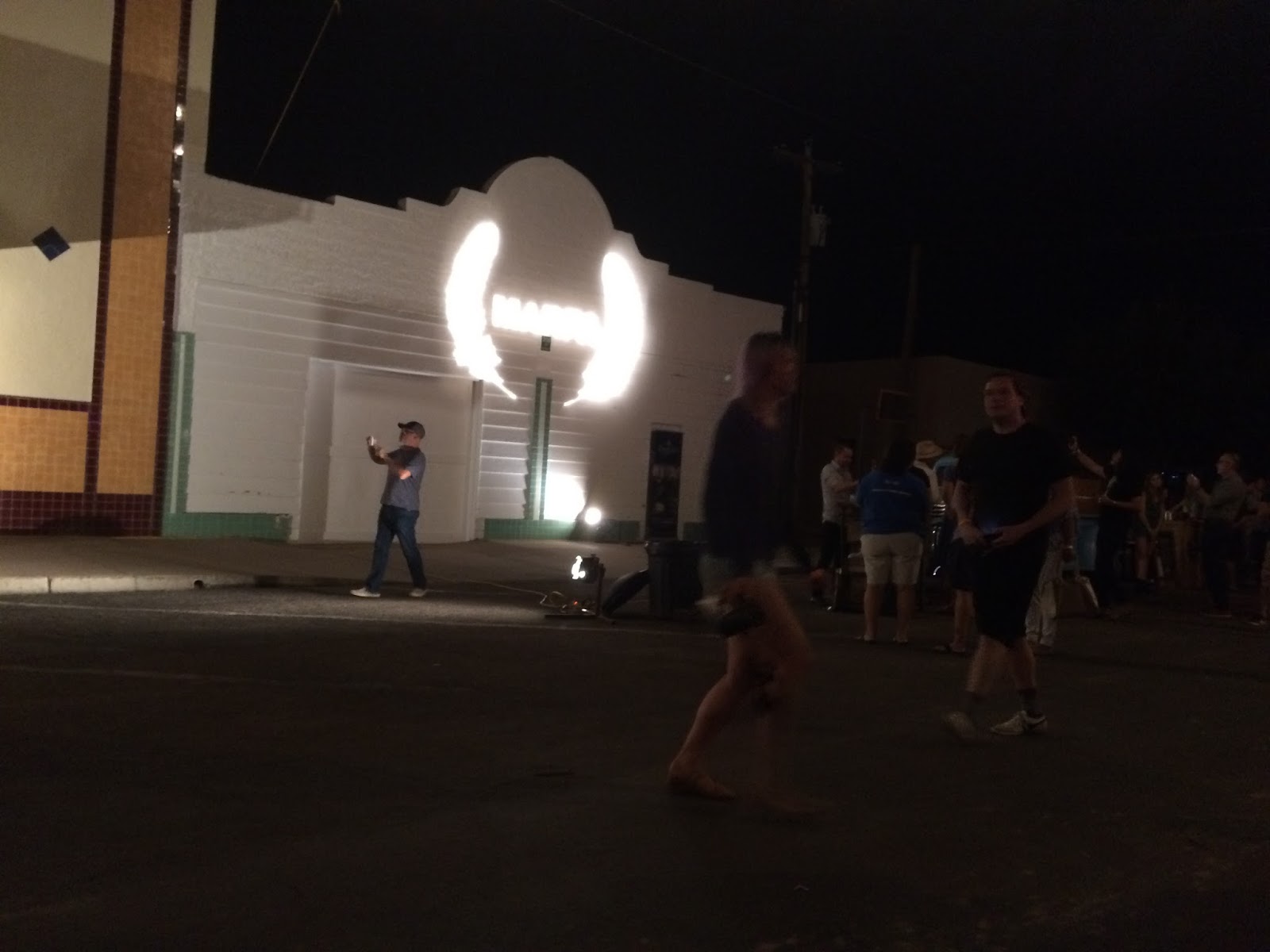
On the festival's first day, which began with an afternoon screening of Greg Kwedar's feature Transpecos, there was a free outdoor Opening Night Party, on one of Marfa's two main streets, the north-south artery Highland Avenue, which had been blocked off to create a plaza in front of the Paisano Hotel. The event aimed to commemorate the 60th anniversary of George Stevens' movie Giant, which was filmed in and around Marfa; stars Elizabeth Taylor, Rock Hudson and James Dean stayed at the Hotel Paisano while filming, as a large photo attests once you walk past the hotel's foyer. The party included a historic room tour, a red carpet photo booth, revelers sporting 1950s Hollywood style, and a dance party DJ'd by local turntablist "Manolo Black." It started slowly but within an hour or so the plaza was brimming with people.

After I grabbed a drink and settled at one of the long tables, I had the pleasure of meeting and chatting with Antonio García Jr., a young actor, writer and director. Garcia is a California native now resident in Brooklyn. He was in Marfa because his short, Flying Eggs, which he'd written and starred in, was among a series of films screening Wednesday morning. After my conversation with Garcia I took in a little more of the revelry, though I didn't dance, pose on the red carpet or take the Paisano room tour, then headed home to read and write a bit more before tucking in early so that I could catch García's film and a few others I did not want to miss.

Downtown Marfa blocked off for the
free Opening Night Party festival  
People gathering on Highland Street 
Many of the film were shorts and screened in continuous blocks, so the range in quality was bound to be variable. One judgment I can offer without hesitation was that the overall visual quality of every film I saw demonstrated polish, even if the content was lacking or not up to. None of the films looked too amateurish, despite the youth of many of the filmmakers, and several were clearly filmed on limited budgets, using digital video. Among the 11 am block, García Jr.'s film, Flying Eggs, directed by Sheldon Chau, and a documentary short, Train Surfers, about Mumbai-based daredevils, directed by Adrien Clothier, was the strongest of the many offerings. Set in New York City, Flying Eggs took a premise that many pedestrians--someone harassing you from a façade window as you walk underneath--would dread, and turned it on its head, with a horrifying revelation in store for the lead, played by García Jr., once he decided to confront his tormentor. This was anything but your light-hearted metropolitan diary. Train Surfers gave glimpses of a world with which I am only passingly familiar, and its strongest elements were the mise-en-scène moments when the daredevils were undertaking their stunts, and its decision to let them speak. I would have loved a bit more context, though, about their lives and prospects outside this activity.

The other films I found less compelling, and two really rubbed me the wrong way. One, Baby Doll, a short by John Valley, entailed a Freddy Mercury-costumed white man lipsyncing to the eponymous song by Austin-based pop-rock band Sweet Spirit. He dons a blond wig (of course) before a captive audience of...captive young women! By captive I mean literally so: bound, ball-gagged, and forced to watch as he frolics, in grating fashion. An ironic twist resolves his presence, but the film ends with the young woman still bound and gagged, so it wasn't enough to redeem the premise or the imagery, at least for me. Another, Brix and Bitch, a short by LA-based filmmaker Nico Raineu, could serve as a textbook example of what liberal misogyny might look like. In it a white woman, "Bitch," must participate in fight club matches with men to pay off a debt. At one of the fights, they lustily chant "Bitch," etc., as a man repeatedly wallops her. (Yes, she fights back, but still--nope.) The white male debt-holder decides that if she can beat one final opponent, she's off the hook. Her partner, a black woman, "Brix," decides to help her out. You can probably guess where this is going. I should note that many in the audience thankfully did not applaud when it ended. 

Several other films were visually striking but fell short in terms of content. In Max Barbakow's short The Duke, a black former football player suffering from the effects of CTE damage, cannot remember the violence he wreaks in every day life. In another, Oh My God, Forgive Me, a world premier by Alex Coblent, a young interracial couple's argument takes a grotesque turn. Both were striking to look at, particularly The Duke, but neither struck me as more than a bizarre anecdote transposed into visual media. Outside of the documentary short Nascent, by Lindsay Branham and Jonathan Kasbe, and filmed in the Central African Republic; filmmaker Alisa Cacho-Sousa's Circunstancia, which poetically explored the Caribbean's duality as an isolating and liberating figure for Cubans; and Swiss filmmaker Nicolas Siegenthelar's beguiling science fiction short Starfall, which I wish were a full-length feature, several other short films and films had the same effect on me; each felt well intentioned, but limited by the constraint of not pushing the idea far enough, even if the film itself had only a few minutes to do so. Again, the technical quality of every film I saw was high, and many of these filmmakers are still at the early stages of their careers, leaving me with the thought that if they can find writers operating at the levels of their cinematographers and producers, they could have strong careers on their hands.

A DJ's booth
Dancing in front of the Marfa Film Festival logo 

I want to comment on two highlights of the festival that I won't soon forget. One was the evening outdoor screening of the newly restored Belladonna of Sadness. Originally debuting in 1973, this animated fable represents Eichi Yamamoto's and Yoshiyuki Fukuda's riff, in combination with the artist Osamu Tezuka and the Mushi Production animation studio, on Jules Michelet's 1862 tome Satanism and Witchcraft, though set several centuries before in a peasant village somewhere in France. In it a young couple, Jean and Jeanne, suffer a devastating blow to their connubial bliss when a local Baron and his allies brutally rape Jeanne on her wedding night. Jean consoles his wife and urges her to look to the future, but a phallic spirit urges her to avenge the attack by allying herself with the devil. As a famine strikes the village and the Baron prepares for war, he demands that Jean, who has become the local tax collector, to press more money out of the locals, and when Jean cannot, the Baron severs his hand. The spirit cajoles Jeanne into taking Jean's place, which she does, to great success, and as a result she provokes the ire and envy of the Baron's wife, who denounces her as a witch. When Jean will not accept Jeanne, she flees to the forest, becomes the lover of the spirit, who turns out to be Satan, and when she is captured and burned at the stake, she marshals her powers and sparks a revolution that overthrows the standing order.

As the above summary suggests, the fairytale elements of Belladonna of Sadness's plot quickly curdle into what is essentially a horror story. Tezuka's images are Klimtian in their mixture of flatness and complexity, and the larger tableaux enrich the plot, often in complementary fashion but sometimes in imagistic counterpoint. Much of the animation consists of pans and small variations on the still drawings, with vibrant use of composition and color, such as when the Baron's rape of Jeanne precedes a red line between her legs that turns into a widening river of blood. The graphic sexual material, which includes ribald jokes and a Dionysian orgy near the film's end, signal it as a product of the late 1960s and early 1970s. Manga and anime artist Osamu Tezuka's stylistic sensibility, at least in this film, appears to derive in part from late 19th and early 20th century European and Japanese visual art traditions. 

Two unappealing throwbacks were the blatantly contrasting color scheme for Jeanne, whose skinned was presented white as snow, while the Baron, particularly when raping Jeanne, and later Satan, when having sex with her, were pitch black, as the images I post below attest. Another obvious and repugnant throwback was the depiction of the "usurer," who helps Jeanne establish herself as the tax collector after Jean's behanding; imagery drawn directly from anti-Semitic templates that circulated in Nazi Germany made me want to walk out. I cannot believe I'm the only one who noticed these aspects of the film, but nothing I've seen online mentions them. Belladonna of Sadness ends with an homage to the French Revolution, evoking Eugène Delacroix's famous painting, Liberty Leading the People; Jeanne, we are supposed to believe, has morphed into Marianne, France's liberation icon, but the leap feels politically incoherent. In fact, the overall effect was a bit stupefying: unforgettable, often trippy visuals paired with a simplistic, moralistic narrative that was both misogynistic and exploitative. On the one hand, I am glad I caught it, particularly at El Cósmico, which was an experience in itself, but on the other, I could stand without ever seeing it again.

Scene from Burden (2016)
Another standout for me was Burden, Richard Dewey's and Timothy Marrinan's 2016 documentary about the late conceptual and performance artist, engineer and sculptor, Chris Burden (1946-2015). Perhaps best known for his controversial 1971 performance, Shoot, in which he arranged for a fellow artist to shoot him with .22 rifle from 16 ft. Utterly simple, utterly dangerous, and thus quite innovative as this art act was, it constituted only one of many such groundbreaking interventions by Burden, beginning when he was still an art student at the then very new University of California, Irvine. The film canvassed his entire career, cutting between past highlights that included his notorious grad school stunt Five Day Locker Piece, which brought him immediate notoriety, and 1974's Trans-fixed, in which he nailed himself to a VW Bug and had it travel in and out of a garage, and contemporary moments with the artist, who kept striking out for new territory--though leaving corporeal performance behind--right up until his death from melanoma a year ago.

Along the way, Burden showed how his work from the beginning often involved taking a very simple idea to its logical, or illogical extreme, as well as his intrinsic merging of the visual, the sculptural, the bodily, and engineering; how integral his wives were to his career, with his first wife, Barbara Burden, supporting him financially by working a full-time job and even stepping in when no one else would participate in what were at times quite scary performances; how gallerists, peers and audiences found themselves continually astonished, and times terrified, of what Burden imagined and then realized as art; how crazed drugs and fame made him at one point; and how he embodied one of the principle insights of many great careers in art, which is never to lose the playfulness and wonderment of childhood, though doing so may create a personal hell for those close to you.

While the filmmakers were too coy about his background and the social capital it provided him, they thankfully did not hesitate show the complexities of his personality and behavior, including one of his ugliest moments, when he angrily struck out, with racist and misogynistic epithets, at his second ex-wife and the art dealer she was seeing, after she'd fled him. Nor did they fail to note the irony that when one of Burden's students brings a loaded gun to class, perhaps in echo and tribute to Burden's earlier landmark piece, the artist complained to the school, and then retired. Imitation in such cases is not flattery but possibly the prelude to real danger. (A second irony is that as a young man, Burden actually said on camera, "Everybody fantasizes about being shot," though this is not true and also must be understood within the specific context in which Burden was creating art.) The film ended on a bittersweet note; shortly before Burden passes away, he completes one of his most beautiful and lyrical pieces, the inflated, self-guiding mini-dirigible that he envisioned as a tribute to the great Brazilian aeronaut Alberto Santos-Dumont (1873-1932). Though he does not live to see the piece's début, it embodies in compelling material fashion the spirit of his later work, and his overall vision.
Photos in front of the Palace Theater
Brooklyn-based actor
Antonio Garcia Jr. 
Peering into Arcade 
When the Marfa Film Festival concluded, I felt glad that I had been able to catch more than a few of its films. One thing I noted throughout the festival was how few filmmakers of color were involved; even films with subject matter that explored the lives and concerns of people who were not white were mostly the product of white filmmakers. The festival's organizers clearly tried to schedule a range of films, for which I give them tremendous credit, so the issue is less the festival itself, but rather the film industry, including indie filmmaking, which I imagine still presents a number of challenges, primarily financial, to transforming creative visions into cinema reality. I also give the filmmakers themselves credit for attempting to stretch their perspectives and to a degree cast a wider net, particularly compared to the Hollywood mainstream, in terms of the subjects they seek to explore, the characters they write, and so forth. Yet I wonder whether a woman director, particularly a queer filmmaker of color, would ever have written, let alone filmed, a movie like Brix and the Bitch. Perhaps yes, though I doubt it. All of this also underlined for me one of the challenges Hollywood faces; it's one thing to add diverse faces to the Academy's rolls, and another to change the system that keeps a wide array of talented people from making films that reflect the rich diversity of lives and experiences in the US and across the globe.

At El Cósmico, where Belladonna
of Sadness
 screened
A still from Belladonna of Sadness
Another still from Belladonna of Sadness

Sunday, June 03, 2012

11+ Things I'll Miss About Chicago

22 boxes and counting
When I first sojourned in Chicago for the spring 2001 quarter, and then returned again to teach and live in fall 2002, people would ask me, Do you like it t/here?  Even before I ever lived here I visited many times, and believe without hesitation that Chicago is a great city, one of the grandest, most exciting and livable big cities in the US. But I would often find myself giving a mixed answer, because there were and are many things I like about it, but there are things I have not liked so much.

A few years in, Chicagoans no longer asked me the question, assuming I suppose that I was still here I must like it as much as they did, but people who came to visit or people I met in other cities who found out that I spent part of each year here would ask me about the city, and almost always whether I liked it. Again my usual response usually proceeded with praise for the city's many amenities, which I would then counter with a statement about the winter. This sufficed, because almost everyone I've come across has an image of Chicago's glamorous downtown skyline (which has grown only more impressive in the years since I've been here), yet shudders with fear over having to spend a winter alongside this side of Lake Michigan, especially after the Snowpocalypse (which really did blow snow through my locked window sashes up onto the inner panes of my apartment's double-paned windows), though as a colleague reminded me yesterday, this was a very mild winter.

Over the last few months I have been thinking of what things I really have enjoyed about Chicago and what I'll miss, and what I have enjoyed less so. Here then are two lists, which do not include my family, friends, students and colleagues (who'd appear in the first).

TEN THINGS I'LL MISS ABOUT CHICAGO

1. My neighborhood, Rogers Park. It's one of the most diverse and affordable neighborhoods on Chicago's north side, quite safe (even though one of the main strips was for years an open-air, 24/7/365 illicit drug mart that cops drove past without batting an eye), full of artists and immigrants and queer folks and people of all ages, colors and religions (I used to live near an Episcopalian Church, Ethiopian church, a Korean Christian church, and a mysterious African-derived church that held ceremonies all weekend long, it seemed, and now live right across the street from a Christian Science outpost), with an accessible beach, lots of cut-rate but tasty restaurants, and proximity to Evanston, which has meant a fairly easy commute to work. The El's and Metra's trains both stopped in the neighborhood. Getting downtown is always a hike, and necessitated my getting a car when I had to teach on the Chicago campus, but there's also a lot to be said for not being in the midst of everything, or being in the midst of other sorts of things that are amenable and livable. That Rogers Park is.

2. The various literary and artistic communities of Chicago. Rarely do they meet, but I have tremendously enjoyed interacting with and in some cases participating in many of them. Alongside my university creative writing, Poetry and Poetics Colloquium, and literary studies colleagues and students, I've had the invaluable benefit of linking up to a range of smart and energizing wordsmiths, artists and performers. From the Reconstructon Room and Second Sun and the Silver Room, who brought visual art, poetry and performance together, to the Red Rover Series, which never failed to bring something innovative and unexpected to its events, to the Human Micropoem, which put the "p" in "people," "poetry," "politics," and "possibility," to the Homolatte series at Big Chicks, which paired queer performers and music in exciting ways, to the Myopic Reading Series at that incomparable bookstore (cf. below), to the Danny's Reading Series, which brought so many friends to town and gave a whole new meaning to reading in bar full of enthusiastic patrons, to the Poetry Foundation and its multiple, enlightening programs, to the Gwendolyn Brooks Conferences at Chicago State University, which I had the good fortunate to be able to speak at and attend, meeting Dr. Haki Madhubuti, James Alan McPherson, Edward P. Jones, and the late Octavia Butler, among many others, to all the projects that Krista, Toni, Nathanaël, Abegunde, Jen, Erin, Amy, Joshua, John, Jennifer, Quraysh, Kelly, and Reg, and a vast extended crew of other writers and artists and programs have gotten going, I never lacked for language and art.

3. WBEZ, Chicago's main public radio station. Though it relies perhaps far too heavily on the Canadian Broadcasting Corporation for programming--on any given day, if I switch on WBEZ, half the time, it seems, I hear Canadian accents talking about Canadian topics, which is okay in small doses, fond as I am of our neighbor to the north--WBEZ is far superior to WNYC in New York. Unlike the latter station, it has a more racially and ethnically diversified local lineup of reporters and hosts, and far more diversified programming. It also featured one of the smartest, most informative programs I've ever heard, Odyssey, hosted by Gretchen Helfrich. That show has gone and Helfrich is in (or has finished) graduate school, but it alone made WBEZ worth listening to every weekday. Also, it broadcasts weekly speeches from the Commonwealth Club of California; features a show called Vocalo that plays house music for hours on end; and yet also features all the NPR staples, including Wait, Wait, Don't Tell Me, Prairie Home Companion, Car Talk with Tom and Ray Magliozzi. Fortunately I can stream it online, so I won't have to forgo it, but I'd much rather be able to tune all my radios to it rather than the New York metro-area dominant WNYC.

4. Metropolis Café, Charmers Café, Caribou Coffee's branches along Clark Street, The Common Cup, Chava Café, and all the great cafés from Rogers Park to Boystown to Wicker Park. I am a coffee person and a café person, and Chicago has many of the latter serving very good cups of the former. Metropolis has excellent coffee, and I've enjoyed sometimes running into favorite colleagues hard at work there, and even met a talented Afro-Colombian artist who'd exhibited his work there.  Charmers is very neighborhoody, and I once stumbled upon a film being shot there. At the various branches of Caribou I have graded many a paper or reread a short story or novella revision; unfortunately I've also always managed to miss Rod 2.0! When we're both in town we seem to operate like two subatomic particles that settle at the exact other Caribou at the same time.

5. Landmark Century Cinema, the Music Box, Gene Siskel Film Center, and all the other venues for seeing new and unusual films, and alongside the theaters, all of Chicago's vaunted film festivals, which are the real thing. The city has tons, you can see films you'd only see on the coasts, and most of them are affordable. There's even a mainstream theater in walking distance from me, right near the Loyola University of Chicago campus, that features very cheap matinees.

6. Lots of cheap, affordable, delicious restaurants. I have mostly cooked since living here, but I can vouch for the fact that Chicago has some of the best food in the US, high, middle and low end, and if you are looking to economize, it also has a number of excellent fairly affordable restaurants, with almost every cuisine you could think of available.  A few years ago one of my students visited the famed Alinea, a temple of molecular gastronomy, and I have said I'd love to try it, but it remains out of my price range. One restaurant I don't hit anymore but which is a must for meat lovers is Hot Doug's, about which I'll say only: bring cash, be ready to stand on line, and don't eat before because you will certainly feel full. There are variations on Mexican cuisine that boggle the mind. Then there's my favorite restaurant, Sticky Rice, a joint serving Northern Thai cuisine that has "worms" on its menu. Chicago does roll like that!

7. More theaters and plays staged than you can possibly ever visit. I'm not a big theater person, but I think Chicagoland has got New York and LA beat by many miles in this regard, Broadway notwithstanding. This is a theater town. On any given night, there are plays underway somewhere in Chicagoland. Or on the verge of being staged. I have caught some great plays and performances, and some awful ones, but without fail I've at least left the theater musing about what I saw.  Within walking distance of my apartment there are, right now, a staging of works by Samuel Beckett and A Light in the Piazza, just to name two of the offerings.

8. The El. Once I was able to avoid having to rely on it all the time, I could appreciate it.  Some of the stations, like nearby Jarvis, look so decrepit it's miracle they're still standing, the cost of a one-way ride just keeps rising, and the hub-and-spoke format means that getting west requires you to travel towards the Loop to connect to lines radiating away from the Lake, but it runs 24 hours, and mostly goes where I need to if I don't want to drive. Getting to Cablevision, the office of the Secretary of State (for car stickers, etc.), requires another mode of transportation, however. I.e., a car.  (I'll put in a plug for the No. 22 bus, which runs up Clark Street. It's reliable and clean and carries all manner of humanity up and down this major east-lying Chicago artery.

9. Chicago is one of the more queer-friendly cities in the US. I have had many criticisms of former mayor Richard Daley, but being homophobic was never one of them. Between the city's government and its general ethos, it is pretty lgbtq-friendly, and although there are racial, ethnic, class, and gender divisions among lgbtq people, the main gay neighborhoods of Boystown and Andersonville (there are others, including Rogers Park) are increasingly gentrified and unaffordable to many non-wealthy queer people, and there is anti-gay violence like anywhere else, Chicago has maintained a vibrant queer ecology in a way that other cities, either through hypergentrification or decline, have not. Outside the northside it's less gay-friendly, but there are gay bars and events on the South Side and West Side, and the general atmosphere places it in the upper ranks of major US cities.

10. Bookstores like Unabridged Books, Myopic Books, Women and Children First, Powell's, and many others. I am packing up books, so many books, so many boxes of books, which is a tiny nightmare, but Chicago still has some fine independent and used bookstores, some offering treasures that astonished me. Like the time, early on in my process of working on this 19th century novel, of coming across a book, in a bookstore, and not a library, on African-American probate records in Boston. Seriously. There it was, right there in the used bookstore. Or going to another bookstore not far from Wrigley Field and seeing first editions for sale for less than $50.  Or finding the Encyclopedia Africana for $20 years ago, a price so low I decide to buy two, and, at the urging of an acquaintance, shipped one to a Brazilian writer who would have had to pay through the pores to get a copy. I have tried to the best of my ability to visit these dens of text-lust infrequently as my departure date has neared, but I know I will miss all of them.

11. Chicago's architecture. I don't just mean the famous architectural treasures, of which there are many, but the Prairie and Arts and Craft-style homes, the solidity of the brick architecture, the human scale of so much of the northside's neighborhoods. Then there are the numerous remarkable exemplars by some of America's greatest architects (H.H. Richardson, Holabird and Roche, Burnham and Root, William LeBaron Jenney, Sullivan and Adler, Walter Burley Griffin, Mies van der Rohe, Frank Lloyd Wright, Helmut Jahn, Stanley Tigerman, Skidmore Owings & Merrill, etc.) dotting Chicagoland , and singular jewels like the Marina Tower (the Honeycomb Building), which never fails to fill me with awe and delight. I've never understood why I enjoy looking at and exploring buildings so much, but Chicago has presented more than enough.

Also, all the museums; the parks and conservancies, with their incredible floral displays; the fact that I was able to be here on the very day in November 2008 when Barack Obama was elected President of the United States, four years after I'd met and spoken with him in Evanston; the affordable rents, even in Rogers Park; my local health food coop, which is excellent; the easy drive to O'Hare International Airport; the beach in spring and fall; and driving toward downtown on Lake Shore Drive in the evening during the fall and winter, when the Loop's skyline gleams in front of you, and off to the left you can see the glittering bracelet of Navy Pier's Ferris Wheel turning, the shimmering moonlit lake churning in the background. It evokes a feeling that isn't exactly romantic but approximates it. If nothing else, it underlines Chicago's distinctive beauty and  I always expect to see this in a film, but never have. Directors, please take note.