Showing posts with label indie film. Show all posts

Saturday, December 30, 2017

Online Movie-Watching in 2017

Earlier this year, I wrote about signing up for FilmStruck, the online movie site owned by Turner Classic Movies that offers classic and more obscure art house and independent films, including Criterion Collection films, from Hollywood and across the globe. I had meant to keep track of the films I watched, and in the earlier blog post I noted a few, but I figured, as is the case with Netflix, that the site itself kept a running list of all the films I watched. Unfortunately, they do not; or rather, they do retain the films that are not cycled off the site.

So here, mostly based on memory, are 21 of the films that especially stood out for me. I know I am forgetting a few, and I intend to keep a better list of my own this year. Nevertheless, here are my standouts, a number of which were by directors, like Rainer Werner Fassbinder and Nagisa Oshima, whose films I have almost all seen, whereas others were my first forays into the work of the director, as were the cases with Jacques Demy and Jacques Tati. The list is heavily male (and European); I do hope that FilmStruck will add more films by women, directors from across the globe (especially Latin American and Africa), and more by openly LGBTQ filmmakers.

In keeping with my longstanding aims and because it's the end of the year, I'll aim to be as brief as possible.

***

1) Luis Buñuel's 1962 film The Exterminating Angel: I'd seen many of his films but not this one. Buñuel handles the scenario, which involves a group of socialites who, for unknown reasons, cannot leave a living room, leading to a breakdown in mores, with utter mastery. The metaphysical horror of their enclosure steadily mounts, functioning as a subtle yet harsh critique of elitism and self-satisfaction.

2) Rainer Werner Fassbinder's 1975 Fox and His Friends: Until last year, I had watched nearly every Fassbinder film but not this one, a powerful early post-#Stonewall gay film, with social class at its center. As with so many films on this list, Fassbinder's vision, and in particular, his embedded social critique, would struggle to gain funding or support in today's Hollywood.

3) Djibril Diop Mambéty's 1973 Touki Bouki: A little gem of 1970s West African cinema, Mambéty's Touki Bouki depicts Senegal's post-independence urban-rural divide, through the prism of alienated youth. The protagonists, Mory and Anta, a student, yearn to escape Senegal for Paris, and drive around on a motorcycle devising schemes to flee. The brevity of Mambéty's career feels especially tragic in light of his achievements with this film.

4) Nagisa Oshima's 1969 film Boy: Oshima often depicts some of the darker sides of human existence; in the early 1960s he was showing young miscreants rolling johns for money, and later took up themes such as suicide, bestiality, and sex addiction. Boy tells the story of a family faking car accidents, using their young children, particularly the older son Toshio, all across Japan, until the law catches up with them. One gets the sense that Toshio may not have learned the right lesson as a result.

5) Peter Weir's 1977 feature The Last Wave: I'd always heard this was a great film and it lived up to its advanced billing. The premise is a white lawyer defends an Aboriginal man charged in a mysterious bar crime, as portents visible at first only to the Aborigines loom. The lawyer, played by Richard Chamberlain, experiences premonitions that become hallucinations, but the film suggests a broader view as well, that a post-colonial, metaphysical confrontation is underway. The enigmatic ending is especially powerful, though I wondered how Aborigines viewed their depictions in the film. 

6) Jacques Demy's 1964 film The Umbrellas of Cherbourg: So many people have raved about this film over the years so I was glad to finally see it. It is about as sweet as a musical can get, starring a very young Catherine Deneuve, with a lightness that differs from American musicals of the time. The Algerian War hovers inescapably in the background, while class issues and the changing ethos of the era are in its foreground, so it is less cotton candy and more a complex confection that delights even as it enlightens.

7) Jean Cocteau's 1950 Orpheus: I found this queer dream masquerading as a film visually astonishing. To cite one specific moment, Orpheus dons surgical gloves and descends into the underworld, through a mirror, a moment that outstrips many a subsequent CGI attempt to transform reality before our eyes. It is truly lyrical, oneiric cinema.

8) William Klein's 1969 Mr. Freedom: Klein is mostly forgotten today, but he produced a number of distinctive films in the late 1960s and early 1970s. Mr. Freedom is a cartoonish, overtly racist, hyper-nationalistic, rightwing white superhero. Put him in a suit, make a real-estate heir and pseudo-titan, and he could easily be the person a minority of voters, 62 million or so, elected in November 2016.

9) François Truffaut's 1968 charmer Stolen Kisses: One of the Antoine Doinel series I'd never seen, Stolen Kisses, starring Jean-Pierre Léaud in his third turn as Doinel, a troubled veteran struggling to fit into society, is delightful in a way that American movies have completely forgotten is possible.

10) Éric Rohmer's 1986 The Green Ray: Yet another strongly heralded film, I was not so sure how it would turn out given its unpromising start. Is it a feminist comedy? Something more serious? Something ominous? Ultimately, Rohmer's confection turned out to be very simple, but also very moving, and ultimately sublime. In any other hands this might have been a throwaway; in Rohmer's and his actors' and crew's, it a model of film art.

11) Basil Dearden's 1951 film Pool of London: One of the first British films to depict an interracial romance, Pool of London also introduced Jamaican-British actor Earl Cameron, who, impressively, is still acting at age 100! The film is not Dearden's best, but its points to his cinematic triumphs to come.

12) Derek Jarman's 1978 reverie Jubilee: Another very poetic and political film, using time travel, Shakespearean characters, and musical performances, Jubilee merges authentic British punk culture & dystopianism as a protest against the monarchy and stagnation in Callaghan-era UK society. As much queered cinema as queer cinema, Jubilee is another film that probably would and could not be made today.

13) Tomas Gutiérrez Alea's 1968 hybrid Memories of Underdevelopment: A landmark Cuban film, which I've seen before several times, the first on PBS back in the 1990s. Among its many questions a chief one is, what place exists for a bourgeois white liberal in a post-bourgeois, multicultural, socially egalitarian, revolutionary society? The apolitical man--or self-assumed one--may really have no place in the post-revolt world. Gutiérrez Alea's collage approach and use documentary also still feel innovative today.

14) Nagisa Oshima's 1960 hybrid Night and Fog in Japan: This strange, powerful political film explores a psychic and political reckoning, several years on, among youthful revolutionaries. It wraps this around what appears to be domestic touchstone, a heterosexual marriage, but it is probably fair to say that taken as a whole, there was little like this film in theaters during its era and nothing like it anywhere today.

15) Susan Seidelman's 1982 feature Smithereens: 3 years before releasing Desperately Seeking Susan Seidelman debuted with this portrait of young, underemployed wannabe punks, embodied in Susan Berman's Wren, one of the most unlikably mesmerizing characters to appear on screen. One hallmark of this film, which appeared during my high school years, is its glimpse of a long-gone NYC.

16) Ousmane Sembène's 1963 Borom Sarret: I had not realized this film is considered to be the first theatrical feature by a sub-Saharan Black African filmmaker, but its significance extends beyond its groundbreaking status. Sembène's very simple but not simplistic masterpiece about a cart driver gave strong clues about the remarkable career to follow.

17) Louis Malle's 1958 crime drama Elevator to the Gallows: This thrilling drama, brought to life by a skillful director, was worth the advance billing.  Jeanne Moreau, as always, burns up the screen.

18) Roger Corman's 1962 The Intruder: Oddly or not so oddly, this portrait of a white supremacist who arrives in a sleepy Southern town to stir up racial resentment against looming desegregation and school integration rarely appears on film. I'd never heard of it. But William Shatner, who plays the agitator, is superb in the role, and it is not a performance you'll forget if you see it.

19) Hollis Frampton's 1970  Zorns Lemma: This is experimental, structural cinema at its purest. 5 minutes of a voice with a black screen, then 45 minutes of 2,700 images flashing by, depicting aspects of a 24-part alphabet, then 10 minutes of a receding snowy image. You can either turn it off or watch it. I did the latter, and was entranced by the film's end.

20) Jacques Tati's 1967 feature Playtime: There are few words strong enough to extol the singular vision Tati expresses in this or any of his later works. Ostensibly another Mr. Hulot vehicle, Tati constructed an entire mini-city for the purposes of this film, and paid a steep financial and creative price. It remains remarkable on every level that he pulled this off.

21) Todd Solondz's 2009 Life During Wartime: The newest film on the list, this also is one of two films by him (Wiener Dog is the other) that I'd missed. Solondz continues to buck the conventional US filmmaking trends, with his acerbic portrayals of suburban life in contemporary America. I thought his 1998 film Happiness, for which Life During Wartime is the sequel, was more disturbing, but this one, which reprises all the characters but with different actors, is not far behind.

Wednesday, July 20, 2016

Marfa Film Festival

One of the highlights of being in Marfa in July was catching this past week's Marfa Film Festival. Running from July 13 through 17, it featured six dozen films, by my count, ranging from shorts to full-length feature films and documentaries. What better way to take a break from writing than catch a few films that might in their own way spark some thought and creative possibilities? Though the festival passes, merchandise and information book were in the Marfa landmark Hotel Paisano, most of the films screened at the Crowley Theater a few blocks away. A few specially designated films, however, like the singular Belladonna of Sadness, about which I'll say a bit more below, ran at more atmospheric spots like El Cósmico, an outdoor restaurant, bar, semi-drive in, and recreational space with--I kid not--charcoal-fired hot tubs. Despite the fact that it was a small-town event, the festival's weeklong passes were pricier than I forecast, but I indulged and purchased one to ensure hassle-free entry into any film or related event.

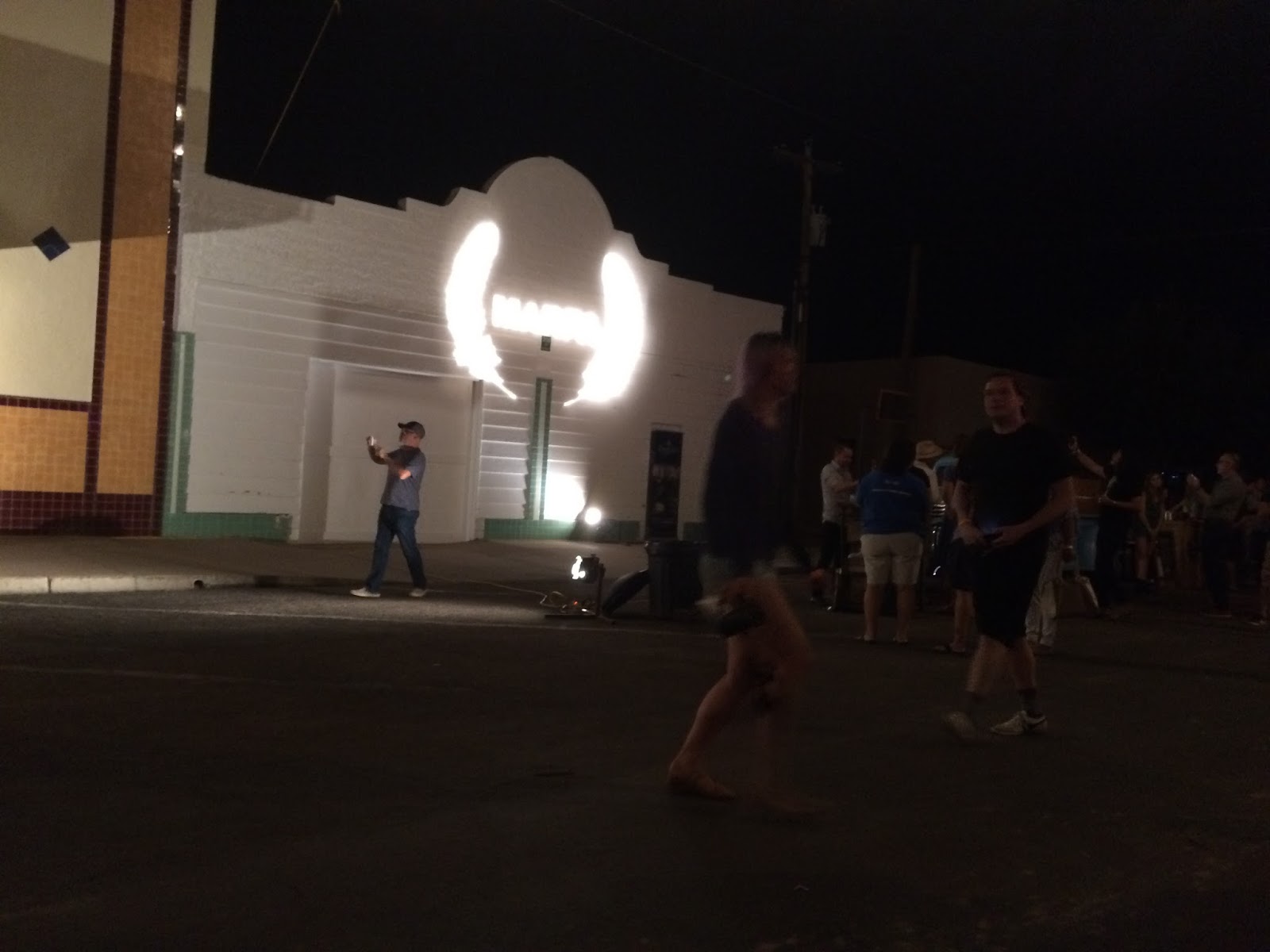
On the festival's first day, which began with an afternoon screening of Greg Kwedar's feature Transpecos, there was a free outdoor Opening Night Party, on one of Marfa's two main streets, the north-south artery Highland Avenue, which had been blocked off to create a plaza in front of the Paisano Hotel. The event aimed to commemorate the 60th anniversary of George Stevens' movie Giant, which was filmed in and around Marfa; stars Elizabeth Taylor, Rock Hudson and James Dean stayed at the Hotel Paisano while filming, as a large photo attests once you walk past the hotel's foyer. The party included a historic room tour, a red carpet photo booth, revelers sporting 1950s Hollywood style, and a dance party DJ'd by local turntablist "Manolo Black." It started slowly but within an hour or so the plaza was brimming with people.

After I grabbed a drink and settled at one of the long tables, I had the pleasure of meeting and chatting with Antonio García Jr., a young actor, writer and director. Garcia is a California native now resident in Brooklyn. He was in Marfa because his short, Flying Eggs, which he'd written and starred in, was among a series of films screening Wednesday morning. After my conversation with Garcia I took in a little more of the revelry, though I didn't dance, pose on the red carpet or take the Paisano room tour, then headed home to read and write a bit more before tucking in early so that I could catch García's film and a few others I did not want to miss.

Downtown Marfa blocked off for the
free Opening Night Party festival  
People gathering on Highland Street 
Many of the film were shorts and screened in continuous blocks, so the range in quality was bound to be variable. One judgment I can offer without hesitation was that the overall visual quality of every film I saw demonstrated polish, even if the content was lacking or not up to. None of the films looked too amateurish, despite the youth of many of the filmmakers, and several were clearly filmed on limited budgets, using digital video. Among the 11 am block, García Jr.'s film, Flying Eggs, directed by Sheldon Chau, and a documentary short, Train Surfers, about Mumbai-based daredevils, directed by Adrien Clothier, was the strongest of the many offerings. Set in New York City, Flying Eggs took a premise that many pedestrians--someone harassing you from a façade window as you walk underneath--would dread, and turned it on its head, with a horrifying revelation in store for the lead, played by García Jr., once he decided to confront his tormentor. This was anything but your light-hearted metropolitan diary. Train Surfers gave glimpses of a world with which I am only passingly familiar, and its strongest elements were the mise-en-scène moments when the daredevils were undertaking their stunts, and its decision to let them speak. I would have loved a bit more context, though, about their lives and prospects outside this activity.

The other films I found less compelling, and two really rubbed me the wrong way. One, Baby Doll, a short by John Valley, entailed a Freddy Mercury-costumed white man lipsyncing to the eponymous song by Austin-based pop-rock band Sweet Spirit. He dons a blond wig (of course) before a captive audience of...captive young women! By captive I mean literally so: bound, ball-gagged, and forced to watch as he frolics, in grating fashion. An ironic twist resolves his presence, but the film ends with the young woman still bound and gagged, so it wasn't enough to redeem the premise or the imagery, at least for me. Another, Brix and Bitch, a short by LA-based filmmaker Nico Raineu, could serve as a textbook example of what liberal misogyny might look like. In it a white woman, "Bitch," must participate in fight club matches with men to pay off a debt. At one of the fights, they lustily chant "Bitch," etc., as a man repeatedly wallops her. (Yes, she fights back, but still--nope.) The white male debt-holder decides that if she can beat one final opponent, she's off the hook. Her partner, a black woman, "Brix," decides to help her out. You can probably guess where this is going. I should note that many in the audience thankfully did not applaud when it ended. 

Several other films were visually striking but fell short in terms of content. In Max Barbakow's short The Duke, a black former football player suffering from the effects of CTE damage, cannot remember the violence he wreaks in every day life. In another, Oh My God, Forgive Me, a world premier by Alex Coblent, a young interracial couple's argument takes a grotesque turn. Both were striking to look at, particularly The Duke, but neither struck me as more than a bizarre anecdote transposed into visual media. Outside of the documentary short Nascent, by Lindsay Branham and Jonathan Kasbe, and filmed in the Central African Republic; filmmaker Alisa Cacho-Sousa's Circunstancia, which poetically explored the Caribbean's duality as an isolating and liberating figure for Cubans; and Swiss filmmaker Nicolas Siegenthelar's beguiling science fiction short Starfall, which I wish were a full-length feature, several other short films and films had the same effect on me; each felt well intentioned, but limited by the constraint of not pushing the idea far enough, even if the film itself had only a few minutes to do so. Again, the technical quality of every film I saw was high, and many of these filmmakers are still at the early stages of their careers, leaving me with the thought that if they can find writers operating at the levels of their cinematographers and producers, they could have strong careers on their hands.

A DJ's booth
Dancing in front of the Marfa Film Festival logo 

I want to comment on two highlights of the festival that I won't soon forget. One was the evening outdoor screening of the newly restored Belladonna of Sadness. Originally debuting in 1973, this animated fable represents Eichi Yamamoto's and Yoshiyuki Fukuda's riff, in combination with the artist Osamu Tezuka and the Mushi Production animation studio, on Jules Michelet's 1862 tome Satanism and Witchcraft, though set several centuries before in a peasant village somewhere in France. In it a young couple, Jean and Jeanne, suffer a devastating blow to their connubial bliss when a local Baron and his allies brutally rape Jeanne on her wedding night. Jean consoles his wife and urges her to look to the future, but a phallic spirit urges her to avenge the attack by allying herself with the devil. As a famine strikes the village and the Baron prepares for war, he demands that Jean, who has become the local tax collector, to press more money out of the locals, and when Jean cannot, the Baron severs his hand. The spirit cajoles Jeanne into taking Jean's place, which she does, to great success, and as a result she provokes the ire and envy of the Baron's wife, who denounces her as a witch. When Jean will not accept Jeanne, she flees to the forest, becomes the lover of the spirit, who turns out to be Satan, and when she is captured and burned at the stake, she marshals her powers and sparks a revolution that overthrows the standing order.

As the above summary suggests, the fairytale elements of Belladonna of Sadness's plot quickly curdle into what is essentially a horror story. Tezuka's images are Klimtian in their mixture of flatness and complexity, and the larger tableaux enrich the plot, often in complementary fashion but sometimes in imagistic counterpoint. Much of the animation consists of pans and small variations on the still drawings, with vibrant use of composition and color, such as when the Baron's rape of Jeanne precedes a red line between her legs that turns into a widening river of blood. The graphic sexual material, which includes ribald jokes and a Dionysian orgy near the film's end, signal it as a product of the late 1960s and early 1970s. Manga and anime artist Osamu Tezuka's stylistic sensibility, at least in this film, appears to derive in part from late 19th and early 20th century European and Japanese visual art traditions. 

Two unappealing throwbacks were the blatantly contrasting color scheme for Jeanne, whose skinned was presented white as snow, while the Baron, particularly when raping Jeanne, and later Satan, when having sex with her, were pitch black, as the images I post below attest. Another obvious and repugnant throwback was the depiction of the "usurer," who helps Jeanne establish herself as the tax collector after Jean's behanding; imagery drawn directly from anti-Semitic templates that circulated in Nazi Germany made me want to walk out. I cannot believe I'm the only one who noticed these aspects of the film, but nothing I've seen online mentions them. Belladonna of Sadness ends with an homage to the French Revolution, evoking Eugène Delacroix's famous painting, Liberty Leading the People; Jeanne, we are supposed to believe, has morphed into Marianne, France's liberation icon, but the leap feels politically incoherent. In fact, the overall effect was a bit stupefying: unforgettable, often trippy visuals paired with a simplistic, moralistic narrative that was both misogynistic and exploitative. On the one hand, I am glad I caught it, particularly at El Cósmico, which was an experience in itself, but on the other, I could stand without ever seeing it again.

Scene from Burden (2016)
Another standout for me was Burden, Richard Dewey's and Timothy Marrinan's 2016 documentary about the late conceptual and performance artist, engineer and sculptor, Chris Burden (1946-2015). Perhaps best known for his controversial 1971 performance, Shoot, in which he arranged for a fellow artist to shoot him with .22 rifle from 16 ft. Utterly simple, utterly dangerous, and thus quite innovative as this art act was, it constituted only one of many such groundbreaking interventions by Burden, beginning when he was still an art student at the then very new University of California, Irvine. The film canvassed his entire career, cutting between past highlights that included his notorious grad school stunt Five Day Locker Piece, which brought him immediate notoriety, and 1974's Trans-fixed, in which he nailed himself to a VW Bug and had it travel in and out of a garage, and contemporary moments with the artist, who kept striking out for new territory--though leaving corporeal performance behind--right up until his death from melanoma a year ago.

Along the way, Burden showed how his work from the beginning often involved taking a very simple idea to its logical, or illogical extreme, as well as his intrinsic merging of the visual, the sculptural, the bodily, and engineering; how integral his wives were to his career, with his first wife, Barbara Burden, supporting him financially by working a full-time job and even stepping in when no one else would participate in what were at times quite scary performances; how gallerists, peers and audiences found themselves continually astonished, and times terrified, of what Burden imagined and then realized as art; how crazed drugs and fame made him at one point; and how he embodied one of the principle insights of many great careers in art, which is never to lose the playfulness and wonderment of childhood, though doing so may create a personal hell for those close to you.

While the filmmakers were too coy about his background and the social capital it provided him, they thankfully did not hesitate show the complexities of his personality and behavior, including one of his ugliest moments, when he angrily struck out, with racist and misogynistic epithets, at his second ex-wife and the art dealer she was seeing, after she'd fled him. Nor did they fail to note the irony that when one of Burden's students brings a loaded gun to class, perhaps in echo and tribute to Burden's earlier landmark piece, the artist complained to the school, and then retired. Imitation in such cases is not flattery but possibly the prelude to real danger. (A second irony is that as a young man, Burden actually said on camera, "Everybody fantasizes about being shot," though this is not true and also must be understood within the specific context in which Burden was creating art.) The film ended on a bittersweet note; shortly before Burden passes away, he completes one of his most beautiful and lyrical pieces, the inflated, self-guiding mini-dirigible that he envisioned as a tribute to the great Brazilian aeronaut Alberto Santos-Dumont (1873-1932). Though he does not live to see the piece's début, it embodies in compelling material fashion the spirit of his later work, and his overall vision.
Photos in front of the Palace Theater
Brooklyn-based actor
Antonio Garcia Jr. 
Peering into Arcade 
When the Marfa Film Festival concluded, I felt glad that I had been able to catch more than a few of its films. One thing I noted throughout the festival was how few filmmakers of color were involved; even films with subject matter that explored the lives and concerns of people who were not white were mostly the product of white filmmakers. The festival's organizers clearly tried to schedule a range of films, for which I give them tremendous credit, so the issue is less the festival itself, but rather the film industry, including indie filmmaking, which I imagine still presents a number of challenges, primarily financial, to transforming creative visions into cinema reality. I also give the filmmakers themselves credit for attempting to stretch their perspectives and to a degree cast a wider net, particularly compared to the Hollywood mainstream, in terms of the subjects they seek to explore, the characters they write, and so forth. Yet I wonder whether a woman director, particularly a queer filmmaker of color, would ever have written, let alone filmed, a movie like Brix and the Bitch. Perhaps yes, though I doubt it. All of this also underlined for me one of the challenges Hollywood faces; it's one thing to add diverse faces to the Academy's rolls, and another to change the system that keeps a wide array of talented people from making films that reflect the rich diversity of lives and experiences in the US and across the globe.

At El Cósmico, where Belladonna
of Sadness
 screened
A still from Belladonna of Sadness
Another still from Belladonna of Sadness