I am not and have never been much of a fashionable person, but during my second year at
Northwestern I can distinctly recall the time a student in one of my undergraduate classes said to me, "You always dress so nicely!" I hadn't really thought about it, but I realized at that moment that while I did not particularly focusing on my daily outfits beyond making sure they were color-coördinated and non-rumpled, I also wasn't (at least for the most part) showing up to classes or university events looking like a slob either.
My self-presentation then as now results from my upbringing and socialization, my past experiences, and my recognition, beginning with my earliest academic jobs, in which I learned quickly that I had to establish myself, a black, queer, working-class, not-famous thirty-something man, as an authority in the classroom visually and through my performance from day one, since there were always undergraduate students, usually white and male, who would show up and wonder what the hell I was doing standing in front of them claiming to be their professor. (This problem has rarely manifested itself with women students of any race or ethnicity at any educational level. Go figure.)
 |
| In a (corduroy) hat |
Post-tenure, things changed a bit, though I never descended into slovenliness, but now that I am at a new institution I realize I have been a bit more attentive to the things I leave the house in everyday to the extent that whenever I see an old friend who's now a colleague at
Rutgers-Newark, he notes that I look "dressed up." I don't think of my clothing as dressy, but I don't hesitate to wear a tie and blazer on most days, or, absent my former curtain of hair, a hat. Instead, I think of myself wearing job-appropriate clothing.
I say all of this not to talk about myself but as an introduction to two recent stimulating features on the
Chronicle of Higher Education's site, the first of which explores the history of black dandyism, and the second of which provides a visual tour through contemporary self-fashioning (in the literal sense) and presentation. What both underline is that clothing choices, especially when pressed beyond the limits of convention, have important, specific, historicized cultural and political meanings, especially for black people in this society, and they matter as much today as they did 200 years ago.
The first feature is
an audio discussion of the early history of black dandyism by Monica L. Miller, an associate professor of English at
Barnard College and the author of the authoritative, enlightening study
Slaves to Fashion: Black Dandyism and the Styling of Diasporic Identity (Duke, 2009), which received the 2010
William Sanders Scarborough Prize for the best book in
African-American Literature and Culture from the
Modern Language Association. In the discussion Miller reprises some of the material from her book for readers unfamiliar with it, offering a way to think not just about the past about contemporary black male fashion, from hip hop to Afro-hipsters, as well as about someone bring so many styles and traditions together like
Kanye West, whose
Concert for Sandy outfit continues to provoke commentary.
 |
Kanye West at 12-12-12 Concert for Sandy Victims
(Photo supplied by WENN) |
The second is
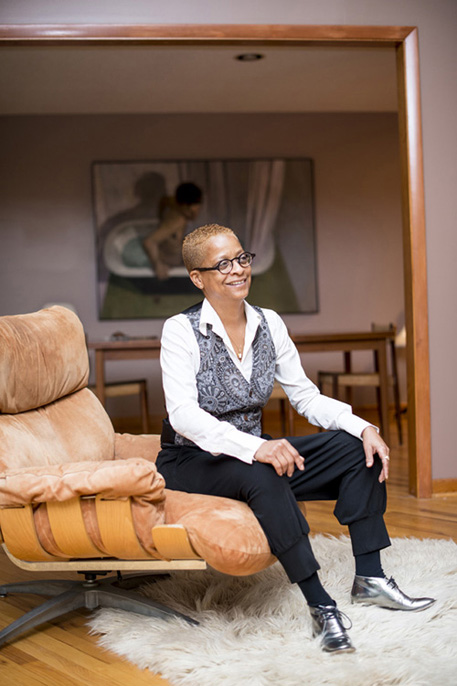
a wonderful photographic spread highlighting three incredibly fashionable (and smart) black faculty members across the
US--including a former colleague,
Sharon P. Holland, who now teaches at
Duke University--who might be said to fall into the "dandy" category. In the quote below, Sharon brings another aspect of her social performance to the fore: the intersection of race, imitation and gender insubordination. Unsettling, playfully, delightfully, insightfully.
A few photos, with related quotes; enjoy!
 |
Hasan Kwame JeffriesAssociate Professor of history, Ohio State University
"A black dandy...conveys a professional swagger
in the face of racial stereotypes about place
and profession."
(Photo by David Bernstein for The Chronicle) |
 |
Sharon P. HollandAssociate Professor of African and African-American Studies
Duke University
"A black dandy unsettles, but always playfully.
You might say, 'Is it a man or a woman?'"
(Photo by Lisa Gotwals for The Chronicle) |
 |
Ernest L. GibsonAssistant Professor of English
Rhodes College
"As a person of color, I feel that
I must be 10 times more invested in
how I present myself aesthetically
to my students and colleagues."
(Photo by Lance Murphey for The Chronicle) |