Showing posts with label French poetry. Show all posts

Wednesday, August 10, 2016

Yves Bonnefoy (1923-2016) + Translation

Yves Bonnefoy at the Collège de France in 2001
(The Telegraph/AP/Getty)

On July 1 of this year, one of the most important--arguably the most important--late 20th century poets of the French language, Yves Bonnefoy--passed away in Paris. Bonnefoy remains little known in the US, I would venture from anecdotal evidence, even though he spent significant amounts of time here, even teaching for a while at a number of universities, including Brandeis, Johns Hopkins, Connecticut, Yale, Williams, and the Graduate Center of the City University of New York; unlike a number of his Francophone contemporaries, his poems are fairly accessible, if quite distinctive from the mainstream of Anglo-American poetics, and most can be found in translation too. In 1981, he was awarded the chair in poetry at the august Collège de France, and taught there for the remainder of his career.

A native of Tours, Indre-et-Loire, France, and an associate of the Surrealists, Bonnefoy might be thought of as the second generation of that movement, though he declined to sign one of their manifestos in 1947, and his poetry stands as testimony to a rather different approach to composition and image-making, even if the Surrealist and prior French influences, including Symbolism, are evident in it. Bonnefoy was not just a major poet, however; he published copiously, creating an imporessive oeuvre that includes criticism, biography, and fiction. One of his chief foci was art history. His book-length prose works include biographies of Alberto Giacometti and Francisco Goya. He also was a translator, primarily of Shakespeare's plays, as well as notable poets including John Donne and W. B. Yeats.

Bonnefoy's first book, Du mouvement et de l'immobilité de Douve, usually translated as On the Motion and Immobility of Douve, though I like the English cognate "movement" better, heralded his entry into the world of letters. It is, like all of his work more or less, a series of highly lyrical, often haunting appeals, alternating between abstract and concrete language, that when read aloud possesses the air of song. Even the book's title is melodic, rhyming, consonant: Bonnefoy signals Douve's presence before calling her name forth in that initial "Du [m]ouve[ment]." I find that so much of his poetry carries this linguistic-semantic resonance, so that even at its most abstract, it is still conveying, in indirect ways, a surplus of meaning.

Nevertheless, Bonnefoy's poetry may puzzle people grounded in the English and American traditions of poetry that is almost always about someone, something, some place, using specific, non-abstract language. This is, in fact, one of many an introductory poetry class will warn budding poets against; alluring as the examples of a Mallarmé or Supervielle--to pick a different generation of poetry--may be, too much abstraction does not a good poem make, even though there are traditions within US poetry in which abstraction flourishes. Bonnefoy's poems often charge the abstraction with a background conflict--a quest, a battle, loss--and dream-like movement, giving them inherent drama that keeps the reader engaged. With Douve, one of the most basic questions is, who is this person to whom the poetic speaker is writing? Who or what is a "Douve"? That alone made me want to read and decipher that text.

8 years ago I had the pleasure of translating a short catalogue essay, on the work of my dear friend J. Eric Hamel, by Bonnefoy, but I have never translated his poetry before. Here, therefore, is my rough translation of my favorite poems of his, "Vrai nom," from his first book. If you read French, you can both see and hear the music, but even if not, try the words and listen to what you hear.  Please forgive any felicities, and do offer your thoughts if you'd like. In tribute, RIP, Yves Bonnefoy!

TRUE NAME

I will name desert this castle that you were,
Night that voice, absence your face,
And when you fall in the barren earth
I will name nothingness the lightning that bore you.

Dying is a country that you loved. I come
But eternally by your dark roads.
I destroy your desire, your form, your memory,
I am your pitiless enemy.

I will name you war and will take
for myself war's liberties and will hold
in my hands your obscure and well-traveled face,
In my heart this country which illuminates the storm.

To appear the deep light requires
an earth profligate and broken by the night.
From a shadowy wood the flame grows bright.
The word itself needs substance,

An inert shoreline beyond all song.
You must overcome death so that you can live,
Blood spilled is the purest presence.

Copyright © John Keene, all rights reserved.

And the original French:


VRAI NOM

Je nommerai désert ce château que tu fus,
Nuit cette voix, absence ton visage,
Et quand tu tomberas dans la terre stérile
Je nommerai néant l'éclair qui t'a porté.

Mourir est un pays que tu aimais.
Je viens
Mais éternellement par tes sombres chemins.
Je détruis ton désir, ta forme, ta mémoire,
Je suis ton ennemi qui n'aura de pitié.

Je te nommerai guerre et je prendrai
Sur toi les libertés de la guerre et j'aurai
Dans mes mains ton visage obscur et traversé,
Dans mon cœur ce pays qu'illumine l'orage.

La lumière profonde a besoin pour paraître
D'une terre rouée et craquante de nuit.
C'est d'un bois ténébreux que la flamme s'exalte.
Il faut à la parole même une matière.

Un inerte rivage au delà de tout chant.
Il te faudra franchir la mort pour que tu vives,
La plus pure présence est un sang répandu.

Copyright © the estate of Yves Bonnefoy, 2016. All rights reserved.

Thursday, March 19, 2015

Translation: Poems: Sunjata


Last summer, one of the books I picked up while in France at the James Baldwin: International Traveler conference in Montpellier was Sunjata's Sabir: Slam Poésie, published by Vents d'ailleurs in La Roque-D'Anthéron in 2014. The publisher's name means Winds from elsewhere, and the town, which I had to look up, is a "commune in the Bouches-du-Rhône department in southern France," according to its Wikipedia page, not far to the east of Montpellier. I knew nothing about the writer, but his name, invoking the great king and founder of the Empire of Mali, and the book's title, with the first word translated as "mumbo jumbo," followed by the appellation "slam poetry," caught my attention, so I picked it up. Searching online, I found another book by Sunjata, Kalachnikov Blues, a 2009 detective novel issued by the same publisher.

Sunjata, it turns out, is the pen name of Soumaïla Koly, a writer, musician, filmmaker, producer, and actor of Ivorian descent born in 1971 in Paris. His education in theater began in the troupe Kotéba d'Abidjan, with whom he began acting while still a child, and he later studied at the Université Paul-Valéry de Montpellier and Louis Lumière in Paris. Sunjata has released three hip hop CDs, two solo with the music company Blaxploitation, and one with the group Liste noir (Black List) from Artikal/Night and Day, and has directed several documentary films. The novel received the 2010 Prix Littéraire Continental in the New Talent category. Since 2013 he has been the spokesperson for the city of Lodève, and director of L'Espace Nelson-Mandela there. 

A glance through Sabir: Slam poésie indicates that all of the poems are meant to be performed live. Reading a few aloud, I can hear their close relationship to American slam poems. They utilize similar internal rhythms and rhymes, with often razor-sharp wordplay, and most aim to make strong political statements. In sum they differ from the various conventions of French poetry that I usually have encountered, especially in translation. They are clearly spoken-word poems, with the speed and force of that genre, and some are quite powerful. I have chosen one that does not rely so much on verbal play but which is far more straightforward and represents an overt diasporic gesture. 

One of the points that I made during my comments on race and translation at the Thinking Its Presence panel organized by Jen Hofer was that in the Anglophone world--and this includes the Anglophone African Diaspora, including Black Americans--is we have a limited view of the lives of other Black people across the globe in part because so few of their works get translated. Music travels, certainly, as does film, but how much--and how little--do we know about the world in which someone like Sunjata lives? We can infer a great deal from the parallels between French and American society, but what do we lose when we cannot read his words directly, even with the slippages that translation by its nature entails? When one considers the ongoing tensions in Western societies around race, nationality, religion, class, and other identity formations, shouldn't we want to pay a bit more attention? 

At the same time, as the poem below, "Up to Obama" indicates, he is quite aware of Black/American history, the eccentric French spellings notwithstanding (I have left all of the original orthography as it appeared in French, with corrections only in English), and the inspiration and power that he and other Black Diasporic people draw from it. This is not to deproblematize the Obama presidency or its continuation of some of the worst aspects of American imperialism and recolonization, but rather to note that even among his black and brown critics, Obama remains a powerful symbol, in part because of the tradition that made him possible and which he in many ways represents. I'll now end my long introduction and just present Sunjata's poem: "Jusqu'à Obama" (Up to Obama)."

JUSQU'À OBAMA / UP TO OBAMA


La barbe de Lincoln
Le treizième amendement ratifié par le Congrès
Le bicorne de Marcus Garvey
La blackstar line contre vents et marées
Le reniement de la nationalité américaine de Web Du Bois
Le manteau de Rosa Parks
La moustache de Martin Luther King
La bague de Malcom x
Le visage tuméfié de Rodney King
Les lunettes de Malik el Shabazz
L'afro de Stokely Carmichael
Le poing levé des athlètes de Mexico
L'assissinat de JFK
Les freedom riders de Montgomery
L'assissinat de Martin Luther King
L'assissinat de Malcom x
Le cuir noir du Black Panthers Party
Le dashiki de Ron Karenga
L'impudence de Cassius Clay
L'impudence de Mohamed Ali
Rumble in the jungle
Ali/Foreman à Kinshasa
Ali boma yé!
Ali tue-le.
Foreman KO en lingala!
Le Vietnam
L'humiliation vietcong
La bannière étoilée se pare de oripeaux du drame,
Les poèmes de Maya Angelou
La NAACP
Huey Newton qui crame
Soul on ice d'Eldridge Cleaver
L'assissinat de Fred Hampton
Mumia Abu-Jamal
La gouaille de Rap Brown
Le cointelpro et l'implacable J. Edgar Hoover
La répression des droits civiques à Jackson
Le sacerdoce du révérend Jesse Jackson
Le black business d'Andrew Young
Les soul fictions de Chester Himes
Say loud i am black proud
La blackpoitation de John Shaft
Le groove rageur d'Isaac Hayes
Gil Scott Heron
Devines qui vient dîner ce soir?
Un noir!
Sidney Poitiers estampillé blackstar
Le noeud pap' d'Elijah Mohamed
Le délire de Louis Farrakhan
Oprah Winfrey Show
Cosby Show
La geste de la liberté de l'Alabama à l'Obama.
The beard of Lincoln
The Thirteenth Amendment ratified by Congress
The cocked hat of Marcus Garvey
The Blackstar Line against winds and tides
The renunciation of American nationality by W. E. B. Du Bois
The coat of Rosa Parks
The mustache of Martin Luther King
The ring of Malcolm X
The swollen face of Rodney King
The glasses of Malik el Shabazz
The afro of Stokely Carmichael
The raised fists of the athletes in Mexico
The assassination of JFK
The Freedom Riders of Montgomery
The assassination of Martin Luther King
The assassination of Malcolm X
The black leather of the Black Panther Party
The dashiki of Ron Karenga
The impudence of Cassius Clay
The impudence of Muhammad Ali
Rumble in the Jungle
Ali/Foreman in Kinshasa
Ali boma yé!
Ali kills him.
Foreman KO'ed in lingala!
Vietnam
The Vietcong humiliation
The Star-Spangled Banner adornes itself with dramatic rags
The poems of Maya Angelou
The NAACP
Huey Newton who's burning up
Soul on Ice by Eldridge Cleaver
The assassination of Fred Hampton
Mumia Abu-Jamal
The joaning of Rap Brown
Cointelpro and the implacable J. Edgar Hoover
The repression of Jackson's civil rights
The vocation of Reverend Jesse Jackson
The black business of Andrew Young
The soul fictions of Chester Himes
Say it out loud, I'm black and I'm proud
The blacksploitation of John Shaft
The angry groove of Isaac Hayes
Gil Scott-Heron
Can you guess who's coming to dinner?
A black man!
Sidney Poitier stamped as a black star
The sacred knot of Elijah Muhammad
The madness of Louis Farrakhan
Oprah Winfrey Show
Cosby Show
The gesture of liberty from Alabama to Obama.

Here is a different sort of poem from the same volume. It has such swift and playful rhymes and homophony (début/eut/haut/beaux/débats/débit, etc.), along the lines both of hip hop and (in)famous French writers like Paul Verlaine ("Chanson d'automne") and Raymond Roussel it would be almost impossible to render perfectly into English. Here's a rough version, with some English-language music to parallel, however poorly, the French.

PALABRES / PALAVER


Au début il y eut
Des hauts des bas
Des beaux débats
À haut débit
C'était de bons débuts
Des baux des buts
Des bruits d'ébats
De gros débris
Des bris des bras
Des gros dégâts
Des aaah!!! des oooh!!!
Face au tourment des maux
Le détournement des mots
Contournement des maux
Desmotscratie des parlementeurs
Qui parlent et m'enterrent
Palabreurs, palabrant pas à l'abri
À l'abri des malappris
Palabres n'est pas bon.
At the start there were
Some highs some lows
Some great debate
At the peak flow
It was a good debut
Some lease some goals
Some lovemaking sounds
A lot of debris
Some shards some arms
Tremendous harm
Some aaahs!!! Some ooohs!!!
Facing pain's agony
The diversion of words
Suffering's contortions
Wordocracy of parliamentarians
Who speak and bury me
Palaverers, palavering not in a refuge
hidden from the misunderstood
palaver isn't good.


Copyright © Sunjata, from Sabir: Slam poésie, La Roque-d'Anthéron, France: Vents d'ailleurs, 2014, 2015. Translation copyright © John Keene, 2015.

Saturday, April 06, 2013

Poem: Charles Baudelaire


Whenever I think of Charles Baudelaire's The Flowers of Evil (Les fleurs du mal), which rattled Francophone poetry when it initially appeared in 1857 and which continues to resound in that and other literary traditions up through today, I associate it with the nocturnal. That is, with things that occur at night, darkness and darkened streets, alleys, rooms--the mind and heart themselves. A glance at the 1857 or expanded 1861 table of contents shows, however, that most of the poems do not treat the night so much as they cast Baudelaire's dark, critical and coruscating poetic light on various aspects of city life, and with a candor that until that time had been quite rare for many centuries in the literature of any country, let alone France.
Baudelaire, a self-proclaimed revolutionary and avant-gardiste, admirer of Edgar Allan Poe and ally of Gustave Courbet, a critic of estimable talent and a post-Romantic figure,knew what he was doing with his remarkable volume, and had to leave out six poems that were thought to have gone too far. As he famously wrote in the prefatory poem, speaking of his reader and himself, "You know him reader, that refined monster / --Hypocrite reader, -- my double, -- my brother," and, as a way of thinking of all the poems in the volume, he notes in my favorite of all his poems, "Correspondences," that "Man passes through forests of symbols / which look at him with familiar eyes"; the poems of The Flowers of Evil represent Baudelaire's poetic journey through those forests and his attempt to record them. The attempt has lost little of his power in the 150+ years since the book first appeared. Here, from The Flowers of Evil, is "Evening Twilight," in two translations. All are taken from the online Flowers of Evil website.
EVENING TWILIGHT

Now is the graceful evening, friend of the criminal;
Now it comes like an accomplice, stealthily; the sky
Closes slowly like a gigantic bedroom,
And Man, impatient, changes to wild beast.

O evening, lovable eveningtime, longed for by him
Whose arms can truthfully say: Today
We have worked! — It is evening that lightens
Spirits consumed by a fierce sorrow,
The stubborn savant whose forehead grows heavy,
And the bent laborer gaining again his bed.

Meanwhile unhealthy demons heavily awake,
Like business men, in the atmosphere,
And fly and strike the shutters and the awning.
Across those lights the wind tortures
Prostitution is ignited in the streets;
Like an ant-hill she opens her escapes,
Spawning all over a secret path,
Like an enemy's sudden attack;
She stirs on the breast of the city of dung
Like a worm that steals his meals from Man.
Here and there one hears kitchens hissing,
The screaming of theatres and orchestras roaring;
The plain tables, where gambling throws its pleasures,
Fill up with bawds and cheats, accomplices,
And thieves, who know no truce nor grace,
Soon go to get to work, they also,
Depart to force gently safes and doors
For a few days' living and to clothe their mistresses.

Reflect, O my soul, in this most solemn time,
And close your ears to this roar.
It is the hour when the sorrows of the ill are sharpened.
Dark Night grips them by the throat; they fulfill

Their fate and move into the common whirlpool;
The hospitals are full of their sighing. — More than one
Will no more come back to seek the perfumed soup,
Beside the fire, at night, by a beloved soul.

Still most, most of them have never known
Home's sweetness nor have they really lived.

— Geoffrey Wagner, Selected Poems of Charles Baudelaire (NY: Grove Press, 1974)

 Twilight

Behold the sweet evening, friend of the criminal;
It comes like an accomplice, stealthily; the sky
Closes slowly like an immense alcove,
And impatient man turns into a beast of prey.
O evening, kind evening, desired by him
Whose arms can say, without lying: "Today
We labored!" — It is the evening that comforts
Those minds that are consumed by a savage sorrow,
The obstinate scholar whose head bends with fatigue
And the bowed laborer who returns to his bed.

Meanwhile in the atmosphere malefic demons
Awaken sluggishly, like businessmen,
And take flight, bumping against porch roofs and shutters.
Among the gas flames worried by the wind
Prostitution catches alight in the streets;
Like an ant-hill she lets her workers out;
Everywhere she blazes a secret path,
Like an enemy who plans a surprise attack;
She moves in the heart of the city of mire
Like a worm that steals from Man what he eats.
Here and there one hears food sizzle in the kitchens,
The theaters yell, the orchestras moan;

The gambling dens, where games of chance delight,
Fill up with whores and cardsharps, their accomplices;
The burglars, who know neither respite nor mercy,
Are soon going to begin their work, they also,
And quietly force open cash-boxes and doors
To enjoy life awhile and dress their mistresses.

Meditate, O my soul, in this solemn moment,
And close your ears to this uproar;
It is now that the pains of the sick grow sharper!
Somber Night grabs them by the throat; they reach the end
Of their destinies and go to the common pit;
The hospitals are filled with their sighs. — More than one
Will come no more to get his fragrant soup
By the fireside, in the evening, with a loved one.

However, most of them have never known
The sweetness of a home, have never lived!

— William Aggeler, The Flowers of Evil (Fresno, CA: Academy Library Guild, 1954)


LE CRÉPUSCULE DU SOIR

Voici le soir charmant, ami du criminel;
II vient comme un complice, à pas de loup; le ciel
Se ferme lentement comme une grande alcôve,
Et l'homme impatient se change en bête fauve.

Ô soir, aimable soir, désiré par celui
Dont les bras, sans mentir, peuvent dire: Aujourd'hui
Nous avons travaillé! — C'est le soir qui soulage
Les esprits que dévore une douleur sauvage,
Le savant obstiné dont le front s'alourdit,
Et l'ouvrier courbé qui regagne son lit.
Cependant des démons malsains dans l'atmosphère
S'éveillent lourdement, comme des gens d'affaire,
Et cognent en volant les volets et l'auvent.
À travers les lueurs que tourmente le vent
La Prostitution s'allume dans les rues;
Comme une fourmilière elle ouvre ses issues;
Partout elle se fraye un occulte chemin,
Ainsi que l'ennemi qui tente un coup de main;
Elle remue au sein de la cité de fange
Comme un ver qui dérobe à l'Homme ce qu'il mange.
On entend çà et là les cuisines siffler,
Les théâtres glapir, les orchestres ronfler;
Les tables d'hôte, dont le jeu fait les délices,
S'emplissent de catins et d'escrocs, leurs complices,
Et les voleurs, qui n'ont ni trêve ni merci,
Vont bientôt commencer leur travail, eux aussi,
Et forcer doucement les portes et les caisses
Pour vivre quelques jours et vêtir leurs maîtresses.

Recueille-toi, mon âme, en ce grave moment,
Et ferme ton oreille à ce rugissement.
C'est l'heure où les douleurs des malades s'aigrissent!
La sombre Nuit les prend à la gorge; ils finissent
Leur destinée et vont vers le gouffre commun;
L'hôpital se remplit de leurs soupirs. — Plus d'un
Ne viendra plus chercher la soupe parfumée,
Au coin du feu, le soir, auprès d'une âme aimée.

Encore la plupart n'ont-ils jamais connu
La douceur du foyer et n'ont jamais vécu!


Monday, September 10, 2012

Poem & Translation: Paul Verlaine + Reading at NY Botanical Garden

The bridge over the recreated pond
The bridge over the lily pond
Though I have many pots in the kiln right now, I did not want to let more than a week elapse since an I reported on an event I participated in at the majestic New York Botanical Garden, which is located in the Bronx: the final reading in the Poetry Society of America's Monet to Mallarmé series, this one dedicated to the poems of Paul Verlaine (1844-1896), the symbolist master, queer pioneer and among the truest musicians of French lyric poetry.

This past Sunday, introduced by PSA's Charif Shanahan, poets, critics and translators Patrick Phillips, Charles Ruas and I read just yards from the Botanical Garden's exhibit and recreation of Claude Monet's garden at Giverny in its Enid Haupt Conservatory. Each of us drew from the rich archive of Verlaine's works. I elected to read both in French and in English, with the translations all by Martin Sorrell.  Patrick Phillips focused on Verlaine's romantic poems, while Charles Ruas explored Verlaine's work after he was sentenced to prison for his 1873 shooting of Arthur Rimbaud (1854-1891), the young seer among poets with whom Verlaine fell madly, crazily in love, one of several amours fous that marked Verlaine's life.

Here is one of the poems I read, certainly one of Verlaine's most famous and exquisite, "Chanson d'automne," or Autumn Song. It is nearly untranslatable, in part because in any other language, including French's Romance cousins, it loses so much of its innate homophonous, rhyming, and assonant music, beginning with the first stanza's vowel sounds ("automne," "monotone"), some very nasal ("sanglots longs"), but all of which mimic and embody the "monotonous" music of (Autumn's) violins. Nevertheless, here is the poem, and my admittedly crude translation. Autumn nevertheless is upon us, and so Verlaine's gem feels right.  If you are in New York and are thinking of an interesting trip outside Manhattan and Brooklyn, the Botanical Garden is only 20 minutes by train from Grand Central Station, about $3.75 (I think) each way, and recreating Monet until October 21, 2012!

CHANSON D'AUTOMNE
Les sanglots longs
Des violons
De l’automne
Blessent mon cœur
D’une langueur
Monotone.

Tout suffocant
Et blême, quand
Sonne l'heure,
Je me souviens
Des jours anciens
Et je pleure

Et je m'en vais
Au vent mauvais
Qui m'emporte
Deçà, delà,
Pareil à la
Feuille morte.
Poem by Paul Verlaine (1844-1896). It initially appeared in his first collection,Poèmes Saturniens, in 1866.

AUTUMN SONG
The drawn-out sobs
Of the violins
Of autumn
Wound my heart
With a languorous
Boredom.

All worked up
And pale, when
The hour nighs
I recall
Days of old
And I cry

And I'm off
On an ill wind
That carries me
Hither, thither
Just as with a
Fallen leaf.


Copyright translation © by John Keene, 2012.

Here are a few photos from the Monet's Garden exhibit. Enjoy!
UPDATE: A photo from Charif Shanahan/PSA:

A listener, Phillips, me, Ruas, at the event


Photos (by me)
Enid Haupt Conservatory at New York Botanical Garden
In the NY Botanical Garden's Monet's Garden Exhibit
The NY Botanical Garden's Monet's Garden Exhibit
Flowers at the NY Botanical Garden's Monet's Garden Exhibit
The pond
Bamboo stalks
Flowers at the NY Botanical Garden's Monet's Garden Exhibit
Une abeille!

Tuesday, July 12, 2011

Translation: Poem: Stéphane Mallarmé

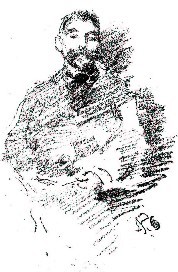
Mallarmé, by Whistler, 1893
I really did think about posting about the various things happening today (the debt limit talks fiasco; the Major League All Star Game in anti-immigrant pacesetter Arizona; the primaries in Wisconsin, in which the real Democrats defeated the fake Democrats; the unfolding News International/News Corporation scandals, etc.), but instead I'm going to post a translation I undertook earlier this afternoon during a break from writing fiction (i.e., a novel, which has nothing to do with the poem below). It is my rendering of one of the more celebrated later sonnets by Stéphane Mallarmé (1842-1898), a poet who needs little introduction.  One of the things that intrigued me early on and still does about Mallarmé, among his many poetic distinctions and triumphs, was his willingness to prioritize sound over sense, or the music of language over the usual semantic approaches to meaning that were predominant in his day (and still hold sway in most poetic precincts as I type this entry). This direction, emphasizing music over meaning, linked to a post-Romantic, intricately developed symbolic register, made possible, as students and readers of modernist literature know, the sorts of poetic innovations that would appear across a range of languages.  He anticipated--and wrote--the poems and books to come even as he dreamed of writing the Poems and Books to Come.

In the translation below, which I have always loved, and which I sent earlier to some poet friends, I tried to retain some semblance of a rhyme scheme, which given the poem's aural structure and specific phonemes, is impossible; Mallarmé's final "i" and "ui" sounds, almost a kind of piercing bell--'eeeee'--cannot be captured in English, so I went for long vowels, with a few short ones in those places where nothing else was possible, and consonance in the final two stanzas (the "s" sounds) to mirror the rhyming. Also, in terms of the content itself, in some cases I took leaps ("flow" for "flee," "it is itself alone," for "it is he,"  "which to it says no" for "it denies it," "seized" for "taken," etc.), following the leads of a colleague and great translator who, in a number of discussions and papers, has led  me to think a lot more about how important it is to think with even greater complexity about translation and what might be carried over and created in the target language. One task I set for myself upon reading Mallarmé's poems like this one was to trace out an argument, thematic or lyric arc, or narrative. Can you figure this one out? Can you trace out the symbols?  I have a book in Chicago, Towards the Poems of Mallarmé (California, 1980), by Robert Greer Cohen, that explores this and similar poems in depth, in case you want to see a scholar's take. I think, that devotes a I think it's clearer than some of his poems, like the famous sonnet "Ses purs ongles....", also known as the "Sonnet ending in -yx", for example. At any rate, here is pale echo, for I do love this poem, in its infinite strangeness.

THE VIRGIN, THE VIVID AND THE BEAUTIFUL NEW DAY

The virgin, the vivid and the beautiful new day
Will it tear apart with a drunken wing's blow
This forgotten hard lake haunting beneath the frost
the transparent flights' glaciers which did not flow!

A swan of yesteryear remembers it is itself alone
Magnificent but without hope of freeing itself
For having not sung the region where it dwelt
When the boredom of sterile winter shone.

Its whole neck will shake off that white agony
Inflicted by space on this bird which to it says no
But not the soil's horror in which its plumage is seized.

Phantom which its pure brightness here assigns,
it is immobilized in the cold dream of scorn
that enfolds amidst useless exile the Swan.

***

LE VIERGE, LE VIVACE ET LE BEL AUJOURD'HUI

Le vierge, le vivace et le bel aujourd'hui
Va-t-il nous déchirer avec un coup d'ail ivre
Ce lac dur oublié que hante sous le givre
Le transparent glacier des vols qui n'ont pas fui!

Un cygne d'autrefois se souvient que c'est lui
Magnifique mais qui sans espoir se délivre
pour n'avoir pas chanté la région où vivre
Quand du stérile hiver a resplendi l'ennui.

Tout son col secouera cette blanche agonie
Par l'espace infligée à l'oiseau qui le nie,
Mas non l'horreur du sol où le plumage est pris.

Fantôme qu'à ce lieu son pur éclat assigne,
Il s'immobilise au songe froid de mépris
Que vêt parmi l'exil inutile le Cygne.

From Stéphane Mallarmé, Poésies, 1887. Translation © John Keene, 2011.