Sunday, August 13, 2006

Blog Roundup

Just a few of the many::

Yesterday, we celebrated C's birthday: Happy Birthday again, Baby!

Kari at Transdada has an interesting news roundup that doesn't leave out the "T" in LGBT, as so often happens.

Bernie has one of the most thoughtful discussions I've seen about the upcoming new season of The Wire (which won't be the same without Idris Elba's "Stringer Bell").

EJ returns from a week's hiatus with a mix that brings back some great memories. (Mantronix, Mantronix, Mantronix....)

Treasure haikus about "Black men's backs". Here's mine:

Summer's heat waning
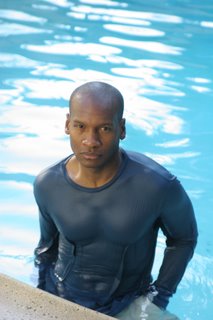
Shirts recover broad dark backs
Remember and smile

Juan José Martínez's compressed haiku en español.

Tayari opens her blog to novelist Eisa Ulen.

Nalo writes about the Amorphophallus plant, which I wanted to...uh, smell.

Update: Rod has one of his outstanding, hilarious writeups of Noah's Arc.

Audiologo is doing it (damn!)
with a superb post on the politics of (Black women's) hair and Cynthia McKinney's recent loss to Hank Johnson in Georgia.


Friday, August 11, 2006

Quote: Senal Paz

Perhaps the new angle we have found is that of the imagination, of fantasy, and we opted for a literature weighed more heavily towards the imagination and a narrative more responsive to poetry...We have softened the tone of our literature: it is now more tranquil, lighter, more self-searching and intimate, less marked by the impact of the plot and subject matter, but having gained in reflection. There is more concern with the trivial pursuit of everydayness and also, and in this we agree, with the ethical preoccupations that stem from the construction of socialism.
--Senal Paz, in Emilio Bejel, ed. Escribir in Cuba: Entrevistas con escritores cubanos, 1979-1989 (Puerto Rico: Editorial de la Universidad de Puerto Rico, 1991)

Thursday, August 10, 2006

Noah's Arc (Runs Ashore) Anew

StephensThey're back, and unfortunately, no better. C and I did watch it all the way through (even though Project Runway also was on, and Michael Knight from Atlanta was designing a stunning Pam Grier-inspired number that won that episode's challenge). As with the first season, Noah's Arc has enough cute outfits and 'dos, some witty repartee, and enough eye candy to fill a small house party, but the problem is, it's the same preposterous storylines, goofy acting, and...oh well, see it for yourself. I just wish that someone would teach lead actor Darryl Stephens (Noah, at right, from Logo Online) a few more facial expressions; he always seems on the verge of giggling when he should be looking serious, and the trembling lip and rocking should have gone out with Sybil. He's like Carrie Bradshaw crossed with Joan Clayton, with a bit too much Gidget Lawrence tossed into the mix. I'm willing to believe cartoon-like versions of Black gbt men like this are out there, but please, try a bit harder to convince your viewers--acting is an art! Anyways, they're back, and all sorts of celebrity hotties, among them Season One veteran and talented actor Wilson Cruz, will be making guest appearances. At this point, that's the only reason I can find for continuing to watch this show.

Random photo

Artist at work, Doma, West Village

Wednesday, August 09, 2006

2006 Elections: Take 2

LamontThe good little right-listing ship Lieberman has sunk. By a margin of roughly 52%-48%, the Democratic voters of Connecticut made it clear last night that they wanted a change of direction, in the person of Ned Lamont (at right, WFSB), the cable company executive whose critique of Joe Lieberman's deepening attachment to the Bush administration's bad policies and politics, especially the Iraq War, brought him from the polling abyss to victory over the well-funded, widely endorsed, political-machine backed incumbent.

Lieberman, in a concession speech last night that was indicative of his entire campaign, refused to step out of the race and after inverting his and his opponent's ideological perspectives, immediately announced that he would run as an "Independent Democrat" (even though using the latter term may be a violation of Connecticut state law), but he also spouted pro-Republican talking points that his friends in the Bush administration, including Karl Rove, Dick Cheney, RNC head Ken Mehlman, Bush's spokesman Tony Snow, and Bush himself, quickly seconded. Cheney even gave a rare press conference to affirm his support for Lieberman. Their main coordinated point was that Lamont's dramatic and important win, a confirmation of netroots activism and little "d" democracy, was somehow a danger not only to the fortunes of the Democratic Party in 2006, but to the US itself. Lamont and his supporters (including yours truly) were "far left activists," extreme "partisans," "wackadoos," Al Qaeda-enablers, etc. The future of America and the free world, to these testerically inclined folks, hinged on Lieberman winning that primary. Fortunately a slim majority of Connecticut's registered Democratic primary voters didn't buy this rhetorical nonsense; and given that 60% of Americans polled want a pullout of some sort (phased, immediate, you name it), it's likely most Americans won't either. Lieberman, like Bush & Co, is on the wrong side of this issue, but he has gone even farther in his hawkishness and delusion, claiming as recently as two months ago that the situation in Iraq was great, even as the carnage caused by the terrorists and the civil war was worsening. Whether this was denial, delusion, willful or passive ignorance or some combination of these I don't know, but the assessment spoke very poorly on his judgment.

But Lieberman, who was a lackluster Vice Presidential candidatewhen he ran with Al Gore in 2000 (I really wish there were studies exploring whether there was any correlative effect between his presence on the ticket and Gore's low or close vote totals in Southern and Midwestern states), has repeatedly been on the wrong side of issues, which is also why he lost the Democratic presidential nomination in 2004 and why he lost this primary battle. He hemmed and hawed on the Social Security privatization boondoggle before finally stating that he was against it; he voted for cloture for Justice Samuel Alito, allowing the full Senate vote to go forward, before voting against Alito; he voted for cloture for the bankruptcy bill, one of the worst pieces of anti-consumer legislation to come along in years; he supported the awful, intrusive Terri Schiavo legislation that the far right in the GOP were pushing; he was pro-NAFTA and CAFTA; and on and on. Of course other Democrats have voted along the same lines on some of these issues, but they aren't in primary battles and might represent more conservative constituencies than Lieberman. On top of all of this, he suggested that women who needed the morning after pill, if denied it at one hospital, could find away to convey themselves to another one, a particularly troubling comment at a time when non-rich women's access across the country to safe legal abortions is under intense attack, and when some conservatives are also pushing to restrict access to contraceptives like Plan-B and to other medications that may protect women's reproductive health. He has repeatedly spoken against affirmative action, and attempted to play racial politics against Lamont, though it backfired. George Bush has called him his "favorite" Democrat for a reason. Although Lieberman's overall "liberal" ratings are high (at least within the context of the current Congress), on key issue after key issue, this darling of Hannity and Limbaugh has often had to be pulled back towards the mainstream of the Democratic Party. Lamont, if he wins in November, however, will be in the center-left of the party as it's now constituted. A Lamont win is hardly certain, but the primary victory was a great step.

McKinneyIn one of the other high-profile Democratic primaries, incumbent Georgia Congresswoman Cynthia McKinney (at right, AP Photo) lost to challenger DeKalb County commissioner Hank Johnson by 59%-41%, making Johnson a lock for the November election. I actually didn't follow this primary race that closely, but I do know that on a wide array of issues McKinney has been one of the most progressive members of the Democratic caucus, which, along with her relentless criticism of President Bush and her pro-Palestinian outspokenness on Middle East politics, has long made her a target for ouster. I remember when she was defeated four years ago by Denise Majette, shortly after publicly questioning the Bush administration's prior knowledge of the 9/11 attacks, only return to office in 2004. After her run-in earlier this year with the Capitol police, which led to her having to issue a public apology, I thought she might again find herself facing a primary challenge. I've seen ads for Johnson on some of the centrist and left-leaning blogs, and only know that while he isn't as outspoken and progressive-liberal on a number of issues as McKinney, he has vocally criticized the Iraq War and other Bush administration policies. Perhaps someone more familiar with this race can tell me more about him and some of the dynamics, but I do think that outspoken people of color, and especially Black women, are always political targets. McKinney, who has been criticized for her outfits, her hair, her comments, and her general attitude, sometimes to outrageous extremes (cf. Neil Boortz), was back in the crosshairs from the minute she reclaimed her office in 2004. I'm hoping that Johnson doesn't become a night-blooming cereus once he takes office.

Update: I see that McKinney's fellow Democrats have been "mum" about her loss. Something tells me they probably didn't shed a tear when they heard about Johnson's win.

In one other race that caught my attention, minister Keith Butler lost to Oakland County Michael Bouchard 60%-40% in the Michigan Republican primary, and so will not have the opportunity to face incumbent Senator Debbie Stabenow. Many pundits spouting the conventional wisdom claim that the energized extremist branches of each party dominate primaries, but this is too formulaic, particularly when race enters the mix. Butler was decidedly more conservative than Bouchard, and could actually have drawn votes in the Detroit and Grand Rapids areas from Stabenow in a general election, but instead, Michigan's Republican primary voters did not tilt so far right (and Black) and selected Bouchard, who'd originally dropped out of the race but who jumped back in after some cajoling by National Republican Senatorial Committee Chairwoman Elizabeth Dole. This seriously undercut the campaign of Butler, who was touting himself as the choice of evangelicals, conservatives and hunters. Bouchard is still light years more conservative than Stabenow, trails in campaign funding, and has an uphill climb.

Random photo

A FilemakerPro class at the Apple Store in Soho

Monday, August 07, 2006

2006 Elections: Take 1

Are Black Candidates for 2006 Statewide and Federal Offices Longshots?
Looking over the electoral map for this fall, it struck me today that one thing I haven't really read anyone saying (though I'm sure some bloggers probably already have) is that this will probably be a bad year for most of the Black candidates running for statewide and federal offices. The reason behind this is that in the cases of Black candidates for state and federal posts, it's the wrong candidate with the wrong politics for the wrong post. Though the Democrats have become resurgent in Congressional and even state generic polls after nearly six years of disastrous one-party Republican rule in Washington, the Democrats who're running for the federal positions (US Senate) are not the best fits for the electorate they're trying to woo, while the Republicans, almost to a person, represent a party whose ideology and policies--if not politics and political handiwork--have proved miserable failures in terms of governance and stability.

In terms of the Democrats, take for example the two open Senate seats in which Black candidates are running: Tennessee and Maryland. In Tennessee, a very conservative Democratic, Harold Ford Jr., is running to fill the seat being abandoned by Senator Majority Leader Bill Frist. Tennessee has trended Republican for a decade, and its last Democratic senator was former Vice President Al Gore, who, during his Senate tenure, was fairly conservative. Ford, who as recently as the past year said that he "loved" George W. Bush, and who has been subjected to a steady stream of racist attacks (which fixate on his friendship with White women), will face Republican former Chattanooga mayor Bob Corker, who is to the left of many Southern Republicans, but about on par with Ford in terms of ideology. This disadvantages Ford, because if the mostly non-Black Tennessee electorate has the choice of two candidates with similar beliefs, they are probably going to choose the non-Black candidate, especially if Corker is able to straddle his party affiliation with the sense that he's not so intimately tied to the far right of the Republican Party. (Effectively, however, once he reaches Washington he will likely serve as a rubber stamp for whatever Bush and that party want.) I'm not exactly convinced that Ford could have won under any circumstances other than facing a far-right extremist who also happened to be Black, like Alan Keyes (as Barack Obama did), but he's definitely going to have a very hard time defining himself as the better option in his run against Corker. Were he to win, it would be a major upset and a noteworthy referendum against the current national state of affairs.

In Maryland, it's a different issue. A liberal-progressive Democrat, Kweisi Mfume, who formerly headed the NAACP, is one of the frontrunners in a primary battle against a moderate Democrat, Ben Cardin. Either of them will probably win Democratic primary and then face Republican Michael Steele, the African-American current lieutenant governor and protegé of Maryland's unpopular GOP governor Bob Ehrlich. Mfume probably would have had much smoother sailing had allegations of sexual harassment in his former post not come to light, and yet he leads the politically incompetent Steele, who has advanced spurious narratives about being pelted with Oreos, compared stem cell research to the Holocaust (he apologized for doing so), and was recently unmasked as the unnamed Republican who trashed Bush and his party to a pool of Washington reporters, though he immediately backtracked when his identity was revealed. His ineptitude seems to know no bounds, and he's on the wrong side of multiple issues. While it's pretty clear that Cardin, if he wins the primary, will defeat Steele handily in a Democratic-leaning state, given the fact that Maryland has one of the highest percentages of Black residents in the US, a progressive Black Democrat with none of Mfume's personal baggage could probably also have been elected by a blowout comparable to Obama's in Illinois in 2004.

The Democrats could have found some viable Black candidates to run in other Senate races; in Minnesota, to replace retiring Senator Mark Dayton (Democrat Amy Klobuchar leads that race); in Rhode Island, to face faltering candidate Lincoln Chafee; or in New Jersey, had governor Jon Corzine nominated state representative Nia Gill, which he very well may do in 2008 when senior Senator Frank Lautenberg, who's in his 80s, very likely steps down. As it is, Obama could have two colleagues, both from former slave states, though it's increasingly looking like he will be the only African American and one of only a handful of people of color in the US Senate for the near future. In statehouse races, the Democrats also haven't advanced many Black candidates, though many of their candidates this year are moderate incumbents--a decent number of women--who probably will be reelected, including in red states such as Kansas and Arizona.

In Michigan, conservative and former city councilman Reverend Keith Butler is vying for the Republican seat to face incumbent Democratic Debbie Stabenow, who defeated incumbent Senator and former Secretary of Energy Spencer Abraham in 2000. Despite the large pool of Black voters in Detroit and its environs, as well as in the western part of the state, Butler is too far to the right and will probably lose to Oakland County sheriff Michael Bouchard; in most polls he's still trailing Stabenow, who has reliably voted with the Democratic caucus and against the Bush administration's policies. Were Butler more moderate, he might actually win the nomination, and could give Stabenow a run for her money, since Michigan's once popular Democratic governor, Jennifer Granholm, is in the political fight of her life, and Democrats are being blamed for Michigan's stagnant economic situation. As it is, Stabenow is far and away the best option and Butler's chances are slim.

In various gubernatorial races, African-American Republicans who've been touted as potential winners increasingly find themselves out of step with the electorate they're trying to win over. In Ohio, Republican Ken Blackwell has moved so far to the extreme right of his party that the state Republican Party, which is facing multiple political and financial scandals, is not giving him its unmitigated support. Blackwell is alleged to have played a key role in the systematic disenfranchisement of African American and poor voters during the 2004 presidential election in Ohio, so it would be karmic justice if he were to lose this year, though he has been galvanizing support among some Black ministers and other Black voters. To win, however, he'll have to win over most of the non-Black Republicans. With his well known ultraconservative positions on a variety of issues (just a week or so ago he spouted virulent anti-gay comments), can he do it? It thankfully doesn't look good. His opponent, Democrat Congressman, Rev. Ted Strickland, who recently was the object of a GOP-engineered anti-gay smear campaign, leads in the polls.

In Pennsylvania, football Hall of Famer Lynn Swann faces incumbent Democratic governor Ed Rendell. Everything I read by and about Swann's candidacy shows that he has few distinctive ideas or plans for the Democratic-leaning state, which went for Gore in 2000 and Kerry in 2004 (by a smaller margin). Swann appears to be relying on his celebrity and a bland, generic GOP message (low taxes, small government, etc.) to carry him into office, which is one of the reasons he's trailing Rendell by a sizable margin. The unpopularity of the Bush administration and of Republicans in the state legislature are the others. In a different year, perhaps during the final years of Clinton's presidency, when some portions of the Pennsylvania population took a censorious attitude on moral values issues, Swann might have been able to eke out a win, but it's unlikely this time. Rendell has got his number and is going to win.

Although RNC Chair Ken Mehlman has repeated expressed pieties and promises about trying to attract Black voters and candidates, from late 2001 through 2005, when George Bush had positive approval ratings, the Republicans had only one Black member of Congress (J.C. Watts, who stepped down in 2002), and did not field one Black candidate to run for a statewide office in the South, which was the Republicans' strongest region and also where the majority of African Americans (over 5o%), many of with conservative social beliefs, live. Did things change this election cycle? Outside of Steele, Blackwell, and a few others, no. In addition, this year they offered no support to potential gubernatorial candidate Randy Daniels in New York, who would have had an uphill battle against either of the two major Democratic candidates, Eliot Spitzer or Tom Suozzi; but the fact is, the party didn't even put any effort behind his interest in the run. Mehlman's cant seems to be convincing only to (some) fellow Republicans. Because of the Iraq War, the economy, the environment, and a host of other issues things look bleak for the Republican Party at the national level in general this fall, but the situation is bleaker still, I think, for the few Black candidates the party has fielded.

Random photo

Young man on motorcycle reading book, 6th St. and 1st Ave.

Sunday, August 06, 2006

Pride in the City Family Day at Commodore Barry Park

Pride in the City Family Day
Yesterday we dropped by Pride in the City's Family Day gathering at Commodore Barry Park in Brooklyn. I'd never heard of the venue, which is right over the Manhattan Bridge, but I was looking forward to returning to the annual outdoor bazaar and live-music event after a few years' hiatus. Below are a few photos from the afternoon. I was happy to see that the event was more intergenerational than the last few Black prides I'd attended, though I saw fewer women this time than in the past events in Fort Greene or Prospect Parks, and almost no children. It felt like there were fewer booths than at prior New York prides too, though I this could have just been my perception. Another thing C., I and our two friends David and Ndlela noted was that the energy level at this event felt low--the word that initially came to mind was "subdued"--though this could have been because we got there in the (very) late afternoon, after the initial crowds had already passed through and before folks starting showing up after dinnertime. It also could have been because we're all getting older and the excitement of pride celebrations is wearing off, though there were many (maybe half the people there?) people there our age(s). I did run into a number of people, as I always do, including friends and acquaintances from Jersey City, Harlem, Chicago, and everywhere else.

David, Ndlela and C

One of the food tents

One of the social service organization tents

The bazaar from afar

Some of the attendees milling about

At the mainstage

Former 100 Black Men in Law Enforcement head Eric Adams, who's running for a New York State Assembly seat

Friday, August 04, 2006

Protests against Ali's Brick Lane Film + Brazell Fundraiser This Sunday

Neighborhood Protests Film of Monica Ali's Brick Lane
Brick LaneA couple weeks back I read in the Guardian Unlimited that some residents of London's predominantly Bangladeshi Brick Lane neighborhood had organized protests to halt the filming of a movie based on British novelist Monica Ali's critically acclaimed novel Brick Lane. Led by local business leader Abdus Salique, the Campaign Against Monica Ali's Film Brick Lane, which included a threat to burn Ali's book at a rally this past Sunday, forced the film's producer, Ruby Films, to end plans to film on site. Salique and others claimed that the book's depiction of Sylhet Bangladeshis was "racist and insulting," and impugned the "community's dignity and respect," reproducing stereotypes. A subsequent Guardian article mentions that protesters have cited a few excerpted derogatory lines and phrases to buttress their arguments, yet also notes that rumors about the film and the production company's hiring policies also stoked the response. Nevertheless, other Brick Lane residents did not agree with the protests and even some of the campaigners were urging restraint.

Reporter Alan Cowell broadens the view on the protests in the New York Times, relating it to larger discussions in Europe (and elsewhere) about the negotiation between free speech and particular groups' sensitivities to certain kinds of rhetoric and discourse; I would add that the effects of such rhetoric and discourse also are key. (I also thought of the furor surrounding the LIFEbeat concert.) He asks specifically, "Should old Western societies, in other words, rewrite their definitions of liberty to accommodate the sensitivities of others?" The issue goes beyond "old Western societies," though, and involves certain kinds of speech and rhetoric by anyone and any group about or against another. (I am also recalling that another young female British author of South Asian descent's play was shut down after violent protests, but I can't recall either her name or the name of the play.) The stakes are quite high: Cowell cites the murder by an enraged Muslim of filmmaker Theo van Gogh in the Netherlands (which accompanied death threats against Dutch parliamentarian and activist Ayaan Hirsi Ali, who'd made the controversial critique of female subjugation in Islam with him) and the worldwide riots that the Danish newspaper Jyllands-Post's cartoons of Mohammad provoked (and, he notes, the fatwa against Salman Rushdie, q. v.). These are only a few of the more extreme outcomes, and concern religion, but as I said above, one could include other kinds of speech and rhetorical acts, like Beenie Man's, TOK's and DMX's lyrics that extolled murder of LGBTs, or even more generally homophobic lyrics of the sort that appeared on Eminem's and Common's early CDs.

Writers and activists have since come out against the protesters and in favor of the filming. Some, like English PEN's Jonathan Heawood, have even suggested that the anti-film protesters might not have read the book (and were this to be true, they would following a longstanding trend). Critic Germaine Greer took the opposite point of view, however, suggesting in a letter that "writers are treacherous," that Ali might not have taken into account the harm her fictional narrative might have had on residents of Brick Lane, that the British had no sense or concern about the Bangladeshis in their midst anyways, and that the residents had every right to stop the filming. Salman Rushdie riposted by calling Greer's piece "pro-censorship twaddle" that contained "ad-feminam sneers about Monica Ali herself," and he argued that protesters did not the right to decide in advance to halt the production. (The Guardian in a separate article delved more deeply into this exchange.)

Cowell provided the following anecdote to close his piece, but the essential questions remain:

[Rushdie's and Greer's] argument recalled a less public debate in Copenhagen last month when Flemming Rose, the Danish editor who commissioned the contentious cartoons of Muhammad, appeared unexpectedly at a conference of American and European Muslims.

Invited to consider the proposition that freedom of speech did not mean freedom to give gratuitous offense, he said: “In a democratic society, no one can have the right not to be ridiculed.”


Rashawn Brazell Memorial Fundraiser This Sunday @ Chocolate Bar (Bkyn)
DJI received the following email from Larry Lyons:

Greetings!

Please be our guest at our second annual "Brighter Days" party, benefitting the Rashawn Brazell Memorial Scholarship. Last year's event was a blast, and your presence will ensure that this one is even bigger, better and BRIGHTER!

Sincerely,
Larry Lyons and Mervyn Marcano, RBMF Founders

DJing2nd Annual "Brighter Days" Party
Hosted by The Chocolate Bar

This year's event is an official Pride in the City party, co-promoted through People of Color in Crisis and featuring DJ Hard Hittin Harry and C2, so there's bound to be a lively crowd on the dancefloor. Translation: You'll fit right in!

The music? Classics.
The cover? $10
The cause? Our fight against racism, sexism & homophobia.
What other pride party can say that?!?

100% of the donations collected at the door will go toward supporting the work of the RBMF, particularly the $1500 scholarship awarded annually to a college- bound NYC high school student committed to the fight against injustice.

Available to work a 1 hour shift collecting donations at the door? Email info@rashawnbrazell.com today to help us make this event a great one! We'd love to have you.

The Chocolate Bar
45 Waverly Ave
Between Park & Flushing
Fort Greene, Brooklyn
August 06, 2006
8pm-3am

Busy? Click here to send your donation!

Rashawn Brazell Memorial Fund
Post Office Box 211
New York, New York 10037-9998
info@rashawnbrazell.com
http://www.rashawnbrazell.com

About our "Brighter Days" events:
By identifying queer-friendly spaces as viable sites to raise consciousness and build community, Brighter Days events confront and repudiate the stigmas attached to our safe spaces. Further, by providing quality parties with a distinctly celebratory tone, the events also distinguish the vibrant legacy of Rashawn Brazell's life from the bleak shadow cast by his death. Read more about this and other RBMF initiatives by clicking here.

Random photo

Met patron behind Van Gogh's Self Portrait with Straw Hat (1887-88)

Thursday, August 03, 2006

The Field Research Study Group A (3.0>)

Exactly one year ago today I posted the following statement from Field Research Group Study A (2002-):


The Field Research Study Group A is planning to relaunch the "Emotional Outreach Project," which appears to be even more necessary and appropriate today than it was when it was first initiated in 2002-03.

To give you background, the "Emotional Outreach Project" consists of a series of business card-sized vouchers, which I distributed free of charge and with disinterest to individuals, under various controls and using specified variables.

On one side of the cards, in bold black ink and all capital letters, an emotional state, response, stage, trait or process (hate, joy, schadenfreude, cold-bloodness, selflessness, horror, indifference, etc.) appeared, with the clear non-bolded caption "Free Emotional Voucher" beneath it.

On the flip side, originally the cards noted
Dear friend, please accept this emotional voucher. Although it possesses no monetary value, you should feel free to draw upon it at any point, particularly if you believe you lack sufficient personal reserves. Acknowledging and managing one's emotions is crucial to psychological and physical well-being.
In the second version of the cards, quotes on the emotions or the passions of the soul by a range of figures, including Arnold Bennett, Eric Hoffer, Plato, Spinoza, and others, were appended.

The relaunched versions will be similar to the second edition, and a full sheet of cards, printed and signed, will be offered free of charge (to be sent by US Postal Office mail) to the first ten people who 1) express an interest in receiving them, and provide a valid address; 2) agree to provide the name and address of at least one other living person you personally know who should receive 1 (one) of the vouchers [not a sheet]; 3) and in your e-mail stating that you would like to receive a sheet and providing your name and address make it clear that you are suggesting a candidate for positive outreach and not for the purposes of harassment, vandalism, or any other negative or problematic reason (that could be so construed or that violates any pertinent laws or statutes in any states or regions of the United States of America and its legal jurisdictions). Basically, I'd like this stage of the project to benefit those who might appreciate it.

As soon as the first ten people have responded, no further names will be accepted until the next stage of the project. Thank you for participating!

Update: Slowly but surely we're getting there. Please click on the word "e-mail" itself, which is hyperlinked, to sign up!

Unfortunately, things never got to the "first ten" people (with or without the ten additional names) stage, which is crucial. The Field Research Study Group A does have the names of several great people (you know who you are) who wrote in, whom it intends to send the materials to (which have been updated*, though they're not very sexy) once the initial conditions have been met (making this a "potential" artwork at the present time), but let's try again.

fieldresearchstudy
group@yahoo.com

You need only send an email to the address above, as detailed above, and once 10 (only 10) people have done so, this project can proceed. (Your information will not be shared with any third parties.) Some 130+ people checked out this site yesterday, so out of that very large group (thank you!), there must be some who want to be part of an art/work/project.

==
*In its current iteration, participants will also receive a sheet detailing the project, some suggested methods for implementing this new stage, a notebook, a pen, and a SASE. (I cannot afford cameras, but that's another story.) So there's free stuff that comes with it as well!

Other Bloggers Say + Frank Leon Roberts's Looking for Langston(s)

Folks are posting
Steven is saying goodbye to the blogosphere in his inimitable way. For a short time? Forever? I hope not. If and when he comes back, fiercer than before, I'll be reading. I'll particularly miss his interviews and musings, especially posts like this. Anyways, I think he's onto something....

Rod has information on the Palestinian media's racist rhetoric and depictions of US Secretary of State Condoleezza Rice.

Audiologo has lots of hot stuff, including an entry on a Seattle-based brotha who unwittingly revisits a fascinating conceptual art piece from 2001 by Keith Obadike on eBay, a writeup of Cauleen's Smith's Dark Matter at the Bungalow Project in Santo Antonio, and very thoughtful pieces on Kalup Linzy and Charles Huntley Nelson.

Bernie talks about how hot it is. Or was. The rain(storms) cooled things off.

Mendi invokes "Miss Lou," Jamaican poet and folklorist Louise Bennett, who passed away late last week.

Nubian is now on wordpress (Blackademic.com). I must update.

Marvin writes a very moving entry about the death of his friend, Ricky Williams.

Samiya lets folks know she'll reading Audre Lorde's work as part of the "Finally with Women" festival taking place at the Cornelia Street Café.

Andres has posts on the pre-premiere press praise for the new movie Quinceañera, and on the ongoing debate over the Iranian government's hangings of two gay teenagers.

Anthony asks if Castro is dying, and wonders about the effects of a real political transformation in Cuba and how it might affect tourism to DR. (I think Raúl and his cohort will hang on for a while before the true battle for governmental control begins. The US is already making its intentions known, in Vietnamesque fashion.)

And these are only a few of the many many-->

Frank Léon Roberts' "Looking for Langston(s)" and My Reply
C called my attention Frank Léon Roberts's very interesting blog post today. Entitled "Looking for Langston(s): Brief Notes towards a History of the Present," in it, Frank looks at his generation of young Black queer people in relation to prior ones, and in particular in relation to a loose constellation of cultural figures (including Jean-Michel Basquiat, whose two-sided painting construction Famous, currently at the Max Lang Gallery in Chelsea, is pictured at left) who came to public renown in the 1980s. Throughout, even as he somewhat romanticizes (understandably) the narrative of his predecessors, he poses important questions which I won't try to restate, but I am posting (I hope it's okay with Frank) his first paragraph, which sets the tone:

So much of what I know about the critical culture of black gay life in the 1980s is only through visits to the library and stories and memories passed down by older, "fictive" kin. But I do know that it’s not an exaggeration to say that the 1980s witnessed a "second renaissance" of black gay men's cultural production. We know this story well: it was the autoethnographic documentaries of Marlon Riggs, the photographs of Rotomi Fani-Kayode, the poetry of Assoto Saint, the wathershed anthologies of Joseph Beam and Essex Hemphill, the performance art of PomoAfro Homos, the graffiti and love affairs of Jean Michel Basquiat, the Saturday nights at Paradise Garage with Larry Levan, the coded (queer) melodies of Luther Vandross and the experimental films of Issac Julien, to name only a few of the figures that created and united what Jose Esteban Munoz has called a "black queer diaspora" aesthetic.

I posted a reply, focusing primarily on the better known Black queer figures he cited, and here it is in slightly adapted form:

The prior respondents, Wiseyoungman and Allen Gallery, make excellent points. I think a key issue to point out in terms of Black queer cultural transmission and its absence is the HIV/AIDS pandemic. As Allen Gallery (C) points out, the loss of several generations—and I'm thinking for example of the one that preceded my own (men and women who'd be in their mid-40s to mid-50s), as well as many of my peers (early 40s to mid 30s), from HIV/AIDS especially, but also cancer and other illnesses, has left a void that will never be filled. When I was in my 20s, James Baldwin, Essex, Marlon, Joseph Beam, Audre Lorde, Pat Parker, and others were all still alive and writing; in fact, people in my peer group, as did I, met, read, and interacted directly with many of these figures. AIDS's deleterious effects, particularly for queer people and especially for Black queer people in the 15 years after 1980, were and must always be remembered as exceptional. I can remember Other Countries performing in Boston (Cambridge, actually, and this would have been before 1993), and both Marlon (and Essex?), who were still alive, being there. Only a couple years later, primarily because of aids later many of these folks were no longer with us. The situation is quite different today, since most of these folks are no longer alive and exist mainly as historical figures and cultural ancestors. Without any mechanisms to keep them in the forefront or even background of subsequent generations'--and I'd add contemporary--Black queer consciousness, they tend to be forgotten or overlooked.

There are are number of important Black queer artists who were creating and publicly active during the era you mention, and who're still alive and still creating: in addition to Isaac, of course, what about Samuel R. Delany, Randall Kenan, Cyrus Cassells, Cheryl Clarke, Jewelle Gomez, Jackie Woodson, Shari Frilot, Thomas Glave, Thomas Allen Harris, Lyle Harris? (And their scholarly peers could also be invoked.) They and others who represent direct artistic/aesthetic/critical links to many of the people and works you're citing. They may be less well known or not so easily positioned within certain highly publicized critical frameworks, but all are significant figures in Black queer/LGBT cultural production, and their work extends into the present day. Some of them are in conversation, as teachers, friends, mentors, and so on, with members of your generation, and this also may not be as well known.

Another issue is perspective. It may take the perspective of retrospection--and the right scribes, popular and scholarly--to capture and historicize the particular kinds of cultural products your generation is creating. I hear you and wiseyoungman when he critiques the current paradigms, which may be inimical to some of the creative forms from prior generations, but this is always the case. I would also add that the generation of the 1980s and early 1990s--the pre-HIV cocktail generation is one way of demarcating it—arose out of two important cultural moments, and functioned within two others (to simplify). First, the gay liberation movement of the late 1960s and 1970s, and the Black Power and Civil Rights movements of the same era created the contexts in which many of the works you cite are situated—the overt invocations and constructions of sexual and racial identity, and the critiques of homophobia, misogyny, and racism with the aim of liberation and the creation of new kinds and forms of community—liberation politics are key—come out of what had preceded these works just a few years before. At the same time, the fierceness of polemic in part resulted from the rise of a popular state conservatism (Thatcher in Britain, Reagan in the US, etc.) and the specter of HIV/AIDS, which literally raised the stakes for all of the people you mention (as well as everyone else).

As Allen Gallery says, you are part of a generation in which queerness has become ever more societally normalized and mainstreamed; it was very different in the 1980s and the 1990s (or before). So necessarily your perspective, and your forms of performance and production are going to differ, and while some of the central elements of that earlier work will not apply, others elements—the critiques of racism, ethnocentrism, homophobia and heternormativism, classism, serostatus (to some degree)--still do. The societal changes, in particular the mainstream of gay/queer culture and even the normalization of HIV/AIDS, that have occurred cannot be underestimated. Whereas once PWAs were literally treated as social pariahs, nowadays millions of people not only live with HIV/AIDS but do so openly; coming out as a PWA was a major political and social act not so long ago. As I need not tell you, many of the questions these figures and others have raised about community, race-gender-sexuality, identity, subjectivity, and the role and effects of private and public politics, among other things, persist. As Allen Gallery says, we're in a social moment, a zeitgeist, of profound anti-intellectualism, immediate gratification, continuous immediacy, and panoptic commercialism and commodification; this was true to some extent of earlier eras too, of the 1980s, but in differing ways. The idea of the public, to take one example, has changed dramatically. Yet conditions, the bases from which we proceed, have changed. This is one of the ironies of history, and I would suggest that it presents unique challenges that I know you're up to the task of tackling.

There is the additional point that artists today may be creating things and aren't receiving public notice for it. I can think of a handful of very talented 20-something and 30-something Black queer artists who're working outside the populist paradigms you mention. Maybe they'll come to wider public attention (I hope they will), but maybe not. The question is, who will write them into the historical record? Will they have to do so themselves? Perhaps it's already happening...and you or I don't know about it. But this is always the case when functioning within the frame of the present. You may not know until (much) later.

I'll add that while Melvin Dixon was in close contact with a number of Black queer writers, out and closeted, and queer-philic artists like Elizabeth Alexander, I can assure that there were (and are) many Black queer folks I knew in the 1980s who had no idea who he was, nor were they conversant with his creative works, let alone his scholarly ones. Not only did he write novels and poetry--and he actually better known and more acclaimed as a poet for much of his adulthood--, but he was also an important figure in African Diasporic transcultural exchange, translating Léopold Sedar Senghor (his translation is still the authorative one) and connecting an array of fellow scholars and writers. How do we keep the multifaceted history and stories of someone like Melvin alive? He is just one person.

And this returns us to one of wiseyoungman's points, which is relevance. How does one make relevant and appealing the kinds of knowledge and cultural production that may benefit the very people who are ignorant of it? Who exists to provide context about works that most people in your generation don't know about, contexts that may require explanation? How do we bring people to these works outside academe, which has its own (deforming?) effect? How do we resituate the idea of "privilege," at least in this context, as something not to be thrown out as an epithet, which in any case is reactionary and self-limiting? Perhaps some will create public venues and forums--magazines, websites, public events, private keekees, etc.,--that facilitate and foster these sorts of connections.

Peace, John


Random photo

Double self-portrait in the rain, 9th St. near Broadway

Wednesday, August 02, 2006

The Heat + Goodbye Middle Class + Kirsch on Glück

It's Hot!
Are these the dog days of summer? The "Canicular dayes"? Or the wolf days, the werewolf days or the vampire days? Or the brush or forest or wildfire days? The pyre days? The days about whose ways Cerberus and his friends know best? The stovetop or Dutch oven days? The forge and foundry days? The open-air gas-or-coal-fired grill days? The kiln days? The blast furnace or incinerator days? The inferno days or the infernal days? The midday in the Azizia desert days? The surface of the sun or sunstorm or nova or supernova days? The frying-an-omelette-on-the-sidewalk days? The liquefying asphalt and blacktop days? The days that are too hot to merit a figurative epithet days? What would yours be?

I love the heat but wouldn't hesitate to beat humidity and full-bore heat like this back. There aren't any beaches in walking distance and it's warmer than blazing fireplace in the shade. This afternoon I registered 103 on the car's external thermometer.

The (Not So Incredible) Shrinking Middle Class
Scott GraphA week or two ago I bookmarked a DailyKos diary entry, "The Incredible Shrinking Middle Class," by Kossack clammyc, that discussed a recent Brookings Institution study on the decline percentage of middle class residents in urban areas. The entry referenced two articles, one in the New York Times and the other in the LA Times, that offered similar takes on the "shrinking middle class" through different perspectives. What reminded me of clammyc's post was that about a week ago I heard pundit Jonathan Alter on Countdown with Keith Olbermann repeating what I've heard and read other pundits assert countless times over the year, which is that while the "economy is great" (at least in terms of certain indicators, like GDP growth, corporate profits or the rise in the stock market) a majority of Americans in various polls are consistently a lack of confidence in the economy and negative attitudes towards Bush's handling of it. Alter, like the other pundits, mentioned that this was baffling; Olbermann's guest host, who was perhaps also baffled, didn't disabuse him of his confusion on the point.

Now Bob Somerby on the Daily Howler suggests that these "millionaire" pundits might not be so disingenuous, but because of their upper-income status and class allegiance they simply don't have a clue or want one. Economist and Times columnist Paul Krugman, however, has been pointing out the problems with Bushonomics, starting with the tax cuts, since Bush was elected. He's also written about why a majority of Americans aren't cutting the president any slack on the economic front. While the economic picture for many corporations and the super rich is as sunny as its ever been (and sunnier still for those who've been using tax shelters and other vehicles to deprive the federal government of over $70 billion in unpaid taxes, which ironically enough comes to light as the Bush administration has suggested eliminating the very IRS agents who'd be looking into the top earners), things have not improved on the wage and job front for a vast swathe of Americans.

Krugman points out that real family income fell last year. The poverty level rose last year, and in fact has risen each year that Bush has been in office, as has the number of Americans without health care coverage. Wages have stagnated in part because of the decades-long assault on organized labor, which has paralleled the steady disappearance of high-paying manufacturing jobs and even the better-paying service jobs as a result of globalized outsourcing and offshoring. The move to privatize government jobs, which was well underway during the Clinton years, picked up steam under Bush. Meanwhile, lower-paying service jobs, often without benefits, have proliferated, though not in the numbers to replace the increase in population. (And even knowledge-economy white collar jobs are disappearing, leaving highly educated workers without options.) Then there is the wage-depressing effect of some undocumented labor. And, as clammyc lays out in, alongside that drop in wages lower-income people are paying more for services (i.e., a "ghetto tax" or "working-class tax") as prices for basic goods, health care and prescription medications, gas and utilities, and along with interest rates and taxes and fees of all sorts keep rising, so their income and financial resources are being stretched to the breaking point. (For retirees living on social security, or who've seen their pensions disappear or whittled away by corporate malfeasance or negligence, the situation is particularly bleak.) Housing and other costs in urban areas are driving middle class families away, but the costs of commuting, exacerbated by $70+/barrel oil prices, have taken the bloom off suburbanization. (And let's not even get into the possible disaster looming with adjustable-rate mortgages.)

Yesterday I came across a story in the NY Times that filled in what I've been hearing anecdotally for some time, which covered the millions of males between the ages of 30-54 who've simply dropped out of the job search or who can't get jobs because of prior criminal convictions. They don't factor into the government's artificially low (4.6 at this point) unemployment numbers, and according to the Times, if they were counted, the actual unemployment rate would be over 12%. The article also stated that the majority of these men (around 41%) are high school graduates, not dropouts, and around 21% have some college study experience. A sizable number of them are living off disability or dwindling savings or refinanced mortgages. Both within this group and outside it, among men of all ages, among Blacks and Latinos the unemployment levels are higher than they were when Bill Clinton left office, and nothing on the Bushonomic horizon looks like it will change this situation. (Stephen Pizzo takes a razor to the Bush economy on BushWatch.)

Clammyc goes on to ask what the effects will be on the future of our country. I remember asking this same question in my early 20s during the end of the Reagan presidency and the economic slowdown under HW Bush. Under his son, however, the negative economic trends have accelerated. Perhaps we're not yet at the point of "Brazilianization," to use the conservative apostate Michael Lind's problematic term from The Next American Nation, but as clammyc notes, many (the majority of?) Americans are continuing to suffer economically, struggling with decreasing purchasing power, rising debt, and fewer opportunities to advance economically. Right now, neither of the two major parties, unfortunately, seems eager to turn things around, though the Democrats in their most recent six-point plan have issued vague statements about the economy. We voters have to keep their asses to the fire on this one. Meanwhile, the middle class will, not so "incredibly," keep shrinking if nothing changes soon, past the tipping point....

Adam Kirsch Reads Louise Glück
Without question, Yale professor Louise Glück is one of the most highly regarded and lauded contemporary poets; the author of 11 volumes of poetry, the 2004-5 US Poet Laureate and a past editor of Best American Poetry, she's won most of the major American poetry prizes. Her formally and stylistically restrained, highly allegorical poems, which I tend to think of in terms of their consistent and commandingly authoritative tone, have received widespread praise. I remember purchasing and reading The Triumph of Achilles when it came out and trying to understand how the pared, simple lines achieved such demonstrable authority. Here is one poem from the collection prior to that one, Descending Figure (Ecco, 1980):

The Fear of Burial

In the empty field, in the morning,
the body waits to be claimed.
The spirit sits beside it, on a small rock--
nothing comes to give it form again.

Think of the body's loneliness.
At night pacing the sheared field,
its shadow buckled tightly around.
Such a long journey.

And already the remote, trembling lights of the village
not pausing for it as they scan the rows.
How far away they seem,
the wooden doors, the bread and milk
laid like weights on the table.

© Louise Glück, 1980.

Helen Vendler protegé Adam Kirsch offers some answers about Glück's authoritativeness and the authenticity of persona and voice that she creates--some very bracing ones, in fact--in his new reading of her work in the current New Republic. Titled "The Myth of Me" (and hyperlinked on the journal's online page under the provocative heading The honesty, authenticity, and narcissism of Louise Glück), Kirsch sternly reviews Glück's newest collection, Averno (FSG, 2006), reading her career and major foci backwards from this volume. His assessment is a severe one, as he presses her against the lenses of the likes of Eliot, Lowell and others, and not to her favor. One of his most acute comments, but indicative of the entire essay, is

The enemy of narcissism is irony, for irony involves seeing one's self as if it were not oneself. And irony is the quality signally missing from Glück's poetry. Surely a saving dose of ironic detachment would have allowed her to avoid bêtises such as the memorable anticlimax of the last poem in Vita Nova.... Ironic self-awareness would have been even more useful in The Wild Iris, a book admirable in its ambition and seriousness. Three voices speak in the closet drama of The Wild Iris: the poet, who implores God to reveal himself; God, who responds with scolding adjurations to modesty; and the flowers underfoot, which look on with detached scorn at human folly. But Glück's version of the Book of Job founders on the threadbareness of her metaphysics: her God says things like "How can you understand me/when you cannot understand yourselves?" More distasteful, however, is the titanic arrogance of the human speaker, which cannot be dismissed as simply a commentary on the egotism of our species, since it so closely resembles Glück's voice as we know it in her other work...."

And so it goes. I hear echoes of critiques of Rilke here, particularly in the argument about the lack of irony, the self-absorption and high self-regard that the work reflects as a representation of the particular poet's ego, the ineffective or inapt use of myth, and the sometimes allegedly absurd resulting rhetoric. ("Oh higher tree in the ear"--though on another level, that line looks several decades forward into the future, so I'll have to give Rilke some points.) But is Glück's work always so absent of irony? Isn't her sustained management of tone a true and praiseworthy achievement? Doesn't she succeed in magnetizing myth at times, certainly in the works from the 1980s, if not the more recent texts (which I have only read in parts)? I have to say that I've rarely come across such a thoroughgoing reading of Glück's work, particularly by anyone from within the poetic system in which she writes, which is to say the mainstream, non-experimental field (and certainly few things approaching Jessica Schneider's Cosmoetica critique). This makes sense, of course, since it would be career suicide for most potential aspirants to the American poetry firmament. Nevertheless, Kirsch, who does write (very pedestrian, old-fashioned, neo-formalist) poetry is willing to go there. I have more than once disagreed with his critiques, of Ashbery, Carson, Graham, Walcott and numerous other poets, but his fearless clarity, at least in this instance, is eye-opening, to say the least.

Random photo

Man heading upstairs, Journal Square PATH station

Tuesday, August 01, 2006

Pride in the City 2006

Today marks the beginning of Pride in the City 2006, New York's Black LGBT pride and community self-and-health awareness celebration. Sponsored by People of Color in Crisis, a great Brooklyn-based community service organization that I worked with a little bit some years ago, Pride in the City will, as it has in prior years, feature events in several of New York City's boroughs.

They include:

  • An Opening Reception on Thursday at the Brooklyn Marriott, featuring an awards ceremony, a roast of nightlife entertainer Harmonica Sunbeam, and a special guest appearance by MTV Real World personality and activist Karamo;
  • BlackOut Arts Series on Friday at the Tribeca Performing Arts Center at Borough of Manhattan Community College (BMCC);
  • Saturday Family Day at the Park at Commodore Barry Park in Brooklyn;
  • Sunday Beach Event*at Jacob Riis Park in Brooklyn;
  • lots of parties, for men and women, both on land and water!

At the Saturday and Sunday events, representatives from a range of organizations will be available to provide information on community-based services, and a collaborative of organizations will be offering Rapid and OraSure HIV/AIDS tests. As in previous years, STD testing and blood pressure monitoring will also be available.

Having attended and participated in New York Black prides for almost a decade, I'm glad to see that the dueling pride era is (temporarily) over. I'm also delighted that the central focus of this event is now firmly on community awareness, wellness and empowerment. What better to be proud of?

--
*Keith Boykin points out in a recent post that US Park officials appear to be trying to shut down the Riis Park beach party by restricting access to the beach and placing stipulations on the event. He has since updated this to say that POCC is hopeful, but not happy with the compromise, which would move the event to a nearby ballpark, is problematic.

Random photo

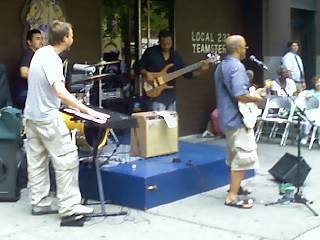
Musicians jamming at an outdoor concert at the union hall on W 14th street

Sunday, July 30, 2006

Howardena Pindell at G.R. N'Namdi Gallery

Yesterday I ventured out to Chelsea to see Howardena Pindell's (1943-) installation at the G.R. N'Namdi Gallery (526 West 26th Street #316). (Pindell, who teaches at SUNY-Stony Brook, delivered a gallery talk last Wednesday, and had I known about it, I would certainly have attended.)

I've followed Pindell's work for years, and have always been intrigued by her negotiation between formal abstraction and conceptualism on the one hand, perhaps best represented by her colorful hole-punch pieces of the 1970s, and outright sociopolitical polemic on the other, which she distilled in her 1980 video short "Free, White and 21." The N'Namdi gallery show, "In My Lifetime," which is up until August 31, featured more of the latter works, culled from the last 35 years of her oeuvre. The majority of the pieces were wall-mounted mixed-media constructions and installation pieces, though there were also some drawings, the video, and a series of quiet, brightly colored photo collage-paintings that Pindell created after recovering from a life-changing car accident around 1980.

I especially enjoyed the dialectic that the show engaged, and which is emblematic of Pindell's work itself, between the less overtly political and more conceptually oriented works, which included examples of quite beautiful delicate, elaborate map-like charts drawn on handmade paper, as well as drawings on videographic images, and the larger, less subtle and sometimes less technically polished polemical mixed-media pieces. (I should add that Pindell's career itself, as a Black female abstractionist pioneer, has always represented a political statement in itself.) What came through in some of these larger and more direct works was the utter insistence, the sheer stake that Pindell felt the political topics and subjects were proposing. In the face of the first Iraq War or this second one, they appeared to be saying to the viewer, or children dying from HIV/AIDS, or inequalities in the labor market, or the effects of the slave trade, would and could a seamlessly brushstroked surface or perfectly aligned stencils possibly be the point?

This isn't to say that these larger pieces were not well-made, but they were rawer, less elegant; their entreaties were evident in and articulated by their craft. I also don't want to imply that polemical art isn't compatible with and representable by and through formal abstraction and technical polish, but rather that it was clear after viewing the larger works where Pindell's overall focus and aims, the screams and shrieks that the injustices, the history, the narratives she was trying to pass on to the viewer, actually lie.

(I cannot find my notes with the artworks' titles, so I'm going to post the pictures and then post the titles when I locate them.)


The Big Lie: this mixed media work developed as a critique of the Gulf War in 1991. The record, though not broken, keeps on spinning into the present.

One of the Cibachrome and acrylic works that Pindell began to make after her accident.

Another one of the Cibachrome and acrylic works.

Ancestors: Memorial/Slavery (93 x 71.5 in. Mixed Media on Canvas): one of the more beautiful and most moving pieces in the exhibit.

This wall installation, showing an array of laminated imagery featuring labor costs, was an interesting commentary on low-wage, especially female, labor.

Separate But Equal Genocide : AIDS (Parts I and II) (75.5 x 42.5 in. Mixed Media on Canvas): from a distance, I wondered what these flags were calling attention to. They draw the eye from across the room. Up close, it's clear that they feature the names of people who've died of AIDS, and the tension between their material beauty and their critical commentary was palpable. The video monitor, which was off, is visible at bottom left.

I believe this piece was titled Slavery Memorial/Lash. Pindell drew upon sources on the slave trade, Black inventors, and the recreations of the reconstituted Black family in the New World.

Saturday, July 29, 2006

Slain Lesbian Couple in Jamaica + Velvet Lounge Back in Business

Inaction on Lesbian Couple Slain in Jamaica
Myrie and WilliamsRod 2.0 reported yesterday that it's been a month since the brutal murder of a lesbian couple (at left, from Rod 2.0) in Jamaica, and yet the prime suspect, the former boyfriend of one of the women, has yet to be questioned. Rod writes that

On June 29th, the mutilated bodies of Candice Williams and Phoebe Myrie were found in a sealed septic tank behind the house they shared. According to the Jamaica Star, at that time the police identified a lead suspect. That man is Dwayne Lewis, Williams' former boyfriend and the father of her year-old infant.
Human Rights Watch has pressed the government on its failure to investigate Lewis. Several weeks ago, Jasmyne Cannick wrote about the horrific killing, and the police's discovery of sheets, pillowcases and a lesbian-themed DVD that were found with the buried bodies of the women, as well as the burnt mattress in their home.

Rod goes on to note the persistent downplaying of homophobic violence by some quarters of the Jamaican media, a criticism that others have also lodged. This goes hand in hand with the Jamaican government's failure to aggressively deal with the ongoing problems of homophobic and misogynistic rhetoric (and I am not saying that Jamaica is alone in this), some of it fueled by the very musicians who were targeted in the recent LIFEbeat protests, which creates a climate ripe for violence and murder. In light of this story, the denialist comments of WBAI host Ian Forrest, which Colin Robinson criticized in an email I posted yesterday, assume a particularly grim irony.

Velvet Lounge Concerts Resume
Toni Asante Lightfoot
sent an email to say that Fred Anderson's Velvet Lounge, the place to go for distinctive Chicago-sound Jazz, resumed its concerts last night. Its new location is 67 East Cermak Road, between Michigan & Wabash in the Chicago's historic Motor Row District, which is right around the corner and within sight of the old Velvet Lounge site. The phone number is the same: 312-791-9050.

The lineup for this weekend is:

Friday, July 28: Isaiah Spencer & Friends
Saturday, July 29: Karl E. H. Seigfried Trio
Sunday, July 30: Greg Ward & Friends
Monday, July 31: Tim Daisy Group

The grand opening is still a few weeks off, so this is really just a test run, but if you want a preview of the space, now's the time to do, and consider donating to help Anderson keep the new space running.

Friday, July 28, 2006

Friday Corral

All week I've been suffering from mental lethargy when trying to blog; I've been able to work on my creative projects, but for whatever reason, when I've tried to post even a poem, let alone type out a full paragraph, it's like my mind shifts into shutdown mode.... But things are clicking today, so here goes:

No Fats! No Fems!
Well over a month ago, Charles sent me an email about a post on "No Fats! No Fems!" at Kevin Bynes's Kaleidoscope blog. I responded with a simple post almost immediately after reading through what I thought was a provocative entry that compared the racist Jim Crow system to the exclusionary policies and politics of some folks in the Black gay community. (I specifically use the word "gay" here rather than LGBT, queer or sgl, since I see each of these terms marking out communities that are constitutively more accepting of various kinds of diversities and pluralities, particularly with regard to body size, and image (self-)representational norms, self-fashioning, and so on.) I checked to see if there were any responses after mine, saw none and unfortunately forgot to bookmark Kevin's site (which I'll add to my blogroll). Yesterday, C alerted me to the fact that a scintillating exchange (WORK!) involving Kevin, Charles, Herukhuti, Larry, and Frank Léon Roberts had opened up not only in the comments section, but also on Larry Lyons's blog (actually this was the earlier post.) Kevin has subsequently added a new post on his blog as well. While I abhor the personalized acidity of some of the discourse, I am also delighted to see these men conducting their arguments at such a fierce level. You could get a mini-quick course in current critical conversations around the politics of sexual desire from this exchange. To reformulate one of Heru's questions, what would a non-normative, disidentificatory politics and practice, particularly around body size, image and gender performance look like? Who is taking up the mantle and who's watching and listening? To point to Larry's arguments, what are the effects of his particular critical practice and how do they call into question the forms and modes of representation that are so common in our communities? Are we looking critically enough at what he's up to? To follow Frank, how can we present and practice critiques which escape the always lurking threat of essentialisms, and, I would ask, don't we all fall prey to essentialism and binarisms? Also, would we recognize an innovative, liberatory political practice around sexual desire and social empowerment if it didn't fit our preconceptions? To echo Charles, artists like Lyle Ashton Harris, Ajamu and others do offer models. (I know, I'm being pollyannaish and positing some sort of consensus here (or misrepresenting the whole damn thing, which is why I provided the links!) which the complexity and occasional enmity of the exchanges belie, but hey, it's my blog and this is how I see it.)

Marcellas's Queer Desire
MarcellasSpeaking of femmy men and representation, I've noticed an interesting thing occurring on a show that I'd vowed weeks ago not to watch but have been following somewhat nevertheless: CBS's mind-shredding, mechanical, voyeuristic spectacle Big Brother 7: "All Stars." (TV, TV, TV...if i have even 1/4th of a brain left down the road I'll be lucky.) Back on July 7 (the day of my initial post on LIFEbeat), I'd called attention to the addition of celebrity stylist Marcellas Reynolds (at left, from his site) to the cast; he is the out Black queer Chicagoan from season 3 who notoriously sacrificed himself for a fellow player (an obnoxious, cheese-obsessed Southern White woman if I recall) and was quickly voted off the show. It was one of those moments where you have to speak back to the TV screen and say, "What on earth are you thinking, chile???" Well, Marcellas is still in this new season's game, and he's been serving up his characteristic drama, which has included overemoting to the point of tears, while also praising, primping and pining over a fellow male cast member. Sometimes his behavior veers into minstrelsy--although on this show all of the houseguests are minstrels at times, which is the point--but one particular aspect of his performance caught my attention last night. Since the show began, Marcellas's chief object of desire has been Kaysar (below right), a gorgeous, ostensibly hetero Iraqi-American graphic designer from California who committed a game-ending tactical error similar to Marcellas's last season. Marcellas has sung Kaysar's praises openly more than once, and last week in the immunity challenge he even engaged in the very erotic (and for some folks fetishistic) act of shaving Kaysar's head of its lustrous black locks, after which he pronounced to Julie Chen, his housemates and America that Kaysar looked even better shorn. For his part, Kaysar, a practicing Muslim, seems to be taking it in stride and even enjoying the attention. KaysarI said to C that I thought it was pretty interesting first to see an out, fem Black queer man not only extolling but expressing sexual desire for another man of color, an Arab American no less (a man whose braininess, in addition to his physique, is one of his most appealing attributes), especially during this politically and socially fraught period, on a popular, national, non-cable TV program. Now, in the large scheme of cultural representations this is a minor thing, but I also thought that at the same time, it's pretty significant. How often are Black fem queer men--or queer people of color in general--afforded the opportunity not only to represent themselves (and yes, the show is heavily edited and edited, so I am talking about a mediated representation) on the national airwaves, but also to present and enact--to voice--narratives of desire that venture outside the sociopolitical norms which are reinforced every minute of every day? How often are Arabs--or Asians or Latinos or even dark-haired Caucasians, or older women, or overweight people (cf. above) etc.--the objects of that desire? Isn't it usually policed and left on the cutting floor? I say this because on the show there are many attractive people, including several fit straight White guys who would usually be the objects of what would be considered normative American gay male enthusiasm (and were I to check Big Brother's boards I'd probably find out that they are). In fact, Marcellas very well might be fiending for them as well. But he has singled out Kaysar, and to me, it marks an interesting moment that I think that has passed completely under (or over) the usual critical radar screens; Marcellas, I would imagine without even realizing it, is showing CBS and America what one version of Black/queer desire might look like.
More Nonsense about LIFEbeat
You would think that the issues surrounding the LIFEbeat protests, which a group of Black and Latino LGBT bloggers led and which resulted in LIFEbeat's cancelation of its Reggae Gold 2006 concert to promote HIVAIDS awareness among Caribbean and Caribbean-Americans, would be fairly clear by now. But as the Caribbeat Magazine insert in Thursday's New York Daily News (which I wasn't able to access online) makes clear, this isn't the case.

Colin Robinson sent me the following email the other day about yet another statement of ignorance:

In "Caribbeat," the periodic Caribbean supplement to the New York Daily News. The lead piece in today's p. 24 supplement, that does not appear on the Daily News website and has no by line, is a 400-word piece headlined "Jamaican Americans React to Forced Cancellation of AIDS Benefit." On the one hand, it opens, "A gay rights effort that led to the recent forced cancellation of reggae concert -- aimed at combating HIV/AIDS in the Caribbean community -- has been met with surprise by members of New York's Jamaican-American community," and attributes to three Jamaicans statements like "says to me very clearly there is no value placed on the lives of Caribbean people" and a description of the protest as an attempt for gay activists to push their own agenda, as opposed to working with the reggae industry to create dialogue and fight...AIDS. On the other hand it does clearly identify Caribbean participation in the protest and our assertion that "the primary victims of dancehall homophobia are the same groups most hurt by...AIDS stigma."

Sadly, however, it concludes using a young Jamaican and WBAI personality, Ian Forrest, to trot out the increasingly popular denialist line on violence in Jamaica that "1,674 people were killed in Jamaica last year" and "contrary to what people would have us believe, half of them weren't homosexuals" and the conclusion that "Jamaican musicians and Jamaicans in general pose no threats to homosexuals."

And it misses the point, suggesting we "called for the cancellation," and ends with Beenie Man's publicist's line about "It's not a gay or straight thing..."

After reading the article, which hopefully one of you will post on your site, folks can e-mail caribbeatmagazine@nydailynews.com.
I agree and urge readers to let them know how off the tracks they are. The point--or at least one point, at I see it--is that homophobic lyrics and rhetoric in dancehall music and other popular musical forms contribute to an environment which fosters violence against lesbians, gays, bisexuals and transgender people or even those who are merely perceived to be gay, lesbian, bisexual or transgender., in Jamaica and elsewhere in the Caribbean and across the globe. It also promotes ignorance about the ways in which HIV/AIDS is transmitted, and makes people less likely to address openly and thoroughly HIV/AIDS transmission or to treat those who are PWAs, especially LGBTs, with full equality. Rather than canceling the concert, LIFEbeat could have required Beenie Man and TOK to address their homophobic lyrics, acknowledge the terrible effects they've had, and denounce them, or simply dropped these artists altogether. Another move might have been to have the artists engage in a public dialogue with Caribbean LGBTs, including some who are PWAs, before the music began. Instead, they copped out by canceling the event and issuing a misguided press release that benefitted no one. Caribbeat Magazine would go a long way towards educating their readers, and those they so freely quote, if they could and would recognize these basic facts.

Face Transformer
I came across this site a while back and as with everything else, have been meaning to post about it for some time. Created by psychology researchers at the University of St. Andrews in Scotland, it's called the Face Transformer and it allows you to roughly transform an uploaded image of your face by age, several large racial and ethnic categories, and even into a manga figure. I did it and am posting the result of the "Modigliani" image at left. It reminds me of a Kabuki mask. If you keep clicking the links, you'll access some pretty interesting online experiments.

Monday, July 24, 2006

Sports Bar SDQ Closes

C alerted me to some sad news that Anthony posted today on his Monaga blog: David Lee has decided to close the Sports Bar, on Calle Palo Hincado in Santo Domingo's Colonial Zone, one of the highlights of any visit to the DR. (David explains the bar's closing here.) C and I both always looked forward to dropping in and saying hello to him, and spending time at this very welcoming space when we were visiting. The low-key, friendly atmosphere, conviviality of the patrons, the mix of Dominican, Caribbean and US hits, and the hum of conversations, in Spanish, English, Spanglish and non-verbal gestures, are all memories I'll cherish. When I visited SD this past spring for the International Book Fair, I actually had the opportunity to have brunch with and just hang out with David, and the experience confirmed for me what a lovely person he is. I'll definitely miss this spot tremendously, as I know C and so many others who've spent time in SD will. We thank David for having opened this wonderful space and for having persevered with it, against the odds. We also definitely wish him the best in whatever he does next and look forward to seeing him in the future.