Thursday, February 08, 2018

Black Lightning, the Series

Cress Williams as Black Lightning
When I was a pre-teen, I read comics avidly, but by the time I reached junior high, I shifted mainly to books, alongside movies and records. This preference has continued into adulthood, though I enjoy reading graphic novels and comics for adults, especially if they're formally experimental, from time to time. But the comic book character families, networks and lore that so many nerds and blerds    hold dear to their hearts were not really part of my adolescence, which probably accounts for why now in adulthood, I tend to be mostly uninterested in movies and TV shows based on standard comic book heroes or teams. Netflix's Jessica Jones (2015) and the subsequent Luke Cage (2016) were rare exceptions. Certainly Hollywood's formulaic approach to most of the comic book franchises does not help things, in my opinion, though I have occasionally gone to see some of the Batman and Spider-Man films on occasion, and loved the Batman TV series as a very small chill. Non-comics derived TV shows involving characters with supernatural powers sometimes do draw me in: Charmed was a favorite during its early run, as was Heroes. But speculative narrative shows and comics are two different things.
Black Lightning, DC Comics version

Black Lightning, the new series on The CW channel, is based on a comic book series, but intrigued me. I knew only a little bit about its origins: writer Tony Isabella and artist Trevor von Eeden issued the first Black Lightning comic book in 1977, and as it turns out, he was the first black superhero to have his own DC Comics book. A little more reading up on the forthcoming series let me know that the metahuman hero was middle-aged, as opposed to a youngster, which I found appealing, and it did not hurt that Cress Williams, an actor I remembered and enjoyed from many shows in the 1990s and early 2000s, including Living Single, Beverly Hills 90210 and Prison Break, and the film Doom Generation, was going to star in it. The basic storyline I could have predicted with my eyes closed; after a stint cleaning up his town, Black Lightning gave up his crime-fighting for a career as a principal and educator. More compelling was the fact that his superheroic efforts had destroyed his marriage and divided his family, leading him to retire in part to heal the frayed family ties. In addition, the show's creator, Salim Akhil, has a strong track record as a writer and producer. Husband of the prolific writer, showrunner and producer Mara Brock Akil, writer for Moesha and Sparkle, and creator of the popular show Girlfriends (2000-2008), the Akils co-developed the successful, provocative TV shows The Game (2006-2015) and Being Mary Jane (2013-). The show's alluring ads, I'll admit, did the rest of the work.

Jill Scott and Marvin "Krondon"
Jones III in a scene from Black Lightning
The Black Lightning series is set in an alternate universe (though filmed in Atlanta), and opens with the superhero, known in semi-conventional human form as Jefferson Pierce (Williams) serving as principal of Garfield High School. He lives with his two daughters, first-born Anissa (Nafessa Williams), who is in medical school and a part-time teacher at Garfield High School, and Jennifer Pierce (China Ann McClain), younger daughter, who is a student at Garfield and dating one of the school's track stars, Khalil (Jordan Calloway). Jefferson remains divorced from his wife, Lynn Stewart (Christine Adams), but they maintain a connection for the sake of their daughters. He seems eager to initiate a romantic rapprochement. As Jefferson, he attempts to guide his students on the proper path, but one result of his work as a principal and teacher is his acquaintance with many locals who have gone off the rails, including various thugs and dealers linked, directly or not, to the area's major criminal organization, The 100. Jefferson also stays in close contact with Peter Gambi (James Remar), his oldest friend and an inventor and tinkerer of Italian ancestry who serves as Jefferson's--and Black Lightning's "tailor"; Gambi creates the superhero's suits and devices, which he continues to improve as the series proceeds.
 Marvin "Krondon" Jones III in a
scene from Black Lightning
Black Lightning's and the town's major antagonists are Tobias Whale (Marvin "Krondon" Jones III), who heads up the 100, and, viewers learn in the second episode, Lady Eve (Jill Scott), a diabolical, platinum-tongued mortician who serves as a coordinating link for all of the major power interests in the city. In the third episode, she harangues Whale, who had previously claimed to have killed Black Lightning, to follow up and rid the town of the beloved superhero forever, threatening him with a dethroning, or worse. Krondon, a hiphop artist and actor in real life, is albino, a rarity on US TV, and one of the show's fascinating conceits is that he will only allow white or very light-skinned people to work for him. In other words, his malevolence is manifest in his colorism, yet surprisingly for TV, the series does not overtly state this, forcing the viewer to figure it out. Another of Black Lightning's antagonists is Inspector Billy Henderson (Damon Gupton), a police officer who also is friends with Pierce but has strongly opposed to the "vigilantism" of Black Lightning, blaming him for disruptions in the police force's ability to maintain order. As quickly becomes clear and perhaps as a subtle critique of the inadequacy of police, the citizenry hunger for Black Lightning's intervention because of the authorities' complacency and failures.

Cress Williams, in a scene from Black Lightning
I've given the background information about Black Lightning's world, but I have said little up to this point about his particular superhero powers. As his name suggests, his chief gift, beyond supernatural speed and the ability, it appears though it hasn't been stated outright, to pass through solid walls and leap onto roofs and ledges, is lightning-like electrical power, which can stun, disable or even kill his assailants. He also has the ability to create ionized fields, which can distribute the electricity in tiny zaps, and generate an electrical force-field, which can shield him from bullets, grenades, and even bombs. So far the series has not shown him creating a black thunder bolt, but when enraged, at least according to the comic strip, he can do so. Additionally, he is able to gather electrical force in his fists to create even stronger punches, perceive nearby electrical flows (and, in episode 3, with the help of new goggles by Gambi, all electrical currents in the area), and even absorb electricity or disappear into electrical wires or powerboxes, traveling like an electrical current. Given these powers, I have to wonder what could stop or at least blunt him; he does not wear a helmet, so he's vulnerable to anything happening behind him if he doesn't perceive it before it hits him. Viewers got a taste of this when during a peace march, despite Black Lightning's presence to protect his family, one of Whale's deputies shoots the march organizer, Reverend Holt, through the upper chest and paralyzes Jefferson's daughter's boyfriend, Khalil. My immediate thought was that had the gunman aimed a bit to the right, he might have struck the superhero dead on. I suppose we will see what measures Whale devises to bring him down.
Black Lightning stars Cress Williams, Christine Adams,
Nafessa Williams, and China Ann McClain
As in the original comic book, Black Lightning is not alone in his crime-fighting. At the end of the first episode, Anissa cracks off part of the bathroom sink, and then, in subsequent episodes, she comes to realize that she possesses unique metahuman powers, inherited from her father, though she is unaware, as far as the viewer knows, that he doubles as Black Lightning. So far she hasn't unleashed any lightning bolts or electrical sparks, but she can create soundwaves by stomping the ground, and can increase her body density to generate super-human strength, which she has used several times to fight off attackers, including a group of adult men selling drugs to teenage girls. We also learn that she is an out lesbian, which, as far as I can tell, makes her the first black lesbian superhero to appear on US TV. The show's approach to sexuality is refreshing and contemporary; when her parents discuss their concerns about her younger sister's Jennifer's announcement that she plans to lose her virginity, they acknowledge their earlier support, though not without tears and shock, for Anissa's coming out, and Akil and the show's writers have fully integrated her relationships into the fabric of the storyline. At a moment when an anti-LGBTQ backlash is underway, and a white supremacist occupies the White House and racism regularly appears in spectacular form, a show about a mature, middle-class superhero and his family, which includes a lesbian superhero daughter, fighting to save a predominantly black and brown town, makes a statement, without hammering anyone over the head.
Nafessa Williams, in a scene
from Black Lightning

Black Lightning
In some ways, Black Lightning feels like a figure conceived during and in response to the previous, pre-Trump moment. A mid-40-something model of flawed respectability, well-spoken and highly educated, a dutiful though divorced father of two smart daughters, a negotiator rather than a hothead, he at first comes off like a Barack Obama with secret superpowers he's willing to use, almost in spite of himself. (His daughters mirror but complicate this template.) Even the stakes, at one level, feel lower than what we currently face as a country and globe. Instead of a supranational or external power, like a fictionalized version of Russia, or against the current hyper-neoliberal/libertarian, overtly racist, misogynistic, anti-liberal political and economic threat, embodied by the Trump administration, the villain he faces is a mostly local crime syndicate. As with Luke Cage, the villainry he's battling is not the result of larger structural and systemic forces, but corrupt and corrupted black people. I understand the desire to depict an enclosed black speculative world, and, more so than with Luke Cage, it feels well built out. But in some ways, it also feels a little inadequate; can this parallel world open out into something that more fully resembles our own? On the other hand, given the current moment of overt backlash, a flawed black superhero family feels appropriate, and, to some degree, emotionally comforting. But is it enough?

What I am waiting to find out is when Jefferson and Anissa will recognize not only that they both possess superhuman powers, but that Black Lightning has a potential partner, if he is willing to accept Anissa--Thunder's--participation in crime fighting. When will Jennifer's powers manifest themselves? Will Jefferson and Lynn get back together? Will the writers allow Anissa's relationship with her Asian American girlfriend, Grace Choi (Chantal Thuy), last the entire season? What is behind Gambi's seeming duplicity in deleting a video feed of Anissa's demonstration of her power, and, in a confusing move, his deletion of Whale's image on a camera feed after the shooting of Reverend Holt? Will the cops work with Black Lightning or continue to see him as a vigilante? I also want to know how Whale's scheme to take out Black Lightning will resolve itself. What other smart, unexpected elements in the series plot and characterization will the writers introduce? Will the show end on a cliffhanger? But let me not get ahead of myself, because there are nine more episodes to go in the thirteen-episode first series, meaning there will be more than enough time to learn how things are going to turn out.
Skye Marshall and Cress Williams,
in a scene from Black Lightning

Wednesday, February 07, 2018

Tayari Jones' Novel Oprah's Book Club Pick + Elizabeth Alexander To Lead Mellon Foundation


A million congratulations to my Rutgers-Newark colleague Tayari Jones, on the publication of her new, fourth novel, An American Marriage, now out from Algonquin Books of Chapel Hill! Tayari's novel has been receiving rapturous reviews (Entertainment Weekly, LA Review of Books, New York Times Book Review, SFGate, and USA Today, to name a few) since its appearance, as well as praise from readers on Amazon, Goodreads, and elsewhere. To add to the excellent news, Oprah Winfrey selected An American Marriage as her newest Oprah's Book Club pick, which she announced on CBS Morning News yesterday morning.

Tayari on CBS, as Oprah announces
her book as its newest Book Club selection

Oprah has said of the book, "I have to tell you, it is intriguing. It's a love story that also has a huge layer of suspense. And it's also so current and so really now that I could not put it down and I've already passed it on to lots of my friends and so I know – certainly believe – that you're gonna love it." On her website, Tayari, a writer of numerous gifts, offers a summation of An American Marriage:

Newlyweds, Celestial and Roy, are the embodiment of both the American Dream and the New South. He is a young executive and she is artist on the brink of an exciting career. They are settling into the routine of their life together, when they are ripped apart by circumstances neither could have imagined. Roy is arrested and sentenced to twelve years for a crime Celestial knows he didn’t commit. Though fiercely independent, Celestial finds herself bereft and unm oored, taking comfort in Andre, her childhood friend, and best man at their wedding. As Roy’s time in prison passes, she is unable to hold on to the love that has been her center. After five years, Roy’s conviction is suddenly overturned, and he returns to Atlanta ready to resume their life together.

I have had the pleasure of hearing Tayari describe the book as she was writing it over the last few years, and have now purchased my copy and intend to dive into it very soon! I also expect the praise to continue and prizes to shower this book too. CONGRATULATIONS AGAIN, TAYARI!

You can purchase a copy of An American Marriage here!

***

Elizabeth Alexander
Yesterday brought more good news: poet, scholar, critic, and generally extraordinary person Elizabeth Alexander has been named the next head of the Andrew W. Mellon Foundation! Elizabeth will assume the Mellon presidency in March 2018, replacing Earl Lewis, who has served since 2013. Currently she is the Wu Tsun Professor in the Humanities at Columbia University, and had served as Director of Creativity and Freed Expression at the Ford Foundation. Before this, she was the Frederick Iseman Professor and had previously held the post of Thomas Donnelley Professor and chaired the African American Studies Department at Yale University, where she taught for 15 years. At the Ford Foundation, Elizabeth "co-designed the Art for Justice Fund, a $100 million fund seeded by philanthropist Agnes Gund to transform the criminal justice system and all of its inequities through art and advocacy."

At Mellon, Elizabeth will preside over a foundation that has long been dedicated to work in the humanities and culture, particularly the liberal arts, from supporting scholarship to scholarly publication to the training and development of future educators, as well as considerable work in the museum world. It will be fascinating to see how her interests, as someone who has long promoted equality, social justice and civic participation in the arts and humanities intersects with Mellon's current agenda, and how she as its leader will guide and develop its focus. Inside Philanthropy offers five to consider in terms of Elizabeth's new tenure. Key will be defending not just the humanities, but universities and higher education in general, from those on the right and, to a different degree, from some critics on the far left. As Elizabeth notes, "The value of free expression, of arts and culture, is not something that’s always shouted from the rooftops, right now."

Elizabeth is one of the major American poets, serving as a Chancellor of the Academy of American Poets, as well as on the boards of the Pulitzer Prize and the African Poetry Book Fund. She also is a prolific author and critic. In 2009, she was President Barack Obama's first inaugural poet, her poem captured in the volume Praise Song for the Day. Her 2015 memoir The Light of the World, a powerful tribute to her late husband Ficre Ghebreyesus, which was a 2016 finalis for the Pulitzer Prize and the National Book Critics Circle Award. She is also the author of six books of poetry, including The Venus Hottentot, Body of Life, Antebellum Dream Book, American Sublime, and Crave Radiance: New and Selected Poems. She also has penned two collections of critical prose, The Black Interior and Power and Possibilities: Essays, Reviews and Interviews, as well as a book for children, with Marilyn Nelson, entitled Miss Crandall's School for Young Ladies and Little Misses of Color.

Congratulations to Mellon for making this superlative choice, and CONGRATULATIONS, ELIZABETH!

Tuesday, February 06, 2018

Adrienne Kennedy's He Brought Her Heart Back In a Box


Adrienne Kennedy's (1931-) published plays, all of them, unfold according to the logic of dreams. Striking imagery and language, juxtaposition and jump-cuts in time, associative connections between characters, scenarios, moments, actions, and uncanny instances of personae and scenes split into multiples, or recombined in unexpected ways appear in various forms in her work, from her brilliant debut, Funnyhouse of a Negro (1960), to her most recent play, He Brought Her Heart Back in a Box (2018). Avant-garde from the beginning, Kennedy's plays nevertheless are anything but formalist or art-for-art's sake; her source material, evident in all of them, is her life experiences, and those of her relatives and friends, as well as the social, political and cultural histories in which those experiences have played out, transmuted into art via her profound interior vision. The result has been dramatic works that are deeply unsettling and unforgettable, like vivid nightmares.

Her newest play, which is making its debut at the Theater for a New Audience, at the Polonsky Shakespeare Center in Brooklyn, is no slouch in this regard. He Brought Her Heart Back in a Box is the 86-year-old Kennedy's first new play in 10 years, and the product of her move, roughly half a dozen years ago, to the Williamsburg, Virginia area, to live with her son, Adam Kennedy, a sometime-collaborator with her, and other family members, as she confided to reporter Alexis Soloski in a recent New York Times report. Though she purportedly detests the sleepy atmosphere and the town's insistent Southern historical pageantry, especially after decades of living in New York City, she penned the play in only six weeks, in a fit of rage, and includes in her inserted program notes the following acknowledgement:
"This play. Could not
have been written
without the room
Facing the trees and the
iPad given to me by my
son Adam Kennedy
And his wife Renee in
their house on the lane.
Kennedy's play is brief as full of life as a budding seed. It officially runs 45 minutes, but gave me the feeling, when I saw it, of being both far briefer and yet, because of the style, form and language, of being longer. He Brought Back Her Heart in a Box is loosely based on the author's mother's accounts of family lore, and takes place primarily in June 1941 in fictional Montefiore, Georgia, and New York. Kennedy's white grandfather owned peach orchards near Montezuma, Georgia, and the play transforms him into the town's white patriarch, Harrison Aherne. Actor Tom Pecinka, who makes his TFNA debut with this play, convincingly inhabits both Aherne, physically represented by a seated manikin whose stiff and ghostly presence looms over all the proceedings, and Harrison's grandson and heir, Chris Aherne, who develops affection for mixed race Kay, based in part on Kennedy's maternal grandmother, a 15-year-old girl who worked in the orchard, and died young, under unclear circumstances.

The conflicting stories about Kay's mother's death up north in Cincinnati are one thread. Was she killed by her white father or did she commit suicide?  Another spools out from Harrison, whom the audience learns had fathered numerous children by several Black women and even created a separate cemetery for the deceased among them, to the dismay of his white relatives. The fraught context of segregated Georgia, with its own codes for racial mixing, and a larger world descending into fascism and war, envelope everything. Kay, played expertly by recent Julliard graduate Juliana Canfield, making her professional stage debut, is a student at a boarding school African American students. When the play opens, the students are performing Christopher Marlowe's The Massacre at Paris, a bizarre request by the school's white founder. Soon enough, Chris, who has been helping out the bookkeeper, is drawn to Kay, and their shared love of literature and songs from Noel Coward's operetta Bitter Sweet, binds them together. The Marlowe play and Coward operetta, however, are not idle choices; both tell stories of ruin; slaughtered Huguenots in the former, failed love in the latter. If the viewer did not already guess that this interracial duo's fate would turn out badly, the references offer a subtle but decisive nudge.

The play proceeds not by intimate scenes between the two, but via their intercutting monologues, which represent their inner desires being vocalized, as well as the stories they have heard from relatives and the letters they exchange being read aloud, the contents offering clues to Harrison's ethos and the thrall he holds the community in, the town's history, including Kay's own white father, like Chris's father and grandfather a member of a prominent family; Chris's desire for escape to the north and plans for a life with Kay; the strange circumstances surrounding Kay's mother's pregnancy, illness and untimely passing; and Chris and Kay's own dreams for their future, which includes settling in Paris, where, they imagine, they will truly be free. Director Evan Yionoulis keeps the pacing swift, while also allowing for those moments where Kennedy's poetry, or Chris's singing, or President Roosevelt on the radio, needs the space and time to root and beguile.

In Kennedy's singular memoir, People Who Led to My Plays (1987), the reader learns of the veil of silence Kennedy's beautiful, mysterious mother drew around her own mother, as well as the well of melancholy and sadness that sat at the center of her heart. While He Brought Her Heart Home in a Box does not resolve the enigmas the memoir raises, it does dramatize the racial, gendered and class power dynamics and the resulting traumas that early 20th century South inflicted on its black residents, and its white ones. The local racism and racial domination, Kennedy suggests, parallels the Nazi regime in  Germany and Austria. What the play also underscores is how power marks everything. The limits Kay, as a young black woman, faces are quite different from Chris's, as is his awareness and intermittent acknowledgement of his considerable privilege, but the desire for each other and a less constrained future is one they both share. That they do not speak or sing, as each does at various points, directly to each other for most of the play is the material correlative to the social and racial divide between them, and yet they do reach each other. Determined to halt anything that contravenes local white custom and his own control of this world, Harrison Aherne finally takes the most violent step possible, in a concluding moment that erupts as only a staged work can, ending with the two main characters walking slowly backwards down a high staircase, as if a vintage, sepia 16 mm film were being run in reverse. To call it a breathtaking finale hardly does it justice.

The set, designed by Christopher Barreca, consists of two levels, one the main stage and above it, at one end, a balcony, below a wall, split by that high staircase, which leads up to a door that could be the exit from the train tracks below or a portal out of this particular hell. The wall becomes a space for projections: the black children's choir, a gun, and more. On the main stage, four chairs rim the periphery, evoking both a train station and the isolated rooms in which Kay and Chris find themselves. The high stairwell and walls doubles as a film screen, with racing train tracks filling it at various points, again signifying the distances between Kay and Chris, as well as Chris's move to New York City, and ultimately Paris. Yet the dummy version of Harrison is always hovering nearby, including at the end, preventing any real escape or changes to the landscape he has long presided over. His silent patriarchal shadow, which has menaced every word uttered, rises, by pulleys, and, devastatingly for the characters and audience, demonstrates that patriarchy, then as now, intends to have the final say.

One unexpected but curious component of the play was a beautiful scale model version of the town of Montefiore, as Chris's father would have constructed it, which sat in a hallway a level up from the main stage. I almost wished there had been a way to project images of this, in holographic form, above the play before it began and after it had concluded. (I thought I took pictures of the model, but I unaccountably forgot to.) Many thanks to my former student Darise, who alerted me to the play's run, and to my other former students Aarthi and Angela, three very talented writers whom I attended the play with. I now want to read the play in print form, and see it again. Adrienne Kennedy did not attend, so I hope TFNA taped it, and will allow it to run on TV or the internet, soon. You can find much more information about Adrienne Kennedy, including an interview with brilliant young playwright Branden Jenkins-Jacobs; critic Alicia Solomon's reading of the play; and more, here.

 The play runs through February 11, so if you are in New York, do not miss it!

Monday, February 05, 2018

Quotes: Will Alexander

Will Alexander, Celebration for Bob Kaufman,
San Francisco Public Library, April 11, 2016
Living art can withstand the peril of the vitriolic via the extrinsic as propaganda, of the masses condoned as they are by critical misperception.

*

I am a spirit who exposes his mandibles in order to appear and disappear. This being a kinetics that spontaneously arranges ghostly collapse to appear as simultaneous visibility. The latter being an apparition that allows the mind to ruminate upon its circuitous connecting traces.

*

I work always knowing that one must resist carking exhaustion, always resisting its a priori inclination as did Alhazen, and in later times Rimbaud. One gains from this resistance impalpable nths of stamina so as to enact prolific creativity rife with palpable transmutation.

*

I think of Desnos rife with oneiric eruption, verbally fishing for oquassa. This being the inner work of extending lightning bolts from stark extremities of sleep. What follows are vocables that mimic proto-fires that condense in the shape of burgeoning aural seed. What then emerges are slivers from uncanny aural scarps that magnify and extend into strangeness.

*

I speak Gullah and cater to stored rats. As for me, there always exists abominable increase, dazed lepers, arachnids crawling through hair. As for hunting migrating forms from the inferno, I scour its satanic region, I take into account forms of unleashed fever, creating from my presence a brackish type of moth, soaring, yet all the while cadenced by telepathic inherence.

-- five selections from Will Alexander's Across the Vapour Gulf, New Directions Poetry Pamphlet #22, New York: New Directions Publishing Corporation, 2017. Copyright © 2017. All rights reserved.

Thursday, February 01, 2018

Black History Month/Langston Hughes Day + Poems: Nicolás Guillén & Langston Hughes

Langston Hughes in Harlem,
1959. (The LIFE Picture
Collection/Getty Images)
Happy Black History Month! February ushers in the month on the US calendar when the history, culture, and experiences of people of African descent, African Americans and all other Black peoples, in America and across the globe, occupy the foreground. As readers of J's Theater know well, every day, every month, every year here offers an opportunity to highlight the artistry, past and present experiences, and rich cultures of Black people, and to the extent that I can do so this month as every month, I intend to.

February 1 is also the birthday of arguably the greatest and most prolific African American poet, (James) Langston (Mercer) Hughes (1902-1967), a Joplin, Missouri native whose poetry transformed Black American and American literature, and who was one of the central figures in the Harlem Renaissance and a link to many of the Black American and non-US literary traditions that followed. One of the many aspects of Hughes' career that has deeply influenced me is his work as a translator; he brought into the English the drama of Spain's Federico García Lorca, the poetry of the Afrocuban luminary Nicolas Guillén, and the prose of Haitian writer Jacques Roumain.

I've previously posted one of his translations of Guillén's poems from Motivos de Son (1938), the collection that made the Cuban poet's reputation. I shared it in conjunction with my trip to Cuba,  which though 9 years ago feels like it was just yesterday. Hughes visited Cuba three times, in 1927, 1930 and 1931, before the Revolution, and as Ervin Dyer discussed in a CBS News piece, the American poet played a role in helping the country connect to its African roots, engaging in conversations with and championing the work of Afrocuban artists and writers at a time when racial discrimination there, as in the US, was rife. One of the poets he met and whom he encouraged was Guillén, who interviewed him for Diário de Marina, according to Dyer. Many stars aligned: Hughes was already famous and being translated in Cuba, Guillén's career was ascendant, and the newspaper had a page dedicated to fighting racism. Hughes would go on to translate Guillén's poetry and cultivated their friendship to the end of his life. At the same time, his presence in Cuba and his art continued to galvanize an array of Afrocuban artists working across genres.

Here is Hughes' translation of Guillén's "Little Song for the Children of the Antilles," which I screenshot from The Translations: Federico García Lorca, Nicolás Guillén, and Jacques Roumain, by Langston Hughes, edited and with an introduction by Dellita Martin-Ogunsola, Columbia: University of Missouri Press, 2003.


And here is a poem Dyer mentions in his article, one of Hughes' tributes to Cuba, "To the Little Fort of San Lázaro on the Ocean Front, Havana." It is also a humorous and sarcastic critique of capitalism, especially of the predatory US kind, which had reached its tentacles deep into Cuba before Fidel Castro and the Revolution hacked it away.  We also might think of it as a fitting epigraph for a good deal of what gentrification and global capital are laying waste to today.

TO THE LITTLE FORT OF SAN LÁZARO
ON THE OCEAN FRONT, HAVANA

by Langston Hughes


Watch tower once for pirates
That sailed the sun-bright seas —
Red pirates, great romantics.

  DRAKE
  DE PLAN,
  EL GRILLO

Against such as these
Years and years ago
You served quite well —
When time and ships were slow.
  But now,
Against a pirate called
THE NATIONAL CITY BANK
What can you do alone?
Would it not be
Just as well you tumbled down,
Stone by helpless stone?

From The Collected Works of Langston Hughes: The Poems, 1921-1940, edited and with an introduction by Arnold Rampersad, Columbia: University of Missouri Press, 2001. All rights reserved.

Saturday, January 27, 2018

De Blasio's Donors, Luxury Housing on NYCHA Land + Comics (Dante's Magic Afro)

This is a rendering of the proposed building
 at 120 3rd Ave. in Brooklyn.
Two more major de Blasio donors
have been picked for the project.
(AUFGANG ARCHITECTS)
© via New York Daily News

Yesterday brought the news that two wealthy real estate companies that were donors to New York mayor Bill de Blasio's campaign last year, where he was re-elected to his second four-year term in a landslide, received New York City approval to build luxury housing on land belonging to the underfunded New York City Housing Authority (NYCHA). The numerous housing projects currently run by NYCHA continue to be plagued by a host of problems, but with neither the city nor state, let alone the federal government able to find or raise funding, de Blasio has turned to private entities as a way of purportedly raising support for NYCHA's existing housing stock.

According to The New York Daily News, the new housing, to be built by developers the Arker Companies and Two Trees, is supposed to include 500--or half of its total--"half-market rate" apartments, which in practical terms means that in addition to the luxury rentals, the landlords will be able to get $3,900 (or $46,8000/year) for two-bed apartments, or half-market rate, on public land. NYCHA will lease the land, for 99 years, in return for payments to address its extensive low-income housing problems. The Daily News points out that this is the second such sweet deal involving a de Blasio donor.

In recent years, I've noted often harsh dismissals of labeling of actions like the developers' deal as neoliberalism, but this strikes me as a textbook example of it. Instead of seeking and finding government funding, via taxes, fees, etc. to support a public housing organization, the government is turning to private entities, which will benefit its lease of government subsidized, lower-cost land, to support private businesses, with some peanuts thrown back to the government in return. This is about as far from the "Sandinista" tag, with which opponents associated Blasio during his first run in 2013, as you can get.

Meanwhile, as the The Daily News article also points out:

Two de Blasio donors have said they raised money for the mayor to gain access to City Hall.

De Blasio disputes claims City Hall intervened on behalf of donor Restaurateur Harendra Singh pleaded guilty to conspiring to bribe de Blasio, stating that he gave to get favorable treatment on back rent he owed for his restaurant on city-owned land.

Prosecutors said a senior aide to de Blasio arranged a meeting for Singh “in an effort to pressure the agency to make its proposed settlement terms more favorable to Singh.”

Developer Jonah Rechnitz said he spelled out to a top de Blasio aide that he was giving money to gain access. After Rechnitz paid a fine over an illegal hotel he owned, the city stopped responding to another year’s worth of complaints about the place.

The Manhattan US Attorney chose not to press pay-to-play charges against de Blasio, however. Nevertheless, according to the paper, "Prosecutor Joon Kim...made a point of stating that his investigation had determined that the mayor had intervened or directed subordinates to intervene on behalf of donors."

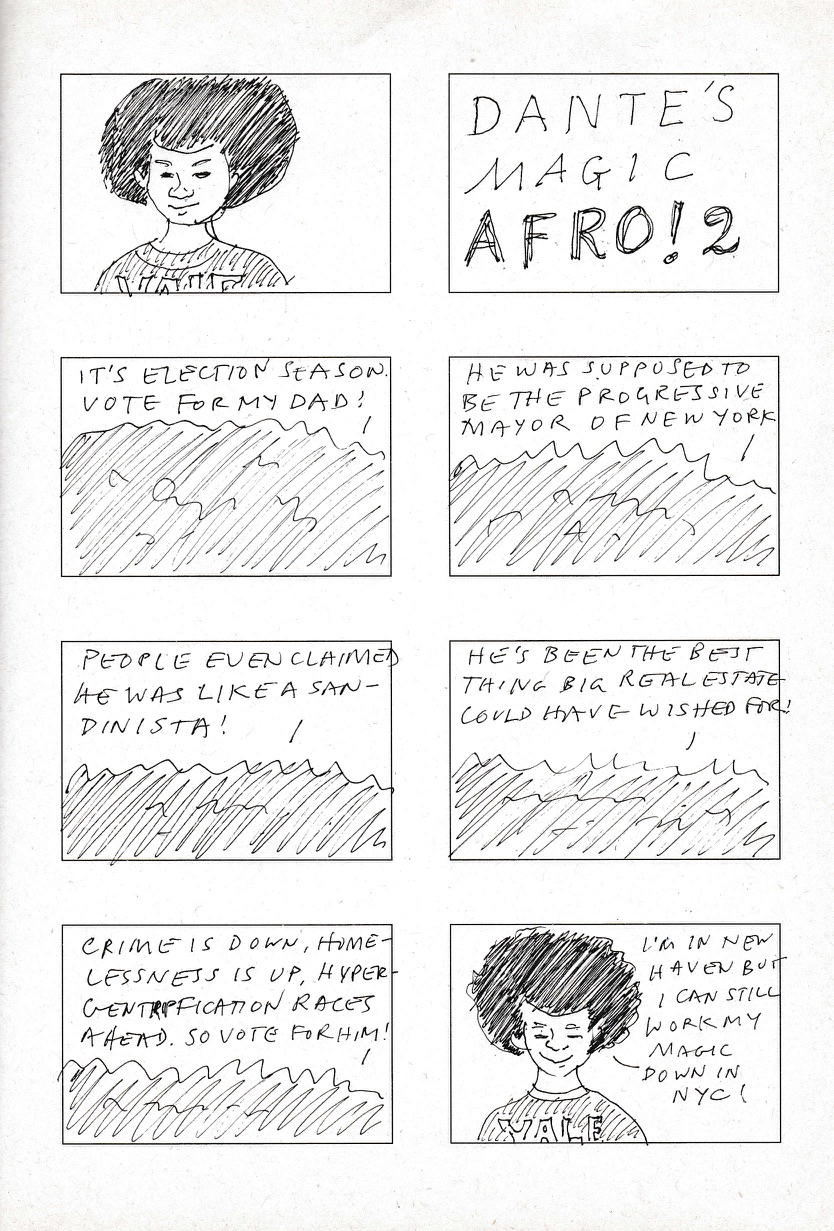
Here's a comic I drew around the time that de Blasio was campaigning five years ago. I often joked with C about how de Blasio's teenage son Dante's afro seemed to be a talisman, working its magic on voters (and de Blasio himself), and then played with it a bit in the frames below. It is the "afro," not Dante, who's speaking.


If my handwriting isn't clear the frames (beginning with #3) say: 
VOTE FOR MY DAD!
HE'LL ADDRESS INEQUALTY & POVERTY!
HE'LL DO SOMETHING ABOUT STOP & FRISK!
HE'LL IMPROVE SCHOOLS & RAISE TAXES ON THE RICH!
HE IS THE ONLY PROGRESSIVE WHO CAN WIN!
& HE'LL HAVE MY SPECIAL POWER TO GUIDE HIM!

More recently, during the lead-up to the 2017 mayor's race, I revisited my Magic Afro drawing. At one point the younger de Blasio, now a student at Yale University, had shaved his afro off, but as the recent campaign picked up, and during recent appearances with his father, Dante has sported that spectacular afro again. 

Unfortunately, it doesn't seem to have any magic to work against neoliberalism, the real estate industry, inequality, homelessness, or any of the other ills plaguing New York City. But hey, Bill de Blasio has another four years to figure it out, no?


If my handwriting isn't clear the frames (beginning with #3) say: 
IT'S ELECTION SEASON. VOTE FOR MY DAD!
HE WAS SUPPOSED TO BE THE PROGRESSIVE MAYOR OF NEW YORK
PEOPLE EVEN CLAIMED HE WAS LIKE A SANDINISTA!
HE'S BEEN THE BEST THING BIG REAL ESTATE COULD HAVE HOPED FOR!
CRIME IS DOWN, HOMELESSNESS IS UP, HYPERGENTRIFICATION RACES AHEAD. SO VOTE FOR HIM!
I'M IN NEW HAVEN BUT I CAN STILL WORK MY MAGIC DOWN IN NYC!

Poems: Nelly Sachs + Paul Celan (Holocaust Remembrance Day)

In honor of Holocaust Remembrance Day, which is today, and of the millions of voices silenced by that horrific period in history, I thought I most post poems by two poets who lived through the Shoah  and wrote about it in their work.

The first poem is by Nelly Sachs (1891-1970), the German-Swedish poet who escaped with her elderly mother from Germany for Sweden just before the Nazi regime planned send her to a concentration camp, and who would later receive the 1966 Nobel Prize in Literature for her work, which, as she noted, like she herself, "represent[ed] the tragedy of the Jewish people." One might also  say that Sachs' poetry represents survival and witness in the face of unspeakable horror, and beauty and memory in response to racist, anti-Semitic and fascist attempts at cultural and human erasure.

Second, I selected a poem by Paul Celan (1920-1970), one of the truly original and transformative poets writing in German, who was born in Bukovina, a region of Romania that had been part of the Austro-Hungarian Empire, and studied there and in France. Once Germany conquered Romania from the Soviets, who had seized it earlier in World War II, the occupying German forces forced his and family first into a ghetto, and then, the complicit governor of Bukovina had the Jewish residents deported to a camp, where his parents died. Celan worked in a labor camp until the Soviets liberated it in 1944. Much of his poetry, whether overtly or not, concerns the fate of the Jewish people, and interrogates (the German) language (itself).

Sachs:


Celan:


And lastly, a second poem by Celan, dedicated to Sachs, in which he speaks of their culturally and spiritually shared, though materially different experiences, in the Shoah.

Friday, January 26, 2018

Hugh Masekela, Trumpeter & Activist, Passes

South African trumpeter and musician
Hugh Masekela at St. Lucia Jazz
festival, May 2012.
(Reuters/Andrea De Silva)
This past week brought a number of homegoings, taking from us the South African musician and activist Hugh Masekela (April 4, 1939 - January 23, 2017), a trumpeter of impressive talent, and a freedom fighter against apartheid and for full equality for Black and brown South Africans. A native of KwaGuqa Township, Witibank, Masekela began his musical career at age 14, after seeing Kirk Douglas in the Hollywood film Young Man with a Horn, and his first trumpet was a gift from Louis Armstrong, via an anti-apartheid Anglican archbishop, Trevor Huddleston.

Masekela would go on to an internationally renowned career, traveling the continent and globe and playing with many of the most important jazz, pop and world-music musicians of his generations, but he never ceased agitating for his people's freedom. Throughout his oeuvre are numerous pieces that address the toxins of apartheid, racism, slavery, social, political and economic inequality, poverty, and other ills. After the 1960 Sharpeville Massacre, in which South African authorities killed 69 protesters in cold blood, Masekela went into exile, and settling in New York, where he befriended US musicians and activists, and was able to study at the Manhattan School of Music, graduating in 1964, and briefly marrying the marvelous singer Miriam Makeba shortly thereafter.

Among Masekela's musical achievements were the chart-topping 1968 instrumental song "Grazing in the Grass," and his star turn with the pop R&B/jazz group The 5th Dimension, on their unforgettable hit "Up, Up and Away," in 1967. He also recorded with musicians ranging from Paul Simon to Abdullah Ibrahim to Kalahari, making a special point to engage other African and Black Diasporic, musicians, including Fela Kuti and Jorge Ben, and musical forms in his work. Throughout, he  enriched the century-long traditions of jazz music. Masekela founded the Botswana International Music School (BIMS) in 1985, an institution that continues, in different form but which still brings together young and established musicians from across Africa.

My introduction to Masekela's music came from hearing my father play both albums featuring his work and ones he issued, and then, in early adulthood, when he was one of the highlighted artists who participated in Paul Simon's famous album Graceland tour, which also included Miriam Makeba and brought to wider attention groups like Ladysmith Black Mambazo. (I may even have the Graceland LP in my collection!)

May he keep blowing his horn and creating beauty wherever he is now, and may we keep listening. In tribute to him, here are a few clips from YouTube. Enjoy!


Hugh Masekela, "Grazing In The Grass"


Hugh Masekela, "Afro Beat Blues"


Hugh Masekela, "Don't Go Lose It Baby [Rare Version]


Hugh Masekela, "Stimela" (with Graceland)
Hugh Masekela, "Blues for Huey"


Hugh Masekela, "Bring Him Back Home (Nelson Mandela)"

Thursday, January 25, 2018

Remembering Ursula Le Guin, Visionary Fiction Writer & Nicanor Parra, Anti-Poet

Photograph by Dana Gluckstein / MPTV Images
via New Yorker
Let me start my note about Ursula K. Le Guin (1929-2018) by pointing out that I always write her name as "Ursula LeGuin," closing that Breton gap between "Le" and "Guin." As it turns out, that was the original spelling of her husband Charles' name, but when they married in France, when both were in graduate school, a clerk urged Mr. Le Guin to use the linguistically correct form. This is neither here nor there, really, except that Ursula Le Guin was very attentive to naming, and more specifically, to language and its power, using and probing it to explore alternatives to the oppressive structures that defined our real world in her visionary fiction career, which spanned half a century, and which left a deep and lasting mark on literature.

Bibliomane and bibliophile though I am, I first learned about Le Guin's work when I saw the first film version--now hard to find--of her 1971 novel The Lathe of Heaven on PBS, when I was a high schooler in 1980, and recall being transfixed by it. The novel, a dystopia set in 2002 Portland, Oregon, turns on the powers of the protagonist, Charles Orr, who can willfully dream new realities, past or present, into being. A psychologist, William Haber, figures out a way to manipulate Orr, for nefarious purposes, but one of the most enlightening aspects of Le Guin's novel is how she explores the potentially devastating consequences of what may, without extensive consideration and extrapolation into the future, seem to be positive or even neutral changes to our reality. To give one example, when Haber utilizes his machine to have Orr eliminate racism, the result is that all people end up turning the same, dull color of light "gray," which addresses the issue of color prejudice but also eliminates a major component of human difference, beauty and identity. (Of course one could also argue with the idea that racism hinges solely on skin color and does not also entail physiognomy and other distinguishing traits, let alone structural and system components, but in the sense that "color prejudice, "as the classicist George Snowden famous put it, lies at the heart of the European project of racial categorization and scientific racism, Le Guin made a justifiable choice.)

The Lathe of Heaven is a powerful example of how her work was less interested in technology, and more engaged with profound philosophical, sociological, anthropological, and, like much realist fiction, psychological questions. I think it once saw it called "soft science fiction," though there is nothing lesser about how she and others explored alternate ways of imagining our world, or alternative and parallel ones they had created from their imaginations. The Lathe of Heaven was a standalone work, though, and not part of her well known Earthsea and Hainish cycle series, for which she is best known. The five Earthsea books, commencing with A Wizard of Earthsea (1968), depict an archipelagic world in which magic plays a key role, and whose characters tend, as I learned with surprise upon reading A Wizard, brown-skinned. The Hainish novels, exemplified by The Left Hand of Darkness (1969), tackle social, political and cultural questions head on; in this novel, a visitor from one planet ventures to another, where he encounters a very different cultural context, including ambisexual characters, which unsettles his initial attempts to understand and connect with them. Social, political and cultural questions run throughout all her work, but Le Guin highlights them in these novel such that it would be hard to walk away from them not somewhat transformed by the questions she raises and allows the texts, and her readers, to mull over. If there were ever a set of works ripe for serialization on TV, and a more opportune time than our current moment of social and political crisis, I could hardly name them. So perhaps some director and production companies will take a hint, negotiate with heirs, and, once greenlighted, start filming.

In addition to her speculative fictional novels for adults, Le Guin also published collections of short stories, one of which, "The Ones Who Walk Away from Omelas," I have taught a number of times over the years. Her work also includes works for children, and works of nonfiction, including essays and a guide for better writing, Steering the Craft (1998), which I am proud to admit is sitting on work table right now. (I'd fished it out in preparation for rereading, as my sabbatical got underway.) She remained a powerful feminist, anti-racist, progressive voice till the very end, delivering a knockout speech at the 2014 National Book Awards, where she overtly critiqued capitalism and the hyper-commercialization of books.  She concluded her brief, powerful oration with the following words:

We who live by writing and publishing want and should demand our fair share of the proceeds; but the name of our beautiful reward isn’t profit. Its name is freedom.

Though Le Guin is no longer among the writing, the conceptual power, assured craft and vivid world-making of Le Guin's art, in the fullest senses of that term, should ensure readers return to it. I know I plan to, beginning with the Earthsea books. May she rest in peace.

‡‡‡


Regular J's Theater readers know that I am a fan of Nicanor Parra's (1914-2018), and have featured his work and posts about him several times over the years. Back in 2012, I posted his anti-poem "Young Poets," and one year prior, I wrote about his receipt, tardy though it was, of the Cervantes Prize, one of the highest honors for a Spanish-language writer. The very idea of the anti-poem, which is to say, a literary work that in many ways eschews what are thought to be the fundamentals of poetry while nevertheless employing poetry's unique resources, especially drawn from everyday speech and the vernacular, have long fascinated me, as has Parra's wittiness and humor, and his willingness to incorporate non-lyric elements in poetry, including images, drawings and charts.

I also have regularly lamented that he was not awarded the Nobel Prize (see the first link above), a prospect extremely unlikely at this point, now that he has passed at the age of 103, but then any number of major authors have been and will be passed over, including John Ashbery, who died late last year, and Ursula Le Guin, who I plan to memorialize below. Neither inventiveness nor longevity was enough to move Parra onto the laureate plane, but not winning the Nobel Prize is not the end of the world (and winning it, as a certain musician did a few years ago, is no guarantee of great poetry), and Parra will remain a vital poet for anyone who is interested in poems--or anti-poems--that make the most out of the simplest means.

Here are a few Parra poems I posted on Twitter that I wanted to share here. Note the first, partiularly cheeky if you ask me. (The first two poems are from, Antipoems: How to Look Better & Feel Great, antitranslation by Liz Werner (@NewDirections, 2004), and the second from After Dinner Declarations, translated & w/ an intro by Dave Oliphant (Host Publications, 2009). Consider drafting an anti-poem, and enjoy.


Monday, January 15, 2018

Happy Rev. Dr. Martin Luther King Jr. Day

The July 10, 1966, march to City Hall
from Soldier Field.
 (Chicago Tribune
 historical photo)
Today, on Rev. Dr. Martin Luther King Jr. Day, I thought I would post a short passage from one of Rev. King's most controversial speeches, which was the centerpiece of one of his most difficult campaigns, the Chicago Freedom Movement, in 1966. Not only did Dr. King remark on the virulence of the racism and white resistance he encountered, but at the time of his death three years later, it probably appeared to many people that the campaign had failed.

Dr. and Mrs. Coretta Scott King had visited Chicago and some of its suburban towns several times over the years, and in 1966 they even moved to Chicago to demonstrate the disparate conditions Black people were enduring under the tenure of Mayor Richard J. Daley. As part of the Chicago Freedom Movement, Dr. King urged Black voters to come out in droves and challenge the Democratic machine, controlled by Richard J. Daley. He decried white supremacy and Northern racism. He urged challenges to the Chicago power structure, better schools, housing, representation in government, everything. He also espoused Black pride and support for Black businesses, though he also criticized the nascent Black Power movement. Much like his namesake, Dr. King even presented his demands in person at City Hall, first by taping them to one of the outer doors, and then the following day in person to Mayor Daley, who was enraged by the campaign.


In the long run, despite the problems Black Chicagoans still face, things did change for the better from the status quo just over 50 years, and for lifelong and longtime Black Chicagoans now in their 70s and 80s, the changes were visible and measurable. Here are a few articles about the struggles Dr. King faced, his actions during that tough summer and year, and some of the changes that did happen. Also, I've posted an image from the speech he gave (readers can find the entire speech at the King Center's site), in which he uses the phrase "the fierce urgency of now." It is one of his memorable lines, and as applicable today as then or ever. (I'd also note that, in light of the ongoing crises Puerto Rico faces, it is notable that he mentions Puerto Ricans and the discrimination they face in Chicago in the speech's final paragraph.)

Chicago Tribune: "50 Years Ago Today: MLK Jr.'s speech at Soldier's Field, march to City Hall with demands for Daley"

Chicago Tribune: "Martin Luther King in Chicago"

WGNTV: "Web Extras: Martin Luther King and the 1966 Chicago Freedom Movement"

Chicago Magazine: "The Longest March"

From Dr. King's Chicago Freedom
Movement Speech (courtesy of the King Center)

Saturday, January 13, 2018

Chatting with Mark Sussman at the Creative Independent


Recently I chatted with writer Mark Sussman for a short feature that has now posted at The Creative Independent, under the title "Writing from the Inside Out." It was such an honor to be invited to participate on the site, which aims to be "a growing resource of emotional and practical guidance for creative people," and features short interviews with an impressive array of creative people across the artistic spectrum, including Hilton Als, Björk, Taja Cheek, Scott Esposito, Shepard Fairey, Diamanda Galás, Roxane Gay, Nikki Giovanni, Jonathan Gonzalez, Rickie Lee Jones, Isaac Julien, Joseph Legaspi, Carmen Maria Machado, Aparna Nancherla, Morgan Parker, Brontez Parnell, Paul Sepuya, Prageeta Sharma, Danez Smith, Michael Stipe, and many others.

The site's first conversation, after its launch note, was with the incomparable Eileen Miles, and the one that posted right before mine engaged Mrs. Smith, a "philanthropist, tone poet, and the world's most unlikely guitar hero." My conversation with Mark, which took place via Skype, even spilled over the alotted time limit, I think, so he could include only a few key portions of it appear on the site. As always I tried not to cover ground that I had in other public conversations, though some of that is unavoidable. One other aspect of the exchange was the light editing; the transcript is very casual, and close to how it was recorded, so what we said is what the readers get. Mark also shared a few of the excerpts that didn't make to the TCI website on his personal blog.

Here are some thoughts about translation, why new translators for extensively or well-translated texts are needed from time to time, and more specifically, some thoughts about translators of Rainer Maria Rilke's poetry. The bolded statement is Mark's, the response is mine:

One of my teachers once said the text in the original language stays the same, but we always need updated translations. And we’re always getting new translations of old texts. Why is that?
Because I think, with each new translation, you bring a different perspective to it. Often, of course, what happens with new translations is they re-situate the work for a new context. I think of a writer that’s so beloved and has been translated by different people in so many different ways, like Rainer Rilke. Two people whose translations of Rilke I think are really great are William Gass and Steven Mitchell. I believe Gass’s precedes Mitchell’s. You know, William Gass was an extraordinary writer in English. But he was also a profoundly philosophical writer. And he, of course, spoke German. He had training in German. So his translations have a certain kind of philosophical sensibility, like he’s capturing something in Rilke, I think, that most translators probably wouldn’t.

With Steven Mitchell, you have a translator who has an extraordinary ear [and] an extraordinary eye and his desire is to give you a Rilke that, on the one hand is as approximate as possible, but also doesn’t lose any of Rilke’s strangeness. If you go back and forth between those two translations, and of course, many lesser translations, you really start to get a sense, if you don’t speak German, of what Rilke might be like. And that, I think, can be really great.

But at times updated translations can just be terrible. If you’re translating the work of a poet, particularly a poet who is also an extraordinary prose writer, you want to retain that poetry, so you want to err on the side of the lyrical that might not be as exact, as opposed to the exact that is not so lyrical, because [otherwise] you lose what is essential to that writer.
Abd el-Ouahed ben Messaoud ben
Mohammed Anoun, Moorish
Ambassador to Queen
Elizabeth I (1600), Anonymous
painter.

And here's one snippet from the excerpt, where we discuss William Shakespeare's Othello, which we both love and have taught:

There’s this amazing portrait of an ambassador, I guess, from one of the North African countries that would have existed then, it wasn’t Morocco. There’s this amazing portrait of this ambassador, and it’s unclear whether Shakespeare would have ever seen that particular picture, but imagery of that kind circulated about Northern Africa and the Middle East, and of course Africa itself. There was also a moment where, in his transposition of the story from Britain to Venice, he’s picking a very similar society. A maritime society, but also a society that you could say gives him a little bit more leeway, but, like Britain, [one that] is very much engaged in mercantilism. So there are all of these parallels between the Britain of his day and the fictional Venice.

But the fascinating thing that most people usually don’t talk about is that, in Shakespeare’s time, he would see Black people walking through the streets of London. They may have been working in the theater, or they may have been working on the docks. This is also the moment where slavery is getting going. So you have all of these things happening in the background, and as you pointed out, they all feed into the play.

I think it’s very interesting that in the play, you have these moments of slippage. One of the things the students always ask is, “What is a Moor?” This is what the dictionary says a Moor is. And then, when you read through it and you see how, in fact, it’s not even so much about Moorishness Africanness. It really is about Blackness. When you think about all of those insults that come out of Iago’s mouth or the horror that Desdemona’s father feels about this. He’s a warrior, he’s just like this big “black ram.” So you see that. Shakespeare was kind of working through multiple things at once, which makes the tragedy that much more powerful. So when Joyce Carol Oates makes the statement, I was just sort of like, “What are you doing? You’re smart enough to know, you’re not making any sense.” You know? I don’t know. I don’t know.
Do read the rest of both interviews if you can.