Friday, February 24, 2012

Carnaval/Carnival/Mardi Gras 2012

Last night and today, more snow, more cold, more winter here in Chicago. The quarter has only a month or so to go; so too, and sooner, I hope, this season and its weather.

Short of being here:

Colgate sign, shoreline, Jersey City (Ellis Island in background)
I wouldn't mind being here:

Beija-Flor samba school revelers
in the 1st night of the Rio 2012 Carnaval parade
in the Sambodrome (Ricardo Moraes/Reuters)

Portela samba school revelers
in the 1st night of the Rio 2012 Carnaval parade
in the Sambodrome (Nacho Doce/Reuters)
Porto da Pedra samba school revelers
in the 1st night of the Rio 2012 Carnaval parade
in the Sambodrome (Ricardo Moraes/Reuters)
Vila Isabela samba school revelers
in the 1st night of the Rio 2012 Carnaval parade
in the Sambodrome (Ricardo Moraes/Reuters)
Or here:
15th edição do Concurso de fantasia Gay 2012
Salvador da Bahia, Brazil (Photo from Dois Terços)
Scholar and activist Dr. Luiz R. B. Mott
15th edição do Concurso de fantasia Gay 2012
Salvador da Bahia, Brazil (Photo from Dois Terços)
15th edição do Concurso de fantasia Gay 2012
Salvador da Bahia, Brazil (Photo from Dois Terços)
Carnaval do Salvador da Bahia 2012, Brazil
(Photo from Dois Terços)
Or here:

Noite Para os Tambores Silenciosos
Carnaval de Olinda 2012, Brazil
(Passarinho/Preifeitura Olinda)
7th Running of the Bonecas Gigantes
Carnaval de Olinda 2012, Brazil
(Luiz Fabiano/Preifeitura Olinda)
Noite Para os Tambores Silenciosos
Carnaval de Olinda 2012, Brazil
(Passarinho/Preifeitura Olinda)
Carnaval de Olinda 2012, Brazil
(Ádria de Souza/Preifeitura Olinda)
Or here:
Second Sunday, Carnaval Vegano 2012
La Vega, Dominican Republic
(Activao.com)
Second Sunday, Carnaval Vegano 2012
La Vega, Dominican Republic
(Activao.com)
Second Sunday, Carnaval Vegano 2012
La Vega, Dominican Republic
(Activao.com)
Second Sunday
Carnaval 2012, La Vega, Dominican Republic
(Carnival Vegano)

Or here:

Queen of Carnival Chariss Bovell's
"Mother of Humanity - The Weeping Madonna"
Trinidad & Tobago Carnival 2012
(www.tntmirror.com)
King of Carnival Roland St. George's Ralliez-Vouz A Mon Panache Blanc
Trinidad & Tobago Carnival 2012
(www.tntmirror.com)
Gerard Weekes portrays "Malak Yahweh - The Praying Mantis"
Trinidad & Tobago Carnival 2012
(www.tntmirror.com)
Rose Marie Kuru Jagessar's "Wachiwi-I Dream of a Bustle Dancer"
Trinidad & Tobago Carnival 2012
(www.tntmirror.com)
Or here:

Gran Parada de la Vía 40
Carnaval de Baranquilla, Colombia 2012
(elheraldo.co)
Gran Parada de la Vía 40
Carnaval de Baranquilla, Colombia 2012
(elheraldo.co)
Gran Parada Carlos Franco
Carnaval de Baranquilla, Colombia 2012
(elheraldo.co)
Gran Parada Carlos Franco
Carnaval de Baranquilla, Colombia 2012
(elheraldo.co)

Or here:


Zulu Social Aid & Pleasure Club
2012 New Orleans Mardi Gras Parade
(Kim Welsh/Offbeat.com)
Mayor Mitch Landrieu (at right)
Zulu Social Aid & Pleasure Club
2012 New Orleans Mardi Gras Parade
(Kim Welsh/Offbeat.com)
Former New Orleans Mayor Marc Morial (l)
and UN Ambassador Andrew Young (r)
Zulu Social Aid & Pleasure Club
2012 Mardi Gras Parade
(Kim Welsh/Offbeat.com)
Krewe de Vieux
2012 New Orleans Mardi Gras Parade
(Kim Welsh/Offbeat.com)

I'd even take here, though it doesn't appear to have been that much warmer. But the beads, beats and free-flowing beer do make up for the chill, and they do appear to be having fun, probably even more so than what I remember from years ago.  Chicago, time to get on it....

Soulard Mardi Gras 2012 Celebration
St. Louis, Missouri
(Steve Truesdell/Riverfront Times)
Soulard Mardi Gras 2012 Celebration
St. Louis, Missouri
(Megan Gilliland/Riverfront Times)
Soulard Mardi Gras 2012 Parade
St. Louis, Missouri
(Steve Truesdell/Riverfront Times)
Men in heels race
Soulard Mardi Gras 2012 Celebration
St. Louis, Missouri
(Bryan Sutter/Riverfront Times)


Wednesday, February 15, 2012

Excerpt: Noam Chomsky

An excerpt from: Noam Chomsky's "'Losing' the World": American Decline in Perspective, Part 1, znet.com, February 14, 2012

"There are important lessons in all this for today, even apart from another reminder that only the weak and defeated are called to account for their crimes. One lesson is that to understand what is happening we should attend not only to critical events of the real world, often dismissed from history, but also to what leaders and elite opinion believe, however tinged with fantasy. Another lesson is that alongside the flights of fancy concocted to terrify and mobilize the public (and perhaps believed by some who are trapped in their own rhetoric), there is also geostrategic planning based on principles that are rational and stable over long periods because they are rooted in stable institutions and their concerns. That is true in the case of Vietnam as well. I will return to that, only stressing here that the persistent factors in state action are generally well concealed.

"The Iraq war is an instructive case. It was marketed to a terrified public on the usual grounds of self-defense against an awesome threat to survival: the “single question,” George W. Bush and Tony Blair declared, was whether Saddam Hussein would end his programs of developing weapons of mass destruction. When the single question received the wrong answer, government rhetoric shifted effortlessly to our “yearning for democracy,” and educated opinion duly followed course; all routine.

"Later, as the scale of the U.S. defeat in Iraq was becoming difficult to suppress, the government quietly conceded what had been clear all along. In 2007-2008, the administration officially announced that a final settlement must grant the U.S. military bases and the right of combat operations, and must privilege U.S. investors in the rich energy system -- demands later reluctantly abandoned in the face of Iraqi resistance. And all well kept from the general population."

Sunday, February 12, 2012

Jeremy Lin(sanity)!

Linsanity!


Jeremy Lin [林書豪], born in 1988 to parents from Taiwan.

–A graduate of Palo Alto High School, where he captained his team to a 32-1 record, winning the California Interscholastic Federation (CIF) Division II state title, yet he received no athletic scholarships, and was guaranteed a spot only on the squads of Harvard and Brown.

Lin, leading the Knicks
–AB, Economics, Harvard College (Go Crimson!), 2010, All-Ivy First Team in his junior and senior years, first Ivy Player ever to amass 1,450 points (1,483), 450 rebounds (487), 400 assists (406) and 200 steals (225), and undrafted by the National Basketball Association.

Jeremy Lin (The Canadian Press)
–2010-2011: Golden State Warriors and Reno Bighorns (D-League)

–2011-2012: Erie Bay Hawks and the New York Knicks

AND NOW:

with Lin in the game,

vs. New Jersey Nets, Knicks win 99-92, Lin scores 25 pts.
vs. Utah Jazz, Knicks win 99-88, Lin scores 28 pts.
vs. Washington Wizzards, Knicks win 107-93, Lin scores 23 pts.
vs. Los Angeles Lakers, Knicks win 92-85, Lin scores 38 pts.
vs. Minnesota Timberwolves, Knicks win 100-98, Lin scores 20 pts.
 
Year
Team
GP
GS
MPG
FG%
3P%
FT%
RPG
APG
SPG
BPG
PPG
13
3
16.1
.538
.200
.796
1.9
3.8
.8
.2
11.2

New York Times: "With 38 Points, the Legend Grows"


How long he can keep this up or whether he'll be allowed to continue starting once the Knicks' stars return, who knows, but what a great story, and after the lockout, it's just what the NBA needs.

Add caption

Saturday, February 11, 2012

RIP Whitney Houston

Whitney Houston in 2009 (AP/Evan Evangelisti)

Whitney Houston (1963-2012)

Whitney Houston, "The Greatest Love of All"

I almost cannot believe this news, but this afternoon, but singer and actress Whitney Houston was found dead in her room at the Beverly Hilton hotel in Beverly Hills, California.  One of the finest and most talented singers of her or any generation, with an extraordinarily powerful voice grounded in the gospel tradition, Whitney Houston could have sung almost any kind of music, but primarily made her mark in rhythm & blues and pop. (Yet as she showed on the many times she sang the "Star-Spangled Banner," she could make it sound like you'd never heard it before, and later sang with a 35-piece gospel choir on The Preacher's Wife: Original Soundtrack Album.) The Newark-born daughter of gospel singer Cissy Houston, the cousin of icon Dionne Warwick, and the goddaughter of the musical goddess Aretha Franklin, this beautiful and poised singer, blessed with a once-in-a-lifetime vocal instrument, debuted her first album, the eponymous Whitney Houston in February 1985, and the hits came right away.  They continued well into the 1990s, with perhaps her apogee being her rendition of Dolly Parton's "I Will Always Love Young," from the popular movie The Bodyguard, whose soundtrack won a Grammy award, one of numerous awards Whitney collected over the years.

Whitney Houston, turning out Chaka Khan's hit "I'm Every Woman" (one of my favorite songs of hers)


I have listened to her music since her debut in 1985, and I rushed out to buy her first and subsequents not long after they appeared. Without question her many LPs and CDs have formed part of the soundtrack of my adult life. I'm even old enough to recall staying up to catch her on Byron Allen's old late night show, so enthralled was I by her music and her.  It's hard to put into words how sorrowful her decline over the last 15 years has been to witness, and how saddened I am by today's new. It was clear by 2001 how bad off she was, but I remember how when C and watched her reality show with her then-husband, Bobby Brown, there was no doubt that she had hit rock-bottom, and perhaps was even on the rock and rocks as the cameras rolled. Yet in 2009 it appeared that Whitney Houston had turned things around, but the struggles that she faced are never easy to win and, whatever happened today, it was clear that her many trials had taken their toll.  It is so very tragic, and so inadequate are these words, but as she sang, I will always love her music and her. RIP, Whitney Houston.

Whitney Houston, "I Will Always Love You"

Here, apparently and tragically, is her last performance, last night, at Kelly Price's pre-Grammy party.

Thursday, February 09, 2012

English 394: The Switchover

Monday marked a major milestone in my academic calendar: it was the final meeting of the first half of English 394: Theory and Practice of Fiction, the semester-long, initial portion of the full-year sequence that all undergraduate creative writing majors and (non-cross-genre) minors must take. As I've noted in previous years, this course breaks the college's quarter system, running past one into the second, at which point the professors change, and the second half of the course runs until the academic year's end, in mid-June.  In the first half the students work in shorter forms (short stories for the fiction track; weekly poems for the poetry track; and assorted forms of the creative nonfiction track), but in the second half they complete a long-form project (a novella for the fiction track; a 125-line long poem for the poetry track; and a long personal or research essay or lyric prose text for the creative nonfiction track).

With the handoff, my teaching load drops to 2 courses (the intro fiction and LGBTQ literature classes) this quarter from 3 (only the creative writing faculty have this load), and my volume of reading and emending student prose will also fall, though only after they hand in their final revisions next week.  It's hard to express how intense, how rigorous, and how energizing the sequence class has been.  I was again able to guide and watch 15 smart and enthusiastic young writers harness their talents and develop their skills as they wrote three short stories and subsequently revised two of them (though some will eventually rework all three), using as their guides the established writers we read and discussed in depth, and several works exploring theories and technical fundamentals of fiction writing. This year I chose stories by Anton Chekhov, Flannery O'Connor, Raymond Carver, Jhumpa Lahiri, ZZ Packer, Lorrie Moore, and George Saunders, and the students drew from all of them to varying degrees, creating narratives that often were unlike anything any of these writers might attempt but also unlike anything they, the student writers, have ever undertaken before.  Their stories ranged from very autobiographical realist narratives to highly speculative, dystopian fantasies. Our discussions and the essays each of the students wrote analyzing the assigned stories by each of these writers did allow for deep investigation into the technical means and thematic aspects of each established author.

Working closely with students for six months means that I have gotten to know not only their work but them as people, their personalities, their senses of humor, their voices, on and off the page, and so the switchover on Monday was not easy. As much work as the class required of me (15 students x 3 stories (at between 8-20 pages) x 2 versions of 2 of the stories, + 15 4-page essays, alongside other classes' work), I deeply enjoyed it, and I can say I already miss heading down the stairs of University Hall every Monday and Wednesday at midday and launching into our discussions. (I feel this way about all my classes, but the length and high-level intensity of the sequence always makes it distinct from all my other classes, and I can say that at no other institution have I ever taught a class quite like either its first or second halves.)

Below is the cake we savored as we concluded our final discussion, on the novella in general and on theirs, still in the prospective state, specifically. Congratulations to them, and as I told them, I am wishing them the best and cannot wait to read what they produce in the novella half of the course!

Let me also thank Ish Harris-Wolff, a SFF writer and MFA graduate student who under the auspices of the university's MA/MFA program, served in the experimental capacity of Teaching Assistant--she was and is the first, I believe, to do so!--and who also read the stories and provided the students with valuable advice and guidance. I think of her as my co-pilot for the journey! Thanks so much, Ish!

Cake to celebrate the end of the first half of English 394

Wednesday, February 08, 2012

Nathanaël & Ronaldo V. Wilson at "Queer(ing) Poetics"

Nathanaël and Ronaldo Wilson
Nathanaël and Ronaldo V. Wilson

On Monday and Tuesday, under the auspices of the university's Poetry and Poetics Colloquium, writers Nathanaël and Ronaldo V. Wilson came to campus to participate in a two-day event, entitled "Queer(ing) Poetics." On Monday evening they gave dynamic readings before a full audience, and on Tuesday afternoon, they offered statements on their poetics and participated in a conversation with faculty members and students on a range of topics, including translation, phenomenology, autobiography, filiation, and their relation to the term queer itself. I have heard both of them read many times, but never together, and was delighted finally to be able to see them together in conversation, and to hear and consider the points of intersections between their distinct and amazing bodies of work.

Here is the brief introduction I offered for their reading, which I have altered slightly.

***
I would like to welcome everyone to tonight's reading by Nathanaël and Ronaldo V. Wilson, which is sponsored by the Northwestern University Poetry and Poetics Colloquium, the Gender Studies Program, and the Weinberg College of Arts and Sciences Course Enhancement Program. To all of our sponsors, thank you very much.

I begin with a brief introduction of both writers together, and then will ask each of them take the floor in succession.


"Queer," the scholar, critic and poet Eve Kosofsky Sedgwick wrote in her landmark essay "Queer and Now," can refer to: "the open mesh of possibilities, gaps, overlaps, dissonances and resonances, lapses and excesses of meaning when the constituent elements of anyone's gender, of anyone's sexuality are made (or can't be made) to signify monolithically." She continued by noting "the experimental linguistic, epistemological, representation, political adventures attaching to the very many of us who may at times be moved to describe ourselves" in many different ways, including as well "people able to learn from, or identify with such." In this essay Sedgwick goes on to decouple "queer" from gender and sexuality per se, to suggest that other concepts and categories of identifications, such as race and class, might be "queer" or "queered," suggesting that "'queer' seems to hinge much more radically and explicitly on a person's undertaking particular, performative acts of experimental self-perception and filitation."


The work of both of today's visitors exemplifies these and many other aspects of what we might term "queer" poetics. In the work of Nathanaël and Ronaldo V. Wilson, we can see an open mesh of possibilities being continuously woven; at the levels of words and syntax, and at the levels of form and genres themselves.  Both writers create texts that function constitutively entre-genre, to use a term of Nathanaël's, which is to say, between genre—and as the French suggests, between gender, queering the concept of genre and forms themselves to engender new forms, new excesses and surpluses of meaning.

Indeed Nathanaël often works in the interstices of language(s) themselves, French and English, translating—and carrying over the living and dead body of—prior discourse, lyric, narrative, her own and others, poetry into essay into philosophy into history into song, pressing forth and producing texts that elude any single language or easy understanding of signification, even as their meanings take shape before our eyes and crystallize. Indeed, in Nathanaël's work one must work to re-orient oneself—for queering the phenomenological is part of Nathanaël's practice and praxis—within and to the text, recalibrating one's eye and ear, to read and listen, carefully: only then can one engage with their insistent spirit of inquiry, and find where their answers lie.


In Ronaldo V. Wilson's work, the desiring and desired brown body, objectified, speaks back. In his first book, which hovers between lyric and narrative, fiction and poem, the reader enters the brown boy's house of thought, of wonders, and wanders around there uneasily, the form, the content, the language itself enstranging one as the boy's own perceptions become enstranged and simultaneously ever more familiar. In his second book, the black object under examination engages in the very kinds of experimental self-perception and self-fashioning, filiation and affiliation, that Sedgwick suggests, improvising what Michel Foucault called an "art of life." In both books Wilson pushes language to its limits—for woven within and beneath his texts are other texts, other languages, black tongues and Tagalog, the discourse of middle-class life and the academy, the discourse of theory and of various poetic traditions, creating a brilliant net from which emerges work like little other, poetic or otherwise: reorient yourself, and enter.


Nathanaël writes l'entre-genre in English and French, with nearly a score of books, including We Press Ourselves Plainly (Nightboat Books, 2010); Absence Where As (Claude Cahun And The Unopened Book) (Nighboat Books, 2009), which received the Prix Alain-Grandbois; At Alberta (BookThug, 2008); The Sorrow And The Fast Of It (Nightboat Books, 2007); Touch To Affliction (Coach House, 2006); Je Nathanaël (l'Hexagone, 2003), which exists in English self-translation (BookThug, 2006); and L'Injure (l'Hexagone, 2004). Other work exists in Basque and Slovene with book-length translations in Bulgarian (Paradox Publishing, 2007) and Portuguese. In addition to self-translation, Nathanaël has translated works by Catherine Mavrikakis, Gail Scott, Bhanu Kapil, and Sina Queyras.
Nathanaël
Nathanaël
Ronaldo V. Wilson is the author of Narrative of the Life of the Brown Boy and the White Man (University of Pittsburgh Press, 2008), winner of the 2007 Cave Canem Poetry Prize, and Poems of the Black Object (Futurepoem Books, 2009), winner of Publishing Triangle's 2010 Thom Gunn Award. He has held fellowships at the Provincetown Fine Arts Work Center, the Vermont Studio Center, The Anderson Center for the Arts, Squaw Valley Community of Writers, Cave Canem, Kundiman, Djerassi Resident Artists Program, the Yaddo Corporation, and has had four poems nominated for a Pushcart Prize. He currently teaches at the University of California, Santa Cruz.
A Medill student interviewing Ronaldo V. Wilson
Ronaldo V. Wilson (r), being interviewed by a Medill student


Saturday, February 04, 2012

"...does it get better?" Panel

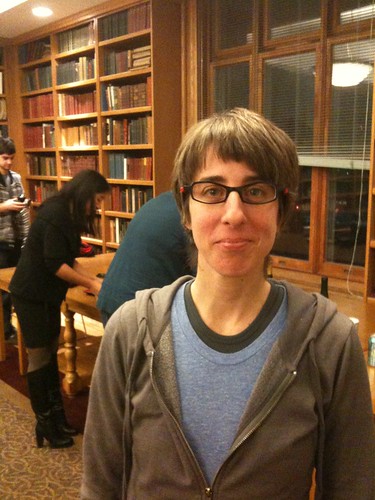
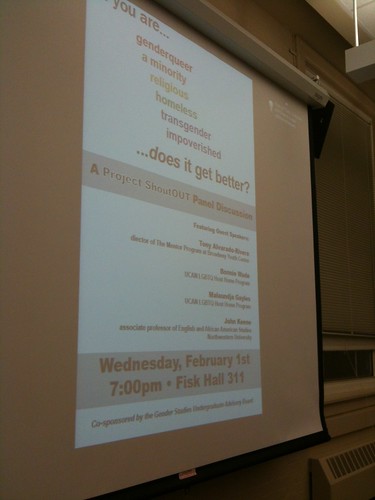
On Thursday night at the invitation of one of my students, Ryan L., I participated in "...does it get better?," a panel discussion examining the widely known It Gets Better series of videos and sponsored by Project ShoutOUT, an undergraduate student group. The panel also included Tony Alvarado-Rivera, former director of the mentorship program at the Broadway Youth Center in Chicago; and Bonnie Wade and Malaundja Gayles, both community organizers from the Uhlich Children's Advantage Network Home Host Program.

"...does it get better" panel, sponsored by Shout Out, at NU 

The university's student newspaper, The Daily Northwestern, covered the event quite well, so I'll only note that the all of the panelists pressed the question of whether it "gets better," and for whom, and how, especially given the multiple challenges many LGBTQ people, especially young, working-class and poor, gender variant and queer, and geographically and cultural isolated young people, may face. The other three panelists spoke primarily about their experiences working with young people, and they emphasized the necessity of listening to them and taking into account their needs rather than imposing or predesigning systems and structures into which they might be fit. We all called into question the American myth of individualism, the ethnocentrism and hidden classism, and the myth of a particularly narrow kind of adolescence that the "It Gets Better" videos promote. For my part I read a version of the piece I wrote and posted on this blog back in October 2010, in which I suggested how people might grow stronger, and thus perhaps things might get better. The questions from the students and faculty in the audience were thoughtful and productive, and it cheered me to see how many of them really do want to make the world a better place for all of us.

Let me offer my deep thanks to the organizers and my fellow panelists, as well as to all the students who showed up to listen to and engage us in a conversation. 

Friday, February 03, 2012

RIP & Poem: Wislawa Szymborska

Not much blogging thus far this month; I am mainly trying to keep my head above water amidst the onrushing rapids of winter quarter teaching, mentoring, advising and committee work. In a few days, as per schedule, I will be handing off one of my three courses, the semester-long (it cuts across the quarter system, and a similar course exists in poetry and creative nonfiction) fiction sequence for the undergraduate creative writing majors and minors, to my dear colleague, who, as I have done in the past, will guide them through the labyrinth of novella-reading and writing. I'll say more about this in a few days, but suffice it to say that if I had little time for blogging before, it's been minimal of late.

Wislawa Szymborska (PAP/Jacek Bednarczyk)
I did not want to let go unmentioned the passing, yesterday, of one of the major poets of the 20th century, the ever-modest, ever-incandescent Wislawa Szymborska (1923-2012), two of whose poems I blogged earlier this year, and whom I've mentioned many times on this site. I won't restate what I said before except to note that you could do yourself a favor if, in the absence of something to read and seeking a book to provoke you to think and feel, you purchased or checked out of the library a translated volume of her poems. Szymborska had the gift of writing poetry that often appears utterly simple or narrowly focused, yet it frequently opens up into some of the central questions of life and its resonances are often profound. This derives from her constant investigation of experience itself, of language, of our human negotiation of and between the two. My colleague Clare Cavanaugh has, with Stanislaw Baranczak, translated a large number of her poems. You can find some of them here.

Here is one of her poems, "Some Like Poetry," in two translations, the first by Regina Grol, the second by Joanna Maria Trzeciak. It's a poem about poetry, and thus about its value to Szymborska and about her own art and practice. Her final, ironic verdict, while it won't satisfy some (professors, critics or poets), is as honest an answer as I can think of: "But I don't know and I don't know and clutch on to it/as to a saving bannister."

(UPDATE: You can listen to a discussion of Szymborska, and archival recordings of her reading, at News from Poland's site.)

SOME LIKE POETRY

Some -
thus not all. Not even the majority of all but the minority.
Not counting schools, where one has to,
and the poets themselves,
there might be two people per thousand.

Like -
but one also likes chicken soup with noodles,
one likes compliments and the color blue,
one likes an old scarf,
one likes having the upper hand,
one likes stroking a dog.

Poetry -
but what is poetry.
Many shaky answers
have been given to this question.
But I don't know and don't know and hold on to it
like to a sustaining railing.

Wislawa Szymborska © 2012, translated by Regina Grol, all rights reserved.

SOME LIKE POETRY

Some--
that means not all.
Not even the majority of all but the minority.
Not counting the schools, where one must,
and the poets themselves, there will be perhaps two in a thousand.

Like--
but one also likes chicken noodle soup,
one likes compliments and the color blue, one likes an old scarf,
one likes to prove one's point,
one likes to pet a dog.

Poetry--
but what sort of thing is poetry?
More than one shaky answer
has been given to this question.
But I do not know and do not know and clutch on to it,
as to a saving bannister.

Wislawa Szymborska © 2012, translated by Joanna Maria Trzeciak, all rights reserved.

Wednesday, February 01, 2012

Langston Hughes Day (Black History Month Begins)

Pastel drawing of Hughes
by Winhold Reiss
Today is the first day of Black History Month, one of many gifts that Carter G. Woodson gave to the United States. I've said before that every month should be black history month, and latino history month, and women's history month, and lgbtq history month, and so on; we should always be acknowledging the diverse and plural contributions of everyone who has created the world we live in, but unfortunately, as I need not detail, the reality is quite different, so this month still has an important role to play.

Today is also Langston Hughes's birthday. Born James Mercer Langston Hughes in 1902 in Joplin, Missouri, he went on to become one of the greatest poets in the American and African American traditions, dying in 1967.  Perhaps half a decade ago, I read and reread a large selection of Hughes' poetry with a student who was preparing for graduate oral exams, and what struck me in a way I had forgotten was not just the thematic wealth and formal breadth of Hughes's poetry, but its political ferocity, its consistent statement of resistance, its capacity for wresting beauty out of some of the ugliest moments in history, while still making sure that readers did not forget that ugliness.  Years ago when I taught junior and high school students, Hughes was one of the poets they most readily responded to. He would, I can imagine, have been proud that he was reaching young people and also helping to pave a graduate student's road to a doctorate.

Hughes's poetry well suited for today, even though the historical moment in which most of it was written is now past. The next time I participate in a Human Micropoem event I intend to read one or two of his poems, which are well suited for the public repetition style the Human Mic requires. But it's also the case that his poetry remains so salient and so relevant because so much of what it portrays, describes, invokes, and evokes, sometimes with lacerating grace, is still with us, has not yet fully passed. The struggles for bread and equality here, for freedom and democracy overseas, for communities bridging the numerous barriers that divide us, have hardly ceased. We have a ways to go. Hughes was aware of that. His poetry is aware of this and can make us aware of this. His aegis is one that poets and politicians and everyone else today would do well to acknowledge.

Hughes with students in Atlanta
during Negro History Week 1947
(Photo: Griffith J. Davis)


Here are several very short Hughes poems, which still pack a punch:

History

The past has been a mint
Of blood and sorrow.
That must not be
True of tomorrow.

Enemy

It would be nice
In any case,
To someday meet you
Face to face
Walking down
The road to hell...
As I come up
feeling swell.

Go Slow

Go slow, they say-
while the bite
Of the dog is fast.
Go slow, I hear-
While they tell me
You can't eat here!
You can't live here!
You can't work here!
Don't Demonstrate! Wait!-
While they lock the gate.
Am I supposed to be God,
Or an angel with wings
And a halo on my head
While jobless I starve to dead?
Am I supposed to forgive
And meekly live
Going slow, slow, slow,
Slow, slow, slow,
Slow, slow,
Slow,
Slow,
Slow?
????
???
??
?

All poems Copyright © The Estate of Langston Hughes, 2011. All rights reserved.

Sunday, January 29, 2012

Apologies + J's Theater Gets Cited in Putin Critique + My Former Agent, Redux

First, my sincere apologies to all J's Theater readers for the typos that pop up here too frequently. I try to be meticulous about these entries, but I've found it's gotten more difficult reading and reviewing material on a laptop screen--though not on the iPad, which has a higher resolution, or on printed texts, such as books, students' manuscripts, or my own critical and creative work, which I always print out and edit by hand, with a pencil or pen--and when I rush to produce these (because have to limit the time I devote to these entries given my workload), the typos abound. I often do update my entries when I spot one or two (as with yesterday's post on "Blogs vs. Term Papers," when C spotted a typo in the first paragraph), and if you spot any gross ones or errors of any sort, please don't hesitate to post a comment or correction. Again, my sincere apologies, and thanks for reading!

***


Yesterday evening I was reading an article by Alexander Nazaryan in The New York Daily News, on a proposed "reading list" drafted by Russia's current and potentially future President, the beefcake strongman Vladimir Putin, that to Nazaryan's eye represents an extremely dangerous, nationalistic attempt at social engineering of the kind that prevailed in Russia before the fall of the Soviet Union. (He points out too that prior Russian governments, under the Tsars, also had censors, prescribed and proscribed writing, and punished violators.) But Putin goes further in the direction of ethnocentrism and racism when he basically suggests that for Russian to prosper, it must not only have ideological coherence (i.e., be under the boot of whatever Putin and his allies want), but ethnic social and cultural coherence as well--does this sound familiar?--and that a common literary canon will help to ensure this.


Putin lays out his ideas in a turgid essay entitled "Russian: The Ethnicity Issue," which basically rejects multiculturalism and pluralism in favor of Russian cultural nationalism, and, Nazaryan notes, includes the following inflammatory rhetoric:
The Russian people and Russian culture are the linchpin, the glue that binds together this unique civilization...this kind of civilizational identity is based on preserving the dominance of Russian culture.
As I said, do this rhetoric and discourse ring any bells? Nazaryan's article would interest me in and of itself, but I ask you to keep reading further into it, for he cites the case of how a group of nationalistic, pro-Putin thugs, organized into a group titled Walking Together (a priceless name, really), burned the books and threatened the life of one of Russia's most important and path-breaking authors, Vladimir Sorokin (1955-), based on his 1999 controversial, experimental novel Goluboe Salo (Blue Lard).*

As part of his discussion of the Sorokin issue, he cites...J'S THEATER!!! Yes, this little blog makes an appearance as part of Nazaryan's critique, and he specifically cites my discussion of Sorokin's Blue Lard, which, as I've mentioned before, has not yet been translated into English, in part because of its linguistic difficulty.  That post has taken on a life of its own, I should add. First, a scholar working writing about the complexities of translating the book wrote to me and sent me a copy of her paper on the topic, and then, this fall, a young scholar writing a dissertation (I believe) was able to connect with the professor after coming across the post. But back to Nazaryan, his main point is that a great deal of Russian literature--one of the world's treasures, especially over the least 150 years--let alone other literary traditions, would challenge the narrow ideological and cultural prescriptions of someone like Putin, and so it won't make the list. Putin cites what appears to be a combination of Mortimer Adler's Great Books Program and Harold Bloom's The Western Canon, but in the cases of both, as excessively Eurocentric as they are, they do not suggest only one ideological and certainly not one nationalistic approach. Nazaryan mentions that a Muscovite is wondering whether the works of George Orwell will make the list, to which Nazaryan replies, "No, he won’t." I though the query was ironic and perhaps sarcastic. But not only would Orwell not pass muster, nor would a great deal of Russia's 20th century writers. Would any of its major poets or fiction writers other than the Socialist Realists clear the bar? What foreign writers would?  It very well could be a short list, a short list indeed.

I often wish that more people would comment on this blog--though not the spammers, who once threatened to overwhelm the comments section--and do often wonder if anyone is reading it, but then I come across a citation like the one in Nazaryan's news article and realize, just because most of these posts meet with silence doesn't mean no one is reading them. So thank you, Mr. Nazaryan, and thank you to the regular and occasional readers!

*Can you imagine even the most extreme right wingers (or anyone on the far left, whatever that might be these days), organizing a book-burning and threatening the life of an American author of experimental literature? Sorokin's book, as I have discussed several times on this blog, is actually quite innovative, formally, linguistically, and thematically.  Most of Sorokin's work is not as formally experimental as Blue Lard, but having read several of his works in English translation--the hilarious The Queue, the utterly chilling and horrifying Ice, and its strange follow-up Bro Says, part of the Ice Trilogy--I can attest that his work always pushes the limits--formal, thematic, structural, political--in some way or other. Jonathan Franzen and the mainstream of contemporary American literature it is not!

+++

(Photo: Ozier Muhammad/The New York Times)
As C put it last evening, I have come across some very interesting people in my lifetime. I'll admit it. So here's a little story about someone I knew once upon a time. When I was in graduate school at NYU I had a good friend, a lovely woman with whom I was in several fiction workshops and who has gone on to publish a novel to some acclaim. One day she introduced me to her boyfriend, a very friendly, enthusiastic, preppy young guy who was looking for clients for the literary agency he was working for. He read my first book, and became a fan. He was very supportive of my work, and I gave him several things to try to get published, but nothing came of it. I then would get the material published myself. This went on for a while, and while I always felt he was very encouraging, supportive, friendly, decent, a good person, he could not sell any of my work. He even once got some of my poems into the hands of the poetry editor of the New Yorker, who said that she was "holding them," but they were never published. I ended up submitting one for a prize, and, to my amazement, it won. (He did once hammer the editors at Out quite relentlessly, though, on behalf, so that I could paid for an article I'd written; they blithely held my check for as long as they could, which reminded me that being a freelance writer was not the way to go.) So we agreed to part company. I still thought very highly of him, and loved to hear about how successful he was with selling other people's work.

A few years down the pike, I heard over the grapevine that he and my friend had broken up, and that he was now seeing a guy. This surprised me, because I didn't think he was interested in men, though C had pegged this the first time they met. (My gaydar is often not very good with people I'm close to.) But more power to him and anyone coming to terms with who they are. His boyfriend was a filmmaker, and the boyfriend's first feature film appeared to some acclaim. I saw the film and found it quite disturbing because of the racist discourse in it. I won't go into it, but suffice it to say that a mixed-race character living in the South ends up striking out not against his white oppressors so much as against black people. Hmm. I have seen such crap all my life--though not as well-made as this film, I'll give it that--and really tire of it. At any rate, another friend told me that the agent was seeing this director, and my friend didn't think the film was so bad at first, until he later thought about it, and then agreed he wasn't a fan. Another friend told me that the agent was getting huge advances for his writers, who now included some very famous people, among them award-winning poets.  I ran into my former agent on the street around this time, and I believe we had a brief, pleasant conversation. That was that.

A few years later, I was reading the newspaper, and happened upon an article about my former agent, in which it was revealed that he had been a crack addict. A crack addict. I fell out of my chair. Literally. Not only that, but according to the article, he had burned all kinds of bridges, lost his clients, hit the skids professionally, gone through rehab (I think), regained old and new clients, and  was now writing a memoir, for which he had received a $350,000 or so (perhaps it was more, I'm too lazy to Google it) advance--as I said, he could score advances! The book's title was Portrait of Addict as a Young Man, riffing off James Joyce's similar, incomparable Bildungsroman, and when I told some undergraduate students that this book was coming out, I gather several thought I might be exaggerating in its title or particulars, though I assured them I was not. I subsequently came across excerpts of the work, which were both more lurid than I expected but yet not as outrageous as I imagined.  I also flipped through the book at the bookstore, but I have not purchased it. Another friend told me that my former agent, who had been quite friendly to him, cut him cold at an event; he wasn't sure why, or whether it had to do with my former agent's newfound fame. I actually did spot him, from a distance, one evening last winter or spring in Chelsea, but he was hailing a cab, so I didn't try to get his attention.

And then, yesterday, I was reading The New York Times, and saw on the front page an article about the distinguished editor, translator and poet Jonathan Galassi, who helms what one of the most prestigious publishing units in the United States, Farrar Straus & Giroux. Without a doubt FSG publishes many of the finest writers from the US and across the globe, and although it is no longer an independent house, it continues to operate like one, with a distinct and distinctive editorial approach, producing beautiful books of the highest quality. As is often the case with articles in the Times these days, the writeup by Charles McGrath functioned a bit like a combination of a gossip column, book review and a press release. In discussing Galassi's new book of poems, Left-Handed, it reveals that the subject matter of the book, a middle-aged man's ending his marriage to a woman and falling in love with a younger man, not exactly new in American or many another literary tradition, was also Galassi's personal life story.

The tone of the article, which I urge you to read, unfolds at a pitch one will find only in the Times; there is something almost prim about it, even as it vies to spill all the juicy details. It is especially interested in citing how Galassi is a member of the upper-middle-class, invoking Harvard College more than once (the Times has an obsession with my alma mater, news to no one), which is the main reason, along with Galassi's exalted position, that the Times even reported on it.  Truthfully, were he some random New York poet or even editor, and certainly were his skin brown, going through the same experiences, we wouldn't be reading about it in that newspaper. Fair enough. I immediately printed the article out and plan to show it to my LGBTQ class, along with Frank Bruni's piece on Cynthia Nixon's comments on "choosing" to be gay. And you thought we were in a "post-gay" world, did you?

So what does this have to do with my former agent? Well, lo and behold, if you read to the middle of the article, it turns out that the "younger man," who in the poetry book is named "Tom," probably was and is my former agent, and that this relationship provoked a real hubbub in the New York publishing world in 2007. How could it not? But it gets better. The former boyfriend filmmaker is now making a movie of my former agent's book too! So it will be onscreen at some point within the next few years, I gather.  And since the memoir appeared in 2010, and the affair treated in the poetry book occurred in 2007, I am wondering whether my former agent was still an addict as he was canoodling with the editor-poet? McGrath rather politely dares not go there.

We all have various bright lights crossing our horizon. For those of us who are creative, we might think that they belong in something we're creating, be it a book, a play, a film, a song. Whatever form is amenable. Often we will do so, whether we're conscious of it or not; lesser lights, and certainly family members, loved ones, you name it, enter our work in some way or fashion, and it might everyone except an astute reader or scholar who comes along years down the road.  When I try to reconcile what I recall of my former agent, a delightful but not especially wild person, I draw a blank when it comes to these later shenanigans. But he is now the subject of his own memoir, of a film, and, it seems, of a book of poems by a distinguished poet. (I am sure a novel featuring him is on the way too, by someone, and a play wouldn't be inconceivable either.) That is really something when you think of it.  Can any J's Theater readers think of another contemporary figure who has been so honored? In a book of POEMS? Also, the behavior described above would not be that unsurprising were we to be talking about many a writer throughout history.  But a literary agent? Talk about a first! At any rate, I do know that I'll be getting Mr. Galassi's book!


Saturday, January 28, 2012

Poets Theater Piece Live on Seven Corners + Ryan Lizza on Obama and Governance

Seven Corners: Kenning Poets Theater Performance
In December 2010, at the invitation Patrick Durgin, a poet and the publisher of Kenning Editions, I participated with five other writers (Daniel Borzutzky, Duriel Harris, Jacob Saenz, Leila Wilson, and Tim Yu) in a weekend poets' theater experiment in Chicago to launch The Kenning Anthology of Poets Theater: 1945-1985, edited by Kevin Killian and David Brazil. I wrote up the very exciting event in a blog post, which involved us collaboratively creating a play that fit the genre of "poets' theater." One of the attendees, poet Steve Halle, editor of Seven Corners, a literary blog-journal (litblournal? litjourg?) decided thereafter to publish it.

Steve, innovative in form in his own work, drew upon his talents and skills to create what has to be, to my eye, one of the most inventive presentations of a dramatic-poetic text I've seen. (A screen capture is visible above.) Using Prezi software, he has laid the piece out in dynamic format, so that you can watch it from start to finish, in flowchart fashion, dive into particular segments, and zoom in and out at will. (To access the control panel, drag your cursor all the way to the frame's or, if you're in page view, the screen's rightmost edge, and it will appear.) The presentation doesn't include any audio material; the Oracle Theater did post a video (which I downloaded, but it is too large to upload to YouTube), and in my earlier post I showed some screenshots of it, but Steve's version still provides a strong sense of how all the sections connect and the piece as a whole unfolded. Imagine Lorenzo Thomas's poetic playlet being read to open and close the event, and you will be transported most of the way there.

My playlet, "Assange Goes to the Mosque," is visible on the left-most edge. The non-English text (which might be Persian) comes from Kathy Acker's play in the anthology, "Death of a Poet," and Duriel read it simultaneously as I read the English, with Jacob and Leila, as the "Americans," reading their Bruce Andrews-inspired parts. It's hard to convey the simultaneity outside of performance, but it was central to the piece.  It do want to note that my citation of "Assange" was not exactly Julian Assange, since I imagined more an Assange-like figure (who could, as the stage directions say, be played by a woman or a person of any race or ethnicity), and, though I do not know the particulars of what occurred between Assange and the women who have accused him of rape in Sweden I strongly condemn rape or violence, especially women, of any sort, but at the same time, it strikes me how salient some of the underlying discourse, involving Assange, Islam, Iran, the United States, Wikileaks, orality, simultaneity and (a lack of) hearing and understanding, submission, all of it, still is. Perhaps even more so right now.

I highly recommend the Kenning Anthology, and am really grateful I not only was able to participate in its launch but also to work with these other superlative writers. I also thank Steve for doing such a great job translating work from beneath the proscenium to the screen!

‡‡‡

I just finished reading Ryan Lizza's New Yorker report, entitled "The Obama Memos," on the President Barack Obama's education in the difficulties with Congressional bipartisanship, one of the central premises of his 2008 candidacy, and it made me pay attention.  Using a slew administration memos, annotated by Obama and his advisors and aides, Lizza builds a convincing case, in a way I have yet to see before, for understanding how the president has governed the way he has, which seems to me to elude most people outside his inner circle, confounding independents, frustrating liberals and progressives, and sending conservatives into apoplexy.  Central to Lizza's piece is the basic truth that Obama has struggled to grasp the opposition's intransigence (and Lizza does note, as I often have privately, how closely Obama's struggles mirror Bill Clinton's), and thus had to step away from his post-partisan ethos in order to work more closely with his party to pass what, as Lizza notes, is, despite valid criticisms of some of its specifics, a slate of legislation second to none. From the Affordable Care Act to the Dodd-Frank financial reform bill, to the inadequate but still invaluable stimulus, Obama has achieved quite a bit. He is hardly the "loser," as the right-wing commentator Peggy Noonan, Lizza says, derides him. Yet he also has not been half as liberal as many of his supporters hoped, or as effective a spokesman for his successes as they imagined.

Among the more revelatory aspects of the article, at least to me, was how rigid his opposition has been, and how gun-shy his advisors became as a result. One quote, by the ultraconservative Republican Tea Party darling South Carolina US Senator Jim DeMint, was especially telling.  According to Lizza, DeMint labeled the stimulus bill "the worst piece of economic legislation Congress has considered in a hundred years...[not since the creation of the income tax] has the United States seriously entertained a policy so comprehensively hostile to economic freedom, or so arrogantly indifferent to economic reality." Now, if you are dead set against the 16th Amendment to the United States Constitution, which is to say, an income tax, and you think this is the "worst piece of economic legislation Congress has considered in a hundred years," how on earth is someone trying to follow even the most basic laws of mathematics and economics supposed to get through to you? (South Carolina, incidentally, was the third state to ratify the Amendment, in December 1910). Though he wanted a bipartisan bill, Obama had originally noted on a memo that he would consider the expedited "Reconciliation" process, requiring a simple majority, and it turned out that this ultimately was required, as all the Republicans voted against the bill, while the 56 Democrats voted in favor of it.

The same approach turned out to be the case with the Affordable Care Act; the GOP almost unanimously rejected it, in both chambers of Congress, forcing the Democrats to pass it alone. Lizza points out that in fact despite all the chatter to the contrary, this has been the modus operandi for Democrats for decades. John F. Kennedy's legislative initiatives suffered because of Republican intractability as did Lyndon Johnson's after Congress changed hands in 1966. I can vividly remember how Clinton readily adopted Republican policy after Republican policy--as Obama in fact has done too, with the Affordable Care Act, to give one example, or the Cap and Trade policy, long touted as a market-based approach by conservatives--only to pass bills with GOP support and then still be slammed by them, and by liberals (I was one, though I did vote for Clinton both times, and even worked to elect him in 1992). The disillusionment this produces among liberals and even independents tends to be understated, but, as Lizza suggests, Obama's supporters don't really grasp how difficult the choices are that he's had to make or that he has made choices that fall on the side of center-left priorities rather than focusing on the far less effective--impossible with the GOP as it stands--reform/post-partisan agenda.  Lizza says almost nothing about Obama's civil liberties issues and his apparent enthrallment by the military and CIA, nor does he speak in detail about Timothy Geithner's role heading the Treasury Department, but he does explore a range of Obama's actions on his domestic policies, and with each year the severity of the political constraints, which I simply had not grasped despite recognizing their existence, becomes clearer.  Accomplishing anything even vaguely liberal in aim or scope with the opposition in power is, for Democratic presidents at least, almost futile.

Lizza's article also suggests something I've told friends several times in relation to hypothetical contrasts with an administration headed by Hillary Clinton. Lizza notes how one of Obama's criticisms of Clinton was that she would find herself in a constantly antagonistic relationship with the GOP, while he would be able to avoid that, and we know how that turns out. But as I think about the often vicious attacks both on Bill and Hillary Clinton in the 1990s--certainly I'm not the only one who recalls them, am I?--it's clear that she probably would have faced what Obama is dealing with, only instead of being attacked as "Kenyan," she'd be linked to the endlessly ginned-up corruption tales launched against her husband; instead of racist attacks she'd be subjected to sexist and misogynistic ones; instead of Obama's lack of "business" experience we'd hear how Clinton had been a "trial lawyer"; and we'd probably have other "scandals" dwarfing the Solyndra brouhaha in the news media on a daily basis. Above all, instead of the groundless attacks on Michelle Obama, there'd be a daily round of obsessive chatter about Bill Clinton and whether or not his pants were on. At the same time, Clinton's legislative record would probably be similar to Obama's, in that she would have probably been a bit more forceful on some issues, but less on others. Would she have even dared try to pass a health care bill after the debacle early in her husband's first term? Would she have pushed more forcefully for a larger stimulus given the likelihood she'd have been tagged as a big-spending New York (as opposed to "Chicago") liberal?  Certainly she showed no hesitation in war making, and might even still have the country in Iraq. Taking Lizza's analysis to mind, I think that whether Obama or Clinton, we'd be pretty much where we are today.

Among the many other points I took from Lizza's piece is that it is essential, despite the seeming ideological unity of the two parties, that people realize how far apart they are in terms of legislative policies, and that if voters want real changes and support Obama's agenda, as modest as it has become, it is crucial that we vote in people who will vote with him or push him further to the left.  This is especially the case in the US Senate. There are almost no liberal Republicans left, since Arlen Specter switched parties and then was ousted in a primary, and of the four who might even be called "moderate," as Lizza says, both Olympia Snowe and Susan Collins are still to the right of the most conservative Senate Democrat, Ben Nelson, who also is stepping down and will be replaced by a Republican if former Senator Bob Kerrey decides not to run. Of the other two, Mark Kirk of Illinois, is now incapacitated by a stroke, and may not be voting for some time, and Scott Brown could and probably will be replaced by a truly progressive Democrat, Elizabeth Warren. Should a raft of new Republicans of the order of Mike Lee of Utah or Roy Blount of Missouri gain control of the Senate, it will become nearly impossible for Obama to pass any legislation of the sort he has proposed the last three years; it will in fact be a steady diet of vetoes until such a GOP majority were sent back into minority status, and even then, as was the case when the Democrats had 59 votes, it will still be difficult. But difficult is better than impossible, and Lizza certainly opened my eyes. I will still carp when I think Obama and the Democrats are flying off the rails, but with a greater appreciation of just how tough things are in Washington these days.