|
| Nathanaël and Ronaldo V. Wilson |
On Monday and Tuesday, under the auspices of the university's Poetry and Poetics Colloquium, writers Nathanaël and Ronaldo V. Wilson came to campus to participate in a two-day event, entitled "Queer(ing) Poetics." On Monday evening they gave dynamic readings before a full audience, and on Tuesday afternoon, they offered statements on their poetics and participated in a conversation with faculty members and students on a range of topics, including translation, phenomenology, autobiography, filiation, and their relation to the term queer itself. I have heard both of them read many times, but never together, and was delighted finally to be able to see them together in conversation, and to hear and consider the points of intersections between their distinct and amazing bodies of work.
Here is the brief introduction I offered for their reading, which I have altered slightly.
***
I would like to welcome everyone to tonight's reading by Nathanaël and Ronaldo V. Wilson, which is sponsored by the Northwestern University Poetry and Poetics Colloquium, the Gender Studies Program, and the Weinberg College of Arts and Sciences Course Enhancement Program. To all of our sponsors, thank you very much.
I begin with a brief introduction of both writers together, and then will ask each of them take the floor in succession.
"Queer," the scholar, critic and poet Eve Kosofsky Sedgwick wrote in her landmark essay "Queer and Now," can refer to: "the open mesh of possibilities, gaps, overlaps, dissonances and resonances, lapses and excesses of meaning when the constituent elements of anyone's gender, of anyone's sexuality are made (or can't be made) to signify monolithically." She continued by noting "the experimental linguistic, epistemological, representation, political adventures attaching to the very many of us who may at times be moved to describe ourselves" in many different ways, including as well "people able to learn from, or identify with such." In this essay Sedgwick goes on to decouple "queer" from gender and sexuality per se, to suggest that other concepts and categories of identifications, such as race and class, might be "queer" or "queered," suggesting that "'queer' seems to hinge much more radically and explicitly on a person's undertaking particular, performative acts of experimental self-perception and filitation."
The work of both of today's visitors exemplifies these and many other aspects of what we might term "queer" poetics. In the work of Nathanaël and Ronaldo V. Wilson, we can see an open mesh of possibilities being continuously woven; at the levels of words and syntax, and at the levels of form and genres themselves. Both writers create texts that function constitutively entre-genre, to use a term of Nathanaël's, which is to say, between genre—and as the French suggests, between gender, queering the concept of genre and forms themselves to engender new forms, new excesses and surpluses of meaning.
Indeed Nathanaël often works in the interstices of language(s) themselves, French and English, translating—and carrying over the living and dead body of—prior discourse, lyric, narrative, her own and others, poetry into essay into philosophy into history into song, pressing forth and producing texts that elude any single language or easy understanding of signification, even as their meanings take shape before our eyes and crystallize. Indeed, in Nathanaël's work one must work to re-orient oneself—for queering the phenomenological is part of Nathanaël's practice and praxis—within and to the text, recalibrating one's eye and ear, to read and listen, carefully: only then can one engage with their insistent spirit of inquiry, and find where their answers lie.
In Ronaldo V. Wilson's work, the desiring and desired brown body, objectified, speaks back. In his first book, which hovers between lyric and narrative, fiction and poem, the reader enters the brown boy's house of thought, of wonders, and wanders around there uneasily, the form, the content, the language itself enstranging one as the boy's own perceptions become enstranged and simultaneously ever more familiar. In his second book, the black object under examination engages in the very kinds of experimental self-perception and self-fashioning, filiation and affiliation, that Sedgwick suggests, improvising what Michel Foucault called an "art of life." In both books Wilson pushes language to its limits—for woven within and beneath his texts are other texts, other languages, black tongues and Tagalog, the discourse of middle-class life and the academy, the discourse of theory and of various poetic traditions, creating a brilliant net from which emerges work like little other, poetic or otherwise: reorient yourself, and enter.
Nathanaël writes l'entre-genre in English and French, with nearly a score of books, including We Press Ourselves Plainly (Nightboat Books, 2010); Absence Where As (Claude Cahun And The Unopened Book) (Nighboat Books, 2009), which received the Prix Alain-Grandbois; At Alberta (BookThug, 2008); The Sorrow And The Fast Of It (Nightboat Books, 2007); Touch To Affliction (Coach House, 2006); Je Nathanaël (l'Hexagone, 2003), which exists in English self-translation (BookThug, 2006); and L'Injure (l'Hexagone, 2004). Other work exists in Basque and Slovene with book-length translations in Bulgarian (Paradox Publishing, 2007) and Portuguese. In addition to self-translation, Nathanaël has translated works by Catherine Mavrikakis, Gail Scott, Bhanu Kapil, and Sina Queyras.
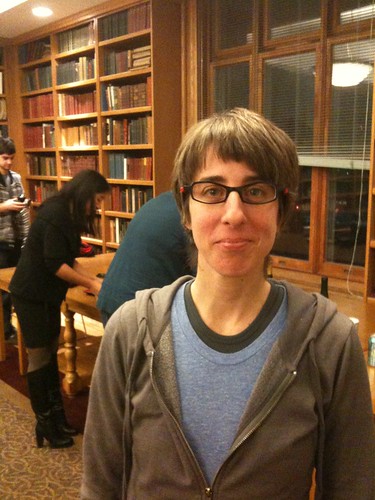 |
| Nathanaël |
 |
| Ronaldo V. Wilson (r), being interviewed by a Medill student |