Sunday, May 31, 2009

Four Electric Ghosts + Italian Poets + On Tiller Murder

A few weeks ago, I caught the last show of Mendi + Keith Obadike's astonishing new opera-masquerade, Four Electric Ghosts, at The Kitchen in New York City. These two never cease to amaze me. For this show, which also included breakout performances by poets-performers Natasha Latasha Diggs, Karma Mayet Johnson, an incredible band, and four of the flyest dancers I've seen in a while, Mendi + Keith started with Nigerian novelist Amos Tutuola's My Life in the Bush of Ghosts and combined it playfully with their take on Pac-Man, the iconic videogame (everyone remembers this, right?) to create a profound and joyful experimental, experientially multimedia extravanganza. They even beckoned people out of their seats to dance at the end, making the event truly interactive.* The opera-masquerade's narrative, essentially an updated fable, involved the three singer-sayers, Mendi, Natasha and Karma, bounteously afroed and futuristically and funkily attired, relating by text and song the story of four sisters, played by the four superbly lithe dancers, who were schooled by their mother and who died after a lightning strike, sending them to the Land of Ghosts, from which each eventually ventured out, thus generating the narrative. Blessed with knowledge, gifts and protective chalk, each Ghost sister, bearing a differently colored series of metallic stripes across her suit, encountered a scenario in which she dealt with a dangerous "mortal" and forgot, temporalily, or failed to register the mother-lessons of her previous life, and had to return home chastened but also recharged by the experience and revitalized by the recognition of what she'd previously learned. It's difficult to convey how seamlessly this all flowed together: the narrating and singing, the dancing, the light displays and projections on the back wall, the musicians' riffs, the complex weave that just keep pulsing with energy and brilliance and depth in a way that I, no huge afficionado of theater and musical performance but no stranger to them either, rarely have witnessed. And it was so grounded in a range of black cultural traditions while also feeling so new.

In addition to the Mendi + Keith and the singer-speakers I mentioned, other collaborators included Angela’s Pulse Performance Projects, comprising choreographer Paloma McGregor, stage director Patricia McGregor, and dancers Maria Bauman, Catherine Denecy, Marjani Forte and Keisha Turner, and design by Kate Cusack (costumes), Yuki Nakajima (animation/projection), Alexandre Delaunay (scenery), and S. Ryan Schmidt (lighting). After the performance Keith introduced me to bassist and producer Melvin Gibbs, with whom he, Mendi and musician Guillermo E. Brown had composed the music, which Keith, Brown, pianist Shoko Naga, and bassist Keith Witty performed live.

In addition to the unforgettable orchestration, songs and singing-saying (though not Sprechstimme), and choreography and dancing, what powerfully struck me was how Mendi + Keith had rethought and tinkered with Tutuola's powerful story and its implications for our current post-modern, hyperwired, digital moment, making it as much a vision about new ways of thinking about living and learning and a vivid, veritable (afro-diasporic-)futurist parable, grounded in the stories of these women--the ghosts and the singer-speakers--as a rereading and renovating of the past. I know they were recording it (and it was also simulcast via the Web, I believe), so I hope that it's available for many more people to see soon, and I also hope that Mendi + Keith follow their precedent of issuing the tracks online in mp3/CD/DVD form. I'm telling you, these tracks were hot, and while I know Mendi is bursting with talent and have heard both Natasha and Karma sing, working with Keith and his combo in songs with richly remixed R&B, house, Afropop, electronica, rock, and hiphop flavor, they set it off individually and as a trio. You have to hear them. I certainly want to again, because this was one of the freshest and most interesting performances I've caught in years (and that includes another recent favorite, Passing Strange).

*(I was fortunate enough not only to leave my seat, but to be bopping with Tracie Morris (I swear!), while Myronn Hardy and others were stepping only a few feet away. As George Lewis watched from the front row. Where else are you going to have an experience like this?)

Here are a few (blurry--my apologies) photos from the event:
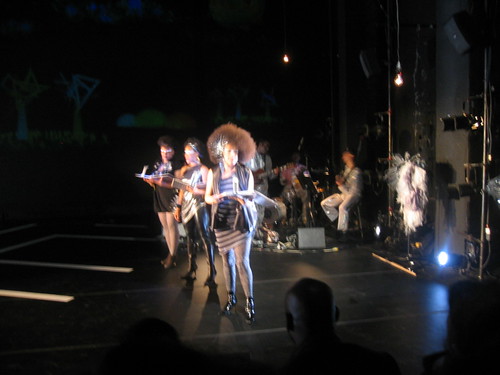
3 Singer-Sayers, Four Electric Ghosts
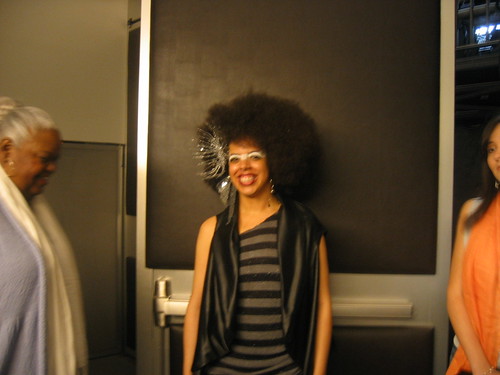
The three Singer-Sayers, Natasha Latasha Diggs, Karma Mayet Johnson, and Mendi Lewis Obadike (left to right)
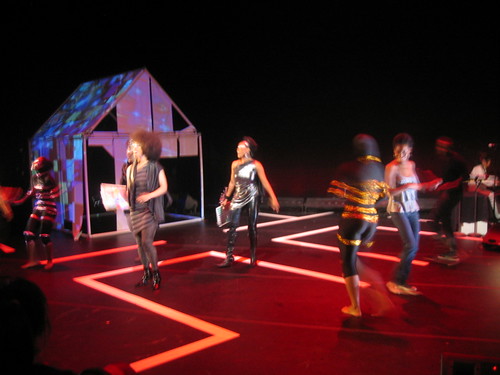
Scene from Four Electric Ghosts
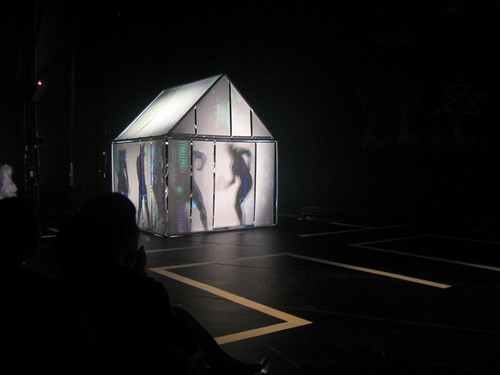
The Electric House
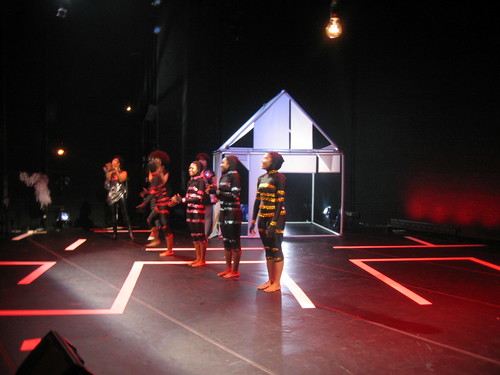
At the end of Four Electric Ghosts
At the end of Four Electric Ghosts, Mendi at left, Karma at center
Curtain call, Four Electric Ghosts
Curtain call
Mendi Lewis Obadike, co-author Four Electric Ghosts
Mendi after the performance

**

Though I was feeling down and crappy earlier in the day, on Friday evening I dragged myself out to a reading by four major established and emerging Italian poets, Maria Attanasio, Giovanna Frene, Marco Giovenale and Milli Graffi, at Think Art gallery in Wicker Park. Poet, critic and translator Jennifer Scappettone organized this event, part of a two-city, four event Italian Poetry Festival, in conjunction with Litmus Press and its wonderful journal Aufgabe--whose issue #7 included a special section on contemporary Italian poetry edited by Jennifer, entitled "Embargoed Voices: Poesia Ultima/Italian Poetry Now--and the Poetry Center's Francesco Levato and UIC's Chris Glomski. (Other sponsors include Poets House, the Italian Cultural Institute of New York, St. Mark's Poetry Project, University of Chicago Arts Council and Departments of Romance Languages and Creative Writing, and the Northwestern University Department of French and Italian.) Each of the poets read in Italian, with Jennifer reading hers and others translations, presenting work that was often striking in its innovation and political engagement, after which they engaged in a conversation led by Jennifer that touched upon questions of the poets' respective "generations," politics and Silvio Berlusconi, and American vs. European aesthetic influence. One of the highlights was the exchange in which Milli Graffi suggested that whereas she had been surer of her place in the literary world in the past she now felt "lost," and suggested that Marco Giovenale's generation--1968 to 1978, as he defined was, in Gertrude Stein's famous comment to Ernest Hemingway, also a "lost generation," a appraisal to which both he and Giovana Frene, also a young poet, challenged vigorously. Afterward I had an opportunity to meet all the poets and chat about contemporary literature, and even show Maria Attanasio and her husband my poetry month blog featuring her, for which Jennifer supplied me with the requisite Italian. Now I need to learn enough to read her book, Il falsario di Caltagirone, which I think means The Forger of Caltagirone, and which has merited considerable praise. I also got to chat with Marco Giovenale and picked up several of his books, including CDK, which is a Flarf-inspired text. Ah yes, even in Italy, they're Flarfing! When I got home, I felt 1,000 times better....

As always, a few photos:
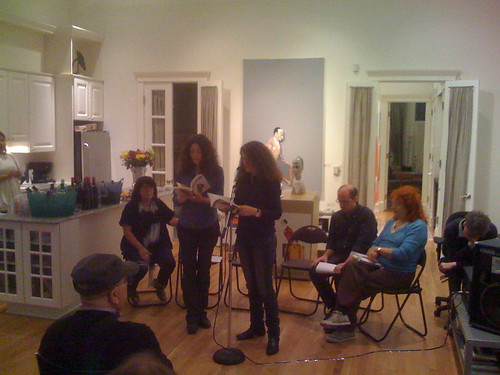
Italian poets reading, Think Art Gallery
Jennifer and Giovanna Frene (R) reading in sequence
Italian poets reading, Think Art Gallery
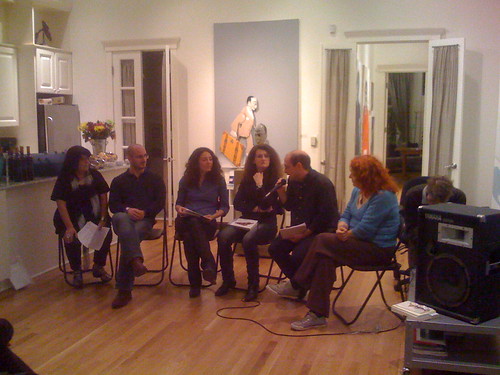
In conversation, from left: Maria Attanasio, translator and U. of Chicago doctoral student Rafaello Palumbo, Jennifer Scappettone, Giovanna Frene, Maro Giovenale, and Milli Graffi.
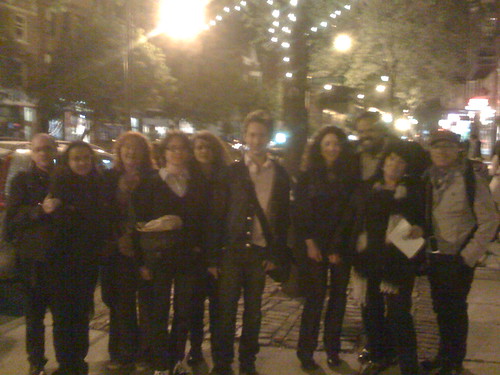
Group Portrait w/ Italian Poets
Group portrait with the poets, their loved ones and friends

***

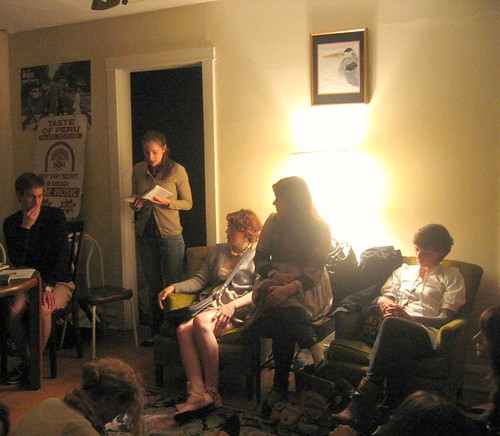
Last night I briefly dropped by the Rogers Park salon that Loyolaites Charles Gabel and his compatriots stage every month or so to hear Lily Brown, Lisa Goldstein, and Nathanaël read their work. It was lively, to put it simply. The evidence:
Lily Brown reading
Lily L. Brown reading her poems
Nathanaël reading from Absence Where As


***

I've been noting how much the rhetoric surrounding abortion and women's reproductive rights has been heating up crazily of late. It bubbled up into a full scale imbroglio surrounding President Barack Obama's invitation to receive an honorary degree at the University of Notre Dame. (As we all know by now, Notre Dame thankfully didn't rescind its invitation; the President spoke; and according to polls and despite some of the browbeating bishops, most Roman Catholics in the country, Indiana, and at Notre Dame supported the invitation; yet the media couldn't stop itself from stoking the controversy and extrapolating broader Roman Catholic opinion from the likes of the odoriferous Bill Donahue). In fact, the strident tenor of the abortion discussion has been reminding me of the period in the late 1980s and 1990s when anti-abortion fanatics, led by Operation Rescue and similar organizations, staged wide-scale public protests and took to targeting and killing doctors who performed abortions. Nevertheless, it was still surprising and horrifying to hear today about the murder in Wichita, Kansas of Dr. George Tiller, 67, a women's reproductive health specialist who was one of the few doctors across the country providing late-term abortions. Tiller was shot dead as he was serving as an usher in the foyer of his church, Reformation Lutheran Church. Authorities have apprehended the suspect, an anti-abortion fanatic named Scott Roeder, 51, from a Kansas City suburb. This wasn't the first attack on Tiller; his clinic was firebombed in 1985 and he survived a shooting, in both arms, in 1993. In addition to increasing security at his clinic he frequently wore a bullet-proof vest. He also had survived repeated legal attempts to close down his clinic.

President Obama quickly issued a statement saying that he was "shocked and outraged" by the murder and condemning the turn to "heinous violence," and Operation Rescue has reportedly denounced it, as have some other high-profile anti-abortion commentators. But former Operation Rescue head Randall Terry responded by calling Tiller a "mass murderer," and on some right-wing message boards, posters have been celebrating what amounts to an assassination. Why do I call it that? Because while I don't watch Fox News Channel if I can help it, you can trace a line of authorization and legitimation of this horrific act back right-wing social agitator Bill O'Reilly. He actually authored and uttered the following statement: "If we allow Dr. George Tiller and his acolytes to continue, we can no longer pass judgment on any behavior by anybody. What Tiller is doing is that bad. And that's the Memo." [H/t to comments on Brad Blog.] That verges on incitement to me. O'Reilly's comments aren't the only ones of this sort, and he may not have directly urged Roeder to act, his and others' extremist rhetoric has played a role in fomenting rage and raising the stakes among right wingers; the nutcase who went on a murderous rampage in Knoxville last year had cited a guest on O'Reilly's show as an inspiration, and he wasn't the only one. It will be interesting to see whether Fox News addresses this issue (doubtful) or if the legacy media, who have in the past used right-wing frames ("pro-life" etc.) and repeated conservative cant on abortion without any apparent awareness of what the affects of doing so might be, addresses the stridency of the anti-abortionist rhetoric and their role, even if inadvertent, in advancing it.

It's important also to note that this murder occurs at a time when safe, legal and affordable abortions for women across the country are far less available than they were 25 years ago. Under both Republican and Democratic administrations and Congresses, we've witnessed a steady assault on Roe v. Wade and a steady erosion in unimpeded access to clinics. The days of Bill Baird centers or public hospitals performing abortions are long gone. Federal and state laws have made it harder for women in some parts of the country to get an abortion at all. These assaults have occurred alongside the increasing lack of universal, affordable health care for all and the relentless promotion and inculcation of failed "abstinence education" in elementary schools and public health programs, both domestically and abroad. (Bristol Palin is the most recent high-profile poster-child for the last issue.) Yet for doctrinaire anti-abortionists, whose behavior points both to sexism in its desire to control, restrict and limit women's rights and classism in its desire to control, restrict and limit poor and working class women's rights to knowledge, information and access (upper-middle-class and rich women can undergo abortions whenever they see fit), this sorry state of affairs is still unacceptable. They are determined to control and limit women's reproductive rights--not just the "choice" to have an abortion but basic and free access to knowledge and information about human sexuality, as well as to contraception and abortion--and personal autonomy, autonomy over their own bodies, even further, and they evidently so fear the new administration's babysteps around, as opposed to back from, this present dreadful state of affairs that some of their adherents are resorting to the sorts of terrorist attacks the country witnessed two decades ago. While I applaud the Attorney General's decision tonight to post federal marshalls at some reproductive health clinics that provide abortions, far more important will be for the administration, the media and entertainment industry--which has been complicit in where we've ended up, since mainstream films and TV shows have tended not to deal truthfully or candidly with human sexuality, unplanned and unwanted pregnancies, and abortion--along with the rest of us addressing the broader problems of which this murder is only a terrifying symptom.

UPDATE: from The American Prospect: Ann Friedman's take: "Why Clinic Violence Is Obama's Problem"

Wednesday, May 27, 2009

Bad News/Good News/Crazy News/Great News

Supreme Court JusticesBy now the dreadful news from California is widely known: by a vote of 6-1, the California Supreme Court upheld the will of last fall's voters who enacted Proposition 8, an initiative which amended California's state constitution to declare that marriage could only legally exist between a man and a woman. The Prop 8 vote, which passed by a margin of 52% to 48% and which has sparked tremendous commentary and opposition, including public protests all over the country. The California Attorney General, former California governor and Oakland mayor Jerry Brown then challenged by the vote, leading to yesterday's eagerly awaited decision. The decision did include the following semi-positive note: the 18,000 same-sex couples who had gotten married before Prop 8 were legally recognized, thus negating the initiative's potentially retroactive power. Yet the overall result is newly denied rights for countless Californians and a court ruling that suggests that the California Constitution does not equally apply to all residents of that state.

To put it another way, for thousands of couples in California, there are no options for legal marriage at the present time beyond leaving the state. The California legislature has twice passed same-sex marriage bills, only to have them vetoed by Governor Arnold Schwarzenegger, who will be out of office in a year, so there is some possibility that with enough of a push, California voters could get the legislature to once again pass a same-sex marriage bill that would be signed into office by a new, progressive governor. At the same time, the threat of yet another referendum always looms, which suggests that the initiative process might perhaps be the better route: a popular referendum, organized by a much broader and more proactive coalition, with specific outreach to non-LGBTQ people of all to overturn Prop 8, written in such a way as to ensure its validity against a range of challenges.

Both of these options, as well as the current financial crisis and political gridlock in California, point to another pressing issue, which is the need for a new state constitution, which might include a limit on popular referenda and the power of such initiatives to make and change laws, including amending the state constitution. (I use to think that splitting the huge state into two smaller states, a Northern California, geographically larger in size but smaller in population, liberal state and a Southern California, geographically smaller in size, larger in population, and slightly more centrist, would be a good option and make both more governable, but both would constitutions that improved on California's current one if they came into being.)

While there have been peaceful protests since the panel's decision, I sincerely hope, however, those some of those in California supporting Prop 8 have come to realize the damage it has done and those opposing it recognize how crucial it is to have an effective, appealing and relentless, broad-based campaign that cuts across racial, ethnic, gender, orientation, and class lines. Here the politics of representation are important. It is not enough any more to follow the popular LGBTQ media's usual modus operandi of depicting only upper-middle-class white couples, especially in a minority-majority state, nor will it work to bury the issue of homosexuality and avoid using controversial terms like "gay" and "lesbian"; showing the true diversity and breadth of those who would benefit from having equal rights in the state and speaking with candor about how people's lives will be positively affected by repealing this odious constitutional amendment will go a long way towards ensuring a better situation for all there and, I predict, in all the other states that still have not enacted or do not permit same-sex marriage.

+++

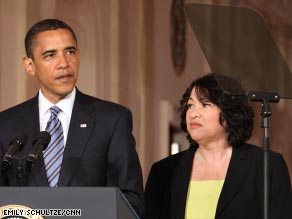
Somewhat counterbalancing this awful news was the announcement yesterday morning of President Barack Obama's first nomination for the Supreme Court, 2nd U.S. Circuit Court of Appeals judge Sonia Sotomayor. (Photo at left, Lynn Schultze/CNN) If approved by the Democratic-controlled US Senate, which is very likely, Justice Sotomayor would be the first Latina, the first Puerto Rican, and only the third woman to join the nation's highest court. I admit to getting choked up as I listened to her life story yesterday on the radio. The daughter of Puerto Ricans who came to the US mainland in the 1950s, she was born and grew up in the South Bronx. Her father had a third-grade education and passed away when she was 9; her mother then sometimes worked multiple jobs to ensure that she and her two siblings received the best education and lives possible. Justice Sotomayor, who is 54 and has lived with diabetes for most of her life, graduated from Cardinal Spellman High School, Princeton University summa cum laude and Phi Beta Kappa (and second in her class!), and Yale Law School, where she served as an editor of the Yale Law Review. This is one obviously brilliant woman. She went on to serve an Assistant District Attorney in Manhattan under Robert Morgenthau, before serving in private practice as an international corporate litigator. Nominated in 1992 by the first President Bush (ugh!) to the District Court of the Southern District of New York, she was then nominated in 1998 by President Bill Clinton and confirmed to the 2nd District Court position she now holds. She's written hundreds of opinions, some of which are summarized by The New York Times here.

Before Obama even selected Sotomayor, the GOP had begun gunning for whomever he picked, and, with the help of "liberals" like Jeffrey Rosen and the media, began smearing her. Rosen in particular deserves to be called out, because he launched a campaign in the New Republic against her using anonymous sources, which both the right-wing and the mainstream media (cf. Gwen Ifill's question on last night's News Hour with Jim Lehrer about Sotomayor's "temperament") latched onto. Mike Tomasky and Glenn Greenwald have written about this mess perhaps as thoroughly and persuasively as anyone. So it redounds to Obama that he did not allow this waxing, toxic Beltway consensus to sway his selection, which is a smart tactical move any way you assess it. It's an history-making gesture, it affirms the importance of Obama's Latino and female supporters (why on earth in 2009 is there only one woman on the US Supreme Court?), it replaces an unexpectedly moderate liberal with an expectedly centrist-liberal, and it creates a difficult challenge for the GOP and the numerous Congressional conserva-Dems.

In fact, despite the GOP's and media's characterizations, Obama apparently has chosen a judge who is truly centrist-liberal in her adjudication (as opposed to a progressive-leftist, unfortunately), It's likely she will vote and write rulings along the lines of the person she's replacing, Associate Justice David H. Souter, though some of her views, on issues such as executive branch power, abortion and same-sex marriage, are unknown. As current commentary about her judicial record shows, she generally has written rulings generally in the liberal vein, but has occasionally sided with businesses or the government against plaintiffs, including plaintiffs of color. While a few of her statements, such as the 2005 comment about appellate courts being the place where "policy is made" (which she immediately retracted) or her ethnic background and gender providing her with a powerful lens to understand the effects of the law in the everyday world will certainly spark conservative concerns, her overall profile strikes me as quite uncontroversial. (Nevertheless, Republicans are already uttering their usual extremely offensive, racist claptrap.) I hope that she moves further to the left the longer she's on the court, though having left-leaning allies, as opposed to the strong right-wing quartet now in place, might help this along. If the President gets another opportunity to appoint a justice, and I hope he will (2-4 would be great), I would love for his next nominee to be a solid progressive or even a liberal visionary, someone whose ideas and writings could serve as an intellectual and foundational counterweight to the likes of Antonin Scalia and John Roberts, Jr. Anyone got any names to send forward?

+++

And then there's the bizarre. By which I mean the "furore," to use the British form of that the word, surrounding the Professor of Poetry position at Oxford University. If you're a not a literary person or somehow happened to have missed this, here's a recap. Three poets--Nobel Laureate Derek Walcott, 79, British poet Ruth Padel, 63, and Indian poet Arvind Krishna Mehrotra, 62--were finalists for the prestigious but low-paying 5-year position that requires its holder to do little but give 3 talks a year and be a poet at Oxford. Prior holders of the chair include W. H. Auden, Seamus Heaney, Paul Muldoon, Matthew Arnold, and Cecil Day-Lewis. Shortly before Oxford graduates and academic staff were scheduled to vote up a winner a few weeks ago, a number of them living in and around the university received anonymously mailed photocopies of a book excerpt from The Lecherous Professor: Sexual Harassment on Campus, by Billie Wright Dziech and Linda Weiner, detailing a 1982 claim of sexual harrassment against Walcott by a female Harvard College student. (This occurred the year before I started my freshman year, at which point Walcott had moved across the Charles River to Boston University, where in 1996 he was sued for harassment by a female graduate student; that case was settled out of court. I should note that I did meet him several times many years later when he read at the Dark Room Writer's Collective, and several other times after that.)

Once this anonymous campaign came to light, Walcott withdrew his candidacy, stating that
I am disappointed that such low tactics have been used in this election, and I do not want to get into a race for a post where it causes embarrassment to those who have chosen to support me for the role, or to myself....
and went to say that
I already have a great many work commitments, and while I was happy to be put forward for the post, if it has degenerated into a low and degrading attempt at character assassination, I do not want to be part of it.
Hermione Lee, head of Oxford's Wolfson College and a Walcott supporter, urged Padel to dissociate herself from the sleazy campaign, as did others, and Padel did so, stating that she was not involved in the shenanigans and praising Walcott's work.

And then Padel, facing only Mehrotra, was duly elected, becoming the first woman to hold the post since it was created in 1708, and replacing critic Christopher Ricks. And then...the news emerged the other day that in fact, Padel had contacted two reporters via email last month to highlight Walcott's past transgressions. When confronted with the news, Padel had the gall to blame an anonymous student for pushing her to do it, before finally resigning from the post on Monday. The chair is thus empty. Supposedly Oxford will enter a period of reflection, before finding someone else to hold this now radioactive position.

I think it was perfectly fine for Padel and anyone else to publicly express concerns about Walcott's behavior. He is, without a doubt, one of the finest living poets and, as everyone knows, a Nobel Laureate, but his past record concerning the harassment charges do provoke legitimate questions and concerns. I imagine that Padel didn't just openly voice her concerns for fear that in doing so, she would appear spiteful, petty and competitive; yet such commentary did arise among some critics at the time that Walcott received the Nobel Prize in Literature, which in any case has gone to several writers with serious personal foibles (T. S. Eliot, Elias Canetti, etc.). Yet the subterfuge of Padel's actions is digusting, on top of being unethical and, worst of all, amateurish. There was no way that she was going to get away with this, so her actions also reflect badly and baldly on her judgment. Are there really people out there today who do not grasp that if you send someone an email, particularly someone in the media, it's easily traceable? To top things off, what ever led her to think she could trust the British media, who are known for their volubility and scandal-mongering? (On the Times of London online site, the uproar was described as a "sex row.")

I have to ask, is such a position really worth this level of skullduggery? I understand the prestige and any poet's desire for the acclaim it might bring (though if I had my druthers I would much more like to be appointed to the Collège de France), and the fact that the competitive element was already part of the process, but really, it is worth destroying one's reputation to get it? But I know that answer to that; I seriously doubt Padel is the first to have engaged in such behavior, which have surely occurred in the past and in other fields, and she won't be the last.

+++

Alice MunroOn a better literary note, congratulations certainly must go to a writer whom it required maturity for me to appreciate, Alice Munro. During my late high school and undergraduate years I would see her name and stories, and for whatever reason, did not read them, and when I found little to interest me; the plots, the characters, the structures, the language of the stories themselves simply did not stick. Around the time I was deciding about going to graduate school, I started to read her work again, and it was if I'd pulled back a heavy curtain. Now her deft portrayal of characters, her ability to push plots to places I didn't anticipate, her careful and often unexpected play with time, and her seemingly simple but apt and often subtle use of language all drew me in. I haven't ever looked back, and have joined the legions of Alice Munro fans out there. She is without question one of the major living short story writers in English, and one of the finest short fiction artists ever. Yesterday she was awarded the Man Booker International Prize for Lifetime Achievement in Fiction, earning about $95,000 and further international acclaim, and joining an august list that includes Nigerian novelist Chinua Achebe and Albanian fiction writer Ismail Kadare. She certainly deserves it.

Thursday, May 21, 2009

Cuba's Gay Rights March + Writers' Collaboration & Resistance in Vichy

Slowly and assuredly the academic year clanks to its end. I'm pretty much dragging myself around at this point, which is one of the reasons for the absence of posts. The other has been my bouncing around between cities; that too will end when mid-June rolls around. But back to academe, so far I've learned that both of my seniors honors project advisees, fiction writer and foodie Taylor Dearr, and literature student, singer and poet Harris Sockel, were both approved for departmental honors, and pending the college's decision, both will receive them when they graduate in a few short weeks. So congratulations to Taylor and Harris! Congratulations as well to all of the university's creative writing (all of whom I worked with this fall as honors director) and literature honors students who will be receiving departmental honors this year. (Once the school year's complete, I'll be posting congratulatory sentiments for all the undergraduate and graduate students.)

***

Mariela CastroOften I'll come across something in one of the papers I regularly scan and note it for a future blog post on here, only to not get around to it because of one thing or another, but I can always count on Reggie to buzz me with an email that gets me thinking. He recently sent links to two articles I'd seen, on Cuba's first Gay Pride March, which Cuban National Assembly head Ricardo Alarcón opened with a welcoming addressed. The event was organized and staged last Saturday under the aegis of the National Center for Sex Education [Centro Nacional de Educación Sexual (CENESEX)], headed by Mariela Castro, the visionary daughter of President Raúl Castro. Mariela Castro, who led a conga line at the event, has become a leading force for LGBTQ equality in Cuba, and has been pressing the Cuban National Assembly to pass one of the most far-reaching LGBTQ rights bills in the world; it would recognize same-sex unions, including inheritance rights, and also allow easy gender changes on the government's ID cards whether or not trans people underwent trans surgery, which became free after a 2008 law that she championed. It does not, however, allow same-sex couples or gay people to adopt children, nor does it use the word "marriage" in relation to same-sex unions. Currently Cuba does not permit any national LGBTQ organizations, and as recently as 2004 the police were still conducting raids on and harassing gay venues, though this has abated of late. (Historically, in a number of Communist states homosexuality has been viewed as a bourgeois activity and counter-revolutionary, and in the post-Revolutionary period not only did Raúl Castro and others allegedly kill gays, but the government under Fidel instituted a policy of "re-education" camps, which were disbanded by the late 1960s.) The bill will be considered later this year and possibility of its passage is unclear, but Mariela Castro does have her father's ear and support and apparently Alarcón's as well.

Here's an interview she gave to a Russian TV station. I still mean to post my fourth set of notes about Cuba, which will include my thoughts and experiences concerning LGBTQ issues during my trip.

***

A week ago I went to see the "Between Collaboration and Resistance: French Literary Life Under Nazi Occupation," at the New York Public Library," which Edward Rothstein reviewed last month in the New York Times, and it got me thinking about the other notion of collaboration, the perjorative one, which this exhibit presented in vivid material form. I found myself mulling not only the trajectories of the many figures who belonged to or participated in the official Resistance or engaged in unofficial resistances, but also reflecting on odious figures like Maurice Barrès and Robert Brasillach, who openly embraced the Germans, fascism and anti-Semitic, and tragic cases like that of Irène Nemirovsky, a brilliant Russian-French Jewish writer whose work not only included notorious pre-War anti-Semitic portraits but who attempted to save herself by publishing her work in anti-Semitic magazines and pleading her case to Marshall Henri Pétain himself (both she and her husband died at Auschwitz). One of the most remarkable pieces in the exhibit is the original manuscript of her two novellas that constitute Suite Française, which her daughter did not find stored in a trunk until many years later; its publication met with almost universal praise.

What the exhibit demonstrates is that the reality was not black-and-white; there were writers who actively fought not only the French regime but the German one; figures whose perspective shifted during the war years; writers who worked clandestinely while overtly giving little to no sense of their opposition; and others, like Jean Cocteau, who accommodated the Vichy regime and were able to work productively without great censure (during the Vichy years Cocteau produced two books of poetry, a novel, a screenplay, three plays, and a book of criticism on El Greco, giving lie to his reputation as the "Frivolous Prince"). A bit surprising and upsetting were the expressions of excitement, by otherwise non-right-wing figures like Paul Valéry, at France's defeat, and the possibility of "something new," mirroring the belief in an awakening and renewal that some notorious German figures (Martin Heidegger comes to mind) felt upon the Nazi takeover of the German government. My thoughts echo Rothstein's; as I walked through the exhibit I found myself thinking especially about when the valences and ethics of silence in the face of the world's horrors, and when silence could not be chalked up as anything but a form of collaboration, which is to say; how writers and other creative figures have subverted officialdom and registered resistance and protest, sometimes in very subtle ways; the dangers of ever allying fully with any politicians (as opposed to being skeptical and critical even when they share ideological affinities) or political movements; and how the events of of this period, and the lessons we might draw from them, are still applicable today.

The entrance exhibit

The exhibit (one of Valéry's daybooks is on the left)

Christian Dotrement, "Postcard to Paul Eluard"

Thursday, May 07, 2009

Recent Readings & Talks in Chi

Note: A link to information on poet Craig Arnold, who was on a creative fellowship in Japan, and has disappeared.

***

A few recent events I've attended have included readings by Zimbabwean novelist and filmmaker Tsitsi Dangarembga, who spoke at the university as part of the Program in African Studies' 60th anniversary; authors Thomas Glave and Dorothy Allison, who presented new work at Women & Children First bookstore; and anthropologist and leading scholar of Afro-Atlantic religions J. Lorand Matory, who spoke on his new book project as part of DePaul University's African Diasporic studies series. Photos below.

Tsitsi Dangarembga visited the university as part of the Program in African Studies' yearlong celebration of its 60th anniversary. (I believe it's the oldest in the United States.) I found myself delivering an impromptu introduction for Dangarembga, which was an honor to do as I've been a fan of her work for some time, and have repeatedly taught her first novel Nervous Conditions, which I imagine is probably one of the best known novels outside Africa by a late 20th century African woman writer. Dangarembga, whose name I pronounced correctly phonetically (though the accented syllable was wrong--I think she pronounced it Dahng-GAHRM-gah) read from that book, and its sequels, The Book of Not (Oxford: Ayebia Clark) and the third in the trilogy, Bira (sp.?), which cumulatively explore the life trajectory of her protagonist, Tambudzai, as she grows up in pre- and post-revolutionary Rhodesia, which became Zimbabwe, whose current sad fortunes the world is quite familiar with. The excerpt from the third, not-yet-published book in the trilogy was particularly disturbing; in it, Tambudzai, whom society has molded into an utterly alienated quasi-person, not only witnesses, but cheers on a violent attack against a coquettish young woman who fails to show proper decorum, in behavior and clothing, at a bus station. Dangarembga talked about all three books, her filmmaking career (the university screened two of her films, which I unfortunately wasn't able to catch), and the difficulties, especially economic, of life in Zimbabwe today. In response to one graduate student's query, she discussed writing in English, which she feels most comfortable working in and which has allowed her to reach a wide audience, alongside Ngugi's dictum to write in an African language, which in her case would be Shona. One of the problems for anyone writing in Shona, as opposed to English (the colonizers' language, of course), or some other African languages like Yoruba or Gikuyu, is the lack of any mechanism of standardization for Shona. When I mentioned this to a Zimbabwean student at the university, he agreed, and said it was an issue under debate back home.

Tsitsi Dangarembga at the university

Writers Thomas Glave and Dorothy Allison read this past weekend at Womens' and Children's Books, in Andersonville. I hadn't seen Thomas since he was last at the university about 4 years ago reading from his collection of essays, Words To Our Now, and hadn't seen Dorothy since one of those early 1990s OutWrites, I think (how I miss those days!), but both were in sharp form. Thomas read excerpts from two stories: first he offered up a sliver of his new collection, The Torturer's Wife's, final story, "Out There," which is set in Jamaica and explores the consciousness of a married man, Aston, who witnessed and then returns to the ruins of the country house where his one close friend and fellow lover of men, Carlton, was burned alive by the local townspeople. The excerpt touched upon Aston's desire for a local fisherman, Solomon, also known as "Brattie," whose presence assumes mythic proportions as Aston reckons with the tragedy and trauma of his late friend's and his lives. Then Thomas shifted to the horrifying ending of the title story, in which the eponymous wife, who has been witnessing vaginas and other body parts, very likely from the young women her husband tortured and murdered, decides to take action into her own nearly disembodied hands. Now don't those descriptions make you want to read the stories? Dorothy Allison read a new story, whose narrative engine was the well-modulated voice of a teenager in Sonoma County (where she lives), who imagines what will happen if he's kidnapped and thus becomes famous. It sounds almost trite to describe it as touching, but the story was, even as it was also often hilarious. Allison knows how to get into character via the technique of voice, while also sketching, from the inside out, an entire (working-class) world. Afterwards I got to hang out a little with Thomas and filmmaker Jason Tompkins, a fellow St. Louisan.

Thomas Glave reading from his collection The Torturer's Wife at Women & Children First

Thomas and Dorothy Allison answering questions

Yesterday I headed down to DePaul University to hear J. Lorand Matory, one of the leading anthropologists studying Afro-Atlantic religions, from Nigerian Òyó Yoruba religion (which led to his acclaimed first book Sex and the Empire That Is No More: Gender and the Politics of Metaphor in Òyó Yoruba Religion [Minnesota, 1994]) to Brazilian Candomblé (about which he's written an important book, Black Atlantic Religion: Tradition, Transnationalism and Matriarchy in the Afro-Brazilian Candomblé [Princeton, 2005], which received the Melville J. Herskovitz Award from the African Studies Association) to transnational Santería. His talk, which was part of DePaul's African Diasporic Studies series, was originally titled "Afro-Atlantic Ontology and the Problems of Transnationalisms," the title of an essay he's writing for a forthcoming edited volume and part of a new project, but he shifted the focus of the talk to a discussion of the signs of citizenship and spirituality, with an emphasis on how sign systems worked in relation to the nation-state in the former, and to transnational spiritual systems in the latter. The resultant title was "Sacred Double-Consciousness: The Signs of Citizenship and of Spirit Possession in the New World," and while I won't try to recap the talk-performance, because Matory really did perform the talk in a way I rarely see scholars do, engaging us in talk, song, dance and, above all, in a show-and-tell session utilizing not only slides but numerous sacred objects that he passed around, I will say that he offered what to me was an expanded way of thinking about "being" itself when he talked about how many Afro-Atlantic religions equate human beings as vessels of multiple spirits and spiritual systems, and discussed the transnational aspects of these spirits. To put it another way, we might think of our bodies and ourselves as "ensembles of being."

As I noted, he displayed actual vessels (soup tureens, cauldrons, etc.), flags, banners, crowns, horns, knives, cane hooks, and so on (some of which are shown below), that are affiliated with particular Afro-Atlantic syncretic deities and divinities, and discussed their relation to several other tenets that are reformulated in Afro-Atlantic religious practices, such as the person as vessel and crossroads, and the notions of royalty and slavery. Part of what also emerged was a rethinking of the terms of nation-state citizenship and its signs, along with a different way of considering the role and understanding of hierarchies, power, slavery, and political economy more broadly. One of the things I was trying to do throughout the talk was to connect his ideas to others I've been mulling about in relation to festival time and space, and questions of time more generally, and I thought I had an aperçu or two, though after I chatted with him, I realized I probably should work these ideas out a bit more, and in dramatized form, as I've been trying to do for some time. Also present at the talk was fellow Chicago poet and healer Abegunde Hamilton Bispo, with whom I hashed out some thoughts during our drive back north. It was only a 2-hour event, but it was definitely a brain workout.

J. Lorand Matory displaying a crucifix at his DePaul University's African Diaspora series talk

Matory makes a point while holding an beaded and cowried garabato (cane hook) for Elegguá

Some of the ritual objects Matory displayed and discussed at his talk

Wednesday, May 06, 2009

May Thoughts

It's 6 days into May and I've only managed to update my May book selections, but I guess that's better than nothing. The final poetry posts for April are still in draft form, but by the end of this week I should be over the (reading) mountain and able to post a bit more frequently. I think. I have been reading for pleasure and edification a bit more, and not just online articles, blog pieces and news stories as happens when I'm bogged down in work-related reading. I'm nearly finished with Thomas Glave's new collection of stories, The Torturer's Wife (City Lights, 2008) and had the pleasure of hearing him read from the title story and the final, arresting final one (set in Jamaica), and I've also gotten about halfway through Forrest Gander's first novel, As a Friend (New Directions, 2009), whose chapter that can only be described as a poetic tour-de-force. Written by an accomplished poet, no less. One thing I love about books of stories (and publishers really could do more to emphasize this) is that you can dip in and read 1-2 at a time, or, if you're really motivated, read as many as you like, though some authors' short fictions require breaks (Alice Munro, Haruki Murakami, etc.) to process even one piece, and Thomas's work is like that. You really have to let what you've just read steep a little. Short novels and novellas, the queer fish of American publishing, are also a blessing. Forrest's prose slows your reading and requires focus, and yet the book is still short and tight enough that you can get through it fairly quickly. I've got such a huge stack following these two that I may have to pick up the/my speed, though.

***

Speaking of reading, I haven't gotten to Colson Whitehead's new novel, Sag Harbor, but Reggie H. forwarded the link to Touré's New York Times review, in which he launches provocatively on a bit about "post-blackness" as if his take on it is a settled matter. I'm not a big fan of Touré's work (though when I met him years ago at Bread Loaf, before his ascendant fame, he was pretty cool), and I feel like his whole "post-black" prologue is trying to mark out some sort of conceptual space for reframing Touré's work rather than offering anything insightful to say about Whitehead's novel, which Reggie H. tells me is quite good. (Whitehead is a very talented novel, and wrote one of the freshest novels of the last 25 years, The Intuitionist.) It's as if he never heard or read any critiques about the term and is unfamiliar with Trey Ellis's "The New Black Aesthetic" essay, which animated conversations at the Dark Room more than 20 years ago.

What I also wrote on the CC list, where a lively series of responses ensued, was this (or some of it):

I'm glad Brian [Gilmore, a lawyer, poet and journalist] mentioned Trey Ellis's famous essay,which caused (and is still causing a stir) when it first appeared, just as Thelma Golden's term set it off too and is still provoking discussion. But then Kyle listed Hughes's "The Racial Artist and the Negro Mountain" on his syllabus, and Hughes's is making an argument heading in this direction at the end of that essay, and also challenging DuBois's "Criteria of Negro Art" and other prescriptive, racially responsible-focused readings of black art and blackness, so perhaps the conversation, the contestation, is a longstanding one.

I wonder if the issue isn't really that post-black is supposed to equal post-essential(ist).

As others have noted, blackness DOES mean many things, always has, with tremendous complexity, in the realm of ideas and in the world. Blackness has conceptual, discursive and ontological power and meaning, and isn't just an empty signifier, just as whiteness isn't. Blackness (and whiteness) have been central organizing principles and tropes for modernity broadly, as [Paul] Gilroy notes for European and American modernities in particular, and as [Toni] Morrison and others have pointed out, for American society, politics, economics, and culture. Randall [Horton]'s citation of various sources is great, and perhaps a course on post-blackness would look at theoretical discussions of race, racism, racial production, blackness as concept, idea, performance, and so on, in order to pivot into a discussion of what "post-blackness" might look like and how it is produced discursively and in other ways, what its effects are, and so on.

In terms of Toure, I won't get personal, but I do wonder if he's not just trying to position himself, as [Tyehimba] Jess says, in a vanguard of some sort, since his work continually fails to do that for him. I'm suspicious of the people who keep labeling [President Barack] Obama and his administration "post-black," or talking about the "post-racial" society we now live in especially given the frequent racist outbursts we've witnessed since January, but also the continued non-spectacular displays and systems of racism that continue. Just look at who's suffering the worst from the economic crisis; the housing crisis; the employment decline. Who still fills our jails? Who's being targeted for attacks because of this current flu outbreak? I can assure it ain't the industrial meat industry.

And I added, responding to a specific point by Reggie:

As for Michael Steele, I think he's quite happy to be black; it gives him a unique space in which to perform his buffoonery. Shelby Steele is the one who has always struck me as trying to flee blackness, but both would do well to listen to Claude Steele, who's the one who got all the smarts.
Really, if we do have to hear from one of these Steeles, let's push for it to be Dr. Claude, okay? And let's stop calling Obama "post-black," at least people who're informed about such things and have good sense, anyway.

***

I also want to highlight two bits of good news about colleagues and friends. Sarah Schulman received the 2009 Kessler Award, which means that she has been selected to deliver the David Kessler Lecture this upcoming fall by the Center for Lesbian and Gay Studies (CLAGS) at the City University of New York Graduate Center. This is a huge honor, as the Kessler lecturer is always someone who has made a major contribution to LGBTQ studies and cultures, and previous Kessler lecturers have included such renowned figures as Samuel R. Delany, Eve Kosofsky Sedgwick, Cherrie Moraga, Judith Butler, Monique Wittig, Barbara Smith, Joan Nestle, John D'Emilio, and Esther Newton, among others. Sarah's important and pioneering work, which continues to combine a powerful, original and vital imagination with an unremitting activist vision and an ethnographer's attentiveness to lived experience, has helped to create the space in which several generations of creative writers and scholars have done their work, especially at the intersection of feminism, discussions of economics and class, and lesbian and anti-racist writing and studies. She has also been a mentor to a number of younger writers, especially women and writers of color, and has put her career on the line more than once to advance causes that benefit countless others, including her recent efforts to address the ongoing paucity of work by female playwrights on New York stages. She is the real deal. Congratulations, Sarah!

Also, congratulations to my colleague Reg Gibbons, who recently received the from the Texas Institute of Letters' Soeurette Diehl Fraser Award for Literary Translation for his exceptional volume of translations, Sophocles' Selected Poems: Odes and Fragments (Princeton, 2008). Reg, you may remember, received a 2008 National Book Award nomination for his beautiful collection Creatures of a Day (LSU Press, 2007), which includes a number of fine short lyrics and a moving long poem, "Fern-Texts," that draws from and converses with Samuel Taylor Coleridge's notebooks. His other translations include such texts as Sophocles' Antigone and, with the late classicist Charles Segal, The Bakkhai (Bacchae), as well as Spanish and Mexican (Luis Cernuda and Jorge Guillén, among others) and Russian poets (Ilya Kutik--these are on their way, I believe). The last set of translations has also seeded, in part, a series of sparkling and profound essays in The American Poetry, on such topics as rhyme's cognitive power and effects, and I hope these become a book as well, very soon. Somehow he does and did all this while teaching full time, producing many volumes of highly regarded poetry and fiction, and, for many years serving as an literary magazine editor, before later serving as department chair (how!?) and now director of a literary center. The prodigiousness deserves an award all its own. Congratulations, Reg!

***

I'll end on the sad note that a good friend, Larry Knight, a brother in spirit, really, passed away earlier this week. It's tough to think and talk about , but let me just say that may his memory live long, may he rest in peace, and may his surviving partner Roberto V.'s sorrow be lifted soon.

Wednesday, April 29, 2009

El Mundo Alucinante: Notes on Cuba, Part 3

I was all set to post yesterday's new poem with commentary and my Obamatude post today, but after two meetings this afternoon my eyes started to give out (so much stuff to read these last few days), then a headache entered the mix, and I ended up by the early evening lying down and listening to "Brother President," as Professor Melissa Harris-Lacewell described him recently, work his magic with the press corps. So perhaps some Obamatude tomorrow. Overall, as I said on Monday, concerning Mr. President Obama, todo chévere (and don't think I've ever uttered this word even once in a Spanish-speaking country. Excelente or chido always come to mind first...).

***
El Mundo Alucinante: Notes on Cuba, Part 3

Another post on the still energizing and unforgettable Cuba trip.

CONNECTIVITY/THE NET/TELEPHONY

Let me mention one point that I forgot in the initial post, which concerns connectivity. I consider myself a reasonably hyperconnected person. I don't talk on the phone all that much, but I do use my cell phone, an iPhone, to text, check and send email, listen to music, and use numerous applications/apps. I almost always carry my laptop with me and often check my various email accounts several times a day, except when I'm teaching or writing; I visit a number of news and blog sites, forums, social networking sites, and so on every day, and as is clear here, I blog when I can; I often read magazines online; and I frequently either listen to or download podcasts and radio programs from the Web. While I imagined that things would be different in Cuba, and that I would not be able to access the net as readily as I can in the US, I was a bit surprised and chastened by how limited the options were. In 2 of the 3 hotels we stayed at, the only net access was via very slow PCs, at the rate of $7-8 CuCs per hour (about $10). [If you are in Havana, I recommend going to the business center at the Havana Libre Hotel, 2nd floor, where the computers are a lot cheaper and a little faster. I was able to upload some university work using a flash drive without any problem.] I had this fantasy that I was going to upload pictures every day with microblogposts, but the reality was that in the first hotel, and sometimes use emailing and Skype as ways to chat with C, but there was barely even an adequate outlet to keep my computer charged, let alone my phone (+camera); in the second hotel, in Pinar del Río, I was able to charge my computer and phone, and the hotel not only didn't have net access. In the third hotel, there were several outlets, but only a two net-ready computers, and they moved at a glacial pace. In the various schools we visited, we learned that internet access was mostly nonexistent, though various Cuban intranets did access. Our guide Tati explained that one of the problems was a lack of broadband wiring and an updated grid, which cost lots of money, financed here in the US both by governmental and private funds. Let me also add that Bernardo suggested I go to the International Press Center, which he was pretty sure had computers, phone access and cards, and so on. So I dropped by there on a particularly muggy day, and was shooed away by an officious official who promptly went back to chatting on the phone with who knows. I stood my ground and said I was a visitor, blah blah blah, and he kindly sent me on a wild goose chase for net access and a phone card (see below) that I described that evening to C as "Kafkaesque." Oh well--at least I did get to walk through the sweltering streets of Havana. One of the things I imagine that will happen over the next 10 years in Cuba will be the development of its data and communications networks, especially if any sources of private funding are allowed in.


One of the letters thanking Fidel for the literacy campaign, Museum of Literacy

Then there was the issue of telephony. I am not a telephone person, let me state that at the beginning. I have always found using telephones in foreign countries baffling, and Cuba was no different. We were told that we could rent cell phones, but I was unable to find any spot that would rent them. From my experiences in other countries (cf. DR, France, Brazil, etc.), I knew I could use phone cards. Hah! The first problem was getting a phone card. Bernardo, knowing such things, urged me to go to an outlet of ECTESA, which is the state phone company. He specifically told me to ask for a phone card priced using the national currency, and not CuCs. So I went to do so, and lo, she requested far more CuCs, not the national currency, than Bernardo had said. Then she and the other people in the little kiosk-sized office proceeded to have a good laugh at my expense in Spanish, until she realized that I was staring at her and listening intently, and then asked, "Me entiendes?" and I said yes, which immediately provoked more professional behavior, and a nice(r) send-off. Truthfully there were speaking so fast I had no idea what they were saying, but I've learned that it's best to appear as though you have half a clue if you want to preserve any dignity. I got the phone card, which was 15 CuCs ($17), and tried several times to call C and several Cubans for whom I'd brought books from a friend, finally getting through briefly before it canceled out. The next day we headed to Pinar del Río, so I couldn't go back to ECTESA for another card, but Bernardo sold me his. I tried repeatedly to use it at the hotel we were staying out, but it wouldn't work, so I tried to use the hotel's main phone to call the US. They told me they couldn't do it, so that led to a late evening attempt to find a phone in the town at which I could use the card. I ended up taking one of the bike taxis, pedaled by a man who might have been 100 years old but huffingly did manage to get us into Pinar del Río's downtown, but I couldn't find a single public phone, including the one used by the "foreign students," that would go through to the US. So finally I walked another 10 blocks and found a charming, small hotel to make even a short call to C. When we returned to Havana, I experienced the encounter at the International Press office that I mentioned above, which included my trolling every hotel and store in the area for a "tarjeta telefónica" before I returned to the ECTESA office (which sits right across the street from the famous ice cream stand Coppélia), and they were completely out of phone cards. The woman whom I'd encountered a few days before was taking cash for people to call at the phones in the office, and I thought I was encountering a scam, so when I protested, I received a nice "mi amol" and was told that, no, they didn't have any cards. And was promptly sent off to one of the many hotels that of course did not have them. I never got to inquire at the Hotel Nacional, which is the largest and grandest hotel in Havana, but I'm told they had everything, including the best cuba libres in the city, so I'll have to try them out next time. At any rate, my expectations for connectivity dropped radically, and I felt that this was excellent preparation for any potential future trips into the rain forest, the desert, or some other spot where the webs of communication I've become so used to, to dependent upon, do not exist.

Entering Casa Fuster (Alex Fuster at bottom left)

EDUCATION

The main reason for the trip, of course, was educational research. Both groups visited a range of educational institutions, from elementary schools (in Havana and the rural district of Pinar del Río, quite comparable in many ways to public elementary schools in the US) to college and university-level institutions (such as the Institute of Higher Arts [Institute de Artes Superiores] built on what was once the largest private golf course of one of the most exclusive country clubs in the Americas, in Havana). Given that, as I said before, the tour was listed as a "research" trip, the terms of our license--the visa which all Americans are required to acquire to visit Cuba legally--mandated that we spend a sizable portion (somewhere around 60-70% of every weekday) visiting institutions or organizations for research purposes, and we did. We even went to meet with a retired teacher who volunteered at the Cuban Pedagogy Association, which seeks to disseminate best teaching practices (primarily via DVD and TV) to teachers throughout the country. I was put in mind of MIT's open-courseware efforts, which include online classes and materials, and other online-based pedagogy projects aimed at elementary and secondary school teachers in the US, and thought about how useful such efforts are, at all levels, to teachers anywhere.


Performance by children at school in Pinar del Río

As part of the tour, we also met with education-related organizations and groups, such as the Cuban Student Union (FEU), a union structured as a quasi-parliament, with members participating in and linked to the government, for university students; and we heard from Cuban social work students and officials. The tour took us to governmental spaces, like Revolutionary Square, constructed originally during the Batista dictatorship in Fascist style, but since the Revolution reformulated as the site of major governmental institutions; the government-focused institutions, like the Museum of the Revolution, which was housed in the former presidential building; the Museum of Literacy, which celebrated the Revolution's striking early and swift success at overcoming the problem of illiteracy, and which featured one of the most moving artifacts I saw all trip, a book of letters written to Fidel by former illiterate people, many of them from the countryside, many women, many mixed-race or black (we learned that the oldest person who learned to read [alfabetizado] during the literacy campaign was 106 years old, and the youngest reading teacher [alfabetizador] was 8); cultural institutions like the national Museum of Fine Arts, whose "Cuban" exhibit sections we saw, including a room dedicated to the marvelous Cuban painter Wilfredo Lam, and a privately established social service organization in Pinar del Río, run by artist Jesús Carrete that provides structure and arts opportunities for people with Down Syndrome.

The focus on the arts encompassed several other community-focused projects, such as the Callejón de Hamel project in Havana's Centro district, in which artist Salvador González Escalona, whose sculptures, paintings, installations, and multiplatform works were the first murals in Cuba to celebrate and synthesize Cuba's four-major Afro-Cuban religions (Abakuá; Arará; Reglas de Palomonte; and the best known, Santería--and all the orixás were present in various forms throughout the space), created an expanding, open-air workshop along an important side street in Havana's cultural history; we were unable to attend the all-day Sunday rhumba parties that are acclaimed across the city, but we did get a brief taste of the opportunities that the space provided for people in the neighborhood and city. A different analogous site we visited was Casa Fuster, a fantastical estate developed the internationally renowned artist José Fuster, who we learned created workshops and projects for the people in the surrounding neighborhood, Jaimanitas. But then, as one of the deans at the Institute of Higher Arts put it quite succinctly, in Cuba "every artist is a teacher," and it became clear to us that this was more than a mere statement--if artists were not teaching in schools (at any level), the societal expectation was and is that they somehow will and must interact with their surrounding communities, a very different approach from the generally cloistered, market-based focus and perspective in the US.

Tati showing us a blackboard damaged by machine gun fire during the Bay of Pigs (Playa Girón) Invasion in 1962, Museum of Literacy

I could write quite a bit about the primary schools we visited, basing most of it on my notes, but I'll only say that I was quite impressed both by the teachers we encountered and by the students, who were incredibly adorable and sharp. We witnessed 5th grade students not only describing with great sophistication why José Martí was a favorite historical figure, but also very diplomatically breaking down for us one of the few Americans who'd supported Cuba's early attempt at liberal, in the late 19th century. A fifth grader. As I said in an earlier post, I did and still do wonder whether we were taken only to model schools and what other schools are really like, but seeing how these institutions operated, particularly given the economic constraints we witnessed, I was impressed. To give one example, since the state cannot afford laboratory equipment, students learn chemistry via videotapes and the intranet. To give another, primary through secondary level teachers earn only about 300-500 Cuban pesos, not CuCs, per month. (Remember, 1 CuC = $1.08/$1.20 with taxes, and there are about 25 Cuban pesos = $1/CuC.) I and others were quite curious about Cuba's secondary schools; education is compulsory through the 9th grade, after which Cubans have several choices. For 10-12th grades, they can either try go find jobs, or select from several educational options. There are technical schools focused on the sciences; there are military schools; there are vocational schools; and then there are schools in the countryside, where students devote a portion of each day to agricultural work. As there are no private schools and as the admittances to the other schools listed above are limited, the majority of 10-12 level students, including all who live in and around cities, either attend these country boarding schools or attend schools in the city where they have to dedicate a portion of their time working in city gardens and the like. As one Cuban told me, the education is very good, but the farmwork immersion and related chores are far less appealing, to put it in nice terms. Naturally, I really wanted to see one of these schools, but we didn't have the opportunity to do so. We did, however, see students in Pinar del Río who appeared to be heading back from vacation (it was around the time of Easter) to their schools, but we (I) didn't get an opportunity to chat with them.

As many (most?) decent jobs require a secondary school diploma, a sizable portion of students pursue this three-year option. I picked up that there was a problem, however, in terms of some students not continuing in school after 9th grade, and so the government and educational authorities were trying to improve the rates of continued school and graduation. At a certain age, all men must serve a period (depending) in the military, 2 years if not attending college or 1 year before college, while all women must participate in a 2-year public service project. To attend college, educational officials look at students' grades and test scores, and depending upon where they fall, they are given an option to attend certain universities or colleges. All education at all levels is free. (The state has also opened an array of what we might consider community colleges that provide people with the option of studying towards a high-school degree, vocational training, what would amount to associate and bachelors degrees, and even professional study.) Studying certain fields, such as the arts, was more difficult than others because of the limited amount of spaces. We also heard that one pending issue was the large number of students studying the journalism, humanities and social sciences (especially psychology) versus the hard sciences (and agronomy, I would add), and how the government was trying to nudge students towards the latter. In the US, of course, parents, the marketplace, colleges' and universities' course offerings and faculties, and our culture in general have a determinative effect, whereas in Cuba, personal choice (to a degree) combined with the government's (and society's) needs control what people study. As someone working in the arts and humanities, I thought about this quite a bit, particularly in relation to the constant and growing discourse about the "uselesness" or lack of utility of not only the arts, which has manifested itself in the stripping away of arts programs in many K-12 systems and the concern of some students with parental approval for taking arts and writing classes, etc., but also of the humanities. Even some very famous humanities scholars have advanced such arguments, to our national and international detriment, I would argue. Ignorance is not bliss, and scholarship is important both on its own terms but also because it often has profound effects in the world, in ways scholars might or might not imagine.

But back to the arts. One of the highlights for me was visiting Havana's Institute of Higher Arts (ISA), which would be equivalent to a state version of most of the US's top art schools combined. Admission is selective, and follows prior study in artistic fields at other institutions. It is the only higher arts school in Cuba, and students from across the country attend to receive a more humanistic training, that is, to receive grounding in aesthetics, philosophy (including Cuban Marxist-Leninism), art history, psychology, and cultural studies and appreciation, and to "experiment." The institute representative told us that students at the Institute could study music; visual and plastic arts; theater (including playwriting) and dance (as is the case at many US arts schools, i.e., NYU's Tisch School of the Arts); and audiovisual communication arts (which I imagine would include photography, film and video production). When we walked up to the spot where we were going to meet our rep from the school, we saw students strolling about the grounds playing instruments, memorizing their parts in plays, and just enjoying themselves by thinking. When we reached the little patio area, we received an impromptu jazz performance by several student musicians. At this point we were able to ask questions, and I had to inquire about creative writing, or the formal study of poetry, fiction and creative nonfiction, including journalism. (Playwriting and screenwriting, as well as cross-genre writing, should be part of this mix, but in most institutions are not.). The representative told me that there was no such thing as a creative writing program. Quoth she: "People write who are called to write." No MFA (and now PhD) as the stepping stone for literary projects or production. Nada. She went on to say that people who wanted to become writers usually but not always studied "artes y letras" (arts and letters) at the University of Havana, which was only steps from our first hotel, and then practiced and refined their art. Of course this is how writing training and as a career unfolds in most countries outside the US and Anglophone world; although some countries in other parts of Europe (like Norway and the Netherlands, I think) have writing programs, it is really only the USA, Canada, the UK, and Australia for the most part that people can and do study and get degrees in writing. And of all these countries, the USA far away has the most writing programs, in no small part because of the large market for them.

José, an artist at the Callejón de Hamel


There were several writers on the trip, and we discussed this a little; it also brought to mind a discussion Harvard scholar Marjorie Garber led a few years ago concerning her study of the role of arts at Harvard, which became a fascinating little book. One question she posed was whether the arts ought to be together in one school devoted primarily to the arts--as at Pratt Institute or RISD--or one division of a major institution--as is the case at Columbia, for example--or distributed throughout a university, as is the case at Stanford, say--or linked to certain schools and departments, as is the case at the university (where undergraduate creative writing study in poetry, fiction and creative nonfiction is part of the English department of the College of Arts and Sciences; graduate creative writing in those fields is housed in the School of Continuing Studies and formerly in the Graduate School; undergraduate and graduate journalism is in the Medill School of Journalism; and playwriting is in the Theater department, and screenwriting is in Radio/TV/Film (RTVF)); or present only in a limited sense (with a department of Visual and Environment Studies, i.e., studio art, and a few creative writers on the English faculty or teaching writing and composition more broadly), as at Harvard. Personally, I believe that all the arts, including computer and online arts, gaming, architecture, graphic design, fashion, and performance arts, should be together, but also part of a larger institution in which the humanities, social sciences, natural and applied sciences, and professional-level studies are present. The divisions strike me as artificial and problematic, but that's for another discussion.
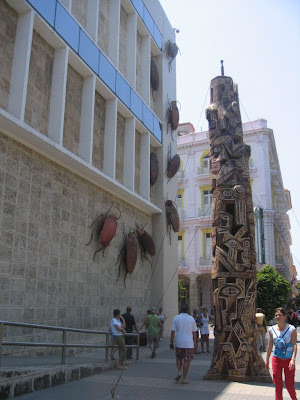
One of the International Arts Biennal outdoor installations (giant roaches crawling up the side of the building!) at the Museum of Fine Arts

I will say that the experience also got me thinking personally about the formal study of creative writing and its usefulness, whether and to what extent writing can be taught, what my and others' real aims are in the classroom, and so on. My experiences at the university and other institutions has proved year and year out that students can and do learn to write better than they did before they began, in no small part because of the focused emphasis on practice, on the technical aspects of writing, on learning to edit their own and others' work, on offering critiques and thinking about how critical reading opens up how works of art function, on modeling based on reading--on reading itself, and its role in changing and enriching one's writing. I see the results in undergraduate and graduate students' work, so I know the programs justify themselves, and yet I worry about the increasing notion that you must have an MFA or even PhD to write and teach writing, or that they're even necessary to be a writer at all. The question to the Institute rep about creative writing led to a lovely moment, however. The dean of the Institute, Jorge Braulio Rodríguez, presented two of us writers with copies of his book of translations of Richard Wright's haikus! It was an extraordinarily thoughtful gift, and for me took on great importance because it was Wright's work, I'd only read a few of his haikus, and I wasn't able, as per my usual fashion, to buy any other books during the trip (the main and famous bookstore in Havana had been closed, and I didn't pick up any books at the outdoor book market or used bookstores as I'd wanted to.)


Ana Laura's visual diary

We later had the opportunity to view some student art exhibits, which were very promising, and chat with some of the students. I also peeked in at a print studio and some classrooms, and snapped a few pictures. In preparation for the trip, I'd made up Spanish versions of my Emotional Outreach cards, and I handed them out to students and faculty. This led to one student who was there to view the art exhibit to assume, based on the Spanish on the card, that I was fluent, and a conversation with another, first-year student Wilber Aguilera, whose powerful ceramic wall sculpture, based on Edvard Munch's "The Scream" I featured several posts ago. I and another person in the first group chatted with student artist Ana Laura Tamburini, who had created a visual diary, comprising months' (a year's) worth of drawings, paintings and mixed-media works, which covered several walls, as well as a diary book that she was displaying. Along with Callejón de Hamel and the Museum of Fine Arts, is one of the places that I really would have loved to spend more time at, and I also would love to return and spend a quarter or term, or some length of time, teaching and learning there myself. One final thing I'll say about the Institute of Higher Arts is that its architecture is worth seeing. The visual art exhibit was in one of the main buildings that had been designed, we were told, by avant-garde and Revolutionary supporters Cuban architect Ricardo Porro and Italian architects Vittorio Garatti and Roberto Gottardi in the 1970s, after Fidel Castro created the institution in 1976 by consolidating and expanding several higher arts schools, including the original post-Revolutionary National Arts School of 1962. The buildings are quite futuristic, in an almost Star Trek-ish style, though using distinctive local red bricks and tiles. Among the more interesting architectural effects they created was an open plaza designed to appear if viewed from the air as a clitoris. (I kid you not.) I heard that while many of the structures were completed, there were a few that had not been built, though this wasn't apparent from a walkthrough. The overall effect was of striking, futuristic buildings that probably do have a beneficial effect on the creation of works of art.

ISA buildings, from a distance

I've written a lot, so I'll stop here. I still have not said anything about discussions with Cubans about politics vis-à-vis the US, gender issues and homo/sexuality, and a few other topics, including those that remained a mystery, like the prison system, so I'll aim for those in my next posts.