Showing posts with label homonormativity. Show all posts

Saturday, June 27, 2015

Supreme Court Affirms Obamacare & Marriage Equality

In this March 23, 2010, photo, President Barack Obama
signs the Affordable Care Act in the East Room
of the White House in Washington.
 (AP Photo/J. Scott Applewhite, File)
This year's Supreme Court of the United States session is nearly over, but the court has just issued two major decisions that will resonate for years to come. In the first, in a 6-3 decision to King v. Burwell, a lawsuit brought by four conservative plaintiffs to challenge the legality of subsidies for people buying plans on the federal Affordable Care Act--a/k/a Obamacare--exchanges, the court ruled in favor of the landmark law. Conservative Chief Justice John Roberts Jr., who had previously voted with the majority in the 2012 case NIHIB v Sibelius to uphold Obamacare's mandate as a tax, again wrote the winning decision, stating that the ambiguous wording of the statute, "established by the state," should be understood in light of Congress's intentions, which were that the subsidies should not be limited to state-established exchanges, but were legally extendable to the federal ones as well. Roberts was joined in his decision by Associate Justices Stephen Breyer, Ruth Bader Ginsburg, Elena Kagan, Anthony Kennedy, and Sonia Sotomayor. Dissenting were conservative Associate Justices Samuel Alito, Antonin Scalia, and Clarence Thomas.

As a result, not only will the 6 million+ people in danger of losing their subsidies retain them, but this ruling effectively ensures the existence of Obamacare through the end of the President's term. What is also clear is that given its proven successes of providing health insurance to 16 million new people through the state and federal exchanges, and of guaranteeing coverage for over 160 million by striking the pre-existing condition bar, it very well may become as popular, despite its multiple market-friendly, neoliberal components, as prior social insurance programs like Social Security, Medicare and Medicaid now are. This, along with the taxes levied on high income owners has been, I think, one of the major reasons behind the conservative hatred of the law. The other major one was, despite its origins in and similarities to early 1990s Congressional Republican health care plans and to the state plan Mitt Romney successfully implemented in Massachusetts, the fact that this marked a major legislative victory by President Obama.

One effect of the ruling I noted was that in those states that faced challenges in rolling out local exchanges, shifting to the federal exchange was now a viable option, thereby federalizing the law even more through the back door. Whether this will lead eventually to Medicare-for-all or, even better from a logistical and economic standpoint, a form of single payer health insurance, remains to be seen. But the President was right to point out that as this ruling ratified Obamacare for the near term; it is here to stay, and in the loss, the Republicans dodged a major bullet, since they had no viable, comparable health insurance plan to speak of. Even conservative journalists had begun to question some Republican leaders on this fact. Now they won't have to devise one; it already exists, and is working.

One final thing I'll say is that it struck me that a bit of literary critical study--or even basic reading comprehension--could have led the court to reject this challenge outright. "The state" in common parlance certainly does mean an individual state, as in "the state of New Jersey, like all others in the US, issues drivers' licences." However, "the state" also has the popular meaning of "nation" or "federal entity." It's not just the literary gambit of William Shakespeare writing of"something [being] rotten in the state of Denmark," but regular invocations of "state violence" or "the state's overreach," etc., that point to this other meaning being valid. Thus it strikes me that the Congress's alleged inartfulness was actually quite clever; in those four words, they had already made their case, and all that was needed was careful reading, which Roberts and the five other justices gave the law. Dissenting conservative Associate Justice Scalia disagreed, in spiteful fashion, but what else is new?

***

Black lesbian couple marrying
on beach (BlackEnterprise.com)
Not to be outdone with the Obamacare decision, on LGBTIQ+ Pride Weekend in New York City, the Supreme Court affirmed, in a 5-4 decision in Obergefell v. Hodges and several other linked cases from Kentucky, Michigan, Ohio, and Tennessee, that according to the 14th Amendment of the United States Constitution, same-sex marriage was a federal right for all Americans under the Equal Protection clause. The opinion, written by Associate Justice Anthony Kennedy, cited equal protection and due process, and effectively federalized same-sex marriage, which only 15 years ago existed in one state, Massachusetts. Kennedy's decision, joined by Associate Justices Breyer, Bader Ginsburg,  Kagan, and Sotomayor, was the culmination of decades of work by marriage equality activists and theorists.

As Huffington Post notes:
In the majority opinion, the justices outlined several reasons same-sex marriage should be allowed. They wrote that the right to marriage is an inherent aspect of individual autonomy, since "decisions about marriage are among the most intimate that an individual can make." They also said gay Americans have a right to "intimate association" beyond merely freedom from laws that ban homosexuality. 
Extending the right to marry protects families and "without the recognition, stability, and predictability marriage offers, children suffer the stigma of knowing their families are somehow lesser," the justices wrote.
In response to the ruling, each of the judges on the losing side, Chief Justice Roberts Jr., and Associate Justices Alito, Scalia, and Thomas, wrote separate dissents, some of them extreme in their rhetoric. Roberts cited problematic historical precedents; Alito wondered whether people who disagreed with same sex marriage would be discriminated against; Scalia harshly mocked Kennedy's opinion and writing style, while seemingly approving sexual liberationist rhetoric; and Thomas, perhaps most offensively, wondered whether enslaved and interned people did not still maintain their dignity, thereby calling for continued discrimination.

The ruling could have been narrower; Kennedy could have found only for cross-state recognition of marriages performed by a state that had legalized same-sex marriage in ones that had not, but the ruling not only ratified that principle, but also legalization in states that had overtly passed anti-marriage equality statutes. The case's lead plaintiff, Ohioan James Obergefell, had married his late partner of three decades, John Arthur, who passed away 3 months later, and had sought to be listed as Arthur's spouse on his death certificate.

Kennedy's 2003 decision in Lawrence v. Texas, which decriminalized state laws against sodomy--in its same and opposite sexual forms--was an important step in the decade and a half-long process towards marriage equality. Another step came in 2013, when the court struck down the odious 1996 Defense of Marriage (DOMA) law, which the GOP-led Congress had passed and President Bill Clinton had signed into law. The decision also tracked the shift towards public support of same-sex marriage, which currently stands at 60% (Gallup), after having been as low as 44% (vs. 53% against) only a decade ago, and 27% back in 1996 when DOMA passed. A major component of this cultural and political shift has occurred because of younger Americans, who show higher levels of LGBTIQ acceptance than their elders.


Despite the significance of the ruling, numerous challenges for LGBTIQ people remain. First, there is no guarantee--despite the legal ruling that some recalcitrant states will apply the laws as required, without visible or invisible resistance. (State responses to various civil rights laws and rulings offer a precedent.) In addition, a number of the leading GOP candidates have called for resistance to the ruling, and several, such as Mike Huckabee, have called for a Constitutional Amendment to counter the new status quo. Perhaps more importantly, in a majority of states, as NPR noted in April, it is still legal to discriminate against LGBTIQ people, or those thought to fall under this category, in employment, housing, and public accommodations. Surprisingly to me, many people, including many queer people, seem not to grasp this. To put it another way, you can now get married to a person of the same sex in Mississippi, but if you live in a municipality that does not offer civil protections, you can be fired, lose your apartment, and be denied a hotel room! You also may risk losing custody of your children as well.

I should also note that there will be increasing pressure on LGBTIQ peeople to marry and thereby (homo)normalize our relationships, a push counter to the gay liberation ethos of the 1970s and early 1980s, in which LGBTIQ people sought to define ourselves as we saw fit, against and outside the demands of oppressive heteronormativity. Not only will innovative and distinctive forms of domestic arrangement between consenting adults become frowned upon, but legal possibilities such as domestic partnerships and civil unions, which my partner and I have, may also be phased out, forcing LGBTIQ people into the same narrowed options as heterosexuals. While this may be fine for some--many?-- homonormative people it may not fit for all, and while I personally and strongly support the legalization of same-sex marriage and support marriage equality under the law, I also believe consenting adults should not be restrained by such laws in creating relationships that work for them. The question no longer may be whether the state will recognize alternative relationship possibilities, but whether LGBTIQ people will sanction them.

Monday, May 27, 2013

Considering Mark Carson, Homophobia & Homophobic Violence

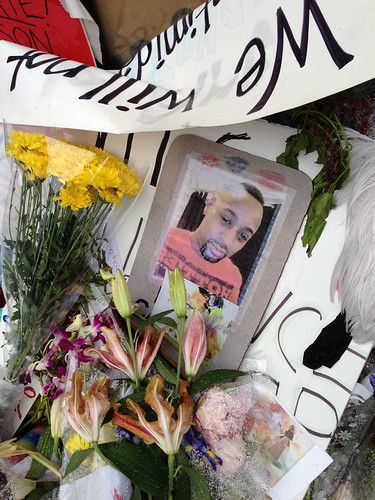
Mark Carson Memorial, Greenwich Village
Makeshift memorial for Mark Carson,
6th Avenue & 8th Street
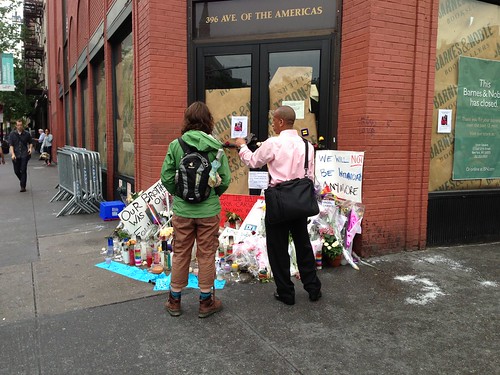
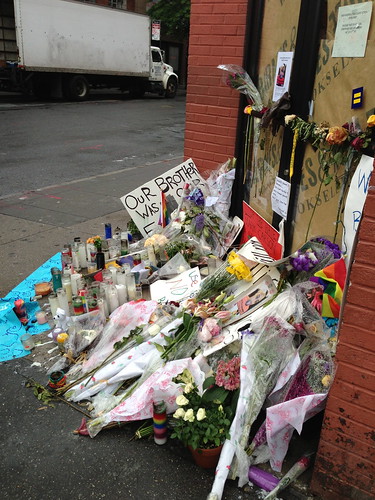
I have been thinking about the recent horrific spate of anti-gay attacks in New York City, including one last night in Hell's Kitchen, and perhaps most specifically about the murder of Mark Carson, a young, African American gay man, who was pursued up a main Greenwich Village street, 6th Avenue, and shot to death in broad daylight. The attacks come as national public attitudes, at least as expressed by polls, suggest an ever-increasing acceptance of lesbian, gay, bisexual and transgender people, and same-sex marriage, especially among younger people. They are occurring at a moment when the President of the United States has repeatedly and openly expressed gay-friend and non-homophobic sentiments, including in his second inaugural address (preceded by an out latino poet, Richard Blanco, delivering the inaugural poem), and most recently at his otherwise controversial graduation address at the prestigious, historically black all-male Morehouse College, which has had its own issues with sexual orientation and difference. We have just had the first male athlete actively playing for a major league team sport, black basketball player Jason Collins, publicly come out, and this weekend, another out gay male athlete, the white soccer player, Robbie Rogers, resumed major league team play for Major League Soccer's L.A. Galaxy. These assaults also are occurring at a moment when one of the leading candidates to become mayor of New York, Christine Quinn, is a corporate-friendly out white lesbian, and another, white Democrat Bill DeBlasio, is married to a black woman who had previously outed herself publicly in the pages of Essence several decades ago. Same sex marriage is now legal in Minnesota and Rhode Island, bringing to a dozen the states and federal districts where nuptial equality has advanced (and, with France's legislative adoption of same-sex marriage, 14 countries across the globe).

This is thus hardly a moment of post-queerness, just as it is hardly a moment of post-raciality or post-racism (or post-classism, post-feminism, post-ideology, etc.). Nor have homophobia, heterosexism, heteronormativity disappeared. We still have many mainstream religions, one of the country's two major political parties, a range of public and private institutions, and the law itself upholding an anti-gay ethos. Yet we nevertheless are living in an era we have never before experienced in this country, nor globally that matter, of widespread queer visibility, perhaps queer hypervisibility, which is to say, out queer people are increasingly present, representing and represented, everywhere, queerness itself, in and as discourse, is widely and actively produced, and the ways that this visibility, and the onward march of equality of all kinds--though primarily social equality--are transforming the society are sometimes difficult to apprehend even as we are living through them. And unlike during prior periods of queer visibility, such as the immediate post-Stonewall period or during the HIV/AIDS pandemic, though negative discourse about homosexuality still circulates and enacts considerable violence, it does so in a changed and changing environment in which some of the key negative tropes and figures of the past (that homosexuality is a sickness or disorder, that AIDS is a gay disease leading to certain death, etc.) are not always or no longer dominant. Moreover, queer representations proliferate. If the official ones, from Hollywood and the legacy TV stations continue to be narrow in terms of race, gender, class, religion, and so forth--to represent queer America, and the world, as homonormatively young, abled, educated, privileged upper-middle-class white men, mostly, and women--increasingly a wider array of representations are also out there, across an array of media, offering anyone who looks (or seeks not to) a glimpse into the far broader and more vibrant imaginaries that exist. We still have a ways to go to present the richest portrait of ourselves, but we are further along than we once were. If it was possible once to say I have never seen or known an LGBTIQ person or I had never seen an LGBTIQ person who looks like me, that is becoming ever rarer. It is still possible, but less so with each passing day.

Mark Carson Memorial, Greenwich Village
Makeshift memorial for Mark Carson,
6th Avenue & 8th Street
It is this visibility, this hypervisibility of difference and semblance, and the self-legibility that they enable, that I think are at the heart of these attacks, and the best response, it strikes me, is to continue to increase visibility, to fight for it, to push whatever the short-term costs, because the long-term victory will be to recast and transform, if not fully eliminate, the conditions under which homophobia and heterosexism can function. (This is one of the key insights and grounds for the utter importance of the International Day Against Homophobia, Biphobia and Transphobia--IDAHOBIT, which takes place every May 17.) The homophobe is often unnerved by the embodiment of his (queer) desires, enraged by the visibility of their enactment and empowerment, in others, others' bodies. (I use the male pronoun throughout here though people of all genders manifest homophobia and heterosexism.) It unsettles him to see, to have to see, to not be able not to see not just a small band of abjected queers, onto whom he can project his disgust as a reflection of his desires, but an ever-increasing circle of queers, some of whom look like him, may be him, are him under other circumstances, whose desires and actions are not being self-regulated and self-policed out of visibility, or regulated and policed by the state or private institutions in the way they once were, out of visibility, who can present and represent and perform their queer subjectivities in ever freer and differing ways, ways he cannot bear to witness, because he may have to see them, look at them, read himself in them. Queer visibility destabilizes his own certainty, any certainty, his own invisibility, queers normativity and makes his own queer legibility that much more likely; it casts the light and reflection back on the homophobe, on the transphobe, because, as the old phrase goes, if you are secure in your sexuality (manhood, womanhood)--as if any sexuality is ever "secure,"whatever that means, as if "manhood" in particular were ever a stable or objective category--why are you getting so upset at what someone else is doing? We often get upset at what someone else is doing even if it has no negative effects on us or anyone else, or even the person doing the thing that upsets us, because we at some level are threatened, read our own actions, our own selves, in what we can barely bear, in what we condemn. This is not merely the epistemology of the closet but another kind of epistemology. What do we start to know if we look at others--and then look closely at ourselves?

And so we see the reactions, based on religion, based on ideology, based on strategies of biopower, based on legalisms, based on incoherence masquerading as a viable system or method of critique, against homosexuality, against gender instability, against queerness even if it is not and cannot be named as such. We see the actions and reactions, rhetorical, discursive, physical, against it. We see how a man (and his friend) pursues another man (and his friend) up a street, in a neighborhood known to be gay-friendly, a "gay" neighborhood, calls out to him and presses him about whether he (and his friend) is a "gay wrestler"--so specific, as if the embodiment of a "type" he may have seen or thought about or dreamt of, that frightens him--as a prelude to striking out, to killing that type, murdering the man who at that moment, in that moment, embodies that image. We see a young man harass another young man he sees coming out of a "gay" club, that he reads as gay, that he questions about being gay ("are you a faggot"?), whom he strikes in the jaw for seeming or being or performing as "gay," for being legible as gay, visible as gay, as a host of friends join in and attack the legibly gay man--what is the young man, what are the young men striking out trying to strike out? What do the bullies who torment queer young people hope to harass or embarrass or brutalize out of them--and themselves? What does the Family Research Council want to quash in its effort to quash everything that it even thinks is queer? What do Fred Phelps's church and its followers hope to achieve by protesting anyone and anything even seemingly connected with empathetic feelings towards anyone, let alone gay people? What are they trying to cancel out because they cannot bear to see--or see in themselves? Of course I am abstracting a great deal here; I am not talking about other fluid intersections, such as power in its multiple manifestations (inflection points), race and ethnicity (inflection points), gender (an inflection point), class (an inflection point), capital (an inflection point), and others. In fact I specifically have chosen not to take up questions of race and ethnicity, since I have noted on more than one online forum that commenters slide very readily and easily onto racist tracks (and tracts), though Jason Collins's coming out, like Mark Carson's murder, have thrown them for (a bit of) a (queer) loop.

Mark Carson Memorial, Greenwich Village
Makeshift memorial for Mark Carson,
6th Avenue & 8th Street
Perhaps this is too much (bad, tired, tiresome, shopworn) speculative psychologizing. I am not saying anything many people don't already know, though I must admit I haven't (yet) seen many people saying  this. But also perhaps as a black man, a black gay man from a working-class background who lives with the persistence of racism and homophobia and heterosexism and classism and sexism and other forms of political, economic and social violence, as someone who is always aware of history and histories and herstories that are suppressed or forgotten, as  someone who listened for most of my elementary and secondary school education to Catholic priests and nuns expatiate on the dangers of homosexuality even as I recognized the queerness in those same authority figures, as someone who is always trying, striving to be critically aware and stay aware, while living in the present and understanding it, I know that every success is hard won, is not permanent, is a paving stone on the vaster and longer road to a better place, and that simply supposing that there is an easy or obvious answer to issues like this is always problematic, but also that not looking carefully at what's going, especially with accumulated evidence before you, also is problematic. It is not enough simply to say the homophobes are staring into a mirror and trying to break it, or that they are peering through a window and disliking (and perhaps liking, and thus fearing) what they see. But that is part of it; more mirrors, more windows exist, proliferate. To wit, to see, to look, in the oldest sense of those terms, is to know. It is increasingly harder for any of us not to see, look, at ourselves, or look away, and also not have that other, that reflection, ours, not see us, not look back.