 |
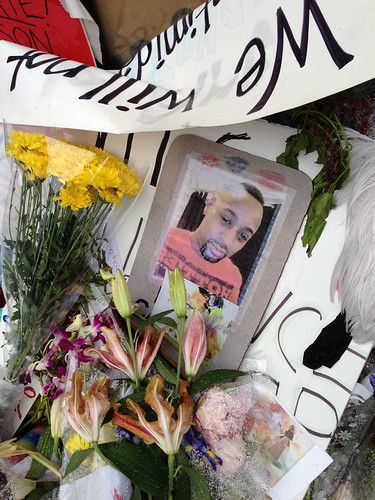
| Makeshift memorial for Mark Carson, 6th Avenue & 8th Street |
This is thus hardly a moment of post-queerness, just as it is hardly a moment of post-raciality or post-racism (or post-classism, post-feminism, post-ideology, etc.). Nor have homophobia, heterosexism, heteronormativity disappeared. We still have many mainstream religions, one of the country's two major political parties, a range of public and private institutions, and the law itself upholding an anti-gay ethos. Yet we nevertheless are living in an era we have never before experienced in this country, nor globally that matter, of widespread queer visibility, perhaps queer hypervisibility, which is to say, out queer people are increasingly present, representing and represented, everywhere, queerness itself, in and as discourse, is widely and actively produced, and the ways that this visibility, and the onward march of equality of all kinds--though primarily social equality--are transforming the society are sometimes difficult to apprehend even as we are living through them. And unlike during prior periods of queer visibility, such as the immediate post-Stonewall period or during the HIV/AIDS pandemic, though negative discourse about homosexuality still circulates and enacts considerable violence, it does so in a changed and changing environment in which some of the key negative tropes and figures of the past (that homosexuality is a sickness or disorder, that AIDS is a gay disease leading to certain death, etc.) are not always or no longer dominant. Moreover, queer representations proliferate. If the official ones, from Hollywood and the legacy TV stations continue to be narrow in terms of race, gender, class, religion, and so forth--to represent queer America, and the world, as homonormatively young, abled, educated, privileged upper-middle-class white men, mostly, and women--increasingly a wider array of representations are also out there, across an array of media, offering anyone who looks (or seeks not to) a glimpse into the far broader and more vibrant imaginaries that exist. We still have a ways to go to present the richest portrait of ourselves, but we are further along than we once were. If it was possible once to say I have never seen or known an LGBTIQ person or I had never seen an LGBTIQ person who looks like me, that is becoming ever rarer. It is still possible, but less so with each passing day.
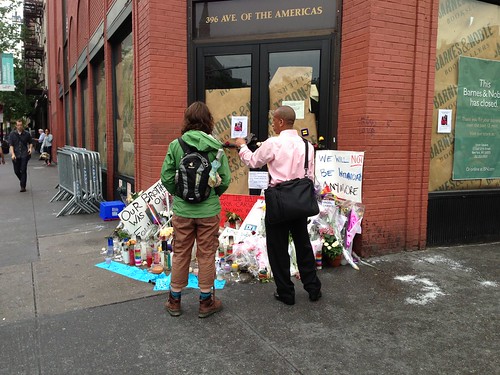 |
| Makeshift memorial for Mark Carson, 6th Avenue & 8th Street |
It is this visibility, this hypervisibility of difference and semblance, and the self-legibility that they enable, that I think are at the heart of these attacks, and the best response, it strikes me, is to continue to increase visibility, to fight for it, to push whatever the short-term costs, because the long-term victory will be to recast and transform, if not fully eliminate, the conditions under which homophobia and heterosexism can function. (This is one of the key insights and grounds for the utter importance of the International Day Against Homophobia, Biphobia and Transphobia--IDAHOBIT, which takes place every May 17.) The homophobe is often unnerved by the embodiment of his (queer) desires, enraged by the visibility of their enactment and empowerment, in others, others' bodies. (I use the male pronoun throughout here though people of all genders manifest homophobia and heterosexism.) It unsettles him to see, to have to see, to not be able not to see not just a small band of abjected queers, onto whom he can project his disgust as a reflection of his desires, but an ever-increasing circle of queers, some of whom look like him, may be him, are him under other circumstances, whose desires and actions are not being self-regulated and self-policed out of visibility, or regulated and policed by the state or private institutions in the way they once were, out of visibility, who can present and represent and perform their queer subjectivities in ever freer and differing ways, ways he cannot bear to witness, because he may have to see them, look at them, read himself in them. Queer visibility destabilizes his own certainty, any certainty, his own invisibility, queers normativity and makes his own queer legibility that much more likely; it casts the light and reflection back on the homophobe, on the transphobe, because, as the old phrase goes, if you are secure in your sexuality (manhood, womanhood)--as if any sexuality is ever "secure,"whatever that means, as if "manhood" in particular were ever a stable or objective category--why are you getting so upset at what someone else is doing? We often get upset at what someone else is doing even if it has no negative effects on us or anyone else, or even the person doing the thing that upsets us, because we at some level are threatened, read our own actions, our own selves, in what we can barely bear, in what we condemn. This is not merely the epistemology of the closet but another kind of epistemology. What do we start to know if we look at others--and then look closely at ourselves?
And so we see the reactions, based on religion, based on ideology, based on strategies of biopower, based on legalisms, based on incoherence masquerading as a viable system or method of critique, against homosexuality, against gender instability, against queerness even if it is not and cannot be named as such. We see the actions and reactions, rhetorical, discursive, physical, against it. We see how a man (and his friend) pursues another man (and his friend) up a street, in a neighborhood known to be gay-friendly, a "gay" neighborhood, calls out to him and presses him about whether he (and his friend) is a "gay wrestler"--so specific, as if the embodiment of a "type" he may have seen or thought about or dreamt of, that frightens him--as a prelude to striking out, to killing that type, murdering the man who at that moment, in that moment, embodies that image. We see a young man harass another young man he sees coming out of a "gay" club, that he reads as gay, that he questions about being gay ("are you a faggot"?), whom he strikes in the jaw for seeming or being or performing as "gay," for being legible as gay, visible as gay, as a host of friends join in and attack the legibly gay man--what is the young man, what are the young men striking out trying to strike out? What do the bullies who torment queer young people hope to harass or embarrass or brutalize out of them--and themselves? What does the Family Research Council want to quash in its effort to quash everything that it even thinks is queer? What do Fred Phelps's church and its followers hope to achieve by protesting anyone and anything even seemingly connected with empathetic feelings towards anyone, let alone gay people? What are they trying to cancel out because they cannot bear to see--or see in themselves? Of course I am abstracting a great deal here; I am not talking about other fluid intersections, such as power in its multiple manifestations (inflection points), race and ethnicity (inflection points), gender (an inflection point), class (an inflection point), capital (an inflection point), and others. In fact I specifically have chosen not to take up questions of race and ethnicity, since I have noted on more than one online forum that commenters slide very readily and easily onto racist tracks (and tracts), though Jason Collins's coming out, like Mark Carson's murder, have thrown them for (a bit of) a (queer) loop.
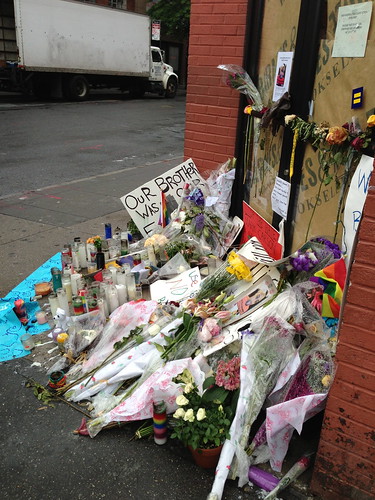 |
| Makeshift memorial for Mark Carson, 6th Avenue & 8th Street |
Perhaps this is too much (bad, tired, tiresome, shopworn) speculative psychologizing. I am not saying anything many people don't already know, though I must admit I haven't (yet) seen many people saying this. But also perhaps as a black man, a black gay man from a working-class background who lives with the persistence of racism and homophobia and heterosexism and classism and sexism and other forms of political, economic and social violence, as someone who is always aware of history and histories and herstories that are suppressed or forgotten, as someone who listened for most of my elementary and secondary school education to Catholic priests and nuns expatiate on the dangers of homosexuality even as I recognized the queerness in those same authority figures, as someone who is always trying, striving to be critically aware and stay aware, while living in the present and understanding it, I know that every success is hard won, is not permanent, is a paving stone on the vaster and longer road to a better place, and that simply supposing that there is an easy or obvious answer to issues like this is always problematic, but also that not looking carefully at what's going, especially with accumulated evidence before you, also is problematic. It is not enough simply to say the homophobes are staring into a mirror and trying to break it, or that they are peering through a window and disliking (and perhaps liking, and thus fearing) what they see. But that is part of it; more mirrors, more windows exist, proliferate. To wit, to see, to look, in the oldest sense of those terms, is to know. It is increasingly harder for any of us not to see, look, at ourselves, or look away, and also not have that other, that reflection, ours, not see us, not look back.