Tuesday, March 07, 2006

Lambda Literary Award Finalists + 3 Passings

Among the finalists for the 2005 Lambda Literary Awards (alphabetical by category), I'm listing the following books and writers, whom I either know, in some cases very well, or have met over the years. I definitely wish all of them the best! (And in the case of Freedom in the Village, I actually have work in the anthology):

Anthology
Freedom in the Village: 25 Years of Black, Gay Men's Writing, ed. E. Lynn Harris (Carroll & Graf); Everything I Have is Blue: Short Fiction by Working-Class Men, ed. Wendell Ricketts (Suspect Thoughts); Bullets and Butterflies: Queer Spoken Word Poetry, ed. Emanuel Xavier (Suspect Thoughts)

Erotica
Best Lesbian Erotica 2006, ed. by Eileen Myles and Tristan Taormino (Cleis)

Gay Men's Poetry
School of the Arts by Mark Doty (HarperCollins); For Dust Thou Art by Timothy Liu

Lesbian Poetry
Where the Apple Falls by Samiya Bashir (redbone press); Directed by Desire: Collected Poems by June Jordan (Copper Canyon); Life Mask by Jackie Kay (Bloodaxe Books); Eye of Water by Amber Flora Thomas (Pittsburgh)

LGBT Studies
Why I Hate Abercrombie and Fitch by Dwight A. McBride (NYU Press)

Nonfiction
Beyond the Down Low by Keith Boykin (Carroll & Graf); Words to Our Now by Thomas Glave (Minnesota)

Romance
Walt Loves the Bearcat by Randy Boyd (West Beach Books)

Sci-Fi/Fantasy/Horror
Fledgling by Octavia Butler (Seven Stories) [very cool that she was nominated, though she said that she wasn't a lesbian]

Spirituality
Fumbling Toward Divinity by Craig Hickman (Annabessacook Farm)

Transgender/GenderQueer
In a Queer Time and Place by Judith Halberstam (NYU Press)

+++

Three more important predecessors and major figures passed away recently:

Yahoo! News: Photographer, filmmaker, novelist, and polymath Gordon Parks dies at 93

Yahoo! News: Malian bluesman Ali Farka Touré passes

New York Times: New York School poet Barbara Guest dies at 85

Monday, March 06, 2006

Oscars + Kirby Puckett RIP

Queen LatifahLast night I sat through the Academy Awards, a show that I'd actually said I was going to stop watching a few years ago, after Titanic was named the best picture, but which, like a very powerful magnet, almost always manages to draw me back and keep me watching in a semi-tranquilized state for its entire 3+ hours.

But I was less narcotized than usual by TV, so here're my 10 points of chatter about the spectacle last night:

  1. Crash, a truly awful mess of a movie, beat out Brokeback Mountain and three other superior films;
  2. The Oscar Academy felt it did all it needed to in awarding Ang Lee the Best Director and passed over Brokeback Mountain and its actors in most of the other categories for which they were nominated;
  3. Because Brokeback Mountain is about THE GAY CLOSET and men who don't "despise themselves" as much as it is a "love story" with "universal themes" and appeal blah blah blah, Hollywood heteros and closeted homos were not about to reward it with the top prize;
  4. Host Jon Stewart was pretty funny at points, but overall the show was too subdued (bring back Whoopi Goldberg!);
  5. Until Rachel Weisz and Sandra Bullock appeared on stage it was the parade of the "ethereals," or ABWs (anorexic blonde women), who, if they get any thinner and their hair gets any lighter-colored, that is, grow more ethereal, are going to simply disappear into the ether altogether;
  6. The montage of homoerotic cowboy movie scenes was funny, well done and reminded the Academy of the closet cases and the fact that they picked Crap as the best picture;
  7. The first rap song by Black performers (thanks, Karsh!) to win an Oscar would have to be about, of all things, the vicissitudes of...pimps! Queen Latifah (above, Yahoo! Oscars) did make a humorous comment about the Three 6 Mafia's win, but it's still telling that of all the hiphop original songs and scores for films, this particular one won;
  8. Jon Stewart made a funny joke about the Three 6 Mafia ("Martin Scorcese, zero Oscar, 36 Mafia, 1");
  9. George Clooney, whom I've never been particularly fond of and who fashions himself as a budding liberal activist (he is a decent actor these days, and pretty talented, I'll admit) might not be congratulating Hollywood so fulsomely on its progressiveness if he were to open a film history book and actually read about portrayals of Blacks and other people of color right up to 2006;
  10. Terrence (Dashon? what happened to the "Dashon"?) Howard is starting to show the effects of what Dave Chappelle posited during his recent appearance on Inside the Actors Studio, which is that Hollywood can seriously mess with Black folks' minds (and that's stating what he said in mild terms).
If you are unfamiliar with Mr. Howard's recent transformation, go no further than to Clay Cane's site, where he links to a Black Planet interview he conducted with the self-described "mixed" thespian. My favorite quote from Clay's interview involves Terrence's fanciful--to put it nicely--description of how Hollywood works these days:

"Well, what's beautiful is that they are realizing that there's no such thing as an African American or a white person. Fortunately I am the make-up of everybody, and I'm aware of that; so I carry your power and yours. Most people aren't aware of the power they have so they allow themselves to be categorized."


Which is why he was nominated for playing a BLACK PIMP who gets into HIPHOP, and why his other major role this year was as a humiliated upper-middle-class BLACK MAN. "No such thing," indeed.

C. thought Dolly Parton didn't look so great; I thought that for a woman climbing the upper reaches of life's ladder, she looked fantabulous. A bit Barbiesque in a sort of freakish way, but great nonetheless. But then I thought Madonna looked great on the Grammys, or whichever of the endless parade of award shows plaguing TV these days that I clicked off right after maybe 10 minutes that she appeared on. Actually, Dolly sounded better than she looked, and her song was catchy, certainly more catchy I thought than the pimp song. (The Crash song performance was like something out of a bad horror film, or maybe even a good one, like Michael Haneke's The Time of the Wolf.)

Where are the out lesbian actors in Hollywood? When will we get to see a woman thank her female partner onstage? Yes, Lily Tomlin was out there last night--one of the highlights, her appearance with Meryl Streep--and perhaps I've missed it, but I do keep wondering where the out lesbians in Hollywood are. Where's one of the most high-profile lesbians in Hollywood, Ellen DeGeneres? Are they embargoing her until we get a Democratic president again? Where are the out lesbians of color? (No comments about the woman pictured above, okay?) Every year, I'm glad to say, there's at least one gay man who openly thanks his partner or husband. But I can't remember a woman doing that--or have I just missed it? Also, when will a woman--lesbian, straight, bi, pansexual or otherwise--who's not Lauren Bacall's age eschew a gown and wear a fierce suit onstage? Ellen would certainly do it....

Okay, I have nothing more to add, except that Will Smith did not look as cute as he has in his recent movies, so I'm not sure what was up, and that Jennifer Lopez looked like she's obviously enjoying her sunny stays (life?) down in Miami.

***

PuckettI learned today that former Minnesota Twins star and Hall of Famer Kirby Puckett (at left, SI.com) died after suffering a stroke yesterday. The Chicago native was only 45 years old. Puckett had a lifetime .318 batting average and led his team to World Series Championships in 1987 (over the St. Louis Cardinals) and in 1991 (over Atlanta, mainly through his heroics), and garnered acclaim for his swift bat and skill in the outfield. His exuberance and sustained excellence made him a favorite of fans in Minnesota and across both leagues. Puckett had to retire in 1995 after suffering from glaucoma, which blinded him in his right eye, and the forced retirement supposedly devastated him. In 2001 he became the second youngest person ever to be elected to Cooperstown. The 5'8" athlete was always stout though fit during his playing career, but had grown increasingly overweight in recent years, which may have led to further health problems. Baseball fans won't forget his marvelous play and effervescent approach to the game anytime soon.

Sunday, March 05, 2006

Snow (Again)

I shouldn't complain, since I knew I wasn't taking a job in southern New Mexico, and it snows in New York and New Jersey, but still...

It's never fun to have to do this, but Chicago is Chicago....

Residents are responsible for the sidewalks near their homes/condo/apartment buildings/wherever they plan to walk and not break their necks

It almost looks beautiful and peaceful, with the titanium sky overhead and the asphalt reflecting the canopies like a black mirror

Until you have to stumble through the snow, giving your hamstrings an unexpected workout

Snowy streetscapes and landscapes always look most beautiful to me at night

And this one is like something out of a dream...

(But I'll take this dream over the previous one in a heartbeat....)

It's nearly March 21, so enough with the snow already!

Saturday, March 04, 2006

Busy Week (Glave, Mendelssohn, New Doctoral Students)

Words to Our NowThis past week was jammed to the rafters with visitors and events. On Tuesday, friend and brilliant writer Thomas Glave came through town and spoke at the university, both to my class and to a general audience at an event jointly hosted by the English Department's Writing Major program and the African-American Studies department. In my class, Thomas discussed his career in great death, as well as two essays by Nobel Laureate Nadine Gordimer and a poem, "Children of Our Age," by Nobel Laureate Wislawa Szymborska, all three of which focused on the moral imagination and writers' moral and ethical responsibilities and actions. He succeeded in taking the discussion to realms I hadn't, including discussing the idea that the imagination should not ever be limited and how he was attempting this in his own work, and kept the class utterly engaged until it was time to end and head to his talk. Then, at the public event, Thomas read excerpts from three of the essays in his powerful new book of essays, Words to Our Now: Imagination and Dissent: "Toward a Nobility of the Imagination: Jamaica’s Shame (An Open Letter to the People of Jamaica)," "Abu Ghraib: Fragments against Forgetting," and "Regarding a Black Male Monica Lewinsky, Anal Penetration, and Bill Clinton’s Sacred White Anus," the last of which may have occasioned the first and I would imagine only time, to my memory, that the words "sacred white anus" were repeated in a departmental gathering, public or private. What would have been the result if President Clinton's consensual sexual partner had turned out to have been a Black gay man? Thomas probed that counterfactual scenario, and his own class's deep and strong resistance to it, in the process getting the assembled audience to engage in a discussion of sexual and racial difference, "pollution" and the presidential and national bodies as well. As always, Thomas was provocative, cogent and profound, particularly in terms of posing questions about the nature and necessity of critique and dissent. It was wonderful to have him visit, even if only briefly.

Mendelsohn's The Elusive EmbraceOn Thursday, the critic, writer and translator Daniel Mendelsohn, whom I'd never met or heard read publicly, came through the Center for the Humanities to present his new translations of the major Greek poet C. P. Cavafy's (1863-1933) poems. I was particularly interested in hearing Mendelsohn's work, as I have been a fan of Cavafy's poetry for years and have even used it ("So Much I Gazed...," "Days of 1903," etc.) as the grist for some of my own poems, and Mendelsohn, an exceedingly brilliant man, didn't disappoint. He rendered some of the early poems, from Cavafy's Victorian period, in close meter and rhyme, which I found a bit jarring (though in fact this is probably how they should be translated), while capturing the later poems with tremendous aplomb and skill. Mendelsohn also contextualized the work quite thoroughly, discussing Cavafy's importance as an out homosexual, the moment of his shift from coded to more explicit language, and his use of classical themes, symbols, figures, and rhetorical forms and genres, in particular the epigram, as a means of exploring the relation between modern Greece and its historical antecedents. One of the most outstanding examples of Mendelsohn's translations was his rendering of Cavafy's sublime short poem "Walls" ( Τείχη, 1896), in which the poem utilizes two different, homonymic linguistic registers of Greek, the Demotiki (or everyday language) and the Katharevousa (or artificial, elevated literary language), to create work that construct inner metaphoric and metonymic walls and mirrors that embody the poem's themes. Mendelsohn concluded with translations of Cavafy's last poems, which have never been translated into English before, and some of them, including a very brief and exquisite four line poem, will be revelations when they finally appear.

From late Thursday through Saturday, the newly admitted, prospective doctoral students in English and African American Studies, came to campus for a visit. I finally got to briefly meet two of the truly dazzling admittees (talk about smart, friendly, personable, and ready to start cogitating!), Frank Léon Roberts (Brooklyn Boy's Blues) and Blac(k)ademic. They had the opportunity to hear two of the top English department fifth year students present their work, as well as the inaugural lectures of the new Leon Forrest Professor, African American Studies chair and English professor Dwight McBride, who gave a short, tight talk that covered topics including the geneology of racial respectability, Alain Locke and the New Negro, which he linked to the anti-gay ethos of the organizers of the Millions More March, and newly appointed Board of Governors professor and eminent historian Darlene Clark Hine, who introduced listeners to the pioneering efforts of early 20th century South Carolina midwife Maud Callen. It was very exciting to have these remarkable young folks on campus, and I hope as many of them as possible decide to enroll.

Friday, March 03, 2006

World Baseball Classic/Spring Training

The World Baseball Classic has begun, with the first sets of games taking place in Asia. Today Korea beat Taiwan (Chinese Taipei) and Japan hammered China 18-2. Most of the other games don't begin until next week, and almost all outside the Asian round will be played in the US, with one round-robin group in Puerto Rico at Hiram Bithorn Stadium. For players not in the WBC, it's spring training time. Here're some shots from both the WBC and spring training (all from Yahoo! News/AP).

Redbird Albert Pujols finds his early groove

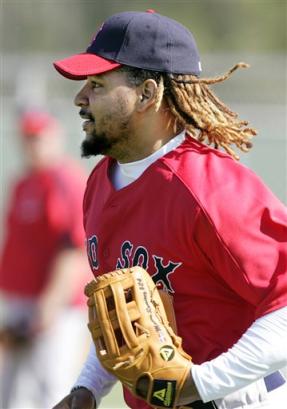
Manny Ramirez (Boston Red Sox) hits the field

Cleveland pitcher C. C. Sabathia on the mound

Florida Marlin Miguel Cabrera arriving at spring training

"Big Papi" David Ortiz of the Red Sox and Equipo Dominicano (Jamie Squire/Getty Images)

Detroit's Reggie Taylor congratulates teammate Curtis Granderson

Atlanta's Jorge Sosa hurls a breaking pitch

Derek Jeter (a/k/a Mr. Yankee) swings and grins (winces--grinces?)

Japan national teammate and Seattle Mariner Ichiro Suzuki (r) in a World Cup game against China

Toronto's Vernon Wells flashes a smile

Jermaine Dye of the World Champion Chi White Sox stretches

Chicago Cub Derrek Lee (a/k/a Talk Drink of Water) preps for batting

Mets and BORICUA [lo siento, borinqueños!] World Cup teammates Carlos Delgado and Carlos Beltrán giggle about a joke

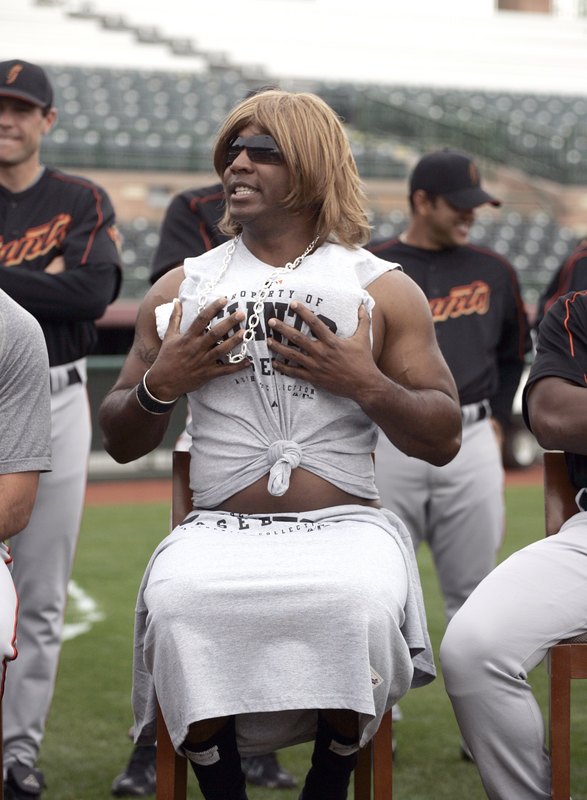
SF's Barry Bonds camps it up as Paula Abdul

Thursday, March 02, 2006

Writers against "Islamism" + "Roman Catholicist" Town in FL + CBA Reading Tomorrow

Recently, twelve major writers published the following manifesto in the Danish Jyllands-Posten in response to the widespread protests and riots, some resulting in deaths, against that conservative paper's publication of cartoons depicting and joking about the Islamic prophet Muhammad, and as an appeal to the Muslim world concerning the spread of what they call "Islamism." In spite of the strong criticisms I have against the paper's overall politics and its unnecessary provocation, I support the principle of free speech and the writers who drafted it, and am reprinting it in full.


"After having overcome fascism, Nazism, and Stalinism, the world now faces a new totalitarian global threat: Islamism.

"We, writers, journalists, intellectuals, call for resistance to religious totalitarianism and for the promotion of freedom, equal opportunity and secular values for all.

"The recent events, which occurred after the publication of drawings of Muhammed in European newspapers, have revealed the necessity of the struggle for these universal values. This struggle will not be won by arms, but in the ideological field. It is not a clash of civilisations nor an antagonism of West and East that we are witnessing, but a global struggle that confronts democrats and theocrats.

"Like all totalitarianisms, Islamism is nurtured by fears and frustrations. The hate preachers bet on these feelings in order to form battalions destined to impose a liberticidal and unegalitarian world. But we clearly and firmly state: nothing, not even despair, justifies the choice of obscurantism, totalitarianism and hatred. Islamism is a reactionary ideology which kills equality, freedom and secularism wherever it is present. Its success can only lead to a world of domination: man's domination of woman, the Islamists' domination of all the others. To counter this, we must assure universal rights to oppressed or discriminated people.

"We reject cultural relativism, which consists in accepting that men and women of Muslim culture should be deprived of the right to equality, freedom and secular values in the name of respect for cultures and traditions. We refuse to renounce our critical spirit out of fear of being accused of "Islamophobia", an unfortunate concept which confuses criticism of Islam as a religion with stigmatisation of its believers.

"We plead for the universality of freedom of expression, so that a critical spirit may be exercised on all continents, against all abuses and all dogmas.

"We appeal to democrats and free spirits of all countries that our century should be one of Enlightenment, not of obscurantism."

Ayaan Hirsi Ali
Chahla Chafiq
Caroline Fourest
Bernard-Henri Lévy
Irshad Manji
Mehdi Mozaffari
Maryam Namazie
Taslima Nasreen
Salman Rushdie
Antoine Sfeir
Philippe Val
Ibn Warraq

***

Ave MariaSeveral days ago I saw this report, maybe on Yahoo! News, and then saw it yet again on HuffingtonPost, under the headline "No Porno, No Condoms, No Birth Control," so I'm going to include a link, a quote, and minimal commentary, though it's closely linked to some of what I was gabbing around in my long statement about the absolute anti-abortionists. It looks like the Roman Catholics among that crowd just may have the village of their prayers, at least on earth, if Thomas Monaghan, the founder and former owner of Domino's Pizza and the Detroit Tigers baseball team, has his way. (I never eat Domino's pizza if I can help it, in part because of his long history of supporting extremist causes, and also because in every place I've ever lived, there's always been a better and more economical pizza parlor that delivers.)

In Monaghan's Catholic community/cult village of Ave Maria (pictured above, from its website), there will be zero abortions (big surprise!), zero contraceptives (including condoms) will be sold in any stores within its borders, and zero pornography will be available via the local cable providers (I guess they haven't heard about Internet porn, but hey, that's a good thing; then there's satellite dishes, etc.). Legalities shmegalities. I wonder if this restricted community will allow a mosque or synagogue to be built on its territory. Can they stop this? What about Protestant churches? What if Dignity, the gay Catholic group, decides to set up camp there. Will they have restrictive laws against homosexuals, bisexuals, transgender people, and people they even vaguely imagine might fall under these categories? How will they deal with their various "Huguenots"? God(s) bless America....

If Domino's Pizza founder Thomas S. Monaghan has his way, a new town being built in Florida will be governed according to strict Roman Catholic principles, with no place to get an abortion, pornography or birth control.

The pizza magnate is bankrolling the project with at least $250 million and calls it "God's will."

Civil libertarians say the plan is unconstitutional and are threatening to sue.

The town of Ave Maria is being constructed around Ave Maria University, the first Catholic university to be built in the United States in about 40 years. Both are set to open next year about 25 miles east of Naples in southwestern Florida.

The town and the university, developed in partnership with the Barron Collier Co., an agricultural and real estate business, will be set on 5,000 acres with a European-inspired town center, a massive church and what planners call the largest crucifix in the nation, at nearly 65 feet tall. Monaghan envisions 11,000 homes and 20,000 residents.

---

Frances Kissling, president of the liberal Washington-based Catholics for a Free Choice, likened Monaghan's concept to Islamic fundamentalism.

"This is un-American," Kissling said. "I don't think in a democratic society you can have a legally organized township that will seek to have any kind of public service whatsoever and try to restrict the constitutional rights of citizens."

Perhaps she's unaware of the long history in America of restricted neighborhoods, real estate covenants and redlining, "sundown" towns, and so on. Or maybe she thinks that in 2006 such nuttiness sounds unconstitutional. Also, local laws can't trump state laws, which can't trump federal laws. Or are they planning to secede? I thought the "Christian" homeland was supposed to be in South Carolina?

***
Center ReadingOn a much more positive note, tomorrow there'll be a big shindig at New York City's Center for the Book Arts (at left, photo CBA Website), which in the fall of 2004 published the exquisite chapbook version of the book that I collaborated on with artist and poet Christopher Stackhouse. Chris will be one of the readers, as will Cave Canem fellow Linda Susan Jackson, and other well-known poets like Rachel Levitsky and Susan Wheeler.

Center Broadsides Reading Series
Fifth Year Anniversary Reading
Friday, March 3rd , 6:30 pm
Series Curators Sharon Dolin, Marcella Durand, Jackie Sheeler, Christopher Stackhouse, Rodney Terich Leonard, with special guest poets Linda Susan Jackson, Rachel Levitsky, Mark Nickels, Angelo Verga, and Susan Wheeler. Hosted By Rory Golden.
Suggested donation $5 members/ $10 non-members

Cross-Post: Resonance Poetry Workshop in NJ

Cross-posted from Mendi O's SWEAT: the deadline has passed, but if you know any poets in New Jersey who're interested, please do still urge them to get their work to Professor Obadike ASAP! She's AMAZING!

Resonance (a workshop for black poets)

Please spread the word about this upcoming poetry workshop -- Mendi

Resonance: Working Sound in the Written Poem
Led by Mendi Obadike
Tuesdays, March 14th – May 2nd, 2006
Bloomfield College (Westminster Hall),
63 Fremont Street,
Bloomfield, New Jersey


Resonance: Working Sound in the Written Poem

When a phrase or idea in a poem resonates, it not only makes an immediate impression, it also stays with the reader long after the moment of reading. During this eight-week workshop, we will discuss methods for learning from other poets, try exercises for generating new ideas, and present poems for critique. While poets are welcome to write on any topic or style, many of our exercises will concern ways to invoke sound (music, voice, noise and even silence) most powerfully in our work. Because many critics and writers have historically located the blackness of black poetry in references to sound, we will also discuss ways and reasons why we might incorporate identifiably "black" matters and materials in our work.

Mendi Obadike is a poet, musician, and conceptual artist whose work has been published, exhibited, and broadcast internationally. Her work explores poetics across media. She is the author of Armor and Flesh: Poems and the librettist of the Internet opera The Sour Thunder. She has received commissions from the Whitney Museum, Yale University, the New York African Film Festival, and Electronic Arts Intermix. Her awards include the Naomi Long Madgett Poetry Prize, the Connecticut Commission on the Arts Award, and the John Hope Franklin Distinguished Teaching Fellowship. She received the Rockefeller Media Arts Fellowship with her husband, artist and composer Keith Obadike, to complete the opera TaRonda, Who Wore White Gloves . Together they recently workshopped their opera Four Electric Ghosts as artists in residence in Toni Morrison’s Atelier at Princeton. Mendi received a Ph. D. in Literature from Duke University. She teaches at The School of Visual Arts and Montclair State University.

Featured poem: Even the Magnolia

Application Process

The New Jersey Workshop is free and open to African American poets from the New Jersey area. Submit two (2) copies of four to six (4-6) poems, with a cover letter stating why you want to attend and what you hope to gain from the workshop. Please be sure to include your street address, telephone number, email address, and a statement of commitment to attending at least nine of the eleven sessions.

Schedule
The class of 12 to 15 poets will meet on Tuesday nights, 7:00 to 9:00 pm, from March 14th through May 2nd, 2006. The workshops are held in Westminster Hall at Bloomfield College, 63 Fremont Street, Bloomfield, New Jersey.

Registration deadline: POSTMARKED BY FEBRUARY 27, 2006

Cave Canem New Jersey Workshop I
Cave Canem Foundation, Inc.
584 Broadway, Suite 508
New York, NY 10012

Cave Canem began programming in New Jersey in the fall of 2003 with a workshop series led by Willie Perdomo. Yusef Komunyakaa, Cheryl Clarke, Tracy K. Smith and Herman Beavers have also facilitated sessions. Designed for emerging writers, the workshops are free and open to African American poets who live in New Jersey. These workshops are located in various areas of the state to bring this opportunity to a wide range of emerging poets: to date, they have been held in Bloomfield, Trenton, Camden and Newark. Course size is limited to 10—12 poets to assure the sense of safety and community that is Cave Canem's hallmark. The workshops have been made possible through the generous support of The Geraldine R. Dodge Foundation. Advanced Workshops meet once a week for eight weeks. Designed for emerging writers whose skills have reached an advanced stage, the workshops are free and open to New Jersey residents. The workshops are taught by renowned poets who are also excellent teachers. We ask for a commitment by participants to attend seven of the eight workshops in order to maintain the group's focus and momentum. Acceptance in future workshops depends on honoring that commitment.

Wednesday, March 01, 2006

Ramblings on the South Dakota Law, etc.

I've been thinking some more about the recent legislation in South Dakota banning abortions in almost all cases, and about similar legislation that's moving through state legislatures across the country. Ohio is proposing an even more extreme statute, though Mississippi appears poised to become the second state to follow South Dakota's lead, and its right-wing governor, Haley Barbour, has unsurprisingly declared that he'll sign the bill when it crosses his desk. I've also been thinking about the fact that the Supreme Court (SCOTUS) has now shifted even further to the right, and the newest justice, Samuel Alito, is now on record as having sent "a valentine," to use Max Blumenthal's term, to one of his strongest proponents, the virulently homophobic religious patriarch, James Dobson of Focus on the Family. In several prior posts, I stated that I was for a woman's right to choose, and more specifically, to have an abortion and to have one. More clearly, I believe that if a woman wants or needs to have an abortion, not only should the state should not restrict her in any way, but I also believe that the woman--all women--should have direct, unimpeded (i.e., no harassing fanatics, no waiting periods, etc.) access to safe, affordable, medically sound abortions in safe, affordable medical facilities, which should be accessible and available in each and every US state and territories. I connect these beliefs with my conviction that with improved comprehensive sexual and personal health education in late elementary and secondary schools, the widespread accessibility of safe and affordable medical and physical contraceptives, and the widespread availability of in-home, early stage abortifacient medications, the need for and prevalence of medical abortions will (continue to) diminish, though they should always be an available, affordable, safe option.

These beliefs undoubtedly place me on the far end of the ideological and political spectrum on this issue in the United States, though until recently I had two US senators (Lautenberg and Corzine) who agreed in principle and practice with these ideas, and a Congressperson (Menendez), now an interim Senator, whose abortion views seemed to be somewhat less liberal, though he is considered at the very least to be "pro-choice." (I should add that I have not ever voted for him, choosing instead the Green or Democratic Socialist candidates to his left--though in a contest where he'd be facing a Republican of whatever stripe and did not have a huge lead in the polls, I'd probably vote for him). Most of the sitting Democratic US Senators, and the majority of the Democrat US House Representatives, would consider themselves to be "pro-choice," though not, I imagine, pro-abortion, and some who are pro-choice (like Harry Reid of Nevada) affirm personal anti-abortion views, and so while they would not vote to uphold laws banning abortion outright, they have agreed to some of the array of legal restrictions that, as Keguro has repeatedly pointed out in his comments to my posts on this topic, all but make abortion unavailable for many women, especially working-class and poor women, and which also have, in conjunction with social and economic forces, endangered the survival of abortion clinics in numerous states. Nearly all of the Republicans in the Senate and House, I would venture, are not only anti-choice, but anti-abortion. Some are rabidly so (as are a few Democrats). A small number, like the liberal Republicans from the Northeast and Northwest, claim to be pro-choice, because they believe in access to abortions or because it's politically attractive, but if I'm recalling correctly, nearly all the Republicans in the Senate voted to seat two rabidly anti-abortion (among other ultraconservative views) Supreme Court Justices nominated by President Bush. The court itself is almost perfectly split between anti-and pro-abortion justices, with conservative, Catholic jurist Anthony Kennedy of California now near, if not in, the middle; and the executive branch has pushed an anti-abortionism since it took office in 2000. Thus at the federal level, one could argue that an anti-abortionist viewpoint holds sway, and is abetted, in the legislative branch, by "pro-choice" politicians who are not, in many cases, either in theory or practice, in favor of women's unimpeded right and access to safe, affordable abortions, let alone the presence of affordable medical clinics that perform abortions.

Many anti-abortionists (and even those with apposite and oppositive views) like to use the term "pro-life," but I have always tried to forgo that term because 1) most of the "pro-life" people I've come across, and in particularly major US politicians and leaders of many "pro-life" organizations, agree with the death penalty and have no problem with non-defensive killings in war (wouldn't this make them anti-life?); 2) most of them seem to show little concern for children, especially poor and working-class children, let alone people, who actually leave their mothers' uteruses; and 3) they aren't especially concerned with the fate of poor fetuses either, particularly in terms of pushing for better and more affordable health care for poor and working-class women and families.

Other writers, far more knowledgeable and theoretically grounded, in philosophy, the law, religion, and so on, than I, have laid all of this out before, so I admit that I may be repeating or mangling some of their ideas. A basic point that I used to see some critics making in the 1980s and 1990s, the heyday of anti-abortion fanaticism, was how reductive and problematic the terms "pro-life" and "pro-choice" were. (And even "anti-abortion" and "pro-abortion" are problematic, but I'll stick with them for the purposes of this rumination.) The unpacking of the terms rarely occurs, particularly in the mainstream media, which is invested in slogans and simplicity in any case. I see there being a spectrum of views, but I want to focus on the most extreme one, because I think it's got the most juice right now and has for some time: absolute anti-abortionism, which is basically anti-right to abortion, anti-access to abortion, anti-abortion procedures, and pro-criminalization of the abortion procedures, the doctor performing it, and to the extent possible, the woman electing and undergoing the procedure. Absolute anti-abortionism has, I believe, gained supremacy within the larger discussion of abortion rights and restrictions, and its leaders and advocates have been able to direct not only the public discourse, but now pulls the strings in terms of not only some state legislatures, but the three branches of the federal government.

Because of Roe v. Wade and the 1973-2006 ideological constitution of SCOTUS, which issued decisions that have upheld the legality of abortion in principle if not in practice, people on the anti-abortion side initially decided to take an gradual incrementalist approach to making abortion inaccessible (if not illegal); on the legislative side, they would keep pushing laws to restrict access, penalize clinics and doctors performing abortions, implement waiting periods and constraints on minors, end comprehensive sexual education (and in particularly any discussions of abortion in schools), and underwrite "conscience" decisions on the part of religious and private hospitals, while also destroying the public hospital system (for other reasons as well), which once served as a site for abortion procedures. On the social and cultural side, they would foster an anti-abortion climate in the country (which led, during a long stretch in the 1980s into the early 21st century, of almost no movies or TV show plots involving characters choosing, let alone undergoing abortions), through a private and public machinery of anti-abortionist sentiment, through symbolic and real violence, and through the increased assertion of religious (though sometimes in secularized form in the discourse around "abstinence") anti-abortionist discourse across all media, inculcating a widespread societal doxa concerning discussions and representations of abortion (even if people by a statistically significant margin still believe in abortion rights). Economically, by legislatively cutting off public funding and abortions in public hospitals, by increasing financial burdens on abortion providers, and so on, they could push abortion providers out of business. (I am old enough to remember the Bill Baird clinics of two decades ago.) The result, again, as Keguro pointed out, was that while abortion is still legal--i.e. de jure--in all states, access to safe medical abortions has been, de facto, severely constrained in some places. For working-class and poor women it is in some states almost unavailable, or very difficult to access without hardship and delay (impeded).

But I think I realized back in the 1980s, beginning shortly after the election of Ronald Reagan, the increase in the murderous statements, and then actions, of some anti-abortionist fanatics, and this led me to conclude that this de facto situation was in the end not going to be enough for the anti-abortionists. The James Dobsons and Phyllis Schlaflys, and more broadly, the Roman Catholic Church and Mormon churches, other conservative religious sects, and the increasingly right-wing Republican Party, are in essence anti-liberals and anti-libertarians (and anti-neoliberals at that); they are anti-liberals even in the classic sense of this term (that is, anti-conservative and anti-classic liberals); their guiding principles lie in natural law and philosophy, authoritarianism and patriarchy (and in some cases in proto-fascism); their beliefs are not guided by reason in the least, but by externally derived moral values, usually but not always from religious tenets. They therefore were not going to be satisfied if, say, women in Mississippi had no access to safe medical abortions in their own state but could, theoretically hop on a bus and receive a safe, economically affordable one in Arkansas, or Missouri, or Texas. (Or if the entire South, save Florida, for example, banned abortions, get on a bus or train or plane to Illinois or Wisconsin or Iowa or Michigan, all of which would be less than a day away.) This is the current state of affairs. Because ultimately, the idea of choice would still remain available in theoretical form, as would the basic legality of abortions (even if there were no places to have them). So the plan had to become an all-out assault after the neoliberal, economically conservative and socially moderate Clinton presidency, with the election of someone who would use the SCOTUS selection process to appoint justices who, once on the court, weren't going to equivocate or look to changes in societal mores or foreign precedents, but take a firm, anti-liberal anti-abortionist view. (Clarence Thomas has libertarian leanings on some issues, but is firmly anti-abortion.) Once this occurred, the assault could then proceed at the state level (hence South Dakota), which would then allow a series of lawsuits to trickle up that would, ultimately in the view of the anti-abortionists, effect a federal ban. That way, there would be no outs whatsoever, except for wealthy women, who would be able to travel to Canada, the EU countries, or wherever they chose to have abortions, while most working-class and poor, and even many middle-class women, would not have this option.

Alongside this legislative and judicial assault on abortion would come attacks first on abortifacient medication, such as RU-486 and on the "morning-after pill." Given the Griswold decision upholding the right to contraception, the anti-abortionists have tried to (and in some cases succeeded) to expand the definition of abortifacience (which they have begun to do), with the result of keeping such medications from the market altogether or severely restricting access to them, while also pushing for "conscience" options for pharmacists not to prescribe them (which led Illinois's governor to direct the passage of a law preventing this). But the long-term goal, which might not exactly be so long-term anymore, would be to ban medical contraceptives, including the pill.

We are now witnessing the second part of the anti-abortionists' all-out anti-liberal assault. South Dakota's position is resolutely anti-abortion; all abortions are banned, including in the cases of rape and incest (or the combination). While this would and ought to be unreasonable to most people (certainly most women, I would imagine), and while Survey USA's September 2005 poll on abortion views suggests that in South Dakota the pro-anti dichotomy is very close (49% of South Dakotans hold "pro-life" attitudes, while 47% hold "pro-choice"--which explains the refusal to allow a popular referendum on the issue), the anti-abortionists see this extreme position as the best option. South Dakota's law is the first in the anti-abortionist experiment to see how far the state-by-state ban plan can go, and what outer limits (such as criminalizing interstate commerce in abortion, etc.) might be established in the process, with the ultimate aim of provoking a fairly draconian federal ban. The goal would be a kind of anti- Lawrence v. Texas, by which I mean, a blanket ruling in the reverse anti-liberal/anti-libertarian direction (and that law may not hold if Bush gets to appoint another SCOTUS judge.)

For the anti-abortionists, taking a conservative "states-right" or libertarian viewpoint is insufficient, because what might result would be a legal state-by-state patchwork that would certainly include a handful of states that allowed unfettered access to (Massachusetts, California, Rhode Island) and perhaps even public funding for abortions (Vermont) to states with laws with varying degrees of restrictions (Michigan, Pennsylvania, Maryland), as is currently the case, to states where there was an outright blanket ban (as South Dakota has legislated, and as Indiana, Ohio, Kentucky, and Mississippi want to join). Indeed, wouldn't conservative "states' rights" demand this? Instead, by forcing the hands of SCOTUS, a federal ban would achieve the ultimate goal--negating once and for all the concept of choice as it's construed, as well as the far more pressing issue of legality. The only choices for many (most?) women would be as they were in the pre-1973 period: have the baby or have an unsafe abortion.

This brings me to the following point that I've been mulling over, which is: how do and can we, in collective fashion, advance a liberal, progressive position--in philosophical, socioeconomic and practical terms--on this topic (and so many others) into the public sphere in a climate in which the discussion and discourse have shifted so radically to the right, employing rightist rhetoric and memes, and in which there appears to be no political body or viable political parties or forces through which to open up, charge and change popular discussions and viewpoints, and eventually laws in liberal-progressive ways concerning abortion, and other issues of concern to those on the left? Must we reach the point, as Keguro suggested in, of a striking down of Roe v. Wade and an outright ban to reformulate the discussion and recharge the progressive legislative process? But then, if that die is cast, would it be possible to roll it again? (Think about 1976 SCOTUS Gregg v. Georgia ruling overturning the 1972 Furman v. Georgia anti-death penalty ruling--that institutional abomination continues in states across the country, despite the increasing prevalence of DNA testing undergirding studies that demonstrate the effects of prosecutorial and police malfeasance and incompetence leading to wrongful convictions, and the overall societal-wide fall in crime. The 2004 Roper v. Simmons ruling was a step in the right direction, and Kennedy was the deciding vote.) I was mentioning to C. last summer that in terms of the popular mainstream media, the only TV channel that I could think of that treated the issue of abortion with complexity, and that actually presented a scenario in which a woman underwent an abortion without negative psychological, emotional and physiological results, was MTV. But MTV alone won't and can't do it. It shouldn't, and in any case, media representations alone are no substitute for grass-roots and large-scale political and sociocultural work. MTV's logic is the ((neo-?)liberal?) market(place), and not political action and praxis. The Democratic Party, at least as its currently constituted, and particularly as its been yoked around by the conservative-leaning/neoliberal Democratic Leadership Council, offers few options at the national level. They have repeatedly capitulated to the extent that we are no longer near the center of this debate, but on its far right edges. So what to do? That is the pressing question....

Tuesday, February 28, 2006

Negro Leaguers Enter Hall of Fame (but not O'Neil)

ManleySeventeen deceased former members of baseball's Negro League and pre-Negro Leagues were elected by special committee today into the National Baseball Hall of Fame in Cooperstown, New York.

From the Hall of Fame site:

The electees include seven Negro leagues players: Ray Brown, Willard Brown, Andy Cooper, Biz Mackey, Mule Suttles, Cristobal Torriente, and Jud Wilson; five pre-Negro leagues players: Frank Grant, Pete Hill, José Méndez, Louis Santop, and Ben Taylor; four Negro leagues executives Effa Manley, Alex Pompez, Cum Posey, and J.L. Wilkinson; and one pre-Negro leagues executive Sol White. Manley, an owner in the Negro leagues, becomes the first woman elected to the Baseball Hall of Fame.

(The AP File photo above is from ABC News, and shows inductee Effa Manley, at left, who co-owned the Newark Eagles of the Negro National League. She's reviewing a scrapbook with one of her former players, Don Newcombe, later one of the Brooklyn Dodgers' star pitchers, at her home in Los Angeles in August 7, 1973. An interesting aspect of Manley's story is that although she was White, she was married to a Black man and passed as Black.)

Shades of GloryIn addition to the election of these individuals, the Baseball Hall of Fame conducted an extensive study of the history of Blacks in baseball, going from 1860 (that's right, before the Civil War) up to 1960, at which point there were Blacks on nearly every team in the major leagues (since Jackie Robinson had broken the color line in 1947, permitting Blacks and Latinos of visible African ancestry to participate, ushering in the era of some of the greatest players of all time, including Willie Mays, Hank Aaron, Frank Robinson, Roberto Clemente, Bob Gibson, Juan Marichal, Lou Brock, Ernie Banks, Willie McCovey, Orlando Cepeda, Luis Tiant, and many others). National Geographic, in conjunction with the Hall of Fame, published a book entitled Shades of Glory this month based on some of the research. (I will be getting this ASAP.)

O'NeilThere was considerable controversy, however, because one of the chief figures behind the honoring of former Negro League players and affiliates, and a notable player and manager himself, former Kansas City Monarchs player and the Black coach in the major leagues, with the Chicago Cubs, Buck O'Neil (at right) was, unconscionably, not inducted. Nor did the special committee elect another fomer Negro Leaguer and one of the first great Black Latino MLB stars, the Cuban player Minnie Minoso, who actually made comebacks with the Chicago White Sox at the ages of 53 and 57!)

O'Neil led the Monarchs to five pennants and two Black World Series, and later played a key role in advancing the careers of "Mr. Cub" himself, the great Ernie Banks, and Elston Howard. (But for whatever reason, he wasn't elected.)

MSNBC's Keith Olbermann (one of the few journalists still appearing regularly on TV) interviews Buck O'Neil here.

The San Jose Mercury News features on article on the controversy here.

Sports Illustrated reports that the 94-year-old baseball veteran "is keeping his spirits up."

Even some members of Congress are upset about O'Neil's snub.

On a related note, Bernie Tarver of Bejata will be in the Hall permanently as well, because he's lent his mellifluous vocals to the exhibition narration for the 18th admittee this year, former St. Louis Cardinals relief pitcher Bruce Sutter, as well as to spots for other inductees and exhibits at the museum! Congratulations again, Bernie. This is yet another good reason for me to finally get my ass up there and visit the place.

Monday, February 27, 2006

One Year Blogiversary

Today marks my 1-year blogiversary.

Although I was initially skeptical of some blogs, which appeared (and still do) to be nothing more than private, unedited journals displayed for all the world to see yet which probably should stay private (is the idea of private space totally lost in this superlinked, supermediated, supersurveilled world?), I was nevertheless profoundly inspired by a number of blogs--including Bernie's Bejata, Charles Stephens's blog (though long gone and wiped clean, it still remains one of my favorites and never ceased to get me thinking), Larry Lyons's blog, Mendi Obadike's multiple sites, and Donald Agarrat's photogallery with commentary--as well as by the many political and arts blogs and websites I came across and was checking daily.

So I decided I'd start my own blog. My aim was to focus on the arts, particularly by Africans and African-Americans, and other African-Diasporic and diasporic peoples, as well as LGBT topics and themes, while also bringing into the mix anything else I found interesting--arts and letters of all kinds, sports, philosophy, science, factlets and gossip, and so on. I wanted to create a little forum, a theater in the original sense, where my and others' ideas might (come into) play. (Though I'd hoped to keep politics-specific posts to a minimum, I soon realized it was impossible not to talk directly about the horrors of life in the Imperium, and the destruction it was wreaking outside the country. The Emperor's war in Iraq, which I publicly protested against back in 2003, was already nearly two years old last winter, but since then, the ever-worsening situation there, the sputtering economy, the Hurricane Katrina disaster, the revelations about the domestic warrantless spying, the ongoing Plamegate investigation, the Vice President's tipsy shooting spree, and so much else impressed on me that I had to post on such topics, however inartfully.)

I initiated my posts last February 27 with a short bit of commentary on one of the poets I most treasure, Jay Wright, and followed that up with a photo and critical thoughts based on C's and my visit to Christo's and Jeanne-Claude's The Gates in Central Park, a public art event that continues to elate me, even in retrospect. (Why are these kinds of positive, public, communitarian, quasi-sublime event-spectacles so rare?) My second post invoked another poet, Rainer Maria Rilke, and my (double) tribute in verse, to him and to the blues, a strange enough combination but the very sort of juxtaposition that's always been typical of my life and interests.

I haven't been able to write half as many original pieces of commentary or thoughts as I would like to, or as I used to be able to do, because I spent almost all my time these days reading-- student creative and critical writing or committee file work (of which there always seems to be an exponentially increasing number!), and commenting on them--but I am pleased that I've been able to nearly meet my goal, even if sometimes only barely, of posting every single day for the year. So far I am only 4 posts short (really 3, since I've occasionally had 2 different, discrete posts on a given day, like on the very first one).

It's also been amazing to see the growth of blogs by friends and acquaintances and to connect to and with people through this new medium. Some of the blogs, like Gukira, KeithBoykin.com, Letras de Cactus, 0r EJ's and Ron Silliman's, have been in existence for at least a few years while others, like Rod (1.0 &) 2.0, Ms. Soucouyant, Monaga, Christina Springer, Ryan's Chronicles and Brooklyn Boy's Blues, are only a little older or younger than my own. I often debate whether I'll keep my blogging up once I reach my 365 posts, and as I've said, I really don't know. I have a leave coming up and so much I want to acccomplish during it, but I shouldn't put the steering wheel before the engine. Instead, I'll just say this past year has been a busy and exciting one, and it's been a real delight (and hard work too) to keep this theater open almost every day!

As I always say, thank you supporting this blog and for dropping in!

Sunday, February 26, 2006

Octavia Butler: RIP

ButlerI just heard the saddening news this evening that Octavia Butler (1947-2006) passed away after falling and suffering a severe head injury outside her home yesterday.

Butler was the first major African-American female speculative fiction writer, and her pioneering, extraordinary work, which included novels, novellas, books of short stories, and essays, redrew the genre through the lens of a Black-centered, politically conscious feminism, in the process opening up new imaginative and discursive spaces within speculative and science fiction, in African-American and African-Diasporic cultural production, and in the larger American literary and cultural fields. Indeed, Octavia Butler found original and very accessible (to a broad readership) ways of treating many of the central and pressing concerns of contemporary society. These include the sociopolitical inequalities of racism and ethnocentrism, misogyny and gender concerns, class discrimination and poverty, as well as issues surrounding community and collectivity, sexualities, history and memory, and so many other themes, locating them, with her consummate artistry, within the speculative literary frame. Her work is, at its core, deeply humane and, I don't think she would deny this, utopian in the best sense. Amidst the complex difficulties that she often portrayed, which are so true to our lives, you could find her faith in our basic and utter humanity and in the possibility of social justice offered readers.

Here's what I wrote on the Cave Canem list this evening, when I learned of her passing:

This is devastating news. Thanks to [poet, professor and literary activist] Q[uraysh Ali Lansana] and everyone else at Chicago State University who made the Gwendolyn Brooks Writers Conference possible this past fall, I had the opportunity to hear her chat about her writing with Sandra Govan, read from her newest novel, and talk about her life and work. Gregory Hampton of Howard [University] gave a brilliant paper on her work. What the experience underlined for me once again was how important and vital her work was and is, and how deeply she connected with people across multiple boundaries. Very sad news--I can see her at the long table in that large atrium at Chicago State and hear her, laughing, patiently answering questions, and sharing her brilliance with everyone who was there. She will always be one of my s/hero/in/es.


At that same conference, I offered some brief and informal remarks, focusing on locations and dislocation,s on Butler's work. Here's a short selection:

In Octavia Butler's works, one of the first things a reader notices, and one of the things that's so exhilarating, is that she finds characters who are, and who situate themselves--whose identities and identifications--are different from the standard norms of science and speculative fiction, fantasy and futurist works. In fact, Octavia Butler is one of the progenitors of what is an increasingly large body of work, that includes her own, written by Black people, Black women in the US across the diaspora, that writes Black people into works in these literary genres.

Her characters, her heroines, usually are women, and usually are Black, or of color. But Butler often complicates this. She doesn’t allow or afford them an "easy place to be," to use that phrase. She engages a poetics of struggle--Kobena Mercer has spoken of Diasporic writing, Black writing, as a "struggle in language"--and when you look at Octavia Butler's various series, her plots, her characters and their narrative journeys, this struggle comes through.

I would say then that one of the locations in Butler's work is this "struggle," which is to say, one of the key places in her work is a place of movement, not stasis, a movement of survival and resistance, of empowerment and self-empowerment, of negotiation.
For the last few years, I have used at least one of her stories in my introductory fiction class, and though I have written nothing that could be called speculative fiction, except in the very broadest sense, I consider her work to be very important to my evolving understanding of the possibilities of creative writing and of art and artistic practice in general. Her superb vampire novel Fledgling, which she published last fall (and spoke about at Chicago State University), is one I highly recommend.

Writer Tayari Jones posts a series of links to other blogs and websites that remember and memorialize Butler in very personal ways.

The Seattle Post-Intelligencer, her hometown paper, has prepared a fine obituary.

From my post on her work last October--how remarkably prescient she was, as always:

Choose your leaders
with wisdom and forethought.
To be led by a coward
is to be controlled
by all that the coward fears.
To be led by a fool
is to be led
by the opportunists
who control the fool.
To be led by a thief
is to offer up
your most precious treasures
to be stolen.
To be led by a liar
is to ask
to be told lies.
To be led by a tyrant
is to sell yourself
and those you love
into slavery.

--Octavia Butler, an excerpt "From EARTHSEED: THE BOOKS OF THE LIVING,"
in The Parable of the Talents (New York: Seven Stories Press, 1998),
p. 167.
Let us read her work, listen and learn. Gods and Goddesses Bless Her!

Saturday, February 25, 2006

Quote: Retort

Afflicted Powers"This [Mohammad Saddique Khan's suicide video manifesto before his participation in the 2005 London bombings], sadly, is the voice of our time. It is the New Old speaking. Of course it is possible for art to reply even to this extremity--did we not start our set of answers with a prose-poem ["Parade of the Old New," from Five Visions] by Brecht? And does it not still apply, all too vividly? Do we not begin Afflicted Powers [: Capital and Spectacle in a New Age of War] by putting [John] Milton beside Abu Ghraib? And go on to describe the Bush administration's panic in the face of Guernica?

"But we look around at the existing art world of the Empire and see no reason to expect much in the same vein. We shall refrain from putting alongside Mohammad Siddique Khan's last testament a brief listing of the themes and styles of this week's gallery offerings in New York and Los Angeles, or a sample of the "ethical stances" of their reviewers."
--Retort*, from "An Exchange on Afflicted Powers: Capital and Spectacle in a New Age of War," in October 115 (Winter 2006, MIT Press), p. 12.
____
*Retort is a "gathering of antagonists to capital and empire, based for two decades in the San Francisco Bay area. Afflicted Powers arises from the group's efforts to confront the current political moment and forms of resistance to it. Involved in the writing were Iain Boal, T.J. Clark, Joseph Matthews and Michael Watts."

Friday, February 24, 2006

Carnival/Mardi Gras

The season of pre-Lenten celebrations (which are also among the more important cultural manifestations and ritual and performative repositories, particularly in the Americas) has begun: Carnival/Mardi Gras.

Mardi Gras in New Orleans is underway, despite the absence of one of the two major sources of its Carnival traditions, Black New Orleanians. I'm of a mixed mind about this: on the one hand, I understand the desire to continue this vital tradition and am well aware of the dire financial straits the tourist-dependent city is in, but at the same time, with hundreds of thousands of Black and other poor, working and middle-class citizens still displaced from the city, can New Orleans hold a real Mardi Gras celebration? (Yes, I'm appealing to a certain notion of authenticity...) Is it too soon?

Mardi Gras in St. Louis, my native city, is a smaller, once far more Eurocentric affair that's now a bit more diverse. It takes place in the historic French colonial Soulard neighborhood, though pre-Mardi Gras parties have already started.

There are also Mardi Gras and Carnival celebrations now across the US, and not simply in formerly French or Spanish-colonized cities. The oldest US Mardi Gras (or Shrovetide) celebration, first held in Mobile, Alabama, dates back to 1703.

In Brazil, the chief Carnaval celebrations are taking place, as always
and in São Paulo, though Carnavals (or Carnavais) will be held in cities across the country from the far north all the way to the far south. This year, the government is giving out free condoms, which led the leading Roman Catholic archbishop of Brazil, Gerald Majella Agnelo of Salvador, to urge public moderation. Officials in Salvador itself will be distributing the "morning-after pill" free of charge.

In Trinidad and Tobago (photo at left, Christine TriniSoca Gallery), "making mas" marks one of the most important African-derived Carnival celebrations in the world and the best known in the Caribbean. The month-long season having already started, the culminating parades and performances will begin next week (February 27th and 28th).

Haiti's Carnival/Kanaval celebrations have already taken place in some cities, like Jacmel, and will continue through early next week. A number of Kanaval videos are already online. This year's events will coincide with some hopeful recent news. Last Thursday, former president René Préval was elected to a new term, after deliberation between members of the electoral council, the UN, representatives from the US and France, and other significant parties (meanwhile, his "twin," exiled ousted former president Jean-Bertrand Aristide, has signaled that he intends to return). In addition to lespwa (hope, and also the name of Préval's political party), one hopes that lapè (peace) is a central theme during this year's celebrations.

Carnaval VeganoIn Dominican Republic, Carnival/Carnaval doesn't start until March 4 and 5. In addition to Santo Domingo's processions and events, there is the famous, 496-year-old colorful Carnaval celebration in the provincial capital of La Vega, el Carnaval Vegano, which is particularly rich in Spanish rituals and traditions, such as the máscara (mask/masque), as the photo at left (J. Marcano) shows.

Panama's Congo Carnival, which artist and Spelman College professor Arturo Lindsay talked about at the university last year and which I blogged on, is a lively and a veritable religious and cultural matrix.

Other noteworthy Caribbean Carnivals take place in Aruba, Curaçao, Saint Thomas, and Barbados.

Canada's major Carnival tradition is the Quebec Winter Carnival, the biggest winter celebration in the world. It's over, having run from January 26 to February 11, 2006. Les québécois savent bien comment s'amuser à l'hiver!

Cologne CarnivalEuropean Carnivals, whose origins lie both in the pre-Christian pagan era and in Roman Catholic Lenten traditions, are also in full swing. They take place in Germany (known as Karneval/Fastnacht/Fasching, at right, Cologne Carnival), Italy (Carnivale), Denmark, the Netherlands, Spain, Belgium, and, through reverse (post-)colonial influence, in the UK (where they get going in the summer).

Sydney, Australia's Mardi Gras celebration, a gay pride extravaganza, is one of the best known outside Europe and the Americas, and gets underway in early March.

Thursday, February 23, 2006

South Dakota Bans Abortion + Iraq Civil War + Food Kitchens + Andrew Hill

I knew the day was coming soon when I'd have to type these words, as I made clear in my remarks about the Alito hearings and the Roe v. Wade anniversary, but I wasn't sure exactly when, or which state would distinguish itself by going first. South Dakota gets that honor, by banning abortions in almost every instances, with the aim of forcing the even more right-wing US Supreme Court to redecide the landmark 1973 ruling. The legislature of that state beat out Kentucky, Indiana, and several other states in enacting the legislation, which the Republican governor, Michael Rounds, has said he would sign.

The lawmakers voted down proposed amendments to allow abortions to protect the health of the mother, in cases of rape or incest. They also refused to allow voters to decide the fate of abortions by referendum. The lone exception would be if the fetus died during a physician's attempt to save the mother's life.

Planned Parenthood of South Dakota has said that it will sue to have the law overturned once it's signed, and it will probably make its way to SCOTUS fairly quickly, especially if the South Dakota appellate and supreme courts uphold it. Once it reaches SCOTUS, the chief question would be how would Anthony Kennedy, the lifelong Roman Catholic, Republican Reagan appointee who's become increasingly moderate in the last few years, would rule, especially now that there are four solid blocks on either side of this issue (on the left, Souter, Stevens, Ginsberg, and Breyer, and on the right, Alito, Roberts, Thomas, and Scalia).

Today, Associate Justice Alito's first day, the highest court signaled its eagerness to hear another abortion-related case, involving a revisitation of its prior ruling on the 2003 partial birth abortion ban law. If the earlier decision is overturned, some states, such as Wisconsin, have said it would de facto make legal abortions almost impossible, but that would only be a prelude to the outright banning of them by SCOTUS. I will go so far as to say that if the Supreme Court does manage to ban abortions either partially or outright in the remaining years of Bush's presidency, no matter how disastrous everything else turns out (Iraq, Plamegate, the domestic spying, the corruption scandals, the incompetence and cronyism, the Medicare prescription drug plan, the economy and deficit, you name it), he will be extolled as one of the greatest heroes of the far right, for generations. He could literally permit another 9/11-style attack, and be championed for having put the judges in place who banned abortion. I hope it doesn't come to that, but I knew when Roberts floated in that we were in for serious trouble.

Update: I saw online that the Ohio state legislature, controlled by Republicans, aims to take an even more extreme step: in addition to banning abortions in almost all cases, it wants to penalize women if they leave the state to get an abortion. So, under this law, if the Supreme Court has not fully banned abortions (yet), but Ohio bans them and the law is under appeal but without a judicial stay, thus not invalidating it, and other states could still have the power to permit them, then a woman whose residence is in Ohio could potentially be penalized for going to the neighboring states of Michigan or Pennsylvania, or even to Canada, to have an abortion. As far as I know, this previously hasn't passed muster as a legal principle (a state barring its residents from engaging in activities in another state), but hey, if the fanatics can try it, why won't they at this point? They see the green light hovering before them...

+++

Shiite enraged
LEFT, REUTERS; RIGHT, GETTY IMAGES
Not that the current scenario in Iraq wasn't imaginable to a great degree as far back as the late summer of 2002, when the W Unltd. mafia began their Goebbelsian propaganda campaign to launch this war (which they'd been planning for years, and which, according to recently released notes, they decided to launch on 9/12/2006), to which the Congress and the national media (though not millions of Americans and people around the world) completely and utterly capitulated, but still--

Horribile dictu, visu, scitu:
Guardian UK: Sectarian violence explodes attack on mosque (Shiite holy shrine)
Guardian UK: On the road to Rubicon
Guardian UK: Iraq slips towards civil war after attack on Shia shrine
UM history professor Juan Cole: Sistani threatens to turn to militia, al-Sadr calls for calm
Christian Science Monitor: Attack deepens Iraq's divide
New York Times: More clashes shake Iraq, political talks are in ruins
The Nation: Ari Berman's The Notion: Days of rage in Iraq

+++

Today's Washington Post reports that 25 million people visited a food bank in 2005, up 9 percent from 2001. (It doesn't say what the percent increases were for the three interim years). To quote

The organization said it interviewed 52,000 people at food banks, soup kitchens and shelters across the country last year. The network represents about 39,000 hunger-relief organizations, or about 80 percent of those in the United States. The vast majority are run locally by churches and private nonprofit groups.

The surveys were done before Hurricanes Katrina and Rita hit the Gulf Coast in 2005. After the hurricanes, demand for emergency food assistance tripled in Gulf Coast states, according to a separate report by the group.

The new report, being released Thursday, found that 36 percent of people seeking food came from households in which at least one person had a job. About 35 percent came from households that received food stamps.

Cousin said the numbers show that many working people don't make enough money to feed their families. She said the food stamp numbers show that the government program, while important, is insufficient.

"The benefits they are receiving are not enough," Cousin said.

Government reports also show the number of hungry Americans increasing.

A U.S. Department of Agriculture report released last year said 13.5 million American households, or nearly 12 percent, had difficulty providing enough food for family members at some time in 2004. That was up from about 11 percent in 2003.

Not that this is any surprise, as the average family income dropped 2.3% from 2001 to 2004, according to USA Today. It seems there is a domestic price for outsourcing jobs and creating only low-wage service ones, gutting unions, and shifting the tax burden onto the poor and working-classes:

Average family incomes fell in the USA from 2001 to 2004, pulled down by a sluggish recovery from the downturn and the sharp stock market drop, the Federal Reserve said Thursday. The decline — the first since 1989-92 — was accompanied by the smallest increase in net worth in that period.

In its comprehensive Survey of Consumer Finances, released every three years, the Fed said the median net worth of the bottom 40% of families declined, while those at the top saw gains. The percentage of families investing in stocks fell 3.3 percentage points to 48.6% from 2001 to 2004, a level last reached some time between the 1995 and 1998 surveys.

***

From 2001 to 2004, average family income fell 2.3%, to an inflation-adjusted $70,700 from $72,400 in the 1998-2001 period. By contrast, from 1998 to 2001, average income jumped 17.3%. Median income — the midpoint of the income range — rose 1.6% to $43,200.

Fed economists said the figures were "strongly influenced" by a more-than-6% drop in median real wages during the period. Also, investment income was less than in the stock market boom years of the late 1990s. (Related: Full report)

Real net worth — the difference between family assets and liabilities — rose only slightly from 2001 to 2004. Median net worth rose only 1.5% to $93,100 during the period, vs. a 10.3% gain from 1998 to 2001. And liabilities rose faster than assets, due largely to a big rise in mortgage debt.

+++

HillOn another beat, the New York Times features an insightful conversation with composer and pianist Andrew Hill (photo at right, by John Ballon). Now 69 and battling lung cancer, Chicago native Hill is one of the remaining pioneers from the major wave of experimentation in jazz that occurred during the late 1950s and 1960s. He chats with Ben Ratliff about CDs* he's listening to, his teenage performance with Charlie Parker, and calls attention to one of my favorite pieces, Max Roach's "As Long as You're Living" (though I like the version with Abbey Lincoln's vocals best). A charming piece that offers a window into this very talented and original musician's mind.
___
*Why does the New York Times persist in adding apostrophes to pluralize acronyms? Don't they realize they're one of the sources behind people adding apostrophes to pluralize everythign these days? CDs. Radars. IUDs. See? It's very simple. Just add an "s" or "es" (if the word ends in an "s" sound) and be done with it. Apostrophes signify possession or contraction--is this so hard for the New York Times to figure out?