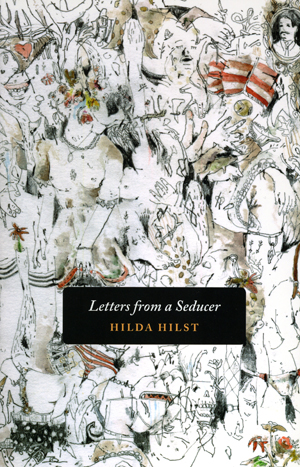
|
At Your Feet, by Ana Cristina Cesar
translated by Brenda Hillman
and Helen Hillman, with Sebastião
Edson Macedo, edited by
Katrina Dodson (Anderson, SC:
Parlor Press, 2018) |
A few years ago at the
Associated Writing Program's annual conference, I was on a panel that focused on translating
Brazilian women writers, and one of the figures I had translated and shared with my co-panelists and the audience was the late
Brazilian poet
Ana Cristina Cesar (1952-1983). Although she committed suicide at age 31 and left only a small oeuvre, it has proved to be among the most significant and durable of her generation. She now stands as one of the important Brazilian poets of the last quarter of the 20th century, as well as one who continues to influence poetry in her native country as well as outside it.
What I did not learn until after that panel had concluded was that the distinguished
American poet and professor
Brenda Hillman and her mother,
Helen Hillman, who was born in
Brazil, had been translating Cesar's poetry as well. Specifically, they were bringing the poems in her acclaimed 1982
Brasiliense collection
A teus pés (
At Your Feet) into English, and had run into the challenge I faced, which was trying to get permission to publish the English translations in the US. (I had only sought journal publication, but they had the entire collection in mind.)
Unlike them, however, I never heard back from Cesar's estate, which I knew did permit some translations, as I had found a copy online of British publisher
Boulevard's (now Boulevard Books The Babel Guides) 1997 edition of Cesar's
Intimate Diary, translated by
Patricia E. Paige, Celia McCullough and
David Treece and edited by Treece roughly a decade ago. As far I know, other than individual poems published in journals and anthologies, that was the only book-length edition of Cesar's books of poetry in English. Interestingly enough, it contains poems not only from the titular volume, but also from
At Your Feet (which itself gathered together the three chapbooks Cesar had published from 1970 through 1980,
Luvas de pelica (
Kid Gloves: Fragments of a Journey), Correspondência Complete (Complete Correspondence), and
Cenas de abril (
April Scenes), at times in versions whose original source remains somewhat unclear (more about this below).
Given Hillman's gifts and stature in the poetry world, and her mother's familiarity with Brazilian Portuguese, I was eager to see how they would capture and carry over into English Cesar's ironic, often casual and erotic tone, the often laser-sharp shifts and textual collaging her poetic speakers engage, and the often very subtle tissue of allusions she weaves into her work, sometimes from Brazilian and global literary traditions (especially Anglophone literature, which she was quite familiar with, having lived in the UK for a short period), sometimes from popular culture.
A few weeks back, I received the fruit of the Hillmans' labor,
At Your Feet, a bilingual collection completed in conjunction with
Sebastião Edson Macedo and edited by
Katrina Dodson, published by
Parlor Press, an indie publisher based in
South Carolina. Their book and translations are certain to become n excellent entry point into Cesar's poetry, and the standard for future English translations of the author's work. Readers now have some of her best known poems, like "[Soundtrack in the background," "[The story is complete:
wide sargasso sea]," and "Samba Song," along with others that have not previously appeared in English before. (I hope that this translation spurs a re-translation of
Intimate Diaries, as well as much more of her unpublished prose and poems like
"Gramas," which I translated a few years ago.)
In her introduction, Hillman rightly describes Cesar as an "avant-garde" poet, which she was, both for her time and today. She also was a key figure in the
Poesia marginal (Marginal Poetry) movement of the 1970s and 1980s, and a pioneer in Brazilian LGBTQ writing. As I noted above, Cesar's mediation between high and popular culture is crucial to how her poems look and sound, and the Hillmans and Macedo negotiate the shifts quite well. Same-sexual desire, and a queering of discourse suffuse her poems, making her love poems in particular feel very contemporary, as if they were written just yesterday, i.e., earlier in 2018 or last year. No wonder that this poetry continues to appeal to young writers and readers of all ages.
Hillman also notes in her introduction that she received help from Cesar's current publishers,
Companhia das Letras, in establishing the correct lineation of the poems. What she does not say, and what a comparison between her and mother's collection and the Paige-McCullough-Treece collection demonstrates, are variant versions of the poems, in some cases considerably so, perhaps arguing for a fuller introduction in a future edition of this or another translated Cesar collection. I do not have the Companhia das Letras edition of Cesar's collected poems,
Poética (2013), or A teus pés (2016), but I assume that these were the versions that the Hillmans worked from. A few years ago I translated some of Cesar's poems that appeared not just in
A teus pés, but also in
Antigos e soltos: poemas e prosas da pasta rosa (Rio de Janeiro, Instituto Moreira Salles, 2008), and
Álbum de retazos: antología crítica bilingüe : poemas, cartas, imágenes, inéditos (Buenos Aires: Corregidor), a collection of her poems, letters, photos, and unpublished work translated into Spanish and edited by
Luciana Di Leone, Florencia Garramuño, and
Ana Carolina Puente.
I assumed the versions of Cesar's poems in
A teus pés were the authoritative one, but with the ones in other volumes, like
Antigos e soltos, I took them as drafts that she--or editors--very well might have refined, she if she had lived to do so, or editors based on drafts they had carefully studied. So I now am quite curious about what versions Paige-McCullough-Treece might have chosen in translating Cesar's poems. Given that the earlier anthology was published in conjunction with the
Center for the Study of Brazilian Culture and Society, now
King's Brazil Institute at
King's College London, and given that David Treece, now the Camões Professor of Portuguese, is still there, I probably should write him to inquire about this.
Here is one example, the Portuguese taken directly from the Hillmans' book, followed by their translation, and, just for comparison, the P-M-T version (which, as you'll see, contains what are freestanding poems in the Hillmans' version.)
SUMÁRIO


Polly Kellog e o motorista Osmar.
Dramas rápidas mas intensos.
Fotogramas d meu coração conceital.
De tomara-que-caia azul-marinho.
Engulo desaforos mas com sinceridade.
Sonsa com bom-senso.
Antena de praça.
Artista da poupança.
Absolute blind.
Tesão do talvez.
Salta-pocinhas.
Água na boca.
Anjo que registra.
SUMMARY


Polly Kellog and Osmar the driver.
Fast but intense dramas.
Freeze-frame of my conceptual heart.
In a navy blue strapless dress.
I take insults but with sincerity.
Sly with common sense.
Village gossip.
Savings artist.
Absolutely blind.
Lust for the maybe.
Limp wrist.
Mouth-watering.
Recording angel.


tr. Brenda Hillman and Helen Hillman,
with Sebastião Edson Macedo
SUMMARY


Polly Kellog and the driver Osmar.
Rapid but intense dramas.
Still frames of my conceptual heart.
In a navy blue strapless dress.
I swallow insults but with sincerity.
Artful with good sense.
Antenna in the square.
Artist of thrift.
Absolutely blind.
The hots for perhaps.
Puddle-jumping.
Mouth watering.
An angel who leaves his mark.


The story is complete: wide Sargasso sea,
     blue blue that does not
frighten me, and sings like a paper siren.
Without you I am a lake, a mountain.
I think of a man named Herberto.
I lie down beneath the window to smoke.
I breathe dizzily. Roll on the mattress.
And fearfully, heartlessly, I raise the price.


tr. Patricia E. Paige and David Treece
Portuguese original and first translation, as well as the two translations below, Copyright © Ana Cristina Cesar,
At Your Feet, translated by Brenda Hillman and Helen Hillman, with Sebastião Edson Macedo, edited by Katrina Dodson. Anderson, South Carolina: Parlor Press, 2018. All rights reserved.
Second translation above, Copyright © Ana Cristina Cesar,
Intimate Diary, translated by Patricia E. Paige, Celia McCullough, and David Treece. London: Boulevard, 1997. All rights reserved.
The final section in the P-M-T version is two free-standing, untitled poems in the Hillman's version: "[The story is complete:
wide sargasso sea]" and "[Without you I'm really a lake, a mountain.]" Each includes slight variations, capturing a truer sense of the Brazilian original:
A historia está completa: wide sargasso sea, azul azul que não
me espanta, e canta como uma sereia de papel.
The story is complete: wide sargasso sea, blue blue that doesn't
amaze me, and sings like a paper mermaid.
And:
In the Hillmans' version of the first now free-standing poem, "[A historia...]", the English words become italicized; "espantar" is translated as "amaze" rather than "frighten," changing the meaning; and in conjunction with that change, the original "sereia," which Paige and Treece translate as "siren," becomes a "mermaid," a more benign figure. In the second poem, which is extremely simple yet wry, as Cesar's poems often are, just on the edge of heartbreak, we get a more mellifluous English translation--"smoke under" and "roll around"--as well as a crucial change, "heartlessly" to "sweetheart." I actually think both slightly miss the sly complexity of Cesar's original, since "sem," meaning without, both does and does not modify "coração" ("heart"), so the original poem is saying both "without bravado [and] heartlessly"
"without bravado, [my] heart"; perhaps "my heart" might have worked the best.
But either way, as she says, she raises the price. At any rate, please do check out the Hillmans' translation when you can.