Monday, April 23, 2018

Poems: Shira Dentz + Robert Hayden

Shira Dentz

I first saw some of Claude Monet's (1840-1926) "Waterlilies" paintings on a school trip to the Art Institute of Chicago when I was junior high school. The trip was memorable--and I have written about it, in condensed form, in Annotations--not just because of the visit to the art museum and my encounter with examples of some of the finest European art of the late 19th and early 20th century, but also because of an unexpected moment, when my classmates and I spied a sailor making love to his girlfriend in a nearby window. This was before cellphones or even inexpensive cameras (beyond Polaroids) and video cameras, so it was a scene that, like the water lilies, I and they committed to the sole repository available: memory.

I am not suggesting that I associate Monet's "Waterlilies" paintings solely with this experience, but there is a sensuousness, a tinge of eros, in Monet's great Impressionist series of flowers and water and light and space, the colors and brushstrokes vibrant and shifting, the Giverney landscapes so alive that the paintings themselves seem to come to life, casting a spell over the viewer.  Over the years I have been discussing and occasionally writing about visual art, I have encountered opposition about particular artists I love (Jean-Michel Basquiat, Andy Warhol, Lois Maillou Jones, Adrian M. S. Piper, etc.) and art works, like Marcel Duchamp's "Fountain" or Francis Bacon's portraits, but I have never heard a negative word about Monet's water lilies. (I have read some critiques, of course.)

Today's poems, then, summon Monet's late masterpieces. The first poem is by Shira Dentz, a poet I have known since my 20s; my friend the fine poet Amy Lemmon introduced us. Shira is a gifted poet as well and the author of four books, including Door of Thin Skins (2012), my favorite and a formal hybrid that manages to surprise and delight from start to finish. Her "Monet" poem appears in her 2010 collection, Black Seeds on a White Dish, whose title, as the poem below make clear, is drawn from this poem.

The title isn't literal, as Shira's poem shows; instead, as her work often demonstrates, it serves as a marker for a complex psychological exploration, in lyric form, that the reader pieces together. That "lilypad" is a metaphor she employs and plays with, the poetic speaker's relationship with her mother linked to their history together "that began before" the speaker was born, and continuing like the "tough rubbery vine" of which the lily pad is but a synecdochic, superficial component. Monet's waterlilies will not redeem things, but they serve as a means of understanding this relationship.

POEM FOR MY MOTHER WHO WISHES SHE WERE
A LILYPAD IN A MONET PAINTING


by Shira Dentz


We’re in a gray tree (you and I).
Lunging into an orange—not eating it.

I’d like nothing better than to come to another kind of
                                             arrangement;
mostly, though, we just don’t come apart.

’

Behold
a single contractual mark 
to possess and to withhold (contractions),
and the dialogue within the dialogue that began before it.

Black seeds on a white dish                     
…………………………… (pores)

         
The sound of your voice has always been a fragment

                     organized as a flower,
              a tin can cling-clanging upstream,

 the spaces between my heartbeats
              lengthening (like shadows);

You a part of the tough rubbery vine that expands on the
                                          skin of the pond.


Previously published in Black Seeds on White Dish (Shearsman, 2010) and Letters to the World: Poems from the Wom-Po Listserv, Leslie Wheeler, Rosemary Starace and Moira Richards, editors (Pasadena: Red Hen Press, 2008).

***

The second poem is by a different kind of lyric poet, Robert Hayden (1913-1980), whom I also hold in high esteem. One of the most important African American and American poets of the mid-20th century, Hayden produced a wide-ranging body of work, with noteworthy lyric and narrative poems, including one of his most famous, "Middle Passage," a masterful marriage of politics and poetry. "Monet's Water Lilies" also combines the political and lyric with concision and elegance, presenting the poet's encounter with one of Monet's beautiful works, which amidst the national and global strife, the violence and oppression produced by state-sponsored racism and wars of colony and empire, returns him to a state of grace, a recognition, despite our inability often to see it, of (our common) humanity.

Hayden is seeking balm in the midst of tumult, a social and political one producing emotional distress, but the paintings are not, as he indicates, a means of escape, but quite powerful sites of spiritual connection, restoration and transformation. "The seen, the known / dissolve in iridescence, become / illusive flesh of light"--the painting embodies this spirituality depth and transfiguration--"that was not, was, forever is"--that never existed because this is only an artistic image, that was the world that Monet painted, that will remain as long as the painting hangs and Hayden and others have the opportunity to see it." I particularly love the final stanza, where, through tears, Hayden is reminded of the auratic power of the artwork--pace Walter Benjamin--and in this exquisite human-made image of the natural world, "the shadow of" the "joy" of that world that we have lost.

Robert Hayden

MONET'S WATERLILIES


by Robert Hayden


Today as the news from Selma and Saigon
poisons the air like fallout,
I come again to see
the serene, great picture that I love.

Here space and time exist in light
the eye like the eye of faith believes.
The seen, the known
dissolve in iridescence, become
illusive flesh of light
that was not, was, forever is.

O light beheld as through refracting tears.
Here is the aura of that world
each of us has lost.
Here is the shadow of its joy.


Copyright © Robert Hayden, from Collected Poems, New York: Liveright, 1996. All rights reserved.

And here are the Art Institute's two paintings from Monet's water lilies series; the first comes from the third set, when he ceased to depict a horizon at all, peering instead into the water itself.

Claude Monet, "Water Lilies," 1906, oil on canvas, Mr. and Mrs. Martin A. Ryerson Collection, Art Institute of Chicago.  


Claude Monet, "Water Lily Pond, "1917/19 oil on canvas, Gift of Mrs. Harvey Kaplan, Art Institute of Chicago.

Sunday, April 22, 2018

Poem: Anne Carson

Anne Carson

If you were to list the iconic works of American visual art, Edward Hopper's (1882-1967) "Nighthawks," with its unforgettable glimpse into the clear panes of a brightly lit all-night West Village diner, would most certainly have to be included. "Nighthawks" (1942) is in the permanent collection of the Art Institute of Chicago, which describes its history and backstory like this:
Edward Hopper said that Nighthawks was inspired by “a restaurant on New York’s Greenwich Avenue where two streets meet,” but the image—with its carefully constructed composition and lack of narrative—has a timeless, universal quality that transcends its particular locale. One of the best-known images of twentieth-century art, the painting depicts an all-night diner in which three customers, all lost in their own thoughts, have congregated. Hopper’s understanding of the expressive possibilities of light playing on simplified shapes gives the painting its beauty. Fluorescent lights had just come into use in the early 1940s, and the all-night diner emits an eerie glow, like a beacon on the dark street corner. Hopper eliminated any reference to an entrance, and the viewer, drawn to the light, is shut out from the scene by a seamless wedge of glass. The four anonymous and uncommunicative night owls seem as separate and remote from the viewer as they are from one another. (The red-haired woman was actually modeled by the artist’s wife, Jo.) Hopper denied that he purposefully infused this or any other of his paintings with symbols of human isolation and urban emptiness, but he acknowledged that in Nighthawks “unconsciously, probably, I was painting the loneliness of a large city.”
Jeremiah Moss, who started the Jeremiah's Vanishing New York blog, chronicling hyper-gentrification's dramatic transformation of New York City over the last two decades, and who last year published a companion volume, Vanishing New York: Now a Great City Lost Its Soul, devoted several posts back in summer 2010 and again in 2013 to figuring out which buildings in Manhattan might have served as a model for "Nighthawks." He concluded that there was no diner, and that Hopper had drawn more upon his imagination than anything else.

I have to say, though, that although there may have been on strict model at the spot or spots Hopper stated, or where Moss conjectured the diner might have stood, I can attest to having walked past similar spots, late at night in the late 1980s and especially in the late 1990s, on my way back from NYU, and unconsciously picturing an analogue to Hopper's scene. It captures a fundamental truth, transformed into a memorable image (would we call it a meme today?), about US urban life, especially during the mid-20th century, the isolation amidst connection, in a commercial space, outside the constraints of conventional normative time.

In the painting the figures are all white and could be viewed as a quasi-community or family, though all appear to be operating in semi-separate spheres of existence; but they aren't a heteronormative nuclear family, they aren't sitting down to dinner with kids, and three of them, at least at first glance, are not at work. Or are they? (The man behind the counter is.) There is a timelessness (outside of daily time) to the painting's image, a feeling almost outside of time, and, speaking of feeling, a tone of loneliness, perhaps even sadness, hovering over everything. And yet the diner's bright lights suggest a harbor amid the surrounding darkness.

Poet, European Classics scholar, artist, and performer Anne Carson might not be the first person who comes mind to be writing a poem about "Nighthawks," since he focus so often are stories drawn from the European Classical storehouse, but she included the one below in her collection Men in the Off Hours, whose title seems also to gesture towards Hopper's painting. There is a sense of "off hours" being depicted, not just in the painting but in the poem. Carson's poem is operating on multiple levels, with paralleling throughout, from the stanzas' ladderlike appearance to the mirroring of the end words, or teleutons, with rhyming when the words are not exact. "Shadows" and "widows" connect figuratively as well.

Carson has created a story about at least two of the figures, the flame-haired woman and the man sitting beside her, and the brief poem shares this narrative. One could imagine others, but Carson emphasizes it with her repetition of the lines, suggesting a passion that has taken the participants out of time--"off hours"--providing a foundation for this reading this by breaking through the poem's chief voice with the disorienting quote from St. Augustine's Confessions. "Time...were not" as the lovers have run away and figured out what their relationship meant, yet the distances have found them--this (homeo)stasis preserved, for all time now, in Hopper's painting and in Carson's poem.

"NIGHTHAWKS," 1942

by Anne Carson


I wanted to run away with you tonight
but you are a difficult woman
the rules of you—
Past and future circle round us
       now we know more now less
            in the institute of shadows.

            On the street black as widows
       with nothing to confess
our distances found us
the rules of you—
so difficult a woman
I wanted to run away with you tonight.

Yet I say boldly that I know that if nothing passed
                              away, time past were not.
And if nothing were coming, time future were not.
And if nothing were, time present were not.
                         (Augustine, Confessions XI)


Anne Carson, from Men in the Off Hours, New York: Vintage Contemporary Poetry, 2001. All rights reserved.

Hopper's painting:


Edward Hopper, "Nighthawks," 1942, oil on canvas 84.1 x 152.4 cm (33 1/8 x 60 in.) signed l.r. "Edward Hopper" Friends of American Art Collection, 1942.51, Art Institute of Chicago

Saturday, April 21, 2018

Poems: giovanni singleton


A few years ago, when her first book appeared, I shared two poems by giovanni singleton, a poet I've known and been a fan of for years. giovanni's collection ascension deservedly won the California Book Award and garnered a great deal of praise from fellow poets and critics, some of whom noted her ability to utilize silence to great affect, and the cumulative power of poems, which, once they set the book down, continued to fizz in their consciousnesses. I wholeheartedly agreed. To this day, I can remember the effect a very short, seemingly simple but powerfully erotic little poem entitled "the chair" had when I heard her read it years ago.

Another direction giovanni has taken, related to those earlier poems, was in exploring poetry's material and graphic qualities. In her most recent book, American Letters: works on paper (Canarium Books, 2018), she reproduces a number of poems that are as much works of art in a visual sense, which is to say, drawings in language, as they are poems made of language. This is not ekphrastic poetry in any of the ways I have presenting it. It is poetry as art, akin to concrete poetry and textual performance (think of the poems I shared by Doug Kearney).

In the case of the second poem-artwork below, it also seems related to asemic writing, though giovanni's calligraphic poem's words are real and do mean something, individually and together, even as they challenge our ability to read them, and bar any easy interpretation. American Letters' poems' sources include African American spirit writing, sacred sound, Tibetan meditation practice, giovanni's study of Japanese language and calligraphy, and the multiple traditions of visual poetry.

The first poem was featured during last year's National Poetry Month by Colorado State University, and as soon as I came across it online, I found myself studying it. One need not read the words to see what giovanni is up to, and yet it is necessary to read them--you can enlarge the image by clicking on it and pinching your trackpad or screen, depending upon what you're using, or even download it, to get a fuller sense of what the poem is doing. Note also how the title, with the marker "Untitled," is similar to many works of visual art.

Poems like "Untitled (Bird Cage)" and the second poem below, from American Letters: works on paper, raise the question of what kind of language is appropriate to discussing the poem, and how to read it. Or rather, it organizes our ways of reading it first, and we have to come to terms with it and how it resets our expectations. That is what poetry and art does, it seems these poems keep reminding us. We can't hear this enough, though.


and from American Letters: works on paper (II):


Source: Poetry (December 2016),

Friday, April 20, 2018

Poem: John Keats

John Keats


If there is a perennial pre-1900s poem about art from the Anglo-American literary tradition, the English Romantic poet John Keats's (1795 - 1821) "Ode on a Grecian Urn" would be it. Keats, in contemplating the Greek artifact, sets a standard for how to write about it, and art in general. The "tl;dr" version of this poem would be "Art lasts, life is brief, the beauty in seemingly dead, antiquated art provides deeper truth." Our mortality is assured, and the art work's instructive and illuminatory qualities will outlast us, a sentiment that would not have been lost on Keats, who died very young from tuberculosis, his health rapidly declining after he published his first book of poems in 1817. This poem's argument pretty much agrees with many of the poems I've posted so far in as much as their argument interrogates the relationship between art and life, between artifact within the moment it was created and the moment, millennia later, in Keats's case (and ours), in which an art lover, a connoisseur, a viewer looks at and tries to understand it, to gain something from it.

The "Grecian urn" that Keats's speaker is viewing--or thinking of--has not been cracked or chipped, unlike so much of what people bring these days to The Antique Roadshow, eager to learn the financial value of some heirloom or family treasure, or a painting, poster or dresser they picked up at a garage sale or church fair; it would not be out of place in the Metropolitan Museum of Art, given its pristineness. Its specific references also remain somewhat opaque to a viewer like Keats. We would assume that a scholar of Hellenic pottery would be able to grasp what the urn's images depict, what "leaf-fringed legend haunts about" the urn's curves and sides, who those "men or gods are," "what maidens loth?" (I love that "loth," though there is no conceivable way to weave it into contemporary conversation or prose.)

Akin to Friedrich Nietzsche's notion of the Apollonian and Dionysian, in The Birth of Tragedy, Keats assesses the tension between the "cold pastoral" (punctuated by an exclamation point) the urn's form and still imagery embody, and the "wild ecstasy" the urn depicts, its record of human and deific pleasure and excess, and how what we cannot know from experience but gain from the art work can delight us even more, just as we take pleasure in the very act of trying to figure out what the urn is showing us. It will survive and a new generation will come along to try and figure out what the urn's images mean, what its function was, just as some four centuries later I am reading and interpreting Keats, and finding knowledge and truth in his poem.

As for "beauty" being "truth" and vice versa, reading this too simplistically is a problem. Scientific considerations of symmetry, the role of mathematical order in nature and natural systems and so forth set to the side, I don't think that Keats is necessarily saying that something "beautiful" is intrinsically "true" (or good, for that matter). The relationship between the two that Plato explores is, we know today, much more complicated than a facile reading would imply. The beautiful can be quite false, and fake things can beguile us far more than something intrinsically beautiful (by various criteria). Yet, as Keats seems to be saying, there is something lasting in truly beautiful art, something that compels us generation after generation, even taking into account the effects of the social and political,  cultural shifts and changes, and so on. And we can learn something from that lasting beauty, those art works that do survive. That is all "ye" need to know, or at least something we should not forget too quickly.

ODE ON A GRECIAN URN


by John Keats


 Thou still unravish’d bride of quietness, 
  Thou foster-child of Silence and slow Time,
Sylvan historian, who canst thus express 
  A flowery tale more sweetly than our rhyme:
What leaf-fringed legend haunts about thy shape 
  Of deities or mortals, or of both,
    In Tempe or the dales of Arcady?
  What men or gods are these? what maidens loth? 
What mad pursuit? What struggle to escape?
   What pipes and timbrels? What wild ecstasy?
 
Heard melodies are sweet, but those unheard 
  Are sweeter; therefore, ye soft pipes, play on;
Not to the sensual ear, but, more endear’d, 
  Pipe to the spirit ditties of no tone:
Fair youth, beneath the trees, thou canst not leave 
  Thy song, nor ever can those trees be bare;
    Bold lover, never, never canst thou kiss, 
Though winning near the goal—yet, do not grieve;
  She cannot fade, though thou hast not thy bliss, 
    For ever wilt thou love, and she be fair!

Ah, happy, happy boughs! that cannot shed 
  Your leaves, nor ever bid the Spring adieu;
And, happy melodist, unwearied,
  For ever piping songs for ever new;
More happy love! more happy, happy love! 
  For ever warm and still to be enjoy’d,
    For ever panting, and for ever young; 
All breathing human passion far above,
  That leaves a heart high-sorrowful and cloy’d, 
    A burning forehead, and a parching tongue.

Who are these coming to the sacrifice? 
  To what green altar, O mysterious priest,
Lead’st thou that heifer lowing at the skies, 
  And all her silken flanks with garlands drest?
What little town by river or sea shore, 
  Or mountain-built with peaceful citadel,
    Is emptied of this folk, this pious morn? 
And, little town, thy streets for evermore
  Will silent be; and not a soul to tell 
    Why thou art desolate, can e’er return.

O Attic shape! Fair attitude! with brede 
  Of marble men and maidens overwrought,
With forest branches and the trodden weed; 
  Thou, silent form, dost tease us out of thought
As doth eternity: Cold pastoral!
  When old age shall this generation waste, 
    Thou shalt remain, in midst of other woe
Than ours, a friend to man, to whom thou say’st,
  ‘Beauty is truth, truth beauty’—that is all 
    Ye know on earth, and all ye need to know.

Below is an image of the Sosibios vase, which Keats sketched and which inspired his poem, along with his drawing below it:


Sosibios vase, image
from the Louvre
Keats's drawing of the Sosibios
vase in 1818, his annus mirabilis

Thursday, April 19, 2018

Poem: Mei-Mei Berssenbrugge

Mei-Mei Berssenbrugge
(Kelsey Street Press)
It was only a matter of time before I posted a poem by Mei-Mei Berssenbrugge (1947-) during this month's ekphrastic/art poem cavalcade; she published a marvelous new and selected volume entitled I Love Artists: New and Selected Poems (University of California Press) in 2006, and has collaborated extensively with her husband, the highly lauded painter and sculpture Richard Tuttle (1941-) over the years. In fact I am a huge fan of her work, and this post marks the third time I have featured a poem by Berssenbrugge, and the other two also could be said to deal with aspects of art and poetry.

This poem, however, explicitly explores the work of two poets Berssenbrugge knows, Kiki Smith (1954-), perhaps best known for her sculptures, figurines and prints, which have explored human bodies and our excreta, feminism, and the AIDS pandemic, among other themes, and Bruce Nauman (1941-), the conceptual artist whose work crosses a range of media, including the televisual.

"I Love Artists" is one of many favorites in the 2006 collection, and I was reminded of it again when I happened upon it on the Painters and Poets blog, which for a number of years focused on the very topic I am posting about this month, poetry and visual art. The organizers of that blog created a real treasure, and stopped blogging last year, but the archives are still up at the link above, so be sure to check it out. They also offer their distinctive takes on Jorie Graham's "San Sepolchro" and other poems I've posted about here.

In the poem below, Berssenbrugge references Smith's drawing "Blues Stars on Blue Trees," a 2006 work, using ink and silver leaf, on Nepal paper, and Bruce Nauman's video piece, "Mapping the Studio 1 (Fat Chance John Cage)," from 1981, which appeared at Dia Center for the Arts back in 2001-2. It was, I can say as someone who went to see it, extremely dull, but, in the way that Andy Warhol's extended cinema could also be, quite fascinating as an idea and in practice. (It lacked the minute-to-minute excitements and spark of other extended works like Christian Marclay's The Clock.)

One thing to consider when reading Berssenbrugge is how she plays with the poetic persona in her poems, and how she shifts from observation and description to more abstract thought, sometimes within a single sentence, thereby shifting the reader's perception of what you are reading in the process. (I should note here that I have had to wrap her long lines, since they go a bit haywire on Blogger, especially when I use the formatting command <pre> which allows me to present poems very close to how they originally appeared.)

In the third stanza, she mentions "Bruce," the mice that were at the center of his video project, and very soon thereafter, we get the line, "I realize my seeing is influenced by him, for example, when we change form and become light reaching into corners of the room." We have left the human plane altogether, in a sense, and are now something more spectral, presence and immanence themselves, reaching into the spaces that we cannot but which is exactly where our minds, like the video, can take us. That is, the spaces poems and films open up for us.

As the poem concludes: "Creation is endless." But poetry it is rarely so simple or simplistic. Good poetry, that is. The poem charts a journey that I urge readers to take. And then please do take a look at Smith's and Nauman's images, for good measure.


I LOVE ARTISTS


by Mei-Mei Bersenbrugge


1.


I go to her house and talk with her as she draws me or
    knits, so it’s not one-on-one exactly, blue tattooed stars
    on her feet.

I pull the knitted garment over my head to my ankles.

Even if a detail resists all significance or function,
    it’s not useless, precisely.

I describe what could happen, what a person probably or
    possibly does in a situation.

Nothing prevents what happens from according with
    what’s probably, necessary.


2.


Telling was engendered in my body and fell upon me,
    like a battle skimming across combatants, a bird hovering.

Beautiful friends stopped dressing; there was war.

I’d weep, then suddenly feel joy and sing loud words
    from another language, not knowing my song’s end.

I saw through an event and its light shone through me.

Before, indifference was: black nothingness, that
    indeterminate animal in which everything is dissolved;
    and white nothingness, calm surface of floating,
    unconnected determinations.

Imagine something, which distinguishes itself, yet
    that from which it distinguishes does not distinguish
    itself from it.

Lightning distinguishes itself from black sky, but trails
    behind, as if distinguishing itself from what espouses it.

When ground rises to the surface, her form decomposes in
    this mirror in which determination and the indeterminate
    combine.

Did you know, finally, there was not communication between
    her and myself?

Communication was in time and space that were coming anyway.

I may suffer if I can’t tell the agony of a poisoned rat,
    as if I were biting.


3.


Bruce leaving for the night makes space for his cat to enter.

Mouse (left) exits door and returns

Moth and mouse on sculpture exit (left), noise.

It’s an exterior relation, like a conducting wire,
    light fragment by fragment.

I realize my seeing is influenced by him, for example,
    when we change form and become light reaching into corners
    of the room.

Even now, we’re slipping into shadows of possessions that
    day by day absorb our energy.

I left my camera on to map unfinished work with shimmering
    paths of my cat (now disappeared), mice and moths (now dead).

There’s space in a cat walking across the room, like pages
   in a flip-book.

The gaps create a reservoir in which I diffuse my embarrassment
    at emotion for animals.

I posted frames each week, then packed them into suitcases,
    the white cat and her shadow, a black cat.

I named her Watteau, who imbues with the transitory friendship
    we saw as enduring space in a forest.


4.


A level of meaning can be the same as a place.

Then you move to your destination or person along that plane.

Arriving doesn’t occur from one point to the next.

It’s the difference in potential, a throw of dice, which
   necessarily wins, since charm as of her handcrafted gift
   affirms chance.

I laugh when things coming together by chance seem planned.

You move to abandon time brackets, water you slip into, what
    could bring a sliding sound of the perimeter of a stone?

You retain “early” and “walking” as him in space.

When a man becomes an animal, with no resemblance between
    them, it feels tender.

When a story is disrupted by analyzing too much, elements
    can be used by a witch’s need for disharmony.

Creation is endless.

Your need would be as if you were a white animal pulling
    yourself into a tree in winter, and your tears draw a
    line on the snow.


Mei-Mei Berssenbrugge, from I Love Artists: New and Selected
Poems, Berkeley: University of California Press, 2006.

Here are the two art works:


Kiki Smith, "Blue Stars on Blue Tree," 2006, work on paper, ink and silver leaf on Nepalese paper, Pace Gallery


Bruce Nauman, "Mapping the Studio I (Fat Chance John Cage)," 2001, video, Dia Foundation, New York.

Wednesday, April 18, 2018

Poem: Carmen Giménez Smith

Carmen Giménez Smith

One of my first posts this month featured a poem by Valerie Martínez, and in introducing that poem, I shared links to Carmen Giménez Smith' s (1971-) Harriet blog post, "Latino Art and Ekphrasis," which she posted back in 2013 in conjunction with a project organized by poet Francisco Aragón, also featured this month on J's Theater, entitled PINTURA: PALABRA, a project in ekphrasis." To summarize, the multi-year project brought together some of the leading Latinx poets writing today, to view artworks at the Smithsonian American Art Museum and participate in workshops in ekphrasis around the US.

In her post, Carmen noted that she had already been exploring an engagement with artists and art work in her poetry, citing the late Cuban-American artist Ana Mendieta (1948-1985), whose presence appears several times in Carmen's highly acclaimed fourth collection, Milk and Filth (Camino del Sol/University of Arizona Press, 2013), which was a finalist for the National Book Critics Circle Award. I thought about selecting one of these poems or excerpting them, but then figured it might be illuminating to see what she had created as part of her participation in PINTURA: PALABRA.

The poem below is one she wrote in response to Asco collective member and photographer Harry Gamboa Jr.'s photograph, "Decoy Gang War Victim." As you can see, Carmen dives deep into the scene the photograph portrays, into the mise en scène the image presents and conveys to the viewer. It is a scene of violence, but also a performance; it is a spectacle, in more ways than one, but serving the purposes of art, in part "to overturn the city," requiring that one "must / surrender body/belongings to the one explosive / spectacle of truth, making it ongoing," much as the static photograph conversely does through the open-endedness of its image. Asco, it turns out, sought to explore the socioeconomic conditions and challenges in which its members, Chicano artists, and those around them, were living and working during the 1970s and 1980s.

Photography, like all visual art, often poses a basic question to the viewer: what is going on? What story or stories does the image tell? What do the flares, a "departure" that "[pink] both ends of  him" really signify? What is the relationship between the truth of the image--this "decoy," and the truth of the world, the society, the neighborhood in which this photo was shot, where this scene might occur in real life (IRL)? Carmen raises all these questions with a lyric verve that zips through the stanza, requiring the reader (or listener) to double back at times so as not to lose the thread. As with all of her poems, the verbal play is impressive, the references and allusions demonstrating not just her wit, but also bringing a great deal into the poem in a way that only poetry can.

I noted in Rita Dove's poem, as with others, how one dictum was to "pay attention," and here Carmen makes it explicit at the end of line 11. Not just poetry, but so much art of all genres and kinds, as we've seen, especially when at its best, takes this as one of its guiding principles. Pay attention. You never know what you might learn, about the artwork, the world around you, and yourself.


DECOY GANG WAR VICTIM


For Harry Gamboa,   Jr.


Just a tick ago, the actor was a Roman candle
shot to the sky, smudged by rain’s helter-
skelter. His motivation was: he’s a stooge
on L.A.’s sodden turnpike, so we have “to make” art. Got
to rezone and react. The world the bare wall to
his bullet. Got to rile up the populace, to fortify
the arsenal. Once in a while, repopulate and penetrate,
paint a list of incitement onto the walls.
An elder told him that to overturn the city, one must
surrender body/belongings to the one explosive
spectacle of truth, making it ongoing. Pay attention.
To overturn the city, not just the scraps but fervor itself.
Not just the wan broadcast of indignation but
IRL incursions into the workhouses and
poorhouses to inflame the thousand points of  light.
A lean surge, departure pinks both ends of  him.
He’s the nth layer folded into the stand’s nerve.


You can read the rest of the PINTURA : PALABRA portfolio in the March 2016 issue of Poetry. All images in this portfolio are courtesy of and with permission from the Smithsonian American Art Museum.

And the image:


Asco, "Decoy Gang War Victim" (photographer: Harry Gamboa, Jr.), museum purchase through the Luisita L. and Franz H. Denghausen Endowment © 1974, Harry Gamboa, Jr.

Source: Poetry (March 2016)

Tuesday, April 17, 2018

Poem: Adriano Spatola

Adriano Spatola


Georges Seurat's (1859-1891) 1884-86 painting "A Sunday Afternoon on the Island of La Grande Jatte," or "Sunday Afternoon on La Grande Jatte," which now hangs in the Art Institute of Chicago, may be one of the most famous and recognizable works of French art from the late 19th century Neo-Impressionist movement, and a master-work of pointillist painting. A series of carefully placed dots that in combination depict an afternoon world of (mostly) bourgeois leisure on a Seine riverbank. The picture indexes a social world, rewarding repeated viewings, even in reproduction, and provoking a range of possible interpretations.

These everyday, fin de siècle characters are in shade because of the sun, but might Seurat not be implying more? What is the little girl in white, staring directly at the viewer, saying through her steady child's gaze? There are sailboats and rowers, but also a woman fishing; how common was this, and who is she? Is this for sport or sustenance, or both? Why does the one woman with the immense bustle hold the leash to a pet...monkey? Off scene, across the river, lay the working-class suburb of Asnières-sur-Seine, which Seurat, as well as many other important 19th century French painters, including Vincent van Gogh and Claude Monet, also depicted. Lastly, there is the famous border, which inverts the colors of the painting, as if to underline the idea that another world or worlds lay just at the borders of this one.

Seurat's painting is a flash impression containing a vibrant narrative; the colors, in Impressionist fashion, pulse before our eyes. This informs the approach that Italian poet Adriano Spatola (1941-1988), known for his linguistic experimentation that often uses fragments and run-on syntax, employs in his tribute, translated by poet Paul Vangelisti, to Seurat's painting. Spatola also taps into the darker veins of the scene Seurat painting; supposedly it was a spot where middle class men could, amidst the bathing, rowing and picknicking, meet prostitutes, and that shadowy boundary between the visibly respectable and the invisible desire and vice lurking in the interstices of social relations appears in Spatola's poem in words such as "tricked out," "penance," "shadow," and "anger," among others. He records the social and emotional tenor of the scene more so than what it is overtly depicting: as poetry often can do, he holds up a lyric stethoscope to the image, and shares what he hears.

It is a beautiful image that even spurred a musical--Stephen Sondheim and James Lepine's famous 1984 musical Sunday in the Park with George--as well as numerous recreations and parodies, but also repays viewing. I did have the pleasure several times of viewing it up close, and urge visitors to Chicago first to go to the Art Institute of Chicago, one of the nation's best, but above all to spend even a little time with Seurat's painting, one of its treasures. And now, Spatola's poem:

SUNDAY AFTERNOON ON THE ISLAND
OF GRANDE JATTE (1884-85), Georges Seurat


by Adriano Spatola


The wonder the sense of lacquered objects
bolted measured tricked out in the clock
generous happy mature penance shadow
that the sun disbanded sews on the leaves
trousers hair parasols and gowns and gloves
anger drowns sighing the groan resounds
against the decorated and blank wall against the scale
unraveled dry whirlpool enameled Gongorism
congenital with thirst with gloomy astonishment
or wonder or the sense of lacquered objects.


Adriana Spatola, from The Position of Things: Collected Poems 1961-1992, translated by Paul Vangelisti. Copyright © 2008 by Adriano Spatola and Paul Vangelisti. Used by permission of Green Integer Press.

And here is the painting:


George Seurat, A Sunday on La Grande Jatte, oil on canvas, 1884-1886, © Collection of the Art Institute of Chicago.


The 2018 Pulitzer Prizes

Kendrick Lamar (pitchfork.com)
Yesterday, the Pulitzer Prize Foundation announced its 2018 honorees, and this year list brought a particularly unexpected surprise: in the traditionally most aesthetically narrow arts category, Music, the prize committee threw prize watches for a complete loop and selected Kendrick Lamar, the platinum record-selling, Grammy-nominated hip hop artist, for his 2017 album DAMN. The Pulitzer jury noted that Lamar's work was a:
Recording released on April 14, 2017, a virtuosic song collection unified by its vernacular authenticity and rhythmic dynamism that offers affecting vignettes capturing the complexity of modern African-American life.
With his win, Lamar became the first musician not working in a classical/Euro-American or jazz idiom to receive the award, and only the fifth African American since the Music prize was initially awarded in 1943. In fact, there was no Black winner at all until classical composer George Walker won in 1996 for Lilacs, for voice and orchestra. Since then, the other recipients have been Wynton Marsalis in 1997 for Blood on the Fields, the first strictly jazz composition to win; Ornette Coleman's jazz LP Sound Grammar, which won in 2007; and Henry Threadgill's In for a Penny, In for a Pound, in 2016.

Indeed, the Music category award roll was, until Walker's award, notorious for excluding not just Black musicians, but all music not falling under the general rubric of "classical music," and in particular, academic classical compositions. Some of the greatest American musicians, including Duke Ellington (posthumously, in 1999), George Gershwin (posthumously, in 1998), John Coltrane (posthumously, in 2007), Thelonious Monk (posthumously in 2006), and Scott Joplin (posthumously, in 1976!), received "Special Citations," but were otherwise ignored, as were all forms of popular music, however symphonic or orchestral, in the Music category.

Interestingly enough, musical theater, beginning with Of Thee I Sing, by George S. Kaufman, Morrie Ryskind, and Ira Gershwin, was honored in the Drama category as far back as 1932, and over the years, other musicals, like Richard Rodgers' and Oscar Hammerstein II's South Pacific in 1950, were recognized, as "Drama," but not as "Music." This was about as close as the Pulitzer Music juries got to the popular music of the moment.


The honoring of hip hop marked an immense shift and might be a harbinger of things to come, as judges in this category, joining their peers in others, may now decide to take a broader view of the contemporary artistic landscape. Lamar is the real thing; about as far as you can get from hip hop-lite and user-friendly lyrics, he's insistently innovative and political, and very much grounded in the language and culture of his native South Central Los Angeles. (None of this year's music judges were hip hop musicians, but adding some now may also help to shake things up in the future.) But we will, I guess, see what happens going forward. The two finalists in the Music category fell into the more traditional classical/art music vein: Michael Gilbertson, for his string composition Quartet, and Ted Hearne, for his cantata for chamber orchestra, electric guitar, and percussion Sound from the Bench. In past years, either might have won.

I can imagine, however, that some classical musicians, who may already feel beleaguered by the shifts in the music industry as a whole and the reported declines in attendance at classical concerts, may now feel concern that what was their protected sphere, as far as widely known US national awards go, no longer exists. That may be true, but then perhaps the award should not have been called "Music," but more strictly named to reflect how much music and how many musicians had been excluded from consideration. Some prior classical music winners--Aaron Copland (1945), Charles Ives (1947), Virgil Thomson (1949), Gian-Carlo Menotti (1950), Samuel Barber (1958), Steve Reich (2009), and of course Marsalis and Coleman, have been in the ears of the wider public, or some of their music has (I recently heard one of Reich's most famous pieces, "Come Out," sampled in a hip hop song, and Barber's Adagio for Strings has been performed more than once on TV, etc.), but in general, far too many of the Music winners remained mostly unheard and unknown to a degree unlike anyother category, including Poetry or Drama.

Other winners in the "Letters, Drama & Music" section included poet Frank Bidart, for Half-Light: Collected Poems 1965-2016 (Farrar Straus & Giroux), a nod towards his status as one of the senior, major figures in American poetry, and someone who had never received a Pulitzer before. I was very happy to see that the two finalists were two poets I know and admire, and collections I thought were stellar: Patricia Smith, for her collection Incendiary Art (TriQuarterly/Northwestern University Press), and Evie Shockley, for her collection semiautomatic (Wesleyan University Press). Given the threats university presses are facing these days, this was also a good vote of confidence in publishing in a genre that has remained the least commercial.

The poetry citation

The Fiction winner was novelist Andrew Sean Greer, for his comic novel Fiction Less (Lee Boudreaux Books/Little, Brown and Company), and the finalists were In the Distance, by Hernan Diaz (Coffee House Press), and The Idiot, by Elif Batuman (Penguin Press).  In the Drama category, Maryna Majok's Cost of Living received the award; the two finalists were Everybody, by the very brilliant and talented young playwright Branden Jacobs-Jenkins, and The Minutes, by actor and playwright Tracy Letts. Bidart's and Greer's awards may have marked one of the rare times that the poetry and fiction winners were both out, gay male writers; had Jacobs-Jenkins also been honored, it would have marked a very rare trifecta.

In the History category, Jack E. Davis's The Gulf: The Making of an American Sea, by Jack E. Davis (Liveright/W.W. Norton), an exploration of the history of the Gulf of Mexico, received the committee's nod. The two finalists were Fear City: New York’s Fiscal Crisis and the Rise of Austerity Politics, by Kim Phillips-Fein (Metropolitan Books), and Hitler in Los Angeles: How Jews Foiled Nazi Plots Against Hollywood and America, by Steven J. Ross (Bloomsbury). The Biography recipient was Prairie Fires: The American Dreams of Laura Ingalls Wilder, by Caroline Fraser (Metropolitan Books); the two finalists in that category were Richard Nixon: The Life, by John A. Farrell (Doubleday), and Kay Redfield Jamison's Robert Lowell, Setting the River on Fire: A Study of Genius, Mania, and Character (Alfred A. Knopf).

Lastly, under the arts and letters aegis, in the category of General Nonfiction, the winner was the highly praised study Locking Up Our Own: Crime and Punishment in Black America, by James Forman Jr. (Farrar, Straus and Giroux). The two finalists were Notes on a Foreign Country: An American Abroad in a Post-America World, by Suzy Hansen (Farrar, Straus and Giroux), and The Evolution of Beauty: How Darwin’s Forgotten Theory of Mate Choice Shapes the Animal World—and Us, by Richard O. Prum (Doubleday)

I must admit that I have tended to pay less attention to the News winners, but some did catch my eye this year. First, art critic and provocateur--and former reality show judge!--Jerry Saltz received the Pulitzer in Criticism for his commentary in New York Magazine. I sometimes strongly disagree with Saltz's readings of exhibits and the general culture, but I do think he knows how to get readers to think about art and society.

In the Public Service category, the recipients were The New York Times, for coverage led by Jodi Kantor, and The New Yorker's Ronan Farrow, for their exploration of the sexual predation, harassment and abuse in Hollywood and other realms of US life, in response to the #MeToo moment and movement. The Washington Post won in the category of Investigative Reporting for its coverage of the Alabama Senate race, and its revelations of the Republican candidate Roy Moore's sexual abuse of an underage teenager; in part because of this necessary reporting, he may have been defeated by Democrat Doug Jones.

I must admit to some skepticism about the dual award in the National Reporting category, however; while the Washington Post rightly deserved a Pulitzer for its thoroughgoing attempts to enlighten the American public about Russian interference in the 2016 campaign, the Pulitzer board moved the New York Times into contention for this award as well, and then jointly named that paper as a winner. Yet the Times has never explained its bizarre October 31, 2016 report that the FBI had determined there was no Russian interference in the election, which we now know was completely wrong based on multiple accounts, and not long after former public editor Liz Spayd attempted to answer the strange report--who gave the Times this information?--she was let go. Will we ever know what or who was behind that Times report, which provided official establishment and news ballast and support for the Trump campaign? Should the Times have been awarded a Pulitzer Prize for this work given this massive blunder?

Monday, April 16, 2018

Poem: Rita Dove

Rita Dove, in 2017
(from Wikipedia.com)

One of the highlights of my youth was working across the hall from Rita Dove (1952-), one of the great contemporary American poets. At that time she was the Poet Laureate of the US, and though I did not work for her or study under her, I did have to periodically consult with her on matters concerning a literary journal for which she served as a senior editor and which I was managing. As much by observation as by osmosis, I learned little tips and grace notes about how to deal with editors and contracts, how to navigate in the shoals of academe, and what dedication to one's art and career, within the context of the university, might look like. She was always warm and kind toward me, and though I have not had many interactions with her since, I will always remember that moment, and her and her husband, the writer Fred Viebahn, with great fondness.

My first introduction to Rita's work was Thomas and Beulah, the book that received the Pulitzer Prize in 1987. I was a senior in college, and like many, was amazed that a young Black woman writer had just won the Pulitzer in poetry--she was only the second ever, after Gwendolyn Brooks--which led me straight to the Grolier Book Shop in Cambridge to buy as many books of hers as I could afford. Her second book, Museum (Carnegie Mellon, 1983), differed from the tightly organized structure in Thomas and Beulah, a perfect volume; it was more like a conventional collection of poems, more wide-ranging in its focus, and a bit more expansive in its forms, though the sure eye and pen Rita brings to every poem in every book were evident in this one too.

I was especially fascinated by Museum's cover image, which, it turns out was by the German painter Christian Schad (1894-1982) in the counter-Expressionist, early Weimar-era style known as the Neue Sachlichkeit, or New Objectivity. Think Max Beckmann, Georg Grosz, Otto Dix, and Rudolf Schlichter; Rita ended the collection with a poem exploring Schad's painting, the artist's process, and the figures contained within it and its depiction of difference.

This final poem, "Agosta the Winged Man and Rasha the Black Dove" is also meta-commentary in part on process and experience in writing poems, including this one, and a metonymic exploration of art-making as well. Yet again as in previous poems I've posted, this one reminds us that it is the canvas--the ground of the artwork--and the art work's subjects themselves, whose gazes are "merciless"; they see and show what the artist does not and yet does, intuitively, in the creation of the painting, and transform the artist, and the viewer, in the exchange.

"Agosta the Winged Man and Rasha the Black Dove" is a lyric poem, but it also paints a portrait, as Rita's work often does, in quick, precise, vivid strokes. There is no excess here, and yet her skill creates an aesthetic surplus, as Anne Carson once put it, of meaning. The poem itself is a model of objectivity, mirroring Schad's stylistic approach--his sharpened realism pressed beyond the observable. Yet it swerves away from mere description with notable subtlety. It also gives glimpses of a world that was on the precipice; just a decade and a half later, Berlin, and Germany, would be at war, on the cusp of one of the most abominable horrors, the Nazi Holocaust, that the human race has ever exacted on itself, and the diverse world we see in miniature here--Russian aristocrats, a Malagasy immigrant performer, Agosta himself--would be swept away with a severity and violence the poem hints at.  Look, it is saying, look closely. And note who and what are looking back at you. Pay attention.


Rita Dove, originally in Poetry, November 1981, from Museum, Pittsburgh: Carnegie Mellon Classic Contemporary Poetry, 1983. All rights reserved.

The Schad painting:


Christian Schad, Agosta, the Pigeon-Chested Man, and Rasha, the Black Dove, oil on canvas, 1929, Tate Modern.

Sunday, April 15, 2018

Poem: Jorie Graham


When I think of the poetry of Jorie Graham (1950-), what immediate comes to mind is a dense, philosophically and phenomenologically infused lyric, ever searching, in pursuit of something--ideas, memories, experience--that lies just to the edge of where the language might take her. To me the acme of this approach in her work appeared in her early volume Region of Unlikeness (1991), which, when I read it, felt almost unlike any other poetry book I was reading at the time. (Jay Wright's poetry had a similar effect, but in a different way.) Its unremitting strangeness--"the sax pants up the ladder, up"--has stayed with me more than 25 years later.

Yet a few years before I had come across Graham's work, and what struck me was its mellifluousness, its sensuous quality. I am thinking particularly of Hybrids of Plants and of Ghosts, her 1980 debut, and Erosion (1983), in which she refined this style and from which I draw the poem below. By her next book, The End of Beauty (1987), she had shifted into the style and subject matter for which she is now very famous; this collection also includes the poems about angels, the poems with the blank spaces, and so on. "San Sepolcro" bears the name of the town where the Italian Renaissance Florentine artist Piero della Francesca (1415-1492) lived and painted, and references one of his most famous paintings, "The Madonna del Parto," which is in the Monterchi Museum, in the Comune di Monterchi, Italy.

"San Sepolcro" opens Erosion and sets the tone for all the poems that will follow. Its invitation is a seductive one, letting the reader know an adventure is beginning, guided by the poetic speaker, a cicerone of tremendous skill, that will require some work, some dynamic participation with the texts, the imagery, the books ideas. "I can take you there, / snow having made me / a world of bone / seen through to. This...." Just read those lines aloud, and note how the mind and tongue trip and then rebalance on that turn at "bone / seen through to." In fact, as the poem proceeds, it is clear that this will not primarily be a description of the Madonna del Parto" as much as a conversation between the artwork, the poem itself, and the reader, a step into contingency, interpretation, feeling.

"This is / what the living do: go in." That is exactly what we do when we read poetry or look at art or listen to a song, at least if we go at all beyond a superficial engagement, but then again, even if we think we're operating on the surface, as "San Sepolcro" suggests, some deeper process may be underway, a peeling away so that those multiple layers of meaning reveal themselves, briefly. Like the Madonna here, a relic, the poem carries the traces of the past it invokes, as well as the substrate of the poet's process of writing it and poem's coming into being. This brings to mind both theorizations about art and our encounters with it by very different minds, Martin Heidegger and John Dewey, chief among others. As I noted a few posts ago with Rainer Maria Rilke's and Francisco Aragón's poems, in the encounter we are altered, even if temporarily--or, as Aragón wittily asserts, made blind. And then, we see again.

At any rate, here is Graham's "San Sepolcro," which I think is best experienced when read aloud, or when Graham reads it.

SAN SEPOLCRO


by Jorie Graham


 In this blue light
     I can take you there,
snow having made me
     a world of bone
seen through to.  This
     is my house,

my section of Etruscan
     wall, my neighbor’s
lemontrees, and, just below
     the lower church,
the airplane factory.
     A rooster

crows all day from mist
     outside the walls.
There’s milk on the air,
     ice on the oily
lemonskins.  How clean
     the mind is,

holy grave.  It is this girl
     by Piero
della Francesca, unbuttoning
     her blue dress,
her mantle of weather,
     to go into

labor.  Come, we can go in.
     It is before
the birth of god.  No one
     has risen yet
to the museums, to the assembly
     line--bodies

and wings--to the open air
     market.  This is
what the living do: go in.
     It’s a long way.
And the dress keeps opening
     from eternity

to privacy, quickening.
     Inside, at the heart,
is tragedy, the present moment
     forever stillborn,
but going in, each breath
     is a button

coming undone, something terribly
     nimble-fingered
finding all of the stops.


From The Dream of the Unified Field: Selected Poems, 1974-1994, by Jorie Graham, published by The Ecco Press. Copyright © 1995 by Jorie Graham. All rights reserved.

And the image:

The Madonna del Parto by Piero della Francesca
© Comune di Monterchi 2015 – Monterchi Museum

Saturday, April 14, 2018

Poems: Doug Kearney

Douglas Kearney
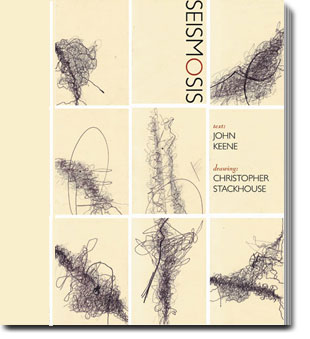
Posting poems about art works and ones using ekphrasis has been illuminating, because one thing I've always known and even practiced myself but never really articulated publicly is how many different ways one can explore conversations between poetry, literature and visual and plastic art. (Seismosis, my collaborative book with artist and poet Chris Stackhouse does walk through various ways of initiating and sustaining the conversation.)

In his poems in response to the late genius artist and musician Terry Adkins (1953-2014), poet and performer Doug Kearney (1970-) shows yet another way to think and write about and with a fellow artist and the work of art. Doug is not just a brilliant, highly inventive poet, but an excellent performer as well. I don't mean simply that he performs his own poetry well, nor do I mean that he is a performance poet; rather, he understands in a profound way what performance can be, and elevates it to an art in conjunction with his poetry, which sizzles as poetry on the page but also serves as a graphic score, with latent possibilities that Doug activates when he is presenting his work live.

But back to this idea of graphic texts, concretion, and poems' visual components: Doug sees and often explores all of these, which is to say the materiality of the text alongside its semantic possibilities and the connections between the two. His "granted collaboration" with Adkins produced a score for a project entitled Freedom of Shadow, as well as poems that look almost all the ones I've shared on here so far. They started working together in 2013, yet Adkins sadly died but a year later, at age 60, of a heart attack. Doug decided to continue, and the result was a series of works that are as much visual art and poetry.

Doug discusses with moving insight the process of working with Adkins, and how he thought through a variety of approaches, only to lose his collaborator, at least in body, just a few months into the new (2014) year. The folio he presented in Poetry--and Adkins, who had created a persona named "Blanche Bruce," after the first black US Senator, from Mississippi, to serve a full term, during Reconstruction, did not want a "book" as the final product for their work together--is both a powerful tribute to Adkins and their thinking and working together, and yet another example of Doug's manifold gifts as a poet. You can read Doug's thoughts at Poetry's website. Below are the two of the drafts and final pieces (poems) that comprised Freedom of Shadow.


And, lastly, here is an image of Terry Adkins' "Muffled Drums," which spurred Doug's imagination, in conjunction with a different Adkins piece, as Lone Wolf, performing his "Muffled Drum Lynch," a sculpture recital about W. E. B. Dubois and his anti-lynching campaign while creating intelligent propaganda with the NAACP. (Via Atum53 on YouTube.)

Friday, April 13, 2018

Poem: Elizabeth Knapp

Elizabeth Knapp

Cindy Sherman (1954-) is one of the most important living American artists. I have to admit, though, that while admire her early Untitled Film Stills (1977-80) series, I used to find the rest of her work that I encountered be a bit repetitive and unengaging. For the life of me I missed why people raved about it and her. I've since seen more of her work, and read a good deal of theory and criticism about her particular approach to (self-)portraiture, its importance in the history of feminist representation and its challenges to female stereotypes, its critiques of the cis-heteropatriarchal male gaze, its play with subjectivity particularly under the rubric of the visual, its narrative force and relationship to prior artists working in a similar vein, and its influence on younger photographers and visual artists, as well as popular culture--think the selfie. More simply, I think I understand much more what she has long been up to, grasping the clear continuities and connections across her oeuvre.

One set of newer images she has been producing really do intrigue me, however. These are her Instagram portraits, a series of curated wgrotesques produced using mobile phone technology that manage to send up the selfie and underscore the insistently performative nature of this genre, especially on Instagram. Sherman has maintained that her staged self-portraits are not her, that they are characters created to interrogate the ways society and culture shape representations. In fact, she has stated that she "hates selfies," and yet, she is using the platform chiefly dedicated to them to turn them on their heads. Her portraits range from the absurd to the wonky to the experimental. They also include "plandids," or planned candid selfies, which she created specifically for W Magazine.

As the magazine put it last year,

Sherman’s project for W apes the social media phenomenon known as the plandid—the planned candid photograph, which is “like a newer, hotter version of the selfie on Instagram,” as one social media expert recently put it. They are carefully composed images of studious nonchalance; they capture subjects who are determinedly carefree. Presented here is a mise en abyme of looking: a woman—or should I say women?—posing for herself on her phone as she poses for another photo that she is pretending not to pose for. Perhaps we are seeing the same images that she is viewing on her screen as she tries out different visages on the fly, shuttling through an uncountable number of aesthetic options with taps and glides of her finger. These works have a particular charge at a time when we snap ourselves with the understanding that our image will ricochet onto any number of screens, devices, and platforms. We are all striving to get it right.

Sherman is characteristically humble, almost flip, about her new digital concretions. “All these Instagram images are, for me, just playing around,” she says. “I don’t think it at all competes with my serious work. They’re just fun, like a little distraction.” But while she says that these “silly sketches” have not yet influenced her art directly, she does seem to be enjoying the ease with which these programs function. “I’m not such a perfectionist with using the apps. If you can erase the background and add another background, I don’t really care if the edges are all clean, and if it looks kind of funky, or if things overlap in a not-so-perfect way. It’s kind of freeing me up a little bit and maybe making me more open to experimentation.”
What does this any of this have to do with poetry or the series of poems I'm posting here? As it turns out, poet Elizabeth Knapp has written a poem--there may be more--in which the speaker produces a self-portrait "as Cindy Sherman's Instagram Account." Except that this sonnet-length, stanza-long verse is not really a self-portrait or a selfie,  but like Sherman's photos, something aslant, the focus not on the artist or person herself, but on the platform, the medium itself. The poem's language sounds more graduate seminar theoretical than lyrical, the argument a series of questions, its focus as much on what the Instagram account is depicting and how it's doing so as much as whom it is sharing with world.  Who and what are those "million followers" consuming as they go from image to image?

It is yet another approach to ekphrasis, one engaging with one of the most dominant social media platforms of our time, and with one of the major visual artists of today. From what I can tell, Knapp, who is the author of an award-winning collection entitled The Spite House (C&R Press, 2011) and a professor at Hood College, has been writing a series of "self-portrait" poems examining various states of being, experiences by others, and so on, taking the very idea of the "self-portrait" into new realms. I hope she will conside new poems focusing on an array of celebrities, particularly ones who are innovating with the (plat)form and others who are buried so deep in their narcissism and self-regard that they may be missing the play they're engaging in.

***

SELF-PORTRAIT AS CINDY SHERMAN'S INSTAGRAM ACCOUNT


by Elizabeth Knapp


And why not Sherman herself, you ask?
Because in this instance, the inclusion
of social media denotes a postmodern
approach to self-portraiture, a Baudrillardian
hall of mirrors in which the self is projected
against a million anonymous eyes, all hungry
for a taste of her. How will she deform
herself next? Will she sport a new prosthetic
chin, her hair stand on end, electrocuted?
A Dr. Frankenstein in the lab with herself.
A million followers, and not one will ever
know her—nipped, tucked, and bruised beyond
all recognition. Das Umheimliche: an unhomely
home. A rubber crotch on a mannequin.


Copyright © 2018 by Elizabeth Knapp. “Self-Portrait as Cindy Sherman’s Instagram Account” originally appeared in Kenyon Review Online. All rights reserved.


 Here are four images from Cindy Sherman's Instagram account, at @cindysherman. The fist looks like a drawn caricature of Julianne Moore, though it is in fact only a digitally enhanced (and warped) photograph of a bewigged and made up Sherman: