Saturday, January 10, 2009

Pretty Invitation (to Nowhere and Nothing) + Harshaw on Oakland Murder + Cardinals Winning Again

So C calls to say, "Did you check your email," and I hadn't for a few hours, because I was driving through the slush-canyoned streets of Chicago, having dug the car out of yet another sarcophagus of snow, because it has snowed every single day that I've been back, but I stopped into a coffeeshop to check my email, and in the message he was flagging I saw photos of what looked like what we, and many others we know, have been dreaming about: an invitation to the inauguration!

I immediately called him back and as we were speaking, my mind was racing. Congressman Sires or someone had come through at the last minute, despite not answering any of my entreaties, and so I would have to reschedule my classes that Tuesday, figure out how to get to Washington and return for departmental necessities, figure out where we might stay, get my one of my suits altered and cleaned....

But when I returned to the apartment, I looked more carefully at the photos. As C had noted, it clearly stated that it was a "commemorative" invitation. An invitation to attend "public" events, just like anyone else who might happen to be in DC or near one of the trains or buses heading north from Virginia or south from Baltimore that day. There was an accompanying page suggesting that we participate in a "local community" service activity on Martin Luther King Jr. day, just as the President-Elect and VP-Elect would be doing, in Washington, which of course wouldn't be "local" for us. Then there was another note announcing that the inaugural balls would be brought to us, so we need not worry about attending them. Not Oprah's, not the Hollywood Stars', not the Military shindig, not the gig for the People, nada. In addition, as C told me, there were also offers to buy commemorative tchotchkes and so forth, perhaps of a slightly more legitimate provenance than those coins my grandmother spotted on TV and was eager to spend her precious dollars on.

In effect, like C's sister and 1 million other people across the country, we had received the Invitation to Nowhere and Nothing.

It is a pretty souvenir, certainly, and although, I really would have loved to hear Elizabeth Alexander deliver the inaugural poem and Aretha Franklin style her musical selection, thrill to the playing of Yo-Yo Ma and the praying of Joseph Lowery, witness Barack Obama and Joe Biden sworn in live, and listen the poetry that I'm sure will issue from our new president's lips (and hum as Rick Warren poured forth his invocation)--live, right there, not hundreds of thousands of miles away, alas, it won't be so. I will be watching, probably via this or another computer, as the events unfold in Washington, just like many hundreds of millions of other people in this country, like millions across the globe. And to think, if only I'd met that most recent midnight deadline for whatever amount of cash Obama and Biden and Michelle Obama and Hillary Clinton and whoever else were asking for that I don't have, I might have been one of the countless but elated hordes who entered the lottery, as happened on and before election day, at the Grant Park Rally, and nevertheless still not been selected to attend. Been there, done that. Of course in reality there'd be no way I could have gotten to Washington and back in time, and then there are all sorts of other logistical issues involved in pulling off what one of my colleagues will be pulling off, which is attending this landmark historical event that will go down in the annals of history for all time, or at least for the time that human beings remain on this earth and we still have what passes for human civilization. While I'm sure my wonderful students would have understood my rescheduling classes for such an important event, I bet they'll be even happier not to have to worry about the hassle or miss my presence in the classroom. And who's to say that the weather would even have cooperated with me leaving this beautiful, artic center of political corruption and drama on the appointed date?

You're bringing the inaugural balls to us, you say, President Obama and Vice President Biden? I will remember, yes I will.

***

Tobin Harshaw blogs an engaging, aggregating post in today's New York Times on "Oakland's Tragedy, and Black America's," or more specifically, the cold-blooded killing, captured on video, by White Oakland cop Johannes Mehserle of a prone, unarmed, detained 22-year Black man, Oscar Grant III, on a BART platform, a story I linked to on Thursday. Harshaw blogs about online exchanges involving social critics like conservative Stanley Crouch and progressive Ta-Nehisi Coates, criminal justice scholar James Alan Fox and economist Steven Levitt, and local Oakland bloggers, that explore and contest the statistics on Black-on-Black crime, especially among young Black men, the responses to it among Black communities versus crimes like this one involving a White cop, and who really suffers when riots like the recent one against police violence occur.

One of the things I wrote to a friend just the other day was along these lines: police continue to kill Black folks, but far too many Black folks are still killing Black folks, especially young Black men killing young Black men. It's an unmitigated tragedy, and we have to work to end not only the former, but at the latter as well.

***

Are the Arizona Cardinals really on the verge of winning two consecutive playoff games? Are they really about to win another one after having won their first home playoff game in 61 years last week, meaning that they hadn't won since they were in Windy City, Chicago (that is, skipping over all the years in the Mound City, St. Louis, when they drove innumerable football Cardinals fans nearly to heart attacks with their inimitable collapses when playoff time came around), all those years ago? If they do win, which appears likely, let me congratulate them, and especially my former 7th grade classmate, Mike Bidwill, who I gather is really running the team these days. You've successfully rejuvenated the career of Kurt Warner. You've made your investment in Edgerrin James pay off. You might even have managed to galvanize your fan base and pay for that glittering new stadium in the desert. The possibility of your getting to the Super Bowl, however, is unlikely, and winning it unlikelier still, but stranger things have happened.

Friday, January 09, 2009

Poem: Charles Reznikoff

ReznikoffThough he might best be known primarily for the style of his poetry, which embodies the concept of Objectivism, Charles Reznikoff's two-volume masterpiece Testimony is a tour-de-force of assembled social documentary, a vast tapestry detailing, in clear, precise and usually prosaic narratives the forgotten history of this country. The litanies in the collection, drawn from court testimony but shorn of the judgments, document, in relentless fashion, the horrors of our shared American reality in a way that few novels, books of poetry, films, or TV shows do. It is in a way like "The Wire" but extended over the entire country, and with only an associative, not plotted, throughline. Here's a poem from Volume 1: the united states (1885-1915) Recitative (Black Sparrow Press, 1978), and specifically from the section Testimony: The United States (1885-1890): The West. I thought of it in relation to yet another report about a Black man being shot by police, even though the race of the victim remains unspoken; it is, in effect, a commentary on the widespread violence that has marked this country from its settlement and founding, a violence, often based on power struggles, economic, political and social domination, and control of resources and thus ultimately of everything that depends upon them, including life itself, that we sometimes want to confine to the margins of memory and history, but that has always been with us, a part of who we are as a society.
Town and Country

1

The body had been buried face downwards.
Only the skeleton was left,
and it separated in handling
when dug up.
The coat was yellow ducking,
lined with a light-colored blanket;
overalls of yellow ducking, too,
and a patch on the knee:
a belt on the skeleton,
a knife in the pocket,
and a bullet hole
in the back of the skull.

Copyright © Estate of Charles Reznikoff, Black Sparrow Press, 1978. All rights reserved.

Thursday, January 08, 2009

New Year?...Hey, It's January 8th!

For once this does feel to me like a new year. A new and very extremely busy year already (sigh), but fresh all the same. It was wonderful to be home with C for a little bit, and to get away for a hot minute too. (Besotes siempre a Anthony M.) But I did post a New Year's message, and I experienced no airline horrors getting back to Chicago, despite all the grim O'Hare flight news that besieged the holidays and holiday travelers, and so a correspondent wondered where I've been since, and I meant to reply to her as I did to a graduate student that I'm in the "mines" right now, so no or only a little posting.

It's a metaphor I didn't think of several years ago when a younger writer asked what my quarters usually consisted of, but this ought to give some sense of what's up: winter quarter classes have begun (I have two, one an undergraduate introductory creative writing class, one an upper level undergraduate class in literary theory, about which I'll write more soon). I am also supervising the honors theses of 2 undergraduate students (one working on a literary study, one writing a fiction manuscript), the MA/MFA theses of 2-5 students, the doctoral dissertation of one student, and a independent study project of at least 1 undergraduate student. (I hope I haven't forgotten anyone!) And then there's the committee and departmental activities of which I cannot say more. The quarter's over in March. I'm going to try to post a bit more than once per week, but the entries may be thin gruel indeed, and it's not for lack of intent or interest....

***

Congratulations to CCer Aracelis Girmay, who won the 2009 Great Lakes Colleges Association New Writers Award for her superb book of poems, Teeth (Curbstone Press)!

***

Today's RedEye (the free, dumbed-down, picture-heavy version of the Chicago Tribune) has on its all-black cover (wink, wink) the question "Is Racism Dead?" Because our 44th president is a black person, you know. (Please do note the images shown in the "Stories" list.)

Why don't we ask him, or him, or him, or them? And those are just the spectacular examples....

(And how could we ever forget this character, who'd like to fill Hillary Clinton's seat. "The Democrats are throwing the election away. And for what? An inadequate black male....Well, I got news for you, McCain will be the next president of the United States!": famous last words, Ms. Christian, famous last words.)

And then there are these buffoons! (And if you're looking for Facebook friends, wackpot and W enabler Ken Blackwell bragged today that he has more Facebook friends than the other contenders. Have you missed out on being part of his online posse?)

***

Police have arrested the quartet of Latino and Black men who brutally gang-raped a 28-year old Black woman in Richmond, California, on December 13, 2008, because of her sexual orientation. A Facebook group, "Help a Sista Out," has been established here.

If you would like to offer some financial support to her, her partner, and her daughter, you can do so here:

Community Violence Solutions
2101 Van Ness Ave.,
San Pablo, CA 94806
Attn: Mrs. Joanne Douglas

If you would like to send a sympathy card, you may do so here:

Richmond Police Department
Attn: Sgt. Brian Dickerson
1701 Regatta Blvd.
Richmond, CA 94804

I hadn't seen this very on-point post by Professor Melissa Harris-Lacewell, one of Princeton's many brilliant lights, but it's definitely worth reading! (H/t to WOC PhD) I haven't seen Milk yet, but then I also didn't get to Noah's Arc: Jumping the Broom when it was in Chicago for an eyeblink. The DVD will be out in February, I believe I saw in this past week's Windy City Times, so I plan to see it as soon as I can.

***

The Israel-Hamas War continues, with a new front possibly opening up as of yesterday. The United States is uniquely placed to bring it to a cease-fire. We all know this. If you have not contacted your Senator(s), Congresspeople and the President-Elect and Vice President-Elect, demanding that they do so, please do so now.

While you're politely but firmly demanding they push for a cease-fire, please also let them know that letting all of the people who engaged in warrantless spying on Americans, who organized and authorized torture, extraordinary renditions, and secret prisons, and who kept Guantánamo in business deserve to be brought before a Truth and Reconciliation Commission at the very least, and prosecuted for War Crimes at best. They really should hear this as often as they can. As should our new president, Barack Obama, who appears poised to go the Clintonian route and sweep all the prior crimes under the rug in an effort to "move forward."

***

Speaking Obama, Illinois, and the junior Senate seat shenanigans, I found myself mentioning Blagojevich in reference to the concept of "tragedy" in my first afternoon class this past Tuesday, which got me to wondering how four major playwrights--William Shakespeare, George Bernard Shaw, August Wilson, and Adrienne Kennedy--would explore the circumstances of his rise (he was elected not only twice to the governorship, but also to Congress in the seat Rahm Emanuel just gave up) and fall.

If I can offer some very potted thoughts, I think Shakespeare would focus on the fatal flaws in Blagojevich's character, and the colorful context and cast that surrounds him. His estranged father-in-law, Alderman Dick Mell, would certainly be a character as would Patrick Fitzgerald and Lisa Madigan. And then there's the ghost of Richard Nixon, whom a young Blago was quite enamored of. (Shouldn't some intrepid reporter have pointed that out to voters before the first election?) Shakespeare probably also would have made much punning on Blago's Kennedyesque affectations; delusions, hubris, grandiosity and denial; and hair. How many allusions to hair do you think Shakespeare would have come up with? Ten? Twenty? Fifty? When speaking before the legislature or to constituents, or when soliloquizing, he would speak in poetry, but in best Shakespearean fashion, when speaking on those tapes, we'd get pure prose (and some clever vulgarities too). The Avon Bard would probably also condense and distill the story so that we got the highlights and lowlights, but in a way quite different from the temporal compressions of contemporary dramas. I think the ghost of Nixon would factor into these. Would it end with impeachment, or just with Blago being marched out of his house by police?

Shaw would probably focus on the malign influence of money, Blago's working-class background, and his desire for greatness fatally undercut by his lack of good faith. I can see one scene including Blago's very public and vocal denunciation of the ever-growing bemoth Bank of America at the Republic Windows and Doors Factory sit-in followed by his very public and shocking arrest right thereafter. One of the key elements of Shaw's treatment would, like Shakespeare's, be the monologues each character delivered. Shaw's Blago would probably have a more gilded tongue than the real governor, and almost convince us spectators of his virtue, just as he conned a majority of Illinois voters before his re-election, despite the fact that the festering pustules of corruption that were eventually to burst would be evident to anyone listening to and watching carefully what was unfolding on the stage. Another key element would be comedy, caustic but effective in getting us to see some absurdity at the base of the tragedy before us. I'm not so sure how Shaw might end the play, except to say that we would probably have a bit more sympathy for Blago, which makes me think that the Burris legerdemain would factor in. Now admit it, didn't you have to give Blago props for his audaciousness in pulling this mess off?

August Wilson would probably also include a ghost, but not Nixon. His ghost might be Martin Luther King Jr., and his focus might be on either Jesse Jackson Jr., who can give a good speech, or Roland Burris, whose ego is Shakespearean, to put it mildly. Barack Obama would certainly be part of this cast. Two of Wilson's greatest strengths as a playwright are his compelling poetry and his gift for encapsulating an epoch in a few gestures, conversations, several acts, so I think if he were to focus on Jackson Jr., we might see a contrast between the dreams and actions of his father and the Civil Rights era, and the contemporary moment, when even a Black person can be as corrupt and connected a player as anyone else. He also might give us some of the hidden family drama unfolding among the Jackson clan: imagine the exchanges Wilson could come up with between Jesse Jackson Sr.; Jesse Jr.; brother Jonathan Jackson, who's allegedly linked to the Blago Senate seat selloff; Jesse Jr.'s wife Sandi, a Chicago City Councilperson; and mother Jacqueline Jackson. If the men ended up wrestling on the floor, while uttering unforgettable lines, would you be surprised? How would Wilson end the play? With Jesse Jr. alone in his Chicago office, watching a TV set on which Burris was being sworn in as Obama stood by (poetic license, you know)?

Adrienne Kennedy, the only one of the playwrights I've invoked who's still alive and writing, would have a field day with this story if she took it up. I could see parallel narratives, one with Blago being sworn in as president of the US, the other of him in jail, telling the story. He might even be represented by various personalities/selves, designated by grotesque masks or grotesquely made up actors, including one who was actually a version of Richard Nixon, one a version of John F. Kennedy, another Richard J. Daley. Or one might be, in outlandish and brilliant Kennedy fashion, a major, tragic female figure from history, like Queen Anne of Great Britain, or Joan of Arc. Given Blago's strong support among Black Chicagoans, one self might be Jean Baptiste Point du Sable! All of them would end up cleverly mixing snippets of Blago's speeches with their own (or invented) words, all undercut by the Blago-in-jail narrator, who would assure us that in fact, the true outcome was that he was elected President, far in the future. I would particularly look forward to the final speech or portion that unraveled or complicated the delusional stance of the governor, and the revelation that the nondescript office was, in effect a jail cell. Kennedy could certainly pull it off.

Thursday, January 01, 2009

Happy New Year 2009!

Happy New Year!
Feliz año nuevo
Feliz Ano Novo
Bonne année
Kull 'aam wa-antum bikhayr
Aliheli'sdi Itse Udetiyvasadisv
Na MwakaMweru wi Gikeno
Feliĉan novan jaron
聖誕快樂 新年快樂 [圣诞快乐 新年快乐]
Bliain úr faoi shéan is faoi mise duit
Nava Varsh Ki Haardik Shubh Kaamnaayen
Ein gesundes neues Jahr
Mwaka Mwena
Pudhu Varusha Vaazhthukkal
Afe nhyia pa
Ufaaveri aa ahareh
Er sala we pîroz be
سال نو
С наступающим Новым Годом
šťastný nový rok
Manigong Bagong Taon sa inyong lahat
Feliç Any Nou
Yeni yılınızı kutlar, sağlık ve başarılar dileriz
نايا سال مبارک هو
Emnandi Nonyaka Omtsha Ozele Iintsikelelo
Subha Aluth Awrudhak Vewa
Chronia polla
Szczesliwego Nowego Roku
Kia pai te Tau Hou e heke mai nei
Shinnen omedeto goziamasu (クリスマスと新年おめでとうございます)
IHozhi Naghai
a manuia le Tausaga Fou
Paglaun Ukiutchiaq
Naya Saal Mubarak Ho

(International greetings courtesy of Omniglot and Jennifer's Polyglot Links; please note a few of the phrases may also contain Christmas greetings)

Thursday, December 25, 2008

Happy Holidays!

Happy Holidays!

Happy Hanukkah
Merry Christmas
Happy Kwanzaa
Fun Festivus!

Friday, December 19, 2008

End of Quarter, On the Road

On Monday the fall quarter finally ended, and I can say that while I'm glad that it's over, I enjoyed teaching my two classes tremendously. The graduate fiction workshop comprised a small, talented group of writers, full of insight and dedication, whom I hope to work with again in the future (two will be graduating soon but several are beginning or midway through their MA/MFA studies). The undergraduate honors seminar brought together 17 of the most gifted creative writing students who've been in the program over the last few years. I still marvel at the accomplishment of these student writers, at the reach and depth of their projects, at how hard they worked and how far they got in the quarter's 11 weeks, and cannot wait to resume working with all of them when January arrives. All of my other university work--committee, etc.--continues on through the break, so I can only slow down a little, but I'm nevertheless looking forward to the next few weeks and time away from the campus. I have a number of personal projects underway, and a couple weeks isn't enough time to do much of anything, but even a little mental relaxation should be a tonic.

Since I've been offline a bit, I initially missed the uproar over President Elect Barack Obama's selection of Rick Warren to give the inaugural invocation. I think it's indefensible, really, and all the PR in the world, even jointly coordinated with sympathetic gay rights groups, isn't going to make up for the fact that Obama selected this hateful person in the first place. WHY? And seriously, out of all the evangelical ministers of note out there, was Warren, who is a Prop 8 supporter, who is against reproductive rights, who has sung the praises of the Syrian regime and who was recently on TV suggesting in good Christian fashion that disagreeable foreign leaders should be assassinated, the best that Obama could find? I mean, didn't he learn anything after his appearance at this man's church during the election season? I understand his desire to reach out to those with opposing views and his aim of transcending the partisan divide (which I think is going to be difficult, at least in terms of the Republican establishment and its media enablers and allies), but why pick this man and this event?

Elizabeth AlexanderOn the other, Joint Congressional Committee on Inaugural Ceremonies's pick for the inaugural poet is stellar: Elizabeth Alexander!!!!!!!! (She's the fifth poet to read at an inauguration: the others were Robert Frost in 1961, James Dickey in 1977, Maya Angelou in 1993, and Miller Williams in 1997.) On a hunch the other day I told C that she would probably be the pick, and she is a superb choice on so many levels: she's one of the nation's leading poets under 50 and a member of Obama's generation, she's a native Washingtonian, she's grappled with many of the issues of our era in her poetry, and she knows the Obamas personally from their common time at the University of Chicago. I must add that I think the world of her and her work. And she was one of the original Cave Canem faculty members, and one of my favorite workshop leaders ever. She was also one of the first poets to read at the Dark Room ("Omni Albert Murray, Omni Omni, Albert Murray") in 1988, which is when I first heard, read and fell in love with her work. Elizabeth talks about Obamapoetics here (h/t to Amanda Johnston!), and her reaction to her selection here.

I was very happy to see that California Democratic Hilda Solis would be the new Secretary of Labor. I still think there's a dearth of women in the new Cabinet, but Solis is a dynamic Congressperson with a long history of involvement in the labor struggle.

And speaking of the Cabinet, what happened to Adolfo Carrión Jr.? He told Yale students he was getting hooked up, and then...qué pasó?

On another note, I have been following the news about the brutal December 3 hate crime attack in Brooklyn on two Ecuadorian immigrants, Jose and his brother Romel Sucuzhañay, on the news and on blogs like Blabbeando. While Romel Sucuzhanay was able to get away, the attackers left his brother near death. Last Saturday, Jose Sucuzhañay died. Police have yet to find and arrest the three alleged attackers, who originally were said to have yelled anti-gay and anti-Latino slurs, though that account was later revised. A previous anti-Latino attack on Long Island, where a group of teenagers stabbed immigrant Marcelo Lucero to death. As the Daily News article above notes, the earlier murder provoked protests from New York to Latin America.

I'll end there; these posts are harder to put up than ever. I think my brain is shrinking or something; just toggling between this main screen and the hyperlinked posts seems to be a lot harder than it used to. Oh well--I hope to get back to a regular posting schedule when I return from a little trip. Hope is the operative word....

Wednesday, December 10, 2008

This and That

Steven Chu is very good pick. So is Nancy Sutley. The Cabinet is shaping up nicely.

How disappointing that Candidate #5 is Jesse Jackson Jr.

The situation in Greece worsens, with a general strike on top of the riots.

Someone (William Deresiewicz) doesn't think the world of James Wood.

Mark Leckey received this year's Turner Prize.

One of the most perceptive reviews I've read in a while, at least the first half of it: Zadie Smith on Joseph O'Neill's Netherland, and another novel.

On "interface aesthetics." You know.

The Brazilian writer Lima Trindade edits this online journal: Verbo21

Tuesday, December 09, 2008

Blago Nabbed + Zimbabwe Slips + Obama/Cicero + Webern [Poem]

I would be lying if I said I weren't transfixed by the news that's been reported all day: federal authorities took Illinois's extremely unpopular and incompetent governor, Rod "Blowdryavitch" Blagojevich, or Blago for short, into custody early this morning after a multi-year investigation by the FBI and US Attorney's office, captured him on wiretap allegedly engaging in a host of corrupt activities. US Attorney Patrick Fitzgerald earlier announced today at his press conference that the most sensational allegations in Blago's "political corruption crime spree" were his demands for financial and job favors, for himself and his wife, in exchange for the US Senate seat that President Elect Barack Obama just vacated, and that he and his chief of staff John Harris had pressured the Chicago Tribune (cf. yesterday's entry) to fire editorial staff who'd repeatedly criticized Blago and supported previous calls to impeach him.

Rod Blagojevich
Illinois Gov. Rod Blagojevich holds a news conference in Chicago on Nov. 5. (AP/M. Spencer Green)

Fitzgerald noted that Obama was not linked to the charges in any way, and that Blago was captured on tape damning the soon-to-be president for offering only "appreciation" as a reward. It appears that Obama's desired pick, Candidate 1 in the indictment, supposedly transition chief Valerie Jarrett, also did not agree to pay to play, although Candidate 5 (Jesse Jackson Jr.) was allegedly willing to pony up around $500K for the position, or at least this is what was captured on tape. As for the Tribune drama, it appears that the principle owner, Sam Zell, and his chief financial officer, had taken into account Blago's criticisms, even though the paper thankfully did not fire any of the editorial staff as a result. The Tribune did, however, hold off reporting about the investigation (including its own) at Fitzgerald's request, which has brought some criticism, though it appears that in this case, allowing the investigation to unfold so as not to obstruct it or force Fitzgerald's hand was probably the way to go.

I think you'd be hard-pressed to find anyone in Illinois in 2008 who did not think Blago was corrupt, though the brazenness of his alleged recent actions, especially in light of the toxic cloud of scandal that surrounded him at the time of his reelection in 2006, is astonishing. It appears he even knew he was investigation, and possibly being wiretapped, and yet he kept right on going. The irony of his having run as a reformer in 2002 isn't lost on anyone else, I imagine, or that he replaced Republican George H. Ryan, who went to jail for fraud, racketeering and other crimes. According to NPR this evening, he joins an infamous roll of Illinois governors, from both parties, who were indicted, and in most cases convicted, of serious crimes.

One question now hinges on the US Senate seat, which Obama vacated swiftly, in part to allow Illinois's newly appointed junior senator to gain seniority. Until or unless Blago resigns, I gather that he could still appoint someone, including himself, though that person would be horribly tainted and have zero political legitimacy and credibility, let alone power, in the US Senate. Lame duck status from the start would mark this appointee from the beginning. Senior Senator Dick Durbin has called for the Illinois legislature to enact a law that would remove Blago's power to appoint Obama's successor and instead vest it in the Illinois voters, through a special election. Senate president and leading Obama replacement candidate Emil Jones has said he would do so. What about Chicago's all-powerful mayor, Richard Daley, about whom scandals have have hovered like dragonflies? He didn't have much to say today.

Now, irrespective of the pertinent issues here, it is curious to me that the Bush administration has gone after at least three Democratic governors (Siegelman in Alabama, Spitzer in New York, and now Blago), and yet a number of Republican governors, including one who did not pay taxes on her per diems and another whose involvement in the unseating of Siegelman has merited little response from the Attorney General or the Justice Department, have gone unscathed. Hmmm....

^^^

How long will Robert Mugabe hang on? A walking death's head, he has precipitated and presided over the complete destruction of his country. The Zimbabwean economy is shot, the government is barely functional, and now a cholera outbreak is racing throughout the country. The African Union, sadly, still supports him. South Africa, which probably has the most leverage and to which thousands of Zimbabweans have been fleeing, refuses to apply real pressure. Some African leaders, like Kenya's PM, Raila Odinga, have called for African nations to help oust Mugabe, as has W, not that anyone is paying him attention these days.

If the economy continues its runaway collapse, worsened by the cholera spread, I foresee the army taking a decisive step and driving Mugabe out, though it probably will have to get a sign of approval and no interference from South Africa. Would opposition leader Morgan Tsangvirai and his MDC Party take over, would control fall to one of Mugabe's hangers on, or would one of the Mugabe's generals hold power? That's something I hope the nations surrounding Zimbabwe, the African Union, and the UN are thinking very carefully about, as the last two options might prove no better than the current situation.

^^^

Obama qua Cicero? The President Elect is a master rhetorician and speaker, true. His opponents in the primaries and in the Presidential election even attempted to use his gifts and skills as an orator against him, with little success. More than once observers have cited Black Church oratorical traditions, along with Abraham Lincoln's and John F. Kennedy's examples and the Bible's rhetorical model, as Obama's influences. In the GuardianUK, Charlotte Higgins discerns classical models, both Greek and Roman, in his rhetoric, noting his use of such figures and devices as the tricolon (trios of phrases), anaphora (repetitions of phrases at the beginnings of sentences), epiphora (or epistrophe, as Thelonious Monk might have suggested-repetitions at the end), and one of my favorites, praeteritio (saying what you claim you won't say), which was also, interestingly enough, one of Richard Nixon's favorites. But Higgins discovers life parallels with one of the greatest orators and stylists of all time, the Roman Marcus Tullius Cicero (106BCE-43BCE). She says:

It is not just in the intricacies of speechifying that Obama recalls Cicero. Like Cicero, Obama is a lawyer. Like Cicero, Obama is a writer of enormous accomplishment - Dreams From My Father, Obama's first book, will surely enter the American literary canon. Like Cicero, Obama is a "novus homo" - the Latin phrase means "new man" in the sense of self-made. Like Cicero, Obama entered politics without family backing (compare Clinton) or a military record (compare John McCain). Roman tradition dictated you had both. The compensatory talent Obama shares with Cicero, says Catherine Steel, professor of classics at the University of Glasgow, is a skill at "setting up a genealogy of forebears - not biological forebears but intellectual forebears. For Cicero it was Licinius Crassus, Scipio Aemilianus and Cato the Elder. For Obama it is Lincoln, Roosevelt and King.
Without a doubt, he'll require all these rhetorical skills and more to keep the country together, marshal the Congress to pass his projects, and lead us out of the mess we find ourselves in. The silver tongue will need to become platinum. Or as Shakespeare, another master rhetorician, says in Henry IV Part 2, invoking anastrophe (reversal of phrases): "We are ready to try our fortunes / to the last man."

^^^

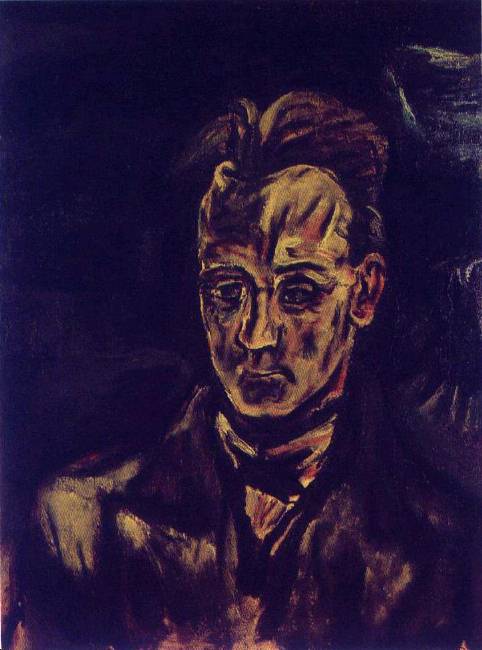
On a completely different note, this little link from Alex Ross's blog caught me: Anton Webern's music on the Andy Griffith Show? Webern in Mayberry: it's not as strange as it sounds.... MMusing blogger Michael Monroe shows how the background music during some of the AGS episodes does sound quite Webernian, which is to say, very spare, a little spooky, and utterly modern. See this clip he found on YouTube. He suggests that mystery visitor might be a certain Mr. Schoenberg. If you're intrigued, search YouTube for "Webern" (portrait below right, by Oskar Kokoschka) there and you'll find a handful of representative clips or snippets of his music. Ross points out in an earlier post, "Tiny Tony," that during the second season of the Sopranos, Webern's "Variations for Orchestra" was playing in the background of a crucial scene!

Webern by KokoschkaOne Webernian pieces that exerts unending fascination over yours truly is his "Symphony (Opus 21)," which sounds unlike any other symphony you are likely to hear on the radio or concert hall, though it must be said that post-Webernian serial composers have created works as strange and haunting as this. I also love that it was after a New York Philharmonic performance of the "Symphony" that composers John Cage and Morton Feldman first met. I have never heard this work performed live, just on CD and in digital form, but I did write a necessarily short poem, an acrostic in (mildly) graphic form, inspired by it. In the case of Webern, the use of the acrostic and graphic forms echo his own constant play with the possibilities of the tone row, and in a larger sense, with his fellow Second Viennese school composers' use of names as guides for notation in their work. My favorite example of all of these is Alban Berg's "Chamber Concerto," in which he weaves Arnold Schoenberg's, [Anton] Webern's and [Alban Berg] his names into the score (using the German pitch notational system), and like his opera "Lulu," at its exact center, a musical palindrome. Webern did this kind of thing often, including a symmetry in the opening phrase of the "Symphonie," except that unlike Berg (or Schoenberg, their teacher, friend and mentor, who was less adept at such games, having pioneered the whole 12-note concept), whose work makes great use of late Romantic elements and lushness at times, he antithetically pared away all excess, creating pieces that often sound like they've been beamed in from another planet (literally embodying Schoenberg's famous quotation of Georg in the revolutionary "Second String Quartet": "I hear the air of other planets...").

So here's my "Symphony (Opus 21)," and then a YouTube of Webern's "Symphonie," which, as you'll hear, is really a symphony deconstructed (vor den Tatsache--or something like that--William?).

SYMPHONY (OPUS 21)

Atoms Atmen
Notes or their shadows evanesce from each tone row
Traces of key melodies echoes: silence
Order mirrors in intervals invariance:
nothing is wasted

Why wreak such beauty on Vienna?
Even the maestro, Mahler on his deathbed lay baffled
because one must retrain the ear to hear
even familiar harmonies.
Revolution begins in lyric restraint in freedom
nothing is wasted


Copyright © John Keene, 2001, 2008.


Monday, December 08, 2008

Trib Kaput + SCOTUS No to Crazy + Art Bubble? + AAWW Awards

So it's happened, the Tribune Company has filed for bankruptcy. Harold Meyerson of the Washington Post has the goods on the CEO, Sam Zell, whose financial legerdemain has put the company's employees' stock option funds (ESOP) at severe risk--i.e., the shares are now worthless--while ensuring that his own stake ($315 million down out of the $8.2 billion private buyback, of which $225 million was a promissory note!) was relatively small, and his own empire remains untouched. Oh, and if you didn't get your severance in a lump sum, you probably aren't getting it at all. How did Hamlet put it in his famous prose passage about man(kind): "The paragon of animals" indeed, though don't think your beloved cat or dog or salamander would pull a number like this one! But you can't say the employees weren't warned; in fact, this is what Zell told two Tribune reporters when discussing the original deal to purchase the Tribune: "The deal...isn't going to change my lifestyle, no matter what happens....It's likely to change yours significantly." So at least you can't say he's a liar. It'll be interesting to see what happens now. I wonder if the papers will be spun off and operate as independent (broke) entities, while Zell holds onto the TV stations, which remain quite valuable. The Cubs franchise and the stadium weren't part of the bankruptcy filing because he's trying to sell both, but one of the likeliest buyers, Dallas Mavericks owner (and soon-to-be-neighbor to W) Mark Cuban is under investigation for insider trading. At a time when we need an active and engaged press, and in particular news organizations with the power and heft to conduct investigations and challenge the government and corporations, the Tribune Company's increasingly eviscerated newspapers, one of them, the LA Times once one of the top four in the country, list like scuttled but still seaworthy ships towards a bleak, unsettling future.

|||

I haven't commented on the auto industry bailout just yet, because I still haven't assimilated all the public details, but in general I do believe that if the government is going to bail out the banking and shadow banking system, which includes an entity like AIG, then the big three automakers, who sit at the center of a vast industrial web, ought to get help as well. It should be conditional, I think, based on a complete change of the top leadership of all three companies; a longterm plan for green technology, increasing fuel efficiency, and continuous modernization; a sustainable benefits package, negotiated with the autoworkers unions, for employees and retirees (which would include helping to push for universal, single-payer health care); and a restructuring, with the cooperation of states and the federal government, of the current regulation of brands, dealerships, and so on. Those would be starting points. Economists and people more familiar with the auto industry have deeper insights about all of this, but in general, I defer on the side of helping the companies, and the people they employ, than letting them crash. One thing I hadn't realized is that black workers would be disproportionately affected if the auto industry collapsed. Which is probably what has led to this phenomenon, though the article notes that the cardinal archbishop of Detroit is also soliticing prayers and organized an ecumenical outreach to Congress to press for support. Something about the current administration's response, however, strikes me as being not the right one....

|||

The Supreme Court said NO to the crazy today. Clarence Thomas unfortunately has a job (for life), so what is Alan Keyes going to do? Start preparing to run for the US Senate seat in Delaware?

|||

Is the contemporary art market like the tulip mania bubble of the 1630s? Is it on the verge of bursting? Will we soon be talking about some other values beyond "exchange value"? Ben Lewis and Jonathan Ford think and say so in their Prospect article. (So whither the likes and fortunes of Elizabeth Peyton (at right,
"Live to ride," 2003)
Takashi Murakami, Neo Rauch, and others?)

|||

Web writers are now eligible for Pulitzer Prizes! With conditions, of course, and not in the creative categories. But things are certainly changing.... Now, will all the people who continue to spout off about blogs being written by pajama'ed 20-somethings lounging around in their parents' basements, or a claque of liars who'll "say anything" at all, and so forth, please, please, please find a clue?

|||

Possible interesting fact I learned after my reading tonight: you can buy 7 guns per day in Virginia, but only two Louis Vuitton special edition purses per day there, or anywhere is. Is this really true? It seems not: certain brands limit purchases to 3 luxury handbags every 30 days. Or they did--before the downturn.

|||

M. ButterflyTonight the Asian American Writers Workshop held its annual awards ceremony in New York. I'm in Chicago so I wasn't able to attend, but this year's winners included a Lifetime Achievement Award to playwright David Henry Hwang, the fiction award to Mohsin Hamid for The Reluctant Fundamentalist (Harcourt), the nonfiction award to Vijay Prashad for The Darker Nations (New Press), and the poetry award to Sun Yung Shin for Skirt Full of Black (Coffee House Press). As part of the event, Hwang reunited with actor B.D. Wong for a reading and celebration the landmark play, M. Butterfly, which they also discussed with Public Theater Artistic Director Oskar Eustis. Congratulations to all the winners and finalists!


Sunday, December 07, 2008

Weekend Notes

I saw today that President Elect Obama is backing the laid off workers who've staged a sit-in since the beginning of this weekend at the Republic Windows & Doors plant (here) in Chicago. The roughly 300 employees were told on Tuesday that because of financial problems caused by Bank of America's cancelation of a line of credit, they would be let go by the end of the week, which was last Friday; one problem is that they didn't receive severance or benefit pay. The article implies the union is working to resolve the issue, while the owners of the company are engaging in shell games and not responding to media queries about what's going. Local politicians are condemning Bank of America, which is an easy target since it's one of the few remaining banking behemoths, although it's doubtful that such posturing will have any effect. Meanwhile, the protesting workers are wondering when they'll get their pay and what will they do just as the holiday season is rolling around. Any bailout coming for them and the hundreds of thousands now out on the street?

+++

To add insult to injury, the parent company of the newspaper to which I'm linking, the vaunted Chicago Tribune, for decades the Second (now Third) City's leading, conservative paper, is on the knife's edge of bankruptcy. As in, it could come as swiftly as this week. The Tribune Company's owner, Sam Zell, took the company private for about $8 billion, an insane amount even factoring in the portfolio's sterling pieces, the Chicago Cubs, and the major league baseball temple, Wrigley Field, neither of which he can unload right now, and repeated decimating waves at the company's various units, including the Los Angeles Times, Baltimore Sun, and the Tribune paper itself, haven't brought in the fantastical revenue needed to service the debt. As I wrote to some correspondents earlier, "the media entities under Tribune control are like those insects that are devoured from the inside out, leaving the appearance, though sickly, of being alive, while being utterly hollow on the inside." Well, not completely hollow, but they're getting there, and we can certainly thank greed and deregulation, alongside the technological challenges the newspaper industry is facing, for hastening these events. At this rate, the nation's second and third largest cities could find themselves with one less major newspaper by January 1, 2009, if things continue on the track they're on now.

(On yet another point, this grim news about the publishing industry came out last week. As James Schuyler once wrote, another day, another dolor.)

+++

On a completely different note, I found Marc Lacey's New York Times article on the muxe, transgender/gender-queering people and related social matrix in Oaxaca, Mexico, both fascinating and a bit confounding. Confounding because the article proceeds as if, despite the wealth of material on gender and sexuality among indigenous peoples and a great deal of work on global performances of gender and sexuality, and despite the extensive contemporary discourse in gender studies and queer theory, there were little context whatsoever beyond the notion there are gay people, there are straight people, and there are some men who don't exactly fit either category but many of them dress up like women, consider themselves women, assume important roles in their community and are mostly and widely accepted, yet how do we define them according to the very fixed rubric of gay/straight? (Of course the word "lifestyle" has to enter the picture!) Etc. I say this not to criticize Lacey so much as to note that for the umpteenth time I'm registering the vast gulf between how things are discussed within academe and outside it, here in the putative newspaper of record. What might an article that were graspable by most readers yet that took into account contemporary discourse on gender and sexuality look like? How might it read so that anybody could read and engage in and with it, and how might academics, and non-academics open up conversations even more to make this happen?
Muxe
“Thalía,” who was named princess the night before at a vela, or community celebration, for the muxes, waits for a parade to begin (New York Times, Katie Orlinsky)

+++

I was going to write about how I've been baking bread of late, and how it deepened my appreciation first for anyone who does this regularly, for homemade food and cooking, for the felicities of the Internet as an archive and resource, for the simple and profound joy you can derive from successfully accomplishing a task of this sort, for C's marvelous examples as a cook, for my ancestors who had to do this sort of thing with far less at hand, for the delight of finding another way to be thrifty, for finding a way to take my mind of the mounting stacks of material to be read and my own glacially proceeding writing projects, and for the ending of Raymond Carver's famous story "A Small, Good Thing," which I regularly teach and which, despite its evident exemplary status in the contemporary, American realist canon, still carries a faint whiff of the ridiculous with its suggesting that devouring freshly baked bread might create an affective, emotional and social bridge between a grieving couple, parents who've lost their only son, and a crank of a baker whose isolation has led him to behave in an unconscionable way. But then, I made and baked and ate this bread--C. had already done so a number of times--and I realized that Carver might be on to something. I'm not saying that freshly baked bread is the best offering to patch up a broken friendship or any other sort of inimical situation, but the smell of the bread coming out of the oven, and the taste, with just a little butter, or olive oil, or olive tapenade, is enough to calm even pretty severe personal tensions. Or at least I thought so after this last loaf came out of the oven. It really is delicious. Since I've heard that a few readers enjoyed the mulled wine, I'll post a recipe for the bread soon. I need to try it a few more times to make sure I've got it right, and then I'll post it here. A photo, though, of the penultimate loaf:

Friday, December 05, 2008

Friday Notes

Day by day we careen ever deeper into what is being called a Recession (a year late, mind you), but feels like a Depression. A steady tide of horrible economic news daily fills our computer monitors, the radio airwaves, and TV screens; millions of people are now out of work, including several people I know, and several more are wondering whether they'll have a job in January; my employer, like many others, has announced retrenchment in the face of the market's collapse, and businesses across industries are suffering and fearful about the future; economic anxiety is a common script on all my graduating undergraduate students' faces; and the hope that so many felt immediately after the election is dissipating as we watch this lamest of lame dodos, George W. Bush (Emperor Katrina, Warrantless Wiretapper, Worst President Ever) blithely blather on about his failed tenure.

Several people in the Congress, including Barney Frank (D-MA), however, are demanding that the President Elect, Barack Obama, take a more active role in addressing the economic crisis. I find these calls ironic because people like Frank--whom I do support--have yet to acknowledge fully how they helped create the problems we're facing by enabling Bush's misrule through repeated capitulation over the years, except for on a few key issues, and for not holding him and Cheney responsible for their crimes through impeachment. Based on what we've known for at least three or four years now, Bush and Cheney should have been removed from office by Congress beginning in 2006. They also are showing their continued ignorance of the US Constitution, which is quite clear on when Barack Obama will have to address the mess we're all in; like his Democratic predecessor, Franklin Roosevelt, Obama has repeatedly stated that there is only one president until the Electoral College meets and the inauguration occurs, and right now, that is W, the man that was foisted upon us in 2000 and that a bare majority of American voters, who have yet to atone for having done so, kept in office in 2004. On January 21, Barack Obama will not be able to deflect anything on Bush or anyone else, despite the widespread recognition that this current administration has set a standard so abysmal we should hope it will never be equaled again; but up to and even after that point, the Democrats who have controlled Congress since 2006 ought to meditate very seriously about their own complete failure of vision and leadership, their incapacity, except on a few key issues, to Oppose this horrendous president and his wrecking crew. We wouldn't be where we are, I think it's fair to say, if they had.

&&&

Odetta (Holmes, at left, New York Folklore), the revolutionary singer and activist, passed away on Tuesday. She was one of the important figures in a generation that made possible many of the changes in society, political, social, cultural, that we take for granted today. The civil rights movement, and related struggles for equality for all people, are battles Odetta directly and dynamically took part in through her songs and writings. It's probably fair to say that her soulful presence, voice and art constituted vital contributions to the soundtrack and living text of these battles. Her gifts, however, were aesthetic as well: she also helped to blaze the paths in which a wide array of musicians, and indeed a school of music, folk, flourished, from the late 1950s to the early 1970s. It's easy to overlook the significance of someone who isn't at the center of contemporary popularity, but Bob Dylan, Joan Baez, and many others have acknowledged their debt to Odetta, to her courage, her grace, her art, and it's a debt, or better, an example, that continues and endures, along with the multiple battles we still face every day.

Here's a YouTube video of her singing "The House of the Rising Son" just last year, on Governor's Island:


&&&

It's a rare day when I find something online before Reggie H. and send it his way, but today I sent him. and Bernie a link to this New York Times article on 67 Orange Street, a new Harlem speakeasy on Frederick Douglass Boulevard. I haven't been there yet, but I'm looking forward to checking it out. I also love these kinds of stories, not simply because they document the vibrancy of our culture and the links that exist across history's gulfs, but also because they offer a glimpse of the past that is far richer and more interesting than anything we are likely to see on a TV or movie screen anytime soon.

From the article:

“I saw the parallel between Five Points, written off as a slum, and Harlem,” said Mr. Williams, who moved to the United States from St. Vincent when he was 6 years old. Five Points was the first free black settlement in New York City, but the influx of Irish immigrants soon made it a mixed-race area. Likewise, as Harlem has gentrified it has become increasingly diverse (for better or worse). The gentrification has brought a demand for more upscale places to eat, like 67 Orange and Society Coffee.

The swirl of multicultural music and dance at Almack’s and other clubs in Five Points had a profound influence in the direction of American arts. The dance halls of Five Points were considered the predecessors to Harlem’s famous “black and tan cabarets” of the 1920s. Dance competitions between native-born whites, Irish immigrants and blacks inspired a cross-fertilization of styles. Tap dancing was born in the interaction between the blacks’ shuffle and Irish jig.


&&&

Pinkie Gordon LaneWord came today via the CC list that Dr. Pinkie Gordon Lane (1923-2008), the former poet laureate of Louisiana and a longtime professor at Southern University in Baton Rouge, had passed away. When I read the news, I thought back to the first Furious Flower Conference, staged by Dr. Joanne Gabbin in 1994 at James Madison University. Not only did I get to hear Gwendolyn Brooks read (with Rita Dove!) for the first time at that event, but I finally was able to see and meet a number of important Black Southern poets, like Dr. Lane, Alvin Aubert, Tom Dent, and Gerald Barrax, whose work I'd been familiar with through my job at the time, but who were not and perhaps still are not as much discussed as some of their contemporaries writing in other parts of the country. What a revelation that was, and how gracious Lane and the other poets were! She was also a pioneer: in 1967 she became the first black woman to receive a Ph.D. from Louisiana State University. While teaching at Southern, from which she retired in 1986, she published 8 books including 5 poetry collections, beginning with Wind Thoughts in 1972; her last published collection was Elegy for Etheridge (2000). The words, thankfully, are still with us.

You can read an interview with Pinkie Gordon Lane here.

Thursday, December 04, 2008

Poem: W. G. Sebald

W.G. SebaldAlthough he is best known as one of the exemplary prose writers of the late 20th century, W. G. Sebald (1944-2001) also wrote poetry, and a few years ago, in one of my favorite used bookstores in Chicago, I found a little book of his poetry, with artwork by the abstractionist Tess Jaray. Here's one of the poems from this collection, which are all written in the following style. It reads like an epigraph for so much of his work:

It was as if

I was lying
under a low
sky breathing
through the eye
of a needle

Copyright ©, from W. G. Sebald, For Years Now (images by Tess Jaray), London: Short Books, 2001, p. 57. All rights reserved.

Monday, December 01, 2008

World AIDS Day

Today is World AIDS Day. In the past I've posted remembrances of those I knew who were lost to HIV/AIDS, an essay on the state of HIV/AIDS, and links to World AIDS Day commemorations. Today I'm linking to several different articles by others on HIV/AIDS that readers might fight interesting.

"AIDS: This is no time for complacency," by Jay A. Levy, San Francisco Chronicle (December 2008)

"AIDS: A stigma endures," by Susan Blumenthal and Melissa Shive, San Francisco Chronicle (December 2008)

"On World AIDS Day, consider the impact on youth," by Sam Ho, Allentown Morning Call (December 2008).

"AIDS fight requires resources, even in tough times," by Archbishop Desmond Tutu, Chicago Tribune (November 2008)

And because I can't find a link to it but received it in an email and thought others might find it as interesting as I did:
"Reconstruction," by Charles Stephens (whose blog was one of the inspirations for my starting this one back in 2005) and Craig Washington, courtesy of AID Atlanta and the National Black Justice Coalition

Over 20 years ago, the writer Joseph Beam proclaimed that "black men loving black men is the revolutionary act." Writing in the midst of an historical catastrophe, Beam was able to articulate a phrase eerily beautiful and simple, yet potent. That was an era when black gay men were the invisible element in the AIDS epidemic, and arguably are still invisible. There was daring and urgency to his message that we must revisit to give us the inspiration and perspective necessary to move forward. As we think about how HIV/AIDS has impacted our communities, lives, and relationships with ourselves and each other, Beam's phrase has never been more appropriate, valuable or relevant. Moving forward we must consider the value of love. Black gay men, black lesbians, and black transgendered people loving themselves and each other. In that love, we must consider the following strategies to provide a paradigmatic and methodological shift, in an effort to energize and recharge our movement.

Re-emphasize the impact of HIV/AIDS on black gay men. The AIDS epidemic was first presented to the public as a white gay men’s health issue. Although GRID (Gay Related Immune Disorder) was quickly redefined as AIDS, non-gay Blacks, Latinos, and women of color were recognized as "the changing face of AIDS", and safer sex education became focused on behaviors. Even with that shift, many non-gay minorities continued to see their risk as determined by their identity. Instead of taking that opportunity to address stigmas attached to queer sexual orientations and sexuality in general, the HIV/AIDS industry dissociated AIDS from "gay" to encourage heterosexuals, especially black heterosexuals to give it priority. Two decades later, despite the irrefutable statistics confirming black gay men as the group most heavily HIV burdened, the campaign to de-gay AIDS rolls on. Black gay men are often missing or underrepresented in prevention marketing strategies, AIDS drug ads, and community mobilization efforts. We cannot effectively respond to the spread of HIV until we recognize that gay men matter.

Rethink home-based testing. The move toward HIV testing in nontraditional venues and outside of clinical settings should be applauded. These efforts can reach individuals who might not go to an AIDS service organization or ask their doctor for testing. Now we must not be afraid to move to the next step - home-based HIV testing. We cannot be afraid to empower our most at-risk populations with immediate access to their HIV status. Having access to one’s HIV status is one of the most effective forms of prevention. Though pre and post test counseling can be an effective tool in HIV prevention, its absence should not a barrier to our people knowing their HIV status.

Restore pleasure to safer sex. People like having sex without condoms because it feels good. But we tend to automatically label those who engaging in consensual sex without condoms as suicidal, self-hating, irresponsible, lacking in self esteem, or mentally unbalanced. When we do that, we underestimate the pleasure principle. Sex is one of our most primal drives and it facilitates pleasure, intimacy, power, comfort and love like no other form of engagement. By imposing a singular medical framework on these acts, we deny the profound spiritual, psychological and emotional value they provide. By deploying fear based incentives, we may briefly capture attention, but scare tactics do not motivate a sustained behavioral change. We instead need to open a broader dialogue with people regardless of their condom use, and help them negotiate harm reduction in ways that respect their sexual proclivities. Skills building workshops, discussions and counseling groups that focus on enhancing sexual pleasure and not merely making condom use "sexy" may reach more people and help them develop healthier, safer and more fulfilling sexual behaviors. Instead of mandating abstinence or consistent condom use as the only viable prevention methods, we can better serve our communities without judging or scaring them.

Re-imagine the range of Prevention options. Though the condom is a necessary and effective part of any HIV prevention strategy, it’s imperative that we develop, improve and sustain newer technologies and approaches to sexual health. As the rates of new HIV infections among black gay men, particularly young black gay men climbs to new heights, we must unshackle ourselves and our work from behavioral approaches exclusively. This means advocating for biomedical and structural methods in HIV prevention, while we continue to develop and innovate behavioral models. With regard to biomedical approaches to HIV prevention, we must insist on the development and distribution of pre and post-exposure prophylaxis, vaccines and rectal microbicides. For structural interventions, we must explore and address the litany of causes that facilitate risk among black gay men: socioeconomic disparities, the lack of a living wage, the lack of housing, and other societal factors that create fertile conditions for risk among our brothers. We must also ensure that those who are HIV positive have access to adequate healthcare and treatments that maintain low viral loads which can reduce their rate of infectiousness. We must be proactive, innovative and willing to think outside the box.

Reinforce our pride. Our struggles with gay identity are much more grounded in our reinforced repression of our inner feminine beings than any conflicts with historical white cultural oppression. We must help gay men work through self hatred and embrace the feminine being within themselves and each other. We also have to de-stigmatize gay identity throughout black communities. Most media images of sexual minorities tend to depict African Americans as irrevocably homophobic. Yet many of us have narratives of love and acceptance from within our community. These narratives are rarely broadcast as culturally normative. We should develop a campaign that conveys messages of acceptance and breakthroughs that occur among black families. Right wing organizers and black demagogues have been marketing homophobia in black communities for decades. It’s about time we started working our own positive campaigns to promote black love among black people. ??

Charles Stephens is the African-American Gay Outreach Coordinator for AID Atlanta. He is committed to art, social justice, and gay men’s health.

Craig Washington, MSW, is a Prevention Programs Manager at AID Atlanta. He is a writer, organizer, and consultant on HIV and social justice issues.

Sunday, November 30, 2008

Post-T-Day Notes

I am, as is often the case these days when I fly, recuperating from a (terrible) cold. For once I did get a flu shot, and try to prep for the Petri dish conditions on the plane, but this time I was ringed by ill travelers, so I think my fate was sealed, despite the best efforts of Zicam, Emergen-C, orange juice, lots of water, and so on. My and our Thanksgiving was nevertheless wonderful, and I'll be working off the added pounds for weeks to come, but I do wish there were a way not to get sick from flying short of wearing a (gas/surgical) mask. One of these days I hope to figure it out.

===

I should note that one of the first bits of international news I heard on Thanksgiving Day morning concerned the horrific series of attacks, lasting for three days, in Mumbai, India. As of the most recent tally, over 195 people were killed, nearly 300 were injured, and the physical destruction to Mumbai's chief attractions and the psychological damage to its people and to India more broadly, as well as the further destabilization of India's already fraught relationship with neighbor Pakistan, are as of this point still incalculable. According to this Daily Mail account by the lone surviving terrorist, the original aim of this gang was to kill around 5,000 people and cause inestimable destruction. 3 RDX bombs they had planted which could have raised the death and destruction totals and razed the Raj, were thankfully either defused or did not go off. The recriminations in the Indian government have begun, as have accusations of Pakistan's complicity, but I sincerely hope before anything escalates at the national level between these two nuclear powers that they, and other nations, including the United States, can sit down and figure out what happened and how, even in light of the intractable problem of Jammu and Kashmir, as well as other issues, to prevent it in the future.

People hold a candle-light vigil, for the victims of the terrorist attack in Mumbai. (AP Photo)
‡‡‡

On a different continent, another horror was playing out: the politically oriented, socially fractious riots in Jos, Plateau State, Nigeria, where over 350 (or considerably more, depending upon the source) people have died, countless have been injured, and residents of certain neighborhoods have had to flee their homes (photo at left, IRIN). The Plateau state governor has dispatched troops to calm the violence, which was led by armed bands of opposing political factions that closely mirrored the Muslim and Christian divisions in many parts of central and northern Nigeria. What appeared to spark the riots were allegations that the People's Democratic Party (PDP) had unfairly won the elections. As the first article I linked to suggests, the Nigerian federal government should probably step in to calm the tensions and assure, to the extent possible, the fairest and most transparent resolution to the electoral contest.

+++

On a completely different note, I've been following of late in some of the conversations composer and Juillard School professor Greg Sandow has initiated on his blog around current problems with classical/European-American art music. He is now compiling a list of what he suggests are ways that classical music "doesn't connect" with contemporary audiences. There have been some excellent thoughts and suggestions, from Sandow and others in the classical music field, and I haven't had too much to add, except on a few points where I can speak without sounding like too much of a fool. Sandow has more than once attempted to analogize the condition of the contemporary classical music world--meaning more than just composers and compositions, for example, and encompassing all of the related institutions--to other art genres and forms, noting for example that classical music concerts tend to emphasize a fairly historically and formally narrow collection of composers and works, especially at the expense of the new.

One of my first thoughts about this was that, in fact, if you take literature, every single genre, in almost every nation, society, and culture around the world, presents new works alongside the classics, and it would be very strange, for example, to read only or primarily works from 200+ years ago, whether they were poetry, drama, fiction, nonfiction, criticism, and so on, even though in some cases those works still hold tremendous sway over contemporary literary production. In the case of American literature, of course, British literature from Modernism backwards looms large, which is unsurprising, but there isn't a single major institution in the academic or publishing realms, no matter how fixated it might be on the importance of British literature in relation to American or any other literature, that would primarily or only teach British texts from, say, the British Renaissance, employ scholars in this area, invite people to present talks on or read from texts written during that period. I don't think even British Renaissance (and perhaps say Italian, French, and German Renaissance) scholars and enthusiasts would find that all too interesting. And yet it is very much the case in the classical music world that the music produced from the late Baroque period through the late Romantic era (roughly Bach to Mahler), primarily in German-speaking countries but with some selections from France, Italy, and Britain, garners the overwhelming share of attention and programming at most orchestras. In some cases, most work produced in the 20th and now 21st centuries, beyond selected composers and works, does not get played very much if at all.

One could make all sorts of arguments about why this happens, and that is what Sandow and company have been engaging in for some time (years, really). I'm interested to know what other J's Theater readers think about this. If we were to look at other genres of say, music, especially popular music, which Sandow does reference quite frequently, I would argue that if the musical genre is still living, which is to say, if people are still creating within the generally accepted forms and modes of that music, it's common to hear both the older, sometimes oldest, forms of that music as well as the most recent. Jazz would be one example, but rock & roll, or the much younger hip hop would also fit the bill. Or maybe none of these musical forms can be analogized to classical music in the same way, because of incommensurabilities, like history and chronology and technology and systems of distribution and performance, and so on. What do you think?

===

I didn't post anything on the 125th edition of "The Game," and I truly didn't pay much attention to it, but when I learned the results, I was quite happy that a certain team based in New Haven did not win (they did not score a point). Nevertheless, the Crimson and the Bears finished in a tie for the league championship. The University's team, the Wildcats, finished 9-3, ranked 25th in the country, which means a Bowl visit.

***

Lastly, this Sierra Leonean begs to differ on a key, recent US historical point, while a black St. Louisan demonstrates he's living in a parallel universe. Chacun à son goût, I think the phrase goes....

Thursday, November 27, 2008