Sunday, June 28, 2009

LGBTQ Pride/Stonewall at 40: 1969-2009

It seems like only yesterday that the Stonewall Riot's 30th anniversary (1999) was here, and friends and I were heartened by the growing number of states providing civil rights and protections for LGBTQ people, the advances in HIV/AIDS treatment and the prevention partnerships with the federal and state governments, the increasing public presence of LGBTQ people and communities, those of LGBTQ people of color, and a waning to some of the worst aspects of the culture wars. Just a few years before, in 1996, the Supreme Court had overturned Romer v. Evans, thus repealing an ordinance banning LGBTQ rights in Colorado. Where there had been only a few Gay Pride celebrations, primarily in major cities, there were Pride celebrations all over the US, including borough celebrations and Prides geared specifically to and for people of color.

Now, 10 years later, we're 40 years out from Stonewall, many of the things we mulled over, that C and I and others have discussed for so long, have continued apace. In 2003, the Supreme Court, in its Lawrence v. Texas ruling, struck down all laws criminalizing same sexual activity, dealing a death blow to what underpinned a wide array of anti-gay laws across the country. In addition to civil protections at the state level, 6 states--Massachusetts, Connecticut, Iowa, New Hampshire, Maine, and Vermont--will now permit same-sex marriage, New York and the District of Columbia will or aim to recognize same-sex marriages conducted in other states, while a few others including New Jersey, have civil unions. HIV/AIDS treatments have improved to the point that most PWAs can live full and active lives. Today not only have a wide array of people have elected to live openly as LGBTQs, but now people come out at even younger ages and are constantly reshaping what it means to be an out LGBTQ person. Many same-sex and transgender couples are raising children all over the country, and gay families can be found in every part of the United States. Alongside this, key elements and aspects of LGBTQ life have not only entered but are reshaping the public discourse. There are even a 24-hour LGBTQ cable TV channel, Logo, and countless online venues by and about LGBTQ people, and while gay stereotypes persist, they are now counterbalanced, to a great degree, by realistic depictions of LGBTQ people, in all our diversity, in the media. In fact, in 2009, many of the right-wing's anti-gay bludgeons have been blunted; ideas drawn from the pioneering erait's nothing to find LGBTQ courses even at the smallest colleges and universities, and the gay-marriage scare no longer holds the sway it did, despite the success of Prop 8. LGBTQ movements are now global; while Western LGBTQ discourses and ways of living have spread across the globe, distinctive local approaches to equality for LGBTQ people and attempts to end homophobic and transphobic discrimination have also arisen, often in conversation with what has come from outside.


Exhibition sign, "1969: The Year of Gay Liberation," at the New York Public Library Schwartzman Research Branch, NYC

Yet many challenges remain. At the federal level with regard to civil and equal rights, we could from some perspectives still be in 1969. Despite the election of a new-generation Democratic president, Barack Obama, who received overwhelming support from LGBTQ people, we not only have STILL the abomination known the Defense of Marriage Act (DOMA), signed by our last Democratic president, Bill Clinton, as federal law, but the Obama administration recently defended it with a vigor and viciousness (comparing LGBTQs to pedophiles and incest participants) that would have made even Ronald Reagan blanch. We still have the dreadful, failed Don't Ask Don't Tell (DADT) policy, enacted by Clinton, on the books, and while Obama pens mash notes to military personnel whose lives and careers continue to be destroyed by DADT, he refuses to take executive action or use his bully pulpit to repeal it. A number of states still do not have comprehensive civil protections for LGBTQ people, meaning that you can still be denied a job or fired, prevented from renting an apartment, or even lose your children, if you are thought to be gay. In 2009. The Employment Non-Discrimination Act (ENDA), still has yet to be passed by the Democratic-controlled Congress, and Obama, when that happens, has said he will sign it. (Who knows either way?) At the federal level, we still get a lot of window-dressing and scraps, and are expected not to ask for much and be glad for the little we get. No thanks!

(A national march for full equal rights for LGBTQ people is being planned for October 11, 2009, in DC. Will you participate?)

In addition, HIV/AIDS, while now even more manageable than in 1999, continue to disproportionately impact LGBTQs of color, especially black men, and effective prevention efforts have reached a roadblock in the US. Many high-profile LGBTQs have come out, including some very noteworthy people of color, yet a great many continue to remain in the closet and a discourse in defense of the closet or invisibility, as a new form of identity/identification, has now arisen in backlash to outness and public visibility. As I wrote some months ago, verbal and physical attacks on LGBTQ youth, and people in general, have risen in the last few years, and although we have federal hate crime legislation, the problem of bullying of gay youth and police indifference to LGBTQ attacks continues. The emphasis on marriage equality has to some degree overshadowed the broader issue of full, equal civil rights and protections.

One issue that perhaps is of less concern to some but always strikes me is the fragmentation and atomization of LGBTQs that has occurred with our mainstreaming; alongside this I would identify the privatization and corporatization of LGBTQ life, an aspect of the creeping neoliberalization of this society that has been underway for decades. In addition, the mainstream LGBTQ leadership and many major LGBTQ organizations remain too white and too focused on upper-middle-class concerns.

I mourn the loss of gay bookstores, gay bars, gay and lesbian and trans and queer institutions; part of this is nostalgia, but part of this is also a recognition that as far as we've gotten, we still need some of these institutions, perhaps more than we realize. To give just one example, once upon a time I knew I could find the poetry books of queer colleagues at A Different Light (where I first met poet Emanuel Xavier), at Private Visions (where acclaimed artist Glenn Ligon discovered a cache of photographs that served as the basis for several art projects), at the Oscar Wilde Bookshop (where I never met with particularly friendly service, but more than once found books I was seeking. Just last week, I went to five different bookstores in New York City, and not a single one had any the books of a handful of queer poets I know; I felt like I did back in the late 1980s, when I would go to the huge Waterstone's on Newbury Street and press them to order books by LGBTQ writers that I knew were on the bookshelf just around the corner at the Glad Day Bookshop on Boylston, where I worked, just so that they'd be more widely available. This is only one example, but I would ask how far Hollywood has come, for example, and whether we can't see the necessity of queer film festivals, queer-themed and focused theaters, LGBTQ-friendly schools, hospitals, and so on. I'm not arguing for segregation or separation, but wondering what we lose when we surrender what we've created and fail to be vigilant.

Finally I would ask, in echo of the gay men and women I came to know when I first came out, in the mid-1980s, people who were forgers and products of the Gay Liberation ethos born out of Stonewall, we enter and become part of the mainstream, but at what cost? What ultimately do we achieve and how does this affect the communities that we've built and developed? Is there a place for those achievements along the way, or do they enter either the museum or the halls of oblivion?
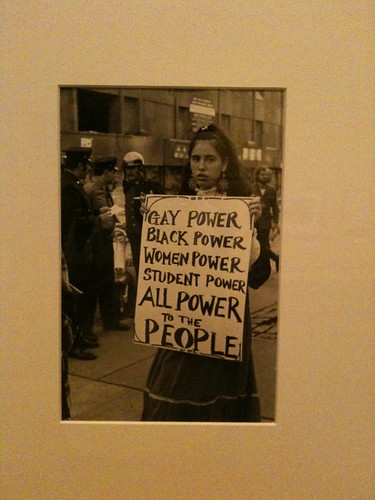
Diana Davies photo at NYPL Exhibit
Protestor at Weinstein Hall demonstration for the rights of gay people on the NYU campus, 1970 (Photograph by Diana Davies, Diana Davies Papers), NY Public Library Schwartzman Research Branch, "1969: The Year of Gay Liberation" exhibit

But things will continue to improve, I'm sure. It's amazing to think that the surviving original participants in the Stonewall Riots, and LGBTQ people of their generation, are in their 60s and 70s, while a new generation of LGBTQ people emerges into a very different world made possible, to a tremendous degree, by the events that proceeded and occurred during the Stonewall era, the subsequent push for gay liberation and equality, and the battles in the 1980s to defeat the HIV/AIDS pandemic and extend the gains of the 1970s. For those of us in our 40s and early 50s who have survived the terrible years of the pandemic (and I've written on here before about how it seemed, at a certain point during the late 1980s and early 1990s, that half the gay men I knew from those years were wiped out), today's changes may be striking--gay marriage in Iowa before New York!--and yet at the same time feel inevitable; society was already changing despite the several waves of right-wing backlashes that we witnessed under Reagan-Bush I and Bush II. Where we are now is to a result of the hard and sustained work of liberation and equality, not just for LGBTQ people, but for black people, women, the poor, and all people in the society, that began long before but took concrete, revolutionary form among LGBTQs at the Stonewall Inn in Greenwich Village in 1969.

Many changes remain, but we are a lot further along that we were in 1969, when I was 4, or 1979, when I was a teenager, or 1989, shortly after I'd graduated from college. I'm looking forward to seeing where we're going to be 5 and 10 years down the road!
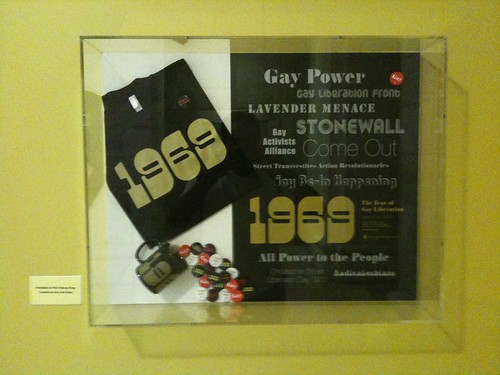
Gay Liberation exhibit poster, NYPL

Friday, June 26, 2009

Michael Jackson + Farrah Fawcett, RIP

Yesterday when I met C at his office so that we could head uptown to the Studio Museum in Harlem to catch Kalup Linzy in conversation and performance, he asked me if I'd heard about Michael Jackson's "heart attack." I hadn't; the only breaking news I'd seen online beyond the ongoing horrors in Iraq and the revelations of about GOP hypocrite #1000+ Governor Mark Sanford was the death of Farrah Fawcett, one of the icons of my childhood years, the blonde "Angel," whose smile and hair and way with charm and firearms on Charlie's Angels, a show that aired when I was in elementary school (beginning in 5th grade, to be exact), engraved the imaginaries of people all over the US and eventually the world. It's hard to believe that she was on the show for only one season; memory extends it to two or three. (None of her replacements every approached her star power, though I must confess that Jaclyn Smith was always my favorite Angel.) As obituaries will recite, she went on to star in TV movies that demonstrated the depth of her acting abilities, while remaining a cynosure of celebrity culture, with the attendant bursts of drama involving her partner, Ryan O'Neal and her son, right up to her death. C and I watched the unspeakably sad documentary about her final fight to cure the cancer that killed her; it was clear that despite her determination, the end was near. It was tough to watch, and as tough to consider that she's passed away.

A little after we arrived at the SMH, the Museum Store's attendant told us that Michael Jackson had died. Neither C nor I could believe it; to recite a commonplace, I still cannot. I could probably spend 20 blog posts on how Michael Jackson and his family have impacted my life, but I'll just touch on a few moments. First, I grew up listening to the Jackson 5 and one of the most vivid memories of childhood was singing their songs and practicing the routines of their dances in the basement of my grandparent's house with my cousins, spinning around to the record player crooning "ABC, as easy as 1-2-3" or "Stop! The love you save may be your own...." I remember not being allowed to see Ben, the movie about rats (which is probably rats don't terrify me today), but singing "Ben" the song and being carried up into a cloud by Michael Jackson's voice. If I think about truly exciting moments in my childhood, one of them would have to be going to see the Jackson Five in performance in St. Louis, when I was about 9 or so. I think I yelled and sang and wept with joy through the whole event. Then there was The Wiz, a critical and box-office failure that I have always secretly imagined was a touchstone for a generation of black gay men; Diana Ross (Stephanie Mills had been in the stage version) and Michael Jackson together, skipping around those immense, funky sets and reprising a story that had been the star vehicle for Judy Garland? In 8th grade, Michael Jackson's Off the Wall came out, and I developed a serious crush on him. I don't think I've ever gotten over what he did to his face and body--and yes, C and I watched the Oprah special where he not only claimed he had suffered from vitiligo, but pounded his chest and said, "I love black people, Oprah!" (Of course he had had his skin chemically peeled, his features altered by surgeons' hands, his hair sewn into place, but really, that wasn't the point anymore.) Those songs from Off the Wall marked his independence from his family, his personal and aesthetic autonomy, and the beginning of his individual superstardom, which would be approached, though never matched, by only one of his siblings, another of my favorites, Janet. Off the Wall was also one of the records I remember dying to buy, with my own saved up money, and I probably listened to the LP so many times that my parents, great music lovers both of them, probably were ready to holler. Thriller was the better album, more jam-packed with hits, but it appeared when I was moving beyond my Michael Jackson-love phase, and more into rock music, punk, and early hiphop, but I bought it and still can listen to the whole album, especially "Wanna Be Starting Something" or "P.Y.T. (Pretty Young Thing)" or "Billy Jean," and barely stop myself from jumping up and dancing.

From that point onwards, I sort of took Michael Jackson as he came, though less rather than more: the high points were the records and some of the songs and videos, the low points the increasingly bizarre (to me) lives he created for himself, from his marriage to Lisa Marie Presley and public kiss with her (which still makes me cringe whenever I see it) to endless surgeries, to the up-and-down and then fading sales, to the pedophilic scandals, to the circumstances surrounding his three children (Prince Michael I, Paris Michael, and Prince Michael II a/k/a Blanket). I would be lying if I said that I wasn't riveted by some of this stuff; I watched the Martin Bashir documentary in horror, and snarked at Jackson's outrageousness while admitting that despite it all, I still loved his music and all the craziness he whipped up around himself. I was thinking just a few weeks ago that I probably wouldn't ever go see him perform again, as controversies raged around his upcoming tour, but now the question has been settled for me. All the obituaries will mention that he was one of the greatest performers of the modern era, an incomparable showman, a racial pioneer (in many ways), a figure of tremendous international influence, a great philanthropist, and a musician of almost inestimable talent, who knew how to create hits like most people breathe. Almost all contemporary American and international popular music bears his DNA. But he was also someone who shaped the inner lives and dreams of millions, including me, and for that I'll always be grateful.

Here's a brief video I took of the spontaneous celebration last night in front of the Apollo Theater in Harlem:

Wednesday, June 24, 2009

Soccer Shocker: USA 2-0 Spain, Confederations Cup

AltidoreA sports shocker: The USA national soccer team defeated the world's top-ranked squad, Spain, 2-0, in the Confederation Cup in Bloemfontain, South Africa (which will host the upcoming 2010 World Cup), to reach the championship match, the first time the USA has ever reached a FIFA final since 1916. Only a week ago the USA team was on the verge of heading home, having lost their first two games and staring at a 1-7-1 all-time record against No. 1-ranked teams.
In addition, Spain, the European champion, had won 15 straight games and run up a 35-game undefeated streak. Yet 19-year-old New Jersey native and sensation Jozy Altidore's (above, center, ) goal in the 27th minute, coupled with excellent defense and Tim Howard's impenetrable goalkeeping, brought a US victory. Clint Dempsey added an insurance goal in the 74th minute.

The US will play either Brazil, to whom they lost 3-0 in their second match of play, or host South Africa, but in a sense they have already won the biggest match of the tournament, and one of the most important in US soccer history. Let's hope they can carry this winning style of play into the final and also into next year's World Cup.

Link: Spain 0-1 USA


Link: Spain 0-2 USA

Tuesday, June 23, 2009

New iPhone 3GS + Video: New York 5 Train

I'm usually not a technological first adopter, whether it's hardware or software (except in peculiar cases, like Gifbuilder some years ago), but I did sign on for the original first-generation iPhone in the fall of 2007, after several fond years of using my RAZR phone with inconsistent Verizon Wireless service, and despite a vow from the mid-1990s that I wouldn't be using AT&T services again if I could help it. But I couldn't: our monopolistic capitalist system affords service carriers exclusive rights, so with the iPhone came AT&T.

I love Apple's products. I love(d) the phone. I love(d) it even more after the iPhone App store debuted. I didn't and don't love the service, which is prone to disappearing ("No Service") in various portions of the 3rd City, such as the university's parking lot, Sheridan Road as it curves from Evanston into Chicago, near Humboldt Park, on Lake Shore Drive at various points before you reach Michigan Avenue, etc. It also flickers in ghostly fashion in Jersey City near Jersey Street, not far from the old, iconic Colgate sign, which makes me wonder if that relic is radioactive, or if something else is breaking the signal.

No rants today, though, because as of Friday I will be continuing on with this same carrier, unless Congress finds a spine and breaks the service carrier monopoly policies, for two more years. I ordered and got the new iPhone 3G S. Almost as soon as I read about it online, I coveted one. The primary reasons were the improved speed, the possibility of better and more consistent phone connections when I'm in Chicago, and, above all, the video camera. The video camera! As J's Theater readers know, I am a terrible photographer but inveterate photomane. I love snapping pictures. I especially love snapping digital pictures (though I will not ever get rid of our 35 mm camera.) And I really enjoy taking video clips. My RAZR did not have one, and the first generation and even original 3G didn't either. So now instead of regularly carrying 2 (or even 3) cameras, as I'm wont to do, I will only have to carry 1, which also happens to be a phone, a DJ, a library, a clock and stopwatch, a news aggregator, a musical instrument, a computer, a....

Here's my second iPhone 3G S video, from last Friday, on the 5 train. I groaned when these artistes boarded the car, because they were following another charmer who claimed to have served in Iraq, but their playing was a rousing accompaniment up to 42nd Street.

Monday, June 22, 2009

Protests in Iran + Twitter-Aid to the Pro-Reformers

MousaviI've been loathe to comment on the unfolding events in Iran in part because I know so little about the country beyond the general contours of its 20th (Mossadegh, the Shah, his fall, the Revolution, etc.) and 21st century history, and even then, my sense of what's going inside the country today is hazy at best. What also clouds my impressions are questions about possibly ongoing US involvement, directly and indirectly, in what's unfolding in Iran. I don't think anyone should forget that we have over 150,000+ troops both to the east (Afghanistan) and west (Iraq) of Iran, and for 8 years (still?) we had (have?) an administration that was determined not only to foment upheaval in Iran, in part to blunt its nuclear ambitions but also to replace its true leadership, which is to say, the mullahs who really rule the place. According to reliable reporters like the New Yorker's Seymour Hersh, this only increased after Mahmoud Ahmadinejad took office in 2005, defeating former president and important cleric Akbar Hashemi Rafsanjani. This is one reason I think President Barack Obama's public stance is the right one; while criticism of the brutal crackdown and praise of the protesters' courage and desire for democracy are appropriate, Obama and the US have to studiously avoid meddling, or even appearing to be doing so, as this can be used as a means to dismiss the legitimate concerns of the reform camps, and even to punish them as foreign agents or puppets. (Not that the US's public and official caution will stop them, but the US need not give them any ammunition.)

For most of the years that Mohammad Khatami, who now stands behind the leading reform candidate, Mir-Hossein Mousavi [photo above, tonbak.wordpress.com], was president (1997-2005), I was under the misimpression that the country's establishment would embrace the political and social liberalization that his initial election augured. While the public rhetoric during Khatami's tenure continued to point towards liberalization and he made repeated overtures towards the West, the clerics remained firmly in control. Yet I also recall that during Khatami's second term, even Supreme Leader Ayatollah Ali Khamenei supposedly was willing to make a deal with the US, yet after the Bush administration rejected the cleric's offer, infamously labeling Iran one member (end?) of the "Axis of Evil," the Iranian regime tightened its line, externally and internally, and has been resolutely firm--at least from what I can tell--ever since. This approach has coincided with the election, and now alleged re-election, of the extremely politically and religiously conservative Ahmadinejad and with the change from the Bush administration to Obama and his team.

The leadup to the election seemed to harken a shift in terms of Iran's politics, or at least this is how I viewed the openness and public nature of the debate between the contrasting candidates and their supporters (Mousavi and Karroubi on the reformist side; Ahmadinejad and Rezaie on the conservative side). But perhaps this was all through the lens of the Western media. I cannot say, but it appeared to be more vibrant than I remembered back in 2005. Then came the vote, and...what looks increasingly like a coup to ensure Ahmadinejad and the ruling ideology stayed in office. Up through today I've read all sorts of analyses of the election last week, and many suggest that there were serious irregularities in the vote tallies. What struck me on the evening of the vote was how quickly Khamenei declared Ahmadinejad the winner, and how dismissive Ahmadinejad's comments were towards Mousavi, Karroubi, and even Rezaie and their supporters. It was as if he knew he had the election in the bag and that his opponents, defeated, would simply accept it as given.

Instead, what the entire world has seen is an ongoing protest, throughout Iran, with massive rallies at first, mostly peaceful on the protesters' part, that have now turned into bloodbaths as the regime cracks down with ravenous brutality to impose its will and order. Yesterday, after following the advice I posted below, and while keeping an eye on the pipe repair here at the house, I was following the #iranelection thread on Twitter. I've followed a number of blogs, news reports (on HuffingtonPost.com especially), and so on, and the Twitter feeds proved an enlightening complement. Many of the posts were repetitive, some led to bad links, others felt like disinfo, but there were quite a few that were giving up to date reports on the state of things, not just in Tehran, but from what I could tell, in some other cities in Iran as well. A number of the tweets led to horrifying YouTube clips; in addition to the now iconic and tragic video of 27 year old Neda Agha Soltan's murder, there were links to attacks on a wide array of protesters, including a clip of the security forces (Basiji? I don't know) torturing one man, another of two wounded students being dragged into a university hallway, where one died, and protesters encountering live ammunition. (The tallies of those killed so far have varied considerably.) Other tweets have focused on the general strike(s), protests by Iranians and others outside Iran, ways to avoid the security apparatus's e-clampdown, links to other pro-reformist (and pro-government) sites, and so on. Just following these tweets and observing the role that Twitter, Facebook and other sites, along with the more widespread SMS technology, are playing, has been fascinating. Once these technologies enter the picture and become more diffuse, not only the Iranian government, but no government will be able to respond as it had in the past.

How will things end? I have no idea. Despite Ahmadinejad's more measured language and near apology this weekend, the clerics' line as of today is even more rigid; Ayatollah Khamenei's sermon on Friday was as firm as a guillotine, as if to assert not only that he wasn't going to back down, but that he was in total control. Countless pro-reformers from all strata of Iranian society and domestic journalists have been arrested, and some have disappeared. The regime has also restricted the work of foreign journalists, and has begun verbally attacking foreign governments. The government today announced that there would be no annulment of the election, that fallen protesters' families would be charged for their burials, and so on. Yet major figures like Khatami and Rafsanjani have cast their lot with the reformers, and millions of Iranians, women and men, are refusing to back down. (I am not sure what's really going on with Rafsanjani, how much power he truly wields, and what this will mean for Khamenei's rule, and I'm still trying to sort all these elements out.) The fly has escaped the flybottle and it cannot be returned. If the clerics and Ahmadinejad do somehow remain in power, however, I cannot but imagine that they control has been severely weakened--whether irreparably remains to be seen.

Related:

I'm not on barely on Twitter (and as far back as last spring [2008] was urging students not to use it during class), but I received this from Tisa B. and am passing it on in order to help those trying to stand up for freedom and democracy there:

If anyone is on twitter, set your location to Tehran and your time zone to GMT +3.30. "Security" forces are hunting for people blogging about the current abuses of pro-democracy protesters using location/timezone searches. The more people at this location, the more of a logjam it creates for forces trying to shut Iranians' access to the internet down. Please cut & paste & pass it on
I did this. Please do it if you can, and take other action to support the pro-reform movement in Iran!

Saturday, June 20, 2009

Shaun El C Leonardo

Shaun El C Leonardo
Shaun El C Leonardo
Self-portrait Icon (1) - performance, 15 min. at P.S.1, Long Island City, NY, 8/6/06. Photos by Jayson Keeling

On YouTube:


Shaun El C Leonardo in an interview concerning his LACMA exhibit


Shaun El C Leonardo at Scope Miami 2007


Shaun Leonardo & Kalup Linzy lipsyncing to "Lollypop"

Friday, June 19, 2009

Happy Juneteenth

Growing up my hometown celebrated this holiday, but it's since spread to all parts of the US, and is now even an international holiday.

Happy Juneteenth!

Juneteenth by Andrew Clayton
Juneteenth is the oldest known celebration commemorating the ending of slavery in the United States. Dating back to 1865, it was on June 19th that the Union soldiers, led by Major General Gordon Granger, landed at Galveston, Texas with news that the war had ended and that the enslaved were now free. Note that this was two and a half years after President Lincoln’s Emancipation Proclamation - which had become official January 1, 1863. The Emancipation Proclamation had little impact on the Texans due to the minimal number of Union troops to enforce the new Executive order. However, with the surrender of General Lee in April of 1865, and the arrival of General Granger’s regiment, the forces were finally strong enough to influence and overcome the resistance.

From Juneteenth.com
Image by Andrew Clayton © 2005.

Commencement Day + Life Thus Far + Photos

Today is Commencement Day at the university, so I can now say to all of the students, mine and others', undergraduate and graduate, CONGRATULATIONS! I won't enumerate all the wonderful students I've had the opportunity to work with over the last few years who've finished up this June, but they've been terrific, and I wish them all the very best, in full confidence that they will all make their distinctive marks upon the world.

***

The end of the school year means my return home, and my unshakeable belief, despite years of contrary evidence, that I'll finally have some (more) time to devote to my creative work. This week, however, has proved that life always has its own plans for us, and this is especially the case when you own a home (or condo, or any other costly piece of real estate for which you're responsible for the upkeep). As I've noted on here before, a great deal--perhaps half--of my time spent at home in New Jersey has coincided with the presence of contractors. This has included the initial renovators and subsequent repairers--the painters, one of whom moved to Hollywood to direct films, another of whom coughed so badly that I thought his lungs would fly out of his mouth as he hovered on a ladder high above the backyard; the electricians, a gaggle that included one who set off sparks as he was installing a light and wondered why I looked ready to call the fire department; the plumbers; the succession of roofers, one of whom went mad and another of whom had the brilliant idea of covering our then-unlined chimney in chicken wire and stucco (we passed on that); a porch builder who promptly vanished from the tri-state area after some of the wood cracked within a week of his installing it; the doormaker-carpenter, the only sane and economic of all the doormaker-carpenters we've dealt with, who'd gone to MIT and produced work worthy of a prize; innumerable hucksters whose mercurial behavior made us wonder how they managed to stay in business at all; and so on--and others unforeseen, like the representatives from the private water contracting company our municipal water company, now privatized, employs. These skillful people not only cracked a 100-year-old water pipe once while deinstalling our water meter, but recracked it while putting it back in! And so now this pipe, which was dripping, is now seeping water, which a series of towels are sopping up. Every day this week, the water company contractor has assured me--promised me--he will show up "after 8 am," though that has meant 11:30 or not at all, if he "forgets." So today, after both C and I called first thing in the morning, I waited, he showed up, we chatted about the state of the pipe, he denounced Jersey City's placement of trees on the sidewalk and galvanized lead, we inspected the curb and learned that 100 years ago, the developers had thought through infrastructure placement quite well, and so now rather than shutting off the entire neighborhood's water supply, they may be able to target their efforts and fix this pipe (replacing it would be the best option). I am sincerely hoping they complete this sooner rather than later (and that, though I had to broach the subject, no lawyers have to get involved), since in adulthood no season ever feels more fleeting than the summer.

***

When we were packing up things in Chicago, C asked if we could spend a little time having lunch at the nearby beach. For all of my time in that city I've always lived in walking distance of one and, as past photos on here will attest, I've walked and snapped shots of them. My favorite time to visit them is when a heavy fog is blanketing both them and the Lake. We went and sat on a (not so comfortable but convenient) bench on the concrete walkway and observed people lying out on the sand, walking their dogs, dipping into the water, and basically enjoying a break from the drear of weeks of cold mornings and rain, and this got me thinking about how this essential feature of Chicago life is almost never portrayed on film or TV. When movies and TV shows depict contemporary Chicago, we see the skyscrapers, the immense suburban homes and the bungalows, the El, sometimes the (remaining) projects, some of the city's unforgettable cultural and architectural highlights (the Art Institute, Frank Lloyd Wright architecture, etc.), the baseball stadia (especially Wrigley Field), various restaurants (i.e., anything having to do with food), and the Lake.

But interestingly enough, rarely do they show the city's beaches that line the Lake for miles, from Rogers Park (Howard and Jarvis Parks) all the way south to the Indiana border (Rainbow Park and Beach). As a result, I imagine that many people, like C., are probably unaware that Chicago, like Los Angeles, New York City, Boston, San Diego, and Miami, just to name some of the more obvious US examples, has pleasant, sandy beaches, real beaches, at its doorstep. (In noting this I'm not suggesting that Lake Michigan is the same as either the Atlantic or Pacific Oceans, or that the sand or beach quality is the same.) Yet I have not met a single native Chicagoan, or anyone who's lived in the city for a while, even those resident far inland to the south, north, or west, who doesn't know about the city's beaches. I also didn't know how extensive or pretty the the beaches were for a good while.

This leads me to ask J's Theater readers, when you think of the cities and towns where they you or have lived, what are some notable aspects or features that everyone who's a native or a longtime resident knows about, but that are never depicted in films or TV shows? What are some of those major hidden elements of the city that might transform how people think about it? Please post a few of these in the comments, and append your name (or a name) in case screenwriters happen upon this blog page (not likely, but you never know).

***

And to conclude today's entry, a few photos from the last few months.

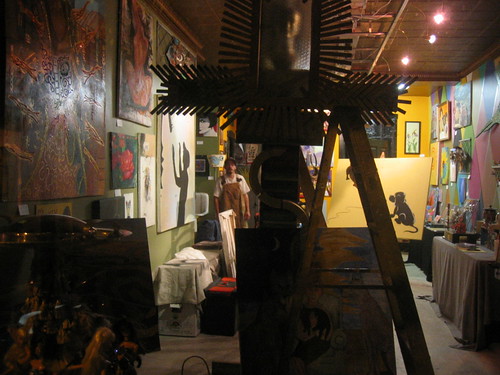
Artist's studio, Greenwood Ave.
A late-night snapshot of artist in his studio in Rogers Park
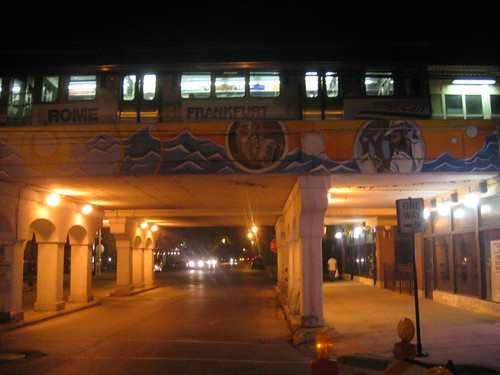
Looking down Morse St. towards Lake Michigan
Morse Avenue El (towards Lake Michigan)
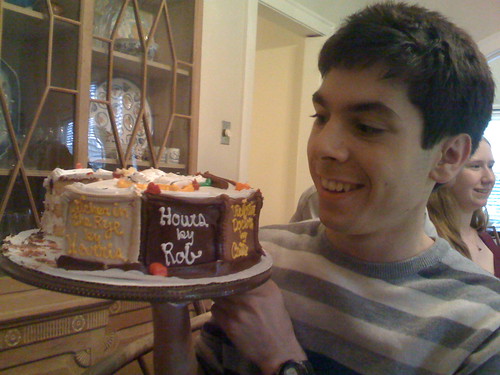
Harris with honors students cake
Harris Sockel, the literature honors student I supervised, holding the students' cake at the lit honors celebration (part of his thesis topic is highlighted in the lighter frosting to the left: J. D. Salinger's The Catcher in the Rye. (He also was co-winner of the Best Senior Literature Major award: congratulations, Harris!)

Marvelous poet and scholar Evie Shockley, reading at the university

Election day a few months ago, Jersey City

The ubiquitous signs (in NYC and Chicago)

One of my favorite NYC statues, Gertrude Stein, in Bryant Park

Gray's Papaya in the West Village, recession special (and they were already a great deal)

Thursday, June 18, 2009

44


The delicious coconut-lemon cake is courtesy of C (and delicious it is!)

Sunday, June 07, 2009

On Publishing

Counting down...one more week till classes are done, and all the wonderful students I've had the opportunity to work with for the last few years graduate and do great things in the wider world.

=-=

Requiescant in pace "Queen of the Blues" and longtime Chicagoan Koko Taylor, historian and multicultural visionary Ronald Takaki, Buffalo Braves baller extraordinaire and "Iron Man" Randy Smith, actor David Carradine, and eminent foreign policy scholar Ernest May.

=-=

I've been wanting to write about the book business, so to speak, for a while, but haven't found the time or energy to do so. (That mental energy has been on the wane for a while.) Instead, I've been culling articles I've come across or that others (Reggie H., Lisa M., Anthony) have forwarded to me about what's been going on with publishing, writing, and such things of late. I had envisioned a grand, synthetic post about the state of publishing, but I realize that's not going to happen, so let me try something more modest.

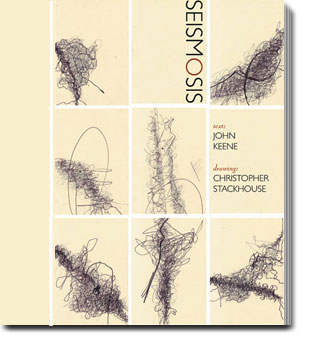
I'll start with a bit of news, which is that about a month ago, I received the annual royalties for both of the books I've written or co-written, and so, THANK YOU to every single person out there who has ever bought either book, but an especial thanks to those who've bought either of them within the last calendar year. They are rarefied creatures, more poetic than regular reading fare, so I really do appreciate the readership (and the reviews, positive or otherwise, and all who've taught both works, all of it!). I've received royalties for Annotations for several years now; those began appearing after the return period had ended, which followed the first few very good years of fine reviews and a second printing. For those unfamiliar with the term "return period" or the concept, this stretch in a writer's relationship with her publisher occurs when bookstores can and do return your books to the publisher if they're not selling or want more shelf space for other books. The publishers ship the books back and I believe they receive credit for them. (It used to be the case that the chains did this more than small and independent bookstores, though Amazon's and Sam's Club's/Wal-Mart's vast storage facilities may have mitigated this to some extent, at least for books with smaller press runs.)

On an annual royalty statement, returns usually show up as a negative tally against your advance, so if you got a hypothetical $10,000 advance, returns are counted against that advance until you've sold enough books to earn back that $10K. (Thus for the huge advances, say $250K on up, authors have to sell enough books to pay those back before they can start receiving royalties, and often that doesn't happen.) Larger publishers are known to do one of two things to books that are returned in bulk: sell them to a remainder house for a pittance, meaning the publisher gets something on the dollar for them but the author gets zero, or pulp them, in which case the book can go out of print. Remaindered books are the ones you often find online or on a remaindered table at bookstores, and they'll often carry a mark on the bottom edge of the pages to indicate they were remaindered. They also usually sell for a fraction of the original cover price (a $25 new hardcover book can sell at a remaindered price for about $5, meaning that the bookstore selling it could get $4 profit if they paid $1 to pick it up from a remainder house.) New Directions, the small, independent publisher of Annotations, however, has a fairly sterling record of keeping its books in print, and they've neither remaindered nor pulped it. In fact, it has earned back the advance, and so now I am receiving a small but regular trickle of royalties. With Seismosis, published by a very tiny and fairly new publisher, 1913 Press, the situation was a bit different; we didn't receive an advance (as is the case for most poetry books), but it too has sold, and so both my co-author and I received (a very small but welcome) compensation for it this year. I mention all of this because the return policy is one of the worst aspects of the book business, but it is not the only bad one; others include outrageous advances to authors for books that do not sell, publishing too many books, dumbing down books, paying the bookstore chains to feature certain books at the exclusion of others, and above all, steadily conglomerating and expecting outrageous profit margins on a business that was never meant to bring in money like others (software, discount investment houses, luxury goods, etc.). Yet in a way these may be more indicative of the book business of the past--or which is passing--and less of what is unfolding now.

Now I am not the first person to speak about the sickness of the book industry, or its considerable structural, formal, and material changes; there are quite a few books that detail its woes, which have been unfolding before our eyes for the past two decades. Andre Schiffrin's coruscating The Business of Books: How the International Conglomerates Took Over Publishing and Changed the Way We Read (Verso, 2000), is a classic, but there are others, like Jason Epstein's memoir Book Business: Publishing Past, Present, and Future (W. W. Norton, 2002) or Laura Miller's study Reluctant Capitalists: Booksellers and the Culture of Consumption (University of Chicago, 2007), that launch a raft of insights about the history and contemporary particulars of American (and international) publishing. But even taking these books' many felicities into account, the contemporary publishing situation is so fluid that none of these works fully grasp it. At the structural level, several of the chain bookstores, which had been the bane for so many for at least a decade, are financially teetering, leaving Amazon (and Wal-Mart), a diversified retailer, as the nation's the major bookseller. The distribution has stumbled badly over the last few years. In material terms, print book sales, like sales of almost everything, keep tumbling; sales of audio books, a moneymaker for some presses, have plummeted; and only e-book sales are rising. This last bit of good news ties directly into the rise of Amazon's Kindle, the major e-book reader on the market today, and similar electronic book technologies, like Scribd, Stanza, which I have on my iPhone--the cost of most Kindle texts is far less than publishers charge for hardcover books of any sort. One of the traditional publicity and promotional avenues, the newspaper, is also faltering badly; these days it's not only book reviews sections or even book reviews that are facing extinction, but the very papers in which they appear. So how are publishers--the big publishers, in particular, which is to say the conglomerates that control the vast majority of publishing today--responding? What are they going to do? Will smaller publishers become the standard again? Will print-on-demand finally take off? Will people migrate to electronic books over printed texts, and will those persist, like radios or bicycles, as useful and perhaps quite necessary, but for the most part superseded but still valued technologies?

Lisa Moore, a great small-press publisher (Redbone Press, in at least one of whose books my work has appeared) and correspondent, hipped me to one of the best recent takes I've read (and I've been collecting quite a few of late). It's by Farrar Straus and Giroux Senior Vice President and author Elizabeth Sifton and is "The Long Goodbye? The Book Business and Its Woes," it appeared in the May 20, 2009 edition of the Nation. (I must note that FSG, though part of a huge German-led conglomerate, Holtzbrinck, remains one of the sharpest publishers in the industry.) Sifton anatomizes the situation rather thoroughly and at times wittily, offering such thoughts as:

In America, pubescent vampire novels are selling like crazy to readers of all ages, also memoirs about cats and puppies; classics are still in demand, as are cookbooks about cupcakes, of which there are an amazing number. Books by brand-name writers continue to populate the bestseller lists (though not racking up the numbers they used to). Every week the trade bulletins report hundreds of new books being signed up, sometimes for absurd amounts of money, by dozens of publishers. Self-indulgent excess doesn't go away, then. This exorbitance in the book sector, as in the gigantic financial and housing sectors, has been weakening our culture for decades. Hubristic, ill-considered follies reached notable highs under the Great Deregulator, President Reagan, but to be fair, book publishers then (many still carrying the names of the confident men who had founded them twenty-five, fifty, 100 or 150 years before) were panicking, for they were losing their once dependable base, and Reagan made things worse by cutting federal funding for libraries and other appropriations that had helped to fuel America's postwar advances in literacy and book-based education.


and

Their ever more powerful agents have successfully decoupled the size of the royalty advances they receive from any estimate of the books' eventual earnings, and routinely assure them that if Knopf or Norton or Morrow fails to earn back the upfront money, it's because their masterpieces were badly published, not because the advances were implausibly high. This is cheering, of course; writers' egos are always shaky, and they tend to forget the sage warning that you should disregard compliments extended by someone whose income derives from your own. Also, they won't acknowledge that literary quality may decline as advances increase; only rarely is a writer liberated into confidence-inspiring freedom by following advice from greedy publishers about Pleasing the Crowd. Willa Cather wasn't the only fine writer who refused advances for being, in her view, unethical, nor was D.H. Lawrence the only one who found them demeaning. The agents have much to answer for.

What now? Publishers are battening down, and chain stores are struggling, having staked so much on nationally merchandised dreck, having committed themselves to imitating the look of the big indies but never quite matching their tighter local focus and skill in "hand selling" genuine books to readers. Anyway, the entire world of American retail business is veering toward obsolescence. Must books now find their way in cyberspace?

This leads Sifton to query what the future not only for publishing, but for reading and books in general will be, particularly in relation to the Internet. (She mentions the lawsuit against Google's unauthorized scanning of copyrighted books, which New Directions, like countless other publishers, was party to.) She has no answers, but is wary, and doesn't trust publishers to do the right thing(s), or perhaps isn't sure if they'll even know what the right thing is until it's too late, despite their self-interest in doing so. She ends the piece by quoting John Locke to make her point, and so the larger question remains: what now?

Sifton's overview and critique proved an interesting lens through which to read New York Times book beat reporter Motoko Rich's blasts from the BookExpo America, the annual US bookseller's convention, which took place two weeks ago in New York City. In her March 29th entry, she noted the "gloom" cast by diminishing book sales. Even the convention itself had shrunk, and some publishers and booksellers were present in obviously reduced fashion, while others did not attend at all. The next day, she posted a more positive, peppier article that, that focused on publishers' thoughts on e-books and which, I noted to Reggie and Lisa, I could have filed from Evanston; it said little that you might not extrapolate from the previous day's downcast report, though some details, like the decision to distribute cards with links to online .pdfs of works, versus actual print galleys, was enlightening. (This reminded me of the fact that at least for the last few years in most of my classes, I've decreasingly distributed photocopies of any articles, and have posted either online links or .pdfs on my courses' Blackboard sites. Even coursebooks are less like from now on.) One other noteworthy bit of news was that on one of the BEA's many panels, acclaimed author and screenwriter Sherman Alexie's declared that he refused to let his novels be distributed in electronic form, and that when he saw a woman on his plane to New York reading a Kindle, he "wanted to hit her." Whoa, Sherman! (He has since apologized.) Rich also submitted entries about the event (naturally) on the Times's Paper Cuts blog, such as what the most recommended books were. Many seemed to be new works by previous seasons' breakout authors, or anticipated bestsellers by prior bestsellers, though there were a few, including a family saga that favored Gone With the Wind (ugh!) and a nonfiction book about a plane crash survivor (just the thought makes me wince) that editors could not put down. But of course, it's always a roll of dice, isn't it, and I don't think publishers would like to think of themselves as engaging in something akin to Steve Wynn's business, would they? As to the larger questions Sifton's piece raises, Rich had (and has had) few answers.

Lisa went to BEA, and sent back a few links--June 1 and June 3--from Shelf Awareness, a great resource on the publishing trade, and both presented different angles on the BEA. The first gave an overall portrait of a trimmer but livelier convention, with some key changes on display and more attendees than the previous year in LA but fewer than two years before in New York. Media representation, however, rose from around 1,250 to 1,700. (Hmmm.) I hadn't realized that having authors in attendance was formely frowned upon, but the Shelf Awareness writeup suggests that booksellers and readers raved about the opportunities to interact with authors. Lastly, as Lisa noted in an email, this entry gives a fuller context for the Alexie panel.

And then Reggie sent (and I'd come across) yet another take, by Elizabeth Eaves, in Forbes, entitled, "Why Write?" Her ultimate take:
In short, book-writing is a worse-than-ever means to a livelihood, and mass-market renown is disappearing as a concept, fractioning into a million niches. Ultimately the only good reason to write books remains what it probably always was: The compulsion to try to entertain, persuade or make meaning is irresistible, and the process absorbs you like nothing else. If it doesn't, there's no reason to bother.
Write because you love, because you surely won't be making money from it from now on (unless you're lucky, Oprah Winfrey picks your book for her club, you tap into some existing or unforeseen market, and...bingo! But I'm back to the games of chance analogy, see?). But again, to the larger question, whither publishing as we knew and know it, or rather, wither...?

Sunday, May 31, 2009

Four Electric Ghosts + Italian Poets + On Tiller Murder

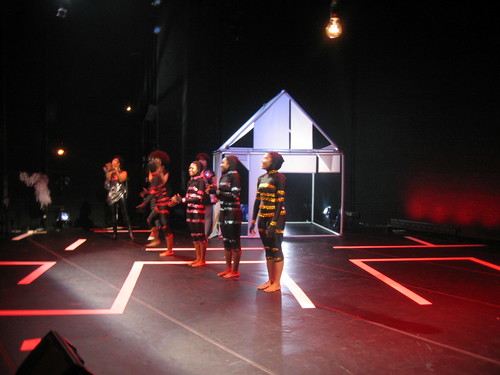
A few weeks ago, I caught the last show of Mendi + Keith Obadike's astonishing new opera-masquerade, Four Electric Ghosts, at The Kitchen in New York City. These two never cease to amaze me. For this show, which also included breakout performances by poets-performers Natasha Latasha Diggs, Karma Mayet Johnson, an incredible band, and four of the flyest dancers I've seen in a while, Mendi + Keith started with Nigerian novelist Amos Tutuola's My Life in the Bush of Ghosts and combined it playfully with their take on Pac-Man, the iconic videogame (everyone remembers this, right?) to create a profound and joyful experimental, experientially multimedia extravanganza. They even beckoned people out of their seats to dance at the end, making the event truly interactive.* The opera-masquerade's narrative, essentially an updated fable, involved the three singer-sayers, Mendi, Natasha and Karma, bounteously afroed and futuristically and funkily attired, relating by text and song the story of four sisters, played by the four superbly lithe dancers, who were schooled by their mother and who died after a lightning strike, sending them to the Land of Ghosts, from which each eventually ventured out, thus generating the narrative. Blessed with knowledge, gifts and protective chalk, each Ghost sister, bearing a differently colored series of metallic stripes across her suit, encountered a scenario in which she dealt with a dangerous "mortal" and forgot, temporalily, or failed to register the mother-lessons of her previous life, and had to return home chastened but also recharged by the experience and revitalized by the recognition of what she'd previously learned. It's difficult to convey how seamlessly this all flowed together: the narrating and singing, the dancing, the light displays and projections on the back wall, the musicians' riffs, the complex weave that just keep pulsing with energy and brilliance and depth in a way that I, no huge afficionado of theater and musical performance but no stranger to them either, rarely have witnessed. And it was so grounded in a range of black cultural traditions while also feeling so new.

In addition to the Mendi + Keith and the singer-speakers I mentioned, other collaborators included Angela’s Pulse Performance Projects, comprising choreographer Paloma McGregor, stage director Patricia McGregor, and dancers Maria Bauman, Catherine Denecy, Marjani Forte and Keisha Turner, and design by Kate Cusack (costumes), Yuki Nakajima (animation/projection), Alexandre Delaunay (scenery), and S. Ryan Schmidt (lighting). After the performance Keith introduced me to bassist and producer Melvin Gibbs, with whom he, Mendi and musician Guillermo E. Brown had composed the music, which Keith, Brown, pianist Shoko Naga, and bassist Keith Witty performed live.

In addition to the unforgettable orchestration, songs and singing-saying (though not Sprechstimme), and choreography and dancing, what powerfully struck me was how Mendi + Keith had rethought and tinkered with Tutuola's powerful story and its implications for our current post-modern, hyperwired, digital moment, making it as much a vision about new ways of thinking about living and learning and a vivid, veritable (afro-diasporic-)futurist parable, grounded in the stories of these women--the ghosts and the singer-speakers--as a rereading and renovating of the past. I know they were recording it (and it was also simulcast via the Web, I believe), so I hope that it's available for many more people to see soon, and I also hope that Mendi + Keith follow their precedent of issuing the tracks online in mp3/CD/DVD form. I'm telling you, these tracks were hot, and while I know Mendi is bursting with talent and have heard both Natasha and Karma sing, working with Keith and his combo in songs with richly remixed R&B, house, Afropop, electronica, rock, and hiphop flavor, they set it off individually and as a trio. You have to hear them. I certainly want to again, because this was one of the freshest and most interesting performances I've caught in years (and that includes another recent favorite, Passing Strange).

*(I was fortunate enough not only to leave my seat, but to be bopping with Tracie Morris (I swear!), while Myronn Hardy and others were stepping only a few feet away. As George Lewis watched from the front row. Where else are you going to have an experience like this?)

Here are a few (blurry--my apologies) photos from the event:
3 Singer-Sayers, Four Electric Ghosts
The three Singer-Sayers, Natasha Latasha Diggs, Karma Mayet Johnson, and Mendi Lewis Obadike (left to right)
Scene from Four Electric Ghosts
The Electric House
At the end of Four Electric Ghosts
At the end of Four Electric Ghosts, Mendi at left, Karma at center
Curtain call, Four Electric Ghosts
Curtain call
Mendi Lewis Obadike, co-author Four Electric Ghosts
Mendi after the performance

**

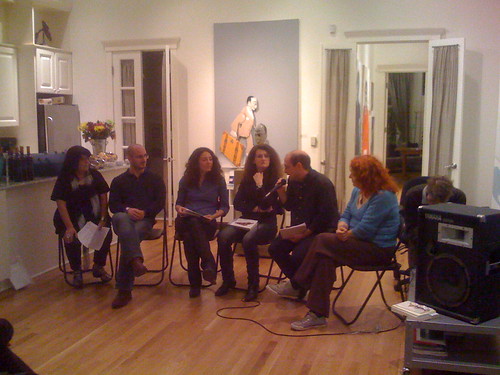
Though I was feeling down and crappy earlier in the day, on Friday evening I dragged myself out to a reading by four major established and emerging Italian poets, Maria Attanasio, Giovanna Frene, Marco Giovenale and Milli Graffi, at Think Art gallery in Wicker Park. Poet, critic and translator Jennifer Scappettone organized this event, part of a two-city, four event Italian Poetry Festival, in conjunction with Litmus Press and its wonderful journal Aufgabe--whose issue #7 included a special section on contemporary Italian poetry edited by Jennifer, entitled "Embargoed Voices: Poesia Ultima/Italian Poetry Now--and the Poetry Center's Francesco Levato and UIC's Chris Glomski. (Other sponsors include Poets House, the Italian Cultural Institute of New York, St. Mark's Poetry Project, University of Chicago Arts Council and Departments of Romance Languages and Creative Writing, and the Northwestern University Department of French and Italian.) Each of the poets read in Italian, with Jennifer reading hers and others translations, presenting work that was often striking in its innovation and political engagement, after which they engaged in a conversation led by Jennifer that touched upon questions of the poets' respective "generations," politics and Silvio Berlusconi, and American vs. European aesthetic influence. One of the highlights was the exchange in which Milli Graffi suggested that whereas she had been surer of her place in the literary world in the past she now felt "lost," and suggested that Marco Giovenale's generation--1968 to 1978, as he defined was, in Gertrude Stein's famous comment to Ernest Hemingway, also a "lost generation," a appraisal to which both he and Giovana Frene, also a young poet, challenged vigorously. Afterward I had an opportunity to meet all the poets and chat about contemporary literature, and even show Maria Attanasio and her husband my poetry month blog featuring her, for which Jennifer supplied me with the requisite Italian. Now I need to learn enough to read her book, Il falsario di Caltagirone, which I think means The Forger of Caltagirone, and which has merited considerable praise. I also got to chat with Marco Giovenale and picked up several of his books, including CDK, which is a Flarf-inspired text. Ah yes, even in Italy, they're Flarfing! When I got home, I felt 1,000 times better....

As always, a few photos:
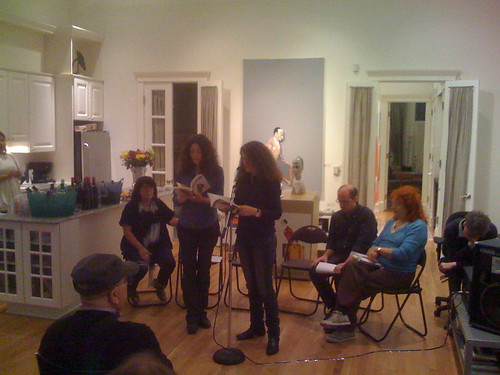
Italian poets reading, Think Art Gallery
Jennifer and Giovanna Frene (R) reading in sequence
Italian poets reading, Think Art Gallery
In conversation, from left: Maria Attanasio, translator and U. of Chicago doctoral student Rafaello Palumbo, Jennifer Scappettone, Giovanna Frene, Maro Giovenale, and Milli Graffi.
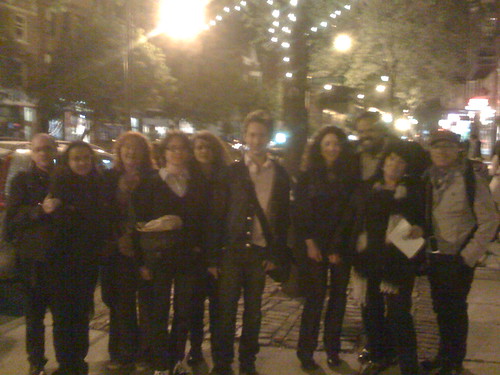
Group Portrait w/ Italian Poets
Group portrait with the poets, their loved ones and friends

***

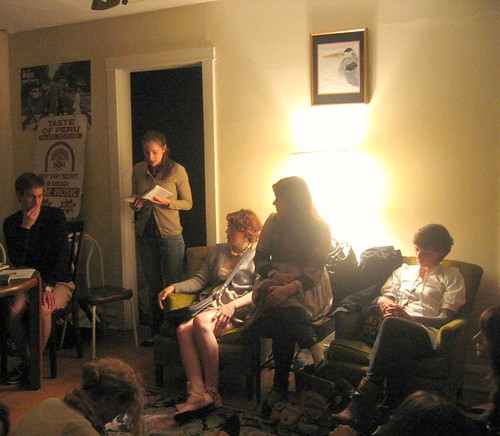
Last night I briefly dropped by the Rogers Park salon that Loyolaites Charles Gabel and his compatriots stage every month or so to hear Lily Brown, Lisa Goldstein, and Nathanaël read their work. It was lively, to put it simply. The evidence:
Lily Brown reading
Lily L. Brown reading her poems
Nathanaël reading from Absence Where As


***

I've been noting how much the rhetoric surrounding abortion and women's reproductive rights has been heating up crazily of late. It bubbled up into a full scale imbroglio surrounding President Barack Obama's invitation to receive an honorary degree at the University of Notre Dame. (As we all know by now, Notre Dame thankfully didn't rescind its invitation; the President spoke; and according to polls and despite some of the browbeating bishops, most Roman Catholics in the country, Indiana, and at Notre Dame supported the invitation; yet the media couldn't stop itself from stoking the controversy and extrapolating broader Roman Catholic opinion from the likes of the odoriferous Bill Donahue). In fact, the strident tenor of the abortion discussion has been reminding me of the period in the late 1980s and 1990s when anti-abortion fanatics, led by Operation Rescue and similar organizations, staged wide-scale public protests and took to targeting and killing doctors who performed abortions. Nevertheless, it was still surprising and horrifying to hear today about the murder in Wichita, Kansas of Dr. George Tiller, 67, a women's reproductive health specialist who was one of the few doctors across the country providing late-term abortions. Tiller was shot dead as he was serving as an usher in the foyer of his church, Reformation Lutheran Church. Authorities have apprehended the suspect, an anti-abortion fanatic named Scott Roeder, 51, from a Kansas City suburb. This wasn't the first attack on Tiller; his clinic was firebombed in 1985 and he survived a shooting, in both arms, in 1993. In addition to increasing security at his clinic he frequently wore a bullet-proof vest. He also had survived repeated legal attempts to close down his clinic.

President Obama quickly issued a statement saying that he was "shocked and outraged" by the murder and condemning the turn to "heinous violence," and Operation Rescue has reportedly denounced it, as have some other high-profile anti-abortion commentators. But former Operation Rescue head Randall Terry responded by calling Tiller a "mass murderer," and on some right-wing message boards, posters have been celebrating what amounts to an assassination. Why do I call it that? Because while I don't watch Fox News Channel if I can help it, you can trace a line of authorization and legitimation of this horrific act back right-wing social agitator Bill O'Reilly. He actually authored and uttered the following statement: "If we allow Dr. George Tiller and his acolytes to continue, we can no longer pass judgment on any behavior by anybody. What Tiller is doing is that bad. And that's the Memo." [H/t to comments on Brad Blog.] That verges on incitement to me. O'Reilly's comments aren't the only ones of this sort, and he may not have directly urged Roeder to act, his and others' extremist rhetoric has played a role in fomenting rage and raising the stakes among right wingers; the nutcase who went on a murderous rampage in Knoxville last year had cited a guest on O'Reilly's show as an inspiration, and he wasn't the only one. It will be interesting to see whether Fox News addresses this issue (doubtful) or if the legacy media, who have in the past used right-wing frames ("pro-life" etc.) and repeated conservative cant on abortion without any apparent awareness of what the affects of doing so might be, addresses the stridency of the anti-abortionist rhetoric and their role, even if inadvertent, in advancing it.

It's important also to note that this murder occurs at a time when safe, legal and affordable abortions for women across the country are far less available than they were 25 years ago. Under both Republican and Democratic administrations and Congresses, we've witnessed a steady assault on Roe v. Wade and a steady erosion in unimpeded access to clinics. The days of Bill Baird centers or public hospitals performing abortions are long gone. Federal and state laws have made it harder for women in some parts of the country to get an abortion at all. These assaults have occurred alongside the increasing lack of universal, affordable health care for all and the relentless promotion and inculcation of failed "abstinence education" in elementary schools and public health programs, both domestically and abroad. (Bristol Palin is the most recent high-profile poster-child for the last issue.) Yet for doctrinaire anti-abortionists, whose behavior points both to sexism in its desire to control, restrict and limit women's rights and classism in its desire to control, restrict and limit poor and working class women's rights to knowledge, information and access (upper-middle-class and rich women can undergo abortions whenever they see fit), this sorry state of affairs is still unacceptable. They are determined to control and limit women's reproductive rights--not just the "choice" to have an abortion but basic and free access to knowledge and information about human sexuality, as well as to contraception and abortion--and personal autonomy, autonomy over their own bodies, even further, and they evidently so fear the new administration's babysteps around, as opposed to back from, this present dreadful state of affairs that some of their adherents are resorting to the sorts of terrorist attacks the country witnessed two decades ago. While I applaud the Attorney General's decision tonight to post federal marshalls at some reproductive health clinics that provide abortions, far more important will be for the administration, the media and entertainment industry--which has been complicit in where we've ended up, since mainstream films and TV shows have tended not to deal truthfully or candidly with human sexuality, unplanned and unwanted pregnancies, and abortion--along with the rest of us addressing the broader problems of which this murder is only a terrifying symptom.

UPDATE: from The American Prospect: Ann Friedman's take: "Why Clinic Violence Is Obama's Problem"

Wednesday, May 27, 2009

Bad News/Good News/Crazy News/Great News

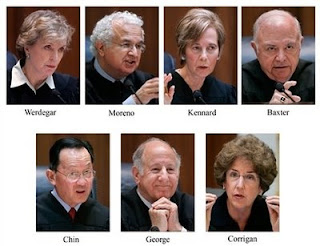
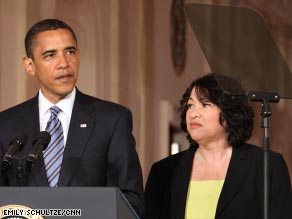
Supreme Court JusticesBy now the dreadful news from California is widely known: by a vote of 6-1, the California Supreme Court upheld the will of last fall's voters who enacted Proposition 8, an initiative which amended California's state constitution to declare that marriage could only legally exist between a man and a woman. The Prop 8 vote, which passed by a margin of 52% to 48% and which has sparked tremendous commentary and opposition, including public protests all over the country. The California Attorney General, former California governor and Oakland mayor Jerry Brown then challenged by the vote, leading to yesterday's eagerly awaited decision. The decision did include the following semi-positive note: the 18,000 same-sex couples who had gotten married before Prop 8 were legally recognized, thus negating the initiative's potentially retroactive power. Yet the overall result is newly denied rights for countless Californians and a court ruling that suggests that the California Constitution does not equally apply to all residents of that state.
To put it another way, for thousands of couples in California, there are no options for legal marriage at the present time beyond leaving the state. The California legislature has twice passed same-sex marriage bills, only to have them vetoed by Governor Arnold Schwarzenegger, who will be out of office in a year, so there is some possibility that with enough of a push, California voters could get the legislature to once again pass a same-sex marriage bill that would be signed into office by a new, progressive governor. At the same time, the threat of yet another referendum always looms, which suggests that the initiative process might perhaps be the better route: a popular referendum, organized by a much broader and more proactive coalition, with specific outreach to non-LGBTQ people of all to overturn Prop 8, written in such a way as to ensure its validity against a range of challenges.

Both of these options, as well as the current financial crisis and political gridlock in California, point to another pressing issue, which is the need for a new state constitution, which might include a limit on popular referenda and the power of such initiatives to make and change laws, including amending the state constitution. (I use to think that splitting the huge state into two smaller states, a Northern California, geographically larger in size but smaller in population, liberal state and a Southern California, geographically smaller in size, larger in population, and slightly more centrist, would be a good option and make both more governable, but both would constitutions that improved on California's current one if they came into being.)

While there have been peaceful protests since the panel's decision, I sincerely hope, however, those some of those in California supporting Prop 8 have come to realize the damage it has done and those opposing it recognize how crucial it is to have an effective, appealing and relentless, broad-based campaign that cuts across racial, ethnic, gender, orientation, and class lines. Here the politics of representation are important. It is not enough any more to follow the popular LGBTQ media's usual modus operandi of depicting only upper-middle-class white couples, especially in a minority-majority state, nor will it work to bury the issue of homosexuality and avoid using controversial terms like "gay" and "lesbian"; showing the true diversity and breadth of those who would benefit from having equal rights in the state and speaking with candor about how people's lives will be positively affected by repealing this odious constitutional amendment will go a long way towards ensuring a better situation for all there and, I predict, in all the other states that still have not enacted or do not permit same-sex marriage.

+++

Somewhat counterbalancing this awful news was the announcement yesterday morning of President Barack Obama's first nomination for the Supreme Court, 2nd U.S. Circuit Court of Appeals judge Sonia Sotomayor. (Photo at left, Lynn Schultze/CNN) If approved by the Democratic-controlled US Senate, which is very likely, Justice Sotomayor would be the first Latina, the first Puerto Rican, and only the third woman to join the nation's highest court. I admit to getting choked up as I listened to her life story yesterday on the radio. The daughter of Puerto Ricans who came to the US mainland in the 1950s, she was born and grew up in the South Bronx. Her father had a third-grade education and passed away when she was 9; her mother then sometimes worked multiple jobs to ensure that she and her two siblings received the best education and lives possible. Justice Sotomayor, who is 54 and has lived with diabetes for most of her life, graduated from Cardinal Spellman High School, Princeton University summa cum laude and Phi Beta Kappa (and second in her class!), and Yale Law School, where she served as an editor of the Yale Law Review. This is one obviously brilliant woman. She went on to serve an Assistant District Attorney in Manhattan under Robert Morgenthau, before serving in private practice as an international corporate litigator. Nominated in 1992 by the first President Bush (ugh!) to the District Court of the Southern District of New York, she was then nominated in 1998 by President Bill Clinton and confirmed to the 2nd District Court position she now holds. She's written hundreds of opinions, some of which are summarized by The New York Times here.

Before Obama even selected Sotomayor, the GOP had begun gunning for whomever he picked, and, with the help of "liberals" like Jeffrey Rosen and the media, began smearing her. Rosen in particular deserves to be called out, because he launched a campaign in the New Republic against her using anonymous sources, which both the right-wing and the mainstream media (cf. Gwen Ifill's question on last night's News Hour with Jim Lehrer about Sotomayor's "temperament") latched onto. Mike Tomasky and Glenn Greenwald have written about this mess perhaps as thoroughly and persuasively as anyone. So it redounds to Obama that he did not allow this waxing, toxic Beltway consensus to sway his selection, which is a smart tactical move any way you assess it. It's an history-making gesture, it affirms the importance of Obama's Latino and female supporters (why on earth in 2009 is there only one woman on the US Supreme Court?), it replaces an unexpectedly moderate liberal with an expectedly centrist-liberal, and it creates a difficult challenge for the GOP and the numerous Congressional conserva-Dems.

In fact, despite the GOP's and media's characterizations, Obama apparently has chosen a judge who is truly centrist-liberal in her adjudication (as opposed to a progressive-leftist, unfortunately), It's likely she will vote and write rulings along the lines of the person she's replacing, Associate Justice David H. Souter, though some of her views, on issues such as executive branch power, abortion and same-sex marriage, are unknown. As current commentary about her judicial record shows, she generally has written rulings generally in the liberal vein, but has occasionally sided with businesses or the government against plaintiffs, including plaintiffs of color. While a few of her statements, such as the 2005 comment about appellate courts being the place where "policy is made" (which she immediately retracted) or her ethnic background and gender providing her with a powerful lens to understand the effects of the law in the everyday world will certainly spark conservative concerns, her overall profile strikes me as quite uncontroversial. (Nevertheless, Republicans are already uttering their usual extremely offensive, racist claptrap.) I hope that she moves further to the left the longer she's on the court, though having left-leaning allies, as opposed to the strong right-wing quartet now in place, might help this along. If the President gets another opportunity to appoint a justice, and I hope he will (2-4 would be great), I would love for his next nominee to be a solid progressive or even a liberal visionary, someone whose ideas and writings could serve as an intellectual and foundational counterweight to the likes of Antonin Scalia and John Roberts, Jr. Anyone got any names to send forward?

+++

And then there's the bizarre. By which I mean the "furore," to use the British form of that the word, surrounding the Professor of Poetry position at Oxford University. If you're a not a literary person or somehow happened to have missed this, here's a recap. Three poets--Nobel Laureate Derek Walcott, 79, British poet Ruth Padel, 63, and Indian poet Arvind Krishna Mehrotra, 62--were finalists for the prestigious but low-paying 5-year position that requires its holder to do little but give 3 talks a year and be a poet at Oxford. Prior holders of the chair include W. H. Auden, Seamus Heaney, Paul Muldoon, Matthew Arnold, and Cecil Day-Lewis. Shortly before Oxford graduates and academic staff were scheduled to vote up a winner a few weeks ago, a number of them living in and around the university received anonymously mailed photocopies of a book excerpt from The Lecherous Professor: Sexual Harassment on Campus, by Billie Wright Dziech and Linda Weiner, detailing a 1982 claim of sexual harrassment against Walcott by a female Harvard College student. (This occurred the year before I started my freshman year, at which point Walcott had moved across the Charles River to Boston University, where in 1996 he was sued for harassment by a female graduate student; that case was settled out of court. I should note that I did meet him several times many years later when he read at the Dark Room Writer's Collective, and several other times after that.)

Once this anonymous campaign came to light, Walcott withdrew his candidacy, stating that
I am disappointed that such low tactics have been used in this election, and I do not want to get into a race for a post where it causes embarrassment to those who have chosen to support me for the role, or to myself....
and went to say that
I already have a great many work commitments, and while I was happy to be put forward for the post, if it has degenerated into a low and degrading attempt at character assassination, I do not want to be part of it.
Hermione Lee, head of Oxford's Wolfson College and a Walcott supporter, urged Padel to dissociate herself from the sleazy campaign, as did others, and Padel did so, stating that she was not involved in the shenanigans and praising Walcott's work.

And then Padel, facing only Mehrotra, was duly elected, becoming the first woman to hold the post since it was created in 1708, and replacing critic Christopher Ricks. And then...the news emerged the other day that in fact, Padel had contacted two reporters via email last month to highlight Walcott's past transgressions. When confronted with the news, Padel had the gall to blame an anonymous student for pushing her to do it, before finally resigning from the post on Monday. The chair is thus empty. Supposedly Oxford will enter a period of reflection, before finding someone else to hold this now radioactive position.

I think it was perfectly fine for Padel and anyone else to publicly express concerns about Walcott's behavior. He is, without a doubt, one of the finest living poets and, as everyone knows, a Nobel Laureate, but his past record concerning the harassment charges do provoke legitimate questions and concerns. I imagine that Padel didn't just openly voice her concerns for fear that in doing so, she would appear spiteful, petty and competitive; yet such commentary did arise among some critics at the time that Walcott received the Nobel Prize in Literature, which in any case has gone to several writers with serious personal foibles (T. S. Eliot, Elias Canetti, etc.). Yet the subterfuge of Padel's actions is digusting, on top of being unethical and, worst of all, amateurish. There was no way that she was going to get away with this, so her actions also reflect badly and baldly on her judgment. Are there really people out there today who do not grasp that if you send someone an email, particularly someone in the media, it's easily traceable? To top things off, what ever led her to think she could trust the British media, who are known for their volubility and scandal-mongering? (On the Times of London online site, the uproar was described as a "sex row.")

I have to ask, is such a position really worth this level of skullduggery? I understand the prestige and any poet's desire for the acclaim it might bring (though if I had my druthers I would much more like to be appointed to the Collège de France), and the fact that the competitive element was already part of the process, but really, it is worth destroying one's reputation to get it? But I know that answer to that; I seriously doubt Padel is the first to have engaged in such behavior, which have surely occurred in the past and in other fields, and she won't be the last.

+++

Alice MunroOn a better literary note, congratulations certainly must go to a writer whom it required maturity for me to appreciate, Alice Munro. During my late high school and undergraduate years I would see her name and stories, and for whatever reason, did not read them, and when I found little to interest me; the plots, the characters, the structures, the language of the stories themselves simply did not stick. Around the time I was deciding about going to graduate school, I started to read her work again, and it was if I'd pulled back a heavy curtain. Now her deft portrayal of characters, her ability to push plots to places I didn't anticipate, her careful and often unexpected play with time, and her seemingly simple but apt and often subtle use of language all drew me in. I haven't ever looked back, and have joined the legions of Alice Munro fans out there. She is without question one of the major living short story writers in English, and one of the finest short fiction artists ever. Yesterday she was awarded the Man Booker International Prize for Lifetime Achievement in Fiction, earning about $95,000 and further international acclaim, and joining an august list that includes Nigerian novelist Chinua Achebe and Albanian fiction writer Ismail Kadare. She certainly deserves it.