Monday, November 12, 2007

Veteran's Day + Mailer/Cooper/Washington + Troy Smith: Beautiful and "Kind"

African American Veterans, World War IIToday is Veterans Day, which I nearly forgot because, I'm embarrassed to say, we don't get it (or any other holidays, save the major ones) off at the university. I'm the son and grandson of (deceased) veterans, the godson (twice over) of veterans, the nephew and cousin of many. Some of them fought in wars (World War II, Vietnam, etc.), but most served during the illusory societal calm we like to call "peacetime."

I always think of some of them--my uncle J., for example, who was deeply affected by Vietnam--when I consider the plight of our most recent new veterans, returning from Iraq and Afghanistan. 1/4th of today's homeless are said to be veterans, though they constitute about only 10% of the population. Iraq returnees are suffering from higher rates of suicide, PTSD, and other psychological problems, than the public at large. Until the public scandal broke earlier this year, hundreds veterans at Walter Reed Hospital were living in conditions that would not be fit even for rats, and veterans, like so many other Americans, are experiencing a range of crises, including home foreclosures, bankruptcy, and so on, yet there appears to be little to no response from the people in power in Washington. Today anti-war veterans were arrested at an American Legion event in Boston.

One of the smallest and most important things you can do is try to be aware of the issues longtime and new veterans are facing, and advocate on their behalf to your elected representatives whenever you can. It's easy to salute the troops, champion their sacrifice and valor, and ignore them when they most need our support, so try not to forget them today, or in the future.

+++

Yesterday brought news of Norman Mailer's (1923-2007) passing. For most of my youth and early adulthood he was considered one of the preeminent American writers, or rather one of the MAJOR WRITERS with a capital "M" (also for MALE). His fame came quickly with his first and best novel, the Pulitzer Prize-winning The Naked and the Dead (1948), but also attended his pioneering works in the then-nascent field of creative nonfiction, such The Armies of the Night (1968) and the infamous and extraordinary The Executioner's Song (1979); he was also of the major literary and cultural celebrities, a liberal, sometimes progressive journalist, critic and commentator on all things American and, misguidedly, many things Black (getting into a verbal sparring match with James Baldwin, among others), one of the co-founders of the Village Voice, a political candidate, a dogged anti-feminist (who stabbed one of his wives in the 1960s), a homophobe and racist who loved to quarrel with Truman Capote, Germaine Greer, Gore Vidal and countless others, and lace his fiction with as much polymorphous perversity as he could, and a larger-than-life personality whose cavorting in the public eye often threatened to eclipse his work. (As far as the fiction goes, it did.)

It's probably fair to say that Mailer's public stature diminished considerably over the last decade, as fewer people of recent generations knew of his exploits first hand and his recent books were generally not worth the time it took to read and comment on them--the last book of his I waded through, Ancient Evenings, an endless, sex-besotted romp through the Pharaonic epoch(s), came out in 1983, and I didn't buy it, my mother, a longtime reader of his, did--but Mailer did still throw some punches, as when he began writing critical pieces about the W Gang a few years ago in the New York Review of Books. The pugnacious and blistering intellect that garnered his fame was on display in these pieces, though the reality was and is that the people who probably might have listened 25, 35, or 45 years ago to the best parts of his arguments were no longer interested or already agreed with him. His passing marks end of era.

Patricia Spears Jones told me that poet Jane Cooper (1924-2007, at left, from W.W. Norton & Co.) had passed away, so I wanted to mention her as well. Along with Grace Paley, Muriel Rukeyser, and several other notable writers she established the acclaimed creative writing program at Sarah Lawrence College, where she taught for over 40 years. I usually tend to think of her as a lyric poet of life's quieter moments, but she could be bitingly sarcastic, as in her famous poem "Seventeen Questions about KING KONG," in which she critiques her familial relationship to the 1933 film's director, Merian C. Cooper.

Here's another of her poems, from the Academy of American Poets website, the lacerating "Clementene," about that most central of American themes, race (click on the link you can hear her read it as well):

CLEMENTENE

I

I always thought she was white, I thought she was an Indian
because of her high-bridged nose, coin-perfect profile
where she sat in an upstairs window, turning sheets sides-to-the-middle—
There are so many things wrong with this story,
Muriel, I could not tell you—

Her cheeks were oddly freckled, and her hair would be squeezed down
into a compact, small knot at the nape, gray as chicken wire, gray
as the light, unaffectionate glance her eyes would give
if she lifted them from her work.
No child would interrupt her.

She came twice a year to do the sewing, she slept in the house,
but her meals were brought up, so that she dined by the Singer,
now and then staring fixedly across the river. She joined neither white
in the dining room nor colored in the kitchen.
Her wishes were respected.

Later I saw the same light, disconcerting gaze and futuristic planes
in Oppenheimer's face, but she looked most like my grandmother's friend
Miss Gertrude
who taught me to tat. Once we moved north, Mother confided
of the two finest families in Jacksonville, no one could be sure
whose father was her father.

2

Muriel, I never told you, I never revealed how Clementene
died in our house a white woman and was claimed by her black
daughter.

How she flung up her arms in wild grief
so different from Clementene's reserve.

How she hollered and called on Christ Jesus,
flinging her body from side to side at the foot of the staircase.

How the police arrived, it was nine o'clock at night,
long past my bedtime.

How I leaned over the stair rail,
unnoticed for once, as their torches burst in.

It seemed as if tumultuous shadows
crawled through the door, odors of pinestraw, magnolia, river
bottom—

They are carrying a blanketed stretcher.
Now the daughter follows, still whimpering into my mother's small-
boned shoulder.

I had seen how a mother could be mourned.
Now I watch my mother shiver and pull away.

Why, if I was not an accomplice,
did I feel—do I feel still—this complex shame?


Copyright © 1994 by Jane Cooper, from
The Flashboat: Poems Collected and Reclaimed by Jane Cooper.
Used by permission of W. W. Norton & Company, Inc.

Yesterday was also the 20th anniversary of Harold Washington's death. He was the 42nd and 1st African-American Mayor of Chicago, elected twice, in 1983 and 1987. Harold Washington was and remains a hero to many people all over the country and globe, for his pioneering victories, for what he represented, and for how he governed while in office. I can remember the near-frenzy among family members and friends an entire state away, in Missouri, when he was first elected; I was a senior in high school and his primary win, against a field of other Democrats, and win in the general election, seemed like the opening of a new era. If only it was...

Here is his first inaugural address. And here's my favorite section, the end, where he cites the founder of Chicago, and says to the city of Big Shoulders, "Let's go to work." And he did.

I reach out my hand and I ask for your help. With the same adventurous spirit of Jean Pointe Baptiste DuSable when he founded Chicago, we are going to do some great deeds here together.

In the beginning there was the word. Throughout this campaign you've given me the word. The word is over. Let's go to work.

+++

Troy SmithReggie highlights a recent appearance by the gorgeous former Heisman Trophy Winner Troy Smith (at right) at a juvenile detention center in his hometown of Cleveland. I'd forwarded the article to a mostly poc-g/sgl sports listserve I'm on, because I felt Smith's actions and remarks were, to put it mildly, extraordinary. What I wrote to the list was this (excerpted):

"I was more interested in how Smith was described and in particularly how he addressed the young brothas in the correctional facility. I may be alone in this, but I rarely read reports of anyone, particularly a young, beautiful, somewhat famous talented Black man still in the public eye, telling other young brothas whom society has decided to give up on that they are "needed" and "beautiful." That a city wants them to come back and participate in shaping its public life? Do you? And that he's brought to the point of tears expressing it?"


Am I wrong? Does this happen often? Does anyone regularly tell young Black men, or young Black women, or young Black people--or young people of any color, especially young people who are poor and working-class, who are already in the cogs of the prison-industrial complex, whose lives may already have passed through versions of Hell and worse, that they are "needed," that they are "beautiful" (and I don't mean in a sexualized-eroticized sense), that they are "wanted," that they are "missed," that without their active participation and engagement society cannot go forward? What would happen if we did this more often? I think of the response Smith got, and of my own experiences, brief though they were, working with young Black and Latino and Asian kids in the New York City schools, and witnessing first hand how they craved someone to show interest in them, to love them, to listen to them, to guide them, to encourage them, to push them, to assure them and challenge them, to let them know that their presence wasn't superfluous, as everything around them was conveying regularly, that they were not subalterns without any possibility of relevance unless they rapped or played basketball or were taking their clothes off. So Troy Smith's actions really moved me, and I was glad Reggie highlighted them. I also wonder, why don't we--since we know our traditional and "mainstream," which is to say, corporate media aren't going to do it, because in their eyes we still do not really exist--make it a regular practice, and make sure that there's some substance to it?

Sunday, November 11, 2007

Duriel Harris (Douglas Ewart & Inventions) @ Velvet Lounge

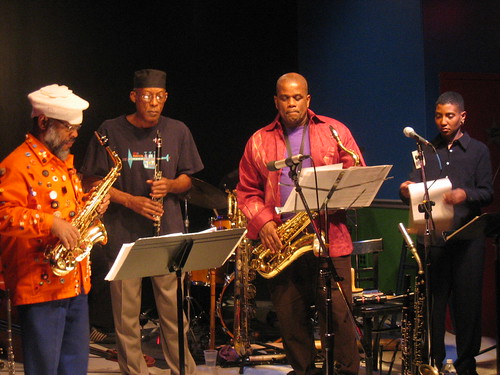
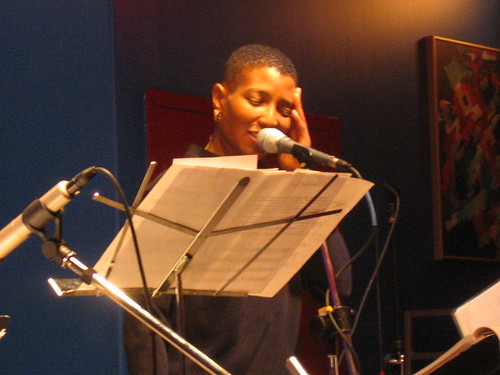
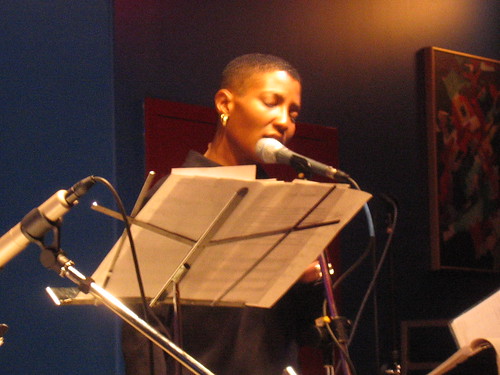
Last night, I headed down to Fred Anderson's "Chicago sound" Velvet Lounge on Cermak (21st Street), to see Aarawak Productions and AACM's (Association for the Advancement of Creative Musicians) concert, featuring Douglas R. Ewart & Inventions, a group that includes my good friend, poet, performer and Black Took Collective co-founder Duriel Harris. I've seen Duriel read and perform her work many times (we've read together a few times over the years), but amazingly to me, never with Ewart and Inventions. The lineup included Ewart (winds, voice and percussions), Duriel, Dee Alexander (vocals and percussions), Edward Wilkerson (reeds and percussions), Mwata Bowden (reeds and percussions), Darius Savage (bass and percussions), Dushun Mosley (drums), and, as a special treat, Anderson himself on tenor sax, and was titled "To Tell the Truth."

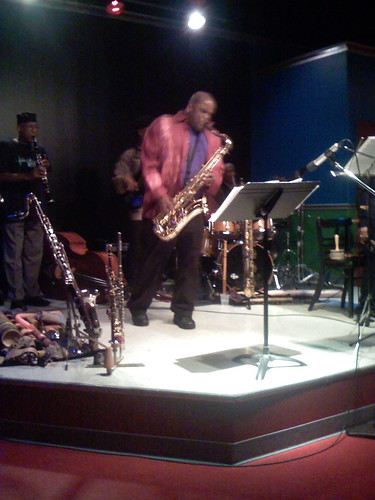
The first piece, a Lester Lashley tune titled "For All We Know," put me in mind of the music of one of my favorites, AACM member and Art Ensemble of Chicago longtimer, composer Roscoe Mitchell, with its opening passage of parallel, dissonant harmonic blocks, on the winds, that slowly shatter into rich improvisatory lines, only to reconvene, piece by piece, at the song's end. Everyone (save Alexander, who wasn't onstage) had a solo, and the wind players astonished me, Wilkerson taking off at a speed that would have impressed Charlie Parker and with an improvisational canniness that brought to mind the sharpest saxophonists in the Afro-avant tradition. The second piece consisted of the trio Bowden, Savage and Mosley entering into musical dialogue with Duriel's poetry, and it was one of those performances in which the embodied voices, the lyric subject's and Duriel's, struggled, warred, sang, wailed, sublimely, against the poetic text's voicings. (To see this on the page, check out Duriel's first collection of poems/texts, Drag.) Bowden's clarinet solo on this one drew an ironic line, with its mellowness a striking counterpart to Duriel's journey through her words and, at the end, to near-wordlessness. The group then remixed its numbers and members, and did so throughout the rest of the concert, to fine effect. Below are some photos, and a short clip of the Duriel's performance. Enjoy!

Douglas Ewart & Inventions
Ewart, Bolden, Wilkerson, and Duriel, as the set was beginning
Duriel Harris performing
Duriel performing
Duriel Harris performing
Duriel performing
Douglas Ewart & Inventions in Concert w/ Duriel Harris, at the Velvet Lounge
Wilkerson in motion during one of his solos

A snippet of Duriel's poem

>>>

Partway through the set, I headed back north, to catch a student production of Naomi Wallace's The Trestle at Pope Lick Creek, which was directed by one of my advanced fiction sequence students, Rebecca Stevens. I'd heard of Wallace's work though I'd never seen any productions of her plays, and this was a great introduction. Set during the Great Depression, the play explores the effects that joblessness, fear of the present and future, and multiply-layered alienation and repression have on several characters, primary among them Dalton Chance (played by Mark Underhill) and Pace Cregan (played here by Anna Perczak), who take to footraces over a trestle as a way of grounding themselves and beating--at least for a while--hopelessness and fate. I was so impressed by what Rebecca, her producer, and the cast and crew pulled off. The acting for the most part was never too stagy or overdemonstrative, the set was spare in the best way, with just enough detail to draw the mood of that era, and her musical interludes, comprisings 30s blues, jazz, folk, and popular songs, none of them obvious, evoked the soundtrack of a too-easily forgotten era. Most importantly, I think, she was able to guide her actors in capturing most of the poetry of Wallace's text; despite the subject matter, the play is anything but naturalistic. Its nonlinear movement and poetic texture, along with the play's overall tragic undertow, require expert management, and Rebecca gets my props for an adroit hand behind it all. And now, a couple of photos:
IMG_0116
Alex Weisman (as Chas. Weaver) and Underhill
IMG_7053
Perczak, Underhill and Catherine Lefrere (as Gin Chance)

Saturday, November 10, 2007

Reading with Students & Reg Gibbons @ High Risk Gallery

Poet Reg GibbonsAnd we keep on sprinting...last night, after a full day of classes and required attendance at day-ending scholarly talk, I read with three students (Steve Jordan, Christine Pacyk, and Nicole Xylouris Osborne, who's currently in my class) and one of my senior colleagues, whom I've mentioned many times here, Reg Gibbons (at left) in one of the university's graduate Masters in Creative Writing program periodic author/student readings. The event took place at High Risk Gallery (Thanksgiving is still at least a week away, but the gallery already had Christmas trees up!) on W. Belmont in the Boystown neighborhood, and just a few blocks from where I lived the first year I stayed in Chicago.

It was exhilarating to see so many of the students I've worked with and their families and friends present, and to see some other Chitown folks in the house as well. And it was a tremendous honor to read (photo of me at left, by author and artist Cornelia Spelman, Reg's wife) with the three students and with Reg, whom I've never read with despite my being at the university for five years. The students repped the three genres we teach (creative nonfiction, poetry, and fiction), and Reg read a few of his stellar translations from Ancient Greek and from his forthcoming collection, while I read (at length!) two linked, still pretty rough early sections--which included dialogue, a forward-moving timeline, and yes, action--I'd never read publicly from my novel in progress, Palimpsests.
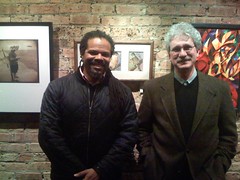
With Reg Gibbons after our readingReading new work always terrifies me, but this time my nerves were settled by the time I took the mic. Afterwards I joined writer friend Rone Shavers, who's also taught in the program (and caught the Dessalines reference, which I did not throw in to keep him on his toes, though I was glad he got it), and some former (Michael, Kayte, Adrienne, Andrea!) and current students on a little bar crawl, then skedaddled back north shortly after the (be)witching hour. The word for the evening, despite my exhaustion, was FUN. In fact, I didn't realize till I got home how drained I really was.

Friday, November 09, 2007

Patricia Hill Collins on "Emancipatory Knowledge: An Oxymoron?: The Case for Contemporary Black Studies"

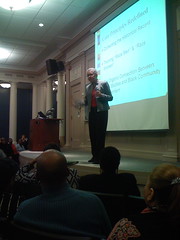
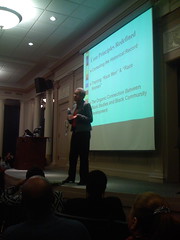
Patricia Hill CollinsWhat a week! First, Junot Díaz was here, then last night, the university's very highly regarded African American Studies Department invited the distinguished scholar Patricia Hill Collins (at left) to deliver this year's Allison Davis Memorial Lecture. (Allison Davis (1902-1983), a pioneering anthropologist and scholar of education, prolific author, and member of the President's Commission on Civil Rights, who was one of the first African Americans to receive tenure at a majority-white institution; he and his colleague Abram Lincoln did so at the University of Chicago, where he had received his Ph.D., in 1948. He taught at Chicago until his death, at which time he was the John Dewey Distinguished Service Professor, and a MacArthur Foundation "genius" Fellow. Every Black person teaching at a majority-white institution should know his name and his story.)

Collins, now the Distinguished University Professor of Sociology at the University of Maryland, the first (2007-8) African-American woman to lead the American Sociological Association, and the author of such groundbreaking books as Black Feminist Thought: Knowledge, Consciousness, and the Politics of Empowerment (1990) and Black Sexual Politics: African Americans, Gender, and the New Racism (2005), needed little introduction to the packed audience, but she did receive excellent ones from our acting dean, sociologist Aldon Morris, and the Af-Am Studies chair Richard Itonchair of African American Studies, political scientist Richard Iton (below, at right). Her topic was "Emancipatory Knowledge: An Oxymoron?: The Case for Contemporary Black Studies." What, she began by asking, does it mean to be doing Black Studies now? What are Black Studies programs, scholars and students focusing on, and how does this relate to their original, historical aims? Is the knowledge diffused among Black communities in the US and elsewhere? Are the three original aims, or core principles, of an organic link between Black Studies departments and Black communities, the development of a special relationship between Black Studies departments and Black students, and the correction of the historical record, exemplified in the practices and praxes of contemporary Black Studies departments? And what about the gulf between what she called "paper programs," underfunded, understaffed Black Studies programs, such as the one she had taught at before her move to Maryland, and those at élite institutions, like the university, which offered doctoral programs, graduate funding, and star scholars for students to work with? How could and can the majority of Black students, let alone Black people, be served under such conditions, or is this, well, an oxymoron?

I won't recapitulate her provocative, often funny, and always lively argument, which she condensed for time constraints and then Powerpointed for purposes of clarity, but I was on the edge of my seat (seriously, does anyone else ever feel this kind of excitement at scholarly talks?) the whole time as she discussed it. In fact, I took about 4-5 moleskine pages of notes, and am still reviewing them, and probably would have stayed behind to ask her questions, but I had to finish reading short stories for my Friday classes. But I saw her as throwing down a gantlet, of the sort that folks in our incredible African American Studies program have been regularly debating, and issuing a challenge to faculty members, students, and people in the community (of whatever race), to think about Black Studies in particular, and its original emphasis on Black liberation and knowledge production, but more broadly about knowledge creation and production in the academy, and its relationship to the wider community.

Patricia Hill CollinsBeing both part of and somewhat outside of academe, I've often felt like so much of the exciting work that's done inside colleges and universities either does not get translated into a form that's accessible and practical to those outside it or does so only after a long hiatus, while too many people with both feet inside academe assume that everyone is part of their conversations--or isn't, but wouldn't want to be. I feel this is less the case with artists and other creative folks, who by and through their practices and production are involved in conversation, negotiation and translation, but I do sometimes feel this strongly when it comes to the many brilliant scholarly conversations that occur and develop within college and university walls. Now, I am not saying that all knowledge, in its articulation and production, has to be immediately or initially practical, but again, there are so many exciting discoveries, developments and discussions--at least they excite me--that occur within academe, and I'm thinking in particular about the humanities and social sciences, that would benefit our public discourse in general, and specific conversations that take place in the media, in the political arena, in private dialogues.

I often think about the rich and nuanced arguments around sexuality, gender and performance, to take one example, and how alongside these you can have a discussion with people, go online or open a book or magazine and find the most retrograde, reductive discourse on these issues, as if the very premises of contestation and complexity were non-existant. I'm not blaming the scholars, who as I know from my experience with the Center for Lesbian, Gay, Bisexual and Transgender Studies at CUNY even went out into the communities they hoped to engage with to hold workshops, classes, discussions, and so forth, but I still feel that all of us could be doing more, and Hill Collins's talk underlined this for me.

One of the things I really liked about Hill Collins's talk, as I do with her books, is how she negotiates scholarly discourse, some of it quite demanding and difficult, in such a way as to also speak to a wider array of readers. She noted at the end of her talk that people are "thirsty for new ideas," and that thinking about what might constitute "emancipatory knowledge," in the broader sense, could very well be one of the things folks out there would love to hear about.

Thursday, November 08, 2007

Junot Díaz in the House + Kennedy Play on Broadway + Ayler on Film

After one of my always too-brief trips home, I headed back west to teach and host this year's Visiting Fiction Writer-in-Residence, Junot Díaz, who flew in for a whirlwind visit from Rome, where he's spending the year on a Rome Prize, awarded by the American Academy of Arts and Letters. As part of his visit, he met with our senior-year writers over two days, spoke to my fiction major advanced sequence class, where he discussed the issue of how to shift from short fiction, which the students are working on now (3 longish stories by the end of the first half of the course) to longer forms (like the novella they'll have to complete by June); delivered a talk about craft, which the students who attended were still talking about a day later; and read a brief section from his new novel, The Brief Wondrous Life of Oscar Wao (one of my October and November book selections), as well as a very brief story, "Alma," before opening the floor to questions. I was incredibly pleased that Díaz was able to join us, and especially appreciated his graciousness, openness, and thoughtfulness when he was with the students, some of whom told me immediately after that class that they found his comments "excellent." (Personally, I also love his REALNESS.) They were taking notes assiduously, and even, like several other colleagues who primarily teach different genres (poetry, creative nonfiction), scribbled down some of what he had to say at the talk. In essence, he broke it down in terms of the issue of character and how important it was (is) to fiction writing, and how characters in relation to each other and the other elements of fiction, which is to say, character as transactional, was what writers ought to keep in mind. He stressed that his comments weren't meant to be prescriptive or proscriptive, but he also then noted that as fiction editor of the Boston Review, he saw a great deal of stories that were really stories of "condition," static, lacking conflict and what emerges from it, without any real movement in terms of narrative arc or dramatic arc, let alone plot(tedness); his emphasis on character(s), the source of conflict, was an effort to counter this. At the reading, both the excerpt from the novel and "Alma" illustrated his points, while also demonstrating how you could artfully negotiate the dangerous ground of second-person narration (you), an issue my graduate class and I have been exploring to some extent (Jhumpa Lahiri's May 6, 2006 New Yorker story "All in a Lifetime," is exemplary in this regard). It was also pleasing to see that both the talk and the reading were packed, and that students as well as people not directly affiliated with the university (hey LaToya!) not only showed up, but actively posed questions and engaged Díaz in conversation. Below are a few photos I snapped with my camera phone, which is 1,000x better than the previous one.

Díaz chatting with one of my introductory fiction students, Andrés, after his talk

The crowd slowly filling up before the reading

Díaz reading his short story, "Alma"

Díaz answering questions after his reading

###

On a different note, for those in New York City and environs, please consider catching the current, brief run of one of my favorite plays, The Ohio State Murders, by one of my favorite authors and cultural hero(in)es, Adrienne Kennedy. Charles Isherwood's mostly laudatory New York Times review today provides some useful background on 76-year-old Kennedy, a treasure of American and African-American literature, and on the work itself, which is relatively formally conventional by Kennedy's standards, but quite challenging in its themes and content, as it delves into her usual trove of racially and sexually inflected uncanniness, with parallel selves, twins, intertextual critique, insanity, and a mysterious murder all mixed together for a haunting measure.

Isherwood criticizes the production, which he suggests could have used a larger, deeper set to enhance the play's eerieness, its underlying terror, but I guess I'd have to see it to judge this. (Point of fact, I've never seen the play, but have read it many times and taught it as well.) This run stars The Practice's LisaGay Hamilton (at right, standing, with Cherise Boothe, from New York Times, Gerry Goodstein) whose performance Isherwood calls "spellbinding." That's quite a compliment, so catch it and be bound by her--and Kennedy's spell--if you can.

###

Albert AylerThere are people for whom the words and phrases "Bells," "Witches and Devils," "Ghosts," "Spiritual Unity," and "New York Eye and Ear Control" conjure a name instantly: Albert Ayler. The saxophone visionary, adept of Cecil Taylor and protegé of John Coltrane, who blazed on the public scene in the early 1960 and made around a dozen landmark records, only to be found floating in the East River in 1970, is one musician whose work, once heard, usually isn't forgotten or mistaken for anyone else's. And not only not forgotten; as a friend once said to me after listening to Spirits Rejoice, she had nightmares and was afraid to be alone in her apartment for a while afterwards. My experience was different, but I recognize that Ayler's music, particularly the late-career inner ear-shearing honks, bleats, shrieks, cries, hollers, and wails, couched within more than a little soulful swinging, to my mind the sonic embodiments of an almost indescribable freedom, and its antecedent and parallel, suffering, that were so palpable for millions of Americans, especially Black Americans, during the period of his career, are not for everyone. Or really for anyone but those who're able and willing to listen. If you've never listened to Ayler's music--and I went through my 20s phase of trying to ferret out every obscure Black musician I could get my hands on, which is how I came across him, and am glad I did, since he was not part of the expansive r&b, soul, rock&roll, and jazz soundscape in which I grew up--there's a new film out, playing for a week at Film Forum in, where else, New York City: Kasper Collin's My Name is Albert Ayler. The New York Sun's reviewer likes it quite a bit. According to another review I saw, it's antithetical to the Burns model; consisting of audio snippets of performances and interviews with Ayler and those close to him, still imagery, and video clips of family members and associates, it sounds like it jars the viewer out of spectatorial passivity. Which seems appropriate in Ayler's case. Ayler's no easy study. But you just might dig him a lot. A whole lot. In small doses.

Sunday, November 04, 2007

In the Garden

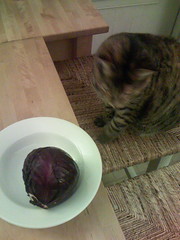
A quick entry (Twitter-ready?), on gardening. Today I was back home and had an opportunity to check out the plants, almost all of which are still thriving, despite our being four days deep into November. The mild temperatures and lack of frost, and intermittent rain have done wonders for all of the herbs, the perennials (which, though flowerless, are all growing), and the vegetable plants. There are enough Brussel sprouts buds to feed a squadron, so we may end up having those for Thanksgiving, but the tomatoes are still growing and maturing, and this afternoon I harvested the lone (semi-)mature head of red cabbage, which will be returning to Chicago with me. I know it must sound pretty bizarre to say, "I always wanted to grow red cabbage," but...I did! It's hard to explain the elation over the plants not dying (as happened in the past) and instead flourishing, and we have had some luck in previous years with collard greens and a cauliflower, but other than strawberries, herbs, roses and the azaleas--and a few unusual flowers like astilbe that I picked up years ago at the Grant Park Conservancy--most of the vegetables did not grow. So the cabbage, I feel, is a real accomplishment. Soon, it'll become either cooked red cabbage or mixed slaw; I haven't decided. Below are some photos of it.

The red cabbage (from the garden)
It's smaller than a supermarket cabbage
From the garden, a red cabbage
From certain angles you could mistake it for a large beet or red onion
Toni looking at the red cabbage
Someone isn't sure exactly what it is

Friday, November 02, 2007

Black Out Day

Today was Black Out Day. Did you know this? I did, because of poet Christina Springer (thanks, Christina!--and check out her blog, from London--lots of poetry, thinking, great stuff.) (I bought coffee on campus, but that's about it. Nothing at the airport tonight, and especially not bottled water, which is, you know, environmentally unfriendly.)

Thursday, November 01, 2007

Will Alexander Benefit in NYC Tonight!

Poetthinker Tonya Foster sent me the following email today, so for those in NYC, please drop by this benefit, and for those of us not there, please consider sending something to help Will Alexander (right, photo from Green Integer) one of the most singular contemporary poets, help pay his medical bills if you can.

Dear Friends in Poetry, in Life:

Poet and artist Will Alexander has become seriously ill. He has no health insurance. In order to help him defray the cost of treatment, poets will gather and read Will’s work as well as poems for Will. If you can't attend the reading below, please make a donation to Will Alexander --he really needs the help of myriad communities right now. (His mailing address is W. Alexander/ 400 South Lafayette Park Place, #307/ Los Angeles, CA 90057.) Will is one of our GREAT/most singular poets and thinkers. I understand that this is a time when many feel "heavy burdened" but ... Please help if you can. Feel free (and in fact feel encouraged) to forward this or post on your blogs, lists, groups of friends who will help.
love and much,
Tonya Foster
BENEFIT READING FOR WILL ALEXANDER
THURSDAY, NOVEMBER 1ST, 6-8PM
BOWERY POETRY CLUB
308 Bowery / F to 2nd Ave, or 6 to Bleecker
$10 suggested donation, more if you can

JEROME ROTHENBERG
TONYA FOSTER
JOEL KUSZAI
BILL MARSH
MARCELLA DURAND
TOD THILLEMAN
JOHN HIGH
RODRIGO TOSCANO
ELIOT WEINBERGER

(and more tba)

Art: Whitfield Lovell

Several weeks ago I noted that artist Whitfield Lovell had received a 2007 John D. and Catherine T. MacArthur "Genius" Fellowship. But I didn't post any images of his art, so here, on the first day of November, are just a few images I culled from Artnet.com. Check out their online catalogue of his work for more. (My post on Lovell's partner Fred Wilson's presentation last spring at the university and so much else is here.) Enjoy!


You're My Thrill (Sculptures, Charcoal on wood, bombshell casings, 2004), DC Moore Gallery

Temptation (Mixed media, Charcoal on wood, found objects, 2000), DC Moore Gallery

Rice Barton: Three (Sculptures, Charcoal on painted wood panel, cabinet, enamel cups, audio speaker, rags, 2006), DC Moore Gallery

Wednesday, October 31, 2007

Happy Halloween (Random Stuff)

Not much to report, just wooooooorrrrrrkkkkkkkk! But the quarter is halfway to its end, or at least I think it is. It feels like classes have been going for four months, not one and a few weeks. Things are sort of a blur. Nevertheless, yesterday I dropped by the Dittmar Gallery at the university's Norris Center to hear Fall visiting writer in residence Ed Roberson read his work. There was supposed to be an accompanist, but s/he wasn't able to make it, so Ed created his own music, starting out with new poems before reading a series of pieces of his collection City Eclogue, which I'd read before but which felt like revelations as he read them. (He'd read before at the university, several years ago, with Cecil Giscombe, but those were earlier poems.)

Among the stalagmites of books here in Chicago I cannot locate my copy (and none were for sale), but when I do, I'll post one of the poems that most struck me this reading, about a guy in a chemistry class Ed taught years ago. He had on mismatched shoes, which signified the loss of a friend to gun violence--and what Ed does with that premise is remarkable. The thing I realized hearing him read these poems was how much life they took on through his voice; not that he performed them, per se, but his inflections and emphases made me want to return to the collection and read it more slowly, something I rarely have had time to do over the last half-decade. A colleague suggested a few years ago that everyone ought to read slowly, and I thought to myself, but how on earth then is one to keep up with the flood--literal, not figurative--of required reading, let alone everything necessary to be even passably current with contemporary literature, art, scholarship, and everything else? But back to Ed's reading, here are a few photos I took with my new phone. (I had to junk the old one, since it got to the point where my conversations with everyone were sounding--to them--like I was 20 leagues under the sea.) Aren't they much better? Maybe several years of carrying the other phone around in my pocket, with keys, coins and everything else, just scratched up its lens too badly, though I don't think it ever had a particularly great camera.

Ed reading his poems

Ed answering questions--he announced at the reading that he'd been elected to the Gwendolyn Brooks Writers Conference Hall of Fame.

***

At lunch yesterday one colleague asked another about my blog, and it was described as a spot where I posted translations of work that hasn't been translated elsewhere. In part that's true, though I haven't posted any translations in a while. But I recently mentioned to Reggie that some of my translations of stories from Brazilian writer Jean Wyllys's collection Aflitos are going to be published next year (spring?), and as I told him a while back, based in part on some of the translations of Alain Mabanckou's poems that appeared on here a while ago, I was invited to provide translations that were used, I believe, at the PEN International Writing Festival earlier this year. This got me thinking about how this great it is to have this resource to post the translations, even in their rawest form, and perhaps, when I have some free time, I can post some more. I may be wrong, but I don't think lots of people are translating a lot of the great non-English language work out there from across the Black diasporic literary world, whether creative or critical, so I feel that in addition to be an enduring interest of mine, it's also an important, necessary and vital form of intellectual engagement.

***

On Flux, a microblurb about Seismosis!

Monday, October 29, 2007

R. B. Kitaj RIP + Film Review: Lust, Caution

I was sorry to hear of the recent passing of R(onald) B(rooks) Kitaj (1932-2007), one of the important contemporary British figurative artists (though born in the US) of the late 20th century. I associate Kitaj and his work, especially the paintings, drawings and prints, with several generations of visual artists who were closely aligned and allied with writers; in Kitaj's case, he had close links to a number of poets who came to note from the late 1950s through the 1970s (cf. the images below), and was a published poet himself. Critic Jed Perl offers a moving tribute, entitled "Impassioned," in the current New Republic; here's a quote:

Kitaj was a connector, an engager, both in the complexity of the themes that he embraced in his painting and in the richness of the social world that he inhabited. He had the old-time bohemian feeling for the life of art as an adventure to be savored, to be approached with a certain deliberateness, and maybe even with a certain sense of ceremony. Whether you were going with him to an exhibition in London or, more recently, after he moved back to the United States, having a glass of juice with him at the little table in his kitchen in Los Angeles, there was a sense that something important might happen--that feelings and ideas were in the air. His houses were themselves works of art, especially the house in LA, where rare prints hung next to art postcards and newspaper clippings and there was one room devoted to the great Jewish writers and another dedicated to Cézanne, whose lithographs were among Kitaj's treasured possessions. As he was talking he might rummage in a jam-packed bookcase and pull out some rare set of film magazines, bought years ago in London for a ridiculously small sum. He was a polymath, with a reverence for information and ideas that was all the more acute because he had learned so much of it on his own. He certainly brought the ardor of the audodidact-intellectual to his letter writing.


"A Day Book by Roger Creeley" ( Portfolio including 13 signed & numbered graphics: 8 screenprints, 4 etchings, 1 lithograph, 24 in. x 16.3 in, 1972), Viviane Bregman Fine Art.

***

On Saturday I went to see Ang Lee's new film Lust, Caution [Se, Jie] (2007), which has been generating a great deal of controversial over several sexually explicit scenes (and yes, they are explicit by movie standards, though in the increasingly pornotopic society we live in, most of them, save one, barely merit an eyeblink), including earning a NC-17 rating, but also mixed-to-poor reviews, like this one, or this one. After reading a few of the reviews, I have to wonder if I saw the same film. Rather than a musty historical drama or a "monotone...spy drama," Lee's film is a compelling dramatization of the dangers that fuzzy-brained idealism, especially when reason gives way to passion, which it usually does when sex is involved, and the stakes are more than theoretical. The film takes place during the Japanese occupation of China during World War II, and revolves around a small group of university students who evacuate from the mainland to Hong Kong, and start up a theater group whose aim is to build up patriotic fervor among Chinese residents and exiles of that British colony. The troop succeeds all too well, and decides, in a tragic turn at least some of them come to rue, that instead of playacting, they ought to be acting against traitors and collaborators for real. Wang Jizhi (Wei Tang, in one of the most moving performances I've seen in some time), a virginal young semi-orphan--her father has moved to Britain with her younger brother, leaving her on her own--agrees to play the fictional wife, Mrs. Mak Tai Tai, of a pseudo-businessman, in order to snare collaborator Mr. Yee (Tony Leung, the star of Wong Kar-Wai's masterpieces Happy Together, In the Mood for Love and 2046), a cool, beautiful, terrifying creature who eventually proves that no brutality is beneath him. I won't give away the plot, but events initially foil the theater troop's clumsy attempts to kill Mr. Yee, who heads off to Shanghai; when the plot resumes four years later, in Shanghai, thinks unfold in such a manner that it's clear Wang and her conspirators, which include the Chinese resistence, have no idea what they've gotten themselves into; not only bodies, but spirits are shattered by the end of the film.

Ang Lee isn't a director I look to for any sort of formal innovation, and the structure of this film bears this out; it's fiction or screenwriting 201: rather than strict linearity, the film starts in the unfolding present, jumps backwards to fill in the plot (and what a plot), then returns to the present, repeating what we've seen before just in cases, before moving towards the climax, which has been amply prepared for up to this point. But form here is only the basic container for what's most important, which is the underlying idea, stunning dramatized. As with his previous film, the landmark Brokeback Mountain, this film is about conviction, principles, desire, and love--and sex, really--under very difficult, or more aptly, impossible consequences. Here, not fully understanding the consequences spells the worst trouble, for all involved. The wannabe patriots, Wang as spy-and-lover, and even the chilling Mr. Yee, all fail to grasp the outcome of what they have dared to undertake, and the sex, as the literal objective correlative and embodiment of risk, assumes tremendous power beyond any prurience. Every moment of the over-the-top sex here is essential, especially when we hear Wang describe, to the evident dismay and regret of her fellow plotter and the disgust of the resistence chief, how it's not only physically and psychologically destroying her, but how totally compromising it is. This is nobody's playacting.

As for the acting, I focused on Wei Tang and Tony Leung, and they did not disappoint, though Joan Chen, as Leung's disengaged wife, also shines. Tang convincingly moves from ingenue to a far more complicated character, glamorous and controlled on the outside, but roiling within. Leung always appears to be roiling, his expression as tight as a tripwire, and when he explodes.... In this film that word had multiple valences, and while I don't want to find ethnocentrism under every bushel, I wonder whether if this film were set in Northern Ireland, say, and instead of Tang and Leung, it were, say, Naomi Watts and Justin Timberlake (not that he'd be qualified to play such a role, but then again, has that ever stopped Hollywood?) rolling around nude, banging and panting and nearly breaking bedframes, the critiques would be so peremptory? Lee has already suggested, perhaps too defensively, that the film would meet with negative criticism; it isn't perfect or even close, and has some clunky parts--particularly some of the historical scenes, but it is a great deal better than so much of what's out there, and the acting is one reason why.

Other critics have noted that this film is insistently political, and directly germane to our current crises in Iraq and elsewhere in the Middle East and world; though it's set 60 years ago in a foreign country, China, that we continue to exoticize while also ignoring at our peril, it's one of the most powerful critiques of the jingoism, amateur cowboy warmaking, and failed long-term thinking of this current administration's overseas adventures I've seen in a while. If the Bush administration is the happy-go-lucky and horribly incompetent theater troupe-cum-conspirators, then I guess Wang would be our military, and, as more than a few very knowledgeable military officials, analysts and scholars have put it, our military under George Walker Bush, Dick Bruce Cheney, Donald Rumsfeld, and the neocons, has been, to put it bluntly, f*cked.

Obama's "Favorite" Reads the Homos


Some of us are Black, some of us are gay, and those of us who are both aren't worth giving the time of day....

The Obama Gospel Concert Hate Tour
Mr. McClurkin is the preacher who had said he was gay but was “cured” through prayer and tonight he was the star act in a parade of star acts, which included the Mighty Clouds.

***

The whole controversy might have been forgotten in the swell of gospel sound except Mr. McClurkin turned the final half hour of the three-hour concert into a revival meeting about the lightning rod he has become for the Obama campaign.

He approached the subject gingerly at first. Then, just when the concert had seemed to reach its pitch and about to end, Mr. McClurkin returned to it with a full-blown plea: “Don’t call me a bigot or anti-gay when I have suffered the same feelings,” he cried.

“God delivered me from homosexuality,” he added. He then told the audience to believe the Bible over the blogs: “God is the only way.” The crowd sang and clapped along in full support....

Mr. McClurkin’s support for Mr. Obama could signal to some black evangelical voters that race and religion are more important than Mr. Obama’s support for gay rights.
And there's more:

A September poll conducted by Winthrop University and ETV showed that 74 percent of South Carolina African-Americans believe homosexuality is "unacceptable."

Michael Vandiver, president of the South Carolina Gay and Lesbian Pride Movement said that he was disappointed by Obama's refusal to take McClurkin off the bill, but that he hopes it will be an opportunity for new dialogue.

"This is not a protest of Senator Obama, but rather a vigil in opposition of Reverend McClurkin and his statements on homosexuality," Vandiver said before the concert. "We're also here to show our support for Rev. Andy Sidden."

Sidden is the white, gay pastor added to the concert bill as a last minute compromise by the Obama campaign. Sidden's appearance was notably brief and anti-climactic: He said a short prayer to the auditorium at the very beginning of the program, when the arena was only about half full, and then he left.

Obama, while not present, appeared on a videotaped message to the crowd, saying, “The artists you’re going to hear from are some of the best in the world, and favorites of Michelle and myself.”

McClurkin said during the concert that he had been introduced to Obama by Oprah Winfrey.

All BFFs of Oprah's, sounds like fun! But wait, there's more! Now Obama's once again spouting right-wing frames. Yippee! (Good people of Illinois, just think, you could have worked to elect Alan Keyes rather than wasted time and money on this wannabe triangulator!)

Part of the reason that we have had a faith outreach in our campaigns is precisely because I don't think the LGBT community or the Democratic Party is served by being hermetically sealed from the faith community and not in dialogue with a substantial portion of the electorate, even though we may disagree with them.

(Pssst: just in case they don't get it, the Black faggots and dykes can just go to hell!)

The somewhat astounding thing is that Obama supposedly had the Black male primary vote in South Carolina sewn up, and was really vying for Black women voters. And as should be clear to anyone with half a brain, neither he nor any other Democrat, including John Edwards who was born there, is going to win South Carolina in the general election under any circumstances. But hey, kicking Black gays under the chassis may win some White and Black evangelical votes in Arkansas, Nevada, Colorado, Ohio, Missouri, West Virginia, and uh, somewhere else, so that's all that matters, right?

Sunday, October 28, 2007

Red Sox Win Series in 4 Game Sweep


Big Papi David Ortiz, Julio Lugo, Manny Ramírez, and Bobby Kielty celebrating Kielty's homer in the 8th inning. The Red Sox won their second World Series in 4 years, in a four-game sweep of the Colorado Rockies (Boston.com, Reuters Photo)

This Week, Pt.2: Int'l Writers + Waldrops + Anti-War Rally Downtown

Friday morning I flew back to Chicago, in order to participate in the university's International Writers Day, a series of events coordinated and hosted by the Center for Writing Arts and Center director Reg Gibbons. He and Assistant Director Stacy Oliver got things going that morning when they brought the six visiting writers, Nirwan Dewanto (from Indonesia), Hamdy El Gazzar (from Egypt), Ksenia Golubovich (from Russia), Lawrence Pun (from Hong Kong), Aziz Nazmi Shakir-Tash (from Bulgaria), and Lindsay Simpson (from Australia), to meet with poet Robyn Schiff's advanced sequence creative nonfiction class, and my advanced fiction class. All of the writers are currently residence at the University of Iowa's International Writing Program, and were in town for events at the university and in Chicago, at the Chopin Theater. After introducting themselves and their work, they conducted a discussion with our students, who had read their work and came prepared with sharp questions about their backgrounds, their work in genres, the role of politics, and related topics.

Golubovich's responses really struck me. She spoke about being a writer from different countries, a writer living in and on borders; an ethnic Yugoslavian whose family had fled Tito after World War II, she was born in the Soviet Union and lived now in a different country, and had a British stepfather who, from her 15th year, expected her to speak and be smartly amusing in English. (Her English was excellent, but then all five of the non-native Anglophone writers were fluent.) Her work, she said, faced the "idea of the border," and one of her challenges was the question: "how do you make yourself whole?" She continued by noting her and other writers of her generation's work redeeming language from its abuse by the state, and suggested that in writing there's always politics, and if not, "it's bad writing." In response to a subsequent question, she spoke about how she and another writer had engaged in the task of translating one of Bruce Chatwin's travel works, heavily influenced by one of Russia's greatest poets, Osip Mandelstam and his wife Nadezhda, back into Russian, and how this "double process" (Russian-->English-->Russian) created a new Russian, something--and language and idiom--that had not existed before. In effect, it changed and enriched her Russian. She pointed out that the Russian translation of The Catcher in the Rye in the 1960s had been fundamental for a generation of writers; the idiom it created influenced these authors as much as and perhaps more than any native Russian works or culture.

I also was taken with Aziz Shakir-Tash's statements about being of Turkish ancestry in Bulgaria. Though Turks were once the majority there, during the Ottoman Empire, after the First World War and Bulgaria's independence, Turks became a minority and it was in this context that Shakir-Tash grew up. As it is, he not only writes in Bulgarian and Turkish, choosing the latter in part because of the much larger pool of readers (70 million+ vs. 8 million), but also English (and he read some droll micropoems later that day) and Arabic, for which he was one of a few translators in his country. He felt that in light of the historical closeness of Bulgarians and Turks, who in a nationalist fervor that is well known across the globe, now hate each other, literature might serve as a bridge by revealing their shared history and experiences, and above all, humanity. "If they know each other they won't fear each other." If only this were true, though I admired his conviction (and hold it, against reality, unfortunately, myself).

After the class concluded, we headed to lunch, and were joined by the most of the rest of our creative writing faculty. It was great to break bread with the visitors, and I had an opportunity to chat a little with Golubovich, primarily about music; Pun, discussing films, particularly those of Wong Kar-Wai (though I confessed to him that Tsai Ming-Liang was perhaps even more of a favorite); and El Gazzar, who gave a colleague and me the names of some of Egypt's best younger fiction writers. I had to run to an afternoon class, my introductory fiction course, so I headed there and after we conducted a scheduled story workshop, we headed to the writers' reading and question and answer session, some of which I photographed below. Though I was exhausted by the end of the event, I also felt tremendous energized, and only wish that it were possible to have more of these sorts of events taking place all the time, particularly with creative people who were so open.


Pun reading his short story "What Exactly Did I Lose?"

Golubovich reading from a project that constituted a tribute, in part, to her British stepfather

Shakir-Tash and Golubovich listen as Dewanto (center) answers a question

El Gazzar, Simpson and Pun ponder a question after the reading

***

Yesterday afternoon, I was still beat, but I got up and after spending time doing some cleaning and shopping, and also reading student work, I headed down to the grand Harold Washington Library (the main branch of the Chicago Public Library) to catch Rosmarie and Keith Waldrop, exemplary poets, critics, translators, and publishers, as part of the Chicago Poetry Project's yearlong reading series dedicated to translation. And who better to launch such a series? They are extraordinary figures in the world of contemporary American literature, particularly experimental writing (talk about people deserving of MacArthur Foundation Fellowships!) and through their Burning Deck Press publishing house have published a wide array of US authors, from Walter Abish and Robert Coover to Marjorie Welish and Xue Di, while also bringing out numerous works in translation over the years. They're also two of the most welcoming people I've ever met, gentle, sage, full of knowledge lightly offered, encouraging, witty, and great storytellers. I can still recall vividly a story Rosmarie told, while I walk around with a few Keith's apothegms in my head as well. Like a number of writers I know, I think of their literary activism--which it is--as a model, and try not to miss them when they pass through. (I met Rosmarie and Keith during the year I taught in Providence, where they've lived for nearly 40 years, where Keith has trained generations of writers and artists at Brown University during that period, and where together they've run Burning Deck Press, one of the signature small presses, for decades.) Poet John Tipton (whom I sketched at his reading last fall) introduced them pithily, and then they read, Rosmarie first, then Keith. Below are a few photos, both of the reading and the library, which is one of my favorite spots in Chicago. (How often do you hear someone say that about a library?)


Rosmarie Waldrop, who started by reading some quotes by Edmond Jabès, whom she translated and knew well

Rosmarie Waldrop, holding up a copy of Curves to the Apple, published by New Directions in 2006; it brings together three of her most acclaimed volumes, The Reproduction of Profiles (1987), Lawn of Excluded Middle (1993), and Reluctant Gravities (1999)

Keith Waldrop, reading some of his translations of Baudelaire's poems from Flowers of Evil and Paris Spleen

From the mezzanine level, looking at the main floor of the Harold Washington Main Branch of the Chicago Public Library

Descending the escalator at the library

***

After I left Keith and Rosmarie's reading, I headed to the Fall Out Against the War Anti-War Rally, which was at Federal Plaza, just a few blocks away. It followed an early-afternoon staging and rally at Union Park, from which participants marched downtown. The Federal Plaza Rally was one of 11 regional marches and rallies; the others were in Boston, Jonesborough (Tennessee), Los Angeles, New Orleans, New York City, Orlando, Philadelphia, Salt Lake City, San Francisco, and Seattle. One of the speakers noted that perhaps 30,000 people were present (the crowd was vast, and people with placards were visible on streets many blocks away), though I overheard a cop scoffing that the speaker had "smoked too much pot" and that the crowd was about 10,000, which was what the traditional media (both the local TV news and NPR) announced. (Maybe they read straight off the script that cop had seen.) The wall of cops was incredible; in addition to the Chicago Police Department contingents, there were traffic cops and what I guess were details from Cook County (the county containing Chicago, Evanston, and few other suburbs) and who knows where else. There were probably even federal and state entities there, for exactly what reason who knows. I doubt it was to protect the marchers and rally participants. I got to hear several of the speakers, and they spoke not only about the ongoing disaster in Iraq, but about the looming threat of a US military attack on Iran, which increasingly seems possible given the worsening rhetoric coming out of the White House and Congress. I kept thinking that despite thousands of people out there in Chicago and more than a hundred thousand at other rallies, and despite the widespread sentiment, quantified by polls, against continuing Iraqmire or attacking Iran, if the people in power are set on doing this, they will. They are unconstrained by the popular will and have been since they seized power in the 2000 election. I know this sounds cynical and defeatist, but I'm not sure what else to say, at least at this point. My faith that the leading Democratic presidential candidates, like the Democratic Congress, will do anything to stop this craziness, is at an ebb. Congress seems to keep falling all over itself to do George Walker Bush, Dick Bruce Cheney and the Military-Industrial Complex's bidding. Nevertheless, it was encouraging to see so many people, from all over the Midwest, and from all points on the political spectrum, converging to express their collective hope and determination to ensure that we follow a more peaceful road than the current belligerent one.


Chicago's famous Federal Plaza, the site of the rally, with the Alexander Calder "Flamingo" stabile sculpture, and buildings (Everett McKinley Dirksen Building; the John C. Kluczynski Building; and the Loop Post Office) designed by one of the greatest modernist architects, Ludwig Mies van der Rohe

The stage from a distance (the speakers were barely visible unless you got close, though you could hear them blocks away)

The stage, and some of the signs (note the Alfred E. Bush/George W. Newman) Impeach sign)

A "peace" standard bearer (and behind her, one of the many people carrying a Ron Paul sign)

Lots of buttons for sale

People milling about during the speeches

On my way back north, crossing the Chicago River

On my way back I encountered this lone protester highlighting another issue; take note!